Blog Archives
After Last Season (2009)
 After Last Season is a little movie that most people wrongly mistook for a joke. Writer/director Mark Region pulled off something rarely witnessed in modern movies: he put together a low budget movie all on his own and got it released nationally. The movie even has a Quicktime trailer on Apple’s website. It was released last summer in only four cities for a limited trial run, which explains why nobody has every heard of Region’s creative opus. It also might have to do with the fact that After Last Season is so appallingly terrible that the distributor reportedly called the theaters to advise burning the film prints rather than returning them. Naturally, given my cinematic tastes for the finest trash and my keen knowledge of the baddest of bads, I instantly had to see this film for myself. The website After Last Season boasts an Amazon.com customer review (nary a good sign of accomplishment) saying that the movie is unlike any you have ever seen. There’s a good reason for that. After Last Season approaches a near Manos level of ineptitude. That should speak volumes.
The plot, as can best be described, involves a university conducting scientific experiments. Sarah (Peggy McClellen) and Matthew (Jason Kulas) are interns conducting their own investigation into a recent string of murders. They have access to a device that allows the connection of minds, and so Sarah and Matthew link brains and get caught in the wavelengths of the campus killer, who now begins to target them. This plot synopsis is actually too kind and might mislead some into thinking the movie has drama or action or suspense. What really happens are characters who you don’t know doing things that aren’t fully explained followed by unexplained location changes where the whole process repeats itself. You haven’t lived until you’ve listened to Sarah’s roommates engage in senseless conversations about going to the North Market.
 When I say that this movie is awful, I really mean it with all sincerity. This movie is so awful, so off-the-charts painful to watch that there is not an ounce of derisive fun to be had. After Last Season does not fall into that coveted category of “so bad it’s good,” no, this movie is simply disastrously, regrettably, incomprehensibly bad. I would not recommend it to my friends or enemies. From a plot standpoint, there’s about 15 minutes of stuff stretched out to a short but far too long length of 93 minutes. The opening 10 minutes concern characters explaining how an MRI machine operates. It’s like Region once wrote a paper on an MRI machine and wanted everybody to know the work put into it. The characters just keep rehashing the ins and outs of this machine, and the machine is clearly made of cardboard and in the middle of somebody’s living room (is it unusual for a metallic ceiling fan to be placed directly above a Magnetic Resonating Imaging machine?). Then there’s a 30-minute stretch in the middle that is nothing more than two people sitting across a table and dreaming about geometric shapes. 30 minutes! I doubt that I even have the ability to adequately explain the amount of mind-numbing torture that this sequence was. My friend Eric and I just kept looking at one another with hopeful expressions, silently pleading, “Will our pain and suffering soon be over?” 30 freaking minutes! One third of the entire movie is like watching somebody’s annoying screensaver from 1987. I can’t wait for the sequel where it looks like a bunch of windows are flying.
The rest of the script isn’t filled with intriguing character dynamics or challenging drama. It’s almost completely built from non-related scenes with non-identified characters having frivolous conversations about nothing. Most of the dialogue is driven by linked non-sequitors, which prompted me to repeatedly yell at the screen, “Why the hell was that important?” Characters will drone on in useless babble, never once circling a subject that seems to be related to the plot at hand. The small group of actors (you will be amazed that the end credits lists over 15 characters) feels like people awaiting an execution. True, the pitiful direction leaves them unmoored, fighting to find meaning in anything they say, but these people just suck at acting. The general range of acting goes from impassive monotone to somewhat less impassive monotone. It’s the acting equivalent of rounding up random people at the bus station and hoping for a miracle.
 I have seen low budget productions before but this movie looks like it was made for the cost of a lottery ticket. For whatever reason, the current info has the budget at five million but there’s no way in hell that can be true (some producer must have ran off with like the whole sum minus twenty bucks). Reportedly the movie cost $40,000, which I can believe barely, and the special effects cost 4.95 million dollars, which I find baffling. The sets are all overly lit basements disguised by the clever decorative abilities of pegboards and sheets of paper. There are scenes where actual paper is taped to the walls like it was shingles, just like what a child might devise as a means of decoration. There’s even a supposed college class that takes place in this same low-rent location, which means that this particular university is really struggling for endowment funds. This utilitarian approach to locations is what I’d expect from a public access show or a student’s video project. These locations make it seem like every person is one moment away from being gutted by a serial killer just off screen. Did Region have only one abandoned office basement to work with? The visitations by the ghost/mind spirit/whatever are just as bad. We have the embarrassment of watching plastic tubs being pulled across the floor with fishing line. Having a low budget should force Region to be more creative with his use of resources, to work around his limitations. Instead, he just continually shines a bright light illuminating every possible limitation in the movie.
From a technical standpoint, After Last Season is an abysmal entry. It fails not just because of its lack of funds but it fails because Region lacks any filmmaking ability whatsoever. Sure, apparently the man was able to pose actors, have them recite lines, and keep the cameras running, but I expect more from my movies than the same criteria I have for family vacation videos. Region’s directorial style is, ostensibly, to have no discernible visual sensibility at all. Actors will routinely be cut out from the camera frame or the spatial relations will be completely out of whack, allowing for tremendous space above heads or showing the actor’s complete body except the upper half of the face. Characters will be bunched in one tiny section of the screen, or Region will suddenly cut back and forth between two different shots that conflict from a geographic standpoint; they don’t visually match up. There isn’t a single shot anywhere in After Last Season that couldn’t have been credited to a tripod for complete creative inspiration.
Here’s a terrific example of how creatively bankrupt this movie is, and no, I will restrain from making reference to the sheets of paper as decoration. The website for After Last Season actually touts its use of special effects. What special effects, you may very reasonably be asking yourself. Evidently, several scenes had less background coverage, so the special effects gurus took a sample background object and copied it to cover the space (like taking one sheet and making a wall out of them). Okay, fine, except that this special effects wizardry doesn’t always work. The website itself even showcases a scene where Sarah goes in for her job interview and on the right hand side we can see the special effect trick of covering up the empty space. However, the left side is completely untouched, leaving exposed all the set shortcomings and extension cords. Why cover one side but not the other? Too expensive? Here’s the best question of all. Why spend any money whatsoever on lame special effects when you could have simply zoomed in so that the two characters filled the screen? That’s a much more cost-effective option and wouldn’t break the perilous illusion of the movie. It is examples like this that condemn Region as an artist with zero creative ingenuity.
 Now it’s at this point where I have to call into question the integrity of After Last Season. Was this entire project created on purpose to be terrible, and if so, does it even make a difference? Is a bad movie more acceptable if it’s intentional or unintentional? From my perspective, you cannot intentionally make a campy movie. The derisive pleasure must come from the fact that the filmmakers thought they were making compelling cinema at some point. If After Last Season is fake (I hesitate to use that word given its connotation) then it’s an even bigger waste of time (Update: I just read online interviews with Region, and the movie is for real). As it stands, the movie is technically inept on every level of filmmaking with a bad script, bad actors, bad pacing, bad direction, bad sets, bad sound coverage, bad “special effects,” and really bad editing. If Region was dreaming of creating a midnight-movie sensation like The Room then he missed the mark. This movie isn’t any fun whatsoever to watch because there’s not enough going on to make laugh at. With The Room, every scene had like eight things wrong with it; that film was a 1000 brushstrokes of bad. With After Last Season, it’s the same forehead-smacking flaws repeated ad nauseam. There’s no derisive joy to be had here, folks.
I’m not shocked that something as unrepentantly bad as After Last Season exists. There is plenty of crap on the Internet and in this modern age of user media, there’s no shortage of poorly executed ideas finding a wider audience. It’s the same with the infamous 1979 blotch on cinema, Caligula. I’m not surprised that something so debased and wildly salacious exists, what shocks me is that a movie with incest, bestiality, necrophilia, hard-core sex scenes, and gallons of blood would star such a celebrated cast of thespians like John Gielgud, Peter O’Toole, Malcolm McDowell, and Helen Mirren (though if you’ve seen Zardoz you know that Mirren wasn’t too picky in those days). What shocks me is not that Caligula exists but the level of involvement and exposure. What truly shocks me is that After Last Season got a theatrical release over the likes of thousands of other movies fighting for a release. Yes, this only played on four screens in four different cities, but how does anybody justify After Last Season even being in the same consideration of cinematic art? I am faint to even refer to this as a movie. It almost seems like a social experiment with disturbing psychological implications. After Last Season isn’t a movie so much as an endurance test of how much pointless garbage a person can consume before they relentlessly cry, “Enough! You have officially destroyed my soul!” I never thought I’d say these words, but After Last Season makes The Room look competent. Your apology letter is in the mail, Tommy Wiseau.
Nate’s Grade: F
Share this:

Disaster Movie (2008)
 Writers/directors Jason Friedberg and Aaron Seltzer couldn’t leave well enough alone. I had become accustomed to these two tainting the beginning of a new year with their deeply unfunny “spoof” movies. In February 2006, they released Date Movie, in January 2007, they released Epic Movie, and in January 2008, they released Meet the Spartans. One cinematic blight wasn’t enough for these two and so, on the third anniversary of Hurricane Katrina striking the Gulf Coast, these sultans of suck have unleashed the appropriately titled Disaster Movie.
I won’t even dignify this movie with a plot synopsis. To do so would acknowledge there was at any point a script. They even make fun of Oscar-winning Juno scribe Diablo Cody’s writing. That’s like George W. Bush mocking Barack Obama’s eloquence.
By pacing their horrible comedies a year apart, Friedberg and Seltzer at least have time to gauge what movies have become popular and what pop culture events have stuck in the public consciousness. But Disaster Movie was put on the fast track and was in production before many of the movies it deems worthy of attack were even released. As a result, it seems that the fail twins were watching trailers for upcoming movies and hedging their bets on what would be popular. This explains why they mention movies that made no cultural impact and flopped at the box-office, like Speed Racer and The Love Guru. Seriously, a “funny” reference to a bad Mike Myers movie months after it has opened and closed is, in itself, kind of humorous in how ridiculous and embarrassing this all is. Once again, Friedberg and Seltzer have assembled a highly disposable pop-culture yearbook except this time they took bets on what would be meaningful. Is anyone going to even get a reference to Jumper? How about in a few more months? Yet again Friedberg and Seltzer have assembled a movie that has a built-in expiration date.
 As expected, Friedberg and Seltzer apply their shallow level of comedy to the movies caught in their crosshairs. These guys simply don’t understand the difference between reference and parody, and once again they deluge an audience with cheap references to other movies and the reference is designed to be the joke. Just having a character appear as the Hulk isn’t funny. Having a character appear as the Amy Adams character from Enchanted isn’t funny. Friedberg and Seltzer don’t even mock the disaster movies befitting its title, like The Towering Inferno, The Poseidon Adventure, or the more recent Day After Tomorrow. The only partially relevant movie they make reference to is Twister because it affords them the opportunity to drop cows on characters (if it’s not funny once, it’s not funny the thousandth time). Disaster Movie cycles through a mix of movies from the fall of 2007 to last summer, including Juno, 10,000 B.C. (a film worthy of parody by smarter people), No Country for Old Men, Sex and the City, Superbad, Beowulf, Wanted, Indiana Jones and the Kingdom of the Crystal Skull, Prince Caspian (another movie that faded quickly), and others. Friedberg and Seltzer mix in attacks on pop culture figures like Jessica Simpson and Amy Winehouse, simplifying each to a one-joke premise (Amy Winehouse is drunk, never heard that one before). But wait; to prove how in touch they are, Friedberg and Seltzer have used their SECOND SPOOF MOVIE OF THIS YEAR to include jokes about Michael Jackson being a pedophile. Oh my good graces, how do these guys come up with such cutting-edge and timely material in the year 2008?
You want to know how truly terrible Friedberg and Seltzer are as filmmakers? Disaster Movie is the film debut of socialite and tabloid queen Kim Kardashian. This woman is known for one thing and that thing is her thang, namely her posterior. Friedberg and Seltzer fail to make even a single joke about Kardashian’s notable assets. Not only that, from a pure exploitation angle, they even fail to take advantage of Kardashian as a sex object.
 To honor Friedberg and Seltzer recycling the same garbage and calling it by a different name, I will stop writing about their newest example of cinematic ineptitude and simply copy and paste sections of my review for this year’s Meet the Spartans. Enjoy my attempt at Mad Libs style film criticism.
“Writer/directors Jason Friedberg and Aaron Seltzer are, and I do not say this lightly, the worst filmmakers of all time. They are worse than Ed Wood, they are worse than Uwe Boll, they are worse than Harold P. Warren, who wrote and directed the worst movie of all time, Manos: The Hands of Fate, because of a bet that he couldn’t make a movie (I’m fairly certain he still lost). Friedberg and Seltzer are the antithesis to funny. They mock funny, they spit at funny. [DISASTER MOVIE] is their [FOURTH] spoof in three years, or, as I see it, their [FOURTH] miscarriage of comedy.
[DISASTER MOVIE] would be hard-pressed to fit the definition of a movie, no matter how generous you are with the term. True, it is a collection of moving pictures, but surely we must have greater stipulations for our movie going entertainment. The actual flick is only [75] minutes long, barely a little over an hour, and then it’s crammed with 15 minutes of outtakes and needless extra scenes to be strewn over the credits [INCLUDING AN ALREADY PAINFULLY DATED PARODY OF SARAH SILVERMAN’S SONG “I’M F***ING MATT DMAON,” ALTERED TO PG-13 FRIENDLY LYRICS ABOUT “DATING” MATT DAMON]. I should be more upset by the total transparent laziness to even construct a film of suitable length, but every minute I was spared more of this junk was an act of divine mercy.
Friedberg and Seltzer are not filmmakers but regurgiatators, wildly lampooning anything that they feel approaches their young teen male demographic. [DISASTER MOVIE], like Epic Movie and Date Movie, cannot be classified as a “spoof” because all the film is doing is setting up references and the references are supposed to be the joke. The film is like a meaningless and random scrapbook for the year in pop culture; the film’s only function to pacify total idiots with attention-deprivation issues.
And yet, astoundingly, the movie still feels like it needs to set up its dumb, obvious gags. The film has one [PERSON] point off screen and say, “Look, it’s [HANNAH MONTANA],” and then we cut to [HANNAH MONTANA CRUSHED BY A ROCK]. Why did Friedberg and Seltzer feel the need to name check? It happens again when [A CHARACTER POINTS AND SAYS, “HEY, IT’S ALVIN AND THE CHIPMUNKS”]. I don’t need a handicap for non-obscure pop culture bon mots.
 From a production standpoint, this movie looks really cheap. The sets and costumes and props look horrible, like something a high school production would ditch. Just because it reuses the same camera setups as [ANY MOVIE] doesn’t mean it gets any closer to parody. For God’s sake, they couldn’t even come up with puns on character names.
The actors all seem mildly embarrassed and they do nothing with their roles. It’s not their fault the material sucks so deeply, however, it is Electra’s fault for appearing in her [FOURTH!] straight Friedberg-Seltzer spoof fest. The key to a good spoof is to play the damn thing straight. It’s annoying and redundant if the film keeps winking back at the audience.
[DISASTER MOVIE] is pop culture vomit. No, this is worse, this is cinematic diarrhea. It’s watery pop culture discharge masquerading as entertainment. This movie if offensive to anyone that appreciates laughter. This film and its ilk are offensive to mankind. And plus, it’s just not funny people, not in the slightest. There’s no wit here, no comedic payoffs, no running gags (besides gay jokes [AND COWS FALLING ON PEOPLE, HE HE HE]), no thought or upheaval of convention; instead, this movie is a lazy, cheap catalogue of pop culture events. Even at [90] minutes (really it’s [75]) this thing drags and feels exhausted long before it bows out. Just as I said in my review of Epic Movie, Friedberg and Seltzer must be stopped at all costs if comedy is to survive.”
In short, don’t see it and punch anyone in the face that ever thinks of seeing Disaster Movie.
Nate’s Grade: F
Share this:

Expelled: No Intelligence Allowed (2008)
 Ben Stein is best known as the monotone teacher in Ferris Bueller’s Day Off, but the man has also been a speechwriter for Nixon, a game show host, and popular figure of deadpanned irony. Expelled: No Intelligence Allowed follows Stein as he travels across the world interviewing scientists, authors, professors, and others about what he sees as a disservice to science and America. “Big Science,” as he refers, is so heavily entrenched in the theory of evolution and the teachings of Charles Darwin that they are unwilling to even broach alternative approaches. Intelligent Design believes that life is far too complicated to occur randomly, and thus must have been created by some powerful supernatural designer. The teaching of evolution is still seen as a controversial subject and I.D. proponents want their theory to be given equal time.
Stein tries to skew his argument into one about freedom. The Constitution calls for the freedom of speech and our nation is built upon the bedrock of being a marketplace of ideas. Stein compares the resistance in the scientific community to Intelligence Design to the Berlin Wall, and he argues that I.D. proponents just want to open up the dialogue. Detractors warn that I.D. is just Creationism in sheep’s clothing, and indeed the U.S. courts have ruled the same way. The problem with Intelligent Design is that it can’t really apply to science. Science can only test what exists in the natural world, and religion by definition deals with the supernatural and thus can’t be tested. It’s one thing to say, “The sky is blue because God made it so,” but what else do you do with that as a scientist? Where do you go from there as a teacher? Science textbooks would be awfully thin, since you would just need one sentence to sum up all of existence. Evolution begins with the start of life and no one has a strong feel for how life began, but I.D. runs into the same wall if you think about it. Saying, “God created life” leads to the question, “How was God created?” and now we’re back where we started. Personally, I don’t see why evolution and religion have to be seen as forces that cancel each other out.
 Ignoring the subject matter, Expelled just doesn’t even work effectively as an expose documentary. The movie continuously jumps to old newsreel footage as a visual resource even for mundane conversations. It happens again and again. Either the filmmakers thought their audience had ADD or was too stupid to sit through an interview without several jump cuts to visual reference points. Some of the clips are fun in a goofy retro way but the whole decision comes across like a narrative crutch and it makes Expelled feel erratic. Stein doesn’t try very hard to disguise his interview style, which includes him leading his interview subjects and lobbing softball questions like, “Intelligent Design is just Creationism, right,” and the audacious, “What was the purpose of the concentration camps?” I think it is telling that the interview subjects are not given lengthy reactions and are not pressed into actually presenting what Intelligent Design proof that exists. In contrast, the evolutionary scientists interviewed are intercut with clips of Nazis and Communists soldiers. I don’t even think Michael Moore would have chosen to go that obvious.
While I’m on the subject of Moore, Stein follows some similar ambush tactics and they are obvious and obnoxious. Stein tries to walk into the Smithsonian Center to get a statement as to why a prominent scientist was released and ends up getting kicked out. Did he expect anything different? Portions of Expelled come across as transparently staged, and upon some research I have learned that some were indeed staged. The film opens and closes with Stein addressing a full crowd of college students. They erupt in rapturous applause by the end of his speech and give the man a standing ovation. That crowd was nothing more than paid extras and Stein has never traveled the college circuit to speak on Intelligent Design. The scientists that were interviewed were also misinformed and told that they were being filmed for a documentary called Crossroads about the “intersection of science and religion.” The evolution scientists interviewed were then barred from free public screenings. That should tell you something.
Scientists being blacklisted by their peers seems rather unfair, but the movie takes their subjects strictly at face value. I am convinced there is more to the story than Expelled lets on. One woman off-handedly mentioned the phrase, and that was all, and was let go. I want to know more, but the film apparently doesn’t. Stein even cuts her interview off and dubs his own voice over as she continues her story. I would have appreciated some interviews with scientists who believe in evolution and God. Given that approximately 99.97 percent of life scientists believe in the theory of evolution, so statistically there must be a healthy slew of scientists who happen to be Christians that believe in the existence of evolution.
 The film is heavy-handed propaganda, sure, but man oh man does it just take an ugly turn in its last third. Ben Stein eventually makes the leap from evolution to… wait for it… Nazism and the extermination of those less desirable. Stein and some of his interview subjects are making the case that Hitler was directly influenced by the tenets of evolution and that he used Darwin’s template to snuff out Jews, Gypsies, gays, the handicapped, and all those holding back the human race with their inferior genetics. There are many steps removed from Darwin to Hitler, but Stein is laying the blame of the Holocaust at the feet of Darwin’s ideas. Arguably, exterminating an inferior race could be applied to the idea of natural selection (though forcibly killing millions doesn’t seem very natural to me) but people were killing each other long before Darwin was ever born. Before Darwin, there was still genocide in the name of eliminating those deemed inferior, and mostly it was performed with the justification of religion. Surely historically religion has been the motivator for more death than Darwin (count the Crusades and the Inquisition). Even specifically Jews have been persecuted and put to mass death centuries before Darwin. And what about all the countries in the world that have embraced evolution as science and not gassed millions of people? But Stein persists in trying to attach the Holocaust and Nazism to evolution. To me, this is like blaming The Catcher in the Rye for shooting John Lennon in the head. Darwin posited ideas and cannot be blamed for others perverting those ideas for their own gain. The film also glosses over the fact that it was Herbert Spencer who introduced the phrase “survival of the fittest,”
And yet after spending a good deal of time linking Darwin and the Holocaust, Stein throws out this caveat: “But I know that Darwinism doesn’t automatically lead to Nazism.” Expelled is filled with other such contradictions. It argues that science and, specifically, evolution does not disqualify the existence of God, and to this I agree whole-heartedly. Science provides the “how” in life and religion can provide the “why” for people. Science does not disqualify God and vice versa; however, Expelled then trumps interview after interview of scientists that explain how evolution turned them into atheists. Huh? The film presses the irritating and confusing point that evolution will turn everyone into a bunch of atheists, but this conflicts with one of the film’s central points on the roles of religion and science. Stein never goes into great detail in this area and ignores the fact that a majority of the American public is both religious and believes in evolution.
 Expelled starts to become an ideological dartboard by the end of its experience. Stein says evolution is responsible for eugenics, which lead to the idea of population control, which lead to Margaret Sanger founding Planned Parenthood. My reaction is: so? Planned Parenthood promotes safe sex and performs legal abortions, yes, but they have nothing to do with eugenics and religion. Henry Ford and Walt Disney were also believers in eugenics. But the interview subjects all seem to repeat the phrase “euthanasia and abortion” like it was a talking point they were handed. The exact phrasing is so precise for several interview subjects that it seems deceptive. Why does this matter at all in a movie reportedly about Intelligence Design?
I cannot honestly see anyone being converted by Expelled. Skeptics and believers in evolution will fail to be swayed, and for the large Christian community the film is courting, well it will be preaching to the choir. I just discovered that there’s a website called expelledexposed.com intent to hold Stein’s film to review. I’m a firm believer in evolution and that Intelligent Design is religion; yeah they don’t specify “who” but how many I.D. proponents were the same ones pushing Creationism in schools earlier? If they stick to the tenets of Intelligent Design then I’d like them to accept the Raelians in their camp (Raelians believe that aliens seeded our planet). Expelled never makes the case for why Intelligent Design should be taught, merely that it is unfair to exclude it from the classroom. The movie presents contradictions, logic fallacies, and some disconcerting guilt-by-association arguments that border on exploitation. Even though I disagree with its ideology, from a filmmaking standpoint it falls apart. The topic of evolution’s relationship to religion deserves a thoughtful and intelligent movie. This is not it.
Nate’s Grade: F
Share this:

Meet the Spartans (2008)
 Writer/directors Jason Friedberg and Aaron Seltzer are, and I do not say this lightly, the worst filmmakers of all time. They are worse than Ed Wood, they are worse than Uwe Boll, they are worse than Harold P. Warren, who wrote and directed the worst movie of all time, Manos: The Hands of Fate, because of a bet that he couldn’t make a movie (I’m fairly certain he still lost). Friedberg and Seltzer are the antithesis to funny. They mock funny, they spit at funny. Meet the Spartans is their third spoof in three years, or, as I see it, their third miscarriage of comedy.
The plot to 300 is the framework for Friedberg and Seltzer to purge their juvenile gags. King Leonidas (Sean Maguire, who actually used to be a pop singer) leads a band of 13 Spartan warriors, including Hercules‘ Kevin Sorbo, against the mighty army of Xerxes (Ken Davitian). Back at home, Queen Margo (Carmen Electra) must seduce Traitoro (Deidrich Bader).
Meet the Spartans would be hard-pressed to fit the definition of a movie, no matter how generous you are with the term. True, it is a collection of moving pictures, but surely we must have greater stipulations for our movie going entertainment. The actual flick is only 65 minutes long, barely a little over an hour, and then it’s crammed with 15 minutes of outtakes and needless extra scenes to be strewn over the credits. I should be more upset by the total transparent laziness to even construct a film of suitable length, but every minute I was spared more of this junk was an act of divine mercy.
Friedberg and Seltzer are not filmmakers but regurgiatators, wildly lampooning anything that they feel approaches their young teen male demographic. Meet the Spartans, like Epic Movie and Date Movie, cannot be classified as a “spoof” because all the film is doing is setting up references and the references are supposed to be the joke. The film is like a meaningless and random scrapbook for the year in pop culture; the film’s only function to pacify total idiots with attention-deprivation issues. That’s why the movie just continues reciting 2007 movies and 2007 cultural figures endlessly, with no context and no setup or payoff; the payoff is intended to be the reference. So 12-year-old boys can recline in their chairs and think to themselves, “Hey, I remember Spider-Man 3. Hi-larious.” When the fat guy from Borat turned into a Transformer and then hit his TV screen mid section, which played the “Leave Britney alone!” kid … I swear, part of my soul died.
 Friedberg and Seltzer have little grasp on he tenets of comedy. Their over reliance on lame pop culture references means that they have set a self-imposed expiration date on their movie. Once time passes this film will serve no purpose other than a crushingly unfunny time capsule. Friedberg and Seltzer think they must be the first ones who poked fun at the homo eroticism in 300. The armada of gay jokes they come up with would be on par with a sixth grade locker room. You want another cutting edge joke? They make a joke about how Angelina Jolie likes to adopt kids. Never heard that one before. Ever. In my life.
There is no such thing as wit when it comes to the comedy black hole. They are simply repeating the plot structure of 300 and throwing in aimless appearances by figures like Paris Hilton, Britney Spears, and Lindsay Lohan, and blurred shots of all three’s vaginas. At one point the judging casts from American Idol and America’s Next Top Model appear inexplicably, and then they too get knocked down into the pit of death. I ask this question: had Sylvester Stallone not made another Rocky movie and released it in December 2006, would the figure of Rocky Balboa even appear in this flick? I doubt it. The core audience for these cannibalistic films has such short attention spans that they need their fragile brains stroked, and Meet the Spartans will not challenge them in the slightest.
And yet, astoundingly, the movie still feels like it needs to set up its dumb, obvious gags. The film has one Spartan point off screen and say, “Look, it’s Ghost Rider,” and then we cut to a skeleton biker swinging a chain. Gee, the Ghost Rider movie came out not even a year ago, and the character is rather hard to confuse with, say, Marry Poppins, so why did Friedberg and Seltzer feel the need to name check? It’s even more confusing considering that the audience that would go see Meet the Spartans is likely the same audience that saw Ghost Rider. It happens again when Queen Margo changes into a black Spiderman suit and the narrator assist by saying she’s becoming Venom. I got it with the suit, yeah, because everyone saw Spider-Man 3. I can also recognize Ugly Betty when I see her, thank you useless narrator. I don’t need a handicap for non-obscure pop culture bon mots.
The product placement is also insulting and annoying. At one point the Spartan narrator tells us that the fighters needed to take a break to replenish their electrolytes. We are then treated to quick cuts of the Spartans holding Gatorade bottles until one looks directly into the camera and says, “Gatorade: Is it in you?” I must have missed what the joke was when the film just repeats the advertising slogan word-for-word without any alterations in tone and context. There is also a scene where Xerxes imitates a Dentyne Ice commercial and holds the product up to the camera. What is the purpose of either of these moments? If I wanted to watch commercials verbatim I’d stay at home and tune on QVC.
If you see these guys (Friedberg and Seltzer) please convince them never to make another movie.
From a production standpoint, this movie looks really cheap. The sets and costumes and props look horrible, like something a high school production would ditch. Just because it reuses the same camera styles as 300 doesn’t mean it gets any closer to parody. For God’s sake, they couldn’t even come up with puns on character names, the only exception being Traitoro and Sonio, neither of which will induce a chuckle. Most of the non-reference “humor” is either insipid slapstick or a handful of moderately gross scatological jokes, and, oh, yes, lots of gay jokes, because those just get better the more you hear. Tasteless doesn’t always equal funny, and people drinking urine is rarely funny without some extra setup.
The actors all seem mildly embarrassed and they do nothing with their roles. It’s not their fault the material sucks so deeply, however, it is Electra’s fault for appearing in her third straight Friedberg-Seltzer spoof fest. The key to a good spoof is to play the damn thing straight. It’s annoying and redundant if the film keeps winking back at the audience.
Meet the Spartans is pop culture vomit. No, this is worse, this is cinematic diarrhea. It’s watery pop culture discharge masquerading as entertainment. This movie is offensive to anyone that appreciates laughter. This film and its ilk are offensive to mankind. And plus, it’s just not funny people, not in the slightest. There’s no wit here, no comedic payoffs, no running gags (besides gay jokes), no thought or upheaval of convention; instead, this movie is a lazy, cheap catalog of pop culture events from late 2006 to summer 2007. Even at 80 minutes (really it’s 65) this thing drags and feels exhausted long before it bows out. Just as I said in my review of Epic Movie, Friedberg and Seltzer must be stopped at all costs if comedy is to survive.
Nate’s Grade: F
Share this:

Epic Movie (2007)
 I wish to raise a call to arms to all moviegoers who enjoy real comedy, and by real comedy I mean exactly the opposite of what you’ll find in the abysmal Epic Movie. This latest spoof-fest is depressing to watch because I think of all the good independent movies that could have been bankrolled instead of this garbage, but I also drop my head in sorrow for the fact that a generation of mostly adolescent boys will grow to maturity thinking THIS is comedy.
The movie essentially sets its aims on anything from the year 2006 and it becomes almost like a fawning scrapbook for that year that will be obsolete in a hurry. The story is framed around a group of orphans discovering a hidden portal in a wardrobe that takes them to the wonderful world of Gnaria. The White Bitch (Jennifer Coolidge, who is actually referred to as “Stiffler’s mom” in this) is looking to take total control and… oh God, it hurts me to even recycle the plot summary. Epic Movie is littered with the same slumming celebrity faces like Carmen Electra and Tony Cox. Only Darrell Hammond is slightly amusing in a fairly decent impersonation of a pointlessly used Captain Jack Sparrow.
Let me make this abundantly clear: Epic Movie and its recent ilk do not parody movies or cultural events, they parrot them. They simply recycle references and treat the references as the joke, so just seeing a group of guys dressed like the NASCAR team in Talladega Nights is supposed to be funny. Epic Movie is spawned by the same team that made Date Movie, but at least that unfunny piece of junk at least had some slight semblance of focus. What qualifies as an “epic” movie exactly? Is Borat an epic movie? Is The Da Vinci Code an epic movie? Is Charlie and the Chocolate Factory an epic movie? Is Click and epic movie? Is “epic” an overused term to begin with? Don’t even get me started on the uselessness of attempting to parody Snakes on a Plane especially with a PG-13 rating.
At least I laughed twice, yes twice, during Date Movie, but I never stopped groaning during every minute of this woeful mess. Most of the jokes fall under uninspired slapstick or the scatological. There’s a running gag where the daffy redhead keeps repeating the sassy black girl. No one makes reference to it and it just keeps happening, so I’m expecting some kind of payoff. Nope. It builds to nothing. This movie makes Date Movie look like Annie Hall. I hope those sadly misguided few that find chuckles from Epic Movie will eventually discover that jokes are funnier when there’s setup, when you play against expectation or convention, and that wit does indeed exist in this universe. I pray that these terrible, cannibalistic, aimless spoofs will fade away, or else we may all be left with the disgusting possibility that the future idea of a comedy will be a movie that simply makes references to Epic Movie.
If comedy is to survive these movies must be stopped. I’m not advocating a violent overthrow but I’m certainly not not advocating it.
Nate’s Grade: F
Share this:

The Forgotten (2004)
 Fair warning: This screed contains huge spoilers about the movie as I rip it apart. The press release for The Forgotten says, “What if you were told that every moment you experienced and every memory you held dear never happened?” And now, upon having seen The Forgotten, I say, “Oh, if only.”
Telly (Julianne Moore) is still grieving the loss of her nine-year-old son who died in a plane crash 14 months ago. She’s seeing a psychiatrist (Gary Sinise) and slowly coming to terms with her loss. One day she discovers all remnants of her son missing. His clothes, baseball glove, even his appearance in pictures has vanished. She accuses her husband (Anthony Edwards) of stealing them, but then is shocked when her hubby and doc both tell her that Telly never had a son. She’s been delusional for years since a miscarriage and has created an imaginary son. Telly refuses to accept the possibility that she’s nuts, and finds initial resistance and then acceptance from another parent (Dominic West) who also remembers a daughter that died in the same plane crash. Together they set off to learn the truth, all the while being hunted down by the NSA for some mysterious reason.
 The Forgotten shares a very dubious honor. Only twice in my life have I been strongly tempted to walk out on a movie, and that was while watching Lost in Space and The Thin Red Line. Six years later, The Forgotten became the third. It got so bad during the second half that I was fashioning my moveable armrest into a crude headboard for me to sleep upon. I was that bored. I can explain the reasons for my boredom very easily: terrible plot structure.
The Forgotten opens with Telly grieving over the loss of her son, and Moore is so good at grief that she can hook an audience as soon as her face crinkles into sadness. Around the 20-minute mark, Telly is told that she never had a son and has been delusional the whole time. Now, stop right there. That’s a great premise. If the makers of The Forgotten had stretched this part of the movie to about 90 minutes, put some thought and skill toward it, then we could have had something fascinating and heartfelt. Instead, you’re given the easily expected and the very boring.
At the 20-minute mark, Telly is told she has no child and she’s crazy. At around the 30-minute mark, none of this matters. The movie doesn’t even allow an opportunity for Telly to even doubt for a sheer second about her wild hunch that everyone in her life, including The New York Times, being apart of some global conspiracy to hide the fact she had a child. And of course, because she?s our heroine and this is Hollywood, her incredibly outlandish theories will be proven right. I understand that, but to reveal her theory’s accuracy only TEN MINUTES later is ridiculous. The Forgotten wastes no time proving Telly’s wild ranting as being correct. It’s as if The Forgotten feels that its audience is cultivated from the dumbest common denominator.
At the 40-minute mark the “A-word” is used, and before the 60-minutes mark, the audience knows everything. The last hour of the film is so obvious; no, it’s beyond obvious. It’s super obvious. It can’t even be obvious because The Forgotten has told you EVERYTHING. You’re not waiting around for predictability to play its way out, because you’ve been told everything. All that’s left is to sit and watch dull chase scenes (a book editor outrun NSA trained agents? Please).
There will be some heavy spoilers in my discussion of the film’s plot. I’m posting fair warning now, but doubt they’ll be too surprising given the ads on TV for The Forgotten (who else would you think was responsible?).
I have no idea what the makers of The Forgotten were thinking. They blow all their secrets in the first half and then mill around for another hour. It’d be like if The Sixth Sense revealed Haley Joel Osment sees ghosts and Bruce Willis is dead in the first hour, and then for another hour they sit uncomfortably and ask about the weather. Anyone think that movie would have worked the same? This is why I was so bored. I could have fallen asleep and accurately predicted everything that would happen in the second hour. There didn’t even need to be a second half to this film. It was all irritatingly explained to us in the first hour. Once the mystery’s gone, the only thing the audience has to keep its faltering attention are the questions of whether Telly can win back her son, and who will be vacuumed out of the universe next. That’s not much to justify another tension-free, revelation-free hour of awful movie.
The ending is also steeped in lunacy. So apparently all-powerful aliens love to play experiments on us and basically control our whole lives. Peachy. Telly is apart of an experiment, and the creepy, slim alien tells her that she’s the anomaly. All the other test subjects have forgotten, but not her, and the little green men want to know why. What’s even more peculiar is that this specimen of a supposedly advanced race is mad at Telly for gunking up the project, and he’s (its?) going to beat her until she forgets and the project is finished. But the alien just said she was the lone anomaly. By definition the project worked if everyone else succeeded. I’m no advanced race and I figured that out. Guess I’m smarter than the screenwriter of The Forgotten.
Once again, humans miraculously triumph over supposedly all-powerful alien species. I realize an audience wants to see our heroes succeed at the end and conquer evil, but is it even plausible when this evil can alter everyone’s existence at a moment’s notice? In the end, Telly gets her son back and her life is fulfilled. The makers of The Forgotten expect you to take this for a happy, victorious ending. Don’t. Sure, Telly has her kid back, but what’s to stop these all-powerful aliens from doing it again. For that matter, since she was the anomaly, wouldn’t they continue to perform experiments on her to see what makes her tick?
 What makes The Forgotten even more irksome is that it’s a blatant rip-off of Alex Proyas’ visionary 1998 sci-fi noir, Dark City. The plot of Dark City is about all-powerful aliens that experiment with human beings. They plant different memories into their heads, allow their human test subjects to live multiple identities, to see what makes us work. A reluctant doctor helps the aliens but is really rooting for the one test subject that seems beyond their power. The aliens are baffled about this anomaly. This is practically the entire plot for The Forgotten; trade Shell Beach for Quest Air, lose all the style, thrills, imagination, and pacing of Dark City, and what you’re left with is The Forgotten.
It’s not enough that The Forgotten is possibly the most ineptly plotted movie ever, or that the trailer and commercials gave away too much (I knew the ending before stepping into the theater), the ails of The Forgotten are exacerbated by the fact that it’s a shallow, homely, incompetent rip-off of Dark City.
I do not fault Moore. She is one of the finest working actresses today and will elevate anything she is in to some degree. She’s stranded by the material. The only performance I even took any note of was the surprise appearance of Lee Tergesen. He’s shown equally impressive comedic chops (USA’s Weird Science) as dramatic chops (He was the closest thing to a hero on HBO’s Oz). It’s always fun to see personally beloved character actors, even if it is in an abomination like The Forgotten.
Director Joseph Ruben (Money Train, The Good Son) finds astonishing ways to make The Forgotten even worse. He overplays his hand early, like having many overhead shots cued with weird, aerial noises. There’s also an ominous and extremely mobile cloud formation that spells out the antagonists. The second half is filled with pointless chase scenes, and Ruben can’t manage to make any part of them exciting. He does have one interesting jump moment while Telly is riding in a car, but I already saw it this year in the superior Bourne Supremacy.
The Forgotten may end up being the worst film of 2004, and with a year dotted by the likes of Hellboy, Van Helsing, Catwoman, and National Lampoon’s Gold Diggers, that may be all I need to say. I suppose someone out there may find something redeemable about The Forgotten (if they haven’t already seen Dark City), but the film’s tepid pacing, mind-numbingly foolish plot structure, and mounting illogical doom the poor audience to two hours of head-smacking boredom. This is a first-class Hollywood train wreck. It doesn’t work as a drama about grief, it doesn’t work as a psychological thriller, and it really doesn’t work as a half-baked X-Files episode. The Forgotten is a really great title, because in a few weeks it’ll be exactly that.
Nate’s Grade: F
Share this:

Gigli (2003)
 It’s the feel-good movie of the year revolving around a lunkhead mobster (Ben Affleck) and his mentally challenged kipnapee and their attempts to covert a lesbian hitman (Jennifer Lopez) in between her yoga/horrific monologues concerning the superiority of female genitalia. Believe the hype people; Gigli is indeed as bad as they have told you. It’s not even entertainingly bad, like Bulletproof Monk, no folks; Gigli is just mundane and awful. During the entire two hour stretch, which feels much much longer, I kept saying one thing aloud: “How could anyone making this think they were making a goodmovie?” Did they think audiences would find it funny that Affleck’s mother (the mother from My Big Fat Greek Wedding) shows us her big fat Greek behind? Did they really think that a mentally retarded kid (who has an affinity for gangster rap and wishes to travel to the mythical “Baywatch”) would come off as endearing? Well instead it comes across as insulting. And what else is insulting is the laugh-out-loud dialogue Lopez is forced to spit out concerning her attraction for women. I can’t think of any actress that could say the line, “I love my pussy” convincingly. And I’m sure a lot of actresses out there have true affection for it. The writing is just atrocious. And so much else fails as well. The score is a perplexing mix of upbeat jazz and inappropriate string orchestra. I don’t understand what emotions they were going for during scenes in Gigli but a full string orchestra playing music better suited for a real drama does not fit. Maybe it was for a tragedy. In that case, then it’s right on the money. You won’t see a more sloppily executed, horribly acted, painfully written, lazily directed, inept film this year. And what the hell did Christopher Walken walking in have anything to do with anything?
Nate’s Grade: F
Share this:

Bulletproof Monk (2003)

This is one of the dumbest movies you will ever see. I don’t mean to sound overly sensational or alarmist, but this is the honest truth if you sit and watch all of Bulletproof Monk. Item #1: The bad guys in the film are –get this– the grandchildren of Nazis. Yes, that’s right, Nazis. We had to have Nazis as the bad guys. There’s actually a scene where a blonde-haired blue-eyed granddaughter wheels her decrepit Nazi grandpa around. Oh yeah, and one of the Nazis runs the –get this– Museum of Tolerance. Oh stop it, you’re killing me. Item #2: The titular monk (Chow-Yun Fat, pray for him) recruits pick-pocket Kar (Seann William Scott) to be his apprentice. Kar is an idiot. The Monk doesn’t help. His big mystery is –get this– why hot dogs and hot dog buns come in different numbers? Man, haven’t heard that one since the third grade. That would heartily explain why a character is called “Mr. Funktastic.” Item 3#: The monk teaches in stupid opposite talk (“You cannot be free until you have been taken. You cannot be cold until you are hot. You cannot die until you have lived,” you try some). One of the monk’s lessons is that the laws of physics, mind you the LAWS of physics, can be bent just by putting your mind to it. He says gravity can be overcome if you just don’t believe in it. This is insane. At least in The Matrix it had some plausibility. Item #4: The movie is a complete rip-off of The Matrix. I’m not just talking style, no, I’m talking everything. There is a scene where the monk and Kar run through a street and building, defying gravity, being chased by men in suits and sunglasses, and they get to a roof where they must combat a helicopter. What movie does this sound like, hmmm? Item #5: The visual effects are done by –get this– Burt Ward’s effects house. Yes, that’s right, the guy who played Robin on the campy 60s Batman show has an effects company. And they did the horrible work on Bulletproof Monk. This movie is so terrible at every level of filmmaking that it becomes enjoyable to watch, in the same vein as 2001’s stinker Dungeons and Dragons. I defy anyone to find merit in any of it. Sometimes you have to wonder what Hollywood was thinking.
Nate’s Grade: F
Share this:

Crossroads (2002)
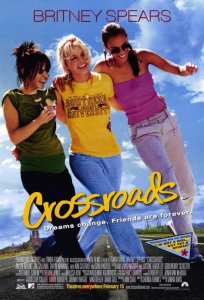 When informed that her feature film debut was receiving shrieks of laughter during advanced screenings for critics, Britney Spears said she was glad because she never likes the same films the critics do. Well Ms. Not That Innocent, the truth hurts; you’re not a girl, not yet an actress. Crossroads is really the filmic adventures of Britney Spears and her ever-present navel. The navel should get second billing, but alas, we do not live in a society of equality for navels.
The film opens up with three 10-year-old best friends burying a box of wishes and dreams and promising to be bestest friends forever and ever. They make a pact to come back and dig up the box on the night of their high school graduation. Flash to the present and the word “bestest” isn’t what it used to be. Lucy (Britney Spears) has become the virginal nerd preparing to give her speech as valedictorian. Kit (Zoe Saldana) has become the haughty popular snob, obsessed over getting married ever since she got her first Bridal Barbie. Mimi (Taryn Manning) is pregnant and become the trailer trash girl that everyone sees fit to remind her of. Despite their growth apart they all do come together to reopen their box of dreams. Mimi informs the others that she plans to head to California to audition for a record deal in an open contest. Kit decides to use this opportunity to check up on her boyfriend at UCLA who has been strangely evasive. Lucy complains that by having her nose in a book her entire high school experience she never got to go to a football game or even “hang out.” Somewhere a small violin is playing. She decides to jump at this chance and possibly see her mother in Arizona, who ran out on Lucy and her father (Dan Akroyd) when she was only three. The wheels of their adventure are provided by guitar-playing mystery Ben (Anson Mount). He pilots them on their travels to the Pacific coast, though the girls think he might have killed someone, but oh well.
 Crossroads is filled to the brim with every imaginable road trip cliché. The girls “open up” after getting drunk, have a scuffle in a bar, reap in the sights of nature, and perhaps create some sparks of romance with their hunky heartthrob of a driver. The car also inevitably breaks down and the girls have to find a way to scrape some quick cash together. They enter in a karaoke contest and Britney proceeds to sing Joan Jett’s “I Love Rock and Roll” with her two gal pals providing backup. But no, this isn’t the last time you’ll hear Ms. Brit sing. In an effort to pad as well as become a showcase for its star, Crossroads gives us many scenes of the girls just singing to the radio. Besides Jett, Shania Twain’s “Man I Feel Like a Woman” and Sheryl Crow’s “If It Makes You Happy” are also on the chopping block. You’ll also be accosted by the movie’s single “Not a Girl, Not Yet a Woman” several times, including one scene where Poet Britney is asked to share her poem and it ends up being the song’s lyrics.
Saldana (Center Stage) is not given much, as the attention is always centered on Britney, so she merely comes off like a token conceited character. Only Taryn Manning (crazy/beautiful) comes away with a little dignity. She gives Mimi a lot more heart than should be there and shows some honest reflections for her character. She also, coincidentally enough, looks like a dead ringer for Joan Jett with her black bangs.
Crossroads is nothing but a star vanity project for Spears, with some not-so-subliminal Pepsi product placement here and there. This was not a script looking for a lead; this was something Britney’s management team suited for her, and Crossroads is perfectly suited for Britney. It allows for many ogling periods of booty shaking. The majority of the film’s drama doesn’t even concern her, and when she does have to act her scenes are cut short to help her when the real drama unfolds. The movie’s true intentions are revealed when Britney is shown in her pink underwear twice in the first 15 minutes.
 Crossroads moves along on gratuitous skin shots of Spears half-naked body every 20 minutes until it reaches its torture chamber of a final act. In this very melodramatic period we get abandonment, date rape, infidelity, and even a miscarriage in one of the film’s most shameless plot devices. Of course none of these horrors matter, especially a psychologically damaging miscarriage, because Britney has to get to her BIG audition in order to perform, yep you guessed it, “I’m Not a Girl, Not Yet a Woman.” She also has to wear what looks like kitchen drapes while she sings.
You’ll walk out of the theater wondering many things. Why does Britney wear pink in EVERY single scene she’s in? There’s even one scene where she changes from a pink top to another pink top and is FOLDING a third pink top into a suitcase. Are we to believe that Akroyd and Spears share some kind of genetics? In what high school would Britney be considered a nerd?
Hopefully Crossroads will be the pop princess’ last foray into film, but I strongly doubt this is the last we’ve seen of Britney Spears. Crossroads is a terrible girl-power trip. Only Spears’ target demographic will enjoy this melodramatic mess. Truly, the two largest groups that will see this film are adolescent girls and creepy older men who fawn after adolescent girls. Crossroads is exactly everything you’d expect.
Nate’s Grade: F
Share this:

Glitter (2001)
 It must be seen to be believed. A new college crap-fest drinking game has begun. Begin the Glitter midnight shows! A new age is upon us! Here are a few handful of Glitter‘s bon-mots it serves up to its audience:
-Mariah Carrey is shown leaving her real mom at age 8 with her kitten. Somewhere through Glitter she has a fight with her boyfriend and takes her cat (yes the very same immortal cat that must have been pushing 20) and leaves.
-She has a fight with said boyfriend and they both try and write a love song to show their remorse. Except they BOTH come up with the EXACT same song word for word, note for note, and NO ONE thinks this is the creepiest thing ever.
-The movie freakin’ ends with Carrey’s boyfriend getting shot and killed. Yes, this is truly how the thing ends. Oh, like any of you cared about plot spoilers anyway.
-Da Brat is in it for “comic relief.”
-The movie is inexplicably set in the 1980s for no reason.
Anyone would have to be crazy thinking Glitter ever remotely resembled art. It’s so bad it’s awesome to watch. Bring some friends over, open up some alcohol, and let the fun times begin.
Nate’s Grade: F, like it matters though
Reviewed 20 years later as part of the “Reviews Re-View: 2001” article.


 nathanzoebl
You must be logged in to post a comment.