Blog Archives
Mary Poppins Returns (2018)

I have no real investment in Mary Poppins as a character or the original 1964 movie, so I was expecting to walk out of Mary Poppins Returns with a shrug, likely finding it middling at worse. I was unprepared for what I endured, and endured is the accurate statement. Mary Poppins Returns is an insane movie and one of the most maddening and painful experiences in a theater I’ve had all year, and no number of spoonfuls of sugar will help this bad medicine go far enough down.
It’s the “Great Slump,” a.k.a. Depression, in London and the Banks children have grown up. Michael (Ben Whishaw) has three young children of his own and he’s struggling to maintain his job at the bank and be the father they need in the wake of his wife’s death. His sister, Jane (Emily Mortimer), has moved into help but it’s still not enough. Enter that famous nanny, Mary Poppins (Emily Blunt), who takes it upon herself to watch over the children, help them through the grieving process, and explore the outer reaches of London with some help from some friends, chiefly Jack (Lin Manuel-Miranda). The Banks family is in danger of losing their home to the head of the bank (Colin Firth) unless they can find a specific title of shares that will grant them a wealth denied their adult lives.
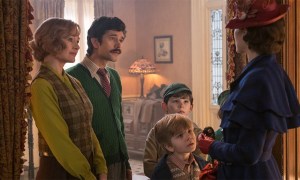
This movie felt like it was eight hours long and I had no sense of how much time was passing, mostly because of its misshaped structure and general lack of pacing. Mary Poppins Returns feels like it could have been renamed The Tony Awards: The Movie. It’s one unrelated song-and-dance number after another, rarely building from the previous one, and so it feels like an eternal televised awards show that just shuffles from one set piece to the next, never providing a sense of direction or finality. Things just happen in this movie and then different things happen but rarely do they feel consequential. This makes the film feel endless because you have no real concept of progression. It’s just another unrelated song into an unrelated magical realm that doesn’t really seem like it matters, and then we’re off to the next. I think some part of me is still trapped watching Mary Poppins Returns, never allowed to leave.
This would be mitigated if the songs were any good. There are over a dozen and not a single one is memorable. It was mere minutes after leaving the theater that I pressed myself into trying to hum any one of them, and I could not. They instantly vanish from your memory because there are no melodies or interesting production aspects that cause them to stand out. They assault you with their blandness and staid orchestration. They’re a careful recreation of an older sounding, 1950s musical, an antiquated sound that doesn’t have the same traction today. The only way you can remember one of these songs is if you have a traumatic experience forever linked to one of these mediocre, warbling collection of sounds.
There are two astoundingly peculiar songs. “Trip a Little Light Fantastic” is a big ensemble number involving the lamp lighters lead by Miranda. However, the song reference is clearly evocative of the Timothy Leary “trip the light fantastic” comment about LSD. It’s strange to think this is only a coincidence when the lamp lighters are dubbed “learies.” It’s not a good song to begin with and the performance literally involves men on BMX bicycles flying around and doing tricks. How is any of this happening in a reported Disney family film? The Meryl Streep “Turning Turtle” song may be the most excruciating five minutes I’ve sat through for all 2018. It’s just embarrassing to watch and made me honestly think of the children’s movie disaster, The Ooogieloves, where you watch once proud actors debase themselves and their legacies in depressing fashion. That’s the level of dread and mourning I had watching Streep slog through a Bela Lugosi accent and dance upside down. It has to be seen to be believed but you shouldn’t ever have to see this. I have a new appreciation for the La La Land songs.

The continual removal of stakes robs the movie of feeling like anything onscreen genuinely matters. Mary Poppins is a magical creature without clearly defined rules or limits. At any point she might simply have the solution to a problem that she wasn’t sharing. Take for instance the ending (spoilers for the duration of this paragraph, but really, who cares?) where the lamp lighters and the Banks family race to ole Big Ben to literally “turn back time” by adjusting the clock hands. The lamp lighters use their ladders to free climb the face of the clock to the very top, only to be undone by not being able to reach the minute hand at it nears twelve. Then all of a sudden Mary Poppins scoffs to herself and flies up to the clock face to adjust it. If she could do this the whole time why did these very mortal men risk their lives in this exercise? I think Mary Poppins may be a cruel god (more on this later). The concluding dash to ensure the Banks family can keep their home involves not one, not two, but three deus ex machinas, a “Turducken of ex machinas” as my pal Ben Bailey termed it. Ultimately all of their actions do not even matter because the film routinely provides an unknown escape route that invalidates their efforts. It turns out, in the end, they weren’t even going to lose their home thanks to (at my best guess) a magical bird head that is best friends with the head of a bank and who never mentioned this before, the same head of the bank who has just been off in what appears to be an adjacent room for whatever reason and that also knows that Michael Banks has accrued a hefty fortune from a childhood investment, and has never mentioned it as well except in this crucial moment. Why, why does Mary Poppins Returns do this? Why does it present stakes or the illusion of stakes only to sabotage them every time?
Is Mary Poppins really a creature of good or does her need to be loved prove her a fickle god who demands adulation, subservience, and obedience? When Mary Poppins travels from world to world, some live action, some animated, all fanciful, every inhabitant seems to know this woman and love her unconditionally despite her prevalent smarm. The bigger question is do these magical worlds exist independent of Mary Poppins? Is there a pocket universe in existence on the side of a chipped porcelain bowl, or did it only come into existence when Mary Poppins decided it would be a lovely vacation spot? If so, that means she is calling into being a throng of adoring creatures that exist to validate her impulsive whims. She is a selfish god that demands an audience of servants and sycophants, not unlike the Javier Bardem character in Darren Aronofsky’s polarizing polemic, mother!.

The actors acquit themselves fine for their roles. Blunt (A Quiet Place) and Miranda (Moana) will still be charming performers even when given substandard material. Blunt holds your attention with her prissy, schoolmarm persona, balancing the audience’s memories of Julie Andrews without going into parody. Her singing (as also evidenced from 2014’s Into the Woods) is above average and can help make some of the songs more tolerable to listen to. Miranda is a talent bursting with charisma and range, which makes it all the more frustrating to squeeze him into the narrow confines of a cockney scamp. He does get a rapping reprise in “A Cover is Not the Book” with a group of cartoon penguins. The stranger element is that it really feels like Miranda’s character wants to have sex with Mary Poppins. They slot him as a forced romantic option for Mortimer’s underwritten sister, but his eyes are clearly set for the woman who bosses people around and has magic in her fingers. He remembers her when he was a boy chimney sweep and I think he’s been fantasizing about her every day since. Plus, she hasn’t aged in 30 years.
Mary Poppins Returns is a bizarre artifact of a displaced time, taking great pains to recreate a style but without providing a purpose or sense of feeling beyond emulation. I don’t know who this movie is for besides the hardcore fans of the original. There are dancing dolphins, talking dogs, bathtub portals, an upside down house, flying balloons, union protests, Angelina Lansbury or an animatronic lookalike, and there’s lots of songs you will be unable to recall and a story that repeatedly removes any stakes or grounding from beneath itself so that the movie never feels firm or purposeful. There were several points where I just wanted to throw up my hands and ask, “What am I watching?” I still don’t know. Mary Poppins Returns is a movie musical that is nothing short of super-cali-fragil-awful.
Nate’s Grade: D+
Share this:

Hugo (2011)
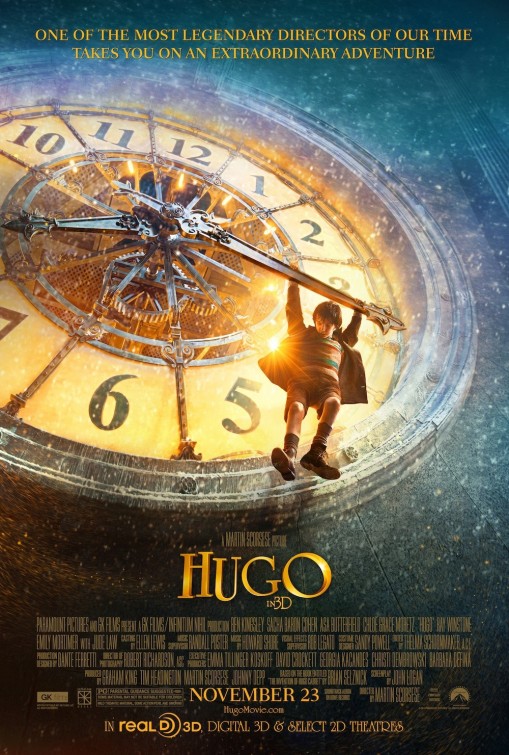 Martin Scorsese tackling a children’s film feels like an odd fit for the man responsible for classic gangster epics and symphonies of violence. But if David Lynch, Kevin Smith, Tim Burton, and Danny Boyle can all make family films that don’t make your brain rot, then why not the greatest living director? Maybe notorious sadist Lars von Trier will be next. Adapted from the award-winning children’s book, Hugo is, as my pal Eric Muller put it, a family film for film historians.
Hugo (Asa Butterfield) is an orphan boy living beneath the walls of the Paris train station. He’s secretly the one responsible for winding up all the clocks and keeping time. He has to stay one step ahead of the Station Inspector (Sacha Baron Cohen), who snatches wayward boys and sends them off to an orphanage. Hugo has been swiping clock pieces from the booth of a mysterious toy collector, George (Ben Kingsley). He needs the tiny pieces to fix a metallic man that Hugo and his late father (Jude Law) had been working on together. Hugo is convinced that if he fixes the metal man the automaton will write out one last message from his father. Hugo befriends George’s niece, Isabelle (Chloe Grace Moretz), and the two of them explore the various shops and shopkeepers of the station. As they uncover more clues, the kids realize that George is actually George Méliès, the filmmaking pioneer best known for the 1902 fantasy, A Trip to the Moon (the one where the moon gets a bullet in its eye).
 Scorsese’s first foray into 3D filmmaking is a rousing sensation for the eyes. The images pop without superfluous objects flying at the camera. The depth of field is nicely and creatively toyed with by Scorsese. Best of all, the 3D enhances the story rather than distracting you. Hugo is a celebration of the advances in moviemaking, and 3D is the latest advancement meant to make the theatergoing experience special. Of course the theatergoing experience has always been special, as the movie indicates. Where else but a theater can we collectively bond with a group of strangers, laughing collectively, feeling the pangs of emotion in unison? There’s a thematic rationale for Scorsese’s use of the third dimension. He masterfully fills the screen with wonderful images, like the massive inner working of clock towers. Scorsese’s signature tracking shots zoom in through the wintry 1930s Paris landscape and train station. A visual highlight is when a trunk of sketches busts open, the papers scattered all over the screen, some moving like flip books, creating the illusion of animation. I can honestly advise people to seek out a 3D showing of Hugo if given the option. For once, it’s worth the extra dough. I only anticipate making this same recommendation for the upcoming Piranha 3DD.
It’s the second half where the movie shows its true intentions, becoming a love letter to the power of cinema and the early pioneers of the art form. Scrosese has long been a historian of the movies, and Hugo is his celebration of the early cinematic dream makers, notably Méliès and his surreal theatrical landscapes. Arthur C. Clark famously said that “any sufficiently advanced technology is indistinguishable from magic.” That’s what early cinema was to a populace that had never seen the likes of moving pictures (we see an early audience fearing for their lives watching a film of a train arriving). It was like a new magic. The turn-of-the century filmmakers like Méliès were charting new terrain as visual storytellers, opening the public to new wonders of the imagination. Simple tricks of editing substitution, dissolves, and visual arrangement could help foster the ongoing illusion. It may be low-rent, like hand painting individual film frames, but it was the special effects of their day. D.W. Griffith once said of Méliès, “I owe him everything.” Scorsese is sharing his passion for the history of the movies and it’s hard not to feel the power of the movies.
But when Hugo gets swallowed whole by Scorsese’s nostalgia, the rest of the plot becomes incidental. The characters, which were not strong to begin with, are given pat resolutions that make you realize how flimsy the characterization is. The movie takes a sub-Amelie route, letting Hugo bring together disparate couples, but you don’t really know anything about these people. Emily Mortimer’s female florist has maybe two lines in the movie, so why should I root for her to get with the Station Inspector? There’s an older couple whose romance is sabotaged by an aggressive pooch. You can imagine the scintillating resolution that awaits. The film history section is honestly the best part of the movie, but it means that everything leading up to that point was just in service to prop up the academic nostalgia. It means that the characters and their mysteries were really unimportant, and they feel that way by film’s end. The movie just grinds to a halt. The mystery of the metal man is that he’s a MacGuffin, a means to discover Méliès’ past. The whole clockwork symbolism can be clumsy, instructing us time and again that people are broken and Hugo feels the need to fix things. Too bad he couldn’t fix the disjointed story.
 The actors manage to make favorable impressions when they can fight free of the movie’s educational pull. Butterfield (The Boy in the Striped Pajamas) is a strong lead actor who rises above the sniveling preface of his character. He makes you root for the kid even when we don’t really know much about him beyond his Dickensian conditions. The kid has some pretty piercing Paul Newman-esque blue eyes too. Moretz (Let Me In, Kick-Ass) is showing the poise and grace to make it long term in this business. Kinglsey (Shutter Island) is effectively curt with his poorly veiled pain and regret. Cohen (Borat) expands his dramatic range noticeably, adding touches of empathy for a character that could mostly have been arch and cartoonish. He’s still the film’s best source for comedy. Michael Stuhlbarg (A Serious Man) makes a welcomed appearance as an expert on early filmmaking, Méliès especially. He serves as the mouthpiece for Scorsese’s passion.
Hugo is a family film that ultimately gets swallowed whole by the filmmakers’ passion. It makes for an entertaining and informative essay on the skill and vision of turn-of-the-century filmmakers, but if people are anticipating a fun story about a scrappy kid and his mischievous adventures, then this is not that movie. Hugo benefits from terrific visuals, strong acting, and Scorsese’s blend of whimsy and innocence without stooping to anything crass or lowbrow. Hugo aspires for the rich, romantic experience of a Jean-Pierre Jeunet film (Amelie, A Very Long Engagement) but comes up short. Hugo is at turns charming and magical but as a narrative it is too often flimsy, a wispy thing meant to lead to Scorsese’s love letter. It’s a fine and fitting tribute but even the best and most powerful love letter can only go so far, never mind the hassle of special 3D glasses.
Nate’s Grade: B
Share this:

Cars 2 (2011)
 Universally regarded as the least involving and nuanced film in Pixar’s illustrious catalog, Cars was the last film I thought would get the sequel treatment. Was it a creative tale that yearned to be told on the big screen, or is this just a business decision motivated by the sound of merchandizing coffers? Those talking cars seemed pretty content by the end of the 2006 original film. It doesn’t take long to realize that Cars 2 was done strictly for the cash. A sequel to the least involving Pixar film, with an even less involving storyline and elevating the most annoying character (Mater the tow truck) to lead status provides little in the realm of adult entertainment. The storyline, a mistaken identity spy thriller, seems like a rejected plot for a lesser direct-to-DVD sequel. While the visuals are still outstanding, the humor is stuck in neutral, overloaded with motor vehicle puns and groan-worthy visual gags. The message about accepting your uncouth friends no matter what their bad behavior might be seems rather misguided. That’s the message? Congrats Pixar, for providing cover for irresponsibility and incivility. The environmental message and its connection to a Big Oil conspiracy feels tacked on as an afterthought to try and crowbar in something more meaningful than a mediocre spy farce. I think cars are rather limited in their anthropomorphic expressions. There’s only so much they can do. And a world populated completely by living, breathing, gas-guzzling (can they get drunk on ethanol?) vehicles begs for an examination on how this world operates without any opposable thumbs. After a magical slate of films that dealt with serious mature themes and danced with storytelling finesse, it’s a shame that daring run comes to an end with such a rudimentary roadblock. Little kids will be entertained by all the bright colors and simplistic storytelling, but I cannot foresee too many fans of Cars even justifying the sequel’s existence. It’s not out rightly bad it’s just so pitifully pedestrian. Cars 2 has so little going on under its hood, you’ll swear it came from a different maker.
Nate’s Grade: C+
Share this:

Shutter Island (2010)
 This was a pulpy B-movie put together with A-movie artistry. In a year that had some artistically polished genre movies, Shutter Island was Martin Scorsese’s return to genre filmmaking and he brought with him an entire team of experts and professionals. The movie is playful and intriguing, engaging the mind enough for a crime thriller that appears to be a straight-forward mystery but then shows flashes of being about something more, something darker. And when you’re dealing with a movie with Holocaust flashbacks, dead kids, Nazi doctors, mental asylums, well you know you’re not going to be reaching subtlety even with a stick. But the way Scorsese orchestrates all these foreboding elements, tying together various plotlines, and working at different levels to satisfy the informed and uninformed, right before delivering a dynamite twist that calls for further investigation and rewatching, well it’s nothing short of masterful. Shutter Island may not be anything more than a souped-up B-movie, but with this level of artistry, it’s also one of the most entertaining films of the year.
Nate’s Grade: A-
Share this:

Lars and the Real Girl (2007)
 In order to be affected by the sweet romantic spell of Lars and the Real Girl, the viewer must accept everything as a fable; to try and apply real world logic would destroy the film’s magic. Lars (Ryan Gosling) is a painfully shy man still haunted by the knowledge that his own birth killed his mother. He lives in his brother’s garage and has difficulties interacting with regular folks. Then one day comes Bianca who just happens to be made of silicone; she’s a Love Doll, though Lars’ relationship with the upgraded Barbie is completely platonic. Lars is using the doll to deal with his own intense loneliness and his family and the town, a.k.a. the most understanding town in the world, play along to help Lars along on his emotional recovery. Gosling, in short, acts the hell out of this movie. His performance is a bit mannered but he channels so much pain and unresolved emotions that it’s a marvel to watch. He makes Lars more than just a weirdo with a weird coping mechanism; he makes Lars deeply, excruciatingly human and filled with unmet desire for affection. Gosling is so immensely talented that I don’t know if there are any limits to what he can bring to a character. The film has just enough psychology to it that the slew of characters deepen as we progress and the audience grows attached. By the end, I was amazed at how much genuine emotion I felt for a giant hunk of silicone. Give credit to the filmmakers who play Lars out with conviction and grace, and give major credit to Gosling.
Nate’s Grade: B+
Share this:

Match Point (2005)
 This is an excellent return to form for Woody Allen and his best film since 1987’s Crimes and Misdemeanors. The first half is deliberately slow, yes, but it is justified by the second half which more than makes up for it. The first half needed to be as slow as it is to set up the incredible minutia of this rich, elite world that former tennis pro Chris (Jonathon Rhys-Myers) has been adopted into. We need to see how comfortable this life is to understand why he doesn’t want to give it up and why he goes through the machinations he does in the second half. The characters and dialogue are spot-on and Allen has transported his world of the upper crust New York elite so well over to London, and the change of scenery has reawakened his writing. Allen knows the privileged world very well and their disconnected view point. However, he rightly centers his film not on the neurotic upper crust but on his social climbers Chris and Nola (Scarlett Johansson), a beauty engaged to Chris’ prospective brother-in-law. It is the second half of Match Point that makes it great. Allen tightens the screws on his social climbers and the tension is superbly taut. The dark turns and in the final act are greatly entertaining, as Allen delves further into his look at a universe built around chance and disorder. The returning imagery of the ball hitting the tennis net elicited gasps from my audience, and I was one of them. I love that Allen lets his story continue to unfold after the dark twists. The film’s biggest flaw is anchoring the entire point of view on Rhys-Myers, a somewhat limited actor that reminded me of Jude Law’s character in Closer. Johansson is an excellent noir femme fatale, her husky voice perfectly suited. Frankly, if ever there was a Scarlett Johansson nude scene, this movie was crying out for it. She has her tawdry affair with Chris and there’s even a sequence where we see her laying on her stomach nude while he applies baby oil to her. Their sex is supposed to be so impassioned and carnal, in contrast to his boring but stable relationship with Chloe (Emily Mortimer). And yet no nudity? Woody Allen, you’ve let me down. Your film, on the other hand, is intelligent, sharp, dark, taut, and wonderfully entertaining.
Nate’s Grade: A


 nathanzoebl
You must be logged in to post a comment.