Blog Archives
Pitch Perfect (2012)
 Take the plot of Bring it On, add remixes and mash-ups of popular music thrown through the Glee grinder, Rebel Wilson’s adlibbed one-liners, and shake, and you have Pitch Perfect, an a cappella singing comedy that was a sleeper hit last fall. My female friends raved about it. It’s from a 30 Rock writer. It’s from the director of the irreverent musical Avenue Q. I like Wilson and the movie’s star, Anna Kendrick (Up in the Air). I wanted to like it, and while I found most of it passably cute, I could not get too attached and the chief reason was Kendrick’s character. She’s so surly and standoffish and just plain bratty, and for no good reason. It gets really annoying. Her rote romance with a bland hunky guy is made even more incredulous because Kendrick, get this, hates movies. Not certain kinds of movies or movies with certain actors, just the entire medium. Who is like this? That’s like disliking all of music entirely. The overall comedic spirit of the movie is amiable with a few oddball touches that keep things interesting, notably one girl who talks very quietly and says outrageous confessions. Listen well. The performance segments are impressive in their own right enough so that I wish there were more of them. There’s also a level of reality to projectile vomit that I was not prepared for. Overall, Pitch Perfect is a fitfully amusing comedy that never really settles down a functional tone, and Kendrick’s bratty character drags the movie down. It’s far from perfect but depending upon your love of a cappella, it could be good enough.
Nate’s Grade: B-
Share this:

Movie 43 (2013)
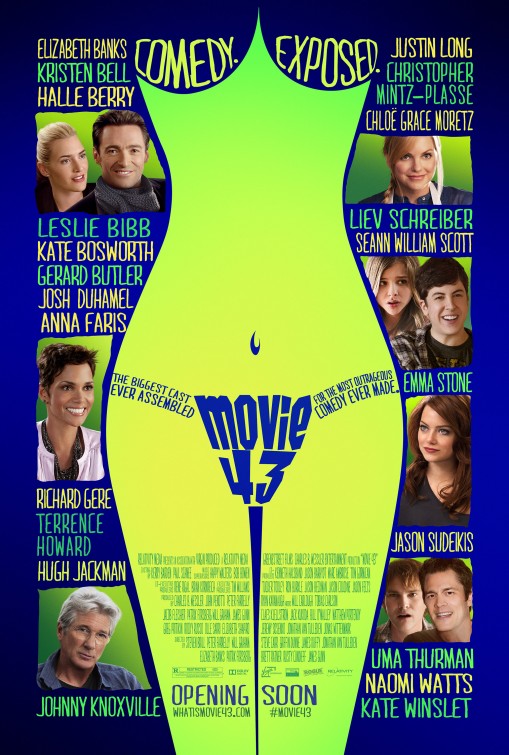 There were two driving reasons why I chose to go see Movie 43, the collection of 13 comedy sketches from different writers and directors. First, the red band trailer made me laugh, so I figured it was worth a shot. If one sketch didn’t work, there was always another ready to cleanse my comedic palate. The other reason is that I have been compiling sketches written by myself and my friends with the intent to make my own sketch comedy movie in 2013. Part of me was also concerned that something so high-profile might extinguish my own project; maybe we came up with similar material with sketches. After watching Movie 43, a tasteless, disconnected, and ultimately unfunny collective, I have renewed hope for my own project’s success.
Like most sketch comedy collections, Movie 43 is extremely hit or miss. This ain’t no Kentucky Fried Movie or even the Kids in the Hall flick. Rating this worth viewing depends on which side racks up the most. Unfortunately, there’s more terribleness than greatness on display, but allow me to briefly call out the film’s true highlights. The best segment in the movie, the one that had me laughing the longest, was a bizarre fake commercial that does nothing more than presuppose that machines, as we know them, are really filled with small children to do the labor. Seeing little urchins inside a copy machine or an ATM, looking so sad, with the faux serious music welling up, it made me double over in laughter.
 With the actual vignettes, “Homeschooled” and “Truth or Dare” where the standouts that drew genuine laughter. “Homeschooled” is about a mother and father (real-life couple Naomi Watts and Liev Schreiber) giving their son the total high school experience, which amounts to degrading humiliation. Dad makes fun of his son’s penis in the shower. Mom and Dad throw a party with the cool kids but don’t invite their son. Dad tapes his son to a flagpole. The kid gets his first awkward kiss thanks to his mom. It’s outrageous without falling victim into being crass for the sake of crass, a common sin amongst many of the vignettes. “Truth or Dare” starts off innocuously enough with Halle Berry (Cloud Atlas) and Stephen Merchant (Hall Pass) on a blind date. As the date progresses, they get into an escalating game of truth or dare that each has them doing offensive acts, like blowing out the candles on a blind kid’s birthday cake. This segment knows when to go for broke with it silliness and it doesn’t wear out its welcome, another cardinal sin amidst the other vignettes.
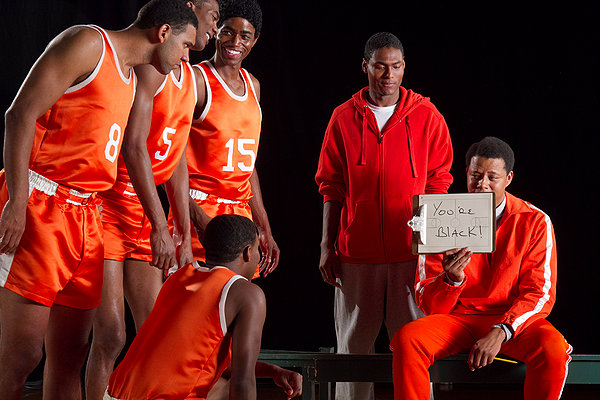
But lo, the unfunny sketches, or more accurately the disappointing sketches, outnumber the enjoyable. Far too often the sketches are of the one joke variety and the comedy rarely leaves those limited parameters. So a sketch about a blind date with a guy who has testicles hanging from his chin (Hugh Jackman) is… pretty much just that. There’s no real variation or complications or sense of build. It’s just that. A commercial about an iPod built to model a naked lady is… exactly that and nothing more. A speed dating session with famous DC superheroes like Batman (Jason Sudeikis), Robin (Justin Long), Supergirl (Kristen Bell) and others should be far cleverer than what we get. While I laughed at the sports sketch “Victory’s Glory,” it really all boils down to one joke: black people are better than white people at basketball. That’s it. “Middleschool Date” starts off interesting with a teen girl (Chloe Grace Moritz) getting her period on a date and the clueless men around her freaking out that she is dying. However, this is the one sketch that doesn’t go far enough. It really needed to increase the absurdity of the situation but it ends all too quickly and with little incident. “Happy Birthday” involves two roommates (Johnny Knoxville, Sean William Scott) interrogating an angry leprechaun (Gerard Butler) for his gold. It pretty much just sticks to slapstick and vulgar name-calling. That’s the more tiresome aspect of Movie 43, the collective feeling that it’s trying so desperately to be shocking rather than, you know, funny.
The worst offenders of comedy are the scathingly unfunny “Veronica” and “The Proposition.” With “Veronica,” Kieran Culkin tries to woo his lady (Emma Stone) with a series of off-putting sexual remarks, delivered in an off-putting “bad poetry delivery” manner, while the film is off-puttingly shot with self-conscious angles that do nothing for the comedy. It’s a wreck. “The Proposition” is just one big poop joke. It’s far more gross than gross-out.
 The frame story connecting the varied vignettes is completely unnecessary. Well, I suppose there is one point for its addition, namely to pad out the running time to a more feature-length 94 minutes. The wraparound storyline with Dennis Quaid pitching more and more desperate movie ideas never serves up any good jokes. Its only significance is to setup an ironic counterpoint that gets predictable and old fast. Example: Quaid says, “It’s a movie with a lot of heart and tenderness,” and we cut to a couple that plans on pooping on each other. See? You can figure out its setup formula pretty quick. I don’t understand why the people behind Movie 43 thought the perfect solution to pad out their running time was a dumb wraparound. These sketches don’t need a frame story; the audience is not looking for a logical link. For that matter why is the guy also pitching commercials? I would have preferred that the frame story was completely dropped and I got to have two or three more sketches, thus perhaps bettering the film’s ultimate funny/unfunny tally.
There will be a modicum of appeal watching very famous people getting a chance to cut loose, play dirty, and do some very outrageous and un-Oscar related hijinks. The big name actors do everything they can to elevate the material, but too many sketches are one joke stretched too thin. I suppose there may be contingents of people that will go into hysterical fits just seeing Hugh Jackman with chin testicles (I think the Goblin King in The Hobbit beat him to it), just like there will always people who bust a gut when a child or an old person says something inappropriate for their age, or when someone gets kicked in the nuts (the normal ones). I just found the majority of Movie 43 to be lacking. It settles far too easily on shocking sight gags and vulgarity without a truly witty send-up. It wants to be offensive, it gleefully revels in topics it believes would offend the delicate sensibilities of an audience, but being offensive and being funny are not automatically synonymous. You have to put real work into comedy. Movie 43 isn’t it.
Nate’s Grade: C-
Share this:

The Hunger Games (2012)
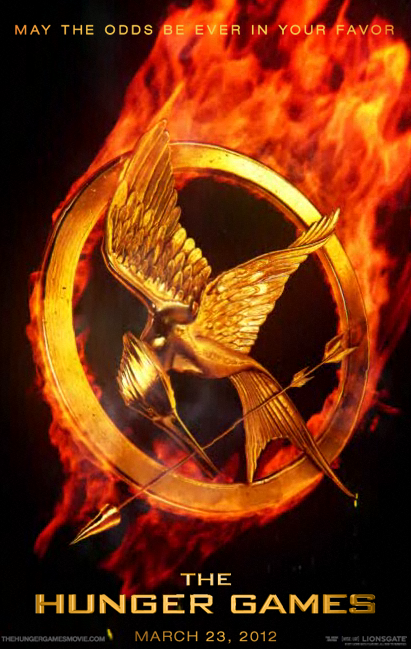 Suzanne Collins’ smash novel The Hunger Games isn’t your normal young adult reading material. Dystopian future, corrupt government, oppressive forces, twisted media culture, and then there’s the whole inhumane concept of children murdering each other for sport. The book trilogy has been consumed by millions of readers, young and old, and inspired rabid devotion reminiscent of other successful publishing franchises like Twilight and Harry Potter. Yes, Battle Royale fans, the premise is not original, but Collins’ book could just as well cite inspiration from The Most Dangerous Game, Lord of the Flies, The Running Man, or even an Outer Limits episode known as “Fun and Games.” Producers are hoping those legions of fans will turn up in droves and start a new lucrative film franchise. Reliably squishy filmmaker Gary Ross (Seabiscuit) was tapped to shepherd the book to the big screen. The Hunger Games movie doesn’t commit any major blunders to screw up a good story, which is good enough for many.
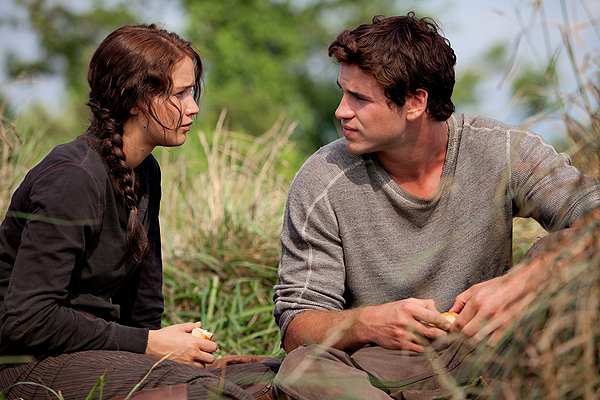
Set in a distant future, the ashes of North America have given way to the country of Panem. It is lead by a Capitol government and ringed by 12 mostly poor districts. Every year the Capitol commemorates the failed revolution of the districts by holding the nation’s favorite televised sport, the Hunger Games. Each district holds a reaping, which randomly draws one boy and one girl aged 12-18 years. These lucky chosen children, known as tributes, are then whisked to the Capitol where they will be placed into an arena and fight to the death. 24 tributes go in and there can be only one winner. In the outlying District 12, day-to-day life is a struggle, and Katniss Everdeen (Jennifer Lawrence) is burdened with providing for her family. She hunts illegally to provide food for her family and to trade for goods that they need. She’s excellent with a bow and arrow. Her hunting partner, Gale (Liam Hemsworth), suggests that they could run away. “We’d never make it more than five miles,” Katniss reasons. The two of them have too many responsibilities to ignore. Then Reaping Day comes, and Katniss’ 12-year-old younger sister Prim (Willow Shields) is chosen as the female tribute. Katniss volunteers to take her place, saving her sister, but throwing herself into a sport where the odds will not be in her favor. Joining Katniss as the male tribute is Peeta Melark (Josh Hutcherson), the baker’s son who has some history with Katniss.
 The tributes are paired with mentors, the oblivious Effie Trinket (Elizabeth Banks) and former District 12 Hunger Games winner Haymitch Abernathy (Woody Harrelson) whose helpfulness is tempered by the fact that he’s drunk often. He advises his newest tributes that they must make the audience like them to earn sponsors, people willing to pay big money to supply the tributes necessary supplies in the middle of the game. The Capitol is full of lush excess, the people donned in cartoonish and colorful garb. Katniss is dolled up and paraded around. She showcases her skills to the Game makers, who will give each tribute a rating that bettors will use. She’s interviewed by TV host Caesar Flickerman (Stanley Tucci) to make an impression. While with Caesar, Peeta reveals that there is a girl he’s had a crush on back home for the longest time – Katniss. The star-crossed lover angle hooks the audience and immediately transforms the dynamic of the games. Katniss is upset, but Haymitch rationalizes that Peeta’s confession has made them more marketable.
Then the dreaded day arrives and the 24 tributes are gathered up, injected with tracking devices, and launched into the outdoor arena to fight to the death. Katniss’ biggest threats will be the tributes from District 1, Glimmer (Leven Rambin) and Marvel (Jack Quaid), and District 2, Clove (Isabelle Fuhman) and Cato (Alexander Lutig). These tributes have trained their whole lives in the deadly arts so that they could volunteer to enter the games, hence why they are dubbed the Career tributes. And they usually win. Once the games begin, Katniss must survive the Careers, whatever surprises the Game makers have, the elements, and win over the affections of the TV audience. Let the games begin.
Firstly, fans can breathe a sigh of relief because The Hunger Games movie is a mostly successful venture brought to visual life. The legions of Collins’ fans celebrating the movie of their beloved book will mostly be satisfied. Collins’ story is still a good story no matter the medium. It establishes its alternative world and the stakes quickly and then it’s off to the killing fields. This is dark and disturbing stuff, far darker than even the darkest days of Harry Potter, and fans will be relived that the movie does not go soft. It’s not the exploitation-vehicle that Battle Royale was. This is trying to tell a story and not revel in the geysers of teenage bloodshed. This is a movie that satirizes reality TV and media culture as much class warfare. Katniss is primed and prepped to manufacture an impressionable image to TV audiences. It’s all about calculation, image control, and the manipulations of the media and audience to produce a star. Here’s a world where the 1% literally celebrate and toast the deaths of the 99%. Here’s a world that takes it cues from the Romans concerning spectator sports. I do wish the movie had channeled more of the book’s accusatory tone against the Capitol citizens, the silent majority complicit in villainy. And of course it was Collins’ point that we, too, the audience could be accountable in our own YA bloodlust.
 This is a story that grabs you and rarely lets go, centered on a heroine that is refreshingly a strong female role model for girls. Bella Swan has nothing on Katniss Everdeen. Here is a heroine that is proactive, resourceful, resolute, compassionate, and she doesn’t need a man to complete her. Sorry Ms. Swan, but Katniss has a lot more important things on her mind than getting a boyfriend. She’s got to provide for her impoverished family and shoulder plenty of responsibility, and that’s before she’s plucked into a death sport. In short, Bella Swan sucks. Katniss Everdeen rules 4-ever.
Since the book was written in first person, we were inside Katniss’ head the whole time. There are disadvantages of leaving that POV, namely that Katniss’ survival skills and cunning can be brushed over. She’s not just fighting the other tributes, she’s trying to think how best to play certain moments, how to appeal to the viewers at home. During the games, the movie jumps back and forth between the action and what I’d like to call Mission Control from Hell, the game makers HQ. This is a smart move that provides a greater antagonistic sense with the book’s unseen game makers. The exposition, mostly handled by Tucci as color commentary throughout the games, is presented in a way that doesn’t feel clunky. I also enjoyed the two sit-downs we get with President Snow (Donald Sutherland), the autocratic ruler of the Capitol, who sees early on the danger of Katniss. He explains that the games are meant to give hope to the poor citizens. “Hope is the only thing more powerful than fear. A little hope is good. A lot of hope is not,” he explains while pruning flowers. It’s nice to have a villain who understands the calculations needed for a proper oppression. It’s also nice to see Sutherland sink his teeth into a role that will only get more enjoyably evil as the films progress. I felt that the tracker jacker sequence, the interviews with Caesar, and the time in the caves were the best-adapted sequences.
Lawrence (X-Men: First Class) is a star, pure and simple. She was the perfect choice to play Katniss Everdeen. The Oscar-nominated young actress brings great steely determination and grit to the Girl on Fire. Katniss isn’t supposed to be a teenage warrior (that would be the Careers), even though she is thrust into that role. She doesn’t celebrate killing. This is not fun for her. Lawrence can play an array of emotions silently, deftly, like her hoarse, wild panic at Prim being chosen, her shell-shocked disorientation at going into the games, her quiet fury at her irresponsible mother and others like the game makers, her budding warmth for Peeta while he rubs a salve over her facial cut. Pages of description can be consolidated in just one pensive, conflicted expression on Lawrence’s lovely face. Lawrence is the heart of the movie and a tremendous presence to ground our sympathy and emotions.
Katniss is a dangerous competitor but she’s also vulnerable. She’s emotionally guarded and thrust into a situation where she has to “pretend” to be in love. Now the romance angle, and the self-awareness on Katniss’ part to give a good show, was a far bigger storyline in the book. In the book, she begins by playing a part and by the end doesn’t know if her feelings are false or genuine. It’s strange that in the movie their this-is-love kiss, meant to make the audience swoon on Katniss’ part, is followed up with nothing but hugs. Maybe the filmmakers thought a romantic angle was in poor taste given the kill-or-be-killed scenario, except that the romance angle is what keeps Katniss and Peeta alive. Want to know the best way to irk a Hunger Games fan? Start comparing the complicated romantic triangle of Peeta and Gale to dismissive terms like Team Jacob and Team Edward.
 The supporting cast performs ably, some better than others. Hutcherson (The Kids Are All Right) is given the most material to work with. He’s a nice kid, strong, but worried about his humanity, and the filmmakers never portray him as anything close to a badass or a helpless baby. Hutcherson shines in the moments where he comes clean with his emotions, like admitting that he has no chance of winning (his mom thinks so too). Peeta’s much easier at charm than bravado, and Hutcherson is a charming guy. I think Banks (Zack and Miri Make a Porno) actually gives the best performance, short of our lead heroine, as the maniacally bent Effie Trinket. Half the performance is the garish outfits, wigs, and makeup, but Banks nails the affluent insensitivity and ignorance of her character. Her forced enthusiasm is good for a few laughs. Harrelson (Zombieland) gives hints about the demons behind his character, a man who has to watch a pair of children under his tutelage die every year as his “prize” for winning. He’s a colorful character in a movie filled with colorful characters, but his sauced sarcasm can sting. Tucci (Easy A) hams it up with great pleasure as the smarmy, inauthentic, over-the-top TV host, Caesar Flickerman. They dolled up actor Toby Jones (Tinker, Tailor, Soldier, Spy) in a bouffant wig and sit him beside Caesar for commentary, but, and I literally counted, he has three lines where he speaks onscreen. Still, I love his oily voice as the games’ announcer.
The movie distills just about everything from the book, plot-wise, so the fans will be sure to see just about every plot event that they’ve developed a mental checklist for. However, this narrative approach, an attempt to satiate the fans that bristle when the movies of their favorite books deviate too much from the source material, blunts the impact of the material. I was astounded at how overwhelmingly rushed and hurried the movie is, spending little time on those variety of plot events, rarely allowing the movie enough room to breathe. With this brisk and brusque pacing, it stops the movie’s vitality. The context and history of important items and people feel clipped, becoming just set decoration. Ross has not done an adequate job of making his movie universe feel richly realized. The significance of the mockingjay, a symbol of perseverance under the oppression of the Capitol, is left unexplained. It just becomes a dinky pin that makes Katniss think about home. The ghoulish mutts have been turned into just a bunch of vicious dogs that eerily resemble the dog demons from Ghostbusters (actually, I’m relieved the mutts were toned down). The contrasts between the impoverished outer districts and the lavish Capitol denizens are nicely showcased thanks to luxurious and weird art direction and costume design; these people took fashion advice from Marie Antoinette and maybe their political outlooks as well (“Let them eat cake… or death”). There are also some passing moments of dark satire as far as the Capitol’s overall stance with the games, and their blasé attitude about the value of human life, though the movie could have and should have pushed harder with its class warfare.
The Hunger Games reminded me of the first two Harry Potter films where the producers crammed in all the plot points they felt fans wanted to see rather than just, you know, adapting it into a good movie. If they wanted to keep everything from the book, plot wise, then they should have followed their convictions and produced a three-hour movie. Imagine The Godfather being cut down to two hours and twenty minutes. Imagine rushing through all that drama. Now I’m not in any way comparing The Hunger Games to The Godfather in terms of quality, but movies need sufficient time to establish their worlds and develop characters. They need time to breathe. The fact that a 142-minute long movie doesn’t have time to breathe is plain inexcusable.
 The characterization, beyond Katniss and Peeta, is extremely limited, and so when he deaths do occur the impact is minimal; only one tribute’s death is given time for mourning, and even this character’s death is limited due to superficial characterization and about two minutes of screen time. I’m not saying that every one of these 24 tributes needs a detailed back-story, but they’ve got to have some personality to them and the movie has to devote some time to develop that; good writing can tell a lot with little. Otherwise they just become somewhat recognizable faces and not characters. Cinna (Lenny Kravitz), Katniss’ stylist for the pre-game publicity in the Capitol, is reduced to being a bland companion. Let me single out the villains, our group of Career tributes. The movies have a long tradition of villains who aren’t given much characterization but are given personality. I need my bad guys to be given an opportunity to make an impression, and no, weapon distinction is not enough. With The Hunger Games, the bad guys just become a series of sneering faces, and these kids (Ludig, Rambin, Quaid, Fuhman) have got some good sneer faces. True, the movie’s entire twisted premise lays enough overwrought tragedy to the entire setup, turning children into killers, and President Snow is the ultimate villain, but the movie should be agonizing, terrifying, devastating, upsetting, and not merely inferential and rushed. I want to feel the deaths. Instead, the movie can’t even be bothered to briefly show the faces of the dead kids during the game’s daily death montage. There are all sorts of kids who were hired to be tributes from districts and I question if they ever got a second onscreen.
I also feel that Ross is, at times, completely wrong for this material. The man behind Pleasantville and Seabiscuit is not the first name you’d think of to tackle a dystopian sci-fi survival thriller built upon the premise of dead children. I almost wish they had hired Paul Verhoeven (Robocop, Starship Troopers), an artist well versed in sci-fi spectacle and subversion. Ross’ misguided visual approach, borrowing a page from the Bourne franchise, can make it hard to enjoy the film. During the opening segment in District 12, as well as the games themselves, Ross will attempt to up the visceral ante with his bobbing handheld camera. Now I’m not one of the people who loudly decry the use of “shaky cam” during action sequences, but before the second minute was over, I turned to my friend and said, “I already hate the shaky cam.” There’s a difference between handheld camerawork, which has some jostle to it, and a deliberately inauthentic docu-drama approach that makes exaggerated and distracting camera bobbling. There are long segments of this movie that is nothing but shaky close-ups cut together. There’s a climactic battle atop a metal structure that is completely incomprehensible to follow. It’s all just a blur of flashes save for two wide shots to thankfully attempt to orient the viewer. When an audience can’t follow the action, it not only kills tension but it also kills investment. The docu-drama visual approach is completely wrong for this movie. When was the last time you saw a dystopian sci-fi movie that had a docu-drama aesthetic? Try never.
 Likewise, to achieve the all-important PG-13 rating, Ross sanitizes the blood sport, utilizing lots of implied violence. The jangly aesthetic works for the duration of the race to the Cornucopia to start the games, as tributes turn a fight over supplies into a bloodbath, communicating the chaotic frenzy. I’m not clamoring for explicit carnage to get its message across, but just seeing children as far-off lifeless heaps is a disservice to the power of the story. Also, I don’t feel like Ross properly takes full advantage of the visual medium. Instead of being told, twice, about mines that will explode if any tribute steps off their platform before the conclusion of the countdown, let’s see it. Since half of these kids are about to become faceless corpses anyway, why can’t one of them lose their balance, fall out of the ring, and blow up? And then we cut to a nearby tribute dusted with pieces of dirt and blood, trying to keep their cool and failing. It would have kicked up the tension and shown the immediate danger that awaits. I don’t want the one-minute countdown to cut around the globe, seeing the different districts watching TV. I want that entire minute spent in the arena, hearing every second counted down, seeing every face of the tributes sick with anxiety and unease, gritting themselves for combat. I want to feel the same sense of doom that they do, not cut around the globe and then have the audio drop out. That’s a sorry way to start the games, even with a PG-13 mandate.
There are heavy expectations for The Hunger Games on all fronts, from studio execs to the millions of eager fans. I consider myself one of their legion. I voraciously read through the trilogy, getting hooked early, and have even helped teach the book as part of an American Literature curriculum. It’s a thrill to watch reluctant readers get excited about the book. The Hunger Games succeeds mostly as the pilot to an exciting film franchise. But having seen the Hunger Games movie twice in 14 hours, and being a huge fan of the book, here are my chief criticisms: the movie is far too rushed, speeding over so many plot points and characters, never getting time to breathe; nascent characterization for supporting characters; the context of so many things is missing; shaky cam overuse to the point of incomprehensible action sequences; dodgy CGI; not taking full advantage of visual medium; intensity a bit muted; and finally, a forgettable score. But, hey, good movie. It just frustrates me because it could have been a great movie, a searing, powerful, provocative, thrilling movie. Good movie will be good enough, especially when it makes more money opening weekend than the citizens of District 12 will ever see in their lifetimes. When you got a fan base as large as this series, the odds will usually be in your favor.
Nate’s Grade: B
Share this:

Role Models (2008)
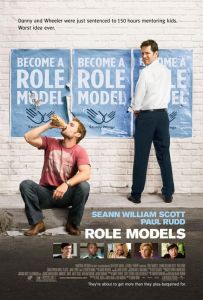 Is there an actor alive more charming than Paul Rudd? The always-affable actor has a terrific sarcastic yet lovable presence that never dips into being glib. Role Models is a great showcase for his sly comedic talents. The plot of irresponsible adults (Rudd, Sean William Scott) learning to be responsible by being big brothers to problem kids (Christopher Mintz-Plasse, Bobb’e J. Thompson) is mostly conventional, but it’s the character camaraderie that makes the movie special. Watching the cast interact is a great pleasure, and they constantly add sustained laughs that seem organic to the plot and the characters. I found myself laughing out loud steadily, and although the ending is a bit formulaic I was amused that film didn’t break character once. It goes for gusto when it comes to embracing the geekery and cheesiness of a climactic medieval battle. There are witty running gags, rewarding payoffs, and the film even packs some heart, though it never gets sentimental. Combine a wicked comedic turn by the daffy Jane Lynch and some added Elizabeth Banks sparkle, and it all adds up into what might be the most satisfying mainstream comedy in a non-Judd Apatow-directed year.
Nate’s Grade: B+
Share this:

Zack and Miri Make a Porno (2008)
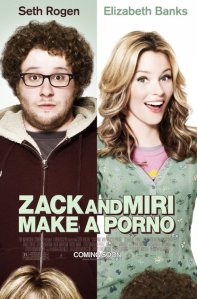 It’s amazing how integrated pornography has become in our culture. Merely a few decades ago people had to wear disguises to venture out to a ratty theater to watch an adult movie alongside plenty of folks in raincoats helping to add to the sticky floors. Nowadays releasing a sex tape is considered a career boost. Porn stars have replaced supermodels as rock star arm candy, porn has become more socially acceptable, and a wealth of bizarre and explicit possibilities exist just a few keystrokes away. In the end, it’s all fantasy with bad acting.
And yet Kevin Smith’s newest comedy, Zack and Miri Make a Porno, got in trouble with advertisers because of people getting in a tizzy over the goofy word “porno.” Major League Baseball was told that a father was uncomfortably asked by his son what a “porno” was after seeing a commercial during a ball game. Heaven forbid our nation’s parents have to deal with an uncomfortable subject, so baseball banned any ads for the movie. Many newspapers nationwide have refused to list the full title. The original poster was deemed too inappropriate so Smith and crew devised a poster of stick figures. Poster version 2.0 then came under fire for being attractive to children because of the stick figure art. It seems Zack and Miri is getting it at both ends (no pun intended).
 Times are tough for lifelong friends Zack (Seth Rogen) and Miri (Elizabeth Banks). They’re scrambling to pay their bills and keep the electricity in their apartment during a chilly winter in Pennsylvania. Inspired by a conversation with a chatty gay porn star (Justin Long) at their tenth year high school reunion, Zack believes amateur porn can solve their money woes. The two will make their own porn video and sell it to the alumni list from their graduating class, who, Zack rationalizes, would buy a porn if they knew someone involved. Zack convinces his coffee shop co-worker Delaney (Craig Robinson) to help fund the project. Delaney agrees as long as he can have a say in casting; after many years of marriage he is eager to see something new. The team also recruits a squeaky-voiced stripper (current porn starlet Katie Morgan), an old bachelor party performer (former porn starlet Traci Lords), a cameraman (Jeff Anderson), and a man free from any inhibition (Jason Mewes). But Zack and Miri must confront their unspoken feelings for one another as they approach their own sex scene. Can they go from platonic friends to lovers?
Being a Smith film, naturally Zack and Miri is outrageous and often hysterical. The film manages to become witty and dirty at the same time, often stringing together vulgarities in exciting and imaginative ways (the curious “Dutch Rudder” as a means of escaping being deemed gay). Smith has a love of the profane. The movie is vulgar like most Smith movies but the beauty of its filth is in the sparkling, rapid-fire dialogue that adds eloquence to the scatological. This is Smith’s comedic brand, the verbose dirty joke. As in other Smith comedies, the true humor is not found in set pieces and set-ups but in the everyday camaraderie of the cast and through casual conversations. Smith writes characters that you just want to listen to for hours. Zack and Miri does have some funny moments that are specific to the production of randy moviemaking, like an unforgettable de-clogging that “frosts” a cameraman. The joke is swift. However, akin to the Judd Apatow brand of comedy, this is a movie where the charm is watching the characters interact, regardless of setting. I do think the movie unfortunately missed plenty of other potential gags on the silly minutia of homemade pornography. How about the crazy duties for a sound design? Imagine a guy trying to recreate the many weird bodily sounds during sex. I’m mildly shocked that Smith didn’t even touch the vagaries of pubic hair style.
 What the movie does nicely is dwell upon the distinction between love and sex. Now I’m not conveniently forgetting the thousands of movies that have come before and dealt with the topic of intimacy and carnality, but Zack and Miri goes into the nuts and bolts (no pun intended) of an industry that has turned intimacy into a mass-market business model. Zack and Miri stress out about their Big Scene and try to convince themselves that it won’t mean anything, but of course their body language betrays them. The actual deed is an obvious turning point for the twosome and count this as one sex scene that is actually, well, emotionally climactic and, yes, sexy. Though the camera only stays at shoulder-length and alternates between two angles, the actors convincingly convey an array of genuine feelings, notably love. It’s not easy for an actor to display honest-to-goodness love, but Banks and Rogen achieve this feat. The aftermath of their onscreen coupling extends into a seemingly unnecessary third act that divides them apart in a contrived fashion. Seriously, the typical third act misunderstanding in standard romantic comedy fluff is alive and well in a Smith vehicle. The characters do not react to this misunderstanding in a realistic manner; one character would rather be sequestered than easily prove their innocence.
While Zack and Miri has plenty of laughs and a nice, mushy center, I cannot help but feel mixed about the results. The characters are not nearly as sharply drawn as they have been in other Apatow comedies, even other Kevin Smith movies. I can go back and remember the multiple dimensions of the funny people that populated Superbad, Sarah Marshall, 40-Year Old Virgin and others, but Kevin Smith’s latest comedy suffers in comparison. Zack and Miri are the only characters with moderate sums of characterization, and yet their unspoken love is essentially the bulk of that. Neither character is well defined or explored in a substantial way that doesn’t involve the other. I get that the movie is a romance. But I expect more from characters than to be defined by whom they desire. I just wanted more. Yes Zack is a slacker who says he’s just looking for a good time, though we know he has his sights set on more, and yes Miri is a gorgeous gal with a lot of patience, but these characters are staples of Kevin Smith movies. The assorted side characters have fun moments but are mostly insignificant. There’s the stripper with a heart of gold, the been-around-the-block type, the henpecked husband, the secret freak behind the button-down exterior, the loudmouth, and the sex-crazed dude. Zack and Miri establishes the idea of filmmaking as a community by introducing this lot, but the movie then forgets to incorporate the supporting characters in meaningful ways. They’re mostly used for jokes that fail to extend beyond the immediate. A late scene involving Delaney’s angry wife (Tisha Campbell-Martin) relies on too many grating “white boy” japes that I tuned out. I’m not intending to slam Smith’s film, but the lack of character work hampers the audience investment in the central romance.
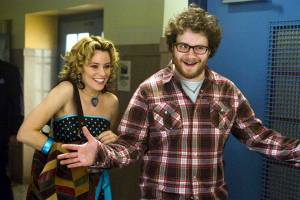 What is lacking on paper is nearly compensated by the great performances from Rogen and Banks. Both are on loan from the Apatow comedy company, and both are skilled at being raunchy one second and heartfelt the next. Rogen finds his comic groove easily and is an enjoyable schmo that taps hidden ambition in the most unlikely of scenarios. It really is Banks who comes across as the star of the flick. She can talk trash with the boys but she is radiant during the film’s dramatic moments, selling Miri’s emotional highs and lows with crinkling smiles and fluttering eyelashes. Banks has always been a solid actress underutilized by most of her marginal film roles. With Zack and Miri, Banks showcases a devilish comedic gleam. Of course yet again the audience must believe that a beautiful gal with a beaming smile would be down on her luck finding a good guy.
In the end (no pun intended), Zack and Miri Make a Porno is a crude romantic comedy that might have benefited by more attention spent on the romance or the comedy. The tone never breaks as sharply as with Chasing Amy, arguably still Smith’s finest accomplishment, but the dirty humor and the gooey romance have a hard time expanding because of the presence of each other. Too often the ribald humor doesn’t feel fully realized because the dirty jokes are just window dressing for the romance, and I had trouble fully engaging with the romance because the characters haven’t been rendered to have substantial depth. Smith may have been better served by making his movie longer; the film is barely an hour and 40 minutes long. Zack and Miri Make a Porno is a sweet movie with a dirty mind but it does not measure up to recent comedies like the best of Apatow’s brand. Smith is a talented wordsmith who certainly knows how to make an entertaining comedy, and Zack and Miri certainly entertains, but like pornography, it just made me want something more fleshed-out and real (no pun intended).
Nate’s Grade: B-
Share this:

W. (2008)
 Director Oliver Stone’s first draft at history is never boring but it’s rarely insightful. The film portrays George W. Bush (Josh Brolin) as a stubborn and simple man trying to live outside his abilities and the long shadow of his successful and emotionally distant father. George W. was not the favored son, as he is routinely reminded, and Ma and Pa Bush express their frustration. And yet the son who did not have his family’s support and acumen accomplished what no one else in the family had. He won reelection. He toppled Saddam Hussein. And then it all came crashing down. Ultimately, who was this movie made for? The detractors of Bush will view the film being too light, providing a psychological context that humanizes the man amongst his mistakes. You may even feel some sympathy as George W. repeatedly tries to earn his father’s approval. The movie is not a partisan or mean-spirited skewering. The fans of Bush will consider the film to be a cheap shot that restrings famous blunders and transplants Bush malapropisms into new settings. People may take offense at the idea of the current Iraq War being a result of unresolved daddy issues. Seriously, for a two-hour movie spanning the life and career of the most reviled modern day president, did Stone need to include the moment where Bush almost choked to death on a pretzel? Over the 2000 election debacle? Over the Air National Guard? Over 9/11?
W. lacks a strong point of view and the film’s timeline closes too soon, only going so far as January 2004, not even the halfway point for a two-term president who has only sunk lower in national approval from that moment. A miniseries would be a better medium to explore the failures and calamities and personalities of the Bush Administration. Brolin is terrific in the title role and he never dips into parody. The rest of the actors are hit-or-miss and the movie becomes somewhat of a game of identifying famous historical figures in their one-scene appearances. My biggest surprise was how much I felt emotionally connected to the first President Bush, played by James Cromwell in a performance that doesn’t even attempt to imitate the real-life figure. Stone and screenwriter Stanley Weiser (Wall Street) certainly don’t hide the characters they connect with (Colin Powell, often the voice of reason, is given a stirring speech calling for caution). Certain creative license is taken to provide dream sequences that can point toward the inner turmoil of Bush, like when his father admonishes him for destroying 200 years of the family’s name over the Iraq War. Overall, W. is an empathetic and sometimes dithering portrayal of the 43rd United States’ president that could have succeeded if it had more to say.
Nate’s Grade: B-
Share this:

Definitely, Maybe (2008)
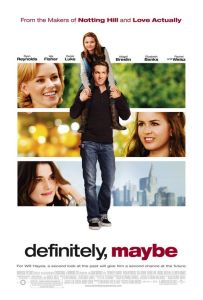 Adam Brooks has spent his whole career in the romantic comedy gutter. His screenwriting credits include French Kiss, Practical Magic, Wimbledon, and the second Bridget Jones flick. Not a whole lot of quality there. Definitely, Maybe is Brooks fourth writing and directing effort but the first to get a major push from the Hollywood studios. Maybe the same purveyors of formula fluff realize that Brooks finally has something good on his hands.
Will Hayes (Ryan Reynolds) picks up his ten-year-old daughter Maya (Abigail Breslin) from school on perhaps the worst day of the school year: sex education day. Kids are crying, parents are stammering to explain, and Maya casually exits her classroom, walks up to dad, and says point blank, “We need to talk.” She wants to know all about the story of how her father and mother, now divorced, met. Finally Will agrees but decides to play a game. He will changes names and identifying characteristics and Maya will have to guess which of his three loves became her mother. Emily (Elizabeth Banks) is Will’s college sweetheart from Wisconsin. Summer (Rachel Weisz) is an ambitious journalist with a taste for older men. April (Isla Fischer) is a Bohemian free spirit that Will meets working on the 1992 Bill Clinton presidential campaign. Maya sits in her bed and pays rapt attention to what she calls a “mystery romance.”
Miraculously, Brooks has written a romantic comedy where the characters are, dare I say it, well developed human beings. These folks are more than stock roles for the genre; in fact, each woman is smart, genuine, charming, fun, and desirable, and yet each woman also has her own set of realistic flaws. Brooks makes sure that we, the audience, admire each woman and recognize that any of the three would make a fine selection. These characters feel real, which is almost unheard of for a genre about ticking biological clocks, cloying and precocious tykes, irrationally sexist and self-absorbed characters, forced misunderstandings that lead to contrived reconciliations that involve some form of chase. Having recently seen 27 Dresses, which plays close to the typical rom-com formula, I appreciate Definitely, Maybe even more.
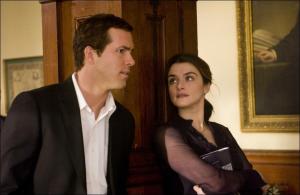
This is a romantic comedy that respects its characters and respects its audience. The people might make bad or impulsive decisions but Brooks doesn’t pass judgment, and, my God, it’s refreshing for the genre. I rolled my eyes when I read blurbs about Definitely, Maybe being “the best romantic comedy since [1976’s] Annie Hall.” While I wouldn’t necessarily go that far, Definitely, Maybe is definitely the best and most enjoyable conventional Hollywood romantic comedies in years (For those wondering what non-conventional romances got me jazzed, here is a small list: Eternal Sunshine of the Spotless Mind, Amelie, Secretary, Once, Sweet Land, A Very Long Engagement, Brokeback Mountain, Aimee and Jaguar, and Before Sunset).
Brooks chronicles Will’s romantic escapades along the timeline of Bill Clinton’s rise in national politics, which is an interesting way to look backwards in time and still be relevant to modern audiences thanks to Mrs. Clinton’s race to reoccupy the White House. I found it interesting that Will’s emotional journey seems to be charted along the same ups and downs as Bill Clinton’s time in office, so when Clinton is mired in the Monica Lewinsky scandal and questioning the definition of the word “is,” Will has lost his idealism and grown into a cynic. He even openly criticizes with great frustration and ire the man he helped put into office. Will’s enthusiasm and disenchantment for Clinton mirrors his budding relationships with women.
Definitely, Maybe has a handful of memorable moments and some amusing dialogue, but Brooks has crafted one hell of a meet-cute scene between Will and April. After an initial first meeting at the campaign headquarters, Will is purchasing a pack of cigarettes when he spots April purchasing a pack of organic cigarettes. He playfully mocks her more expensive purchase. She counter punches and says that her brand is made from better stock and will actually smoke slower, thus being the better purchase. He challenges her to a smoke-off and the two step outside, light up, and for the sake of scientific research they take equally long drags, and sure enough Will’s cigarette cannot last as long. They laugh and eventually Will visits April’s apartment and learns about her poignant search for her lost copy of Jane Eyre out there that has her father’s inscription. It’s a great scene that allows both actors to size each other up.
Thanks to each woman being presented fairly the movie doesn’t make it obvious which woman will eventually become Maya’s mother. The ladies fade in and out through the plot. The guessing game gimmick grabs our intrigue early and Brooks doesn’t tip his hand until the film’s end. What I find interesting is that Will changes with each woman and could feasibly be happy with any of the three, a desirable predicament if ever there was one. The movie even tackles divorce sincerely and without any doom and gloom overly dramatic pronouncements. Definitely, Maybe doesn’t go out on a limb and certainly isn’t remotely edgy, but the flick has a soothing, amiable adult spirit. It may not be revolutionary but simply telling a good story with mildly relatable characters seems like a great step in the right direction for this oft-sneered at genre.
Reynolds knows how to work his suave charisma to a fault. He’s certainly a capable leading man for romantic comedies and he can deadpan with the best of them. He seems like he could use a bit more direction, because there are moments where he seems to be falling back on his standard sly, indignant persona that has characterized his comedy work from 2002’s Van Wilder and on. His interaction with all three women produces varying spikes on the chemistry chart, and for my money he scores the best sparks with the subdued seduction of Weisz.
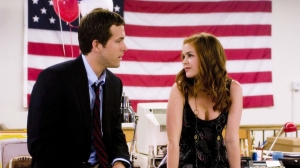 The women of Definitely, Maybe are the real winners here even if only one will eventually take home Will. Fisher becomes the heart of the movie and, given the most emotional material, shines the greatest. Banks is wholesome and easy to get cozy with. Weisz is the most enigmatic of the three and offers a beguiling yet very knowing charm. She has a very seasoned sensibility. Her on-again off-again affair with an aging literature professor (a fabulous Kevin Kline playing a fabulous blowhard) adds an intriguing dynamic to her character. The only irritant for me was Breslin’s acting, which was just off enough to annoy me.
Definitely, Maybe is a romantic comedy that proudly treats its characters with respect and develops them into relatable, authentically human characters in a typically inauthentic universe. Brooks mines a gimmick for all its worth, but even after the signs become clear the film is still pleasurable in its predictability thanks to the great characters. It’s rare to see a romantic comedy that bestows a moderate amount of characterization; usually these roles just fall under archetypes. Brooks has shied away from the trappings of the genre (there isn’t a single sing-a-long!) and crafted a genuine romantic comedy that doesn’t rely on sentiment and easy answers even as it heads toward happy ending material. The movie even tackles divorce from a non-judgmental yet honest approach. As far as I’m concerned, Brooks has made amends for his previous screenwriting duds and made a movie that men can truly enjoy as they’re dragged into the theater by their significant other. I would definitely recommend Definitely, Maybe to fans of the genre. This is one worth seeing, folks.
Nate’s Grade: B+
Share this:

The 40-Year-Old Virgin (2005)
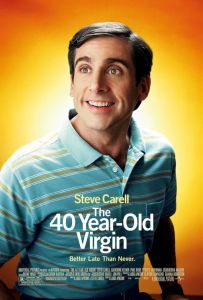 Yes it’s an uproarious sex farce, that’s a given from the ads, but this movie is also surprisingly sweet and genuinely moving. A lot of credit goes to star/co-writer Steve Carell and co-writer/director Judd Apatow, creator of some of the best, most honestly funny TV series unjustly cancelled. Apatow is a master at mining human comedy for pathos, where you get a great sense of character and really feel for those onscreen, and yet nothing feels cheap or unwarranted, all the while deriving comedy from the situations. We need more men like Apatow in the film industry. Carell can do it all whether it’s deflecting his insecurity, which we feel so bad when he comes up with outrageous things he’s overheard to make himself seem like one of the guys. The supporting cast is top-notch. They’re basically the stock roles in a sex comedy and yet they bring so much more to the table, with a true-to-life boys-will-be-boys camaraderie that you can identify with. The character relationships in The 40-Year-Old Virgin really elevate the story and the jokes and make the film something really special. It’s not merely a barrage of gross-out humor; it’s a nice story with some very tender moments. This is a movie that goes well beyond its gimmick premise, never feeling like a skit blown up into a feature film. It mixes in psychology, heartbreak, awkwardness, but also insights into loneliness and human connection. The best character-based comedy in years.
Nate’s Grade: A
Share this:

Spider-Man 2 (2004)
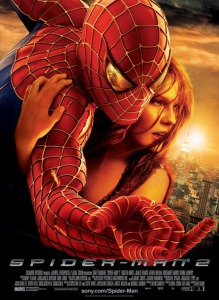 No other movie had higher expectations than Spider-Man 2 and no other movie met and trounced those expectations than director Sam Raimi’s high-flying webslinging sequel. Spider-Man 2 was that rare sequel that excelled in near every way. The action sequences were lively and highly exciting, but what made Spider-Man 2 so thrilling was its success in building strong emotional characters. After all, how many superhero films are written by the writer of Ordinary People? (One wonders what he would have done with Catwoman) Alfred Molina, as Doc Ock, made for a great formidable foe and brought surprising humanity to the dastardly part. Spider-Man 2 was a momentous crowd-pleaser that also dazzled the hardest critics. It reaffirmed exactly what a summer popcorn film can make us feel.
Nate’s Grade: A
Share this:

Catch Me If You Can (2002)
January at the theaters is a tale of two kinds of films. One type are the studio bombs (take Just Married and Darkness Falls, please take them far away). The other type are the prestige pictures expanding their releases in hopes of garnering some of that Oscar magic. A lot of prestige films were released around the holidays and though not every one could be a winner, they were all better than Kangaroo Jack. Well, except for The Hours.
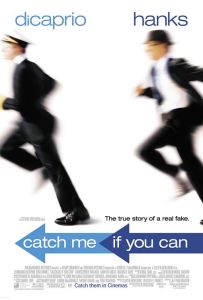 Catch Me If You Can (2002)
Premise: Successful true-life con artist Frank Abagnale Jr. (Leo DiCaprio) zips across the world posing as a pilot, doctor and lawyer all before the age of 18. A mousy Tom Hanks provides the chasing.
Results: Breezy and light-hearted, Catch is an entertaining and fun romp that works with a charming Leo (unlike in Gangs), a jazzy score and a skillful recreation of the 1960s life and mood. Spielberg hasn’t made a film under two hours since 1989, so Catch is a tad long.
Nate’s Grade: B


 nathanzoebl
You must be logged in to post a comment.