Blog Archives
The Invention of Lying (2009)
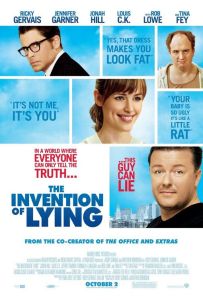 Imagine a world where people could only tell the truth. Sounds scarier than anything in horror movies today.
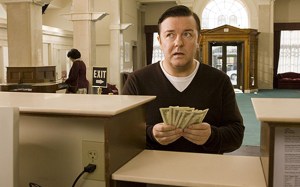
Mark (Gervais) is trying to romance Anna (Jennifer Garner) but even the waiter tells him she’s out of his league. She tells him upfront that she finds him unattractive and he will never have any hope of having sex with her. She’s more interested in Mark’s snide but handsome co-worker, Brad (Rob Lowe), who she feels is a better genetic match. Mark is about to be fired from his job, writing historical screenplays about the 13th century, and his secretary (Tina Fey) delights in telling him that she loathed every minute they spent together. This is a world without a filter. Until one day Mark goes to take out money from the bank, and something inside his brain switches. His balance is $300 but he asks for $800, and the bank teller apologizes for the computer error and gets Mark his full $800. He explains to his barfly friend Greg (Louis C.K.) that he said something that wasn’t. Nobody understands. “I’m a black Eskimo,” Mark says. Everybody takes him at his word. Mark is the only human on earth who has the ability to tell a lie, which he uses to his great advantage whether it be gambling, getting out of a traffic ticket, or unearthing a “lost” historical chapter about ninjas and aliens that makes for a stirring “non-fiction” film. Mark can’t even explain what he’s done, since the world lacks even a word for “lie.”
Gervais and co-writer Matthew Robinson concoct some interesting and inspired ideas of what a world bereft of lying would be like. Naturally, advertising would be completely different if people had to tell the truth, the whole truth, and nothing but the truth; imagine prescription drug ads that only said, “This is a placebo. Your penis won’t ever grow bigger.” The slogan for Coca-Cola is, “It’s very famous,” and the slogan featured for its rival, Pepsi, is, “When you can’t have Coke.” No one has any concept of fiction, of people pretending to play parts, so movies only consist of an older man sitting comfortably and reading a historical account with some minor dramatic inflection. Movies have become book reports. The sign in front of a retirement center says, “A Sad Place for Hopeless Old People,” and a motel sign reads, “A Cheap Place to Have Intercourse with a Near Stranger.” However, I’m puzzled by how forcefully open every person is. Just because you can only speak the truth doesn’t mean you have to be talking constantly. I understand Gervais’ point about the need for lies to protect people’s feelings, but just because you think someone looks fat doesn’t mean you have to blurt it out. When Mark greets Anna at the door for their date she reveals, “You’re early. I was just masturbating.” It’s funny, sure, but did she feel compelled to link the two statements? It seems in this world, everyone is incapable of keeping their mouths shut.
 The premise of the movie is terrific, and I’m honestly shocked no one has thought of it before. But the premise wears a little thin after the first 30 minutes of people speaking with no filter. You begin to expect outrageous comments that will be hurtful and blunt, and because you expect them it takes away the shock value and lessens the humor. But then The Invention of Lying takes a sharp right turn at about minute forty and becomes a radical and subversive and much funnier movie. Mark is comforting his dying mother (Fionnula Flanagan) who is afraid of leaving existence. She’s afraid of a cold nothingness. So Mark explains to her that there is an afterlife, a world beyond our own, where everybody gets to be around their loved ones in a mansion, and there’s no pain. She closes her eyes and dies in peace with this new knowledge. The doctors and nurses are amazed and beg to know more. Mark has created the idea of religion and God! He’s mobbed by people and camera crews demanding him to explain what he knows. Mark then works up the courage to establish a system of 10 rules to follow, which he tapes onto old pizza boxes. He then addresses his flock and has to explain the complicated minutia of religion, with hilarious questioning from the acolytes. Mark explains that there is a “man in the sky” who watches everything we do and is responsible for everything that happens. “Does that mean the Man in the Sky gave my sister cancer?” someone asks. Mark tries to explain the nature of a loving, all-powerful deity who willingly allows bad things to still happen. “Screw the Man in the Sky,” someone yells, “He’s going to kill us all. We need to fight back!” You try explaining the nature of the unknown to people.
It’s at this point that the movie transforms into a biting satire on belief and belief. I was cackling but I noticed that my theater seemed to get awfully quiet the longer the religious satire went on. I almost spat out my drink when I saw a spinning newspaper headline that said, “Man in the Sky Continues to Give Children AIDS.” It’s offensive but completely within the bounds of religious questioning. Gervais and Robinson aren’t ridiculing religious belief; in fact they seem to prove that it has a definite place of significance within society and can be beneficial psychologically. The satire isn’t savage and still manages to play with the amiable, fable-like nature of the story. Gervais isn’t laying out an argument that believing in an unforeseen deity is stupid. The movie isn’t condescending or hectoring, like Bill Maher’s anti-religion documentary Religulous, but it does take some slyly subversive swipes at the nature of faith and its reliance upon the unproven.
 The Invention of Lying suffers from trying to be a romantic comedy. Too much of its conflict is spent on whether the chubby guy can get the pretty girl. The movie gets a tad sentimental for dealing in bitter-truths, and Gervais and Robinson steer the film to the ultimate romantic comedy setting: objecting at a wedding. I wouldn’t have minded the rom-com asides if they didn’t feel like they kept striking the same chord. Mark wants to be in a relationship with Anna. She points out that he’s fat, has a snub nose, and not a good genetic match. He persists. She points out that he?s fat, has a snub nose, and not a good genetic match. This goes on and on until the inevitable break at the end. Mark, and especially Gervais, is an appealing guy, self-effacing and witty, even downright cute at turns, but when Anna keeps repeating the same looks-first mantra, it makes her seem increasingly shallow and him seem like a glutton for punishment. Garner is a fabulous comedic actress and packs a lot more emotion into her character than I would have expected given the conceit.
Ricky Gervais is catching fire as of late, and it seems that America is finally waking up to the charms and brilliance of this squat comedian. He created The Office, the standard for squirm-based comedy, and appeared in the underrated supernatural comedy Ghost Town last fall. Gervais shows the necessity of lies in our world, from sparing hurt feelings to making mass-market entertainment. The world needs dishonesty. When The Invention of Lying is on-target, it is a hilarious, almost brilliant, comedy, with its best gags saved for taking on “the Man in the Sky.” It’s too bad then that the entire movie doesn’t live up to these flashes of comedic brilliance. Still, the movie is sweet enough and ends on a satisfying level, even if The Invention of Lying begins as one movie and ends as another. Gervais is an appealing lead, though he doesn’t prove much in the way of a director, and he has some real dramatic acting chops too, nicely put to use during his mother’s deathbed scene. I hope more Americans wake up to this man’s charms. Gervais continues to show audiences the sharp wit that has made him one of the world’s foremost funnymen.
Nate’s Grade: B+
Share this:

The Illusionist (2006)
 The Illusionist is a satisfying, well-staged period piece con game. It’s set in 1900 Vienna (though everyone’s accents sound British to me) and revolves around Eisenheim (Edward Norton), a magician that truly dazzles the crowds and leaves his skeptics guessing. He becomes a monstrous hit with tricks like making an orange tree grow from a seed and having butterflies carry handkerchiefs. The city’s Chief Inspector (Paul Giamatti) is a fan but also inquiring on counts of fraud. Prince Leopold (Rufus Sewell) is planning to marry the beautiful duchess Sophie (Jessica Biel). Little does the prince know that Eisenheim and Sophie were childhood friends forbidden to see each other because of class differences. It’s been 15 years since they last saw one another but they’re making up for lost time. The Prince sets the Inspector to ensnare the lovers and shut down Eisenheim.
The movie has a very interesting character relationship between Eisenheim and the Chief Inspector. They have a friendly, respectful relationship, with the Inspector pleading with Eisenheim not to force his hand. The Inspector enjoys magic and showmanship, but he also knows what backs he has to scratch to keep his title. I found the frustrating friendship and admiration between Eisenheim and the Inspector to be meatier than the forbidden love angle that drives the story. The Illusionist has the air of a historical romance, but it’s really more about these two men and their bond.
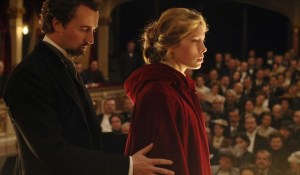 Giamatti has a very strong role and plays all the different shades of his well-trodden man who still keeps hold of his ethics when he’s told to look the other way. He’s just as an important a character and Giamatti has completely wiped my memory of Lady in Water (not that he had to atone for it). Norton is easily one of our greatest actors, but in The Illusionist he underplays too much, slightly smiling his way through an altogether stale performance. I know part of his acting requires a reserved knowledge, since he is setting up those around him. I just felt that anyone else could have played the role the same, with or without a teenage goatee. Biel holds her own, which is something I never would have thought possible amongst celebrated Oscar-nominees. Her role is pivotal but small and doesn’t require much speaking, but all things considered she does pleasantly surprise. Maybe there is an actress somewhere in that pinup body.
The Illusionist, like its title practitioner, knows that an audience loves to be fooled, but only for so long. A magician is the perfect profession to showcase a con game, and writer/director Neil Burger crafts an intriguingly enjoyable tale where we do want to know how they did it. Burger knows how to misdirect but also how to stretch a small budget to create a rich dramatic environment. I don’t know if the explain-a-lot-in-a-minute ending does a disservice to the film or not, but I was happy to get some answers even if they were a tad predictable. That’s the whole thing with magic — we want to know but we love being confounded.
This is an extremely well made indie period film. The production design is astute and often times foreboding, like the Prince’s hallway completely filled with deer heads whose antlers form a really creepy canopy. The special effects are used judiciously and have more impact than the mega budget Hollywood summer spectacles. The Illusionist is a nice example of a character driven mystery that seems to be overlooked all too often today. This is an engaging, satisfying, and handsome movie that entertains by hooking into our curiosity to know how the trick is done.
Nate’s Grade: B+
Share this:

The Italian Job (2003)
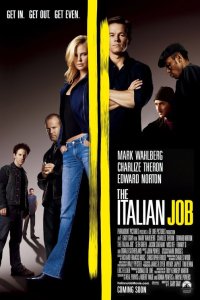 The Italian Job is equal parts dumb and equal parts entertaining, which makes for fine breezy summertainment. The cast is agreeable, the heist is interesting, the action is full of sexy cars and explosions; I call into question how in the world Jerry Bruckheimer’s name is absent from this. Maybe he’s too busy with his TV work.
The film opens up on a nifty heist in, of all places, Venice. Grizzled old-timer John Bridger (Donald Sutherland) leads his crew for, say it with me now everyone, one last heist. Charlie (Mark Wahlberg) is his second in command and the heir to the thievery throne. The crew steals a safe full of gold bars by applying explosive paint to specific levels of ceilings, causing the safe to drop two floors into the awaiting arms of our scoundrels. The Venice police believe the safe to be riding off in a boat, driven by the crew’s getaway man Handsome Rob (the always good to have Jason Statham). But no the real safe has fallen into the canal and Charlie and John are scuba-safe-crackin’. The crew gets away with their misdeed and toast about their thievery atop a mountainside.
 Everything is good. But wait, Steve (Edward Norton) double-crosses his peers and hijacks the gold and kills John. Heres what I dont get. Everyone in the crew is shocked, especially an overactive and whiny Wahlberg (and there’s no worse kind than a whiny Wahlberg). “How could you do this?” whines Whiney Wahlberg. Let me think here. Maybe its because … YOU’RE ALL THIEVES, JACKASS! What was that old saying, no honor among thieves or something. To paraphrase Go, you guys aren’t exactly in a highly ethical industry. There aren’t good thieves and bad thieves; this ain’t no Errol Flynn pic. I would also like to note that everyone in the crew should have known of Steves predestined treachery just by the fact that Norton has a mustache. C’mon, do you need any bigger a sign? Anyway, the van the crew is in drives off a bridge into subzero water. Steve fires some round into the water and believes hes killed his former crew. They of course are not dead and instead are using the scuba gear to breathe. Of course, it’s still subzero temperatures but what does that matter?
We then flash to one year later. Dead John’s not-so-dead daughter, Stella (Theron), conveniently works as a professional safe-cracker to tests security systems. Hmm, I wonder if that will come in handy later. Charlie approaches her with a plan to re-re-re-steal the gold from Steve, the man who, dramatic pause, killed her father. She agrees to help because she wants to see the look on Steve’s face when he finds his money gone. Its probably something very similar to many people over 40 I see now that the stock market is full of price-inflated charlatans.
 What follows is Charlie reassembling his crew; Seth Green as the geeky tech dude, Handsome Rob, and Mos Def as the demolitions expert. Together they work out a plan that is part elaborate and part ludicrous, but still entertaining. This is where The Italian Job gets the rules of heist cinema right: 1) Efficient amount of time must be made to plan the heist so the audience knows the steps and every role of importance. 2) The heist must go off for an extended period of time for the audience to enjoy the payoff of watching all the rehearsal proceedings. 3) The heist has got to be done in an interesting way. 4) Not everything has to go according to plan. The only real action sequences in The Italian Job bookend the film, with the opening Venice heists and the later and extended Steve steal. With this said, the end still carries a good sense of payoff for the audience, and watching all of the different elements of the team work together with their own responsibilities builds a sense of attachment to these otherwise undeveloped characters.
I am convinced Mark Wahlberg is a black hole of acting. Sure, he can do Affable Lug fine and dandy as evidenced by Boogie Nights, but when Wahlberg attempts (and that is the operative word) to emote he looks like his leg is caught in a bear trap. His whole bland handsome understatedness isn’t fooling me. Theron is a pretty face but I still havent seen anything shes done to convince me shes anything more. Green is very funny in his geeky role, complaining that he had the original idea for Napster and it was stolen from him by his roommate. Statham and Mos Def round out a likable if slightly one-note crew.
Director F. Gary Gray (The Negotiator) has graduated from the world of music videos but still knows how to stage some exciting scenes. The slick ending heist, with the L.A. gridlock, three trucks to chase after, and fleet of patriotic Minis is a great popcorn action set piece all the more appreciated because of the patient setup the movie has given.
In the days of summer, where some people wrongly consider a bloated and pretentious action film to be entertaining, even if they dont get a lick of it, it’s especially nice to have something like The Italian Job remind us the escapist fun summer flicks can offer. Just don’t worry if Wahlberg looks to be in pain.
Nate’s Grade: B-
Share this:

Red Dragon (2002)
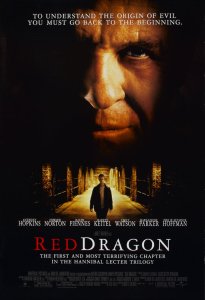 The following is a conversation overheard between two studio producers:
Person #1: So this Hannibal movie made like a ton of green. What else can we do to squeeze out some more money?
Person #2: Hey, do you remember a movie called Manhunter based on the first Lector novel?
Person #1: Nope.
Person #2: That’s fine because nobody else does.
It’s official folks: Hannibal Lector, America’s favorite cannibal, is now more comical than scary. See the element that 1991’s Silence of the Lambs carried with it was a stealthily gripping sense of psychological horror. It hung with you in every closed breath you would take, surrounding you and blanketing your mind. I mean, there aren’t many serial killer movies that win a slew of Oscars. And while the follow-up, last year’s Hannibal, gleefully bathed in excess at least Ridley Scott’s sequel was so over-the-top with its Baroque horror that it was entertaining. So what’s Red Dragon, the latest Lector flick based on Thomas Harris first novel like? Well it’s like the bastard child of Lambs and Hannibal after a drunken one-night-stand neither would be proud of in the pale light of morning.
 In an extended prologue we see the capture of the good doctor with a good appetite, Hannibal Lector (Anthony Hopkins, completing his trilogy of the character). FBI Agent Will Graham (Edward Norton) seeks his advice on a profile of a serial killer, not knowing that Lector more than fits the bill. A violent struggle ensues that leaves Graham with a long scar across his abdomen and Lector locked away for nine consecutive life sentences.
Turns out there’s another madman on the loose. The Tooth Fairy, dubbed by tabloid journalist Freddy Lounds (Phillip Seymour Hoffman), has butchered two families in their homes and inserted shards of broken mirror into their eyes. The FBI coaxes Graham out of retirement to try and track down the Tooth Fairy. But it seems in order to make any significant ground he must seek help from an old advisor – Hannibal Lector.
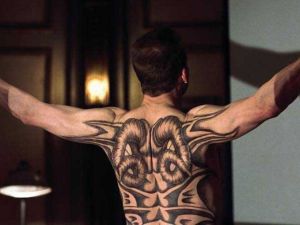
The crux of the film follows Graham’s attempts to figure out the identity of the Tooth Fairy, which we learn fairly fast is pretty boy Ralph Fiennes. Seems Fiennes has a cleft palette and years of physical and sexual abuse to toil over. He desires to transform into a mythical Chinese creature known as the Red Dragon. But wait, the lonely Fiennes is befriended by a lovely blind woman (Emily Watson) who identifies having people look differently at her. Can her affections melt the cold heart of a cold-blooded killer? Well, if they did thered be no other half of this movie.
What Red Dragon feels like is more of a checklist of what we expect to see in a Hannibal movie than anything of creative nourishment. It’s like a slimmer version of Lambs plot. Once again there’s an FBI agent who recruits Hannibal for advice on tracking down a serial killer. Once again there’s a disturbed killer trying to transform himself. Once again Hannibal Lector scares the crap out of anyone at will. Check, check, and check. Creative stagnation? Double check. The most disappointing aspect is the rudimentary feel this whole exercise has. Even though Red Dragon is a prequel it still seems like it’s begging to meet our expectations of two earlier films.
The first stab at the Red Dragon novel was in 1986 by director Michael Mann (Ali, The Insider) with the thriller Manhunter. William Peterson (before his work at CSI) was a more brooding Graham, Tom Noonan was a spookier Tooth Fairy, and the tension was stacked better. There were no comparative expectations.
 Norton is the finest actor of his generation but has certain trouble breathing life into Graham. The character is far more straight-laced than what we’ve been told is an expert at delving into the minds of killers. Grahams relationship with Lector doesn’t have any of the complexity, or interest, that Jodie Foster’s Clarice Starling had. He can even be very flat-footed in his detective work for a specialist. He stares at the home videos of the two slain families for about an hour wondering what the connection is while we in the audience shout it out to him. Lets go to the videotape Ed!
Anthony Hopkins returns as the devil in the flesh and seems to have another grand old time. Lector worked in Lambs because he was caged up, like a wild animal not meant for four glass walls. You never knew what would happen. He’d get in your head and he would know what to do with your gray matter — not that he didn’t have a culinary degree in that department with Hannibal. With Red Dragon, Hannibal is just window dressing to another serial killer. He’s a supporting character in a story that he has nothing to do with. He’s reduced to comic relief with his sudden attacks of chattering teeth and velvety voice. The amazing supporting cast of actors all do well, especially the beaming Watson who will shine in anything you put her in. Just try.
Ultimately the story of Red Dragon is far from flawless and meanders for quite a while. It would have been a marginally competent movie had it not been trying to replicate Silence of the Lambs so damn hard. So, is this the last youll see of Hannibal Lector? No as long as clinging cash registers can still be heard. Cue evil laughter.
Nate’s Grade: C+
Share this:

The Score (2001)
 Marlon Brando, Robert De Niro, Edward Norton, three of the greatest actors of three generations. This draw alone warrants a stroll to view The Score one would assume. But not so fast my friend. If you venture out to witness this movie chances are you will fall asleep within the first hour.
The plot runs through the all too familiar terrain of so many crime capers and heist flick predecessors. There’s the old pro who wants to retire (Robert De Niro) who gets pulled into a risky heist planned out by a young pup with some bite (Edward Norton). Will the old pro forgo his plans of retiring on a beach side with little umbrella drinks for one last shot at the big score? If you have to think about this question then you need to get out more. The scheme is to break into the Montreal Customs building and steal a scepter that could be worth as much as 30 million dollars. Stealing a scepter from French Canadians? Was this idea written on the back of a napkin at a bar?
This is in essence the plot of The Score. The characters are mere shells and never fleshed out. With any heist picture there should be the scenes where the characters engross themselves with the ins and outs of their scenario, the rehearsing and practicing, and finally the big move. The Score decides to lightly touch the first, skip the second, and barely give the audience much of the third. The film just isn’t playing by the rules it gives.
 The Score is muddily directed by famed puppeteer Frank Oz. He has directed comedies over the past few years but his first foray into drama, or action, or whatever you want to call it, is downright embarrassing. The entire film waddles in muggy darkness, as if they didn’t have enough money to light the damn picture. After so many scenes of watching the outlines of actors or making out just their faces it just becomes fruitless to even watch. Maybe some of the money should have been poached from the stars’ hefty salaries to make sure that they were adequately lighted.
The beginning hour of The Score may very well be the worst time I’ve had in a theater all year. It’s drawn out beyond its own bounds to establish a set-up that could have been done properly with only a few minutes. This half of the film is leaden and wallowing in boredom, and it feels like it’s never going to end. I think I was actually contemplating suicide at one point.
The structure of The Score is easy to diagram. The first half has to do with the superfluous set-up, then we have ten minutes of the actual heist sequence, and then… it’s done. The film actually ends about three minuets after the heist complete with the now requisite twist ending that anyone with a functional brain will see coming a mile away. What needed to be done is to consolidate that slow-as-a-glacier beginning into something like twenty minutes, then double the length of the heist sequence and actually give it tension. Finally then have the rest of the movie play as a cat-and-mouse game of who has the upper hand with their burgled prize. This would have played with the actors more and at least keep the audience guessing and awake. As it stands, The Score is an incredibly unsuccessful effort when it comes to story structuring. This could be a future classic example of how not to tell a story.
 Norton is the only real punch of intensity in the movie. When Norton reappears onscreen it’s as if The Score regains a sense of renewed life. He’s great to watch, either as the young ambitious hotheaded criminal or as his mentally retarded janitor cover. De Niro must be getting a good long distance plan because he phones in yet another performance. He plays his character too smooth that the audience can never fear that he is actually in any danger. Brando is basically for comic relief, that is, if you can understand him through his garbled mumbles. Did this man have a stroke or something? Angela Bassett is useless in this film and wasted. Her role is the frequently off camera girlfriend who urges her man to settle down and let this last one go.
The Score is a lousy heist picture and a lousier attempt at entertainment. It lacks tension, proper story structuring, and even basic movie fundamentals like proper lighting. The Score is a wasted ensemble of a great cast that could only echo the silly cartoon that was Con Air. See The Score if you dare, but make sure to take some NoDoz for the first half.
Nate’s Grade: C-
Share this:

Fight Club (1999)
 Fight Club is a movie that will kick you in your teeth. It’s the adaptation of a sort of anarchist handbook by David Fincher, the man who gave us the grisly masterpiece Se7en. Fincher’s latest re-teaming with Brad Pitt is a disturbingly gritty tale of politics and violence.
Ed Norton plays our un-billed narrator through the harrowing tale of fascist propaganda and anti-social behavior. Norton dwells in a world of cubicles and consumerism. He meets Brad Pitt’s Tyler Durden on a flight and the two instantly connect. Norton moves in with Pitt into something resembling the Munster’s house once his own apartment has exploded. Pitt and Norton find the therapeutic realization through fighting. These fights grow larger and build up into clubs where all the guys are fighting to get in to get their head slammed on concrete. These clubs start turning into neo-fascist soldiers of fortune as they try to ambitiously grow and destroy the reality of consumerism. It kind of spins out from there and never returns back.
David Fincher’s direction is ultra slick and highly stylized. He is one of the most lavish and intriguing visual artists of this decade. He really knows how to pump out excitement and vivid hypnotism from striking images and tones strewn apart every inch of letter-boxed form. Norton has the same commanding presence and magnetic performance that he flashed so brilliantly in last year’s American History X. Norton is the one that runs the emotional gambit and shows just how it should be done. Brad Pitt takes on a role none have seen (Does anyone remember Pitt splicing porn images into children’s films with Legends of the Fall?) and once again proves there’s a calculating and superb actor behind the pretty face. Helena Bonham Carter goes leaping against type to play the bumbling Goth love interest with such charm and humor. And Meat Loaf will really surprise as a pathetic breast enhanced friend to Norton.
Fight Club speaks to a world where men feel they have been robbed of what has historically defined them; a world with Oprah, The English Patient, and self-help groups telling them to cry, be kind, rewind. All of the social consciousness has made some men feel less like their upright ancestors. So Fight Club‘s proposition is that to freely express your emotions you need to either be pummeled into ground round or be the one doing the pummeling. The notion is a tad laughable. Fight Club is a flick with so much on its mind to say that it brisks from topic to topic sometimes not dwelling as much as it could. The twist ending is unnecessary and is something that truly comes out from left field.
Fight Club has been criticized for its promotion of violence, but if anyone actually sees the film the violence is gruesomely repellent. No kid is going to walk out of this and think it would be cool to start a Fight Club in their local suburb. The movie is an interesting mirror to our always-on-the brink commercial society, and its push toward a kinder gentler civilization and its effects on the male psyche. Despite some oddities at the end and some fascistic rhetoric, Fight Club is an exciting blend of suspense, action, and dark humor. Go ahead and break the first rule of Fight Club – tell your friends about the adrenaline kick this movie is.
Nate’s Grade: A


 nathanzoebl
You must be logged in to post a comment.