Blog Archives
Attack on Darfur (2010)
 The idea of a filmmaker of Uwe Boll’s caliber tackling a subject like contemporary genocide seems like an artistic stretch. The man is mostly known for the poorly made, poorly received video game adaptations. It would be like the Wayans brothers making a stirring expose on supply side economics. The topic just seems far beyond their purview. I mean, maybe if somebody created some Darfur video game I might start thinking of Boll circling the project. Apparently, the despised German filmmaker had something Important to Say About Society. Attack on Darfur (or Darfur in some listings) is a well-intentioned cry for justice for a conflict often ignored by Western media. It’s a disturbing and grueling experience; however, the shortcomings of the script hinder the impact of the film and its crusading message. It ends up being a message movie subsumed by its message.
The Darfur region in southern Sudan has been the site of great atrocities. Thousands of people have been injured, raped, killed, and displaced. It is an ongoing civil war pitting Arabs against black Africans. The Sudanese government has been accused of working with death squads and militias, particularly the Janjaweed group. The Sudan government and the rebel groups formed a ceasefire after intense international pressure. But those in the Darfur region still report violent raids. The United Nations has dispatched a group of journalists to investigate a village for evidence that the ceasefire has been breached. Along the way are reporters (Billy Zane, Kristanna Loken, David O’Hara), a photographer (Edward Furlong), a cameraman (Matt Frewer), and others. Shortly after departing the village they can see the Janjaweed approaching in the distance. If they continue to leave then the village will most certainly be slaughtered. If they stay, perhaps they can avoid a bloodbath due to the presence of Western media. Some will go back to help fight for the condemned village and lay their lives on the line.
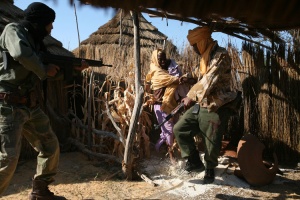 Attack on Darfur is Boll’s attempt to be a serious filmmaker. He’s targeted a serious issue and he’s going to give it serious attention. And he does, mostly. The first half of the movie is almost entirely expository, attempting to educate an audience ignorant to the depths of the genocide. The film even ends on a post-script lecturing us that because action has not taken place that the world has learned nothing. It’s easy to see Boll had some very good intentions with his film, and it follows an Edward Zwick path of preaching. Except while Zwick buries his lessons in easily digestible action. Boll doesn’t bury his message. His message is all you will get for 90 minutes. The opening focuses on many establishing shots of village life, and it’s truly amazing that the film doesn’t condescend or pander. Attack on Darfur feels authentic without having to ratchet up the differences with Western culture. Well, it tips into that territory when Loken hands out deflated balloons to the village kids as a treat. The problem is that all those horror stories end up blurring together, which is a horrible statement. This is because during this 40-minute chunk of exposition, Boll doesn’t fully educate about the conflict. All we know is that one group is getting treated really really badly. We don’t know about the people’s history, about the intricacies of the conflict, or the particulars of who belongs to what.
When the massacre is unleashed Boll doesn’t hold anything back. We witness mass murder, rape, baby smashing, baby impaling, baby slicing, child burning, and, oh, more rape. It’s a harrowing montage of death and destruction and dehumanization. It’s hard to watch, and that’s exactly the point. Boll overwhelms with the emotional appeals, trying to raise people’s collective sense of outrage. People are lined up and executed. Kids are locked into a hut and then the hut is burned to the ground. Nobody escapes this hellish nightmare. At last, Boll is utilizing commentary with his displays of exploitative violence. However, because of the lengths of degradation, it’s hard to even the scales from a storytelling standpoint. The leader of the Janjaweed militia (Sammy Sheik, Charlie Wilson’s War) is a way to put a manageable face to a problem too difficult to fix. It introduces a villain that can be vanquished so there’s some small sense of satisfaction by the time the movie draws to a close. We yearn for somebody to right these egregious wrongs, and that’s who our white journalist characters are supposed to be. I don’t exactly know what their plan is considering three head back to save the village and two of them have minimal to no experience with firearms. Three guys with guns vs. much more than three guys with guns? It’s even more confusing when our journalists-turned-gunmen stick with their handguns. They fail to grab the automatic weapons from the bad guys they kill, and naturally they run out of ammo when they need it most. While the third act produces some minor level of satisfaction as the bad guys are picked off here and there, we all know where this is headed; there will be no happy ending because that would disrupt the Message.
 In the end, despite all the good intentions and horrific displays of violence, I’m left wondering why this story needed to be told? I’m not talking about the backdrop of the Darfur genocide, which clearly needs more attention. But what about this story did Boll and co-writer Chris Roland deem worthy of being their vehicle to garner attention to a worthy cause? The structure follows a very Edward Zwick approach; we’re introduced to the moral atrocity and then expected to stand up and make a difference. The first 40 minutes of Attack on Darfur is nothing but characters holding a microphone. That is the only purpose for the majority of our above-the-title recognizable faces. They are mic holders, and perhaps that’s a metaphor for the film as a whole but I doubt Boll has thought that deeply. We’re treated to extensive montages of village life and the testimonials from actual survivors of genocide (a nice touch by Boll). But what purpose do all of these characters serve if only THREE go back to fight against the Janjaweed? Billy Zane (Titanic, Bloodrayne), Edward Furlong (T2, Stoic), Matt Frewer (Dawn of the Dead, Rampage), and Kristanna Loken (Terminator 3, In the Name of the King)? They all stay in the car.
Completely ignore the poster/DVD cover art. Judging from that artwork, you would think very differently about where the story will head. With Zane front and center, sporting sunglasses and an automatic weapon, you’d naturally think Zane is going to lead a team to defend the victimized. And the bottom half of the artwork contains men in combat armor and attack helicopters looming overhead. But then would you ever guess that those same steely looks and explosions add up to… the advertised thespians sitting in a car looking glum? Their role is to serve as the shocked white faces of anguished reaction so we can truly know how bad things are, because otherwise how would we even know?
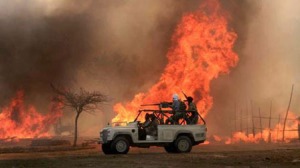 Boll is definitely trending upwards in his directing abilities. It’s not leaps and bounds but progress is unquestionably being made from the days of House of the Dead. He seems to be aping the visual aesthetic of a different artist with every film. Due to the true-life nature of the genocide it’s no surprise that Boll makes use of the Paul Greengrass docu-drama approach: quick edits, swishy camerawork, and extreme close-ups angling to keep the actors faces inside the frame. This visual aesthetic works effectively during the chaos of the massacre, but it proves to be a distraction beforehand. There’s no reason that the edits have to be so choppy and the camerawork so self-consciously handheld when characters are just standing around talking. It also somehow manages to minimize the visual urgency of the ensuing massacre. The concluding shootouts are efficiently entertaining without packing any thrills. Boll’s command with actors has improved, though this might owe up to the fact that his last couple of his movies have been devoted entirely to improvised dialogue. Reportedly the actors created exhaustive research to study the habits of journalists and create elaborate back-stories for their characters. That’s nice. It’s also a gigantic waste of time considering the actors have little to do.
Attack on Darfur is a hard film to watch and a difficult one to justify beyond raising awareness. What’s the point of the movie’s story? Why introduce characters to only have them turn away when danger mounts? I understand Boll wants to communicate the frustration of the inaction to the Darfur genocide. He wants us to get angry when our U.N. peacekeepers keep to the line that they can do no more than observe. Boll wants to compel us to make sure what happens in Darfur will never happen again. Never forget. But this intent to shock and horrify overwhelms his narrative. The message becomes the movie and the characters just get pushed to the edges to make room for more atrocities. Boll would have served his message and his movie better by building a better story.
Nate’s Grade: C+
Share this:

Stoic (2009)
 Until recently, it would have been unthinkable to associate Uwe Boll with the idea of social activist. This is the same man who has caused people so much pain and with his movies, ranging from bad to ridiculously bad to “You cannot unsee what you have seen” bad. The German director who has caused so many film and video game fans suffering seemed an unlikely candidate to seriously explore the suffering of others. And yet Boll’s heart grew three sizes and he directed a slate of movies with a social conscience. His movie about the genocide in Darfur is still circling around, awaiting a release date, but let me stop to remind you that Uwe Freaking Boll directed a movie about a topical humanitarian crisis. This is akin to… Eli Roth directing an Edith Wharton adaptation (“From the director of Cabin Fever comes … Ethan Frome!”). It just doesn’t seem like an organic pairing. Boll is used to blood and boobs (both of the mammary kind and of the idiot variety), not social relevancy. You don’t expect an exploitation filmmaker to shine a light on exploitation. While we await his Darfur movie, in the meantime is Stoic, a quick and cheap movie about three prison inmates (Edward Furlong, Sam Levinson, Steffen Mennekes) brutalizing their cellmate, Mitch (Shaun Sipos) when a bet goes wrong. It’s based on a true story from a German juvenile detention center, or so we’re told.
So what kind of movie is Stoic, actually? Well, for starters it’s an uncomfortable one. The movie aims to show the capability of human cruelty and how easy it is to become compliant within a group, to go along with the flow despite some murky moral hazards. The three cellmates end up kick starting a cycle of violence, each trying to top the last so as not to appear weak or to damage ego. Can this cycle of cruelty be stopped? The dehumanization leads to some rather brutal and disgusting acts of violence and degradation including forcing Mitch to eat his own vomit, dumping urine on the guy’s face, raping him, and sodomizing him with a broom handle (“Just curiosity, I guess,” explains one of his attackers). Despite all this, there are actual moments of restraint on Boll’s part, particularly during the rape sequence. The audio drops out, the edits become jump cuts stuttering ahead through time, and I thought perhaps Boll was maturing. Needless to say this thought was torpedoed a tad when Boll later showcased the inmates rubbing the bloody broom handle over Mitch’s unconscious mouth. Stoic is essentially a torture movie; it’s 80 minutes of literal torture with some extra psychological justification tagged along for safe measure.
 Where Stoic comes into issue is whether or not it possesses any merits to justify watching 80-some minutes or torture. The movie doesn’t offer much in the way of psychological insights or rich characters. Watching people become increasingly hurtful is not the same as exploring the habits that make such escalating acts of barbarity occur. Boll and the actors pound us with the message that we’re in prison and prison has its own operating system and everybody jockeys for position; Peter (Levinson) repeatedly tells us that he feels sorry but felt he had to participate or else they’d turn on him. It’s all about having somebody weaker to take the fall. I’ll give Boll credit that the amplification of events seems plausible given the circumstances, to the point that the three guys have come to the conclusion that there will be serious consequences for their actions unless they convince Mitch to go along with a fake suicide. The movie maintains believability even as things get more and more out of hand, which is commendable. But what isn’t commendable is that there seems little reason for Stoic to exist. Narratively the movie is simple: three guys pick on another guy. The characters are all slight variations of one another based upon the level to process guilt and deception. During the interviews, we’re given fleeting glimpses at denial and coping mechanisms, mainly lying (“I would’ve remembered something like that.”) to self-rationalization (“I kept saying to myself, ‘As long as it’s not me.’”). There aren’t many insights to be gleaned from the brief interviews, which serve as commentary.
Boll decided to make Stoic his Mike Leigh film, meaning that he had the basic outline of a story and told his actors to run with it while he filmed them. There was no script and all the dialogue was completely improvised. This does allow Stoic to maintain a naturalistic feel, however, it also means that the actors are beholden to tough guy clichés. The dialogue, particularly during the interrogation scenes, keeps falling back to a “you don’t know what’s it’s like, man!” mantra. Here are some examples of bland dialogue that the actors came up with:
“What choice did I have?”
“You’re either with them or against them.”
“What don’t you understand? If I didn’t seem like I was apart of it, they’d kill me.”
“I had no choice. They forced me.”
“I want to lie because I don’t want to be that person.”
“I felt like there was no way out.”
And because you knew it had to happen:
“I’m just as bad as the two of them because I didn’t do anything to stop it.”
 You’ll note that most of these dialogue examples belong to the Peter, the chattiest and most remorseful interviewee. Improvisation has its virtues but it can also lead to actors falling back on stuff they’ve seen in countless other genre examples, which means that the banal, cliché dialogue all gets stirred together one more time.
In defense of Stoic, it may prove to be Boll’s finest directorial effort yet. The handheld camera, sharp edits, and close angles copy the Paul Greengrass (The Bourne Ultimatum, United 93) style of visuals, and yet the docu-drama copy works. The visual aesthetic improves the quality of the film and allows Boll many opportunities for interesting compositions and smart stylistic decisions with the economical space of the set. The interviews are shot as one static camera shot to contrast with the shaky, reactionary movement from within the cell. It may not be an original style, but then again Boll seems to adopt (some might say rip-off) a new style with every film. For Stoic, Boll’s direction makes you feel in the middle of these awful incidents, and the pain feels even more real.
But is there any reason to really watch Stoic? The acting is mostly good, and maybe fans of Edward Furlong would like to see what he’s been up to since 1998’s Pecker and American History X. Perhaps the declaration of “Boll’s best directorial effort” will appeal to maybe six or seven curious, and questionably masochistic, film fans. Due to Boll’s German background, I can’t help but wonder if his country’s history influenced him to try a narrative experiment hat explores how easy it is to go along with something awful, how difficult it is to make a moral stand against the grain, and how easily circumstances can find momentum and get out of control. I wonder if Stoic is Boll’s personal act of penance, of trying to understand a nation’s actions (and inaction) and working through a lingering shroud of shame. Then again, I may be reading way more into this movie than was ever intended. It could have just been a lark for a quick buck/deutschmark. Stoic is a mildly interesting little filmic experiment from Boll. Due to its narrative simplicity and limited characterization, it can’t offer much more than another voyeuristic slideshow of human degradation.
Nate’s Grade: C


 nathanzoebl
You must be logged in to post a comment.