Blog Archives
Fool’s Paradise (2023)
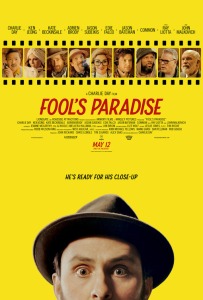 Charlie Day is a very funny guy who works with lots of funny people, so why isn’t his directorial debut, Fool’s Paradise, well, funnier? It’s about a mute simpleton (Day) with the intelligence of a five-year-old, or a Labrador retriever we’re told, who is mistaken for an acting savant. The intended joke is that this industry projects what it wants to see and is full of shallow, insecure, greedy idiots chasing anything that might be popular or career advancing. That’s a fine start but there is a shocking lack of jokes and funny scenarios to be had here, so the 93 minutes just creaks on by in protracted and pained awkward silence. It was a mistake to have Day, a comedian with such a distinct voice and often prone to hilarious outbursts, play a character who doesn’t talk at all. It’s not just that, he kind of shrugs or raises his eyebrows in response, and every time the camera cuts to him for a reaction shot, I was left wondering if this is all the movie had. This passive character, mistakenly named “Latte Pronto” by a director who finds him as a replacement for a prima donna Method actor (also Day), is just a miss. He’s not interesting, and what her reveals about the people around him is even less interesting and just as obvious and tiresome. It’s a movie about non-stop mugging to the camera and hoping to evoke some overly generous pity laughs. It’s attitude over wit. The jaunty score tries hard to make you feel the missing levity from scene to scene. It’s not convincing. The movie is chock full of stars, many of them friends and colleagues that Day has accumulated over a decade in comedy, but nobody has anything funny to do. It’s just all so confounding. Clearly the inspiration owes a debt to 1979’s Being There, a gentle political and social satire where everyone projects what they want to see on one middle-aged gardener raised on TV (I recently watched that movie and felt it was rather dated and quaint). At least that movie had a larger point. There’s just so little to hold onto with Fool’s Paradise, with a boring nothing of a character that never seems to uncover or reveal anything on a tour through Day’s many famous friends. Even the physical comedy is an afterthought. This is no charming Little Tramp. Do yourself a favor and watch any 90 minutes of 2022’s Babylon and you’ll see a funnier and more excoriating satire on Hollywood than the collective shrug that is Fool’s Paradise.
Nate’s Grade: C-
Share this:

Avatar: The Way of Water (2022)
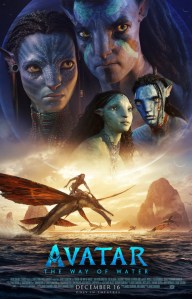 In the 13 ensuing years since James Cameron’s smash hit Avatar, we’ve debated whether or not the collective consciousness has simply moved on and forgotten what was, at one point, the highest-grossing movie of all time. What cultural dent had it made? Are there really still fans? Was it a fad of the new 3-D, itself already dissipated? Does anyone really want three or four sequels? Then Avatar: The Way of Water was released in late 2022 and it didn’t do as well as its mighty predecessor. Instead of being the highest-grossing movie ever, it’s only the third highest-grossing movie ever with a paltry $2.3 billion worldwide (how can the man even sleep at night?). It’s a lot of the same, both in its big feelings, awe-inducing visuals, and its resurrection of characters, scenarios, and conflicts of before, so you’ll likely find yourself reliving your own 2009 Avatar reaction.
Cameron’s long-awaited follow-up returns to the alien word of Pandora where our Marine-turned-Na’vi Jake Sully (Sam Worthington) has raised a large blended family with his Na’vi partner, Neytiri (Zoe Saldana, given little to do but cry this time). The first hour of this three-hour blockbuster is establishing the family dynamic with the different kids, including adopted daughter who is… somehow… the daughter of the deceased scientist Grace (both Sigourney Weaver) as well as the human child nicknamed Spider who is the biological son of Quaritch (Stephen Lang), our deceased villain. Nobody seems to stay dead in this series as Quaritch concocted his own backup plan in case of his untimely demise. He transferred his consciousness into a tank-born avatar, and this new Na’vi Quaritch has his own team of Marines in blue-skinned Na’vi bodies. They’re heading back to Pandora for some out-of-body vengeance, and thanks to their genetics, they seem to get a pass from the natural environment of Pandora mistaking them as native.
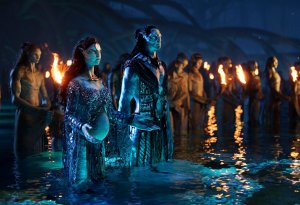 There’s a lot of set up here, and the second hour introduces us to the coastal community, and it becomes another formula of the outsiders learning the rules and culture of the new setting and integrating, turning enemies into friends, gaining honor, etc. It’s within this second hour that the big environmental message coalesces around whaling, with one Sully son bonding with an alien whale Free Willy-style. There’s a whole hunt sequence that poaches a mother and her calf that’s quite upsetting. The parallels are obvious but subtlety is not exactly one of the storytelling options in the Avatar universe. This is a broad canvas in the biggest sense, so every message will be spelled out very finely and underlined, with character voicing obvious themes and villains practically twirling space mustaches. And that’s okay. The final hour is an action-packed showdown bringing all the characters to account and forcing Jake to face off once again with his old commander.
The visual immersion is outstanding and the real reason to sit still during all three hours of Way of Water. The Oscar-winning visual effects are transcendent, and the extended sequences underwater really captivate and achieve the sense of natural awe Cameron aspires for. It is an exceedingly pretty movie to watch, and the level of high-definition detail is astounding. There’s a tangible realism here even when it’s entirely gangly CGI characters. At no point does it feel like an empty green screen stage or an over-exposed cartoon. The world of Pandora is still interesting and worth exploring, and the coastal aliens with their evolutionary differences makes me excited to explore other corners and communities of this alien world. The story works, and the payoffs work, and each of the Sully kids has a moment to shine, though I kept confusing the two older brothers (where did one of these kids learn to say “bro” every other word?). It’s a bit strange to see and hear Weaver in a preteen alien’s body, but that disconnect is part of the point, as the character feels like a foreigner searching for meaning. Considering the decade-plus delay, the huge scope, and setting up potentially three other movies, I’m impressed that Way of Water even works as well as it does as a sequel. I was able to re-acclimate pretty easily in that first hour.
 It’s not revolutionary storytelling but not every movie need be. It follows a familiar formula but puts in the work to make the action meaningful and connected to character and for the emotional beats to resonate. I thought the upside-down sinking military vessel had some striking, terrifying Poseidon Adventure-esque visuals, and the sequence was rooted in the family trying to save one another. With so many moving pieces and characters, the plot can be overburdened and redundant at times (the Sully kids get kidnapped so often they might as well save time and tie themselves up early) but even at three hours it doesn’t feel slow or wasteful. There is a sense of repetition in bringing back so many of the same faces, like literally rehashing the same villains. I wish more consideration was given to the new Quaritch and his own existential journey of the self. Just because you have the brain of this dead evil guy, do you have to follow in his doomed path? That could have been a really intriguing and profound character journey, the cloned Marines bred to be weapons who decide their own identities. That could have sufficed as the entire movie for me. The messages are heavy-handed but effective, though Pandora already had a natural resource that Earth wanted to exploit so I didn’t think we needed a second natural resource that essentially functions as immortality juice. At this point, will the third movie introduce ANOTHER magical resource that cures cancer? Likewise, I hope the next movie doesn’t find us yet another Quaritch (a twin brother!) looking for further score-settling. The ending sets up a larger confrontation with Earth’s corporate elite that will come about with the ensuing sequels, though I would have thought since Way of Water makes a big leap forward in time that Earth’s powerful forces would have already marshaled their unhappy response to being kicked out in the original movie.
Cameron has an innate blockbuster sensibility and storytelling structure; the man just knows how to tell rousing big screen adventures like few others. I didn’t see Way of Water in theaters but I won’t make the same mistake with the many Avatar sequels that will dominates the 2020s. It’s a bit hokey though deeply sincere, and Cameron proves yet again that he should not be doubted on big stages of his own creation. It might take the domestic gross of a small country to make these sci-fi epics of his, but the man delivers like few in the rarefied field of dependable blockbuster artists. There’s going to be an Avatar sequel every two years, so this universe won’t go extinct anytime soon, and I’ll be there waiting too.
Nate’s Grade: B
Share this:

I Love You, Daddy (2017)
 After years of rumors, highly influential comedian and television guru Louis C.K. has admitted that the sexual allegations against him are indeed true. Several women recently came forward in a New York Times article citing C.K. as asking them to watch him masturbate, forcing women to watch him masturbate, or masturbating over the phone with an unsuspecting woman. Right now in the new climate of Hollywood, it appears that C.K.’s comedy career is at a standstill if not legitimately over. And strangely amidst all this was the planned release of a little movie he wrote, directed and stars in called I Love You, Daddy, about a famous Hollywood director with rumors of sexual indecency. The movie has been pulled from release but not before screeners were sent to critics. I don’t know when the general public will get its chance to watch I Love You, Daddy, but allow me to attempt to digest my thoughts on the film and any possible deeper value (there will be spoilers but isn’t that why you’re reading anyway?).
Glen (Louis C.K.) is a successful TV writer and producer. He’s starting another show and Grace (Rose Byrne), a pregnant film actress, is interested in a starring role and perhaps in Glen himself. His 17-year-old daughter China (Chloe Grace Moritz) takes an interest in a much older director, Leslie Goodwin (John Malkovich), with a troubled past. Glen idolizes Leslie Goodwin but isn’t comfortable with the interest he’s shown in his underage daughter.
 It’s impossible to resist the urge to psychoanalyze the film especially considering it’s otherwise a fairly mediocre button-pushing comedy. The biggest question that comes to mind is why exactly did C.K. bring this movie into existence? He hasn’t directed a film since 2002’s blaxploitation parody Pootie Tang. It didn’t even come into being until this past June, when C.K. funded it himself and shot it over the course of a few weeks. What about this story was begging to be brought to life, especially with C.K. as its voice? He didn’t have to make this. He brought this into the world. Given the controversial subject matter, C.K. must have known that the film would at minimum reignite the long-standing rumors of his own sexual transgressions. So why would he make I Love You, Daddy? This is where the dime-store psychiatry comes in handy, because after viewing the finished film, it feels deeply confessional from its author. It feels like C.K. is unburdening himself. I cannot say whether it was conscious or subconscious, but this is a work of art where C.K. is showing who he is and hoping that you won’t realize.
This is very much C.K.’s riff on Woody Allen movies and Woody Allen’s own troubled history of sexual impropriety; it’s an ode to Allen and a commentary on Allen (C.K. had a supporting role in Allen’s Blue Jasmine in 2013). It’s filmed in black and white and even follows a similar plot setup from Manhattan, where Allen romances a 17-year-old Mariel Hemingway. It’s about our moral indignation giving way to compromise once our own heroes are affected or whether or not our own lives can be benefited. The stilted nature of human interaction among a privileged set of New Yorkers is reminiscent of Allen’s windows into the world of elites. It’s an approach that C.K. doesn’t wear well, especially coming from his much more organic and surreal television series. The movie is trying to find a deeper understanding in the Woody Allen-avatar but never really does. I grew tired of most of the conversations between flat characters that were poorly formed as mouthpieces for C.K.’s one-liners and discussion points (and an N-word joke for good measure). Leslie is an enigma simply meant to challenge Glen on his preconceived ideas. Leslie isn’t so much a character as a stand-in for Woody Allen as stand-in for C.K.’s own fears of hypocrisy and inadequacy. And that begets further examination below.
 In retrospect, looking for the analysis, there are moments that come across as obvious. C.K. has generally played a thinly veiled version of himself in his starring vehicles. Here he’s a highly regarded television writer and producer who seems to keep making new highly regarded television series. There are too many moments and lines for this movie not to feel like C.K. is confessing or mitigating his misdeeds. One of China’s friends, a fellow teen girl, makes the tidy rationalization that everyone is a pervert so what should it all matter? Sexuality may be a complicated mosaic but that doesn’t excuse relationships with underage minors and masturbating in front of women against their will. Glen says that people should not judge others based upon rumors and that no one can ever truly know what goes on in another person’s private life. There’s a moment late in the film where Glen is irritated and bellows an angry apology with the literal words, “I’m sorry to all women. I want all women to know I apologize for being me!” I almost stopped my screener just to listen to this line again. In the end, Glen has a fall from grace and loses his credibility in the industry. He’s told by his producing partner, “So you were a great man and now you’re not.” And the last moment we share with Glen before the time jump that reveals his fall from grace? It’s with China’s “everyone’s a pervert” friend and after she confesses that she once had a crush on Glen when she was younger and that she finds older men sexy. After a few seconds, he slightly lurches toward her like he’s going to attempt to kiss her and she recoils backwards. Glen interprets the moment very wrong and tries to make an unwanted move on a much younger woman. Yikes.
There’s also a supporting character that twice visually mimes masturbating in public. Yeah, C.K. literally included that gag twice. For a solid twenty minutes I didn’t know if Charlie Day’s character was real of a Tyler Durden-esque figment of Glen’s outré imagination. Day plays an actor with a close relationship with Glen. He’s not like any other character and seems to speak as Glen’s uncontrolled sense of id, urging him into bad decisions. During one of those furious masturbatory pantomimes (not a phrase one gets to write often in film criticism, let alone the plural) Day’s character is listening to Grace on speakerphone. This is literally the same kind of deviant act that C.K. perpetrated on a woman detailed in The New York Times expose. It’s gobsmacking, as if Bill Cosby wrote a best friend character that would drug women at a party he hosted, and Cosby wrote this after the rape allegations already gained traction. Double yikes.
 As a film, I Love You, Daddy feels rushed and incomplete. The editing is really choppy and speaks to a limited amount of camera setups and shooting time. Locations are fairly nondescript and the entire thing takes on a stagy feel that also permeates the acting. C.K.’s television work has revolved around a very observational, natural style of acting and a style that absorbs silence as part of its repertoire of techniques. I Love You, Daddy feels so stilted and unrealistic and it’s somewhat jarring for fans of C.K.’s series. The actors all do acceptable work with their parts but the characters are pretty thin. You feel a lack of energy throughout the film that saps performances of vitality. There’s a method to the reasoning on presenting China as an empty character until the very end, which speaks to Glen’s lack of understanding of who his daughter is as a person. The overall storytelling is pretty mundane, especially for C.K. and the topic. He seems to open conversations on topics he believes don’t have easy answers, like age of consent laws, statutory rape, and judging other people based upon their reputations, and then steps away. The film wants to be provocative but fails to fashion a follow-through to connect. There aren’t nearly enough nuances to achieve C.K.’s vision as saboteur of social mores.
It feels like C.K. might have anticipated having to come forward and accept the totality of his prior bad behavior, and maybe he felt I Love You, Daddy was his artistic stab at controlling the reckoning he knew would eventually arrive. I would only recommend this movie as a curiosity to the most ardent fans of C.K. comedy. I Love You, Daddy delivers a few chuckles but it’s mostly a mediocre and overlong Woody Allen throwback companion piece. It’s harder to separate the art from the artist when that artist has complete ownership over the vision. As of this writing, I can still watch Kevin Spacey acting performances and enjoy them for what they are, mostly because he is one component of a larger artistic whole. In C.K.’s case, he writes, directs, stars, and it’s his complete imprint upon the material. I consider 2016’s Horace and Pete to be of nigh unparalleled brilliance that I wouldn’t hesitate to call it a modern American theatrical masterpiece that could sit beside Eugene O’Neill. So much of C.K.’s material was based around his brutal sense of self-loathing and now the audience might feel that same sensation if they sit down and watch I Love You, Daddy. Unless you want to do like I did and unpack the film as a psychological exercise of a man crying out, there’s no real reason to watch this except as the possible final capstone on C.K.’s public career.
Nate’s Grade: C
Share this:

Freedomland (2006)
 There’s one thing I’m going to remember about Freedomland more than anything — seeing this movie cost me about $300. Allow me to explain. Upon returning home from seeing this terrible film, I received an e-mail from a friend alerting me that a secret code had been floating around the Internet. This code was to be used at Amazon.com, and when punched in at the check-out, your order would be free as long as it totaled over 80 dollars. Just as I was about to check out with over $300 of goods the window closed and the code was no longer working. If I had not seen Freedomland then I would have gotten this news earlier and would have been able to obtain my booty. Alas, I did see Freedomland, a drama that attempts to shed light on racial woes. Movie mogul Joe Roth, the head of Revolutions Studios, doesn’t direct movies fairly often and when he does they’re not great (America’s Sweethearts, Christmas with the Kranks). I knew exactly what I was getting into when I entered the theater; I just didn’t know it was going to cost me $300.
In 1999 New Jersey , Brenda (Julianne Moore) walked dazed and bloodies through an urban neighborhood to a hospital. She tells detective Lorenzo Council (Samuel L. Jackson) that she was the victim of a car jacking while she was traveling through an urban area. She says a black man threw her from her car and drove off. Brenda’s four-year-old son Cody is still in the car. This sets the neighboring communities abuzz. Brenda’s hot-headed cop brother (Ron Eldard) is ready to turn the black projects and high rises upside down, unafraid of whom he may harass. The black community is in an uproar over the treatment, succinctly pointing out that many black children go missing but the news vans and police cars only come out when the missing happens to be white (for further proof, look to the still ongoing coverage of Natalee Halloway). Karen (Edie Falco) runs a team of mothers who volunteer nationwide to help find missing children. Lorenzo has his own doubts about Brenda and the details of her story.
 Plain and simple, Freedomland just does not have enough story to justify its existence. It goes nowhere and practically drifts to its long-awaited conclusion. You’ll see the light at the end of the tunnel around the halfway mark, and then Freedomland limps to its foreseeable ending, devoid of any twists and turns that aren’t telegraphed a mile away. It got so pathetic that I was actually hoping, against all odds, there’d be some gonzo M. Night Shyamalan-esque twist at the very end to jar me out of my complacency. No such luck. The marketing folks of Freedomland seemed to advertise a twist ending, which is hard to believe since everything plays out exactly like you?d first suspect. Moore’s overacting hysteria makes the audience doubt her from the start; plus the fact that Brenda’s like, “Oh yeah, I almost forgot, my SON is in the hijacked car.”
This is a movie so mishandled by Roth that every moment feels false, and when it doesn’t feel false it feels trite and awkward. Take a moment when Lorenzo takes Brenda to an empty urban high-rise. He?s got her pinned in a corner, very literally, and is pressing to know if she killed her kid. The framing of the scene would almost suggest something quasi-romantic, with Lorenzo leaning very closely into Brenda and his arm against the wall beside her. At the very least, it?s really intrusive. And then at the end of Brenda’s “he was all I got” monologue the two actors seem to just stare at each other, like they’re mentally waiting to hear the word “Cut.” The weird framing and the editing make the scene feel amateurish.
But Roth doesn’t stop there. Freedomland itself is a gigantic mislead, and the old abandoned building has about five minutes of total screen time. It’s not enough to even qualify as a red herring, let alone justify it as a movie title. Apparently, this building has been rotting in the woods for decades, and yet Lorenzo lets a large volunteer search party just trounce around inside. I’m pretty sure any policeman worth their salt would need to get a team to make sure the building was structurally sound before letting civilians snoop around in a potential crime scene. That’s not enough stupidity. Later while the people are exploring the Freedomland building, Karen says the floorboards may give way at any moment, and then she leaves Brenda by herself with said unreliable floorboards. Do these people even understand what they’re doing?
Freedomland seems so message-hungry and preoccupied with making some Big Statement that it forgets to be entertaining. Roth is clueless how to juggle all his plot elements, letting the racial tensions turn both sides into offensive stereotypes. The white cops have short fuses and have no hesitation to assault innocent black people (they’d be suspended and then reviewed). The black community in Freedomland, while seeming to have nothing better to do than assemble and shout at the police, stir up their community ills whenever the plot deems it necessary. Some black people are seen setting the community’s own property on fire, swept up in the rising air of a riot. Rafik, a youth given a lot of foreshadowing, instigates the riot and an entire wall of angry black faces proceeds, never mind that this brash decision results in many innocent people being beaten. The movie seems to say that all blacks are victims or instigators. Freedomland is so earnest to be earnest that it misses the mark when it comes to all the details. How else to explain why the film is inexplicably set in 1999. Someone didn’t tell the film’s costume designer, because Rafik is wearing a “G-Unit” shirt, a rap group that didn’t come into light until after 50 Cent’s commercial rise in 2003.
 Perhaps the film’s ending is Roth?s biggest misfire. Lorenzo visits Cody?s shallow grave, now festooned with flowers and personal messages. He reads one that says, basically, “Cody’s death made us all look beyond our differences and realize what we have in common, the ability to feel sad.” What? Is Roth actually justifying the death of a child and subsequent racial fallout as being medicine for society’s ills? This seems ridiculous to me, especially after sitting through two hours of a movie where no one came together, unless you’re talking about the human connection of fist-to-face.
The acting in Freedomland is so unrestrained and shows another of Roth?s directorial weaknesses. Moore, always so reliable a performer, goes out of her mind and gives what should be the worst performance of her career. She’s so over the top, so Looney tunes, so wildly out of control with no bearing, she’s practically bouncing off the walls; it’s kind of embarrassing to watch. Her hysterical theatrics provide several moments of unintentional laughter, particularly a moment where Lorenzo is interrogating her and she just blurts out, “I love you.” Freedomland does her no service by handing her some dreadful dialogue and drawn out monologues. I think it may be time for Moore to star in something a little happier instead of more movies where she’s predominantly crying or grieving. And is it me, or does it seem like Moore has a habit of losing her kids in movies (maybe she should start tethering them to her waist)? Note to Julianne Moore: just because you get to cry and scream doesn’t mean you should take the role. Did you actually read the script to Freedomland?
Jackson, left directionless with an underdeveloped character, reverts to his standard operating procedure when it comes to authority figures … namely staring and yelling. Lorenzo has some character traits (asthma, a son in prison) that are either dropped or have no payoff or insight toward his character. He?s a cop in the middle of it all, and yet Freedomland feels like just having Jackson as an actor should cover the characterization part. At this point, Jackson can do these roles in his sleep.
Falco, far more subdued than everyone else in a very yell-heavy movie, leaves the biggest impression and gives the movie life when she’s onscreen. Falco’s character is what Freedomland should have been based around, not Moore’s shrieking loon of a mother. Falco has the film’s only great moment, effortlessly shifting a story about her own loss and need for closure back to Brenda. The patience and control Falco has in that scene only reminds me how much I need The Sopranos back on the air.
Freedomland is so starved to say something grandiose about racial tensions that it neglects being entertaining. When the movie is entertaining, it’s mainly because of the wild, embarrassing overacting and the nonsensical human behavior. At its worst, Freedomland is offensive to cops and blacks and moviegoers in general with working grey matter, at its best Freedomland is a muddled, incompetently directed movie that drifts unchallenged toward its expected and welcomed end. Roth should leave directing to people that have a better feel for taking control of actors, material, and editing. For those that said the racially-charged Crash lacked tact, I invite them to take a trip to Freedomland. It’s trite, it’s dull, it’s funny when it’s not meant to be, and it’s one of the worst films of 2006.
Nate’s Grade: D+


 nathanzoebl
You must be logged in to post a comment.