Blog Archives
Jurassic World: Rebirth (2025)
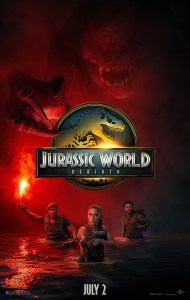
“Rebirth” might be a bit optimistic in that title. The issue with the still-quite-popular Jurassic Park/World franchise is an ongoing lesson in diminished returns. Back in 1993, Steven Spielberg and special effects breakthroughs enchanted audiences on the peril of man’s hubris and the core love and undying appeal of dinosaurs getting to be wrecking machines. Thanks to the marvels of modern big-budget blockbusters, we can bring realistic dinosaurs back to life for perilous adventures in survival, but much like the famous line, the producers eager to crank out a new Jurassic movie every so many years only focused on whether they could and not whether they should. The movies are still significant moneymakers; the worst film in the franchise, 2022’s Dominion, still made over a billion dollars at the global box-office. Just imagine how much that could have raked in if it was actually, you know, good. Jurassic World touched upon the nature of diminished returns through satire, that audiences that were once wowed by the very presence of real dinosaurs have grown bored and need more to capture their flagging interest. Since then we’ve had a movie about dinosaurs eating the rich in a haunted house-style horror-thriller and a nostalgic-heavy conclusion that was more about giant locusts and far less about dinosaurs cohabitating with mankind. The interesting storyline (man co-existing with dino) has been there for multiple movies, and yet the producers keep neglecting that glorious potential. Now here comes Jurassic World: Rebirth, another attempt to keep this franchise chugging along with more mediocre sequels that have fleeting moments of popcorn thrills. Ultimately, it’s a bit more of the same, and like the characters in this world, I too am growing restless.

There are two groups of characters that we follow. The first is a clandestine science team funded by a large pharmaceutical company looking to create the next big drug as a result of studying dinosaur blood and tissue. This is the familiar movie world of quippy security experts and ex-CIA agents and panicky scientists thrust into danger in the field. The other group is a family going on a sailing trip through… dinosaur-infested waters for some reason. The first group is on a mission. The second group is just trying to survive, and possibly for the teen daughter’s boyfriend to grow on her skeptical father.
Rather than reinvention, Rebirth is once again more of the same old same old. There can still be intrigue and spectacle from simply interacting with living dinosaurs brought to life by the best special effects money can buy, so the Jurassic movies will never be without some level of primal appeal. There are some fun moments and sequences throughout Rebirth, but it’s hard to stitch together the whole movie from these minor pieces. I think the premise could have worked. The team on the mission has to track down and retrieve blood from the three biggest dinosaurs by habitat: one by land, one by sea, and one by air. There’s some flimflam excuse that these creatures have the biggest hearts and therefore the live blood they extract blah blah, but it doesn’t really matter. The premise of having to track three of the biggest dinos in different terrains makes for an episodic but varied structure that is easy to follow and engage with. All along the way, we know what the total number needs to be and the progression provides mini-climaxes. It’s just that the retrieval of all of these is completed before Act Three. That’s right, it’s all done before the movie is supposed to get really climactic and intense. The land dino isn’t even a challenge, more just an attempt to recreate the majesty of when we first saw those plodding apatosaurs in 1993. This feels like a mistake, and each of the dino retrievals should be getting moderately harder to succeed. There should be escalation so that each one feels more like an accomplishment with the team getting better not worse.

So what could be Act Three? Well you see, dear reader, this is yet another new island. I can already hear you asking how many islands there are, and the answer is however many the studio needs. This island could have been nicknamed Monster Island because it was the dinosaur experimentation labs. Here’s where the InGen scientists threw darts at a board and said, “What if you mixed a [anything] with a raptor?” That seemed to be their go-to for these sequels. We’re introduced into mutant T-Rex in the opening, presented like a monster lurking in the shadows, and then we come back to our giant lab-designed monstrosity. Except this is the silliest looking dinosaur mutant. I laughed out loud when I saw its full form. It made me think of the xenomorph and human hybrids from Alien Resurrection. Its head is so bulbous like he’s part mushroom, but there’s no contours or anything menacing like spikes or something evolutionary useful. It’s just a big goofy head. This is the kind of dinosaur that would be made fun of by the other dinosaurs who snicker when his considerable back is turned. It has larger forearms but walks with them like a hunched gorilla. A T-Rex was already frightening because of its size, as evidenced during one of the movie’s better sequences where a normal T-Rex chases after the beleaguered family in a raft. This just made the T-Rex’s head comically oversized, like somebody glued a shower cap on this guy. This guy has a bigger head but it doesn’t mean bigger brain. It makes for a rather perfunctory and silly ending fighting against a disappointing dino Frankenstein. We shouldn’t have held our expectations too high considering this mutant’s lab breakout all stems from a lone Snickers candy wrapper getting loose.
The characters are also pretty disposable and strictly archetypal. Scarlett Johansson (Fly Me to the Moon) is the lead as our quippiest ex-CIA agent, more or less playing a version of her Marvel persona. She has a slight arc about joining the mission for the money and being convinced by the idealistic head scientist (Jonathan Bailey) to release the medical information to the entire planet. I don’t think this is as hopeful as the characters think because it seems like you’re also making it so plenty more mad scientists have access to dino DNA to make their own at-home Jurassic Parks. The other lead character is played by Mahershala Ali (Leave the World Behind) as the boat captain who provides the movie with the most disposable of characters so that the dinosaurs have something to feed upon. It doesn’t seem like a coincidence that the one lost family is gifted a dinosaur baby that they trot around like an adorable puppy. That thing’s going to get extremely big and I don’t know if anybody is going to be able to pick up after it. I wouldn’t say any of these characters are memorable or even that likeable, mostly stars coasting on charm autopilot.
I didn’t know where else to put this but I loathed every time the Jurassic Park musical themes would start to trinkle into a scene, especially since so many of them are perplexing. Why would you insert that familiar theme over this scene? It’s intrusive, tone deaf, and just a bizarre creative choice.

It’s hard to really see the added value of returning veteran screenwriter David Koepp (Black Bag) and new director Gareth Edwards (Godzilla, The Creator). This whole enterprise feels a bit like a runaway train rushing to meet its release date deadline. The development needed for a relaunch seems to go by the wayside so that we can squeeze in more set pieces, and I suppose two sets of characters equal always having a new and fraught action sequence we can jump to. It’s just that everything feels so rote and familiar, so much of the same kinds of thrills and chills we’ve gotten from the previous six movies. The most exciting development across these new movies since 2018 has been the reality of humans having to adapt to an Earth with dinosaurs in our ecosystems, and yet this again is hand-waved away in exposition that limits the dinosaurs to a much smaller band of the Earth. Turns out they only really live around the Equator now. Okay, if that’s the case, then tell me a story from that setting. It can still be done. Jurassic Park: Rebirth doesn’t feel like the start of something new or exciting or even promising. It feels like more of the same, sliced and cut up with different actors getting their turn to make frightened faces. It’s not as bad in design or execution as Dominion but Rebirth is no more than more of the same.
Nate’s Grade: C
Share this:

Rebel Moon: Director’s Cut (2024)
 What a rarity for a movie to potentially appear twice on my worst of the year list, and such is the destiny of Zack Snyder’s Rebel Moon, originally released in 2023 and the first half of 2024, and now with added lengthier director’s cuts. So what do you get in the newest “Snyder cuts” besides fewer hours in your day? Let’s tackle the opening sequence demonstrating the power and villainy of our evil empire as they invade a crumbling city in resistance. Within short order we’ve witnessed: 1) female priestesses being forcefully disrobed and having their breasts branded, 2) an adorable little CGI pet become a literal suicide bomber, 3) a son brutally beating his father’s brains out of his skull to spare their family only for them all to be massacred anyway. Yikes. While there is a little more world-building absent from Snyder’s prior cuts, like a religious sect that turns the teeth of their conquered victims into a decorative washboard, even the extra time, and it is literally hours over the course of the two parts, feels strained and still poorly developed to better understand the world, the characters, the conflict, the history, anything that could make Snyder’s hopeful franchise its own universe. Theres now a giant metal goddess whose tears fuel space travel. All right then. One of the more interesting characters, the samurai-esque loner robot, is given more material but he’s still just as inscrutable. There’s plenty more cruelty here, slow-motion head shots painting the screen in sticky viscera. There’s also plenty more breathless and awkwardly extended sex scenes, but hey, at least those are consensual, so there’s that. I’m just stunned why Netflix would want different versions of these movies when they’re ultimately all housed under the same banner. It sure feels like the “Snyder cut” brand is now an expected marketing ploy to be exploited for added publicity. After all, why watch one long slightly bloody poorly written sci-fi space opera, when you could watch TWO versions, one of which being even bloodier and more miserable? Will there be an even Snyderier Snyder cut, adding more scenes of side characters suffering and even more festishized gore in even slower motion? Will the whole movie just be played in slow motion, now requiring nine hours? Where does it even end, Netflix?
Nate’s Grade: D
Share this:

Rebel Moon – Part Two: The Scargiver (2024)
 Back in December, Zack Snyder offered his very Snyder-y holiday take on big-budget space operas with Rebel Moon, a project that began as his Star Wars pitch that was turned down. It was what you would expect from a Snyder movie: big, loud, silly yet played completely serious, and drained of all vibrant color. Rebel Moon Part One was on my worst of 2023 list and I felt was a waste of two hours. I was not looking forward to the concluding Part Two. I was worried it would be two more hours of the same, and now having seen Part Two, a.k.a. The Scargiver, the edgy nickname of our lead rebel Kora (Sofia Boutella) fighting the good fight against the Evil Empire, I can now say that the Rebel Moon duology is now a dreary waste of four of your waking hours.
Saying Scargiver might be minimally better than Child of Fire (did you remember that was the subtitle for Part One? Don’t lie to me, dear reader, you know you didn’t) is a nominal victory. There’s more action and a clearer sense of climax, with our underdogs planning their guerrilla war against the overpowering forces approaching (we’re basically watching the training of a Vietcong-like insurgency) and then pulling off their unexpected victory. The problem is that we’re still stuck with all the same characters from Part One, few of which will prove to be emotionally engaging or intriguing. We’ve assembled our fighting force thanks to the events of Part One, but far too many of them are interchangeable and punishingly free of personality besides the default character creation setting of “stoic badass.” There’s one lady who has laser swords so at least that sets her apart. When it comes to attitude, personality, perspective, and even skill level, these characters are awash, which makes the action falter when it comes to any sort of meaningful emotional involvement. The bare bones story is so plain with broadly drawn good versus evil characters from its obvious cultural influences. The fact that it’s derivative is not itself a major fault, it’s the fact that it does so little with these familiar pieces that the movie feels like it’s trying to skate by on your familiarity. After four hours, it’s clear to me that Snyder and his co-writers composed this not as a living, breathing universe with its own lore and history and intrigue, but as a story where he could have used the Star Wars universe to fill in the gaps.
 Snyder can be a first-class visual stylist but his sense of fluid and engaging action stops at “cool images,” like living splash pages from comic books. Like Part One, there is no sense of weight to these action sequences. Things are just happening, and then in the next shot things are just happening. Occasionally there will be a sliver of relation, but whether it’s 60 minutes or 6 minutes, the effect is still the same. The action feels like it’s all happening in a vacuum, and the momentum we feel the upstarts are gaining is hampered. We went through the trouble of explaining their counter-offensives, so why does so much of it feel like it’s just watching a jumbled, ashen group of characters fire guns? This is best epitomized by Jimmy the robot (voiced by Anthony Hopkins) who has gone rogue from his programming and sits out much of the action for reasons entirely unknown. Then he arrives, takes down a few evil tanks, and I guess decides to sit back out. If this is our fighting force, what exactly has it amounted to? This makes the entire movie, and its predecessor, a frustrating viewing even for forgiving action fans. Things blow up good, and there are a few impressive visual orchestrations, but it’s so fleeting and slim.
Over the course of two two-hour movies, totaling four hours, with the promise (threat?) of more, it’s clear that what we really had here was perhaps one underdeveloped movie at best that has been unfortunately spread out over two (and counting) movies of time. Part One was entirely about assembling the team of rugged defenders, and this could have served as the first 45 minutes of the overall movie, with the events of Part Two filling in the rest. With Scargiver, the defenders don’t even start training the villagers until 40 minutes into the movie and the big battle doesn’t kick in until a full hour. Structurally, this doesn’t feel like we’re using our time wisely, and this is best evidenced by the fact that after AN ENTIRE MOVIE of character back-story, Snyder still stops the action to have his characters sit around and share their sad back-stories. Did these characters just not talk at all to each other after initially gathering person-by-person? Tarak (Staz Nair) still hasn’t put a shirt on. I felt like yelling at my TV as the character took turns, and another 15 minutes, for each member to share their tortured back-story again but with different visuals. I was almost worried that right before the battle another character would say, “Wait, before it all really goes down, I need to share, yet again, more of my back-story.” It’s not like these extra glimpses give us new understanding or even meaningfully differentiate their characters; they’re all just victims of an abusive space government that imposes its terrible will most forcefully.
 There is one tragic back-story that does separate itself from the pack, notably because it literally separates itself from the pack and is told well before our group share. Kora explains her part in the assassination of the royal family, securing the military coup that left the Evil Empire extra evil, and I guess the guy named Balisarius as supreme leader (oh how this man must have been teased for his name as a schoolchild, which might be his own tragic back-story that we’ll get three helpings of with an eventual Part Three). This betrayal is personal and stands out, with Kora being the one to shoot the little princess, a girl who, in her dying breath, says she forgives Kora. That’s rough. This is actually a good sequence from a character standpoint as it establishes Kora’s accountability and guilt convincingly. However, Snyder makes some baffling creative choices that blunt the impact of this sequence. During the assassination, the musical score favors a string quartet, which is an emotionally plaintive choice. However, the music is actually diegetic to the scene, meaning it’s coming live from the room. There is literally a string quartet of musicians playing in the room while the royal family is betrayed and slaughtered. These guys are really dedicated to their art to keep playing throughout, and I assume they must also be part of the conspiracy or else big bad Balisarus (snicker) would kill them too. You might as well have them also start stabbing the royal family with their bows. It’s details like this that trip up Snyder, a man beholden to images and ideas but lacking the finesse to make them work.
An issue I had with this conflict was the disparity in scale between the forces, mainly my nagging question of why put together a ragtag group of space adventurers to defend this town if the Evil Empire could just nuke the planet from space? Well Snyder attempts to answer this early with Part Two, and the answer appears to be… grain. This community theorizes that the empire needs their grain yield so badly that they wouldn’t do anything to damage it, so their plan is to harvest all their wheat, turn it into grain, and then use the grain like human shields, hiding behind the valuable resource as cover and distributing it across the village. This is beyond silly. First, this isn’t like an entire planet harvesting grain, it’s one little village on the outskirts. It’s not like we’ve seen a giant warehouse that goes for miles and miles stockpiled with thousands if not millions of deposits of this food. Also, we’re talking grain here (stay tuned for my exclusive Rebel Moon-related podcast called “Talkin’ Grain”). It’s not like we’re talking about some super rare mineral or substance that is only found on this one planet, something linked toward like the power source for an ultimate weapon or space travel. We’re talking about grain here. Grain. You think this Evil Empire won’t nuke the planet because they’re worried they won’t get enough grain, the same crop that can be harvested on multitudes of other planets? How about they just kill everyone and then repopulate the planet with robots to harvest the precious grain? Or how about this simple village make some upgrades as we’re in a future world with space travel and artificial intelligence but people are still harvesting wheat by hand like they’re the Amish. Regardless, I hope you love slow-mo montages of grain harvesting because that’s what you’re getting for the first 40 minutes, as if Snyder is rubbing your face in his silly non-answer.
 In the conclusion to Rebel Moon Part Two, once the dust has settled, and long since that grain has been harvested, the last five minutes sets up a would-be Part Three, informing us that an unresolved storyline is next up on the docket. The characters gang up for their next adventure, and you’re expected to be chomping at the bit for this continuation. I openly sighed. Every movie feels like a tease for the next adventure, and it seems to promise that this one will be the real one you’ve been waiting for, but it feels like franchise bait-and-switch. It’s more than incomplete or lazy storytelling, it’s a scheme to leverage interest in a world and series that deserves little. The universe of Rebel Moon is not interesting. The characters of Rebel Moon are not interesting. The visuals of Rebel Moon are fine, though some of the costume choices again can rip you right out of the reality of this universe (a guy fighting in blue jean overalls?!). In short, not enough has been established, developed, or even paid off to make Rebel Moon an interesting and satisfying movie, let alone two, let alone three, let alone however many Snyder wants to leech out of Netflix. I would say Part Two is better because at least it provides an ending but it doesn’t even do that, merely an intentional passing of the baton to the next movie, and round and round we go. Rebel Moon is a living poster stretched to its breaking point. Leave this shallow universe behind.
Nate’s Grade: C-
Share this:

Rebel Moon – Part One: A Child of Fire (2023)
 Creating an original sci-fi/fantasy universe is hard work. It involves bringing to life an entire new universe of characters, worlds, back-stories, rules, conflicts, cultures, and classes. There’s a reason major studios look to scoop already established creative universes rather than build their own from scratch. This is what director Zack Snyder had in mind when he pitched a darker, grittier, more mature Star Wars to Disney, who passed. Over the ensuing decade, Snyder and his collaborators, Shay Hatten and Kurt Johnstad, continued working on their concept, transforming it into an original movie series, resulting in Netflix’s big-budget holiday release, Rebel Moon – Part One: A Child of Fire, a clunky title I will not be retyping in full again. Snyder’s original results of the “darker, grittier Star Wars” are rather underwhelming and don’t make me excited for the concluding second movie being released in April. Why go to the trouble of building your own universe if you don’t want to fill in the details about what makes it important or at least even unique? I can see why Snyder would have preferred Rebel Moon as a Star Wars pitch, because they could attach all the established world-building from George Lucas and his creative collaborators as a quick cheat code.
In another galaxy, the imperial Motherworld is the power in the universe. The king and his family have been assassinated, and in the power struggle that follows, several planets have taken up arms to fight for independence. On a distant moon, Kora (Sofia Boutella) is doing her best to live a nondescript life as a farmer, helping to provide for her community and stay out of trouble. Well trouble comes knockin’ anyway with Admiral Atticus Noble (Ed Skrein) and his fleet looking for resources and powerless villagers to abuse. Kora’s history of violence comes back to her as she fights back against the Motherworld soldiers with cool precision. Her only hope is to gather a team of the most formidable warriors to protect her village from reprisals. Kora and company band together while her mysterious past will come back to haunt her reluctant return to prominence.
 For the first thirty to forty minutes of Rebel Moon, I was nodding along and enjoying it well enough, at least enough to start to wonder if the tsunami of negative reviews had been unfairly harsh, and then the rest of the movie went downhill. One of the major problems of this Part One of a story is that it feels like a movie entirely made up of Act Two plotting. Once our hero sets off on her mission, the movie becomes a broken carousel of meeting the next member of the team, seeing them do something impressive as a fighter, getting some info dump about their mediocre tragic backstory, and then we’re off to the next planet to repeat the process. After the fifth time, when a character says, “Anyone else you know?” I thought that the rest of the movie, and the ensuring Part Two, would be nothing but recruiting members until every character in the galaxy had joined these ragtag revolutionaries, like it was all one elaborate practical joke by Snyder. Some part of me may still be watching Rebel Moon, my eyes glazing over while we add the eight hundred and sixty-sixth person who is strong but also shoots guns real good. Then the movie manufactures an ending that isn’t really an ending, merely a pause point, but without any larger revelations or escalations to further our anticipation for Part Two in four months’ time. What good are these handful of warriors going to be defending a village in a sci-fi universe where the bad guys could just nuke the planet from orbit? Find out in April 2024, folks!
The entire 124-minute enterprise feels not just like an incomplete movie but an incomplete idea. This is because the influences are obvious and copious for Snyder. Rebel Moon starts feeling entirely like Star Wars, but then it very much becomes a space opera version of The Magnificent Seven, itself a remake of Akira Kurosawa’s Seven Samurai. With our humble farmer, our high plains drifter trying to turn their back on an old life of violence, and the recruitment of our noble fighters to ward off the evil bandits coming to harass this small outpost, it’s clearly The Magnificent Seven, except Snyder doesn’t provide us the necessary material to invest in this scrappy team. The characters are all different variations of the same stoic badass archetype, like you took one character mold and simply sliced it into ten little shear pieces. The characters don’t even have the most basic difference you could offer in an action movie, variation in skill and weapons. One lady has laser swords (a.k.a. lens flair makers) but pretty much everyone else is just the same heavy gun fighter. One guy doesn’t even bother to put on a shirt. Some of them are slightly bigger or more slender than others but the whole get-the-gang-together plot only really works if we have interesting characters. If we don’t like the prospective team members, it’s like we’re stuck in an endless job interview with only lousy candidates.
 The fact that Rebel Moon is derivative is not in itself damaging. Science fiction is often the sum of its many earlier influences, including Star Wars. Rebel Moon cannot transcend its many film influences because it fails to reform them into something coherent of its own. There is no internal logic or connection within this new universe. The original world building amounts to a slain royal family, an evil fascist regime, and maybe a magic princess connected to a prophecy of balance, and that’s it. All the flashbacks and expository data dumps fail to create a clearer, larger picture of how this sci-fi universe operates. The inner workings are kept so broad and abstract. We have an imperial evil and assorted good-hearted little guys. The movie begins by introducing a robot clan of knights that are dying out, and even a young Motherworld soldier who seems likely to defect, both opportunities to go into greater character detail and open up this world and its complications. So what does Snyder do? He leaves both behind shortly. Even though we visit a half dozen planets, these alien worlds don’t feel connected, as if Snyder just told concept artists to follow whatever whim they had. They don’t even feel that interesting as places. One of them is desert. One of them has a saloon. One of them is a mining planet. It’s like the worlds have been procedurally generated from a computer for all we learn about them. They’re just glorified painted backdrops that don’t compliment the already shaky world building. They’re too interchangeable for all the impact on the plot and characters and any declining sense of wonder.
Given the open parameters of imagination with inventing your own sci-fi/fantasy universe, I am deeply confused by some of the choices that Snyder makes that visually weigh down this movie in anachronistic acts of self-sabotage. Firstly, the villains are clearly meant to be a one-to-one obvious analog for the Empire in Star Wars, itself an analog for the fascists of World War II, but Lucas decided having them as stand-ins was good enough without literally having them dress in the same style of uniforms as the literal fascists from World War II. You have an interconnected galaxy of future alien cultures and the bad guys dress like they stepped out of The Man in the High Castle. It’s too familiar while being too specific, and the fact that it’s also completely transparent with its iconic source references is yet another failure of imagination and subtext. I just accepted that the Space Nazis were going to look like literal Nazis, but what broke my brain was the costuming of Skrein’s big baddie in the second half of the movie. At some point he changes into a white dress shirt with a long thin black tie and all I could think about was that our space opera villain looks like one of those door-to-door Mormon missionaries (“Hello, have you heard the Good Word of [whatever Snyder is calling The Force in this universe]?”). Every scene with this outfit ripped me out of the movie; it was like someone had photo-shopped a character from a different movie. It certainly didn’t make the devious character of Atticus Noble more threatening or even interesting. I view this entire creative decision as a microcosm for Rebel Moon: a confused fusion of the literal, the derivative, and the dissonant.
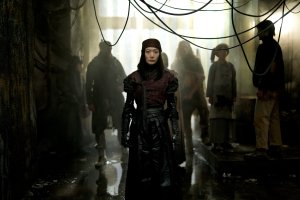 Snyder is still a premiere visual stylist so even at its worst Rebel Moon can still be an arresting watch. He’s one of the best at realizing the awe of selecting the right combination of images, a man who creates living comic book splash pages. I realized midway through Rebel Moon why the action just wasn’t as exciting for me. There’s a decided lack of weight. It’s not just that scenes don’t feel well choreographed or developed to make use of geography, mini-goals, and organic complications, the hallmarks of great action, it’s that too little feels concrete. It feels too phony. I’m not condemning the special effects, which are mostly fine. The action amounts to Character A shoots at Bad Guy and Character B shoots at Other Bad Guy, maybe behind some cover. There’s only one sequence that brings in specifics to its action, with the challenge of defeating a rotating turret gun pinning the team down from escape. That sequence established a specific obstacle and stakes. It worked, and it presented one of the only challenges that wasn’t immediately overcome by our heroes.
The Snyder action signature of slow-mo ramps has long ago entered into self-parody territory (I’m convinced a full hour of his four-hour Justice League cut was slow motion), so its use has to be even more self-aware here, especially in quizzical contexts. There are moments where it accentuates the visceral appeal of the vivid imagery, like a man leaping atop the back of a flying griffin, akin to an 80s metal album cover come to life. Then there are other times that just leave you questioning why Snyder decided to slow things down… for this? One such example is where a spaceship enters the atmosphere in the first twenty minutes, and a character drops their seeds in alarm, and those seeds falling are detailed in loving slow motion. Why show a character’s face to impart an emotion when you can instead see things falling onto the ground so dramatically?
 The actors are given little to do other than strike poses and attitudes, and for that they all do a fine job of making themselves available for stills and posters and trailers. Boutella (The Mummy) is good at being a stoic badass. I just wish there was something memorable for her to do or make use of her athleticism. The best actor in the movie is Skrein (Deadpool) who really relishes being a smarmy villain. He’s not an interesting bad guy but Skrein at least makes him worth watching even when he’s in the most ridiculous outfit and awful Hitler youth haircut. There’s also Jena Malone (Sucker Punch) as a widowed spider-woman creature. So there’s that. Cleopatra Coleman (Dopesick), who plays one half of a revolutionary set of siblings along with Ray Fisher, sounds remarkably like Jennifer Garner. Close your eyes when she’s speaking, dear reader, and test for yourself. I was most interested in Anthony Hopkins as the voice of our malfunctioning android (literally named “Jimmy the Robot”) operating on mysterious programming that hints at something larger in place relating to perhaps the princess being alive. Fun fact: Rebel Moon features both actors who played the role of Daario on Game of Thrones (Skrien and Michiel Husiman).
Even with all the money at Netflix’s mighty disposal, Rebel Moon can’t make up for its paltry imagination and thus feels like an empty enterprise. I’m reminded of 2011’s Sucker Punch, the last time Snyder was left completely to his own devices. I wrote back then, “Expect nothing more than top-of-the-line eye candy. Expect nothing to make sense. Expect nothing to really matter. In fact, go in expecting nothing but a two-hour ogling session, because that’s the aim of the film. Look at all those shiny things and pretty ladies, gentlemen.” That assessment seems fitting for Rebel Moon as well, a movie that can’t be bothered to provide compelling characters, drama, or world-building to invest in over two to four hours, once you consider the approaching Part Two. I wish this movie had a more distinct vision and sense of humor, something akin to Luc Besson’s lively Fifth Element, but fun is not allowed in the Zack Snyder universe, so everything must be grim, because grim means mature, and mature means automatically better, right? Rebel Moon is a space opera where you’ll prefer the void.
Nate’s Grade: C-
Share this:

Alita: Battle Angel (2019)
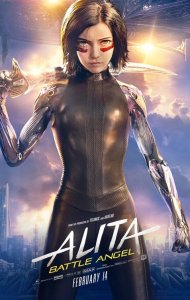 James Cameron has been dreaming about making Alita: Battle Angel for decades. He bought the rights to the 90s manga and has been sitting on the property, having to continuously push it back because of technological demands and the demands of, at last count, a thousand Avatar sequels. Cameron co-wrote the screenplay and handed the directorial duties over to Robert Rodriguez (Sin City), a talented visual stylist who has been struggling of late. The marriage looks good and the final 122-minute feature is the closest a live-action film has ever gotten into replicating the look and feel of an anime, for better and worse.
Hundreds of years after the fall of civilization, a lonely scrapper and doctor, Dr. Ido (Christoph Waltz) discovers the remains of a cyborg with a still beating heart. He puts her back together with a new body and names her Alita (Rosa Salazar). She’s special and learning about the big new world, trying to unlock her memories of the past, and we’re talking way way back into the past. She’s old technology, something that’s quite valuable for the street gangs that strip amputees for parts and for the global corporation whose emissary (Mahershala Ali) needs to reclaim the powerful tech. Alita falls in love, learns about her sense of humanity, and fights lots and lots of robotic villains.
This visual decadence of Battle Angel is the greatest reason to see it, especially on the big screen if able. The future setting is immediately visually engaging, with people walking around with mechanical limbs that look like they were literally cobbled together with whatever junk was lying around. There is a have/have not dichotomy between the huddled masses trying to eek out a living in a garbage city and the floating metropolis above that regularly dumps its trash onto the people below. It’s easy to see the influences of Battle Angel in other media, like Elysium, as well as its own cyberpunk influences, from the likes of Blade Runner to recycling the chief sport of Rollerball. The character design is to die for in this movie, with exceptionally assembled figures that stand out in memorable, dangerous, sometimes junky ways. There are a number of different robotic killers with colorful and unique weapons and personalities, and the larger world invites further scrutiny. There is a bustling post-apocalyptic life here and it’s plastered on a splashy, broad visual canvas with some spectacular special effects. Not all of the effects are at the highest level, from some compositing issues with faces to the big anime eyes (more on that later), but Battle Angel is an expensive movie that puts it all onscreen. The world is fun to watch and the action sequences feel ripped directly from the manga, with larger-than-life creatures fighting in vicious and frenetic ways. Even when the movie feels like it’s losing its momentum there’s always the visuals to enjoy.
 The central idea of this post-apocalyptic junk town being populated with deadly bounty hunters who work for a mysterious conspiracy is a great starting point. There is a bevy of killers with different allegiances and different codes, and then you throw in a powerful new addition who doesn’t remember her hidden past and you’ve got a recipe for drama and conflict with some crazy characters. There are even little dark touches that I would have thought would have been clipped in the adaptation process. Battle Angel has so much going for it that it can get a little frustrating when it feels like it’s spending so long to stay in the same place. The plot revelations are fairly predictable but still effective, but the long delays between them are filled with numerous action set pieces that diminish a sense of progression. I liked the Alita character and her relationship with her surrogate human father, but I didn’t think enough of any other relationship she had in the film. I wasn’t that invested in uncovering her past, which was still a bit too vague for me as a non-reader of the source material. At the end of the story, Rodriguez has set up his audience for a continuing saga of strife that feels too incomplete. Alita has learned more about herself (though I’m still confused) and has a goal of vengeance (against a force that is left too vague) and a renewed sense of purpose (built upon a relationship that doesn’t feel that affecting). It’s a curious end point and a questionable decision for a movie this expensive to assume it would secure demand for a presumptive sequel.
Where Battle Angel began losing me was because its title character, Alita, became too overpowered for her own good, eliminating a sense of stakes early on. The battle calculus skewed far too quickly. After the first act, actually from her first fight onward, there is never any doubt whether Alita will triumph. She doesn’t undergo any training or any real learning curve when it comes to her superhuman defense. Right from the get-go she’s doing amazing acts of fight choreography and making it all look easy. She even defeats an enemy when she’s only a one-armed torso. That’s admittedly impressive but another indicator that there is no real threat that can be posed against her. No matter how huge the cyborg, or how many pointy appendages at their disposal, it’s only a matter of time before our little pint-sized warrior is eventually triumphant. There is really only one fight where she’s presented with any slight disadvantage, the aforementioned one-armed torso sequence, but this too is shortly rectified. She goes from having a nigh-invincible body to an even more nigh-invincible body, making her, you guessed it, even more powerful. This reality takes something away from the numerous cyborg-on-cyborg battles, and without greater variance on the scene-to-scene needs, the fights become somewhat stale. Visually they are still impressive with a sense of fun watching the manga pages come to startling life, but without stakes and variance, it’s all the same punches with less power.
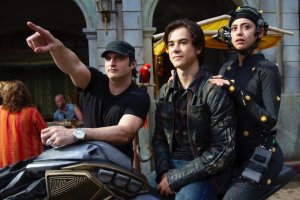 Now Battle Angel isn’t the only story to deal with an overwhelmingly powerful protagonist (see: Neo, Superman, just about every character on Dragonball). The solution is usually a specifically applied weakness or, most often, the vulnerability of those closest to the hero. It’s the regular people that can be gotten to, that can be endangered, that approximate the “weakness” for the overpowered protagonist. However, for this to work, you need an emotional connection to the characters in order to feel their potential loss. This cannot work if the characters are stuck in archetypal mode and add little help. That’s the problem with Battle Angel; I didn’t really care about any of the other characters. They had points of interest, a tragic shared back-story, a dream to escape their earthbound poverty, some secrets they don’t want getting out, but it’s never enough to make them feel that much more refined than the secondary background players. The film doesn’t even go the route of really threatening the more vulnerable people in Alita’s life, which is a strange miscalculation. What we’re left with is a very kickass robot woman doing her thing and taking down the big bad cyborgs. It’s entertaining and there’s enough of an interest in bullies being beaten by the underdog, but Alita isn’t really the underdog and so the many action sequences become a tad tedious.
Salazar (The Maze Runner: The Death Cure) gives an expressive performance and enables her superhuman cyborg to find a semblance of her humanity. Because of the character design the degree of performance capture relies much on the micro expressions of Salazar, so if she overdoes it then Alita can lose that tenuous sense of reality. She finds a balance that makes her feel real, at least real enough to exist in this world. Waltz (Downsizing) is enjoyably paternal with a few dark secrets of his own. His rocket-powered pickax thingy falls under my category of something that’s futuristic but not exactly practical. This wouldn’t present much of a problem except his character is an expert at using the parts he can scrounge up to get the job done. Skrein (Deadpool) has found a real career for being sneering villains with oh-so punchable faces, and he succeeds yet again. Ali (Green Book) and Jennifer Connelly (Only the Brave) deliver enough with so little that you wish the screenplay asked more of them than the occasional in-shadows skulking. It’s interesting to look at this cast, which has four Oscars to their names (possibly another one for Ali), and an additional nominee with Jackie Earl Haley.
 Let’s talk about those eyes. The film is based upon a popular manga and anime and James Cameron was determined, from the earliest point, to recreate that stylized big-eyed look famous to Japanese art. It’s one thing on the page and another brought into real life, and the response has been all over the place. Some cite the uncanny valley and cringe while others argue it makes Alita more vulnerable, the eyes being the window to the soul and all. It does set her apart from the crowd, which is supposed to befit her character and where she came from, so to that end it works. It’s not as distracting as I feared and you do grow accustomed to them. However, was any of it necessary? Would we feel any different for Alita if she had more human-sized eyes? I doubt it. The costly effect of a very costly movie ($200 million reported) made me think of a similar quirk with the 2011 Green Lantern film where Ryan Reynolds’ suit was a CGI effect. Rather than simply wearing a costume the filmmakers spent millions applying one in post-production, and in the end what of value did it offer to the experience?
It’s hard for me to watch Alita: Battle Angel and understand why this was a property that James Cameron set aside for almost two decades. What about this makes it special or at least separates it from the pack of imitators? It’s a world with points of interest and characters that could be interesting, though many stop short at the design phase. The live-action version is entertaining and visually sumptuous, but I was finding myself grow tired of the film’s loose stakes, predictable plotting, simplistic themes, and archetypal characterization. The action can be pretty fun but even as Alita lines up more obstacles and more enemies we never feel threatened or concerned. Without a larger sense of danger and plot development the many fights start to grow monotonous. The special effects are wild but they service a story that seems ordinary genre. Alita: Battle Angel ought to please fans of the source material but it short-circuited for my attention.
Nate’s Grade: C+
Share this:

If Beale Street Could Talk (2018)
 Barry Jenkins’ follow-up from his Oscar-winning masterpiece Moonlight is an affecting adaptation of James Baldwin’s novel exploring a larger picture of the African-American experience through the life of one family under pressure. It’s a beautifully tender movie that aches with human feeling, tragic and joyous. We follow a young couple where Tish (Kiki Layne) is pregnant and Alonzo “Fonny” (Stephen James) is in jail for a crime he did not commit. Jenkins jumps around in time, providing mirrored juxtapositions that enliven the emotional outpouring of the scenes on screen, adding a sense of dread at the hardships we know await and a extra compassion for the good times while they last. Regina King is so outstanding as Tish’s mother, who goes out of her way to gather evidence to free Alonzo, that I wished she had more to do than her handful of big Oscar moments. There’s a racist cop that comes into the picture and is easily sidelined again. Many moments follow this lyrical, free-floating structure, zipping from one memory to another, which nicely presents a fuller picture with less. However, it also makes the film feel like it doesn’t fully come together by its very end and whether all of the assorted moments and insights are as helpful. It presents a case study of criminal justice reform and reminder that this family is only but one example. The intimate cinematography is gorgeous and the use of color is spellbinding. The music by Nicholas Britell is also highly involving without being overbearing. If Beale Street Could Talk might not have the awe-inspiring power and artistry of Moonlight, but it’s a moving, compassionate, and beautiful movie that confirms Jenkins as one of the greats.
Nate’s Grade: B+
Share this:

Deadpool (2016)
 Deadpool is easily the most fan service of comic characters, so it makes sense that his big screen spotlight is a movie that feels a fan service movie. The “merc with a mouth” is a character that doesn’t take himself seriously and neither does his big screen adventure, which is the biggest appeal of an otherwise standard super hero formula hiding under waves of winking irony, crass humor, and gleefully bloody violent mayhem. Ryan Reynolds plays Wade Wilson, a hired gun that undergoes a risky experimental treatment by a shady black ops organization to cure his terminal illness. It makes him generally indestructible with a rapid healing ability but his flesh is also horribly scarred and Wade is afraid his girlfriend Vanessa (Morena Baccarin), a hooker with a heart of gold, will reject him. Even in the opening credits, you know this isn’t going to be a typical super hero movie. The time is ripe for a film that knowingly ridicules the tropes of the super hero film industry, and Deadpool scores some big laughs when its making fun of itself and its super peers. The dark humor can often surprise with how go-for-broke it can get, like Wade and his Vanessa’s flirty one-upsmanship of hypothetical sexual trauma. There’s a clever montage of Wade and Vanessa’s romantic history told through sexually-specific holiday celebrations, and the inclusion of a couple of low-rent X-Men provides a comic foil for Deadpool to bounce off from. The action is fun and the movie is entertaining from its opening credits to the now-mandatory post-credits bonus. Reynolds is spiritually attuned with the irreverence of the anti-hero, finally plugging into a part that makes full use of his charm, motor mouth, and physicality. Deadpool’s runaway box-office success (grossing more than any X-Men film and on at least half the budget) will hopefully allow Hollywood to feel comfortable allowing their less than family-friendly comic titles to stay true to their intentions. Then again maybe they’ll just take all the wrong messages and think that audiences just want to hear more swearing from people in spandex. Deadpool is a super hero movie that prioritizes fun over everything else, and while it may not be for everyone, at least it’s trying to be for someone different.
Nate’s Grade: B


 nathanzoebl
You must be logged in to post a comment.