Blog Archives
The Strangers: Chapter 1 (2024)
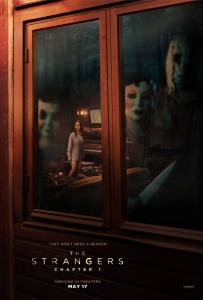 The most terrifying part of The Strangers: Chapter 1 is during its closing seconds, as text appears to inform all of us woeful viewers: “To be continued.” Oh no. Chapter 1 is intended to be the first in a new trilogy bringing back the essential concept of the 2008 home invasion thriller, that the masked attackers have no agenda, no motivation, and are being sadistic silent tormentors just because. The explanation, “Because you were home,” was a key revelation to the original, and here this famous line gets re-worked and has the same clumsy impact as Madame Web trying to reword that Spider-Man oath (“When you take on the responsibility, great power will come“). Not that the dialogue is the strong point of this thriller, with clunky expositional lines as nakedly transparent like, “Today is the third day of our three-day road trip around the country,” followed by, “Or our five-year anniversary.” It’s in the annoying, “Yeah I work here too” kind of lazy exposition. But you’re here for the scares, of which Chapter 1 has precious few because I think these are the most unimpressive and lackadaisical home invaders I’ve ever seen. I think the Wet Bandits might give these goons a run for their money (I’d watch Kevin take on The Strangers). Much of the movie is spent waiting, or checking places around the cabin, sometimes while one intruder plays the piano for ambience. One could make an argument they’re toying with their prey, but I would counter that I just don’t think they’re good at their whole enterprise. It doesn’t help that the main couple are so boring and undeveloped and I found it hard to fear for their well-being. As far as memorable scares or set-pieces or ingenious obstacles or overcoming said obstacles, it’s a big miss on all counts. A home invasion scenario can be exciting and terrifying, and it can be delicious fun to turn the tables on the attackers. This movie has so little that even the core ideas feel stretched beyond their breaking point. It’s hard to even feel much reverence for the original here, as The Strangers: Chapter 1 feels more like the steady, unrelenting squeezing of all IP for any possible drops of renewed audience interest. If this is what Chapter 1 has to offer, please spare us the rest. Fun fact: if you want to know what director Renny Harlin (Die Hard 2, Cliffhanger) has been doing lately, well here’s your underwhelming answer.
Nate’s Grade: D+
Share this:

Hit Man (2024)
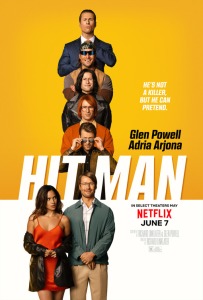
Hit Man is a movie that is wonderfully hard to describe. The premise has an easy-to-grasp hook that promises fun and hijinks, but where it goes from there takes on as many transformations as its protagonist, Gary Johnson (Glen Powell). It transforms from a fun game of undercover conning with wigs and silly accents into an unexpected rom-com hinging upon mistaken identity, maintaining assumed appearances, and secrets that then transforms into full film noir without losing its unique identity and the stakes of the character relationships. If you’d expect any filmmaker to pull off that trick, writer/director Richard Linklater has to be one of the best to keep things running smoothly, and that he does, as Hit Man is a crowd-pleasing comedy with some unexpected directions to keep everyone guessing until it lands on its own morally gray terms.
The movie is also, chiefly, a showcase of star and co-writer Powell, a handsome young actor hitting a new ascent of his career with last year’s Anyone But You and the upcoming Twisters. Powell is probably best known as the smirking guy you loved to hate in Top Gun: Maverick, but he’s also played memorable supporting roles in Scream Queens and three other Linklater film projects, notably 2016’s Everybody Wants Some!!, a pseudo-spiritual sequel to the seminal Dazed and Confused. This is Powell’s acting showcase and he’s utterly terrific. He has great infectious fun getting into the various hitman characters, which mostly exist in montages, and trying on different personas and voices. I cackled when he was doing his impression of Christian Bale’s Patrick Bateman, and I smiled throughout most of the other personas. It’s easy to see the network TV version of this premise, where every week Gary adopts a new persona and disguise to bust the next possible criminal from hiring a hitman, like an edgier Quantum Leap). The culprits are played like nitwits but then again the police are also played as nitwits (are there THIS many attempted hitman hirings in one city for the police to have a full-time unit?).

But before this acting experiment can get too broad or too redundant, Linklater and Powell switch things up. Around the Act One break is where Gary meets Madison (Adria Arjona), and that’s when everything changes for him and the audience. Now we have emotional stakes, because Gary intervenes to save Madison. While the circumstances of their first meeting involve her wanting to kill her husband and believing Gary as the professional to do such a job, the scene plays as a disarming first date you’d find in another charming romantic comedy, where it’s clear to anyone with a pulse that these two have something together. Instead of busting her for the solicitation, he pushes her to change her mind, take the money and leave her no-good husband rather than finding a questionable man to eliminate him. From there, they form a romantic relationship that fluctuates wildly. She thinks Gary is “Ron,” the suave and confidant persona Gary adopted for their sit-down. So the nerdy tech nerd who teaches philosophy must pretend to be the daring and dangerous man of mystery he wishes he could be. The script doesn’t get carried away with its farcical elements in play, juggling multiple identities for multiple specific audiences, but it asks the question, “Why can’t the milquetoast Gary simply be Ron? Is this an unexpected means of self-actualization for the nerd to win the girl?” Through this extreme exercise, Gary can mold himself into the man he would like to be. The rom-com is flirty, funny, and just as enjoyable as the earlier wacky comedy of being a versatile master of disguise.
It also really helps things when your two lead actors have such strong chemistry. Powell and Arjona (Father of the Bride, Andor) are smoldering together, like full on “get a room already” territory. This lends even more credence when Hit Man makes its next transformation into film noir thriller. I won’t divulge the specific plot elements but it all works with what Linklater has already established. There’s trouble for the both of them, and the question becomes how far is each participant willing to go to stay above the fray. The transition from silly costume comedy to sundry noir thriller is handled so naturally, as if the characters, already existing under such unique circumstances, found themselves in the elevated movie-movie version of their crazy relationship. Rather than feel contrived, Linklater and Powell have put in the work to make these twists and turns credible and exciting. The shifting nature of the movie is a wonderful reflection of its fake hitman hero. There’s a scene late in the film, where all of our principal players have come together, and you have characters saying one thing, intimating another, for different versions of different audiences, and it’s such a masterful tonal dance that feels satisfying as a climactic turning point as well as genuinely impressive for all the myriad subtext in play.

This is a clear-cut case of a movie being “inspired by” a true story rather than being “based on” a true story. Generally, we expect the “based on” stories to have some voracity to reality. We accept that there will be alterations for dramatic purposes, externalizing the internal, condensing timelines and characters into a more accessible structure, etc. If you go to a movie about Jackie Robinson, you don’t expect to see the famous baseball slugger fighting space monsters (“Racism was the real giant monster all along”). Hit Man is based upon a 2001 long-form news article by Texas Monthly journalist Skip Hollandsworth, the same author of the source material for Linklater’s fascinating true crime dark comedy gem, 2011’s Bernie, which I highly recommend (a career-best Jack Black). The real Gary Johnson really did pose as a fake hitman for the purposes of catching real criminals, but the rest of the movie exists in its own fictional universe of dramatic complications. Usually we want our film stories to have more fidelity with the truth and reality, but I’m glad Linklater and Powell recognized the sheer storytelling potential of this quirky premise. Sticking to the facts could have told an amusing story, but feeling confident to take bold leaps with well-worn genre motifs, when called for, is the right call for making the most of this tale.
The shame of Hit Man is how quickly it will likely be subsumed by Netflix’s suffocating tidal waves of content. Here is a fun, likable, and surprising indie comedy with definite mass appeal buoyed by great performances, clever writing, and a tonally shifting narrative to keep things fresh. Powell gets the breakout showcase he deserves and we get one of the most unexpected and amusing rom-coms of recent years. Hit Man is a movie that deserves to be seen, to be enjoyed with a crowd, but I worry it will get lost in the shuffle of streaming titles. I suppose this might just be the current reality for fans of mid-level adult dramas and comedies. At least they have a home on the streaming networks even if these movies would have been theatrical breakouts years ago. Regardless, Hit Man is a good time with good people pretending to be bad, or is it bad people pretending to be good, but whatever pretense, it’s a charming winner worth your two hours.
Nate’s Grade: B+
Share this:

The Last Stop in Yuma County (2024)

As a general rule of thumb, if some movie is described as “Coen-esque,” I must watch it. The Last Stop in Yuma County is a blend of Coen darkly comic malevolence, as well as Tarantino’s knack for the menace of dramatic irony and boiling tension waiting to explode, and it’s a firecracker of a debut for writer/director Francis Gallupi. It’s a relatively contained tale, sticking mostly to one rustic roadside diner and gas station along the dusty Arizona byways. On this day, two of its patrons happen to be recent bank robbers on the run, and they’re holding the other diner patrons captive until the gas pumps get fixed to fuel up and escape. The first hour then becomes a dread-filled game of waiting for things to go very badly. Our two main characters, a traveling knife salesman (Jim Cummings) and a waitress (Joceline Donahue) who happens to be the wife of the town sheriff, are working together to try and elicit help without endangering their lives, all the time more people keep entering the diner and inadvertently joining the simmering hostage situation. The way Gallupi writes his different characters is sharp and efficient, and the dread compounds in such organic complications, showing how fiendishly well-developed he’s made his potboiler. It also has a clear eye for style. Around the Act Two break, the movie becomes something else, which it intimated through a very specific film reference in conjunction with a specific character reference. It still proves compelling, but the overall sense of darkness and tragedy wore me down a little by the end. By the conclusion of its 90 minutes, I was hearing the saintly voice of Marge Gunderson in my head, shaking her head at the preventable body count and bad choices (“And all for a little bit of money. There’s more to life than money, don’cha know?”). The Last Stop in Yuma County is a twisty and twisted little macabre morality play in the guise of familiar Coen-esque capers. Welcome to the big leagues, Gallupi.
Nate’s Grade: B+
Share this:

Atlas (2024)
 In the world of Netflix releases, it’s hard to judge what is gauged as a success. Take for instance their new sci-fi action movie Atlas. It cost the streaming giant $100 million and they now tout it as being the top movie across the globe on their platform. This could very well be true, though Netflix has long been cagey about sharing their viewing numbers, instead preferring to go with the, “Hey, just trust us, okay?” defense, which hasn’t exactly been reassuring in an era where bonuses are linked to number hits. With the ever-expanding catalog of titles, being a reported hit on Netflix can sometimes feel like being, say, Homecoming Queen from 1989, an accomplishment soon eclipsed and forgotten. What was the last big Netflix action movie that had cultural staying power, that caused people to continue to discuss weeks or months later? Netflix swears their most-watched movie is 2021’s Red Notice, a star-laden breezy adventure caper that I challenge anyone to remember much about besides its stars. This is the challenge of gaining traction in a world of near endless content choices. Atlas is an above average film benefiting from a strong character dynamic at its core even if the rest of its story elements feel forgettably disposable.
Atlas (Jennifer Lopez) is a data analyst who has also helped develop Earth’s orbital security system. An A.I. program/robot named Harlan (Simu Liu) was born from Atlas’ mother, and then Harlan went and murdered millions of humans. The killer robot fled Earth with his robotic followers and Earth has been awaiting his return for decades. Atlas joins a mission to land on a distant planet where they think Harlan has operated as his base. However, Atlas must work with an A.I. program inside her mech suit that calls itself Smith. In order for them both to survive in this new world, they must work together.
 I found everything within the mech suit of Atlas to be engaging and dynamic, and everything that happens outside that giant suit to be underdeveloped and mediocre. I was genuinely surprised how Atlas essentially becomes a buddy survival movie. It’s the human who is distrustful of accepting help from others and especially from advanced technology with a mind of its own, and an A.I. program that is trying to improve its capabilities by getting to know its user and learning how to grow from her. They need each other to survive and that requires a trust and relationship to be fostered, and it’s a surefire enjoyable plot to watch two enemies become allies and maybe even friends over the course of their united struggles. The growth between them also feels relatively organic, coming at a natural progression with personal insights and offerings without clunky leading dialogue lines, like, “So why don’t you trust robots, huh?” This dynamic reminded me a bit of 2004’s I, Robot where Will Smith played a detective who hates robots who has to work with a robot and the two of them form a bond (there are other similarities I’ll get to later). Much of the movie takes place within a three-foot window from the capsule inside this mech suit, and the shared struggle between Atlas and Smith is the heart of the movie, and it’s actually quite good. Both of these characters find ways to surprise one another, both of them shed preconceptions, and both of them will discover the lengths they go to protect the other even if it puts their own existence in question. As a story about a woman and her robot, Atlas is a fun and fairly involving sci-fi buddy movie adventure.
Now, the world building and story that gets Atlas to this alien world, and the escalating stakes of world destruction are where the movie dissipates into an amorphous cloud of sci-fi action keywords. I don’t know why it had to be killer terrorist robots that brought out Atlas and her team of mech-suited warriors to this foreign planet. The reason why the characters are stranded on this unknown planet is unimportant. It could just as likely be a science team exploring a potential new habitable world for an Earth burning through its natural resources too quickly. It could be exploring the remnants of a possible alien civilization. It could even simply be the closest planet available during a distress from their spaceship going down for whatever mechanical or orbital obstruction. The story is about the relationship between the human being and the robot/A.I. working together to survive in an unfamiliar and hostile land.
 The robot insurrection feels like an acceptable plot device but it’s so under-explored until the movie needs to dramatically escalate the stakes into an apocalyptic cataclysmic scale. The fact that Harlan, which let’s agree is a terrible name for the villain of your movie, determines that the best way to save humanity is to annihilate humanity is already a tragically familiar refrain we’ve heard from numerous sci-fi villains, from The Hunger Games to Infinity War to The Day the Earth Stood Still to even I, Robot. In that last movie, the A.I. system determines the only way to protect humanity is through controlling and ultimately eliminating them, and this same motivation comes to Harlan. This character is introduced as our Big Bad through an opening montage, he disappears, and then only comes back at the end to be a force to threaten Earth. The entire robot uprising is so tremendously underwritten that the movie doesn’t even do the barest whiff of ambiguity to question whether humanity has been mistreating its robot servant class. Instead, Harlan is introduced right away as a terrorist figure and stays true to this characterization. I thought that Act Three would be upending for Atlas, where she learns the robots were framed or at least the conflict is more nuanced and her “side” might be more culpable than the military’s cover story. Nope. Evil Robot King is simply Evil Robot King. Fine, he’s a boring killbot, but then why go to such lengths to provide a personal connection for Atlas and Harlan. It’s unnecessary when she has to stop the killer robot from killing the Earth; we don’t need a personal connection for this to work. The level of personal guilt attached to Atlas is ridiculous, including multiple levels of tragedy that feel far too overwrought. Atlas didn’t need to feel guilty over her involvement in developing Evil Robot King as a child; she could have been simply the daughter to the woman who unintentionally brought this killer tech forward, or she could have simply been a woman who experienced a tragedy linked to the robot uprising without having a mom who developed the technology. She could just be a victim. She doesn’t have to be the first victim.
 Atlas is really a one woman show, so your feelings of Lopez (Hustlers) as an actress will dominate how you feel about the overall experience. I don’t know if Atlas is made substantially better with her as the lead actress but she certainly performs ably and doesn’t seem left unmoored by the fact that she’s talking to a voice in an empty space for most of her months filming. Lopez has a determination that gives her action novice character an underlying strength to tap into upon the call of action.
As a sci-fi action spectacle, the blockbuster aspects are sufficient for our casual entertainment fulfillment. The special effects and action are pretty solid under director Brad Peyton (San Andreas, Rampage) who knows his way assuredly around effects-heavy spectacle (he was also co-creator of the delightfully daffy 2019 Netflix apocalyptic series Daybreak). Much of the movie takes place within one mech suit, but I never felt a sense of visual claustrophobia thanks to the buddy dynamic and Peyton’s use of space. The big action sequences at the end have their share of impressive cool moments, but they also benefit from coming at the end of a character relationship that has helped to make the action more satisfying. I do lament the modern trend of filming on such large green screens or LED stages that lighting is always the same bright overhead setting without significant variance with shadows and other light sources.
If you’re looking for a Netflix action movie to divert your attention, or even barely pay attention to, then you could do far worse than Atlas. It might even hold your attention and keep you engaged thanks to the fun buddy film dynamic that serves as its foundation. There are plenty of elements that feel tacked on, underdeveloped, or blandly familiar, but the core works and Atlas is worth a couple hours of escapism.
Nate’s Grade: B
Share this:

The Hunger Games: The Ballad of Songbirds & Snakes (2023)
 Who exactly was watching The Hunger Games and thought to themselves, I wonder if this evil old fascist dictator played by Donald Sutherland was ever young and sexy and in love? Well fear not, whomever you are, because 2023 gave us the adaptation of The Ballad of Songbirds & Snakes, the far too long adaptation of Suzanne Collins’ prequel book, thus granting the studio more material to grind into products. I guess we should all be grateful that this wasn’t stretched into two movies like the original plan. Taking place 60 years prior to the events of the first movie, young Coriolanus Snow (Tom Blyth) is trying to financially secure his family’s safety in the Capitol, and he’s also mentoring one of the district combatant’s in the tenth annual Hunger Games death match. His charge is District 12’s Lucy Gray Baird (Rachel Zegler), a feisty Romani-esque young woman who uses song as her vehicle for rebellion, and young Snow has to coach her to victory if he has any hope of righting his family’s lost standing. Fortunately, the Hunger Games behind-the-scenes coordination and development is interesting, and filled with top-level actors living it up in these outsized roles (Viola Davis, you national treasure). The deadly games themselves are confined to one dilapidated arena and are visually engaging even in such a limited space. Unfortunately, the would-be Romeo and Juliet romance between Snow and Lucy Gray is far less engaging, and young Snow proves to be a handsome bore. There was potential here in exploring the origin of a monster but the villainy seems awfully contrived to push him along on an arc, with several drastic personal decisions absent believable development. We’re talking big character leaps here, the kind that I can’t even really explain except, “Well, I guess he just had it in him the whole time.” The hazy rationalization and rushed development reminded me of Anakin Skywalker’s underwhelming descent into the dark side. Songbirds & Snakes is only really going to work for the diehard fans of the franchise asking for a little more time in this dystopian universe and daydreaming about the washboard abs and baby blue eyes of their favorite older fascist.
Nate’s Grade: C+
Share this:

Dune: Part Two (2024)
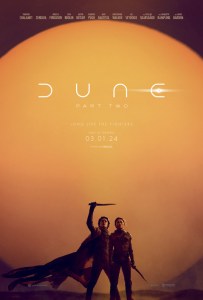 I wasn’t fully taken with the first Dune movie when it arrived in 2021. It was visually sweeping, with dense world building and careful development of characters and themes, but then it just hit the pause button without any certainty there would be a conclusion. Thankfully, director Denis Villanueuve was able to complete his vision, and what a spectacular science fiction landscape this man has fashioned, visually resplendent but also with a story that deepens and improves on all the promise and setup from 2021. The triumphant of Paul (Timothee Chalamet) becoming a hero and avenging his father from their betrayers is tempered by the tragedy of Paul, becoming the false messiah that will bring about mass genocide. The movie doesn’t hold back in its criticisms of its hero while also providing complexity that makes us root for him but uneasily dread what might become. The narrative structure is easy to follow with Paul ingratiating himself with the native culture, rising to power and influence, and organizing a resistance against the well-funded imperial overlords of Arakis. This is the kind of sumptuous, big screen spectacle with intelligence that is so rare in the Hollywood system, and Villaneuve once again shows his ability to perform artful blockbusters that put him in a rarefied class with hew others. After the first Dune, I was hopeful but a little wary. After the second Dune, I feel like all of my concerns were wiped away.
Nate’s Grade: A-
Share this:

The Idea of You/ Turtles All the Way Down (2024)

The Idea of You is the kind of movie that Hollywood used to crank out, a romantic drama star vehicle based upon a popular novel and with a skilled director, and now it forgoes any theatrical run and ends up as another option on a streaming channel. The Idea of You follows a 40-year-old divorced single mom played by Anne Hathaway who also happens to run an L.A. art gallery and has a meet-cute with a handsome boy band member (Nicholas Galitzine, Purple Hearts) at the Coachella music festival (oh the magic lives of people never having to worry about bills in rom-coms). they hit it off, and the rest of the movie is whether or not they can make a romance work. There’s a 15-year age gap that she feels very self-conscious about as an older woman (“older” by Hollywood standards). She’s this formerly normal woman who wants to date one of the most famous music stars in the world who isn’t always available, but most of the problems and conflicts stem from the perceived issues of the age gap. It’s a charming romance that’s more dramatic than it is comedic, and Hathaway is quite good as our lead plucked from obscurity. Though the many scenes of our smitten boy band member making googly eyes at Hathaway as he reminds her how attractive she is, and as she bashfully demurs, are a little much (it’s Anne Hathaway, notorious horrible-looking human specimen, right?). As a core romance, the movie works well under the guidance of director and co-writer Michael Showalter (The Big Sick), and it’s more adult than I was expecting. It’s rated R for language and it’s also more sensual, but it’s also more adult as in looking at the ramifications of this relationship in a mature perspective, from the terrors of paparazzi imposition to her daughter being harassed at school. The portrayal is thus more engaging and engrossing and feels above the more flippant and flimsy romances that would settle for far less. Though be warned: there are several sequences of singing and serenading which might cause you to shrink awkwardly inward on your couch. Surprisingly thoughtful, and relatively romantic, The Idea of You is a charming reminder of the appeal of comforting tales of love blossoming in unexpected places and pretty people allowing themselves the choice to be happy.

Based on best-selling YA author John Green’s 2017 novel, Turtles All the Way Down is a very accessible and very affecting glimpse at living with mental illness, obsessive compulsive disorder, and intrusive thoughts. Aza (Isabela Merced) has an overwhelming inner monologue that sabotages her daily life in high school and carries her along anxious thought diversions, constantly relating to some illness growing inside her that she needs to cleanse. This is the crux of the story, along with her relationship with her super eager best friend. There’s a romantic side plot where she helps out a rich classmate whose billionaire dad has gone missing, which feels like a plot device to necessitate the two characters spending time together. The standout aspect of this adaptation by writer/director Hannah Marks (Don’t Make Me Go) is its unsparing and honest yet hopeful depiction of mental health and intrusive thoughts. Merced (Dora and the Lost City of Gold, Madame Web) is excellent and deeply empathetic as this woman held hostage by her wayward thoughts and impulses. It’s a performance that goes beyond easy depictions of aloof detachment or exaggerated histrionics, shedding any acting techniques that are too mannered or attention-seeking. Marks’ direction helps reflect Aza’s troubled mind with rapid insert edits and voice over to communicate the intrusive thoughts and maelstrom of spiraling negative emotions. If you’re a fan of Green’s popular novels, or YA-themed literature, or even just honest attempts to empathize with teens in turmoil, then Turtles All the Way Down is worth battling through any negative thoughts to finish and relish the journey.
Nate’s Grades:
The Idea of You: B
Turtles All the Way Down: B+
Share this:

Rebel Moon – Part Two: The Scargiver (2024)
 Back in December, Zack Snyder offered his very Snyder-y holiday take on big-budget space operas with Rebel Moon, a project that began as his Star Wars pitch that was turned down. It was what you would expect from a Snyder movie: big, loud, silly yet played completely serious, and drained of all vibrant color. Rebel Moon Part One was on my worst of 2023 list and I felt was a waste of two hours. I was not looking forward to the concluding Part Two. I was worried it would be two more hours of the same, and now having seen Part Two, a.k.a. The Scargiver, the edgy nickname of our lead rebel Kora (Sofia Boutella) fighting the good fight against the Evil Empire, I can now say that the Rebel Moon duology is now a dreary waste of four of your waking hours.
Saying Scargiver might be minimally better than Child of Fire (did you remember that was the subtitle for Part One? Don’t lie to me, dear reader, you know you didn’t) is a nominal victory. There’s more action and a clearer sense of climax, with our underdogs planning their guerrilla war against the overpowering forces approaching (we’re basically watching the training of a Vietcong-like insurgency) and then pulling off their unexpected victory. The problem is that we’re still stuck with all the same characters from Part One, few of which will prove to be emotionally engaging or intriguing. We’ve assembled our fighting force thanks to the events of Part One, but far too many of them are interchangeable and punishingly free of personality besides the default character creation setting of “stoic badass.” There’s one lady who has laser swords so at least that sets her apart. When it comes to attitude, personality, perspective, and even skill level, these characters are awash, which makes the action falter when it comes to any sort of meaningful emotional involvement. The bare bones story is so plain with broadly drawn good versus evil characters from its obvious cultural influences. The fact that it’s derivative is not itself a major fault, it’s the fact that it does so little with these familiar pieces that the movie feels like it’s trying to skate by on your familiarity. After four hours, it’s clear to me that Snyder and his co-writers composed this not as a living, breathing universe with its own lore and history and intrigue, but as a story where he could have used the Star Wars universe to fill in the gaps.
 Snyder can be a first-class visual stylist but his sense of fluid and engaging action stops at “cool images,” like living splash pages from comic books. Like Part One, there is no sense of weight to these action sequences. Things are just happening, and then in the next shot things are just happening. Occasionally there will be a sliver of relation, but whether it’s 60 minutes or 6 minutes, the effect is still the same. The action feels like it’s all happening in a vacuum, and the momentum we feel the upstarts are gaining is hampered. We went through the trouble of explaining their counter-offensives, so why does so much of it feel like it’s just watching a jumbled, ashen group of characters fire guns? This is best epitomized by Jimmy the robot (voiced by Anthony Hopkins) who has gone rogue from his programming and sits out much of the action for reasons entirely unknown. Then he arrives, takes down a few evil tanks, and I guess decides to sit back out. If this is our fighting force, what exactly has it amounted to? This makes the entire movie, and its predecessor, a frustrating viewing even for forgiving action fans. Things blow up good, and there are a few impressive visual orchestrations, but it’s so fleeting and slim.
Over the course of two two-hour movies, totaling four hours, with the promise (threat?) of more, it’s clear that what we really had here was perhaps one underdeveloped movie at best that has been unfortunately spread out over two (and counting) movies of time. Part One was entirely about assembling the team of rugged defenders, and this could have served as the first 45 minutes of the overall movie, with the events of Part Two filling in the rest. With Scargiver, the defenders don’t even start training the villagers until 40 minutes into the movie and the big battle doesn’t kick in until a full hour. Structurally, this doesn’t feel like we’re using our time wisely, and this is best evidenced by the fact that after AN ENTIRE MOVIE of character back-story, Snyder still stops the action to have his characters sit around and share their sad back-stories. Did these characters just not talk at all to each other after initially gathering person-by-person? Tarak (Staz Nair) still hasn’t put a shirt on. I felt like yelling at my TV as the character took turns, and another 15 minutes, for each member to share their tortured back-story again but with different visuals. I was almost worried that right before the battle another character would say, “Wait, before it all really goes down, I need to share, yet again, more of my back-story.” It’s not like these extra glimpses give us new understanding or even meaningfully differentiate their characters; they’re all just victims of an abusive space government that imposes its terrible will most forcefully.
 There is one tragic back-story that does separate itself from the pack, notably because it literally separates itself from the pack and is told well before our group share. Kora explains her part in the assassination of the royal family, securing the military coup that left the Evil Empire extra evil, and I guess the guy named Balisarius as supreme leader (oh how this man must have been teased for his name as a schoolchild, which might be his own tragic back-story that we’ll get three helpings of with an eventual Part Three). This betrayal is personal and stands out, with Kora being the one to shoot the little princess, a girl who, in her dying breath, says she forgives Kora. That’s rough. This is actually a good sequence from a character standpoint as it establishes Kora’s accountability and guilt convincingly. However, Snyder makes some baffling creative choices that blunt the impact of this sequence. During the assassination, the musical score favors a string quartet, which is an emotionally plaintive choice. However, the music is actually diegetic to the scene, meaning it’s coming live from the room. There is literally a string quartet of musicians playing in the room while the royal family is betrayed and slaughtered. These guys are really dedicated to their art to keep playing throughout, and I assume they must also be part of the conspiracy or else big bad Balisarus (snicker) would kill them too. You might as well have them also start stabbing the royal family with their bows. It’s details like this that trip up Snyder, a man beholden to images and ideas but lacking the finesse to make them work.
An issue I had with this conflict was the disparity in scale between the forces, mainly my nagging question of why put together a ragtag group of space adventurers to defend this town if the Evil Empire could just nuke the planet from space? Well Snyder attempts to answer this early with Part Two, and the answer appears to be… grain. This community theorizes that the empire needs their grain yield so badly that they wouldn’t do anything to damage it, so their plan is to harvest all their wheat, turn it into grain, and then use the grain like human shields, hiding behind the valuable resource as cover and distributing it across the village. This is beyond silly. First, this isn’t like an entire planet harvesting grain, it’s one little village on the outskirts. It’s not like we’ve seen a giant warehouse that goes for miles and miles stockpiled with thousands if not millions of deposits of this food. Also, we’re talking grain here (stay tuned for my exclusive Rebel Moon-related podcast called “Talkin’ Grain”). It’s not like we’re talking about some super rare mineral or substance that is only found on this one planet, something linked toward like the power source for an ultimate weapon or space travel. We’re talking about grain here. Grain. You think this Evil Empire won’t nuke the planet because they’re worried they won’t get enough grain, the same crop that can be harvested on multitudes of other planets? How about they just kill everyone and then repopulate the planet with robots to harvest the precious grain? Or how about this simple village make some upgrades as we’re in a future world with space travel and artificial intelligence but people are still harvesting wheat by hand like they’re the Amish. Regardless, I hope you love slow-mo montages of grain harvesting because that’s what you’re getting for the first 40 minutes, as if Snyder is rubbing your face in his silly non-answer.
 In the conclusion to Rebel Moon Part Two, once the dust has settled, and long since that grain has been harvested, the last five minutes sets up a would-be Part Three, informing us that an unresolved storyline is next up on the docket. The characters gang up for their next adventure, and you’re expected to be chomping at the bit for this continuation. I openly sighed. Every movie feels like a tease for the next adventure, and it seems to promise that this one will be the real one you’ve been waiting for, but it feels like franchise bait-and-switch. It’s more than incomplete or lazy storytelling, it’s a scheme to leverage interest in a world and series that deserves little. The universe of Rebel Moon is not interesting. The characters of Rebel Moon are not interesting. The visuals of Rebel Moon are fine, though some of the costume choices again can rip you right out of the reality of this universe (a guy fighting in blue jean overalls?!). In short, not enough has been established, developed, or even paid off to make Rebel Moon an interesting and satisfying movie, let alone two, let alone three, let alone however many Snyder wants to leech out of Netflix. I would say Part Two is better because at least it provides an ending but it doesn’t even do that, merely an intentional passing of the baton to the next movie, and round and round we go. Rebel Moon is a living poster stretched to its breaking point. Leave this shallow universe behind.
Nate’s Grade: C-
Share this:

Civil War (2024)
 In writer/director Alex Garland’s Civil War, the United States has broken after a third-term president (Nick Offerman) has disbanded the FBI, attacked his own citizens, and used the power of the government to remain in office. The forces of California and Texas have joined an unlikely alliance to depose the American president. With this conflict escalating, we follow a group of journalists, primarily prize-winning war photographer Lee (Kirsten Dunst) and her would-be protege Jessie (Priscilla’s Cailee Spaeny), as they drive from New York down to D.C. with the intention of getting one more interview with the president before it all comes to a bloody end.
Civil War is Garland’s (Ex Machina, Men) attempt to evoke the ethos of journalists who stress merely trying to depict the world rather than question it. It’s a movie really about shared trauma, as these characters are plunged into a world where your neighbor might be stringing up men at the car wash. Garland’s sound design does him major credit at being able to keep his audience unsettled, not just in the melange of gunfire and explosions but also the absence of sound. After one close explosion, the sound drops completely for over a minute. During key parts of the frantic action, the movie will cut to the black and white images of our photographers, providing an immediate reprieve to contemplate as a depiction of what is taking place. Garland’s movie keeps things on a realistic level and is really less of a movie about an America on the brink than a story of journalists going about their dangerous job. It just so happens that instead of it being Afghanistan or Syria or other more familiar war zones that it’s the United States. As a simplified, point-A-to-point B war zone road trip, the movie works well enough, unless, that is, you’re expecting anything more than the quasi-objective documentation of terrible acts.
 However, that same ethos of centrist non-engagement also kept me struggling to really invest in the movie. I kept waiting for… simply more to happen, for insightful exchanges with our characters, for harrowing moments really crystallizing the state of this nation, for clues that gave a clearer picture of the larger conflicts and how the United States got to this point. For anyone expecting much from Offerman’s presidential character, he’s literally in the movie for, at best, two minutes. The far majority of the movie follows along on this road trip with these undeveloped characters taking pictures of occasionally upsetting and occasionally mundane events, although the totality of these events fails to add up to a clearer picture or more coherent social commentary. I just kept waiting for the characters to get more compelling, along with the conflict, and it just didn’t. I think we were following the wrong characters, people who are trying to stay objective and above it all, because then they’re just stand-ins for a camera and a microphone. We know Lee is a celebrated war photographer, and we get snippets of her past worldwide skirmishes, but what else do we know about her? What else do we know about Jessie, besides she’s an aspiring photographer who idolizes Lee? Does a mentorship relationship form? Not really. Does a rivalry form? Not really. The characters are just there, opaque, acting essentially no more than a stand-in for the audience. Now there’s a deeper conversation to be had about the ethics of embedded journalism, of documenting horror rather than intervening, or turning tragedy into digestible art for the masses. What are the ethics of non-intervention and holding to one’s moral objectivity in the face of the most objectionable? However, this is not the movie interested in having that conversation.
 The world of this civil war felt strangely unaffected. Hotels are going about their business, WiFi is carrying on, local shops are carrying on their discounts. I understand that part of this is meant to be surreal, the juxtaposition of a nation going about business as usual, even though these are unusual circumstances, but it makes the movie feel less significant, and the cavalier attitude of the characters continually betraying the stakes of the drama. If it’s just another assignment, how bad can it be? It makes Civil War feel like there’s hardly much of a civil war going on, which begs the question why even tackle this concept if this is it? If you have a movie about an American civil war but pussyfoot around on the why, forgo making the impact felt, and have the majority of the characters shrug it all off, then why are you even going through this story? The apolitical nature makes it so that many viewers will project their own perspectives and prejudices to fill out the unspoken history. It’s an interesting artistic decision but also one that nagged at me as a “both sides are bad” declaration to the middle to tell us that polarization is the real enemy.
There are a few sudden jolts and unsettling moments in the movie, but watching Civil War feels like I’m only watching 45% of a movie that will never be filled in. By that I don’t mean I need every point spoon-fed to my stupid plebeian brain, but I needed a movie where the time added up to something more substantial than “people do bad things during war.” I kept mentally going back to The Purge franchise, a concept that asked what people might do if they had a brief window of lawless freedom, and what that says about us as a society when the rules are put on hold. That is a franchise that embraces its genre roots and premise but finds ways to make its concept a reflection of our troubled times, and while it’s blunt commentary, when we have Nazis marching in the streets, maybe blunt times call for blunt commentary. Civil War feels so timid to say anything really that might be relevant to our current anxious and fractious political climate. Civil War was disappointing to the point that I was longing for the clarity and conviction of The Purge franchise.
 There are so many different versions of this story and concept that can prove compelling, so it’s all the more mystifying for me why Garland wanted to pick this version. Imagine a grueling Downfall-style drama about the last hours inside the White House of a three-term fascistic president who turned on his own people and enacted a bloody civil war, and imagine watching those closest to him reconcile with their own culpability as well as the resignation of the end coming for all of them and what they have done. Or even imagine a similar version about being behind enemy lines and looking for safe harbor, not knowing which American could be trustworthy and which might ultimately be a defector (as Jesse Plemons so ominously says in the movie’s intense high point, “Okay, but what kind of American are you?”). There’s a little known indie war movie from 2017 called Bushwick, starring Brittany Snow and Dave Bautista, that has a similar premise, following a military invasion of Brooklyn (Texas allies with the Southern states to attack the big cities, though they didn’t expect so much push-back from the locals). This is a better version of the similar modern civil war premise, with characters that are more compelling, a conflict that keeps upending our sense of safety, and some gutsy filmmaking choices, not all of them successful (the ending is too bleak and mean and deserved a ray of hope). There are myriad ways to tell this story and make it engaging and though-provoking, and Garland inexplicably chose this dull option. You could do worse than Civil War, but with such tantalizing dramatic potential, you could do better.
Nate’s Grade: C+
Share this:

Late Night with the Devil (2024)/ Immaculate (2024)
 Late Nigh with the Devil is an intriguing novelty, a found footage item of 1970s late night talk show fame reportedly documenting the last show of Night Owls, a talk show hosted by a man who recently lost his wife to cancer and is also slipping in the ratings and losing his traction in the industry. So Jack Delroy (David Dastmalchian, best known as Polka Dot Man in 2021’s The Suicide Squad) gets the great idea to hold an exorcism live on stage or his big spooky Halloween show. What could go wrong, right? The movie is dedicated to upholding the style and awkward tone of 1970s talk show, and its commitment is by far its most interesting aspect to the found footage sub-genre. I wouldn’t classify the movie as necessarily scary, but it held my attention and I appreciated the corny little nuances of recreating an older form of television and comedy schtick, with a growing sense of foreboding as things start to get progressively worse and Jack pressures his new girlfriend, an occult writer, to bring out her possessed pupil. It takes a little long to get going, and the overall conspiracy of Jack’s connection to an Ilumminati-esque showbiz cult feels so tangential to be important, but I was objectively impressed with the overall recreation of an archaic form of TV. The conclusion, once all chaos is finally unleashed, breaks the rules of the found footage setup but at that point it’s welcomed and things can get a little more weird and visually audacious. Late Night with the Devil works more as a late-night curiosity than a boo-style horror thriller. I appreciated the committed efforts and artistry, as well as the game actors and some wicked gross-out makeup prosthetics, more than the overall movie.
 Nuns in Distress has long been a horror genre staple, as the mixture of Catholic imagery and overwrought religious themes proves an unbeatable mix with classic exploitation elements, the depraved and the sanctity. To this we have Immaculate with rising starlet Sydney Sweeney (HBO’s Euphoria) as an American nun traveling to a remote Italian convent and becoming an unwitting victim in a sinister ploy to gestate a new potential messiah. While very serious and broody in presentation, Immaculate is a pretty by-the-numbers mystery that goes to its most obvious route and becomes an overextended hostage thriller for Sweeney. The movie is at its best when it gets crazy, and that includes Sweeney, when she’s allowed to be all-out histrionic. For too long, the movie is too somber and simmering, which works best if the mystery is at least involving and surprising or we build to a great gonzo finish. I wish the movie was more wild. The ending is the best part of Immaculate, where Sweeney is pushed to the point of intense madness, while splattered in blood as per genre rules, and is forced to make extreme and personal choices. In that regard, perhaps Immaculate best operates on a metaphorical level about the horrors of pregnancy, more forced birth from oppressive leaders, and restricting women’s autonomy in a post-Roe v. Wade world. It’s a long wait to that worthwhile finale, and you might get restless from your unholy wait.
Nate’s Grades:
Late Night with the Devil: B-
Immaculate: C


 nathanzoebl
You must be logged in to post a comment.