Blog Archives
Spencer + Penny, Forever (2023)

In the best way, Spencer + Penny feels like a Pixar short, something sweet and subtly profound that then suckerpunches you into a mess of feelings that you didn’t think were possible given the abbreviated length as well as the subject matter. You may ask yourself, “Am I really about to cry over some pencils?” and I’m here to tell you yes, and it’s okay to cry. In just a matter of seconds, this Ohio-made short film gets you to think from a different perspective, that of a mechanical pencil named Spencer (voiced by writer/director Eric Boso), and through that object we will feel all-too familiar human traits. There’s elation at aligning with one’s purpose, but also a melancholy that comes when we feel spent, empty, and rundown, needing to be replenished. Because of Spencer’s unique identity, his lead can be replaced, though this also causes him to feel hollow at times. Then one day he meets a friend, a traditional wooden pencil named Penny (voiced by Samantha Martin). She’s chipper and unflappable in her enthusiasm and optimism, lifting Spencer’s spirits. And then this relationship rapidly changes through a simple and elegant visual means of montage, and all at once this cute film about two pencils, and thematically about mental health, has transformed into one about mortality and legacy. It works so well that I was shocked to be feeling urgent emotions, begging a muted pencil to speak back. That’s quite a creative coup for Boso (Bong of the Living Dead). The short itself is visually lean and clean, given to presenting the story like it was a writing utensil catalog. The sparse visual arrangements further made Spencer + Penny, Forever feel like a children’s storybook come to whimsical life. I enjoyed the emphasis given to erasers and the disappointment we feel at making mistakes but the acknowledgement that mistakes are also a part of life, a big idea but made easily digestible for all ages through the carefully crafted writing style of a bittersweet child’s storybook.
I won’t delve into detailed spoilers but I think the ending concept is fitting but we needed a different path to finally wind up there. It’s sweet but feels like a different story starting, which may well be the point. I also think the metaphysical and eschatological implications are rather large to try and make this work, so I think something more practical with the in-universe setting and a direct connection would have felt like a more appropriate thematic conclusion. Still, it works, I just quibble with the means we reached this ending.

Spencer + Penny, Forever was produced for the 2023 Winterfilm Festival in Ohio and won several awards, including Best Writing, Audience Award, Best Music (the music does have a definite Jon Brion-esque quality of deceptive whimsy that blends into heartache), and Best Film. It’s easy to see the movie as a crowd-pleaser and an unassuming charmer, able to delicately hit weightier themes with cute observational quirk (a.k.a. The Hidden Life of Writing Utensils). It will be entering the festival circuit shortly and I’m sure I won’t be the last person walking away from Spencer and Penny and shaking my head and smiling that an eight-minute short made me think differently about my pen.
Nate’s Grade: B+
Share this:

Monster (2003) [Review Re-View]
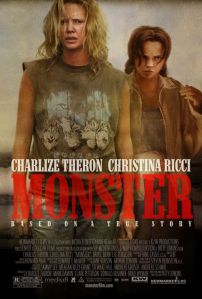 Originally released December 24, 2003:
Monster follows the life of Aileen Wuornos (Charlize Theron, now nominated for a Best Actress Oscar), Americas only known female serial killer. In the late 1980s, Wueros was a roadside prostitute flexing her muscles with Florida motorists. She describes hookin’ as the only things shes ever been good at. One day Wuornos has the full intention of taking her own life, but she meets 18-year-old Selby (Christina Ricci) at a lesbian bar and finds a companion. Driven by a growing hatred of men from sexual abuse, Wuorno’s starts killing her johns to try and establish a comfortable life for her and Selby.
Let’s not mince words; Theron gives one of the best performances I have ever seen in my life. Yes, that’s right. One of. The. Best. Performances. Ever. This is no exaggeration. I’m not just throwing out niceties. Theron is completely unrecognizable under a mass of facial prosthetics, 30 extra pounds, fake teeth and a total lack of eyebrows. But this is more than a hollow ploy to attract serious attention to the acting of a pretty face. Theron does more than simple imitation; she fully inhabits the skin of Aileen Wuornos. The closest comparison I can think of is Val Kilmer playing Jim Morrison in The Doors.
Theron is commanding, brave, distressing, ferocious, terrifying, brutal, stirring, mesmerizing and always captivating. It may be a cliché, but you really cannot take your eyes off of her. Her performance is that amazing. To say that Theron in Monster is an acting revelation is perhaps the understatement of the year.
With previous acting roles in Reindeer Games and The Cider House Rules, Theron is usually delegated to pretty girlfriend roles (who occasionally shows her breasts). Who in the world thought she had this kind of acting capability? I certainly did not. If Nicole Kidman can win an Oscar for putting on a fake nose and a so-so performance, surely Theron should win an Oscar for her absolute transformation of character and giving the performance of a lifetime.
With this being said, and most likely over said, Monster is by no means a perfect film. Minus the terrific central performance, Monster is more of an everyday profile of a grotesque personality. The film weakly tries to portray Wuornos more as a victim, but by the end of the film, and six murdered men later, sympathy is eradicated as Wuornos transforms into the titular monster. Some supporting characters, like Ricci’s narrow-minded Christian up bringers, are flat characters bordering on parody. The supporting characters are generally underwritten, especially the male roles that serve as mere cameos in a film dominated by sapphic love.
Monster is proof positive that human beings will never be phased out by advancing machinery when it comes to acting. Monster boasts one of the greatest acting achievements in recent cinematic history, but it also coasts on sharp cinematography and a moody and ambient score by BT (Go). Monster is a haunting film that you won’t want to blink for fear of taking your eyes off of Theron. She gives an unforgettable tour de force performance that will become legendary.
Nate’s Grade: B
——————————————————
WRITER REFLECTIONS 20 YEARS LATER

Monster was a revelation for Charlize Theron, an actress who until then had mostly been known for parts that asked that she be good looking and little else. Twenty years later, Theron is one of the best actresses working in Hollywood and it almost never happened without her breakthrough performance where she brought to startling life the horror of Aileen Wuornos’s tragic life and tragic desperation. When this movie came out originally in 2003, I doubt anyone but Theron’s closest friends suspected she was capable of a performance this raw and spellbinding, but that’s also a condemnation on all of us. How many other actresses out there could maybe rival the best of the best if they just had the right opportunity? How many actresses are stuck playing the same limited roles because that’s all they’re ever asked to do? How many actresses are wrongly assumed to be of limited talent simply because of their comely appearance? That isn’t to say there’s some hidden universal equation that the uglier you are the better at acting you have to be (though it sure has worked out for [insert your example of a conventionally unattractive actor here]), but this movie is a clear indication that too many actors are never given enough opportunities to shine.
Back in early 2004, I credited Theron’s performance as one of the best I’ve ever witnessed in my then-twenty-one years of moviegoing (although that number should be smaller considering I wasn’t keenly watching Scorsese as a baby). She is very good, but I’d like to claw back some of my rapturous words of praise now that we’ve seen twenty years of Theron acting excellence. Looking over her career, I might actually cite 2011’s Young Adult as her finest performance, and that one didn’t even nab an Oscar nomination (she’s since been nominated twice since, for 2005’s North Country and 2019’s Bombshell). The draw of the movie is the head-turning performance from Theron and she just disappears completely inside the skin of her subject. It’s hard to remember at times that this is Theron, thanks to the richness of her startling performance but also the accomplished makeup effects, which were not nominated. At every point, you feel the fire burning behind the stricken complexion of Theron, a fire that will eventually consume her and everything she loves. While highly compelling, this is not a performance of subtlety and restraint. This is a big performance, and the movie is often prone to making loud pronouncements about its subjects and pertinent themes. It’s loud, brash, and maybe for some it will seem a little too loud, a little too unsubtle, but it’s a movie that refuses to be ignored for good reason.
 In my original review I raised some reservations with the rest of the movie, and I’m here to recant one of them. I wrote back in 2004, “The film weakly tries to portray Wuornos more as a victim, but by the end of the film, and six murdered men later, sympathy is eradicated as Wuornos transforms into the titular monster.” I’m positive that many will still cling to this same idea but oh boy have I come around in twenty years. By the time the movie is over, you wonder why more women haven’t just snapped and gone on killing sprees. Wuornos is indeed a victim. She’s responsible for terrible deeds but that doesn’t change the fact that she started as a victim and continued as one until put to death by the state of Florida in 2002. She was a sexual assault survivor, groomed into prostitution, and then trapped by a society that saw her as little other than trash, something to be pitied but ultimately forgotten. She comes of age as an adult thinking her only value is the fleeting moments of pleasure she can provide for men, and in the narration, we hear her dreams that one of these men who repeatedly tell her how pretty she is would take her away to another life, like a princess. Alas. It’s impossible to separate her past as a victim of predatory men from her actions when she turns on predatory men. Being forced into prostitution out of desperation is one of the definitions for sex slavery and trafficking. The movie does try to make her last few johns more ambiguous over whether or not they are “good people” and thus “deserving” of their fates, like a scale is being introduced and we’re doing the calculation whether Wuornos will strike (#NotAllMen, eh felas?). There’s a clear dark path where the murders get considerably worse. She begins by defending herself against a rapist, but by the end, it’s just a kind family man who picked her up without even the intention of having sex. We’re meant to see her transform into the titular monster, but I kept wondering about Aileen Wuornos as the societal stand-in, accounting for thousands of other women who lived and died under similar tragic circumstances.
I also found myself growing increasingly contemptuous of the love interest character played by Christina Ricci (Yellowjackets). When we’re introduced to Selby, she’s a wide-eyed naif testing her boundaries of comfort but clearly tapping into repressed homosexual feelings. Their relationship is meant to serve as the emotional rock for Wuornos, the reason that she’s acting more rash is because she’s trying to earn enough money for the two of them to run away together and build a new life. She is her motivation, but Selby is absolutely the worst. You can excuse some of her hemming and hawing about striking out on her own and leaving her controlling parents, as she’s fighting against repression as well as trepidation for starting out independently, but this lady becomes fully aware of the dangers and dehumanization that Aileen goes through to earn her meager amounts of money, and Selby encourages her to do so. Not just encourages her, Selby pressures her to do so, to get back out there and “provide” for her, knowing fully well what that means, knowing fully well how these men have treated Wournos, repeatedly abusing her. What are you doing to help things out, huh Selby? She’s embarrassed hanging around Wuornos around some other lesbian friends she just met, so she’s already looking to upgrade and move past her lover. By the end, as she’s trying to coax a confession of guilt from her girlfriend to save her own skin, Selby becomes just another user, taking what they want from Wuornos and discarding her when they’ve had their fill.
 This was the directorial debut for Patty Jenkins, who also served as the sole credited screenwriter, and while the indie darling-to-franchise blockbuster pipeline has been alive and well in Hollywood, it was quite a surprising leap that her next movie after Monster was none other than 2017’s Wonder Woman. To go from this small character-driven true crime indie to leading the big screen solo outing for comics’ most famous female hero is quite a bizarre but impressive jump. Her only other feature credit is the much less heralded 2020 Wonder Woman sequel. She was attached to direct a Star Wars movie about fighter pilots but that seems to have gone into turnaround or just canceled. So is the way with Star Wars movies after 2019’s Rise of Skywalker. Just ask the Game of Thrones creators, Josh Trank, and Taika Watiti how that goes.
Monster is a phenomenal performance with a pretty okay movie wrapped around it in support. Twenty years later, Theron is still a monster you can’t take your eyes away from. It changed her career destiny and I think acts as an exemplar for two reasons: leaving the viewer with the question how many other wonderfully talented performers will never get the chance to showcase their true talents because of faulty assumptions, and how many other women are out there living in quiet degradation like Aileen Wuornos.
Re-Veiw Grade: B
Share this:

Leave the World Behind (2023)
 Apocalyptic thrillers can oddly enough serve as a therapeutic means for dealing with our fears of being helpless against forces well beyond our control, but they’re also reflections of our current state of anxiety as well. There’s more than just giant hurricanes or earthquakes breaking records on the Richter scale, it’s about how we respond to the momentous and alarming changes and what that says about The Way We Live Now. The new Netflix apocalyptic thriller Leave the World Behind, based on the 2020 book of the same name, has some big mysteries that I feel safe to say won’t fully be explained by the end. There is a possible explanation but it’s a movie more consumed with how people respond to tumult than the tumult. I found the majority of the movie to be gripping and engaging, and while it doesn’t exactly nail the landing, writer/director Sam Esmail (Mr. Robot, Homecoming) crafts a paranoid thriller with flair. It’s an apocalyptic thriller at crossroads with a paranoia thriller and a disaster movie, and the biggest challenge of them all is ultimately being able to trust another person during a time of remarkable uncertainty.
Amanda (Julia Roberts) and her husband Clay (Ethan Hawke) have elected to take a spur-of-the-moment family vacation out of New York City and onto a lavish home in Long Island. Everything seems so placid until the phones no longer get a signal, the TV broadcasts are strictly limited to a blank emergency screen, and two strangers show up (Mahershala Ali, Myhal’la) saying this is their house and they would like to stay inside. They claim that the U.S. is under a cyber assault and there’s more to come.
 Leave the World Behind has two intriguing questions to keep the audience hooked: what is actually happening and who are these new people? Most disaster movies put you in the thick of the action, from presidential boardrooms to scientific outposts keeping up with the changing data and going over the options to prevent further loss of life. This movie purposely leaves you in the dark in a well-kept Long Island home and the first thing that goes is the expediency of knowing things from our phones. When two new people come knocking at the door to say the world is falling apart and this is our home, trust us, it’s hard not to hold some level of suspicion. Can we take these people at their word? What kind of agenda could they secretly have? And if so, what does that say about what has happened or what is happening in the outside world? They seem like they know more than what they’re letting on, so how much do they know themselves? It’s the slow drip of information that makes the movie simmer in such an anxious predicament of looking at every new piece as another new question. This places the viewer uncomfortably in similar territory as Amanda, who despite her prejudices might be right not to trust the newcomers. We’re stuck on the outside wondering what has happened and what may be left. The movie is carefully crafted to only give us so much to work with while our minds start reading and rereading everything for more connection and meaning, running rampant and going stir crazy just like the characters. While the second big question naturally gave way and could only produce so much tension, the main thrust of the movie kept me hooked and excited and worried and actively questioning just what exactly was going on.
I appreciate how Esmail is a restlessly ambitious filmmaker. He took on directing duties for the entire second season of Mr. Robot and from there continued coming up with new challenges. There was an episode meant to be told as an episode-length elaborate tracking shot. There was an episode that was told almost without any spoken words, entirely through visual action. There was an episode that was presented like a five-act stage play and it was enthralling. While these are the easy to recall gimmick episodes, Esmail’s directing vision for his series never eclipsed the series itself. It elevated the episodes but the emphasis was still on the significance of the characters and their emotional states (highly recommend Mr. Robot, one of my favorite 2010s TV shows, to anyone who has yet to watch). With Leave the World Behind, only his second feature after 2014’s parallel universe rom-com Comet, Esmail refuses to let any sequence pass without some kind of visual flourish. His camera is constantly swooping through the visual landscape, flipping and spinning and craning above the characters from on high. It reminded me of Brian DePalma, who also loves the high angle pans across rooms and also abides by the dogma that there should be no uninteresting shots in a movie. It’s easy to appreciate but without an engaging story can quickly become a distracting exercise in empty artifice, which is also how I view most DePalma. Here, much like Esmail’s accomplished prestige TV work, the style makes me better appreciate how much effort and thought Esmail has put into his presentation and his ideas. The man wants you to see his work, and there’s no fault in that as long as you’re enjoying the experience, which I was for the most part.
 There are some supremely well-crafted moments played to a breaking point of intensity. Early on, as the family relaxes on the beach, they see a ship in the distance, an ordinary sight on a seemingly ordinary day. Then hours pass and it’s getting closer, and closer, and finally the realization begins to settle in that this thing is now a danger and they need to very much run very much now. Esmail’s camerawork keeps the scene feeling kinetic, with a long take that establishes the colossal danger as the tanker runs aground and the family has narrowly fled in time. In many ways this moment also serves as an ecological metaphor, with problems looming in the distance but ignored until they are at their most dangerous and right on top of us. Another sequence involves Clay venturing outside and discovering what appears to be a dust storm the color of blood. It’s getting closer and closer and the movie is testing how much we can take before you start hitting an imaginary gas pedal to strongly suggest Clay out of there. There’s another sequence that’s a literal pile-up of driver-less cars coming to the same nexus point like they’re all migrating. It makes for an immediately eerie sequence that becomes extra horrifying once the Teslas become unmanned missiles.
The themes of disconnection aren’t exactly subtle but that doesn’t mean they are misguided. This movie is about as subtle as an oil tanker heading straight for you, but I didn’t mind because of the skill of the storytellers and the ongoing mysteries that kept me begging for every new morsel. The messaging isn’t exactly complex. At one point Amanda has a speech that might as well be titled “This is Why Humans Are Terrible and We Deserve This.” Following this, another character tells her that they may not agree on much but she agrees with every word she just uttered with her speech, so you know this is the kind of pessimistic monologue that can reach across the doom-scrolling aisle. The movie almost frustratingly ends without a larger sense of clarity over what has been happening, a fate that would have greatly angered my wife. Esmail gives you something that can work as an explanation without making it definitive; it’s merely a theory but it’s enough to hold onto if you desperately need an explanation. However, the way the movie ends feels less conclusive and more like the conclusion of a season of television where the characters, now grouped together, are in for something fierce next year so stay tuned. The nature of this story is designed to leave you hanging, and that’s why I circle back on it mattering more on how these characters respond to this apocalyptic event versus what is clearly happening.
 Chilling and effectively plotted to keep you guessing until the end, Leave the World Behind is an apocalyptic thriller that really simmers in the anxiety of the unknown. It’s not perfect but it’s pretty good, as long as you can accept not having all the answers. The acting is strong but it’s the control and finesse that Esmail exhibits as director and screenwriter that really makes the material engaging and impactful. It’s an apocalyptic thriller where the scariest proponent might be having to live with one another.
Nate’s Grade: B
Share this:

Godzilla Minus One (2023)
 In his seventy years, Godzilla has been many things, a force representing mankind’s hubris, a protector of the Earth, a father, a weird chicken-like creature that Godzilla 1998 director Roland Emmerich asked his concept artists to make “sexy,” but rarely has the famous giant lizard been genuinely scary, and even rarer still has any of the thirty movies been genuinely serious. The surprisingly affecting Godzilla Minus One achieves both with impressive execution. Set shortly after the end of World War II, the far majority of this monster movie is given to somber human drama, with our protagonist a kamikaze pilot too afraid to give his life senselessly for the cause. Once he returns home, he is treated like a pariah, shamed by his neighbors attempting to literally put the pieces of their lives back together amidst the rubble. He’s riddled with post-traumatic stress and two counts of survivor’s guilt eating away at him. For this man, his war is not over. To make matters even worse, there’s a gigantic lizard terrorizing the seas and heading straight for Tokyo. The second half of the movie follows a very satisfying formula taken from Jaws, with a group of men getting on a boat, working together, and trying to catch their big prize. The ingenuity of their plans makes use of the meager means at their civilian disposal, as the military cannot get involved out of fear of stoking U.S.-Russia aggression in the dawn of the Cold War. The way this character’s arc comes together, at a great moment of heroism that also ties in his relationship with other supporting characters you’ve come to enjoy, is great storytelling. Usually in monster movies the human drama is filler and you can’t wait for those pesky people to get squished to make way for the waves of destructive fun. Not so here, as every scene the characters are in peril has you clenching your fists in fear that Godzilla could triumph. This Godzilla is terrifying and I really enjoyed the sense of scale the filmmakers exhibited, making sure we saw him from a human-sized perspective, and the special effects, while not outstanding, are quite remarkable for its small-scale budget. For Godzilla fans, there might not be enough of the Big Guy for them. I was taken with the emotional journey of these hardscrabble characters fighting for dignity and redemption and to protect their found families, and that was never something I thought would be the major selling point of a Godzilla movie — human emotion. Fear not, the 2024 American release looks to bring back the cheesy nonsense.
Nate’s Grade: B+
Share this:

The Boy and the Heron (2023)
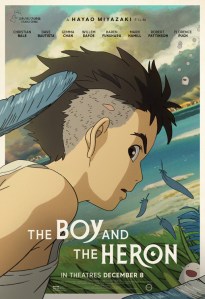 It’s been over ten years since renowned animation legend Hiyao Miyazaki graced the silver screen with what was believed to be his last film yet the retirement didn’t kick, for the benefit of all of us. I’ve resisted watching 2013’s The Wind Rises simply because of the melancholy of it supposedly being his final film. The man is in his 80s and still hand draws much of his storyboards, so if indeed this is the last Miyazaki movie we ever get, it ties thematically with many of the concepts and interests of this man’s storied career that it feels like a fitting capper. It’s his most autobiographical, following 12-year-old Mahito as he relocates to the country after surviving the firebombing of Tokyo during World War II. Unfortunately, he lost his mother in the bombing, and now his father is remarrying his mother’s younger sister, who looks near identical to Mahito’s mother. On the grounds of his new home, the boy discovers a strange overgrown tower with a door that leads to another world, and it’s within this world that a creepy scary bird promises Mohito can find his mother again. The Boy and the Heron is an imaginative and transporting fantasy with some major themes around the edges about grief and acceptance and environmental disaster, but it’s the haphazard structure and poor pacing that hold it back for me. Simply, it’s too long to get going and then too short to conclude. We don’t exit to the hidden fantasy world until almost halfway through, and the time in the regular world is stretched out, especially without going into further detail about our protagonist, who is kept very opaque. The discovery of the new world and learning its strange mostly bird creatures and rules and conflicts is where the movie really gets interesting, especially once the menacing heron becomes a squat man serving as our reluctant guide. It feels like there’s going to be some heavy revelations forthcoming, especially with the supposed duplicate nature of Mohito’s mothers, but it all comes down to an aged Man Behind the Curtain with a reveal straight out of Willy Wonka and the Chocolate Factory. We take too long to get to that intriguing fantasy world, and then once we’re there it feels a little too surface-level in design for a world on the cusp of dying. Then it’s a mad scramble to leave, and while the culminating decision feels earned in its wisdom, it also feels like the movie has simply run out of ideas. The Boy and the Heron is beautifully animated; the world feels like it’s undulating before your eyes, and there are numerous moments that allow it to breathe. However, it feels like maybe we could have gotten started sooner and finished a little later. Even mid-level Miyazaki is better than most, so The Boy and the Heron is still a worthwhile animated fantasy even if it doesn’t reach masterpiece status from a master storyteller. At least now I can finally watch The Wind Rises, so there’s that too.
Nate’s Grade: B
Share this:

Joy Ride (2023)
 The “girls can do it too” spirit pervades the raunchy comedy Joy Ride, which follows four twenty-something women of various Chinese-American heritage as they road trip through China to discover one woman’s birth mother. It’s a comedy about smashing representation barriers, giving voice to a specific identity crisis while also promoting sex positive shenanigans. I enjoyed the details of the cultural perspective of being young and Asian, but I felt the characters were too thinly drawn, settling into archetypes without fully embracing their comic differences. I liked each character from the actors and their performances primarily. There is one really ribald comic set piece where the ladies, collectively, hobble a basketball team from their individual sexual appetites, and I heartily laughed at the mounting catastrophes, but the other crass humor feels a bit too listless and surprisingly forced. An impromptu K-Pop performance of “WAP” should have been a lot funnier. Still, Joy Ride, while being less than euphoric, is a mostly fun movie that coasts thanks to the easy camaraderie of our four funny leads and some well-articulated perspectives getting their chance at the ole’ sex comedy formula.
Nate’s Grade: B-
Share this:

May December (2023)
The critical darling May December reminded me of another 2023 Netflix prestige awards contender, David Fincher’s The Killer. That genre movie was about trying to tell a realistic version of the cool super spy assassin and I found that enterprise to be fitfully interesting but mostly dull and unfulfilled. This movie seems to be going for a similar artistic approach under director Todd Haynes (Carol, Far From Heaven), tackling a sensationalized ripped-from-the-tabloids tale of perversity but telling a more realistic version, which also leaves the movie fitfully interesting but mostly dull and unfulfilled. May December is a frustrating viewing experience because you easily recognize so much good, so many exciting or intriguing elements, but I came away wishing I had seen a different combination and execution.
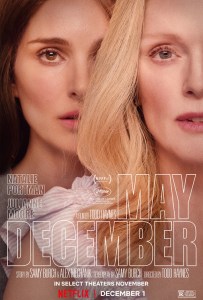
Elizabeth (Natalie Portman) is a famous actress with an exciting new movie role. She’s going to play Gracie (Julianne Moore), a woman who gained national scandal for her sexual relationship with a then-13-year-old Joe. The two of them have been together for several decades and have several children and now are inviting Elizabeth into their home to better understand her character. Each person is on their guard. Elizabeth wants to keep prying to uncover emotional truths that she can gobble up to improve her future performance and career. Gracie is wary of making sure the version of her story that she wants for public media consumption is what Elizabeth receives. And Joe (Charles Melton), now in his mid-thirties and looking more like an older brother than father to his graduating children, is reflecting about the history of his relationship and who was culpable.

There’s so much here in the premise of an actress studying her subject and wreaking domestic havoc in her attempt to discover secret truths that would rather stay hidden. May December uses this premise as an investigative device, allowing the inquisitive actress to serve as the role of the audience, trying to form a cohesive vision of events from each new interview. It allows the first half of the movie to feel like a true-crime mystery, uncovering the different sides of a sordid story and the lasting consequences and legacy for so many. There’s a very lurid Single White Female approach you could go, where the avatar of the person starts to replace the real person, where Elizabeth crosses all sorts of lines and even thinks about crossing some of the same lines that Gracie had; what better way to get in the mind of a predator, right? I was waiting for this interloper to destabilize this carefully put-together illusion of a “normal family,” but by the end you feel like little has been learned and most everything reverts to its prior stasis. I suppose that’s, again, the more realistic version of this kind of story, that even when confronted with uncomfortable revelations most people will fall back on what they know. May December’s underwhelming conclusion is that, by the end, maybe people are actually who we think they are.
Haynes’ cinematic specialty is exploring the artificiality of movies, from having multiple actors portray Bob Dylan in 2007’s I’m Not There, to destabilizing the nostalgia of the 1950s Douglas Sirk-styled romantic drama with 2002’s Far From Heaven. He’s also inherently drawn to stories of emotional and sexual repression. This movie is all about performance as identity; it’s about an actress trying to refine her tools, but it’s also about a middle-aged woman who has adopted performance as her defense system (this also might explain why Gracie’s lisp seems to come and go). Some part of her has to know that she crossed some very serious lines, no matter how many times she explains away their relationship as merely “unconventional.” Even though they’ve kept this union for 25 or so years, it still began when Joe was 13 years old and she was an adult. There are very intriguing dimensions to this dramatic dynamic, with the excuse of a Hollywood version of their “love story” to motivate each participant to reflect with renewed perspective. The problem is that Gracie has worn her mask for so long that I doubt there is another version of her any longer (“I am naive. In a way, it’s a gift”). As a means of survival, she projects herself as a well-intentioned victim of scrutiny rather than as a child predator who has manipulated her husband into codependency for decades. This means that, frustratingly, there isn’t much there to glean once the facts of the case have been collected, which makes watching a bad TV actress try and better emulate a bad person incapable of introspection seem like an empty exercise in artistic masturbation, and maybe that’s the point?

The conversation around May December being some kind of “camp comedy” (it was recently nominated for Best Comedy/Musical by the Golden Globes) has left me genuinely stupefied. I think the term “camp” is used a little too loosely, as some seem to conflate any heightened emotion as equivalent to camp. May December is really more an example of melodrama. It’s near impossible to retell the Mary Kay Letourneau story without the use of melodrama, so its inclusion doesn’t merely qualify the movie as camp. But at the same time Haynes is making deliberate use of certain elements that make the movie even more jarring, like the oppressive and operatic musical stings that hearken to earlier 1950s melodramas. These musical intrusions are so broadly portentous that it’s practically like Haynes is elbowing you and saying, “Eh, eh?” I suppose you can laugh at how arch and over-the-top the musical stings are, but is this a comedic intention? Are we supposed to laugh at how out of place this musical arrangement is in modern filmmaking, or is Haynes trying to draw allusions to old Hollywood melodramas and make a case for this being similar? Whatever the case may be, I guess one could laugh at the stilted performances but then I think that’s approaching the movie from an ironic distance that makes it harder to emotionally engage, which seems like the whole point of the exercise, to go deeper than lazy tabloid summation.
The performances from the female leads circling and studying one another are rather heavy on mannered affectations and arch irony, but it’s Melton (TV’s Riverdale) who emerges as the soul of the movie. He’s so easy going and dutiful, quick to defend his wife and assure everyone that even at 13 years old he knew what he was doing and consented to their affair. Of course this is nonsense, and the real draw of the movie is watching this family man begin to crack, and when he does it’s like every repressed emotion comes spilling out. It makes you wish that he had been the main character of the story and Elizabeth more the supporting character trailing after.

Allow me a tangent, dear reader, because I’m reminded of the 2023 re-release of 1979’s notorious Caligula where a producer tried to re-edit the famously trashy movie, hewing closer to author Gore Vidal’s original screenplay and less the explicit excess of producer and Penthouse publisher Bob Guccione’s editorial influence. It seems like so much effort to reclaim one of cinema’s most over-the-top movies, but can you really make a classy version of a movie about the cruel Roman emperor that has a wall of spinning blades as an execution device and copious floating brothels? The movie is forever known for its trashy and outrageous elements because it is emulating an outrageous tyrant of history given to hedonistic and lascivious excess. Nobody wants the “classy” version of this sensational story because that’s the tamped-down and boring version of this story (granted, there are plenty of prurient Guccione additions that we could also do without). Taking sensational melodrama and trying to subvert the sensationalism under the guise of genre deconstruction can work; however, the key is that the “classy” approach has to be a more compelling alternative to the soapier, melodramatic version. I think I would have enjoyed the more sundry and soapy version of May December because with this version I felt too removed, and the movie itself felt too removed and uninterested in so many of its more potent elements for the sake of drifting ambiguity. It’s a drama that seems to stew in downy contemplation but without enough compelling examination to make the effort fulfilling. I kept waiting for the movie to open up, and then the movie just ran out of time. It’s got some admirable goals, and a strong performance from Melton that makes your heart ache, but May December would have been better served either being far more trashy or far more serious rather than straddling a middle ground that left me distant and impatient and ultimately disappointed.
Nate’s Grade: C+
Share this:

Cold Mountain (2003) [Review Re-View]
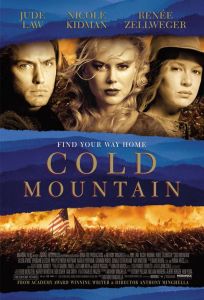
Originally released December 25, 2003:
Premise: At the end of the Civil War, Inman (Jude Law, scruffy) deserts the Confederate lines to journey back home to Ada (Nicole Kidman), the love of his life he’s spent a combined 10 minutes with.
Results: Terribly uneven, Cold Mountain‘s drama is shackled by a love story that doesn’t register the faintest of heartbeats. Kidman is wildly miscast, as she was in The Human Stain, and her beauty betrays her character. She also can’t really do a Southern accent to save her life (I’m starting to believe the only accent she can do is faux British). Law’s ever-changing beard is even more interesting than her prissy character. Renee Zellweger, as a no-nonsense Ma Clampett get-your-hands-dirty type, is a breath of fresh air in an overly stuffy film; however, her acting is quite transparent in an, “Aw sucks, give me one ‘dem Oscars, ya’ll” way.
Nate’’s Grade: C
——————————————————
WRITER REFLECTIONS 20 YEARS LATER
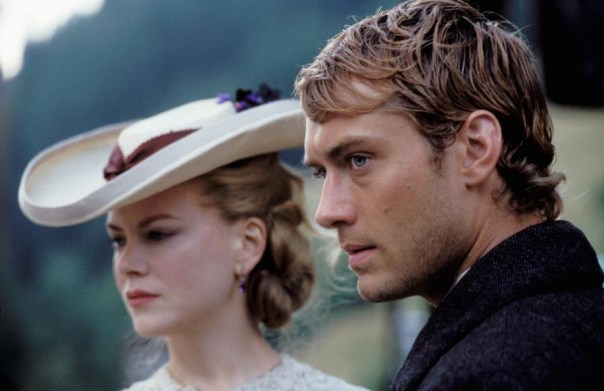
I kept meaning to come back to Cold Mountain, a prototypical awards bait kind of movie that never really materialized, but one woman ensured that it would be on my re-watch list for 2003. My wife’s good friend, Abby, was eager to hear my initial thoughts on the movie when I wrote my original review at the age of twenty-one. This is because Cold Mountain is a movie that has stayed with her for the very fact that her grandfather took her to see it when she was only nine years old. While watching, it dawned on nine-year-old Abby that this was not a movie for nine-year-olds, and it’s stuck with her ever since. I think many of us can relate to watching a movie with our parents or family members that unexpectedly made us uncomfortable. For me, it was Species, where I was 13 years old and the movie was about a lady alien trying to procreate. I think my father was happy that I had reached an acceptable age to go see more R-rated movies in theaters. Social media has been awash lately with videos of festive families reacting to the shock value of Saltburn with grumbles and comical discomfort (my advice: don’t watch that movie with your parents). So, Abby, this review is for you, but it’s also, in spirit, for all the Abbys out there accidentally exposed to the adult world uncomfortably in the company of one’s parents or extended family.
Cold Mountain succumbs to the adaptation process of trying to squeeze author Charles Frazier’s 1997 book of the same name into a functional movie structure, but the results, even at 150 minutes, are unwieldy and episodic, arguing for the sake of a wider canvas to do better justice to all the themes and people and minor stories that Frazier had in mind. Director Anthony Minghella’s adaptation hops from protagonist to protagonist, from Inman to Ada, like perspectives for chapters, but there are entirely too many chapters to make this movie feel more like a highly diluted miniseries scrambling to fit all its intended story beats and people into an awards-acceptable running time. This is a star-studded movie, the appeal likely being working with an Oscar-winning filmmaker (1996’s The English Patient) of sweep and scope and with such highly regarded source material, a National Book Award winner. The entire description of Cold Mountain, on paper, sounds like a surefire Oscar smash for Harvey Weisntein to crow over. Yet it was nominated for seven Academy Awards but not Best Picture, and it only eventually won a single Oscar, deservedly for Renee Zellweger. I think the rather muted response to this Oscar bait movie, and its blip in a lasting cultural legacy, is chiefly at how almost comically episodic the entire enterprise feels. This isn’t a bad movie by any means, and quite often a stirring one, but it’s also proof that Cold Mountain could have made a really great miniseries.

The leading story follows a disillusioned Confederate defector, Inman (Jude Law), desperately trying to get back home to reunite with his sworn sweetheart, Ada (Nicole Kidman), who is struggling mightily to maintain her family’s farm after the death of her father. That’s our framework, establishing Inman as a Civil War version of Odysseus fighting against the fates to return home. Along the way he surely encounters a lot of famous faces and they include, deep breath here, Phillip Seymour Hoffman, Natalie Portman, Giovanni Ribisi, Cillian Murphy, Eileen Atkins, Taryn Manning, Melora Walters, Lucas Black, and Jena Malone. Then on Ada’s side of things we have Zellweger, Donald Sutherland, a villainous Ray Winstone, Brendan Gleeson, Charlie Hunam, Kathy Baker, Ethan Suplee, musician Jack White, and Emily Descehanel, and this is the storyline that stays put in the community of Cold Mountain, North Carolina.
That is a mountain of stars, and with only 150 minutes, the uneven results can feel like one of those big shambling movies from the 1950s that have dozens of famous actors step on and as quickly step off the ride. Poor Jena Malone (Rebel Moon) appears as a ferry lady and literally within seconds of offering to prostitute herself she is shot dead and falls into the river (well, thanks for stopping by Jena Malone, please enjoy your parting gift of this handsome check from Miramax). Reducing these actors and the characters they are playing down to their essence means we get, at most, maybe 10-15 minutes with them and storylines that could have been explored in richer detail. Take Portman’s character, a widowed mother with a baby trying to eke out a living, one of many such fates when life had to continue after the men ran to war for misbegotten glory. She looks at Inman with desperate hunger, but it’s not exactly lust, it’s more human connection. When she requests that Inman share her bed, it’s just to feel another warm presence beside her, someone that can hold her while she weeps about the doomed fate of her husband and likely herself. There’s a strong character here but she’s only one stop on our expedited tour. The same with Hoffman’s hedonistic priest, a man introduced by throwing the body of a slave woman he impregnated over a ridge, which might be the darkest incidental moment of the whole movie. His character is played as comic relief, a loquacious man of God who cannot resist the pleasures of the flesh, but even he comes and goes like the rest of our litany of very special guest stars. They feel more like ideas than characters.

This is a shame because there are some fantastic scenes and moments that elevate Cold Mountain. The opening Civil War battle is an interesting and largely forgotten (sorry Civil War buffs) battle that begins with a massive surprise attack that produces a colossal explosion and crater and turns into a hellish nightmare. Granted, the movie wants us to sympathize with the Confederates who were bamboozled by the Yankee explosives buried under their lines, and no thank you. The demise of Hoffman’s character comes when he and Inman are captured and join a chain gang, and they try running up a hill to get free from approaching Union troops. The Confederates shoot at the fleeing men, eventually only with Inman left, who struggles to move forward with the weight of all these dead men attached to him. When they start rolling down the hill, it becomes a deeply macabre and symbolic struggle. The stretch with Portman (May December) is tender until it goes into histrionics, with her literal baby being threatened out in the cold by a trio of desperate and starving Union soldiers (one of which played by Cillian Murphy). It’s a harrowing scene that reminds us about the sad degradation of war that entangles many innocents and always spills over from its desired targets. However, this theme that the war and what it wrought is sheer misery is one Minghella goes to again and again, but without better characterization with more time for nuance, it feels like each character and moment is meant to serve as another supporting detail in an already well-proven thesis of “war is hell.”
Even though I had previously watched the movie back in 2003, I was hoping that after two hours of striving to reunite, that Inman and Ada would finally get together and realize, “Oh, we don’t actually like each other that much,” that their romance was more a quick infatuation before the war, that both had overly romanticized this beginning and projected much more onto it from the years apart, and now that they were back together with the actual person, not their idealized imaginative version, they realized what little they had in common or knew about each other. It would have been a well-played subversion, but it also would have been a welcomed shakeup to the Oscar-bait romantic drama of history. Surely this had to be an inconvenient reality for many, especially considering that the men returning from war, the few that did, were often not the same foolhardy young men who leapt for battle.
Zellweger (Judy) was nominated for Best Actress in the preceding two years, for 2001’s Bridget Jones Diary and 2002’s Chicago, which likely greased the runway for her Supporting Actress win from Cold Mountain. There is little subtlety about her “aw shucks” homespun performance but by the time she shows up, almost fifty minutes into the movie, she is such a brash and sassy relief that I doubt anyone would care. She’s the savior of the Cold Mountain farm, and she’s also the savior of the flagging Ada storyline. Pity Ada who was raised to be a nice dutiful wife and eventual mother but never taught practical life skills and agricultural methods. Still, watching this woman fail at farming will only hold your attention for so long. Zellweger is a hoot and the spitfire of the movie, and she even has a nicely rewarding reconciliation with her besotted old man, played by Brendan Gleeson, doing his own fiddlin’ as an accomplished violin player. As good as Zellweger is in this movie is exactly how equally bad Kidman’s performance is. Her Southern accent is woeful and she cannot help but feel adrift, but maybe that’s just her channeling Ada’s beleaguered plight.
I think there’s an extra layer of entertainment if you view Inman’s journey in league with Odysseus; there’s the dinner that ends up being a trap, the line of suitors trying to steal Ada’s home and hand in the form of the duplicitous Home League boys, Hoffman’s character feels like a lotus eater of the first order, and I suppose one reading could have Portman’s character as the lovesick Calypso. Also, apparently Cold Mountain was turned into an opera in 2015 from the Sante Fe Opera company. You can listen here but I’m not going to pretend I know the difference between good and bad opera. It’s all just forceful shouting to my clumsy ears.
Miramax spent $80 million on Cold Mountain, its most expensive movie until the very next year with 2004’s The Aviator. Miramax was sold in 2010 and had years earlier ceased to be the little studio that roared so mighty during many awards seasons. I think Cold Mountain wasn’t the nail in the coffin for the company but a sign of things to come, the chase for more Oscars and increasingly surging budgets lead the independent film distributor astray from its original mission of being an alternative to the major studio system. Around the turn of the twenty-first century, it had simply become another studio operating from the same playbook. Minghella spent three years bringing Cold Mountain to the big screen, including a full year editing, and only directed one other movie afterwards, 2006’s Breaking and Entering, a middling drama that was his third straight collaboration with Law. Minghella died in 2008 at the still too young age of 54. He never lived to fully appreciate the real legacy of Cold Mountain: making Abby and her grandfather uncomfortable in a theater. If it’s any consolation to you, Abby, I almost engineered my own moment trying to re-watch this movie and having to pause more than once during the sex scene because my two children wanted to keep intruding into the room. At least I had the luxury of a pause button.
Re-View Grade: B-
Share this:

Beau is Afraid (2023)
 Beau is Afraid is a ramshackle mess of a movie, and that is both the highest compliment and an indictment on its tremendous excess and lack of focus. It’s Ari Aster’s big swing after his modest successes in elevated horror (Hereditary, Midsommar), so the indie maven studio A24 gave him a thirty-million budget and three hours and full artistic reign to do whatever he wanted, and love it or hate it, one has to objectively admit, Aster really went for something all right. I’m still deliberating where that final something falls on the artistic merit equation. There’s undeniable ambition and artistry here, but there’s also so many ideas and moments and bloat, it genuinely reminded me of 2007’s Southland Tales (did your stomach just drop, dear reader?). It’s because both movies are stuffed to the brim with their director’s assorted odd ideas and concepts, as if either man was afraid they were never going to make another movie again and had to awkwardly squeeze in everything they ever wanted into one overburdened project (in Richard Kelly’s case his suspicion might have been correct, as he did only direct one more feature -so far). While I certainly enjoyed -if that is the right word- Aster’s movie more, Beau is Afraid is not an easy movie to love, or enjoy, or even simply sit through, and not just because of its bloated time.
 If I had to boil down this sprawling movie into one easy-to-digest concept, it’s about Jewish guilt. If you’re not a fan of feeling uncomfortable or anxious from the intensity of a movie, I would skip this one entirely. Beau (Joaquin Phoenix) might as well be a stand-in for the biblical figure of Job for all the cruel punishments and indignities he endures. Just when you think, “Well, it can’t get any worse,” Aster rolls up his sleeves and rises to the challenge and makes things even worse for his pathetic put-upon plebeian. This is a movie of escalating discomfort, chiefly meant to convey the constant state of anxiety that is Beau’s daily existence, and for the first hour or so, Aster works marvelously at making you squirm. It’s a movie less meant to reflect our objective reality and more a projection of one man’s anxious feelings and paranoia, the unsettling urge that everyone secretly hates you and something bad is always ready to lethally strike.
Beau is Afraid is an absurdist comedy of heightened almost screwball proportions, with Beau becoming increasingly frazzled and muttering “Oh no” hundreds of times as fate has it out for him. Small worries become all-consuming, like the simple task of trying to get water to swallow his new prescription medication, and how this eventually spirals to the ransacking of his apartment building, which is also all Beau’s fault, inadvertently, though that won’t mitigate the guilt. There are numerous fears and worries amplified to breaking points, inviting morbid chuckles and nervous titters. Beau sits in his bathtub to stare at an unknown man squeezed against the walls of his ceiling and about to slip and fall. Why is this man there? Why does Beau not immediately leap out of the tub? Why do both men remain fixed in their positions until the inevitable? It’s because it’s a ridiculous paranoid fear manifested into a ridiculous scenario made even more ridiculous. It’s the same with ignoring his mother’s calls only to have a stranger answer her phone to inform Beau that she has been killed and happens to be without a head now. It’s a realistic fear, avoiding phone calls and the draining emotional energy required to answer, and following it up with a consequence of darkly absurdist proportions to make him feel even worse. The movie leaps from one squirm-inducing, grueling sequence to the next, testing your limits and patience. There’s a post-coital revelation debunking, and then confirming, an outlandish worry that made me laugh out loud with tremendous auditory force. What else could I do? It certainly feels like Aster is inviting the audience to laugh at Beau’s pain and tragedy because what other human response can there be but to laugh in the face of unrelenting torment?
 Where the movie loses momentum is about halfway through, after Aster has established the drive of the movie, Beau’s attempts to get to his mother’s funeral so they can finally bury her. Every hour he is delayed, Beau is reminded that his mother’s body is rapidly decaying and only furthering her “humiliation” at the hands of Beau’s inaction. The second part of the movie involves Beau recovering from injuries in an upper class family’s home, the same family (Nathan Lane, Amy Ryan) that accidentally ran him over and is now kind of holding him hostage against his weakened will. We have an urgent goal, we have obstacles keeping him from that goal, and this is where the movie continues to work, as each new attempt to escape only confirms how much stranger and dangerous this family unit is. This dynamic plays into the established heightened fears and absurdist complications. It’s keeping him from his goal. But when he does eventually free himself from this hostage scenario, he literally wanders into the woods and discovers a troupe of thespians that refer to themselves as the Orphans of the Forest, and then a theatrical production may or may not present the rest of Beau’s natural life. This was where the movie’s momentum, which had steadily been ratcheting up along with the dark comedy, began to flag, and when I started to worry, then suspect, then confirm my sinking feeling that this all isn’t going to add up to something more cohesive and thought-provoking. It’s really more a movie of sustained memorable moments and unpredictable, tone-shattering twists and turns. Beau is Afraid is unpredictable, and that both works as an asset and eventually as a handicap. That’s because every scene is hammering the same overall thematic point just with a different stylistic arrangement of fears and anxiety. Following this redundant framework, a 130-minute version of this movie world would feasibly have the same thematic impact as the 180-minute version, merely eliminating some of the many detours.
Another nagging aspect of the movie that failed to add up to much more for me was how little Beau seems to matter in his own story. He’s more intended to be the universe’s lone fall guy rather than a person, a victim whose chief characterization is his ongoing victimization. He suffers and that is his identity. Considering the movie is more a loose fable, this can work since Beau is essentially a stand-in for all of humanity, but there are more personal aspects of him worth exploring in finer detail. The toxic relationship with his mother is worthy of further examination, especially the decades of emotional manipulation to ensure Beau would never replace her with another woman. I wish Aster had devoted more of his 180-minute run time to exploring Beau as a person rather than pitting him against a proverbial assembly line of pies to the face. Phoenix (Joker) has so little to do here except stare wide-eyed, helpless, and mumble as the world constantly befuddles and antagonizes him. It’s a performance purely of pained reaction.
 Can I recommend Beau is Afraid? For most viewers, probably not. It’s too long, too sporadic, and doesn’t come to anything cohesive or cumulative or even meaningful beyond a mean-spirited sense of pessimism directed at our titular human punching bag. It’s wildly ambitious and off-putting and bloated and outlandish and the kind of big artistic swing that artists usually only get so rarely in their careers. And yet I have to admire the sheer gusto of Aster making a movie this strange and alienating, a movie that’s constantly altering its very landscape of possibilities, usually to the detriment of Beau’s physical and mental well-being. It is an exhausting experience, so that when the end finally arrives, we, much like Beau, are simply ready to accept the finality we’ve been waiting for after so much abuse. There are moments throughout these ungainly 180 minutes that are sheer brilliance, and sequences that are sheer torture, some of which are on purpose. There’s also just way too much of everything, and without variance or finer exploration of its themes and specific characterization, it becomes a cosmic game of whack-a-mole where you might be the one actually getting hit over the head, and after so long I can’t blame anyone for not enjoying the prolonged experience.
Nate’s Grade: B-
Share this:

Are You There God? It’s Me, Margret (2023)
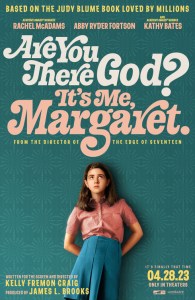 When is it not weird for a 41-year-old man to cry about a young woman getting her first period? When you’re watching the film adaptation of Judy Blume’s long-celebrated coming-of-age novel, Are You There God? It’s Me, Margaret. Blume waited almost fifty years before signing over the rights to writer/director Kelly Fremon Craig, whose 2016 movie Edge of Seventeen showed a downright Blume-esque combination of authenticity, good humor, and grace. That trusted vision is evident with how natural and deeply felt the movie comes across. We’ve had numerous coming-of-age tales since Blume’s influence, so I worried that maybe it would feel outdated or surpassed, but the movie taps into a great reservoir of empathy, bringing to relatable light the uncertainty of puberty, of fitting in, and trying to navigate the ever-approaching adult world. Usually these kinds of movies invite the viewer to reflect back upon their own young adult experiences, which I did even though I was never a teenage girl, but I had my own awkward and vulnerable moments too. I really enjoyed that Craig’s movie makes ample time for the adults too, which is where my relatability was prioritized. Watching Rachel McAdams try and explain why her parents disowned her for marrying a Jewish man is a powerfully affecting moment of an adult trying to explain a very hard truth to their child. The movie is affectionate and uplifting and earnest without being too cloying. It’s a pleasant and wholesome movie that showcases Craig as an agile filmmaker who deserves more opportunities and that even fifty years later, being an adolescent girl is still the same old awkward agony.
Nate’s Grade: B+


 nathanzoebl
You must be logged in to post a comment.