Blog Archives
Hellboy (2004) [Review Re-View]

Originally released April 2, 2004:
Guillermo del Toro loves things that go bump in the night. The Mexican born writer/director has shown prowess at slimy, spooky creatures with Cronos and 1997’s Mimic. He helmed the 2002 sequel to Blade, which had super vampires whose mouths would open up into four sections with rows of chattering teeth. The man sure loves his movie monsters. del Toro also loved Mike Mignola’s cult comic book Hellboy enough to turn down directing Harry Potter 3 and Blade 3 to ensure he could bring Hellboy to the big screen. Was it worth the sacrifice?
Let me just explain to you the villains of this movie as an example of how ridiculously stupid Hellboy is. The villains are … Nazis. Yes, the tried and true villains everyone can hate – Nazis. But these ain’t yo’ daddy’s Nazis; they’re immortal and led by zombie Rasputin (yes, the Rasputin). They all wish to puncture a hole into another dimension. What’s in this alternate dimension? Why nothing except for a giant floating spaceship that houses, I kid you not, the Seven Gods of Chaos, which all happen to be gigantic space squids. Why would anyone create a universe that has nothing but the imprisoned gods of evil? That seems awfully precarious. How exactly are giant squids going to take over the industrialized, nuclear-age world? Shoot ink at everyone? Sorry, space ink?

Let me not forget a Nazi assassin and his handy dandy arm-length blades. This assassin is also 100 years old and his body is filled entirely with sand. He winds himself up like a big clock. But if his body is filled completely with sand how can the clock gears work inside? You see what the normal audience member has to deal with? Plus these are just the villains, there’s a whole plot left to toil over as well.
The story revolves around a hulking, red demon named Hellboy (veteran character actor Ron Perlman). Hellboy escaped the space squid dimension in the 1940s when the Nazis unsuccessfully tried to open a dimensional hole large enough for your everyday on-the-go space squid. Now, Hellboy is an elite soldier for the government’s Bureau of Paranormal Research. He fights the creepy crawlies. He has to deal with a wide-eyed rookie, the watch of his “father” (John Hurt) and an attempt to rekindle a romance with a mentally troubled fire starter (Selma Blair). Oh yeah, and all the Nazi/Rasputin/space squid stuff mentioned before.
Perlman is really the only redeeming thing about this movie. The makeup is impressive, and he gives an enjoyably droll performance as a man who fights monsters with the same ho-hum-ness as a plumber reacts to clogged sinks. The rest of the acting runs the gamut of either being too serious (I’m looking at you Blair) or just too over-the-top silly (I’m looking at you, league of villains).
Hellboy is strung together with bizarre inanities, flat one-liners, heavy Catholic imagery, conflicting logic and contradictions, ridiculous villains, painful comic relief, half-baked romance and frustratingly ever-changing plot devices.
Watching Hellboy is like playing tag with a kid that keeps making up new rules as he goes (“You can’t tag me; I have an invisibility shield!”), and after a while you lose any interest. Late in the film, the Nazis will all of a sudden decide not to be immortal, and at a very inopportune time. Why? How? I don’t know. Hellboy also gets sudden new powers for some reason. Like he can bring people back to life by whispering otherworldly threats in their ears. For some reason nobody’s clothes burn when they’re set on fire.

Not only does Hellboy frustrate by changing the rules of its world arbitrarily, it will also frustrate out of sheer uninhibited stupidity. How come characters can’t hear or see a pendulum the size of the Chrysler building? How come during a vision of the apocalypse we see a newspaper that actually had the time and staff, during the Apocalypse, to print an issue that reads, “APOCALYPSE”? Why doesn’t Blair use her pyro superpowers immediately to vanquish all the H.P. Lovecraft creatures instead of letting Hellboy foolishly wrestle with them all? The gaping holes in Hellboy are large enough to squeeze a gigantic space squid through.
All this frustration and insanity might have been moot if the action sequences were somewhat thrilling. Sadly, they are not. del Toro’s action sequences seldom matter. There’s such little consequence of what’s going on that the action becomes stiff and lifeless. The first time we see Hellboy chase a creature through city streets it’s a fun experience, but soon the novelty wears off. The overuse of CGI wears down the audience, and after the third or fourth time we watch Hellboy battle the same monster, the audience is ready to go to sleep. There’s little entertainment in the film’s action sequences but just as much frustration and stupidity.
I have never watched a film that induced more eye rolls, shoulder shrugs, raised eyebrows, pained and confused glances and mutters of, “What the hell (boy)?” Comic book aficionados may enjoy the fruits of Hellboy but general audiences will simply shrug. I’m amazed that the majority of film critics seem to think positively about this movie. Maybe I’m the last sane person in an insane world but Hellboy is one of the worst films of the year and one of the craziest films you could ever hope to see in a lifetime.
Nate’s Grade: D+
——————————————————
WRITER REFLECTIONS 20 YEARS LATER

When I first saw 2004’s Hellboy, toward the tail end of my undergraduate years that April, I had no real familiarity with the character and went in with my pal, and fellow college newspaper entertainment critic Dan Hille. I went in a blank slate to the grumbling demonic lug created by Mike Mignola. To say I was underwhelmed would be an understatement in my original review. I had an extremely hard time gelling with the world and finding some firm internal logic, and my general astonishment colored every inch of that incredulous review from a snarky 22-year-old soon-to-be college grad. Twenty years later, we have a sequel, reboot, and a series of animated shorts and feature-length films, so the character is much better known today than back in 2004. I also think its occult-heavy, Lovecraftian world-building has also been further established through mainstream horror and science fiction projects. So, in 2024, I’m more familiar with the title character, the cultural connections and background, and especially Guilermo del Toro as a filmmaker, and I’m still left unmoved by this initial pitch to the character and his weird world.
It took del Toro and company years to get this movie made as the big studios lacked faith in the material, in Ron Perlamn as the lead, and in superhero and comic book properties period. This really was its own superhero story with outlandish villains, oversized heroes burdened with secrecy, shame, and guilt, and heavy themes reaching into religion and determinism. The concept of an underground agency of monsters to fight monsters is a good starting point for stories, and Perlman brings the right degree of curmudgeon charm to the outcast character who might become the ultimate hero of the world or its instrument of doom. The iconography of a demon trying to be a good guy provides a fun sense of irony, as well as a natural point of conflict as the wider world would have trouble seeing past the red skin, forked tail, and big curved horns. It makes me think of the gut-punch reveal from Arthur C. Clarke’s novel Childhood’s End where the benevolent aliens look exactly like the common visualization of a hooved and horned demon. The starting point for Hellboy has potential. However, it’s the rest that ultimately lost me.

Secret agencies and hidden conspiracies working behind the scene need to, themselves, be interesting. Think of the Men in Black and their assortment of goodies and agents. With the Bureau for Paranormal Research and Defense (BPRD), I expect more from the supporting characters and what they can unlock about our understanding of the world and the unknown. There really are only two super-powered supporting players, with Doug Jones playing Abe Sapian, a variation on the Creature from the Black Lagoon gillman, and Selma Blair as a pyrokinetic woman who checks herself into mental asylums to protect others. Both of these characters have possibility and are fellow outcasts like Hellboy, but neither feels sufficiently fleshed out and incorporated into this story. Because of Abe’s scenic limitations of being in water, he serves as more of a taste of “the world world” and narrative device. He’s not even involved in the entire final act of labyrinth misadventures. With Blair’s unstable pyro, her character is relegated to a tormented love interest for Hellboy to save, get jealous, and also save again through even more ludicrous means. For a secret agency, it all feels a little too small.
The biggest side character is John Myers (Rupert Evans, The Man in the High Castle), invented for the movie to be the audience’s entry point into learning more of this strange land of strange creatures. He’s a total bore, and he also doesn’t factor much more into the story than being a living reaction shot. He has one significant moment in the climax, and that’s simply telling Hellboy to remember who he is, ultimately convincing the big man to turn back from his destiny of enabling the apocalypse. Why do we need this character? Can’t another super-powered creature serve this same purpose? Why not Blair’s love interest figure, which would then present more attention on beginning that romantic connection between her and Hellboy? There’s a reason in X-Men that we followed a mutant to learn about other mutants and not some boring human. John Myers isn’t even included in the 2008 sequel, The Golden Army, because by that point he had served his only purpose of introducing us to a new world and being a benign romantic foil.

In a story with literal living Nazis brought to life through the magic of anti-Semitic clockwork, I’m dumbfounded why so much of the movie is watching Hellboy fight these boring lizard creatures with tongue tentacles. I appreciate the emphasis on practical effects and the reality that it’s a bunch of stunt performers in monster suits rather than complete CGI. The movie is another love letter of del Toro’s to his influences. His affection for the monsters and outsiders is apparent in every movie going back to his first, 1993’s Cronos. It’s too bad then that the primary opponent are these rudimentary lizard monsters that feel like the kind of easily disposable pawns you would see heroes fighting in other superhero spectacle. They’re faceless, and the fact they can regenerate and duplicate upon death doesn’t make them more formidable, only makes them more depressing as they can’t be easily rid of. If you’re going to give me giant space squids in an alternate dimension, then give me the giant space squids. If you’re going to give me Nazi zombies led by Rasputin, then give me that crazy mess. Don’t confine these potentially interesting villains to the opening and closing only. I will also say the ending is still a rather sizable letdown as far as how formidable these evil space squid gods might prove in a world of explosive devices and a modern military with a practical blank check for its budget.
Fun fact, at the time of its release, some theaters were so worried about playing a movie with “hell” in the title during Easter weekend, and coming off the ongoing success of The Passion of the Christ that brought in more conservative ticket-buyers, they decided to re-title it “Helloboy” on their theater marquis. I find this absolutely hilarious.

Hellboy has some points of interest, as del Toro was still fine-tuning his brand of fantasy-horror into a more mass-appealing conduit. It’s got terrific makeup effects and some fun ideas, and it’s also certifiably insane. It threw me for a loop back in 2004, and I just couldn’t process this level of hyper absurd elements jumbled together, and it still makes for a bumpy viewing. I enjoyed the 2008 sequel much more, which took more of a dark fantasy bent, and I wonder if I was more accepting of that realm of material than I was for Lovecraftian sci-fi nonsense. del Toro has learned from the Hellboy experience, becoming something of a masterful chameleon. He delivered one of the best kaiju action movies of all time that made me feel like a giddy kid. He created a haunting fairy tale timed to the Spanish Civil War. He created a charming romantic fable where a woman falls in love with a fish and it won an Oscar for Best Picture and he won Best Director. He created one of the most visually impressive stop-motion animated movies of all time that can make me cry like a baby and deservedly won another Oscar. Next up, he’s got another stop-motion animated movie and another creature feature, a remake of Frankenstein. Through his versatility, creative consistency, and inherent ability to find human drama in the most peculiar places, I’ll see any movie that del Toro decides to devote his worthy attention towards. Hellboy though? I’ve seen it twice now, and I think I can leave it at that. I’ll upgrade my earlier ranking but not too higher, Hoo boy is that 2004 review a fun read.
Re-View Grade: C
Share this:

The Bye Bye Man (2017)
 I think La La Land has a shadowy culprit to blame for the big slip-up at the 2017 Academy Awards where it mistakenly was declared Best Picture before the rightful winner, Moonlight, was crowned. Actress Faye Dunaway was the one who spoke aloud the infamous slip-up, but I think she had something else on her mind. She was so preoccupied with trying NOT to think about the Bye Bye Man that she wasn’t fully paying attention to the moment. Fortunately, Moonlight got its rightful due. Unfortunately, The Bye Bye Man exists as a horror film and Dunaway within it. This is a movie whose mantra is “Don’t say it, don’t think it,” all but begging to be forgotten.
If The Bye Bye Man had been the film it appears to be in its opening scene, we might have had an effectively unnerving horror thriller. We watch in a single long take as a distressed man drives home, mutters to himself, and takes out a rifle and systematically kills every person who admits they said “it” or told someone. He goes from person to person, pleading whether they told anyone, and it’s always yes. Then he moves on to kill that person, asking them the same question. It’s an effectively chilling scene and a fantastic way to open a horror movie. And it’s all sadly downhill from there, folks. The rest of the movie is a stupid thriller with stupid teenagers doing stupid things.
 Any power the Bye Bye Man has as a concept, a mimetic virus, is wasted as a goofy Boogeyman knockoff with vague powers and intentions. Apparently, one of the insidious side effects of the Bye Bye Man is his ability to cause erectile dysfunction. After the first night he-who-shall-not-be-named is named, two of our college students talk about trying again and how “that” never happens to them, all but implying the Bye Bye Man was a sexual detriment. Another weirdly defined power is that the Bye Bye Man causes his victims to see hallucinations, though sometimes they’re nightmares like maggots crawling out of eyeballs, and other times they’re fantasy, like a naked friend beckoning for a lustful tryst. One character hears disturbing scratching noises and then visions of people standing buck naked on train tracks (the amount of brief nudity made me recheck that this received a PG-13 rating). “We’re all losing our minds at the same time,” a character bemoans at the 41-minute mark. At one point, the Bye Bye Man sends himself as a GIF, knowing how to reach millennials. I don’t understand why these kids don’t accept that if they see something horrific it’s probably false. They know the Bye Bye Man is terrorizing them with their fears and yet they fall for it every time. When you’re talking with someone and all of a sudden they start seeping blood from every orifice, maybe that should be a clue. If Elliot (Douglas Smith) knows he’s afraid of his girlfriend sleeping with his best friend, then shouldn’t he doubt the voracity of seeing them together after the malevolent force with evil visions has entered his life? What’s the point of scratching “don’t say it, don’t think it” as a preventative measure? That calls more attention to the forbidden item. It’s like in Inception, when they say, “don’t think about elephants,” and invariably that’s what you’re going to think about.
If the Bye Bye Man can make people say its name, then why isn’t it doing this all the time? Why all the hallucinations to drive teens to kill themselves? That seems ultimately counter productive to Bye Bye Man business. Any businessperson will tell you the key to expanding your outreach is through happy customers. Fulfill these people’s wishes and then come to collect later. I can write an entire proposal for the Bye Bye Man to shore up his business. He seems to be doing everything wrong. If the goal of the Bye Bye Man is to spread its name/message, along the same lines of self-preservation through proliferation like the haunted Ring VHS tape, then it needs a more straightforward approach. Let these doomed teenagers know their nightmares will end if they bring in an additional however many new victims. Alas, the Bye Bye Man is painfully unclear (it even has zero references on the Google imitator search) and just another boo spook.
Even for horror movies, the characters can be powerfully boring and meaningless. The entire premise is a group of college kids moving into a house that used to be owned by the crazy guy in the opening flashback. They each take turns seeing things, hearing things, and doing things, some as mundane as scribbling without their direct knowledge. The plot is in a holding pattern that requires characters to repeat the threat over and over. The only setup we have with these characters is one house party so we don’t exactly know what they’re like before they start going crazy. Much of their hallucinatory confusion could be mitigated if they just communicated with one another. “Help, Friend A, I am seeing [this]. Is that what you are seeing as well, Friend A?” It leads to a lot of rash actions for supposed friends. Elliot even refers to his friend as a “jock,” which is a term I don’t think anyone out of high school says. When the police suspect Elliot of foul play once his friends start dying, he is acting completely guilty. He begs Carrie Anne Moss (The Matrix) not to force him to say a certain name or else her kids might be in danger. That sounded like a thinly veiled threat. And then the police let him go!
 The mystery of the Bye Bye Man’s history is the only point of interest in this story, and even that has its limits. The librarian (Cleo King) is hilariously hyper focused on delivering exposition. She even knows the protagonist on a first name basis. I think she lives to tell people about this one weird event in the school’s history. She even calls Elliot on the phone! The librarian reaches out to him, saying, “I’ve had some strange dreams ever since we talked.” She then asks if she can come over to his house later. What kind of relationship does this person forge with students? Dunaway is featured as the wife of the opening killer, and I just felt so sorry for her during every second on screen. She deserves better than this. Somebody go check on Faye Dunaway and make sure she’s okay.
The Bye Bye Man is a horror movie that’s so bad it can be outlandishly funny. It starts off well and deteriorates rapidly, abandoning sense and atmosphere for jumbled scares. There’s an extended bit during a climactic dramatic moment where a father has to convince his daughter to pee out in public. I felt so bad for every actor involved. I’ll even spoil the ending, which made me howl with laughter. A little girl talks about how she saw a table with some writing. “What did the writing say?’ her father asks, and oh no, here we go again you think to yourself. Then a second later the little girl says, “Daddy, you know I can’t read in the dark! What do you think I am, a flashlight?” My God, that moment should have been followed by a rimshot. This half-baked movie opens up a lot more questions than it has the ability to answer. What is the mythology of this character? What’s with the constant train imagery? Why does the Bye Bye Man have a pet dog? Why are the coins a significant part of its Bye Bye motif? And always, if it can simply make people talk, why isn’t it doing this all the time to spread its name? The Bye Bye Man is fun bad but oh is it still bad.
Nate’s Grade: D
Share this:

Hellboy II: The Golden Army (2008)
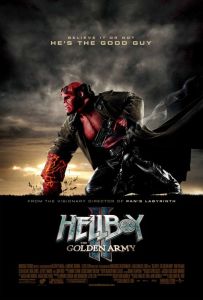 I disliked the first Hellboy, dubbing it the second worst film of 2004. The fact that I enjoyed the sequel is nothing short of shocking. Honestly, I think this mumbo jumbo is easier to swallow when it’s more fantasy based than science fiction based. I can accept an alternative magical world filled with elf princes, troll markets, and tiny “tooth fairy” creatures that act like piranhas with wings. Nazis and Zombie Rasputin trying to open a portal to giant squids? Hellboy II is even more imaginative and far more enjoyable. Writer/director Guilermo del Toro has refined the world and makes sure his story follows the rules it sets, which means that while the plot gets crazy it doesn’t feel cheap. I actually had some fun with Hellboy II and del Toro knocks out some pretty crafty action sequences. As expected, the makeup and creature designs are impeccable, which may explain why I had more fun watching the various magical creatures than following Nazis and slime wolves in the first flick. The lithe Angel of Death is particularly startling, with a head like a fried calzone and eyeballs dotted along expansive bird wings. This is a film that feels much more confident about its identity, thanks in part to getting rid of the rookie main character from the first film and focusing on the big red guy. If del Toro ever makes a third Hellboy film, I can honestly say I’ll be highly intrigued to see what weird wonders he cooks up. This statement is astounding considering I felt that there was only one 2004 film worse than the original Hellboy.
Nate’s Grade: B
Share this:

Fantastic Four: Rise of the Silver Surfer (2007)
 No better or no worse than the original, this less than fantastic follow-up to the cruddy 2005 superhero dysfunctional family melodrama ups the apocalyptic ante with the emergence of the powerful Silver Surfer, the herald for a cosmic cloud, yes cloud, that consumes the life forms of planets. The special effects run the gamut from fake and awful to passable, but what ultimately kills this movie is how little substance there is. It’s lightweight, shallow, and more interested in making the kids giggle. Example: The Human Torch, after touching the Surfer, can now switch powers with any of the members after they touch him. The Thing, covered in spongy orange rock, is lamenting his state but finds solace in his relationship with a blind woman. The Human Torch asks what Mr. Rock Dude what would do if he had but a few moments left in this world. Now, I’m thinking that the Human Torch is going to swap places with his buddy so that The Thing can enjoy even one night as a regular flesh-and-blood human being with his sweetheart. Maybe they could even knock boots without her getting serious rug burn. But no, the movie does nothing and just moves along because it doesn’t have the scope, the interest, or even the time to flirt with anything outside its limited plot. The storyline, what little there is, is predictable from beginning to end and the action sequences, while expanded from the first film, still fall far short of eliciting tension or tickling the imagination. I swear the only reason the flying jet thing is introduced was to sell toys. You have a bunch of people with unique super powers; the least the script could do is think of exciting things to do.
Nate’s Grade: C
Share this:

Pan’s Labyrinth (2006)
 Fantasy has a naturally cheerful tone. Someone did not tell that to Mexican writer/director Guillermo del Toro. The Hellboy director is obsessed with all things creepy, crawly, and gooey, and his films all seem to revel in the things that go squish in the night. Pan’s Labyrinth is a children’s tale not intended for children. It’s more in line with the fairy tales of old that were violent, sickening, and something to strike fear in disobedient kids.
Ofelia (Ivana Baquero) travels with her pregnant mother to live in a cottage along the Spanish countryside. Her mother has remarried The Captain (Sergi Lopez), a brutal officer in the ruling fascist government. He’s a stern and unforgiving man and plotting to eliminate the remaining scattered resistance soldiers. Ofelia discovers a series of stone stairs that lead to an underground labyrinth. Inside is a faun (the titular Pan) who recognizes the spirit of his world’s missing princess inside Ofelia. He gives her tasks to complete that will prove whether or not she can return to the other world.
This is a fabulously dark Alice in Wonderland for a more mature set. Pan’s Labyrinth is very similar to del Toro’s 2002 The Devil’s Backbone, a smart and affecting ghost story set against Spain’s bloody civil war. del Toro has set his supernatural fantasies against some very real and very dangerous backdrops. The Devil’s Backbone was more than just a ghost story, and now Pan’s Labyrinth is more than just a fairy tale. The real world is a violent and cruel place and worthy of a magical escape. However, the fairy tale creatures are not from the Disney school of kinder, gentler folklore. The faun is evasive and prone to outbursts when he/it does not get his hooved way. The other creatures, like a giant slimy toad, are all after their own gain and don’t much care for a little girl’s interference. There is no escape to safety.
 There are plenty of staples commonly found in fairy tales. Ofelia has to complete three tasks before the cycle of the moon. She has to complete trials of courage and prove her purity of heart. The characters look familiar but they definitely don?t behave the same. Pan’s Labyrinth has a continuing sense of dread. People die vicious deaths and the threat of violence is ever present.
The real world segments are just as engaging as the grander flights of fantasy. del Toro spins a very worthy tale of secrecy and suspicion at the dawn of Franco’s Spain. Several members of The Captain’s quarters are aiding the remaining resistance officers and risking their lives to hide their allegiance. It also draws the viewer in because these characters are the kind ones that look after Ofelia, who accidentally stumbles upon their secrets. The Captain is an earthly monster equal to the horrors of the fairy tale world. He has a deadly fixation with wasted time and punctuality (another Alice in Wonderland homage – the ticking pocket watch). Whether he’s torturing or shaving, the man seems peeved in all that he does. He tells the doctor that if a choice must be made, save the baby over the mother. His legacy demands an heir.
del Toro straddles differing genre lines like few artists out there. He has a great love for monster movies and horror but he also has great feel for human drama and a child’s wide-eyed point of view. Ofelia rests her head on her mother’s pregnant belly and speaks to her unborn brother. When her mother is experiencing complications she implores her brother to be gentle. It’s a little action but comes across as so honest and heartfelt from a child. The film is touching and exciting and pretty scary when it wants to be. Pan’s Labyrinth is a genre-bending gem that?s exceptionally well executed. The production design and make-up effects are terrific and lend to the otherworldly feel. The special effects are mostly a mix of practical designs and creepy make-up work, especially with the “Pale Man.” I especially enjoyed how the fawn moved and sounded, all clicks and creaks like he hadn’t moved his bones in ages. del Toro and his movie magicians do an excellent job of transporting you to two distinct worlds.
I could have used more labyrinth in my Pan’s Labyrinth. As it stands, the movie is divided as 15% fantasy world and 85% real world. That?s not enough for me. Maybe I just loved the fantasy elements too much or was expecting more of a live-action Spirited Away. Then again, del Toro has his mind set on an ambiguous ending that will divide the skeptics from the believers. Are there opposing worlds? Is Ofelia just making it up to escape reality? Whether what’s happening is real or not is irrelevant; Ofelia believes it is real. I feel that the movie could have been even greater had it utilized its fantasy side more.
 Take for instance the “Pale Man,” a grotesque monster that has to place its eyeballs in the palms of its hands to see. When Ofelia enters his realm its covered in ancient art showing this faceless creature devouring children. A giant pile of shoes sits in a corner as a constant reminder of the creature’s appetites. However, the creature sits at the head of a table motionless, unless some irresponsible child takes a bite from the illustrious feast of food at the table. Then the “Pale Man” springs to life. The imagery is horrifying but beautifully sickening, and it’s just too regrettable that Pan’s Labyrinth only gives such a memorable monster one single scene. I kept hoping that the movie would revisit the world it had begun establishing, all for not. I thought at least del Toro would have a fascist officer chasing after Ofelia and she would trace a portal back into the “Pale Man’s” world. Then she would escape but the officer would be trapped. He’s take a bite from the feast and then our occularly-challenged friend would go, “Well, you’re a little older than I like, but hey, beggars can’t be choosers.” CRUNCH! You must judge a movie for what it is, not what it could be, but I am certain Pan’s Labyrinth would have been even more remarkable had it just done more with its wild imagination. Oh well.
2006 has been something of a revelatory year for Mexican directors working within the Hollywood system. Alejandro Gonzalez Inarritu released Babel (bleh); Alfonso Curaon released Children of Men (wonderful), and now del Toro’s dark fantasy Pan’s Labyrinth is just starting to get a wider release. The film straddles the lines of genre, touching upon horror, human drama, fairy tale, historical action, and still finds time to be invigorating and moving. The production design and make-up effects do wonders to bring del Toro’s mordant imagination to chilling life. del Toro reigns supreme in the realm of sticky and icky things. Had the film actually spent more time interacting with its twisted fantasy creatures, I would gladly call Pan’s Labyrinth the best film of 2006. But alas we can’t all have our wishes comes true no matter how many fauns we encounter.
Nate’s Grade: A
Share this:

Hellboy (2004)
Guillermo del Toro loves things that go bump in the night. The Mexican born writer/director has shown prowess at slimy, spooky creatures with Cronos and 1997’s Mimic. He helmed the 2002 sequel to Blade, which had super vampires whose mouths would open up into four sections with rows of chattering teeth. The man sure loves his movie monsters. del Toro also loved Mike Mignola’s cult comic book Hellboy enough to turn down directing Harry Potter 3 and Blade 3 to ensure he could bring Hellboy to the big screen. Was it worth the sacrifice?
Let me just explain to you the villains of this movie as an example of how ridiculously stupid Hellboy is. The villains are Nazis. Yes, the tried and true villains everyone can hate Nazis. But these ain’t yo daddy’s Nazis; they’re immortal and led by zombie Rasputin (yes, the Rasputin). They all wish to puncture a hole into another dimension. What’s in this alternate dimension? Why nothing except for a giant floating spaceship that houses, I kid you not, the Seven Gods of Chaos, which all happen to be gigantic space squids. Why would anyone create a universe that has nothing but the imprisoned gods of evil? That seems awfully precarious. How exactly are giant squids going to take over the industrialized, nuclear-age world? Shoot ink at everyone? Sorry, space ink?
Let me not forget a Nazi assassin and his handy dandy arm-length blades. This assassin is also 100 years old and his body is filled entirely with sand. He winds himself up like a big clock. But if his body is filled completely with sand how can the clock gears work inside? You see what the normal audience member has to deal with? Plus these are just the villains, there’s a whole plot left to toil over as well.
The story revolves around a hulking, red demon named Hellboy (veteran character actor Ron Perlman). Hellboy escaped the space squid dimension in the 1940s when the Nazis unsuccessfully tried to open a dimensional hole large enough for your everyday on-the-go space squid. Now, Hellboy is an elite soldier for the governments Bureau of Paranormal Research. He fights the creepy crawlies. He has to deal with a wide-eyed rookie, the watch of his father (John Hurt) and an attempt to rekindle a romance with a mentally troubled fire starter (Selma Blair). Oh yeah, and all the Nazi/Rasputin/space squid stuff mentioned before.
Perlman is really the only redeeming thing about this movie. The makeup is impressive, and he gives an enjoyably droll performance as a man who fights monsters with the same ho-hum-ness as a plumber reacts to clogged sinks. The rest of the acting runs the gambit of either being too serious (Im looking at you Blair) or just too over-the-top silly (Im looking at you, league of villains).
Hellboy is strung together with bizarre inanities, flat one-liners, heavy Catholic imagery, conflicting logic and contradictions, ridiculous villains, painful comic relief, half-baked romance and frustratingly ever-changing plot devices.
Watching Hellboy is like playing tag with a kid that keeps making up new rules as he goes (“You cant tag me; I have an invisibility shield!”), and after awhile you lose any interest. Late in the film, the Nazis will all of a sudden decide not to be immortal, and at a very inopportune time. Why? How? I don’t know. Hellboy also gets sudden new powers for some reason. Like he can bring people back to life by whispering otherworldly threats in their ears. For some reason nobody’s clothes burn when theyre set on fire.
Not only does Hellboy frustrate by changing the rules of its world arbitrarily, it will also frustrate out of sheer uninhibited stupidity. How come characters cant hear or see a pendulum the size of the Chrysler building? How come during a vision of the apocalypse we see a newspaper that actually had the time and staff, during the Apocalypse, to print an issue that reads, “APPOCALYPSE”? Why doesn’t Blair use her pyro superpowers immediately to vanquish all the H.P. Lovecraft creatures instead of letting Hellboy foolishly wrestle with them all? The gaping holes in Hellboy are large enough to squeeze a gigantic space squid through.
All this frustration and insanity might have been moot if the action sequences were somewhat thrilling. Sadly, they are not. Del Toro’s action sequences seldom matter. There’s such little consequence of what’s going on that the action becomes stiff and lifeless. The first time we see Hellboy chase a creature through city streets it’s a fun experience, but soon the novelty wears off. The overuse of CGI wears down the audience, and after the third or forth time we watch Hellboy battle the same monster, the audience is ready to go to sleep. There’s little entertainment in the film’s action sequences, but just as much frustration and stupidity.
I have never watched a film that induced more eye rolls, shoulder shrugs, raised eyebrows, pained and confused glances and mutters of, What the hell (boy)? By the time the resurrected torso of a Russian skeleton appears to make cheesy puns and wisecracks, you should have left the theater, demanded full compensation, and maybe, if you’re into it, destroyed whatever Hellboy display was within burning distance. Comic book aficionados may enjoy the fruits of Hellboy but general audiences will simply shrug. I’m amazed that the majority of film critics seem to think positively about this movie. Maybe I’m the last sane person in an insane world but Hellboy is one of the worst films of the year and one of the craziest films you could ever hope to see in a lifetime.
Nate’s Grade: D+


 nathanzoebl
You must be logged in to post a comment.