Blog Archives
Disney Nature’s Earth (2009)
 The kind folks at the newly established Disney Nature division want to make sure those who missed out on the stunning 2006 Discovery Channel/BBC miniseries Planet Earth get another chance. Earth is a re-edited, recycled version of the globe-trotting miniseries, cutting down 8 hours to a bladder-friendly 95 minutes. Disney has given the film a family-friendly narrative, following the exploits of three families; a mamma polar bear and her cubs, a whale and offspring, and an elephant and its little thundering toddlers (note to parents: the film doesn’t shy away from death but you won’t watch any onscreen kills). The footage is jaw-dropping and to witness it on the big screen is a must-see. The mini-series, and by extension the new movie, is a powerful advertisement for conservation without having to get on-message or preachy. The gorgeous images speak volumes. The filmmakers spent over 5 years compiling mass amounts of footage, and some cameramen sat in isolated and harsh conditions for a year in order to snap rare moments on film. While the film cannot rival the mini-series, it’s still a highly watchable experience with eye-popping visuals and, really, little else. It serves as a tasty appetizer for the larger main course, the immersive and riveting Planet Earth mini-series. But hey, there is something God-like about listening to James Earl Jones detail the particulars of life on this spinning blue orb. Earth is mostly spectacle but ho boy, is it first-rate spectacle.
Nate’s Grade: A-
Share this:

American Teen (2008)
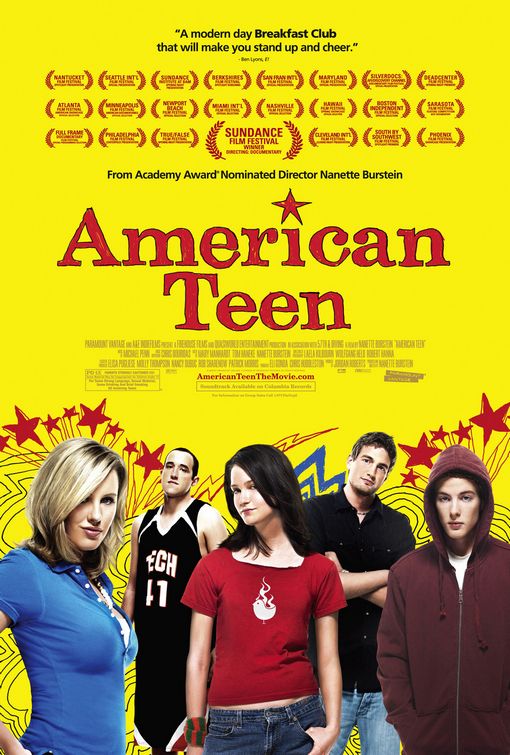 Filmmaker Nanette Burstein (On the Ropes) wanted to document the lives of actual American teenagers. After a national search, she settled on the town of Warsaw, Indiana, which we’re told in the opening narration is “mostly white, mostly Christian, and red state all the way.” American Teen is the feature-length documentary that chronicles the lives of four Warsaw teens during their senior year. The class of 2006 includes Colin, a basketball star worried about securing a scholarship. His father, an Elvis impersonator, supports his son but reminds the kid that dad has no money for school, so it’s either a scholarship or the Army. This, naturally, places tremendous pressure on a 17-year-old and his play diminishes as he tries to up his stats. There’s Megan, the queen bee at the school who feels pressured by her family to get into Notre Dame. This makes her act like a cretin, apparently. Jake is a kid who feels uncomfortable in his own acne-scarred skin. He plays video games a lot and desperately wants to find a girlfriend. Then there’s Hannah, the artsy girl prone to spontaneous dancing who feels trapped by her town.
I found American Teen to be largely unbelievable for two major reasons. First, teenagers today are way too media savvy after having grown up on a bevy of reality TV programming, the ultimate genre of manipulation. Remember way back in 1991 when MTV first started The Real World, the pioneering reality TV show? The people selected to live together as a social experiment were interesting, unguarded, a nice cross-section of the country; you felt like you could run into these people on the street some time. Then about half way into its run, the likely turning point being the Las Vegas season, The Real World participants became self-aware. They knew to exaggerate behavior for manufactured drama, to play up romantic crushes, and to work from the realm of playing a well-defined cliché character; no longer did these people feel real, instead they felt like drunken auditions for a really lousy soap opera. And all of the people started looking inordinately beautiful, chiseled hunks and leggy, waif-thin models. When was the last time they ever had an overweight person on that show? Anyway, the point of this anecdote is that thanks to the machinations of reality TV, teenagers today have grown up with the concept of cameras and they know how to manipulate reality. One could argue that you will never capture the true essence of a person by pointing a camera at them, because the instant a camera is placed to document reality it changes reality; people talk differently, either more reserved or confessional. A camera changes reality, but this discussion point is a little beyond the realm of American Teen. So I doubt the legitimacy of watching the “real lives” of “real students,” especially when these kids come from a more affluent area and probably digest other MTV semi-reality dramas like the unquestionably fake The Hills.
 So how would you behave if you knew a film crew was making a documentary in your school? I fully believe that many of the actions caught on camera are done so because the students wanted to ensure that they would be in a movie. I cannot blame them. I mean, if I was close to being involved in a film I would probably check every possibility to ensure my lovely presence eventually fills up the big screen. What do you want from kids who have grown up as a generation of self-reflective narcissists thanks to reality TV and uninvolved parents (sorry, soapbox moment)? This is why the nature of documenting reality in a high school setting is questionable. Burstein’s cameras follow Jake around and he’s able to walk up to girls and ask them out, point blank. Would he normally be so bold? I don’t know. What I know for certainty is that there would be fewer girls interested in the acne-scarred self-proclaimed geek if he didn’t have the adjoining camera crew. I’m sure girls looked at Jake and thought, “Here’s my ticket to being in a movie.” I’m not trying to be mean here because Jake is a rather nice, typically uncomfortable and socially awkward teenager who will find his niche once he leaves the confines of high school. I’ve known several Jakes in my life. But I don’t believe that a socially awkward kid like this naturally dates three different girls, all of them pretty, without the promised presence of cameras.
Also, there’s this popular guy Mitch completely thrown in at the middle of the film. All of a sudden he sees Hannah onstage rocking out at a school battle of the bands function, and the movie slows down, Hannah literally starts glowing, and Mitch says, “Wow, I have a crush on Hannah Bailey.” Allow me to doubt the sincerity of this sudden cross-clique crush. We never witness the beginning of this relationship, each side feeling the other out, the nervousness and delightful possibilities. We just get a voice over of Mitch saying he likes her and then the film cuts to like weeks into their supposed relationship when they’re goofing off at a gas station. When Hannah is invited to a party with Mitch’s friends, naturally she’s going to feel a bit out of place amongst the cool, popular crowd. He hangs out with his friends instead of his girlfriend. He makes sure to say hey to everyone else even while Hannah is sitting next to him. The next day Mitch breaks up with Hannah via the modern marvel of text messaging (ouch). You never see Mitch again until the end credits reveal that he feels he has matured. Essentially, Mitch is only seen and introduced to the movie because of his attachment to Hannah. Clearly, Mitch knew that if he buddied up next to the pixie girl he would ensure some place in the movie’s running time. It worked, because Mitch is featured in the trailer, the poster, and even tagged along on the national press tour. To paraphrase the title of Burstein’s superior documentary, the kid found a way to stay in the picture.
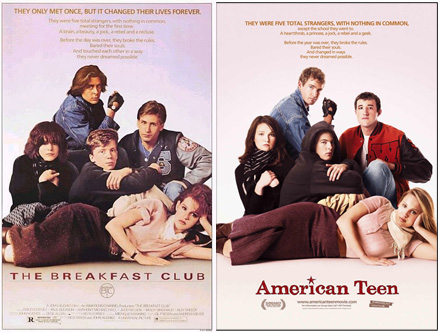 My second point of contention is that Burstein has taken scissors to 1200+ hours of footage to make her documentary about high school stereotypes, not people. Burstein has selected five figures to spotlight and she has whittled them down to one-word stereotypes: jock (Colin), geek (Jake), princess (Megan), rebel (Hannah), and heartthrob (Mitch). She isn’t destroying these lazy classifications but reinforcing them willfully. The marketing campaign around American Teen recreated the poster from The Breakfast Club. I swear, I think that art imitated life and now high schoolers are just imitating what they have seen propagated time and again as stone-cold reality in their schools: the rigid social caste system. There are so many missed opportunities by painting in such broad strokes. Colin is a jock because he plays on the basketball squad, but why can’t he also be a geek? Why can’t a rebel be a princess? I feel tacky talking in such degrading, baby-fied terms. Burstein doesn’t help her case by giving the main figures their own animated fantasy segments. Hannah is obviously the star of the film, and Burstein has seen to it that she narrates the tale as well. I suspect some canniness on Burstein’s part. Either the filmmaker felt that Hannah would most reflect the spirits of the crowds that attend indie documentaries, thus ensuring a bigger gross, or Burstein saw much of herself in Hannah and naturally wanted to make the “different girl” the star, possibly working through some of her own high school demons.
There’s also the issue of how staged some of this comes across. Am I to believe that Burstein’s camera crew managed to capture those perfect moments where the students stare out into space, thoughtfully? Am I to believe that the camera crew managed to capture everyone’s dirty little text messages then and there in the moment? Am I to believe that scenes of Hannah dramatically walking down the hallway weren’t planned? I’m forgiving when it comes to re-enactments but when a movie feels overburdened with re-enactments or posed figures, then it feels too manufactured. Just like The Hills.
Perhaps I’m coming down too hard on American Teen. After all, most documentaries distort some facet of reality and generally are edited to present a series of points. But the reason American Teen doesn’t work is because it offers zero insights into the American high school setting and little to no insights with its “characters.” Hannah is a cute girl with an independent streak but I fail to get a sense of her as a person. She gets dumped twice over the course of American Teen, suffers from crippling anxiety to the point that she misses almost a month of class, and she longs to leave the reach of her conservative town for the holy destination of California, so why then does the film not present her as a person instead of a classification? I also get the feeling that we don’t see any of would-be filmmaker Hannah’s own work because Burstein may be shielding her subject from the harsh realities or critical response.
 Obviously Megan is the villain of the piece and Burstein takes advantage of the girl’s self-absorbed sense of entitlement. Megan could be an interesting subject as far as casual cruelty. Megan vandalizes a student council member’s home because the guy had the gall to devise a different prom theme. We watch Megan literally spray paint a penis on a window followed by the word “FAG,” and then she whines that everyone is being mean to her even when the punishment she gets for a borderline hate crime is a slap on the wrists. Megan’s friend Erica makes the unfortunate decision to send a topless picture of herself in an e-mail to the guy she likes, who happens to be Megan’s friend and object of territory. So Megan briskly sends the picture to scads and scads of students with e-mail subject lines like “silver dollars” and “pepperonis.” Megan then leaves mean-spirited voice mail messages saying that Erica is destined “to live the rest of her life as a slut.” This is her friend! Burstein has the good sense of mind to interview a teary-eyed Erica after the topless photo fallout, and it probably is the emotional highpoint of the film because it’s so honest and wounded. Why not follow Erica after this? Surely her story, recovering from humiliation, is more intriguing then watching Megan scoot along her privileged life or whether or not Colin can be a better teammate. Speaking of the tall kid with the Jay Leno-sized chin, why does his dad insist that Colin needs a basketball scholarship or else “it’s the Army”? Has he not heard of student loans? Does Colin’s father believe sending his son into a war zone is preferable to amassing debt?
American Teen is a pseudo-documentary that has little intention to dig deeper under the surface of the realities of high school life. If your high school experience exactly mirrors this film, then perhaps you watched too many movies. Or the filmmakers did and tried to feed into the film idea of what goes on in a high school. Or both.
Nate’s Grade: C
Share this:

Man on Wire (2008)
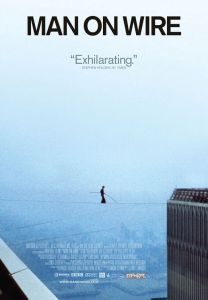 Why? That’s likely to be the question on many people’s minds when this documentary concludes. Why did effete Frenchman Philippe Petit decide to walk on a tight rope between the World Trade Center towers in 1974? Why devote an entire feature-length documentary to a subject that seems pretty limited? Well, Man on Wire is certainly an engaging film; amusingly, director James Marsh structures the flick like a heist movie, where we watch Petit assemble his team and practice his stunt. There is a sense of beauty watching a man balance on a wire hundreds of feet above the ground. The film also has colorfully French characters to fill in the details on how they pulled off the “artistic crime of the century.” Of course any modern art dealing with the World Trade Center is given new meaning, and Man on Wire is aided by added poignancy of watching the building construction and then the daring feats of Petit. I confess, though, that I’m dumbstruck at this movie being declared the finest documentary of 2008. It’s a good movie, sure, but not even the fourth best documentary I’ve seen in a doc-heavy year. The footage of Man on Wire is more amazing than the story behind how it happened.
Nate’s Grade: B
Share this:

Bigger, Stronger, Faster* (2008)
 Chris Bell came from a roughly normal family in Poughkeepsie, New York. He and his brothers were a little chubby but saw weight lifting as their ticket to success. In the 1980s, Bell and his brothers idolized muscle-bound heroes like Arnold Schwarzenegger, Hulk Hogan, and Sylvester Stallone. Muscles were the answer for the Bells. Chris Bell became a teenage weightlifting sensation and moved out to California to follow his dreams at Gold’s Gym, just like Arnold. Bell’s older brother, Mike “Mad Dog” Bell, actually had a career as a professional wrestler on the national televised stage, though he was always the one getting beat up. Bell’s younger brother, Mark “Smelly” Bell, could lift hundreds of pounds. Both Mad Dog and Smelly have been using steroids for years. Chris Bell decided to make a documentary that examines both his family’s interest in steroids and the culture that bigger is better. Bigger Stronger, Faster* *The Side Effects of Being an American is that final product, and it radiates with sadness and anger.
Don’t let the subject matter fool you. This is less an expose over steroids then it is a penetrating and somewhat sobering look into the intensely competitive culture in America to “be the best” and shuttle the rest. Bell uses a clip of Patton addressing his recruits, saying, “Americans love a winner and will not tolerate a loser.” Bell interviews a wide variety of subjects, from doctors on both sides of the issue, and when he gets to sports fans the general line of thinking is that steroids are awful, unless, that is, they can help my team. If the dominant culture is pushing athletes to be the best that they can be, or else, then is it any wonder that taking steroids would seem customary? Should we as a nation chastise athletes that we, as a nation, pressured into juicing up to attain the glory we expect, nay, demand from our competitors? It seems like the same folks that are shaking their fists and bemoaning the impure state of athletics are shirking their own responsibility for contributing to the toxic mindset to win at all costs. In many ways, bodybuilding and muscle-bound athletes can fall prey to the same distorted mentality as those suffering under anorexia and bulimia. Both groups have significantly dissatisfied body images, one wants to continue getting smaller and the other wants to continue getting larger. Bell interviews Gregg Valentino, who has biceps that looks like five-pound sacks full of ten pounds of potatoes. He says the ladies are repulsed but the men come up to him in awe. Mad Dog says that he knows he was “destined for better things” and cannot find any sliver of satisfaction in living a normal life. His brother points out that Mad Dog has a good job, a loving family, and a wife who goes along with all of the emotional turmoil but still supports her man. Can’t he be happy with just being who he is?
 When the film shies away from Bell’s personal connection to the topic, the movie isn’t as compelling, though it is rather informative. Steroids have been painted as a scourge; however, the scientific evidence doesn’t bare this out. In the end, anabolic steroids are a supplement and have risks just like any other supplement or drug on the market. Bell has plenty of data to argue that legal drugs, like tobacco and alcohol, kill tens of thousands more a year than steroids (I think the doc informs that the yearly deaths attributed to steroids is around 3). The reason our society is so misinformed about steroids is because of heightened media hysteria and the likes of overly anxious lawmakers. Bell speaks with clear disdain when he reports that in 2004 Congress spent eight days covering the topic of steroids and grilling baseball stars; that eight days was longer than Congress spent deliberating the Iraq War, the response to Hurricane Katrina, and over health care. When Congress covered the steroid topic in the 1980s they interviewed heads of national public health offices, and those wise experts stated that the health risks from steroids had been exaggerated. So Congress just ignored their testimony. I get it, steroids serve as a boogeyman because few actually know what it does or, frankly, what is actually is. There are many different kinds of steroids, some of which are used all the time with societal approval, like cortisone shots intent to aid inflammation. Where people seem to have issues is over anabolic steroids, which is an extra boost of testosterone. Bell points out that the side effects of steroids are almost always completely reversible after the user stops taking the drug. How many other drugs, legal and illegal, can make a similar claim?
A very interesting side step the film takes is over the issue of legal dietary supplements. The dietary supplement industry does not require FDA approval to sell products. This means that the FDA must prove that a product is unsafe to take it off the shelf, rather than the more traditional approach where the drug company must prove that their drug is safe before selling it to the masses. It should also be no wonder then that the supplements that people buy in giant bottles at health food megastores are likely not much more than placebos, if you’re lucky (one supplement package advertised its “new legal formula”). Bell hires a few illegal immigrants and concocts his own dietary supplement with rice powder. He bottles it, labels it as “The Juice,” and can sell it for a gigantic profit margin, and it’s all legal.
Is performance-enhancement just apart of being an American and living out the American dream? Tiger Woods got laser eye surgery and can now see better than 20/20, so is that an acceptable performance enhancer? What about the United State’s fighter pilots who regularly are prescribed “go pills” to boost their energy levels? It’s suitably alarming to discover that the United States is the only country to make it mandatory for its fighter pilots to take amphetamines. Of course not everything Bell touches upon as performance-enhancing drugs measures up credibly, like when he mentions beta-blockers for people with performance anxiety. I don’t think tamping down anxiety is akin to enhancing performance since it merely allows the performer to perform with what they already have. Bell’s documentary has loads more questions than answers, but the best part of the film is that it doesn’t hide from contradictions but instead magnifies them and asks for an ongoing debate.
 Bell’s film is wide-ranging, lucid, and unexpectedly funny, but the most compelling moments occur when Bell looks at his own family history. Both of his brothers will likely be life-long steroid users because they feel that it doesn’t give them an edge but evens the playing field. Mike’s little brother, Smelly, is not content to go from lifting 700 pounds to 600 pounds. Neither brother has the courage to open up to loved ones about the steroid use. Smelly teaches teen boys and they idolize him, quoting his encouraging assertions that the kids don’t need drugs to go places. The hypocrisy is sad and I wonder what Smelly’s kids will think once they catch the documentary. Bell’s mother is brought to tears trying to determine where she feels she went wrong as a parent. Two of her boys are rampant steroid users and have equated muscles with self-importance, but it’s the admission that Bell himself once tried steroids that shatters her. When Bell also enlightens his mother that her own brother was the source of steroids then she just shuts down. She pleads with her son to stop because she can only take too much. Bell was brought up to believe that cheating is wrong and inherently un-American, and yet the system is practically rigged to reward cheaters. Carl Lewis and other 1988 U.S. Olympians actually tested positive for banned supplements but were given a pass, as the Olympic Committee blamed the results on “inadvertent use.”
Bigger, Stronger, Faster is a clear-headed and entertaining movie that challenges the audience to reconsider its feelings over steroids. The film is informative and presents counter arguments and thankfully plays out multiple sides to controversial and complicated issues. By the end of the film, Bell isn’t necessarily pro-‘roids but asking that we better scrutinize the culture that pushes for greatness at any cost. Human beings willingly destroy their bodies out of a desire to simply forever be better. When perfection is adopted as the norm then it’s no wonder that millions of Americans will never be remotely satisfied with whom they are. Bell encounters a 50-year-old body builder at the gym he works at. This man is packed with muscle but he says he’s forever “in training” and still waiting for his big break, whatever that may be. He currently lives in his car, but he justifies his plight by saying that if he can out-lift and out-bench others then he’s the winner. This man could not be a more perfect symbol of the price of winning at all costs. The asterisk in the film’s title is what truly tells all.
Nate’s Grade: B+
Share this:

Dear Zachary: A Letter to a Son About His Father (2008)
 Dear Zachary: A Letter to a Son About His Father is an extremely personal movie, but it’s also a gut-wrenching, emotionally devastating film that will completely empty out your tear ducts. As an ardent fan of film, I cannot fully advise doing some research on the real-life case before seeing the movie, but those with less strong sensibilities may be better off knowing what they are going to be in for. This film is emotionally draining and infuriating, but it is also unquestionably one of the best films of the year, bar none. Just thinking back on it makes me have to fight back tears.
In 2001, Dr. Andrew Bagby died at age 28. The squat man had a chubby face, a large personality, and an innate ability to make friends wherever he went. Here was a case where one man made a difference simply by living out his life (several grooms had pegged him to be their Best Man in weddings). Filmmaker Kurt Kuenne decided to make a movie that would serve as a living testimony to the life of his departed friend. He traveled the nation, interviewing scads of friends and relatives about what Andrew meant to them. For Kuenne, Andrew was his childhood best friend and the star of numerous home videos, which are a treasure trove of footage that reveal a charismatic star.
 But, you see, Andrew didn’t simply die, he was murdered. He was enrolled at med school in St. John’s, Newfoundland. There he met a woman who became instantly smitten and very emotionally needy. Dr. Shirley Turner was 40, twice divorced, and controlling. Friends lament that Andrew’s fragile sense of self-esteem when it came to girls probably made it easy for him to relish the lavish attention that Turner gave him. He found a family practice in Pennsylvania for his medical internship, and he didn’t invite Turner to come along. After being dumped, she drove 1000 miles to talk to Andrew. The next morning he was dead, lying face down in a park and having been shot five times. The circumstantial evidence was pretty damning for Turner, so she fled the country back to St. John’s in Canada. Andrew’s family thought the extradition process would be over quickly, but the wheels of justice in Canada spin even slower, and Tuner, a likely premeditated first degree murderer, was allowed to be free on bail even though she didn’t have to put a single cent down, nor did anyone else.
But this is where the story gets even more tragic. Turner revealed to the world that she was four months pregnant, and a DNA paternity test revealed that Andrew was the father. Andrew’s parents, David and Kate Bagby, moved to St. John’s to gain custody of the last link they had to Andrew. Kuenne’s film had a new purpose: to educate a child about the father that they will reluctantly never know. Turner gave birth while in prison and named the child Zachary Andrew Turner. Amazingly, the Canadian courts gave Turner custody while the extradition process dragged on for nearly two years. One ruling by appeals Judge Gale Welsh will make your head explode. While Turner was in jail and going to be extradited, Welsh granted Turner bail, again, without requiring Turner to put any money down, again (are numbers just meaningless?). Welsh ruled that Turner did not pose a threat to the community because the alleged crime of murder was “not directed at the public at large but was specific in nature.” Ergo, because Turner only sought to kill one man and succeeded, surely she poses no risk to others. Excuse me? And you’re a freaking judge? It does actually get worse from there.
 You will likely not see a more chilling antagonist in a movie this year than that of Dr. Shirley Turner. I do not say this lightly, but this woman is evil. You never see a glimmer of remorse in her eyes, only cunning manipulation and a deep psychosis. She readily knows the power she has and punishes Andrew’s parents over and over, putting them through an emotional wringer to be near their grandson, and all the while Turner pretends like nothing of consequence happened. It’s like a normal play-date between her and her in-laws. I am amazed that Andrew’s parents were able to swallow so much injustice to be involved with Zachary, the last living connection to their lost son. When David Bagby says how much he hated Turner, you too will feel every bit of seething anguish. To be fair, Kuenne’s film is wholly biased when it comes to his depiction of Turner, but you know what? I don’t care. Let’s objectively compare Andrew and Turner and see what each left in their wake. Andrew has a glut of friends and family that mourn him. Turner does not. This woman is evil and she had a long history of dangerously unstable behavior that Canadian justice officials ignored. The lengths that Turner will go to hurt others is terrifying. This woman makes Joan Crawford look like a responsible parent.
But while it’s the horror and tragedy and near unbearable sadness that will long stay with you, Kuenne’s movie also is a showcase for the capacity of human goodness. Andrew’s parents should be fast-tracked for sainthood after having to obey the whims of their son’s emotionally disturbed killer, who astoundingly was given the upper hand in the custody battle in Canada. David and Kate are exceptional people, both hardscrabble and resourceful but also funny and enormously good-hearted. When they move to St. John’s they immerse themselves in the community and quickly collect new friends. Many of Andrew’s friends feel like they were practically adopted by his parents; they will readily credit David and Kate for expertly raising such a beloved person. Dear Zachary is a terrific example of people who excel at parenting, who instinctively know how to tackle the greatest challenge in life, shaping a human being. Kate is so naturally loving with little Zachary that it eventually causes friction with Turner when she realizes that the baby doesn’t want to leave grandma’s arms. By the conclusion, you will feel better about the state of humanity that there are people like David and Kate out there to make a difference in a thousand subtle ways in a thousand different lives.
 As a filmmaker, Kuenne doesn’t overwhelm his true-life tragedy with spiffy visual artifice. That doesn’t mean Dear Zachary feels like a glorified home movie. It’s somewhat morbidly fascinating to watch one man work through his grief, and the film serves ultimately as a means of catharsis for the filmmaker. In that regard, Keunne can be forgiven for overdoing it a tad with some music cues trying to amp up emotion that’s already present. He also displays his understandable anger at certain points that mock Canadian authorities and Turner. The imperfections seem to make it feel more authentic. The documentary is only 90-some minutes but Kuenne packs lots of information and interviews into a small space of time. In fact, Kuenne serves as director, writer, narrator (he occasionally even gets choked up), composer, but his work as editor is the most accomplished. Through teams of interviews and home movies, Kuenne is able to bring Andrew to life in a manner where an ordinary audience member feels like they know the guy. The editing can be spastic, sometimes interviews bleed over into one another and Kuenne uses elliptical sound bites for poignancy. The editing keeps viewers alert and intrigued. I never found the editing to be problematic, but I welcomed Kuenne trying to pack as much life into his film about recreating a life.
Dear Zachary is a documentary that needs to be seen to be believed, and it desperately and deservedly needs to be seen. This potent doc is emotionally wrenching and will stir up great anger, which might just point lynch mobs toward our bewildered neighbors to the North. But Kuenne’s film isn’t just a sad movie that requires a few boxes of tissue at hand. No, Dear Zachary is also inherently a very life-affirming tale about the long reach of human goodness, as evidenced by Andrew and his parents. While the Academy has already left Dear Zachary off its shortlist for the Best Documentaries of 2008, I doubt you’ll find a more stirring and heart-breaking story in documentary form.
Nate’s Grade: A
Share this:

Young @ Heart (2008)
 Old people and rock and roll seem like contradictory terms. It’s easier to imagine a 70-something grandma listening to the soothing tunes of Lawrence Welk or the Andrews Sisters than the likes of Sonic Youth and The Clash. Young @ Heart is a documentary that follows a unique chorus made completely of senior citizens (the youngest member is 72) who travel the country singing contemporary rock songs. Now, bear witness to great-grandmothers rocking at a reasonable hour and partying on days where they take their meds.
Once old people reach a certain aged age they fall into the same category as children, and by that I mean you can position them to do anything out of the ordinary and it suddenly becomes adorable. Seeing a baby wear a top hat? Cute. Seeing an old person dance to a modern rock song? Cute. I don’t make the rules, folks, but the end of life and the beginning of life have much in common, which includes the universal appeal of young and old doing things unlikely for their age. So, yes, Young @ Heart has a steady supply of adorable moments, especially as you watch how joyous many of the members are when they practice. Many members of the chorus have severe medical ailments and profess that participating and singing has medicinal benefits. They feel young and energized, and sometimes the members will defy doctor’s orders to attend. It is clear how much singing can mean to these people, and watching them come alive is undeniably heartwarming, but it’s downright moving when the Young at Heart chorus branch out. They perform at a prison and literally bring incarcerated prisoners to tears. I’ll admit that I was fighting back tears myself during the stirring performance of Coldplay’s “Fix You,” which is given a somewhat profound new meaning. The lyrics, “Lights will guide you home,” and “When you lose someone you can’t replace,” are given more relevance when sung by octogenarians who have all experienced recent loss amongst their ranks.
 With such a naturally intriguing premise, it’s a shame then that director Stephen Walker doesn’t do more with the material. In many ways, Young @ Heart is a rather ordinary documentary that forgoes several opportunities to dig deeper. The interviews are rather basic and rarely penetrating, and the narrative structure of practicing for the big show means that the concluding fifteen minutes will be locked into being the performance. Walker narrates the movie and often inserts himself into the film because it seems like he wants to be part of the fun. Documentaries can succeed from objective and subjective point of views, but I get frustrated when people like Walker don’t want to merely tell the story but piggyback so they are part of the story. It smacks me of narcissism.
I think there was a stronger dramatic dynamic with Young @ Heart than what Walker captures, and I think he misses this because he had lowered ambitions for the film simply to document the seven-week period of practice. Every now and then you’ll discover a moment that points to what Young @ Heart had the potential to become, but Walker’s intention is more along the lines at gushing at what geezers can do. I get that Walker feels affection for his subjects but couldn’t he have gone further than the old-people-sing-young-people-songs gimmick? Some times the film feels like it has as much depth as a prototypical behind-the-scenes featurette on a DVD.
Walker evenly divides the film between performances and interviews and he also doesn’t overdose on the pathos even after deaths hit the Young at Heart clan. The movie has several music videos where the old folks sing to songs like “Golden Years,” “I Wanna Be Sedated,” and “Stayin’ Alive.” As you can see, each song is given something of a twist. However, the music videos come across as cheesy and unnecessary since seeing the performers live would be more interesting and real. Including several music videos, of songs that we never see the chorus practice no less, seems like wasted time that could have been spent getting to know our cast of characters better. I’d rather better know them as people than laugh and giggle at them performing The Bee Gees at a bowling alley.
 There are some chorus members that separate from the pack like 92-year-old Eileen Hall who used to be a burlesque dancer many moons ago. She’s the oldest in the film and yet in many ways has the most indomitable spirit, frequently cracking jokes and making suggestive statements that Walker deems to be “flirting.” Fred Knittle is a man who was told he’d have two years to live after suffering his latest heart attack. By the time he rejoins the chorus he’s at two years and four months and running. He ably steps into the solo spot to sing “Fix You” after the original singer passes away. The moment is so pure and emotional that it reminds you about the power of music in a non-saccharine way. One of the more interesting figures in the film is Bob Cilman, the music director of the Young at Heart chorus. Here is a man in his 50s teaching contemporary rock songs to the elderly, and yet the film never explores this man and his infinite patience. What are his reasons for doing the Young at Heart chorus? What does he think about his own life’s purpose? The movie would have strongly benefited by spending more time exploring the life of this man and his unique mission. I want to know what makes him tick.
My faults with the film do not fall upon the subjects. This batch of senior citizen rockers is a delightful group and watching them perform can be entertaining and occasionally inspiring. However, I cannot fully recommend it because its scope and interests are far too narrow given the subject matter. Director Walker would rather treat his senior subjects like they were posing for a calendar in adorable poses, and I’m glad he has such warm affection for these lively octogenarians. But his affection clouds his filmmaking judgment and Walker ignores plenty of palpable drama. The concluding concert will certainly produce smiles and some toe tapping, but this drama could have been so much more. I can honestly say that, beyond the communal experience, there is no reason to catch this movie in a theater. It will play the same on your TV screen. If only Walker had listened a little harder to his older subjects then maybe he would have realized that true wisdom does not come merely from a cute gimmick.
Nate’s Grade: C+
Share this:

Religulous (2008)
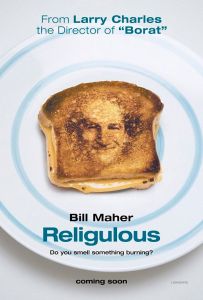 There is no topic in the world more volatile than religion. It dominates cultures, reshapes geography, inspires people to work with the poor, inspires people to attach bombs to their chest, and is as old as time itself. Most civilizations constructed a religion after they grew to a certain size. So who in the world would want to make a sacrilegious opinion-piece documentary that wants to open eyes as well as have a good laugh? Bill Maher is a comedian that respectfully never holds back his true feelings. He’s unflinching in his social commentary on his HBO TV talk show, and religion has often been a thorn in Maher’s side. He personally views it as a mental disorder. Religulous is his eviscerating and intriguing expose as he travels the holiest sites in the globe and asks, “Why?”
For the most part, Religulous doesn’t take a hammer to religion as it does the fundamentalist followers. There are several subjects that cry out for ridicule, like pastors living large and very un-Christ-like on the coffers of their congregations, egomaniacal televangelists that squeeze pennies out of lonely widows, those that babble in tongues, Joseph Smith, Scientologists, and people that celebrate scientific ignorance. Maher is attacking the hypocrisy of fundamentalism, but his condemnation isn’t only reserved for Christianity. He is an equal opportunity offender. In the most surprising venture, Maher takes a trip to the Holy Land and chats with Islamic practitioners about the double standard of its more ardent followers. I suppose repeatedly yelling “Death to Israel” is copacetic but an editorial cartoon that tweaks the religion over its extremist tendencies toward violence is an insult that cannot stand as freedom of speech? Maher really delves into un-PC territory and wants to know why he sees Islamic followers being so overly sensitive to criticism. I think given the fact that like 50 people died as a result of protests over cartoons, there may be room for discussion here. I credit Maher for not ducking away from provocative questions no matter the setting (he even got into the Dome of the Rock mosque!)
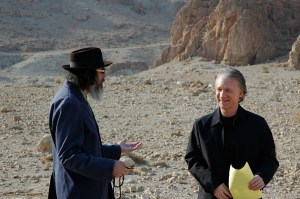 Maher and director Larry Charles follow the same documentary techniques Charles honed as he directed 2006’s Borat movie – a small shambling camera crew that ambushes rubes with tough questions and watches them sputter and squirm. This technique can be amusing when we feel that the harsh inquisition is deserved. Your regular Joe who believes that Jesus is his co-pilot is not deserving of Maher’s smug stares. There’s a moment where he asks a nice guy if he believes that he will reach heaven upon death. He believes he will. “Then why don’t you kill yourself?” Maher asks coldly. It’s uncalled for, and I say all this as a genuine fan of Maher. Still, the movie is regularly funny as it deconstructs religious traditions with quick-cuts to old Hollywood religious epics as cinematic rimshots. One of the better and more convincing moments is when the film compares the theological coincidences between the Egyptian god Horus and Jesus Christ, all set to the Bangles instructional song “Walk Like an Egyptian.”
I personally don’t believe that having faith in the unseen/unknown or being religious equals being stupid. Quite the contrary. However, it’s easy to gather a specious view of religion when all you talk to are ignorant yokels. Maher has perhaps one or two sit-down interviews with people educated in theology, but mostly he sticks to interview subjects that he can mock or those that share his opinion (his extended interview with the leader of Amsterdam’s pot-fueled “cantheism” is irritating). I think Maher is doing a disservice to his film’s target by not discussing theology with learned scholars, with people that can articulate lucid and complete thoughts, with people that have all their teeth. Did he seriously think he was going to able to find a defense for Biblical contradictions at the Holy Land amusement park or at the trucker church? I strongly doubt it. In many ways Religulous strictly sticks to the sideshow of Christianity, peering at the fringe elements. I’m all for grilling fundamentalists that cannot square science and God, but if Maher wants to expose all religious followers as wrong-headed, and not just the ones that think Jesus rode a dinosaur, then he needs to tackle more substantial figures in the field.
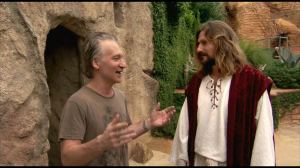 But then Maher fumbles his conclusion and loses me. It is in the closing five minutes that Maher attempts to string together his thesis statement, saying that in order for man to live that “religion must die.” Up until this point Maher has been irascible but committed to his ongoing ideology of “I don’t know.” He professes not to know what will occur after death and wants to press other people into a spirited discussion of the spiritual. But then comes the finish and Maher speaks with the same certainty that he castigated fundamentalists earlier. He is no longer preaching discussion but preaching immediate action to thwart belief. Maher becomes very agitated, his tone gets very sharp, and he steps on the soapbox to once and for all attest that religion of all shapes and measures is rubbish. It’s in these concluding moments that Maher sidesteps from his message of doubt and speaks in aggressive and alarmist hysterics. Maher spent most of [i]Religulous[/i]’ running time attacking hypocrisy but now he demonstrates his own.
I feel that Maher has many good points to make. Religion becomes extremely detrimental when it morphs into nationalism. The Founding Fathers did not envision the United States as a “Christian nation” and were mostly deists with little regard for traditional worship. Questioning and doubt are actually signs of a healthy relationship with faith, because it means that person is active with their faith. Maher showcases the well-known historical grievances caused by religion, or more accurately the followers of religion, but he brushes past the good of religion. It can be a unifying force that calls for people to love thy neighbor as thyself and to turn the other cheek (it’s amazing that the fire and brimstone Bible thumpers forget about the Be-attitudes). Religulous is an entertaining skewer of fundamentalism and close-mindedness, which is why it falls apart when it too turns close-minded.
Nate’s Grade: B-
Share this:

Taxi to the Dark Side (2007)
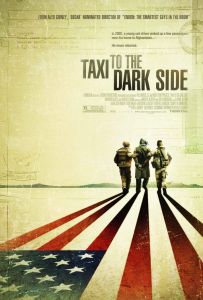 Just like he did in 2005’s excellent documentary Enron: The Smartest Guys in the Room, filmmaker Alex Gibney is able to distill a complex topic into a coherent argument. His Oscar-winning documentary Taxi to the Dark Side looks deep into the repugnant state of justice after 9/11 and the Bush Administration’s disregard for the law. It’s decidedly uncomfortable and upsetting, but Gibney’s film should be essential viewing for everyone to fully understand what questionable lessons we are sending out to the world under the guise of winning the indefinite War on Terror.
In late 2002, Dilawar drove two passengers out of town in his taxi. He was stopped at an Afghan militia checkpoint and he and his passengers were turned over to the U.S. military. The Afghan militia leader accused the trio of being responsible for rocket attacks against U.S. forces (In reality, the militia leader was responsible and just turning over innocent men to make inroads with military personnel). Dilawar was sent to Bagram prison where he was subjected to sleep deprivation, physical abuse, and made to stand for hours on end handcuffed to the ceiling. He died after two days in custody. The military coroner ruled that Dilawar’s death was a homicide. The report was swept under the rug until a New York Times journalist went searching for answers. The official who instigated the “interrogation techniques” was rewarded and sent to teach her harsh brand of degrading interrogation to another prison – Abu Ghraib. I think we all know how well that turned out.
 Like No End in Sight, which Gibney also produced, the film benefits enormously by staying away from brash finger pointing and hysterics. It slowly assembles its methodical case using hard evidence, like the prison coroner’s report and declassified memos, and a bevy of interviews from the people who were on the frontlines and behind the scenes in Washington. Gibney builds a devastating case that left me sick to my stomach and overwhelmed with the urge to weep. Taxi to the Dark Side is a powerful and masterfully assembled indictment on how far the United States of America has slid from its moral high ground. I felt sorry for the numerous innocent men plucked from their homes and tortured. I felt sorry for the soldiers being pressured to get results fast and through whatever creative means only to be turned into patsies by a government looking to pin “a few bad apples.” I felt intense shame in my own government condoning degrading and humiliating practices that stretch the legal definition of torture. And I felt burning anger at the realization that President Bush had tucked away a little provision in a bill signed into law that stated no officials in his administration could be tried for war crimes. The soldiers on the ground who followed orders set out by those officials, however, were fair game. Bush pardoned himself!
Gibney uses Dilawar’s story as a framing device that broadens the scope of the film. He explores the whole nature of torture and the questionable tactics our government and military have engaged in since 9/11 in the name of keeping the country safe. But as the film continues on we still remember Dilawar. His death casts a pall that hangs over the entire running time that serves as a potent rejoinder to any interview clip or TV segment where officials dismiss the severity of torture techniques (Secretary of Defense Rumsfeld scribbled on one memo complaining that he stands many hours a day, so how could this be torture?). Thankfully, the film also comes back to Dilawar during the closing moments to draw out the man’s humanity and shine a closer look at the personal cost of such illegal practices. It’s sad and shocking that well over 90 percent of the prisoners in Guantanamo Bay and U.S. coalition prisons were turned in by locals for money. Who knows however many innocent men like Dilawar are imprisoned without any path to see a court (recent Supreme Court rulings have said that detainees do have a right to contest their imprisonment in U.S. courts).
What is all too evident is that Bush administration officials were establishing a hazy and vague definition of torture on purpose. This of course had the benefit of not linking their names to illegal practices that could lead to war crimes. This also made sure there was no set guideline for interrogation and detention. Without any guidelines and rules the soldiers were expected to get results with no oversight. It doesn’t take a genius to figure out that being isolated in a foreign country and surrounded by a culture of machismo is going to breed cruelty if there is no enforcement of law. The U.S. skirted the Geneva Conventions by denying suspects any rights and saying they could be detained, without charge, for the rest of their lives. Vice President Cheney proudly declares that the enemy plays dirty and therefore America has to resort to the same dirty tactics. One soldier recounts a mentally handicapped prisoner who officials kept swearing was just putting on an act. “This is the new cover for al-Qaeda,” they were told even as the man ate his own feces. I’m sorry, but my country should be morally above whomever we deem an enemy. The “he started it” defense does not register for me.
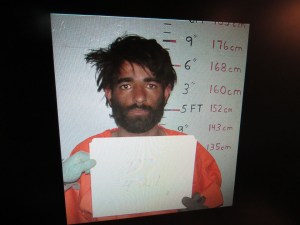 But perhaps the biggest non moral related sticking point is that torture is notorious for not generating factual claims. When someone is being tortured they will say whatever to make the situation cease, and this includes fabricating tales about terrorists and an Iraq link to 9/11. Instead of verifying and corroborating these confessions, the interrogators jot them down as fact, send them to the brass above, and that’s how the U.S. produced sources that said Saddam Hussein and Osama bin Ladin share a friendship bracelet and have brunch on Tuesdays. Even if you do not object to torture on moral grounds, and I pity you if you cannot, then a thinking person should at least object to torture on the very basis that it does not work. It produces bad intelligence, false intelligence, and in a rush to conflict that can yield terrible and far-reaching ramifications (six years in Iraq and counting, insurgent recruitment rising, the erosion of the U.S.’s standing over the world). The ends clearly do not even approach justifying the means.
After detainee abuses, President Bush declared to TV reporters that, “The United States doesn’t torture.” The asterisk to that declaration is that the U.S. rejects the internationally agreed upon definition of torture and will decide what constitutes torture, and even then we’ll just outsource it to countries that will torture. Taxi to the Dark Side is a sobering and powerful film that will serve as an important reminder for generations to come about the damning evidence of torture. The film is presented with clam and precise logic but it still manages to eradicate any argument that torture is acceptable under the right circumstances (advocates like to cite the idea of a ticking bomb and a suspect who knows the location). One interview says it all. He’s an FBI interrogator for over 20 years, and he says that to glean workable intelligence you don’t beat someone and make them fear you; you make them like you. You play “good cop” not “insane cop,” and you will gather actionable, verifiable, helpful intelligence and you have nothing to feel guilty over. If only the current administration had more men with such clarity and moral fiber.
Nate’s Grade: A
Share this:

Expelled: No Intelligence Allowed (2008)
 Ben Stein is best known as the monotone teacher in Ferris Bueller’s Day Off, but the man has also been a speechwriter for Nixon, a game show host, and popular figure of deadpanned irony. Expelled: No Intelligence Allowed follows Stein as he travels across the world interviewing scientists, authors, professors, and others about what he sees as a disservice to science and America. “Big Science,” as he refers, is so heavily entrenched in the theory of evolution and the teachings of Charles Darwin that they are unwilling to even broach alternative approaches. Intelligent Design believes that life is far too complicated to occur randomly, and thus must have been created by some powerful supernatural designer. The teaching of evolution is still seen as a controversial subject and I.D. proponents want their theory to be given equal time.
Stein tries to skew his argument into one about freedom. The Constitution calls for the freedom of speech and our nation is built upon the bedrock of being a marketplace of ideas. Stein compares the resistance in the scientific community to Intelligence Design to the Berlin Wall, and he argues that I.D. proponents just want to open up the dialogue. Detractors warn that I.D. is just Creationism in sheep’s clothing, and indeed the U.S. courts have ruled the same way. The problem with Intelligent Design is that it can’t really apply to science. Science can only test what exists in the natural world, and religion by definition deals with the supernatural and thus can’t be tested. It’s one thing to say, “The sky is blue because God made it so,” but what else do you do with that as a scientist? Where do you go from there as a teacher? Science textbooks would be awfully thin, since you would just need one sentence to sum up all of existence. Evolution begins with the start of life and no one has a strong feel for how life began, but I.D. runs into the same wall if you think about it. Saying, “God created life” leads to the question, “How was God created?” and now we’re back where we started. Personally, I don’t see why evolution and religion have to be seen as forces that cancel each other out.
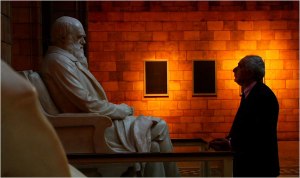 Ignoring the subject matter, Expelled just doesn’t even work effectively as an expose documentary. The movie continuously jumps to old newsreel footage as a visual resource even for mundane conversations. It happens again and again. Either the filmmakers thought their audience had ADD or was too stupid to sit through an interview without several jump cuts to visual reference points. Some of the clips are fun in a goofy retro way but the whole decision comes across like a narrative crutch and it makes Expelled feel erratic. Stein doesn’t try very hard to disguise his interview style, which includes him leading his interview subjects and lobbing softball questions like, “Intelligent Design is just Creationism, right,” and the audacious, “What was the purpose of the concentration camps?” I think it is telling that the interview subjects are not given lengthy reactions and are not pressed into actually presenting what Intelligent Design proof that exists. In contrast, the evolutionary scientists interviewed are intercut with clips of Nazis and Communists soldiers. I don’t even think Michael Moore would have chosen to go that obvious.
While I’m on the subject of Moore, Stein follows some similar ambush tactics and they are obvious and obnoxious. Stein tries to walk into the Smithsonian Center to get a statement as to why a prominent scientist was released and ends up getting kicked out. Did he expect anything different? Portions of Expelled come across as transparently staged, and upon some research I have learned that some were indeed staged. The film opens and closes with Stein addressing a full crowd of college students. They erupt in rapturous applause by the end of his speech and give the man a standing ovation. That crowd was nothing more than paid extras and Stein has never traveled the college circuit to speak on Intelligent Design. The scientists that were interviewed were also misinformed and told that they were being filmed for a documentary called Crossroads about the “intersection of science and religion.” The evolution scientists interviewed were then barred from free public screenings. That should tell you something.
Scientists being blacklisted by their peers seems rather unfair, but the movie takes their subjects strictly at face value. I am convinced there is more to the story than Expelled lets on. One woman off-handedly mentioned the phrase, and that was all, and was let go. I want to know more, but the film apparently doesn’t. Stein even cuts her interview off and dubs his own voice over as she continues her story. I would have appreciated some interviews with scientists who believe in evolution and God. Given that approximately 99.97 percent of life scientists believe in the theory of evolution, so statistically there must be a healthy slew of scientists who happen to be Christians that believe in the existence of evolution.
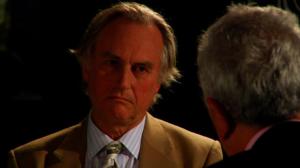 The film is heavy-handed propaganda, sure, but man oh man does it just take an ugly turn in its last third. Ben Stein eventually makes the leap from evolution to… wait for it… Nazism and the extermination of those less desirable. Stein and some of his interview subjects are making the case that Hitler was directly influenced by the tenets of evolution and that he used Darwin’s template to snuff out Jews, Gypsies, gays, the handicapped, and all those holding back the human race with their inferior genetics. There are many steps removed from Darwin to Hitler, but Stein is laying the blame of the Holocaust at the feet of Darwin’s ideas. Arguably, exterminating an inferior race could be applied to the idea of natural selection (though forcibly killing millions doesn’t seem very natural to me) but people were killing each other long before Darwin was ever born. Before Darwin, there was still genocide in the name of eliminating those deemed inferior, and mostly it was performed with the justification of religion. Surely historically religion has been the motivator for more death than Darwin (count the Crusades and the Inquisition). Even specifically Jews have been persecuted and put to mass death centuries before Darwin. And what about all the countries in the world that have embraced evolution as science and not gassed millions of people? But Stein persists in trying to attach the Holocaust and Nazism to evolution. To me, this is like blaming The Catcher in the Rye for shooting John Lennon in the head. Darwin posited ideas and cannot be blamed for others perverting those ideas for their own gain. The film also glosses over the fact that it was Herbert Spencer who introduced the phrase “survival of the fittest,”
And yet after spending a good deal of time linking Darwin and the Holocaust, Stein throws out this caveat: “But I know that Darwinism doesn’t automatically lead to Nazism.” Expelled is filled with other such contradictions. It argues that science and, specifically, evolution does not disqualify the existence of God, and to this I agree whole-heartedly. Science provides the “how” in life and religion can provide the “why” for people. Science does not disqualify God and vice versa; however, Expelled then trumps interview after interview of scientists that explain how evolution turned them into atheists. Huh? The film presses the irritating and confusing point that evolution will turn everyone into a bunch of atheists, but this conflicts with one of the film’s central points on the roles of religion and science. Stein never goes into great detail in this area and ignores the fact that a majority of the American public is both religious and believes in evolution.
 Expelled starts to become an ideological dartboard by the end of its experience. Stein says evolution is responsible for eugenics, which lead to the idea of population control, which lead to Margaret Sanger founding Planned Parenthood. My reaction is: so? Planned Parenthood promotes safe sex and performs legal abortions, yes, but they have nothing to do with eugenics and religion. Henry Ford and Walt Disney were also believers in eugenics. But the interview subjects all seem to repeat the phrase “euthanasia and abortion” like it was a talking point they were handed. The exact phrasing is so precise for several interview subjects that it seems deceptive. Why does this matter at all in a movie reportedly about Intelligence Design?
I cannot honestly see anyone being converted by Expelled. Skeptics and believers in evolution will fail to be swayed, and for the large Christian community the film is courting, well it will be preaching to the choir. I just discovered that there’s a website called expelledexposed.com intent to hold Stein’s film to review. I’m a firm believer in evolution and that Intelligent Design is religion; yeah they don’t specify “who” but how many I.D. proponents were the same ones pushing Creationism in schools earlier? If they stick to the tenets of Intelligent Design then I’d like them to accept the Raelians in their camp (Raelians believe that aliens seeded our planet). Expelled never makes the case for why Intelligent Design should be taught, merely that it is unfair to exclude it from the classroom. The movie presents contradictions, logic fallacies, and some disconcerting guilt-by-association arguments that border on exploitation. Even though I disagree with its ideology, from a filmmaking standpoint it falls apart. The topic of evolution’s relationship to religion deserves a thoughtful and intelligent movie. This is not it.
Nate’s Grade: F
Share this:

My Kid Could Paint That (2007)
 Prodigy, fraud, normal preschooler? This incisive and captivating documentary looks at a four-year-old who has made thousands of dollars on her modern art paintings. If she is the real deal, what does that say about modern art when a child can compete with serious artists? This intensely interesting story is given as objective a viewpoint as possible even as the filmmaker is forced into his own movie when the family he’s been documenting is looking at his film as a favorable retort to a very critical 60 Minutes segment casting doubt that the paintings are genuine. The filmmaker has his own doubts and explores the nature of journalism and storytelling and objectivity and what is art, and that’s when the documentary transcends its story and becomes about much more. I have no doubt that the child is involved in painting (the question registers with how involved her failed artist father is), but the people that are buying her paintings are buying them because they are also purchasing the story. My Kid Could Paint That, as one interview subject states, is really a story about adults seeking the limelight, because otherwise it would just be a kid having fun painting in the confines of her home. Is she exploited? Is she a genuine talent in a world of paint splashes and squiggly lines? Will she ever just be allowed to be a kid? These are just a few of the tantalizing questions this mature and insightful movie raises.
Nate’s Grade: B+


 nathanzoebl
You must be logged in to post a comment.