Blog Archives
Zootopia 2 (2025)
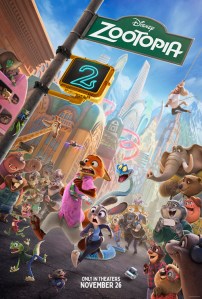 I’m genuinely shocked it took nine years for Disney to drum up a sequel to their billion-dollar “woke” allegorical hit, Zootopia. It used anthropomorphic animals living in a modern metropolis to analyze prejudice, racism, and segregation through the dichotomy of predators (untrustworthy animals beholden to vicious nature) and prey (docile animals). Specifically, it was about plucky police officer Judy Hopps (voiced by Ginnifer Goodwin) learning to work with con artist-turned-ally Nick Wilde (voiced by Justin Bateman). Now the partners are back and on another wild case uncovering yet another long-standing mystery of the city’s history entrenched in blame and suspicion of a “kind of people,” namely serpents/reptiles, who were driven out of town generations ago. There is a slight repetition in the message about looking beyond staid stereotypes and accepting other animals as equals (will Zootopia 3 be about finally accepting insects?), but when the tolerance message is essential to what made the 2016 original movie so much more thoughtful and relevant and satisfying, then keep it. The movie rises on the bickering but engaging buddy dynamic between Judy and Nick, who obviously love one another but don’t know how to admit it (consider me a shipper). The mystery tackles themes of gentrification, forced relocation, on top of its anti-prejudice and pro-tolerance foundation, so there’s plenty to unpack thematically while also taking in the visual whimsy and action slapstick. I laughed heartily at several points, including a very unexpected but transparent reference to a classic horror film complete with heavy music cues. It’s not as fresh or as finely developed as its predecessor but Zootopia 2 is further proof that this universe and its creativity can house many adventures, even if some of those plots and themes get repetitive.
Nate’s Grade: B
Share this:

Lilo & Stitch (2025)/ How to Train Your Dragon (2025)
 Two new live-action remakes are recreating Millennial staples, Lilo & Stitch and How to Train Your Dragon, as transparent facsimiles, and they’re both reasonably fine. If you’ve never watched either animated movie, you’d maybe even call the live-action versions pretty good for your first experiences with these stories. Both movies understand what works essentially from their predecessors and don’t reinvent the wheel. They keep things pretty safe and strict, which translates into pleasant but predictable entertainment for anyone familiar with the originals.
 I don’t even know how to fully review these entries, which is why I’m combining them together. They’re both so thoroughly fine yet one is the highest-grossing movie of 2025 so far, the popularity of which I cannot explain. My conceptual issue with the nature of live-action remakes is the implicit belief that animated films improve when they are brought into a real-world setting. I strongly disagree. Animated movies can be vibrant, stylistic, and exaggerated in such daring and artistically enigmatic ways. Translating that into real-life often strips away that style or liveliness; take for instance how un-expressive and dour the “live-action” Lion King was, a collection of possessed (cursed?) taxidermy. Animation does not require verisimilitude to be entertaining or engaging. I’m also worried over the speed of which these live-action remakes are coming, now refreshing fairly recent movies. Has there been enough distance between now and 2010 to have compelling artistic differences with the original How to Train Your Dragon? Apparently not. When the live-action Moana comes out in 2026, will it be dramatically different or better than the animated version? I strongly doubt it. We need more distance from the original animated movies so the remakes aren’t just slavish yet inferior versions of the originals. There needs to be more than simply a tracing over. I don’t see this ending any time soon considering the commercial rewards, and so the live-action Lilo & Stitch and How to Train Your Dragon continue to be good stories, just unnecessary.
Nate’s Grades: B
Share this:

Moana 2 (2024)
 It’s hard not to see the DNA of its original incarnations as a TV series for Disney Plus, as well as the awkward adjustments to slap this together into a feature film. Unless you’re a super fan of the original Moana who needs any additional content, you’ll likely have a less than impressive response to Moana 2. It feels quite episodic from villains and storylines popping up for small increments of time only to go away and be replaced by a new storyline, to a new batch of characters meant to hold our attention while other main characters, in particular Maui (Dwayne Johnson), sit out for long stretches. The animation is a notable step down as well, and while it’s still pleasing to watch and far from bad, it’s lacking the detail and refinement of the feature team, especially with lighting, as everything in this world lacks shadows with such high key lighting washing everything out. Without Lin-Manuel Miranda returning, it’s obvious the songs will not be nearly as catchy and enchanting, and the tunes for Moana 2 are pretty instantly forgettable. I’m struggling to rethink any melody right now as I write this. It’s hard not to feel like everything is so slight, from the storytelling to the visuals to the songs to the inclusion of the beloved characters from the original. I loved Moana and consider it the best of modern-day Disney, and I’m clearly not alone from the box-office dominance that the sequel was able to achieve. I actually think I would have preferred future Moana adventures as a TV series because the mythology and world has more to explore. But that version of new Moana has been transformed, Frankenstein-style, into a releasable feature film, one that suffers in the transformation into something it’s not suited for. Disney made a billion dollars from this gamut, but the rest of us are left with a Moana 2 that had much further to go.
Nate’s Grade: C
Share this:

Winnie the Pooh: Blood and Honey 2 (2024)
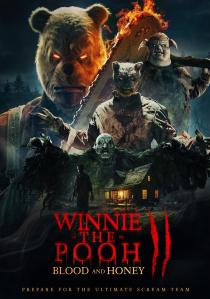 The first Winnie the Pooh: Blood and Honey was, unquestionably, my worst film of 2023. It wasn’t merely a bad horror movie, it was a depressingly cynical cash-grab with such little forethought of how to subvert the wholesome legacy of its classic characters. As I said in my review: “The startling lack of imagination of everything else is depressing, as is the fact that this movie has earned over four million at the global box-office, hoodwinking enough rubberneckers looking for a good bad time. The problem is that Winnie the Pooh: Blood and Honey is only a bad bad time.” Oh, dear reader, I wasn’t looking forward to the inevitable deluge of follow-ups, as writer/director Rhys Frake-Waterfield would resupply his surprising success with further sinister revisions to public domain properties. He’s planning on a “Poohniverse” crossover event with a combination of Pooh, evil Pinnochio, vengeance-fuelled Bambi, and a traumatized or villainous Peter Pan. Again, schlocky movies that lean into their schlock can be wonderful things, but a movie that does next to nothing with its subversive hook, with the history of its cutesy iconography, and could be easily replaced with any other menacing slasher killer is beyond lazy, it’s insulting. I figured there could be nowhere to go but up with a sequel, and while Blood and Honey 2 is an improvement in just about every way, it’s still not enough to qualify as a fun or ironic treat.
Wakefield and new co-writer Matt Leslie (Summer of 84) completely rework the mythology and history established in the first movie, which is now revealed to be the literal movie-within-a-movie of the account of the Massacre of the 100 Acre Wood where Pooh and Piglet slaughtered a troupe of bad-acting British coeds. In this prior film, it was established that Pooh and his buddies were angry with Christopher Robin (Scott Chambers, replacing Nikolai Leon) when he left for college. They felt abandoned and grew feral and monstrous, rejecting the ways of man (though still wearing the clothes of man and driving the cars of man). However, now in the sequel it’s revealed they were always feral and blood-thirsty and it was Christopher who incorrectly remembered them as cute and fluffy. This scene makes for the hilarious visual of a child waving innocently at a blood-strewn manimal lurking about. Also, Christopher had a young brother who was abducted by the creatures of the 100 Acre Wood and never seen again. Also also, there was a mad scientist who was creating human-animal hybrids from missing children, so the blood-thirsty animals might not be actual animals after all (can you see where this is going?). While the first Blood and Honey movie did nothing with the characters, this movie actively gives them a tragic history with some twists and turns, enough to lay a mythos. The use of hypnotherapy-induced flashbacks isn’t exactly smooth or subtle, but I’ll take it. At least this movie provides a distinguishing plot that makes some use of its particular elements. Don’t mistake me, dear reader, this is faint praise at best, but after enduring the creatively bankrupt first film, it’s like a desperately needed oasis. Ultimately, it might all just be a mirage but at least it’s something to those of us who suffered!
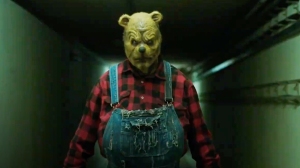 In the grand sequel tradition, bigger is better, and now instead of two ferocious beasts wreaking havoc, it’s four, with the addition of Owl (Marcus Massey) and Tigger (Lewis Santer). None of these monsters has a particular style or attitude that distinguishes them. I guess Tigger calls people “bitch” a lot and slashes people. There is one point where hapless cops are investigating a crime scene and say, “Let’s bounce,” and Tigger says from the luxury of the shadows, “Hey, that’s my line.” I figured they’d incorporate the signature Tigger bounce on his tail, but perhaps that was too expensive to perform or that bounce was more a byproduct of the Disney version of the character, still under copyright, and not the available A.A. Milne version. The animal costumes look better than the cheap Halloween masks of the original, though for my money Owl looks more like a turkey vulture wearing cray paper. I’m sure we’ll get Kanga in the inevitable third movie in 2025 where her zombie baby leaps out of her pouch to feed on brains. There is a snazzy addition late into the proceedings where Pooh is welding a fiery chainsaw. It makes little sense for the character but it’s cool, so it’s excusable in lapsed movie logic.
I was hoping for more unique kills, twisted takes related to the characters, like Pooh turning some poor soul’s head into a honeypot. The kills are just grizzly and extensive, favoring quantity over quality. There are plenty of decapitations, gougings, impalings, and other fraught and violent encounters, nearly all of them featuring squealing, terrified women. It’s always women that seem to get the worst in these movies, but of course this is a feature and not a bug of the genre back to its 80s heyday. It gets relentless but I suppose at least these girls aren’t having their tops mysteriously fall off while they’re being butchered. A third act rave set piece features maybe two dozen kills and risks becoming tedious slaughter. It got to the point where I was hoping not to see another cowering person hiding behind a corner because it meant the sequence was going to be even more unbearably long (I’m not personally cut out for the Terrifiers).
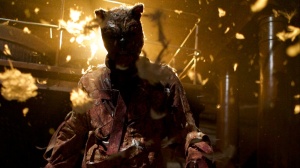 In between the spillings of blood and guts is the attempts at human drama, namely Christopher Robin trying to live a normal life while also re-examining his past. Apparently people think he’s to blame for the massacre from the 100 Acre Wood, and so he’s become a pariah, whose very presence unsettles others. He’s trying to find steady work in a hospital setting but he’s blacklisted from pursuing his career because of the negative attention his name generates. He even has a romance with a single mom so that when the Robin family is inevitably skewered we have other characters that can be personally threatened to provide meaningful stakes. The life of Christopher Robin and his discovery of repressed memories makes for a surprising story foundation for Blood and Honey 2, especially when the plot of its predecessor was mostly Christopher being held prisoner and the baddies casually roaming and killing coeds. I think Chambers is a better actor as well, and he’s posed to be the writer/director of Neverland Nightmares, which just began principal photography a month and a half ago as of this writing. Good luck, guy.
While the budget has increased tenfold, Blood and Honey 2 is still a scuzzy, sleazy slasher movie at heart. If you’re in the mood for a low-budget exploitation movie heavy with gore, there may be enough to qualify this sequel as moderately mediocre, which again is a marked improvement from what I declared the worst movie of 2023. I’ll credit the influence of co-writer Matt Leslie to try and put some standards in place for this runaway gravy train of IP allocation. What’s scariest of all is what Frake-Waterfield’s unexpected success has wrought, encouraging imitators to jump on his now proven novelty act. There’s a 2025 Steamboat Willie horror movie called Screamboat as Steamboat Willie has now entered the public domain (but not other versions of Mickey). Will it be any good? I sincerely doubt it. Will it make money from curious horror hounds looking for an ironic twist on a wholesome childhood fixture? Most assuredly. This is our present. This is our future, and it’s the legacy of Frake-Waterfield and his ilk that stumbled onto a lucrative novelty act. Winnie the Pooh: Blood and Honey 2 is just bad, and for that it’s an improvement.
Nate’s Grade: D+
Share this:

Elemental (2023)
 The joke is how Pixar has taken its storytelling motif of examining The Secret Life Of [Blank] and showing what happens in our world when we just aren’t paying attention. We’ve had toys with emotions, bugs with emotions, fish with emotion, cars with emotion, robots with emotion, rats with emotion, and even emotions with emotions, so why not break things down to their basics and give the elements of carbon-based life their own emotions too?
In Element City, Ember (voiced by Leah Lewis) belongs to the fire community living on the outskirts of town, as the big city wasn’t built for their kind. The earth people, and water people, and air people go about their business while the fire people form their own thriving offshoot. Her father and mother came across the sea to give their baby a new life, and the family shop will pass over to Ember’s management when her traditionalist father thinks she’s ready. Her whole life has been about serving her family and trying to live up to their hopes and dreams. This gets more complicated when Wade (voiced by Mamoudou Athie), a water person and a health inspector, has to report her family’s shop for code violations. They work together to save the shop and also learn from one another’s cultures and differing perspectives, and then this unexpected friendship becomes an even more unexpected romance, but can elements so different stay together?
 I was pleasantly surprised at how enjoyable Elemental is to experience and how wondrous its visual presentation is to watch. It is a certifiable treat for the eyes, with so many dazzling colors and quirky but easily readable character designs. There’s a mixture of hand-drawn animation used as Spider-Verse-style accents that provides a pleasing element that allows the images to pop even more. I was never bored looking at a single second of this movie, and even with my theater’s 3-D presentation, the glasses didn’t darken the screen and lessen my overall enjoyment. By existing within a fantasy universe, it allows for every scene and every location to better inform you about this new world and its rules and highlights (fire baby carriages that are barbecue grills). This is a bright, colorful, and supremely enchanting movie to watch because, at least visually, it feels very well developed as far as its world building and atmosphere. What would a community of fire people tend to look like? What would their jobs be? What would their celebrations be like? Their heritage from the Old Country? Naturally, with any fantasy universe, you can nit-pick it to death with questions, such as why do people even bother wearing clothes in this world? What part of the exposed fire or water is observed as obscene? How exactly do these different communities have their offspring? What does air exactly eat for food?
Where Elemental really takes off is with its charming and affecting romance. It’s been a while since romance was at the forefront for a Pixar movie, since 2008’s WALL-E (a.k.a. the greatest Pixar movie). Now there are themes and resonance that go beyond the romance and also enrich it, like Ember’s personal conflict of being a first-generation immigrant daughter and upholding the traditions and wishes of her family at the expense of her personal desires, but the core of this movie is on the burgeoning feelings between Ember and Wade. The movie begins with them butting heads as two elements seemingly in conflict but it doesn’t exactly follow an enemies-to-lovers path. She runs hot and explosive with trying to keep things under control whereas he is deeply empathetic of others and wants to help them become their best selves. He accepts who he is, and the movie doesn’t equate his full-bodied embrace of big feelings as some point of weakness. It brings about laughs from exaggeration, the streaming rivers that burst forth from his eyes upon crying, but it’s his compassion and acceptance that challenges Ember for the better and helps her assert her sense of self. They’re good together, and Wade helps serve as a guide to the wider world for Ember as she’s been isolated her whole life. Their interactions are cute and heartwarming and elevated by pleasant vocal performances. I was drawn into their story and cared about their well-being, enough that I don’t mind sharing that I shed some water myself by the end (I guess this could also make some people mistake that I peed my pants, and I assure you that was not the case, dear reader).
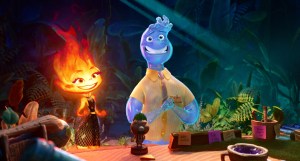 While the core relationships are poignant and winning, the world building and metaphorical allegories feel half-finished and a tad confusing. The movie also goes surprisingly soft exploring its miscegenation metaphor of two elements being forbidden to mix romantically. This universe has four communities of living elements, though air is represented as clouds and those are, literally, water vapor, and the xenophobia and discrimination that the fire people endure feels like a direct parallel to a disadvantaged minority group. However, this isn’t explored in any satisfying depth. We’re told that fire people aren’t really wanted in the city, and the city isn’t really built for them, which is typified by a rail line that splashes water discharge. There’s a lot more that could have gone into this including a more elaborate examination of the harm of red-lining and restricting the economic mobility of one group for bigoted reasons (I know, I can already hear people scolding me for even asking for such socio-political commentary in a family film). However, this metaphor gets a little murky when you take into account the literal danger that living fire exudes. Yes, you can drown, and you can get crushed under earth, but these creatures aren’t walking incendiary devices. This doesn’t translate directly to people, and thus applying class metaphors to actual races can be circumspect. Ember’s worry is that she’ll explode if she gets too angry, and this causes literal physical destruction around her. You can say it’s meant to represent when hurt, angry people lash out that they can inadvertently harm others, but not everyone can incinerate a block because they lose their temper. This kind of undercuts the lesson on misplaced fear.
Also, so much of the external story consists of bad public planning and everyone’s lackadaisical attitude toward fixing this infrastructure miscue. Again, if the larger point was a society that is actively hostile to the fire people, then the ignorant city planning that actively harms a disenfranchised group of people makes sense, but without that larger underlying conflict, it all seems so strangely forgotten. Much of this conflict is on the structure of a wall against a coming buildup of water, something possibly deadly to the fire community, so you would think this community would be a lot more concerned about this looming conflict. You might think that others would organize to provide better safeguards or maybe they would get the city’s attention. That this threat goes unreported and is played at such low stakes makes it all feel forced and manufactured. If the characters don’t seem to think it’s a big deal, then who are we to worry as well? And I can hear some of you trying to branch this out into, say, a metaphor for larger problems that go ignored, like climate change or societal inequalities, but that’s giving Elemental too much credit.
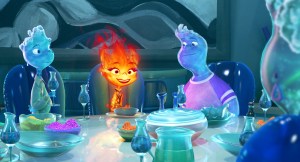 Elemental reminds me of 2020’s Onward, coincidentally one of the last movies I saw in theaters before the pandemic shutdown. I was worried that the core story looked weak but it was actually the world-building that was a bit hazy and under-developed and the emotional core was strong and authentic. It’s the same with Elemental, and while I can quibble about its dropped potential and misshapen world, it has a strong foundation that matters more. The relationships between Wade and Ember and Ember and her family are what makes the movie work and ultimately what made me smile and tear up. It’s an emotional nourishment that makes the movie feel satisfying and worthwhile no matter the lingering questions for this bizarre world. It’s also one of Pixar’s best looking movies, fully deserving of being seen on a large screen for added impact. Elemental has the right DNA for a charming and enjoyable family film for everyone.
Nate’s Grade: B
Share this:

The Little Mermaid (2023)

With every new Disney live-action remake, and we’re not slowing down any time soon folks, I feel like I need to stipulate two reservations I have, so, dear reader, here is my boilerplate. First, I believe that simply because a film is animated does not mean it is missing something or somehow inferior to a live-action movie. Animation is a showcase of imagination and ingenuity and visual decadence, and often the live-action interpretations of this only serve to dilute and downgrade the quality of those presentations. I can’t believe the recently announced live-action Moana will add anything more magical or visually beautiful than the 2016 animated original. Second, the closer these original animated movies are to the present, the less likely that Disney will be to change things up. The core audience will be demanding fidelity to the source material, and thus we usually just get an inferior version of the same story with minimal alterations. Occasionally, Disney can really surprise with some of these live-action remakes; I adored Pete’s Dragon, was charmed by Cinderella, and will defend Tim Burton’s unfairly maligned Dumbo.
Now we reach The Little Mermaid, whose 1989 release began the much-heralded resurgence of Disney animation through the 1990s. I re-watched the original a couple years ago and found it still quite ebullient and compelling, but I was shocked at how short it was (only 80 minutes long) and how brisk much of its third act felt. With a few more old-fashioned wrinkles to iron out like gender roles and the prominence of securing a man, I felt there was actual room where a modern remake could actually improve upon the original. Having seen the live-action Little Mermaid, I can say that it falls into a middle zone where it can’t quite escape the shadow of its predecessor but it exhibits plenty of its own winning qualities to cheer audiences and fans of the original.
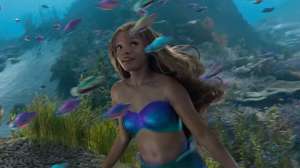
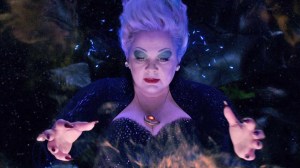
Ariel (Halle Bailey, not to be confused with Halle Berry) is a teenage mermaid and the youngest daughter of King Triton (Javier Bardem), the ruler of the seas. She longs to be part of the surface world, the world of man, and she’s willing to sacrifice her voice to her malevolent Aunt Ursula (Melissa McCarthy) for a pair of legs. She has three days to secure true love’s kiss, likely from Prince Eric (Jonah Hauer-King), but she can’t recall what she needs to do as part of Ursula’s spell. Her friends Sebastian (Daveed Diggs) the crab, Scuttle (Awkwafina) the gannet, and Flounder (Jacob Temblay) the fish must help protect and guide the new Ariel-with-legs.
Let’s start with the positive attributes that separate this Little Mermaid, and chief among them is the fantastic lead performance from Bailey (one half of the singing sisters Chloe x Halle). This is a star-making turn from this young woman who completely makes the role her own. She has a natural grace, curiosity, and charm to her Ariel, and when she gets her chance to belt the big musical numbers, she delivers a stirring rendition. I got tingles during different parts of “Part of Your World.” A good half of the movie takes place after her Faustian bargain, so Bailey is acting without her voice and she still is able to communicate so much through her physical performance as well as her facial expressions. The filmmakers decide to give Ariel several new songs through the guise of internal monologues where she can express all that she is feeling and thinking during her fish-out-of-water adjustments. I think it’s a smart move and while none of these new songs are particularly memorable, giving Bailey more opportunity to flex her own voice, both literally and thematically to express her character’s perspective, is a good creative choice.

I also was pleased that much of the added time, which amounts to almost a full hour of material, is devoted to fleshing out Eric and the development of the romance with Ariel. Rather than simply being a handsome himbo, this Eric is an adopted son of his island nation, and he feels more at home aboard a ship than in any royal ceremony. There’s a direct parallel with Ariel and Eric rejecting their predetermined roles under the pressure of royal expectations. This Eric even gets his own version of a “Part of Your World” ditty about dreaming for something more, especially after his chance encounter with a mermaid set his world afire. It’s not a particularly great song, as none of the new additions are on par with the Oscar-winning originals, and some of the lyrics made my wife physically cringe next to me in the theater (“Strange as a dream/ Real as the sea/ If you can hear me now/ Come set me free”). There is added time where the romance feels much more organic as we witness Ariel and Eric get to know one another and watch one another come alive and share their interests. The added curse of Ariel forgetting her end goal of true love’s kiss is an intelligent way to make the romantic feelings between them feel more believable and less the byproduct of her urgency and the manipulation of her friends. The added rom-com moments give more credence to their romance and it better reflects on both members.
McCarthy (Thunder Force) acquits herself very well as the villainous sea witch. She puts her own spin on Pat Carrol’s famous vocal performance from the original, making her Ursula the seething also-ran waiting on the sidelines and nursing old grudges. The added back-story makes Ursula Ariel’s aunt now, which adds an extra degree of menace to their transactional bargain. I was also reminded how little Ursula is in this movie until it counts, so to justify her continuing presence, we have a few check-ins where she basically monologues her thoughts on the action. It feels like padding but I didn’t mind because I got to spend more time with McCarthy.
And now, dear reader, let’s go through some of the adaptation changes that aren’t quite as charming or beneficial. The colorful realm of the sea feels rather limited in this rendition. The vastness of the ocean and its mermaid kingdom feels strangely contained, and that’s a result of the reality of filming on a large empty set as well as the cost of extensive special effects. This is another case where the beauty and imagination of animation proves incomparable. The differing versions of “Under the Sea” really magnify this. Along those lines, making Ariel’s aquatic friends photo realistic robs them of the personality and expression they exuded in the animated movie, and it also drags them into an uncomfortable uncanny valley. Stop robbing characters of expression for the sake of added biological “realism.” It’s a bad trade. Stop it, Disney. Watching a photo realistic Flounder flop around on dry land while he tries to cheer Ariel on with his expressionless might-as-well-be-dead fish eye is not as whimsical as it should be. The original voice of Sebastian, Samuel E. Wright, has a small cameo as a fisherman, and it’s nice to hear his familiar voice again, especially knowing the actor sadly passed away in May 2021.
I’ve already discussed the new songs by Lin-Manuel Miranda being mostly agreeable but unremarkable, but there is one new track that stands out for all the wrong reasons. Being a Miranda musical, it’s not unexpected for the inclusion of a new hip-hop-infused song, especially with his Tony-winning Hamilton co-star in the movie. What is surprising is that Daveed Diggs doesn’t get the bulk of the new rap song but instead it’s Awkwafina, and her voice at these levels of gravely intensity feels like an aural assault. I was wincing throughout the song “Scuttlebutt” and kept wondering why Diggs wasn’t the star considering he handled the most linguistically complex flows in Hamilton. I even enjoy Awkwafina as a vocal artist but this song is painful to endure.
The 2023 live-action Little Mermaid has enough positive additions that fans of the 1989 original will likely enjoy while still checking the boxes of their own nostalgia requirements. Bailey is sensational and the added time for the romance to be more organic and believable, with some extra fleshing out supporting characters like the Queen and Grimsby also allowing the world to feel more textured and less archetypal. The visuals aren’t as murky as I feared but the magical world of this hidden undersea realm definitely feels lacking. The pacing is a bit sluggish too, as we don’t even get our deal with Ursula until an hour into the movie, and the added songs fail to compete with the classics even with the artistic prowess of Miranda. I don’t know if it needed to be this long, and I certainly don’t care for the photo realism approach, but I was smiling throughout the movie and found it charming. Consider this mid-tier Disney live-action scale, a remake with enough of its own to swim with the weight of expectations.
Nate’s Grade: B
Share this:

Peter Pan & Wendy (2023)
 I’m not a big fan of the Peter Pan story. I think it has some meaty themes but the world of Neverland was never that interesting and I always found the characters to be more annoying and flimsy than enchanting and diverting. It also doesn’t help that there have been dozens and dozens of Pan adaptations; by existing in the public domain, one is guaranteed every few years, like 2015’s disastrous Pan by director Joe Wright (Cyrano) and 2020’s Wendy, the long-awaited follow-up from director Benh Zeitlin (Beasts of the Southern Wild). The only aspect that had me even remotely intrigued in Disney’s new live-action version was the creative team behind it. Director/co-writer David Lowery is better known for sumptuous and deeply humanist indies like The Green Knight and Ain’t Them Body Saints, plus having Rooney Mara eat an entire pie for ten minutes of A Ghost Story (thus fulfilling my requirement to mention this baffling moment whenever the opportunity arises). He also happened to make the 2016 live-action remake for Pete’s Dragon, which was soulful and heartwarming and excellent. It’s in fact my favorite of all the recent Disney remakes and proof of what great artists can do when given enough creative latitude, from the parent studio as well as general audiences and their expectations. I think the overriding Disney demands won out, as Peter Pan & Wendy is a rather bland update that every so often gives a glimpse of a more introspective, thoughtful, and possibly better Pan.
You probably know the story already, as we follow the Darling children from their home in London all the way to the magical fantasy island of Neverland thanks to immortal child and would-be lovable scamp, Peter Pan (Alexander Molony). The kids can forever be kids on adventures with the fellow Lost Boys, battling against pirates led by Captain Hook (Jude Law). Except Wendy (Ever Anderson) starts to wonder whether growing up might be a necessity.
 Considering the original Disney animated movie was released in the 1950s, there have been more than a few updates to modernize this tale, which have predictably riled the easily triggered culture warriors always looking for their next outrage. The offensive minority representation has obviously been altered, with actual indigenous actors portraying indigenous roles (no Rooney Mara as Tiger Lily in this go-round), and we have a brown-skinned Peter and Tinkerbell (Yara Shahidi), and the Lost Boys includes girls too in a throwaway explanation that’s entirely credible. Wendy also gets more empowered and has much more influence in the end events. I cannot understand the mentality of anyone that gets this upset over the skin color of fictional characters when it doesn’t alter the story. Who cares what the race of the actress playing Tinkerbell is, she’s a fairy. Why can’t there be darker-skinned fairies, hobbits, and mermaids? There are some exceptions; if Superman was played by a black actor, the world would view this overpowered alien in a completely different light, and that demands to be explored. However, most stories in a fantasy or sci-fi setting are not dependent on specific ethnicity, so why care? Of course, when the Tinkerbell character is such a waste, used solely for wordless reaction shots, it doesn’t matter what the race of the actress is when the character is this inconsequential.
One change I did like was bringing more of a personal fidelity between Peter and Captain Hook, beginning as close friends before falling out. The role of Hook has usually been modeled as an analogue for the Darling’s disapproving father and played by the same actor for the obvious parallels (in this iteration, Alan Tudyk). With Lowery’s version, Hook began as simply James, a Lost Boy who was Peter’s BFF until James started to miss his mother. This cherishing of the past rather than out-rightly rejecting it caused a wedge between the two friends, and James returned home only to eventually return back to Neverland as a grown man. I don’t know if the adult James was seeking out the comfort of his old friend and the familiar or if he was seeking out Peter for the sake of vengeance, blaming him for the years of time he lost and missing the death of his mother. Perhaps Peter’s harsh rejection of his grieving friend sent him into a tailspin. This painful past, when it starts to break through the cracks of family spectacle, can be captivating. Characters who are unable to articulate their loss but they feel it, as if there’s something just below the surface that they know isn’t right in all these redundant clashes. Can these characters even die? There are several that come back from certain demise. There are exchanges where Peter and Hook feel like they’re on auto-pilot, mechanically giving into the demands of a universe keeping its players in tidy and conforming roles. There’s a slight danger when the movie hits these little bumps, like characters becoming aware of more than what they’re used to. It’s like they’re breaking free of the Matrix to briefly realize how they’re being manipulated by fate before succumbing back to it.
 These occasional philosophical glimpses are what kept me going, hoping that somehow the movie would rise above its familiarity into something different and more exciting. I don’t mean adult or darker, though there are clear horror routes one could take with the story of Peter Pan. Pete’s Dragon wasn’t a particularly complex story by any means but it channeled a clear and heartfelt tone and vision, and was executed at a high level to be appealing to all ages. I was hoping for something the same here, but the muck of the Peter Pan expectations ultimately gets the best of Lowery and his team. I liked the idea that Wendy may not be the first Wendy to be lured to Neverland to be the house mother for these wayward children. I liked the idea that Peter Pan could be the real villain of this realm, holding children hostage more or less through their rejection of growing up, and how resentful and remorseful that can make someone when they are cut out of their former life. I liked the idea of James/Hook possibly maybe even being a distant relative of the Darlings and what that could do for their relationship and perspectives meeting. I liked the idea of characters falling into patterns but not able to comprehend why they’re being manipulated. There’s a more penetrating movie here just on the peripheral and it pokes through but only occasionally. It’s frustrating to watch because it feels like uncovering artifacts of an older, more arresting screenplay that has, over the course of numerous rewrites and studio intervention, been diluted. The Peter Pan movie we get in 2023 is fine with some diverting visuals, but it’s a shadow of what could have been had Lowery been allowed to explore more of his creative impulses.
The movie is not without its charms and beauty, and for 106 minutes you can watch it without investing too much of your emotions. Law (Fantastic Beasts) is easily the best part of the movie, really enjoying the snarl of his over-the-top villain but finding opportunities for nuance to showcase his lingering vulnerabilities. Hook comes across like a bigger kid hurt and lashing out, and there’s tragedy to that that Law is able to tap while also playing into the foppish and slapstick comedy. I adored Jim Gaffigan (Linoleum) as Smee and was amused that he becomes the moral center for the pirates, speaking out when he fears they’re crossing a line. The natural scenery has a luscious storybook quality to it, and the mossy ruins made me think of Lowery’s Green Knight and its many visual pleasures. I enjoyed the presentation and physics of a below deck sword fight while the ship is rotating in the air. It made me think of Inception’s famous gravity-defying hallway fight, in a good way. I enjoyed how active the cinematography was, swooping and swirling with the energy of a child radically at play, and the montages of characters feeling the full power of happy memories had a downright ethereal quality of demonstrating a fuller life.
 If you’re hungry for a live-action Peter Pan movie, then try the 2003 version with a deliciously maniacal Jason Isaacs (Mass) as Captain Hook. If you’re looking for a Peter Pan that goes beyond the bounds of the same old story, try Steven Spielberg’s Hook, a touchstone of many Millennial childhoods. Or check out the 1922 silent era Peter Pan. There is no shortage of Pan adaptations to choose from, so there’s a Pan for every occasion, and I’m sure there will be fans of this new live-action update as well. I found it a little too bland. It’s certainly better than the recent Pinocchio, but that itself is not reason enough to watch this. Peter Pan & Wendy offers too little to distinguish it from its predecessors, so it becomes yet another Pan adaptation that fails to fully take flight.
Nate’s Grade: C+
Share this:

Guillermo del Toro’s Pinocchio (2022)/ Pinocchio (2022)
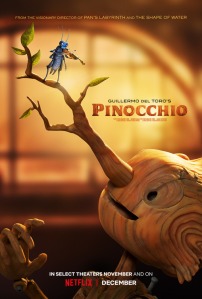 It seems 2022 has unexpectedly become the year of Pinocchio. The 1883 fantasy novel by Carlo Collodui (1826-1890) is best known via the classic Walt Disney animated movie, the second ever for the company, and it was Disney that released a live-action remake earlier in the year on their streaming service. Now widely available on Netflix is Guillermo del Toro’s stop-motion Pinocchio, so I wanted to review both films together but I was also presented with a unique circumstance. Both of these movies were adaptations of the same story, so the comparison is more direct, and I’ve decided to take a few cues from sports writing and break down the movies in a head-to-head competitive battle to see which has the edge in a series of five categories. Which fantastical story about a little puppet yearning to be a real boy will prove superior?
1. VISUAL PRESENTATION
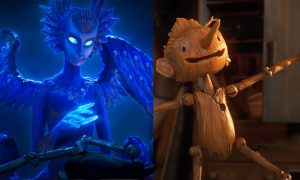
The Netflix Pinocchio is a lovingly realized stop-motion marvel. It’s del Toro’s first animated movie and his style translates easily to this hand-crafted realm. There is something special about stop-motion animation for me; I love the tactile nature of it all, the knowledge that everything I’m watching is pain-stakingly crafted by artisans, and it just increases my appreciation. I fully acknowledge that any animated movie is the work of thousands of hours of labor and love, but there’s something about stop-motion animation that I just experience more viscerally. The level of detail in the Netflix Pinocchio is astounding. There is dirt under Geppetto’s fingernails, red around the eyes after crying, the folds and rolls of fabric, and the textures feel like you can walk up to the screen and run your fingers over their surfaces. I loved the character designs, their clean simplicity but able readability, especially the sister creatures of life and death with peacock feather wings, and the animation underwater made me question how they did what they did. del Toro’s imagination is not limited from animation but expanded, and there are adept camera movements that require even more arduous work to achieve and they do. I loved the life each character has, the fluidity of their movements, that they even animated characters making mistakes or losing their balance or acting so recognizably human and sprightly. There’s a depth of life here plus an added meta-textual layer about puppets telling the story about a puppet who was given life.
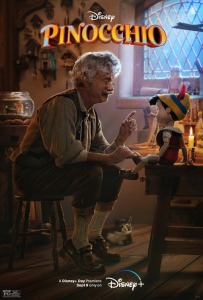 In contrast, the Disney live-action Pinocchio is harsh on the eyes. It’s another CGI smorgasbord from writer/director Robert Zemeckis akin to his mo-cap semi-animated movies from the 2000s. The brightness levels of the outside world are blastingly white, and it eliminates so much of the detail of the landscapes. When watching actors interact, it never overcomes the reality of it being a big empty set. The CGI can also be alarming with the recreation of the many animal sidekicks of the 1940 original. Why did Zemeckis make the pet goldfish look sultry? Why did they make Jiminy Cricket (Joseph Gordon-Levitt) look like a Brussel sprout come to life? It might not be the dead-eyed nightmare fuel of 2004’s The Polar Express, but the visual landscape of the movie is bleached and overdone, making everything feel overly fake or overly muddy and glum. The fact that this movie looks like this with a $150 million budget is disheartening but maybe inevitable. I suppose Zemeckis had no choice but to replicate the Pinocchio character design from 1940, but it looks remarkably out of step and just worse. When we have the 1940 original to compare to, everything in the 2022 remake looks garish or ugly or just wrong. The expressiveness of the hand-drawn animation is replaced with creepy-looking CGI animal-human hybrids.
Edge: Netflix Pinocchio
2. FATHER/SON CHARACTERIZATION
The relationship between Pinocchio (voiced by Gregory Mann) and Geppetto (David Bradley) is the heart of the Netflix Pinocchio, and I don’t mind sharing that it brought me to tears a couple of times. As much as the movie is about a young boy learning about the world, it’s also about the love of a father for a child. The opening ten minutes establish Geppetto’s tragedy with such surefooted efficiency that it reminded me of the early gut punch that was 2009’s Up. This Geppetto is constantly reminded of his loss and, during a drunken fit, he carved a replacement child that happens to come to life. This boy is very different from his last, and there is a great learning curve for both father and son about relating to one another. This is the heart of the movie, one I’ll discuss more in another section. With del Toro’s version, Geppetto is a wounded and hurting man, one where every decision is connected to character. This Pinocchio is a far more entertaining creature, a child of explosive energy, curiosity, and spitefulness. He feels like an excitable newborn exploring the way of the world. He’s so enthusiastic so quickly (“Work? I love work, papa!” “I love it, I love it!… What is it?”) that his wonder can become infectious. This Pinocchio also cannot die, and each time he comes back to life he must wait longer in a netherworld plane. It provides even more for Pinocchio to understand about loss and being human. This is a funny, whimsical, but also deftly emotive Pinocchio. He points to a crucifix and asks why everyone likes that wooden man but not him. He is an outsider learning about human emotions and morals and it’s more meaningful because of the character investment.
 In contrast, the Disney live-action Pinocchio treats its title character as a simpleton. The problem with a story about a child who breaks rules and learns lessons by dealing with the consequences of his actions is if you have a character that makes no mistakes then their suffering feels cruel. This Pinocchio is simply a sweet-natured wannabe performer. He means well but he doesn’t even lie until a sequence requires him to lie to successfully escape his imprisonment. The relationship with Geppetto (Tom Hanks) is strange. This kindly woodcarver is a widower who also has buried a son, but he comes across like a doddering old man who is quick to make dad jokes to nobody (I guess to his CGI cat and goldfish and multitude of Disney-tie-in cuckoo clocks). I don’t know what Hanks is doing with this daffy performance. It feels like Geppetto lost his mind and became stir crazy and this performance is the man pleading for help from the town, from the audience, from Zemeckis. It’s perplexing and it kept me from seeing this man as an actual character. He bounces from catalyst to late damsel in distress needing saving. The relationship between father and son lacks the warmth of the Netflix version. Yet again, the live-action Pinocchio is a pale imitation of its cartoon origins with either main character failing to be fleshed out or made new.
Edge: Netflix Pinocchio
3. THEMES
There are a few key themes that emerge over the near two-hours of the Netflix Pinocchio, which is the longest stop-motion animated film ever. Sebastian J. Cricket (Ewan McGregor) repeats that he “tried his best and that’s the best anyone can do,” and the parallelism makes it sound smarter than it actually is. The actual theme revolves around acceptance and the burdens of love. Geppetto cannot fully accept Pinocchio because he’s constantly comparing him to Carlo. When he can fully accept Pinocchio for who he is, the weird little kid with the big heart and unique perspective, is when he can finally begin to heal over the wound of his grief over Carlo, allowing himself to be vulnerable again and to accept his unexpected new family on their own terms. There’s plenty of available extra applications here to historically marginalized groups, and del Toro is an avowed fan of freaks and outcasts getting their due and thumbing their nose at the hypocritical moral authorities. By setting his story in 1930s Italy under the fascist rule of Benito Mussolini, del Toro underlines his themes of monsters and scapegoats and moral hypocrites even better, and the change of scenery really enlivens the familiar story with extra depth and resonance. All these different people want something out of Pinocchio that he is not. Geppetto wants him to strip away his individuality and be his old son. Count Volpe (Christoph Waltz) wants Pinocchio to be his dancing minion and secure him fame and fortune. Podesta (Ron Perlman) wants Pinocchio as the state’s ultimate soldier, a boy who cannot die and always comes back fighting. When Pinocchio is recruited to train for war with the other young boys to better serve the fatherland’s nationalistic aims, it’s a far more affecting and unsettling experience than Pleasure Island, which is removed from this version. In the end, the movie also becomes a funny and touching exploration of mortality from a magic little child. The Wood Sprite (Tilda Swinton), this version of the Blue Fairy, says she only wanted to grant Geppetto joy. “But you did,” he says. “Terrible, terrible joy.” The fleeting nature of life, as well as its mixture of pain and elation, is an ongoing theme that isn’t revelatory but still feels impressively restated.
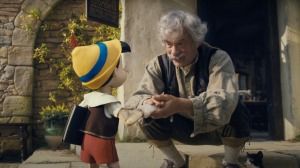 I don’t know what theme the Disney live-action movie has beyond its identity as a product launch. I suppose several years into the Disney live-action assembly line I shouldn’t be surprised that these movies are generally listless, inferior repetitions made to reignite old company IP. For a story about the gift of life, the Disney Pinocchio feels so utterly lifeless. I thought the little wooden boy was meant to learn rights and wrongs but the movie doesn’t allow Pinocchio to err. He’s an innocent simpleton who gets taken advantage of and dragged from encounter to encounter like a lost child. The Pleasure Island sequence has been tamed from the 1940s; children are no longer drinking beer or smoking cigars. They’re gathered to a carnival and then given root beer and told to break items and then punished for this entrapment. The grief Geppetto feels for his deceased loved ones is played out like a barely conceived backstory. He’s just yukking it up like nothing really matters. By the end, when he’s begging for Pinocchio to come back to life, you wonder why he cares. If you were being quite generous, you might be able to uncover themes of acceptance and understanding, but they’re so poorly developed and utilized. That stuff gets in the way of Pinocchio staring at a big pile of horse excrement on the street, which if you needed a summative visual metaphor for the adaptation, there it is.
Edge: Netflix Pinocchio
4. EMOTIONAL STAKES
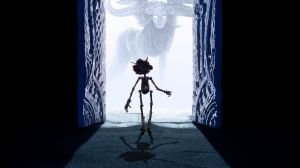 One of these movies made me cry. The other one made me sigh in exasperation. The Netflix Pinocchio nails the characterization in a way that is universal and accessible while staying true to its roots, whereas the Disney live-action film feels like a crudely packaged remake on the assembly line of soulless live-action Disney remakes. By securing my investment early with Geppetto’s loss, I found more to relish in the layers of his relationship with Pinocchio. In trying to teach him about the world, Geppetto is relying upon what he started with his past son, and there are intriguing echoes that lead to a spiritual examination. Pinocchio is made from the tree from the pinecone that Carlo chased that lead to his death. Pinocchio hums the tune that Geppetto sang to Carlo. Is there something more here? When he visits Death for the first time, the winged creature remarks, “I feel as though you’ve been here before.” These little questions and ambiguity make the movie much more rewarding, as does del Toro’s ability to supply character arcs for every supporting player. Even the monkey sidekick of the villain gets their own character arc. Another boy desperately desires his stern father’s approval, and he’s presented as a parallel for Pinocchio, another son trying to measure up to his father’s demands. Even this kid gets meaningful character moments and an arc. With this story, nobody gets left behind when it comes to thoughtful and meaningful characterization. It makes the movie much more heartwarming and engaging, and by the end, as we get our poignant coda jumping forward in time and serving as multiple curtain calls for our many characters, I was definitely shedding a flurry of tears. Hearing Geppetto bawl, “I need you… my boy,” to the lifeless body of Pinocchio still breaks me. Under del Toro’s compassionate lens, everyone is deserving of kindness.
As should be expected by now, the Disney live-action movie is lackluster at best when it comes to any kind of emotional investment. The characters stay as archetypes but they haven’t been personalized, so they merely remain as grubby facsimiles to what we recall from the 1940 version. Jiminy Cricket is meant as Pinocchio’s conscience but he vacillates from being a nag to being a smart aleck who even breaks the fourth wall to argue with his own narration. I hated every time he called the main character “Pee-noke” and he did it quite often. He’s far more annoying than endearing. There’s also a wise-cracking seagull that is just awful. The Honest John (Keegan Michael-Key) character is obnoxious, and in a world with a talking fox who dresses in human clothing, why would a “living puppet” be such a draw? He even has a joke about Pinocchio being an “influencer.” The only addition I liked was a coworker in Stromboli’s traveling circus, a former ballerina who injured herself and now gets to live out her dancing dreams by operating a marionette puppet. However, the movie treats the puppet like it’s a living peer to Pinocchio and talks directly to the puppet rather than the human operating the puppet, and the camera treats her like she’s the brains too. Safe to say, by the end when Pinocchio magically revives for whatever reason, just as he magically reverted from being a donkey boy, I was left coldly indifferent and more so just relieved that the movie was finally over.
Edge: Netflix Pinocchio
5. MUSIC
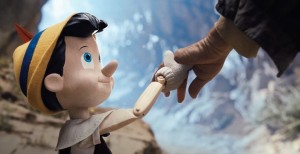 This was one area where I would have assumed the Disney live-action film had an advantage. Its signature banger, “When You Wish Upon a Star,” became the de facto Disney theme song and plays over the opening title card for the company. It’s still a sweet song, and Cynthia Erivo (Harriet) is the best part of the movie as the Blue Fairy. It’s a shame she only appears once, which is kind of negligent considering she sets everything in motion. The Netflix Pinocchio is also a musical and the songs by Alexandre Desplat (The Shape of Water) are slight and low-key, easy to dismiss upon first listen. However, the second time I watched the movie, the simplicity as a leitmotif really stood out, and I noticed the melody was the foundation for most other songs, which created an intriguing interconnected comparison. While nothing in the Netflix Pinocchio comes close to being the instantly humable classic of “When You Wish Upon a Star,” the songs are more thoughtful and emotionally felt and not just repeating the hits of yore, so in the closest of categories, I’m going to say that Netflix’s Pinocchio wins by a nose (pun intended).
Edge: Netflix Pinocchio
CONCLUSIONS
One of these Pinocchio movies is a visual marvel, heartfelt and moving, wondrous, and one of the best films of 2022. The other is a hollow vessel for corporate profit that copies the imprint of the 1940 animated film but only more frantic, scatalogical, and confused. In the year of our lord Pinocchio Two Thousand and Twenty-Two, there is only one movie you should see, and at this point ever see as it concerns this old tale. Guillermo del Toro has harnessed magic, and we are all the better for his bayonet imagination and enormous heart for his fellow outsiders.
Nate’s Grades:
Guillermo del Toro’s Pinocchio: A
2022 Pinocchio: C-
Share this:

Encanto (2021)
 2021 has been quite a year for Lin-Manuel Miranda who has provided the musical accompaniment to three movies, Vivo, In the Heights, and now Encanto, Disney’s latest animated musical (Miranda also has the live-action Little Mermaid, though that’s 2023). It would be unfair to expect a generation-defining Hamilton-esque masterpiece every time Miranda sets pen to paper; I’d happily settle for even a lesser Moana, as far as quality goes (to be fair, Moana is also brilliant). With Encanto, the musical numbers have interesting tone/melody shifts and the hip-hop syncopation we’re used to from Miranda’s style, but none of them will be able to be hummed by the end credits. They evaporate from memory pretty quickly. They seem on par with Vivo and less than In the Heights. With that being said, I found the remainder of Encanto to be quite charming and emotionally resonant. It’s set in Columbia and follows a magic home to a magic family where at a certain age the children are blessed with a unique magic power with a ceremony and celebration. Except for Mirabel (voiced by Stephanie Beatriz) who was denied a power and is looked at with skepticism by her Abuela, who insists on sticking to their family traditions no matter if her children and grandchildren chafe from her expectations. This is a much more insular and contained musical, almost taking place entirely on the family grounds. Its great quest is much more about repairing family relationships and actually listening to another person rather than making assumptions about their life because of their status. Because of this story design, it leads to plenty of catharsis and reconciliation, and it made me blubber like a baby at points. I bought into the emotional stakes of the family, of Mirabel feeling like an outsider, and the pressure to conform. I enjoyed that near everyone in this extended family gets a chance to share their own perspective. The story felt very empathetic to its supporting players while still remembering to be entertaining and funny. The conclusion feels a bit rushed, with happy endings being doled out rather hastily, but quite satisfying. I found Encanto to be colorful, rich in feeling and theme, and delightful to experience. Also, the animated short with the raccoons beforehand hit me hard too.
Nate’s Grade: B+
Share this:

Jungle Cruise (2021)
 Disney turned a theme park ride that mostly involved sitting into a billion-dollar supernatural adventure franchise, so why not try another swing at reshaping its existing park properties into would-be blockbuster tentpoles? Jungle Cruise owes a lot to the Pirates of the Caribbean franchise, and actually owes a little too much for its own good. For the first half of the movie, it coasts on the charms of stars Dwayne Johnson and Emily Blunt and some light-footed visual misadventures. Then the second half turn involves a significant personal revelation, and that’s where the movie felt like it was being folded and crushed into form to closely resemble the Pirates franchise. It gets quite convoluted and littered with lackluster villains, too many and too stock to ever establish as intriguing or memorable (one of them is a man made of honey, so that’s a thing). I found myself also pulling away in the second half because of the inevitable romance. Their screwball combative banter between Johnson and Blunt gave me some smiles and entertainment and then, as they warm to one another, it sadly dissipated, as did my interest. The comedy is really labored at points. Johnson keeps referring to Blunt as “Pants” because she’s a woman and she wears pants in the twentieth century. It was not funny the first time and it’s not funny or endearing after the 80th rendition. The supernatural elements and curses feel extraneous and tacked on. With the Pirates films, at least the good ones, there are a lot of plot elements they need to keep in the air and you assume they’re be able to land them as needed. The competing character goals were so well established and developed in those movies and served as an anchor even amid the chaos of plot complications and double and triple crosses. With Jungle Cruise, it feels like a lot of effort but also a lot of dropped or mishandled story and thematic elements. This feels more creatively by committee and the heavily green screen action is harder to fully immerse with. As a wacky adventure serial, there may be enough to keep a viewer casually entertained, but Jungle Cruise feels too beholden to the Pirates formula without bringing anything exciting or fresh on its own imagination merits.
Nate’s Grade: C


 nathanzoebl
You must be logged in to post a comment.