Blog Archives
Still: A Michael J. Fox Movie (2023)
 Reminiscent of the Val Kilmer documentary from 2021, with archival footage taken from the star himself, Still is a documentary that opens up an actor’s biography but also makes you reconsider your own feelings as you process them in a diminished state. Fox was a natural actor, and his trajectory from Canadian student to international stardom was fast, but things took a dramatic turn when Fox first exhibited symptoms of Parkinson’s, a neurological disorder that causes involuntary movements. The present-day interviews with Fox are startlingly candid, showing the effect the disease has had on his body as well as his spirit, as he fights to get his quick wit out from a body that is betraying him. Fox himself doubts he’ll even make it to 80 under his current condition, which we see the rigors of his physical therapy as well as the challenges of everyday life. The Hollywood stardom tale is familiar but still intriguing with Fox’s insights and recollections, and director Davis Guggenheim (An Inconvenient Truth) makes clever use of the many clips from movies and TV to reflect the emotional state of Fox’s story as needed. It’s also interesting to learn about the tricks he would use to better hide his Parkinson’s symptoms in TV and film, as now we have a better understanding and can see the moments in a new light. You will likely feel different levels of sympathy as you reflect on what effect the disease has had on this spry, commanding performer, but Fox wouldn’t want your pity. Fox is irascible and self-deprecating but still so easily charming, and spending 90 minutes with him as he opens up his life, his family, and his physical and mental struggles feels like a rare and privileged peak into this man’s rich life before it’s gone.
Nate’s Grade: B
Share this:

Waiting for Superman (2010)
 Award-winning documentary filmmaker Davis Guggenheim (An Inconvenient Truth) tackles an even more alarming subject – the state of the nation’s education. Guggenheim, who admits to enrolling his own kids in costly private schools, felt bad about all those “other kids” resigned to public schooling. His film addresses a myriad of issues related to the disparity in education. The deluge of data and statistics is broken up by the heart-wrenching story of five children ranging in age from five to fourteen. These children are hoping to land a chance to enroll in neighborhood charter schools. These charter schools perform higher than their public competition, so there are more applicants than seats open. Far more. By charter guidelines, the applicants are given a number and a lottery is taken to determine who earns a place in the school. To these five students and their families, the random drop of a numbered ping-pong ball can determine the fate of all.
You’d have to have a heart of stone not to feel such powerful pangs of emotion by the film’s devastating conclusion. Guggenheim frames the overall demise of public education by telling the small story of five hopeful students who must look to the simple luck of the draw to get a quality education in their neighborhood; the bigger issue now has a face to empathize with. And you will. Obviously the odds are stacked against all five kids Guggenheim selected to follow. I think the best charter school lottery odds had 20 seats available and only 65 applicants. It should therefore be no surprise that there are many dashed hopes and crushed dreams, and you too will feel tears rolling down your cheeks as you watch shell-shocked parents try to compose themselves as their child’s number is never called. It’s flat-out devastating to witness. It is a profound embarrassment that these families are forced into a lottery system just to earn a quality education. The anguish and bone-shaking disappointment will long linger, which is exactly what Guggenheim wants. The concluding portion of the movie drops all stats and cogent rhetoric and just opens up completely to unashamed, yet highly effective, emotional appeals. Guggenheim clearly knew that the odds were against these kids being selected, which upon reflection, gives the montage of sorrow a slightly unpleasant exploitative aftertaste.
 I wasn’t expecting a detailed manual on how to fix the nation’s educational woes, but at the same time I think Guggenheim is laying the blame a little too explicitly at the feet of intractable teacher unions. Now, full disclosure to my adoring readership: I work for a public school system and belong to a prominent teacher’s union, the National Education Association. I’m trying to be as impartial as possible in my analysis of a documentary that hits fairly close to home. It’s pretty impossible to not walk away affected from Waiting for Superman. You’ll be left shaken, red-eyed, and clamoring for reform, but what reform? Guggenheim tends to keep whacking at his target, the teachers unions, but a grave omission is that he never interviews a SINGLE teacher. He interviews retired teachers and numerous teachers that have become administrators, but a documentary about the concerns of a modern classroom might want to include the views of those teachers who are expected to get consistent results with inconsistent materials. There is enormous pressure on teachers, often the first to be blamed for circumstances beyond their control. Are teachers responsible for poverty and absent parenting? Are teachers responsible to fix all society’s ills? The modern educational environment has changed so much in recent years (I cannot even think of a life teaching before the distraction of texting and cell phones), and yet so much of our system is geared toward an outdated model. Tracking systems do more to segregate students into an educational caste system that tells a portion of students that nobody truly has high expectations for them. The summer recess was so that the kids could return to work on the farm in time for harvests. Hey, guess what, we stopped being an agrarian society for over 100 years.
Educational reforms like No Child Left Behind (NCLB) are mentioned, but the aftereffects are shockingly soft-pedaled by Guggenheim. The NCLB act was meant to make educators accountable, and in a way it does, but only to a single high-stakes test. The curriculum of many school environments is now entirely shaped to passing this test, which isn’t a surprise considering school funds are determined almost entirely by this single measuring device. There’s little room for enrichment when the test dictates all. I have spoken with several teachers and administrator, and I’ve heard horror stories where lower-performing students are tossed around in devious manners to keep the school’s percentage higher. The shame of NCLB is that its legacy may be that even more children are left behind. I’m flabbergasted that Guggenheim neglects to include any of the detrimental consequences of NCLB in his film. Now I’m by no means saying that teachers should not be held accountable and that unions can lead to abuses of power. Guggenheim references the infamous “rubber rooms” where disciplined teachers sit and collect full paychecks while reading the newspaper or playing cards. On the surface, naturally this excess is appalling and a waste of taxpayer dollars. But then if you stop and think, looking through the indignant broad strokes, you realize several of these rubber room inhabitants are simply getting the full measure of due process. Excess may be needed to ensure the rights of every citizen. Or do we start selectively choosing who is denied due process?
 At the risk of sounding too ideologically defensive, allow me to lastly take aim with Guggenheim’s thesis that he carefully shapes. Charter schools become Guggenheim’s shining beacon of hope for his handful of student subjects. The film itself evasively admits that only 1 in 5 charter schools succeeds and that most perform at levels below public schools. I’m not knocking the success of charter schools and the dedicated professionals who operate them. It’s just another choice, and I suppose that’s what Guggenheim really boils it down to – choice. He shows us that lower income Americans are denied educational choices, which leads to a limited array of choices of opportunities in a lifetime. Charter schools are free from the Byzantine bureaucracy of the public school system, which I think is why Guggenheim lionizes them despite the 20% success rate. Waiting for Superman shows that the status quo is anything but for too many.
With all of my rebuttals, it may sound like I strongly disliked this muckraking documentary. On the contrary. Waiting for Superman is supremely engrossing, stirring, moving, devastating, illuminating, occasionally frustrating, but easily one of the best films of 2010. Most of the ills of the United States can be traced back to the epicenter of educational failure. The state of America’s education is in crisis. Just like Guggenheim’s Oscar-winning Inconvenient Truth, this is meant to sound the alarm of an impending disaster. If the educational system keeps failing students en mass, you can expect there will be far-flung generational ramifications. How can the richest country in the world fall behind so far in education? Guggenheim is passionate about a problem with no clear-cut solution. Nobody knows what makes a good teacher. There is no secret formula. And just as each child is a unique and different, so are the educational situations nationwide. Every school is going to have a different solution than another. Guggenheim has a handful of ideas on how to patch up our schools (take away the excessive power of unions, make it easier to fire poor teachers, better access to alternative schools), but the ugly truth is that there is no magic solution. Simplistic at times and perhaps a little too evasive, Waiting for Superman is nonetheless a powerful document that challenges a nation to do better.
Nate’s Grade: A-
Share this:

An Inconvenient Truth (2006)
 Al Gore is possibly the least likely movie star in the history of movies. The former Vice President and 2000 presidential candidate has been making the scene with An Inconvenient Truth, a potent documentary warning about the impending perils of global warming. Gore has traveled all over the globe giving a well-honed Power Point presentation on the topic. An Inconvenient Truth is a 90-minute big screen version of this presentation. Consider it more concert film than documentary. An Inconvenient Truth is equal parts spellbinding and terrifying. Best of all, it’s that rare film that could quite honestly change the world for the better.
This is like sitting through an impassioned lecture by your favorite college professor. Gore smartly turns the issue of global warming from a political issue to a moral issue and asks how can we let this happen to our planet. He delivers a highly persuasive science show that should shake everyday Americans out of complacency and galvanize them to action. But what’s best about An Inconvenient Truth is that it doesn’t crush you to death with data. Gore explains the perils of climate change in general, easily graspable terms and uses choice pictures to service his message. It’s downright startling to see photos of glaciers and lakes that have gone dry in such a short span of time. As the film continues, Gore gains momentum and the facts, graphs, and charts multiply, and you’ll be hungry for even more. An Inconvenient Truth is a great learning tool because it really whets your appetite for knowledge and follows through on its convictions. Gore climbs an elevated lift to illustrate on a chart where carbon dioxide emissions will be heading. The moment is both grand theater and a stupendously straightforward visual demonstration that there will be far, far, faaaaaar greater carbon dioxide emissions in the near future than there has even been in 650,000 years.
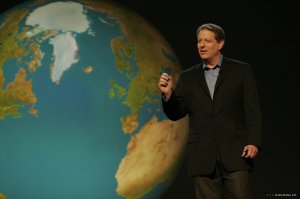 Gone is the hectoring, emotionless Al Gore that people seem to recall from his political days. An Inconvenient Truth displays a Gore rich with humor, command, and most surprising of all, guile and charm. Old Gore might have harrumphed at his critics and come across like a walking stiff, stick firmly entrenched in rear. The Gore on display here seems candid, spirited, and easily engaging, plus he never comes across as preachy. It helps when he’s presenting on a topic he’s devoted much of his life to being a cheerleader for. Nevertheless, he’s a disarming speaker and it’s easier to swallow his spoonfuls of science when he’s turning on the charm.
Gore presents an overwhelming case for the existence of steady global climate change. But why then is there still much hand wringing about whether scientists can even agree? An Inconvenient Truth seems to have the answer. We see a ten percent sample, around 900 peer-edited scientific reports, concerning the topic of global warming. Not one of the 900 reports concluded that the proof of global warming was inconclusive. However, we then see that over 50 percent of all media reports mentioning global warming cite scientific wavering, saying the jury’s still out in the scientific community when it is anything but. Perhaps this is why people still see global warming as inauthentic hippie alarmism. Gore tackles his critics and presents very levelheaded reasoning. You can tell this man believes strongly and genuinely in the topic.
Let me put aside my film critic hat, if I may for one moment. I am getting fed up with how flippantly people dismiss science when it conflicts with their own belief system or agenda. There was a time when people looked at scientific findings and accepted them, saw their extensive testing and recalculating, and chalked it up to truth. Nowadays we have people trying to define their own versions of science, whether it be a new opening to slip religion into a classroom (Intelligent Design), a new way to control behavior (suppressing FDA-approved birth control studies), or simply a way of turning back time and civil rights (erroneous abstinence only sex ed). This stuff really irritates me. Let’s trust the science to the scientists, not Pat Robertson when he says he knows condoms are unreliable. When I get a cold I don’t consult my pastor, do you? That’s why I too am frustrated by what Al Gore sees. There’s a cabal of special interests trying to turn the issue of global warming from fact to theory, and in the process delaying serious response because it affects their cash flow. Okay, rant completed.
The science side of the equation is open and shut. Global warming is taking place but what can we do about it? We learn in the movie that the United States is the biggest polluter in the world. Thankfully, An Inconvenient Truth actually suggests ways of cutting down on energy that the average American can do. The end credits are full of helpful do-good aphorisms and suggestions to combat climate change. One of those suggestions just happens to be telling your friends to see An Inconvenient Truth. Surely the makers of this film get nothing out of that option.
 Less effective are the minor asides the film takes to look into Al Gore’s personal and political past. The point I suppose is to show how we can turn personal tragedy or setbacks into a rallying point to save the planet. I don’t really know. These segments clog up the engrossing horror story Gore is dictating. I don’t want to learn about Gore’s tobacco farming family or how he handled losing the 2000 presidential election, I want to get back to the doom, the gloom, the graphs, and the pictures! It’s the equivalent of listening to a grand ghost story by camp light and having the storyteller occasionally stopping to mention they once caught an eight-pound bass. Get back to the good stuff already.
You don’t have to agree with Gore’s politics or even like him to be strongly affected by An Inconvenient Truth. As a film, it’s little more than a bigger stage for Gore’s patented, visually friendly slideshow, but as a message movie its aim is true and striking. Gore lets the science speak for itself and to that end the case seems closed. Global warming is happening, despite what media reports, skeptical business big wigs, and energy polluters might say. It’s saying something about the reach and importance of a documentary when actual oil companies are releasing smear commercials to discredit its message. Gore’s impassioned science lecture is fascinating, incredibly informative, and easy on the eyes with lots of stark pictorial examples. Al Gore is right; global warming is too big to be deemed a matter of political right and wrong. It demands attention and action, and An Inconvenient Truth demands to be seen; it’s not the best movie of 2006 but it’s certainly the most important.
Nate?s Grade: B+


 nathanzoebl
You must be logged in to post a comment.