Blog Archives
Tenet (2020)
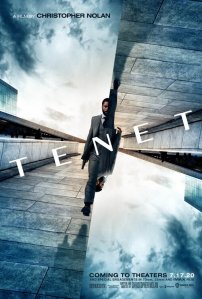 As my girlfriend described, Tenet is a headache disguised as a movie. I can agree about the confusion and irritation from trying to make sense of a 150-minute movie that almost defies you to even keep watching. From the opening sequence, my head was hurting from trying to make sense of everything and deduce meaning and connection. Christopher Nolan’s movie was set up to be the savior of the summer, a thinking man’s blockbuster with such size and scope that people would come back to the newly opened theaters to get a taste of the summer they missed because of COVID. It didn’t work out that way and Tenet’s box-office disappointment contributed to the recent decision for its parent studio to release its entire 2021 slate of movies onto its streaming service (nobody should risk their life to go see the Tom and Jerry film). Tenet has too much going on for me to call it a bad movie, but it also has too much going on for me to call it a good movie.
Protagonist (John David Washington) is recruited by a secret organization that is trying to thwart a cold war from becoming hot between the future and the past. Neil (Robert Pattinson) explains about “reverse entropy,” about effect before cause, and that there are machines that can allow people to reverse their direction in time. It’s less jumping through points than it is hitting the rewind button. A Russian oligarch (Kenneth Branagh) and his wife (Elizabeth Debicki) may be the key to preventing a future catastrophe or one that hasn’t happened yet or has already happened. It’s time travel so the tenses can get confusing. That’s not the only thing that’s going to likely confuse you.
 At around the half-hour mark, it felt like every character was talking past me, like they had no intention of being accessible. It is practically maddening to be in a conversation where everyone is talking above your level, relying upon lingo and references you are unfamiliar with, and you can try your best to grasp the basics of context clues to try and decipher a base level of understanding, and then, when you think you have things together, they start talking backwards. That is Tenet in a nutshell. It is a mystery how Nolan expected general audiences to even want to keep up with this. I’m not one of those people that needs my story spoon-fed to me, and I welcome challenging storytelling that rewards multiple viewings. However, the problem with that gambit is that if you require your movie to be seen a multitude of times to be understood, you better guarantee anyone will want to watch it a second time. I’m certain I’ll better understand Tenet with another watch and that I’ll find even more little clues to celebrate the exquisite cleverness of Nolan, but I don’t want to re-watch this any time soon, if possibly ever.
Nolan has been here before with 2010’s Inception, a movie that could have been confusing from its very conception given a heist upon four levels of dreams each with their own sense of linear time. Early on, Inception was also confounding, but slowly Nolan opened up his world, allowing the audience to adjust to a learning curve and process the information we needed to be set by the time the big heist got underway. Even after, we had mysteries and complications to be solved. It was a complex puzzle with layers but it was accessible. I thought early into Tenet we would be following a similar track, and I kept waiting to adjust to the learning curve, for things to gain a momentum. There needs to be rules, a demonstration of the rules, and then we proceed. I guess I understood things on a general level, stopping the bad guys from somehow destroying the world, and special turnstiles that make you go in reverse time, and there’s a palindromic plotting emphasis that becomes a late justification for 90 minutes of mostly boring blather with the occasional set piece. For the purposes of further clarity, I even read the Wikipedia plot summary to fill in the gaps of my personal comprehension, and it didn’t really assist beyond confirming for me that I understood the broad strokes of an otherwise confounding movie. It’s hard not to feel like Tenet is more an expensive, globe-trotting experiment for Nolan than a movie intended for mass entertainment. Again, I’m not deriding Tenet because it’s ambitious. I’m deriding it because it’s indignant of a potential audience.
I cannot stress enough that every time characters began speaking, I liked Tenet less. If somehow the movie had eliminated all dialogue, it might have worked better. It’s not like Nolan’s scripted words offer much comprehension anyway. It feels like the dialogue is nothing but impenetrable riddles about scientific jargon and vague pronouncements often given to too cute dialogue about the nature of time. There were points I just wanted to scream. Of course there were other moments I was straining just to try and understand what was being said. Tenet is another example of Nolan’s self-sabotaging sound design where he makes the volume of characters speaking subsumed to the volume of sound effects and score. It becomes another hindrance to try and understand an already confusing and aggravating movie experience.
 Another factor that made Tenet a slog was the lack of any emotional engagement. Nolan has often been criticized for being a cold filmmaker, one more beholden to the intricacies of his origami-styled plots and surprises. I think this is often an unfair charge but he’s certainly a filmmaker known for his preference for plots that take ownership of character. You would not confuse a Christopher Nolan blockbuster for some mumblecore indie. Even in a movie with as much plot groundwork as Inception, Nolan provides an emotional core with the story of a man literally haunted by the ghost of his wife and his grief over his own culpability for her demise. The climax even involves him having to finally let her go in order to save the day. With Tenet, we get nothing. There’s an abused wife and while I don’t want to watch her get threatened and attacked by her husband, that’s not exactly the same as providing an emotional anchor. She’s, at best, a supporting player. The world-saving stakes are all you’re going to get. I didn’t care about Protagonist as a protagonist, and I didn’t care about Tenet as a secret organization, and I didn’t even like spending time with these people. These characters are boring, but the movie thinks by keeping them moving fast enough, or talking nonsense long enough, that you will fail to notice.
I’m not even fully cognizant of the benefits of inverse time. You can travel backwards and watch people go in reverse but is this really a practical application of technology? Reverse fight choreography can be cool, like people doing reverse flips, and it can also look extremely silly with punches exchanged that look too fake and people scooting on the ground like child trying to break dance. For me, it’s a toss-up whether watching characters run in reverse is surreal and dreamlike or just plain goofy. I guess one could reverse and then un-reverse, more or less traveling back to a point in the past and going forward from there. This means you’ll have to live those extra days, weeks, whatever the time difference, but it also seems to indicate that you must do everything you did before because you have already done it. If this is the case, why bother going back in time if you’re just indebted to doing the same things all over again? Why take a test again when you have to give all the same responses to the same questions? It feels like Nolan wanted to try and make a time travel movie that isn’t quite a time travel movie, so he settled on people running backwards. There is an intriguing disorientation at work when Nolan really plays with the physics of reverse time, but I don’t think this core idea ever fully comes together in a satisfying manner.
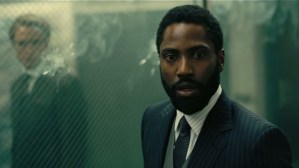 The last hour of Tenet does liven things up as we have two large action set pieces that play out with patience and an expansive scope. This is Nolan’s spy action-thriller. A high-speed heist on the road leads to a car chase with reverse cars to combat. It’s the only action sequence where the audience has a good understanding of the mini goals. Even an earlier art heist resulted in raising questions of credulity (“If the security system sucks out all oxygen, and they’re triggering this, why have they not come prepared with their own oxygen tanks?”). The high-speed heist and ensuring chase sequence flat-out works and is pretty cool. The conclusion involves two teams of soldiers, one going forward in time and one going in reverse, and that has such amazing potential for an intricate and exciting culmination of action. Imagine a character going back and forth and jumping from their unique perspectives to aid and inform each team. Unfortunately, in execution it comes across as jumbled chaos. Again, I imagine there are details and parallels I would notice more with a second viewing but I doubt when that will happen. For a movie essentially about time travel, it feels like Nolan has put more careful thought into trying to make his movie a palindrome than trying to come up with engaging and cool things to do with time travel action.
Christopher Nolan is one of the biggest names working today, a man whose risky, expensive blockbuster projects get greenlit because of his artistic audaciousness. You would never want a Nolan movie to simply play things safe. He seems at his most comfortable when it’s playing around with chronology and audience expectations of what moments have meant. There is a reverse palindromic feature to this screenplay I do admire from a writer’s perspective. However, knowing it takes a confounding 90 minutes to get to that reveal means that you’ve had to endure 90 minutes of protracted set up and with characters that are, at best, glib archetypes, empty suits, and guns with people attached to them to occasional bark orders or say confusing terminology. It makes for a very frustrating and at times disengaging viewing experience, one I even contemplated retreating from. I’m glad I stuck it out but cannot say it was worth the time and ensuing headache.
Nate’s Grade: C
Share this:

BlackkKlansman (2018)/ Sorry to Bother You (2018)
 Two African-American filmmakers, one making his debut and another in his fourth decade of popular storytelling, have produced two of the most uncompromising, entertaining, provocative, and exacting and relevant movies of this year. Boots Riley’s absurdly comic indie Sorry to Bother You was a festival smash, and Spike Lee’s BlackkKlansman is being positioned as a summer breakout. Audiences have often looked to the movies as an escape from the woes of our world, and when the news is non-stop catastrophic woe, that’s even more apparent. However, both of these movies, while enormously entertaining and charged with fresh relevancy, are a reminder of the very social ills many may actively try to avoid. Both films, and their respective filmmakers, make cases why ignorance is a privilege we cannot afford. Also, did I mention that the movies are outstanding, daring, and hilarious?
It’s the early 1970s, and Ron Stallworth (John David Washington) is the first black officer on the Colorado Springs police force. He wants to be a detective and taken seriously, and one day he calls the leader of the local chapter of the Ku Klux Klan pretending to be a white nationalist. He builds a relationship over the phone with the Klan but he can’t meet them in person. Enter fellow officer Flip Zimmerman (Adam Driver) who stands in as the public Ron Stallworth, avowed white supremacist. Problem is Flip is Jewish, a group the Klan isn’t much more favorable with. The two officers must work together to gather enough actionable evidence to stop the Klan before they kill.
 This is Lee’s best film since 2000’s Bamboozled and he feels jolted awake by the material. He doesn’t shy away from the film’s relevance and potent power but also knows how to faithfully execute the suspense sequences and police procedural aspects of the story by Charlie Wachtel, David Rabinowitz, Kevin Willmott, and Lee himself, based upon Stallworth’s book. The story alone is the film’s greatest selling point. It feels like a bizarre recreation of that Dave Chapelle sketch about the blind, and black, Klansman. It’s a story inviting irony and bafflement, and it’s ribald and funny for long stretches, buoyed by Washington’s charismatic and forceful performance (close your eyes and he sounds just like his dad, Denzel). The story is so fascinating that you just want to see where it goes. Stallworth is fighting for respect in a still-racist police force, and he’s pushing Zimmerman to feel more invested in their operation from his own maligned status. “I never thought much about being Jewish,” he shares with Ron, “But I’ve been thinking a lot about it recently.” Theirs is a partnership we root for, and each new accomplishment bonds them together and increases their credibility with a wary police chief. It’s a movie that has a steady supply of payoffs and complications, leaving you satisfied by the end but also more than a bit rattled at the uneasy connections to contemporary news.
This is a character-driven suspense film that does so much so well, drawing in thrills and laughs without making either feel cheaper by their inclusion. This is an undercover operation so every scene with the Klan has the electric uncertainty of whether or not Flip will be caught and our heroes doomed. Because you have two Ron Stallworths, we already have a complicated ruse to keep up (though why Flip couldn’t simply also be the voice on the phone is likely just how it happened in real life). Each new piece of information, each new meeting, takes our characters deeper into the Klan infrastructure, including a guided visit from none other than Grand Wizard (a.k.a. head honcho) David Duke (Topher Grace in an outstanding performance). The risk escalates from being caught to thwarting a planned bombing that could kill innocent minority protestors. The movie does a great job of finding new ways to remind you what is at stake, and while the Klansman are set up to be laughed at and ridiculed, they are still seen as dangerous. They still have the direct intent to physically harm others, not just harass and intimidate.
 Because of the undercover operation, you’d be right to assume that Stallworth’s personal life and blossoming romance with a collegiate activist, Patrice (Laura Harrier), would be the least interesting part of the movie. It’s not poorly written or acted by any means. She serves as a reminder of Stallworth’s split loyalties, working for the police, which many in his community see as a tool of oppression from racists with a badge (and we too see this in action). He is always hiding some part of himself, be it his racial identity, his personal affiliation, or even what he really feels about his corrupt colleagues. Even with her, he cannot relax completely. It shows the more personal side of the Stallworth character and provides something real for him to lose, especially once the local Klan targets Patrice. I understand the role she serves in the larger story but I’d lying if I wasn’t eager to get out of every one of her scenes and back into the action. That’s the problem when you have one superior storyline; the others begin to feel like filler you’d rather leave behind to get back to the good stuff.
BlackkKlansman also can’t help itself with the political parallels to our troublesome 45th president, but I loved every one of them. A superior officer warns Stallworth about his dealings with Duke, specifically that he might make good on the promise to retire as Grand Wizard and go for political office. “Come on, America would never elect a man like David Duke as president,” he says with thinly veiled incredulity. The characters might as well turn and wink to the camera and say, “We’re talking about Trump,” but I laughed all the same. At one Klan dinner, the participants chant, “America first,” which is a Trumpian campaign slogan, if you didn’t know dear reader, derived from the Klan (Trump’s own father was arrested attending a 1927 Klan rally). These parallels are destined to turn off some viewers, though I think the subject matter and Lee’s name should be enough to know exactly what kind of movie you’re electing to watch. Nobody goes to a Lars von Trier film expecting to be uplifted about the state of humanity.
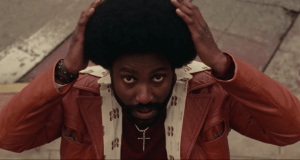 It’s at its very end where the film reminds you just how sadly relevant it still is today (minor spoilers but I don’t think they will ruin anything for you). While Stallworth has bested the local chapter of the KKK, there’s another late night with a sudden alarming noise, Stallworth on his guard, and a cross is burning out in the distance. Just because our characters have foiled a band of racists doesn’t mean racism has been eradicated. Instead, as the film suggests, it evolves, and Lee concludes with an impactful montage of news footage of the Charlottesville white supremacist rally and President Trump contorting to find fault on “both sides” when clearly one side was murderous and racist. You even see real-life David Duke on the premises spewing his re-branded style of hate. The evolution of white supremacy demagoguery has become political, and it has found cover under the guise of a president eager to stoke racial resentments and divisions to his advantage. He’s normalized the abhorrent behavior and given it mainstream cover. It’s a powerful and lasting conclusion (much in the same way as the montage of Hollywood’s harmful depiction of black people in Bamboozled — including the Klan hero worship in Birth of a Nation, also featured here prominently) that should remind people that the threats of racism and Nazis and the KKK are not a thing of the past. It is very much a staple of the present, and how much it is allowed to remain a staple is up to the moral outrage of voters.
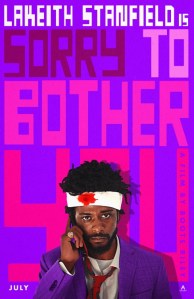 Sorry to Bother You is also sharply cutting and topical about being black in America. In present-day Oakland, Cassius “Cash” Green (Lakeith Stanfield) is struggling to make ends meet, move out of his uncle’s garage, and do right by his girlfriend and performance artist, Detroit (Tessa Thompson). He gets a job at a telemarketer and discovers a new talent when he turns on his “white voice” (voiced by David Cross) and becomes a power caller, crushing his competition. He moves his way up the chain, losing touch with his base of working-class friends looking to strike to unionize. Once at the top, Cash draws the attention of the CEO, Steve Lift (Armie Hammer), who has big plans for a man with Cash’s gifts and seeming flexibility when it comes to corporate moral relativism.
Sorry to Bother You is a wild, hilarious movie bursting with things to say with its shotgun approach to satire, or as my pal Ben Bailey termed, a blunderbuss approach, messy and all over the place and, sometimes, maybe missing its intended mark. I thought the movie was simply going to be about the modern-day struggles of being black and poor in America, and the movie covers those aspects with aplomb. It’s also sized up ample room to satirize consumer culture, labor exploitation and worker rights, male and female relationships, art and media, cultural appropriation, and even memes. Because of all the topics, the movie could run the danger of feeling unfocused, but thanks to the remarkably assured vision and handling of writer/director Boots Riley, it all feels connected by its unique voice operating at a risky but exhilarating level.
 There are a lot of bizarre dips into the absurd that had me howling and on the edge of my seat wondering where we would go next. The most popular TV show is just watching a person get the stuffing beaten out of them, and it adopts a pretty simplistic name to go along with this transparency. A very Google or Amazon-esque company is offering “lifetime jobs” for employees to live in their factories and have all their cares taken for by a corporate slaver, I mean kindly overlord. There’s an art show that consists of hurling cell phones at a woman’s body. There’s a corporate video with a female caveman narrator where she is, 1) stop-motion animated, and, 2) topless the entire time, complete with animated swinging breasts. There’s an ongoing thread that seems to trace the life cycle of a meme. A woman throws a Coke can at Cash in protest. She gets plucked form obscurity, gains a talk show, gets an endorsement from Coke and her own video complete with dramatic re-enactment and chirpy jingle, and Cash getting hit becomes its own Halloween costume for white people. There are throwaway lines in this movie that any other major comedy would die for. This is a movie that is impossible to fall asleep to because every moment could be different and you won’t want to miss one of them.
There are moments that strike beyond the immediacy of the onscreen absurdity. One of those moments was when Cash was invited to join the big corporate after party. He’s out of his element, surrounded by rich, relatively young privileged white people. They assume, being black, that Cash will instinctively know how to rap, and they insist that he perform a free-style rap for the assorted group. This ignorant assumption is just the start for Riley, because Cash gets up there and struggles to perform, barely able to scrap together the most elementary of rhyme, and the illusion has become dashed with the crowd. He notices they’re losing their interest with him, so in a desperate ploy, he just shouts two words over and over into the microphone with enthusiasm: the N-word and a profanity. He does this for like a minute, and the crowd of privileged white people shouts it back at him, seemingly lying in wait for some tacit permission by “popular music” for them to likewise use the N-word. It was an indictment that went beyond that scene. Another is ultimately what happens to the big bad corporation by the film’s end. It literally made me guffaw because it felt completely in place with the tone of the movie.
 All of this zany and funny stuff would feel passing if there weren’t at least some characters worth our time. Cash is an engaging young man trying to get his life on track. He discovers he has a gift when it comes to coding, to blending into a white-majority community in a comfortable and acceptable manner. It’s a survival technique many African-Americans have had to perfect on a daily basis, and soon to be featured in the upcoming adaptation of the best-selling YA novel, The Hate U Give. Even amidst its more bizarre moments and asides, the movie is about a black man trying to get by with limited opportunities in a society that too often devalues him.
Stanfield (Get Out) has been a strong acting presence for some time, first in the remarkably powerful Short Term 12 and most recently on Donald Glover’s Atlanta. He grabs your attention and Stanfield has a gift for comedy, particularly a nervous energy that draws you closer rather than pushing you away. His character goes on the rise-and-fall path, so we still need to be pulling for him to turn away from his newfound egotism, and Stanfield keeps us rooted. Thompson (Thor: Ragnarok) is Cash’s conscience and her wardrobe and accessories are amazing, from her declarative “The Future is Female Ejaculation” T-shirt to her large earring messages. Hammer (Call Me By Your Name) is confidently smooth and sleazy as a coked-out, venal CEO that is so blasé about his wrongdoing that it doesn’t even register for him as wrong. I appreciated that even with all the wackiness of this cracked-mirror version of our universe, Riley puts in the time and effort to make the characters count rather than be expendable to the satirical aims.
Now, there is a significant turn in the third act that veers the movie into territory that will test how far audiences are willing to go along with Riley’s raucous ride. I won’t spoil what happens but for several of my friends it was simply a bridge too far. For a select few, they even said this turn ruined the movie for them. It worked for me because it felt like an escalation in the dastardly labor practices of the corporation and was finally a visceral reminder of their cruelty. Beforehand, Cash has been making moral compromises to keep his ascending career, excusing the after effects of his success even when it’s selling weapons to foreign countries. That stuff is over the phone, part of his coded performance, and easier to keep out of mind. This escalation finally is too much to pretend to ignore. It’s too much to excuse his own culpability working for the enemy. It’s what pushes Cash back to his circle of friends he had left behind for the corporate ladder, it’s the thing that politically activates him, and it’s what pushes him to make a difference. I can understand, given the somewhat goofy nature of the plot turn, that several viewers will feel like Riley gave up his artistic high ground to self-indulgence. However, I would counter that the line between self-indulgence and an assured vision can be tenuous. The movie is so alive, so vibrant, and so weird, so having another weird detour felt agreeable.
 BlackkKlansman and Sorry to Bother You are each unique and fun but with larger messages to say about the black experience and other fissures within our volatile society. You’ll be thoroughly entertained by either film and you’ll walk away with something to ponder and discuss with friends and family and maybe that one racist uncle at Thanksgiving, the one who uses the term “false flag operation” a little too liberally. BlackkKlansman tells a fascinating, comic, and thrilling story about racism of the past, drawing parallels to the trials of today, in particular under the era of Trump. Sorry to Bother You has many targets, many points, and much to say, exploding with thoughts and cracked comedy. Riley is holding up a mirror to the shortcomings and inanities of our own society and the ease we can all feel to turn a blind eye to the difficult realities of systemic racism, capitalism, and worker rights. Lee is a known firebrand and his polemic doesn’t shy from its political relevancy, but it tells a highly engaging story first and foremost, with top acting performances from its cast. In a summer of studios afraid to take chances, here are two excellent movies that take crazy chances and provide bountiful rewards.
Nate’s Grades:
BlackkKlansman: A-
Sorry to Bother You: A-


 nathanzoebl
You must be logged in to post a comment.