Blog Archives
Until Dawn (2025)

I’m going to do something I don’t know if I’ve ever really done before in my twenty-five-plus years of toil as a film critic. I’m going to devote almost the entirety of this review to try and make sense of the ending and its cascading choices that confound and astound me. I’ll present some spoiler-free analysis beforehand but, dear reader, this is going to be a spoiler-heavy review because, quite simply, it’s all I want to talk about as it concerns Until Dawn. The horror movie is an adaptation of a 2014 PlayStation video game that itself was fashioned like a ten-hour horror movie. It was a love letter to the horror genre and your goal was to keep as many of the characters alive as you could through quick-time events and choices that could have lingering and unexpected consequences later in the game. It was, above all else, fun, and news that Hollywood was going to turn it into a movie made a degree of sense. After all, it was practically an interactive movie to begin with. Then news matriculated that they weren’t really adapting the game and instead were making something new and different, so why call it Until Dawn? Beyond the cash-grab from the use of a familiar name, if you’re going to be Until Dawn in name only, why not just be that original horror idea and let someone else actually adapt Until Dawn as it was? You’re not going to get another crack at this title, so why is the first attempt one that could be done without the game existing? Regardless, the movie is a bad adaptation of the game and a bad use of dwindling brain cells.
Five teenagers make a trip to search of Clover’s (Ella Rubin) missing older sister. They trace her last recording to a gas station just outside the mining town of Gore County. The gas station attendant (Peter Stormare) lets these curious kids know that weird things happen in town, and sure enough the weird stranger is right. The teens take refuge in a visitor center with a guestbook and a peculiar hourglass time piece on the wall. Soon enough they’re beset with masked killers and monsters and each of the five friends is slaughtered. Then they wake up back in the visitor center with the hourglass starting over. They have to learn about this mysterious location to try and stay alive all the way… until dawn!

Before the heavy spoilers begin, I’ll provide a few accolades to what the movie does well. Director David F. Sandberg (Shazam!, Lights Out) has a clear affinity for the horror genre and can summon some pretty effective and skin-crawling imagery. I actually like the premise of a horror time loop, though this was also covered with the tongue-in-cheek genre tweak that was 2017’s Happy Death Day. However, that movie primarily dealt with a slasher scenario whereas Until Dawn can mix and match different genres, which makes each new iteration feel like a blank slate to explore. I loved the shortest loop, where the characters hold up in a bathroom and gruesomely discover what happens if you drink the local water. It’s the best development in the movie and one I’m glad the script revisits from time to time. With most time loop movies, once the characters adjust to the reality that death is not final, they get a little more loose with their physical well-being. I enjoyed some of the turns the characters make with the understanding that they’ll come back again. The visual nods and connections to the game are there without feeling too gimmicky. Plus, having Stormare come back to play a variation on his nattering psychiatric weirdo from the game is exactly what the movie adaptation needs. Stormare is on his own unique wavelength.
Now, the madness. Abandon all hope ye who enter the spoiler section of this review.
I don’t understand this movie. At all. I read over its Wikipedia summary and watched a few of those YouTube explanation videos to see if it was just me and I missed important pieces of information that would connect the various elements together. It’s not me, folks. These story elements don’t connect. They don’t form a coherent whole. I don’t need a reason why time loop scenarios happen; they never explained it with the genre grandaddy Groundhog Day, and if it’s good enough for Groundhog Day, it’s good enough for your movie. The problem is when they try to explain and it actively makes things worse, because now you begin to question everything. I liken it to 2019’s Us, a movie with plenty of outlandish story elements including the existence of a same-age evil twin for every person but living in a subterranean mimicry of surface life. I would have happily accepted that as-is, but then the movie tries to find a real explanation for where these people came from and why, and now the illusion of ignorance is shattered. Now all those pesky questions start flooding the mind that could have before been kept at bay.

Let’s examine the explanations for the two primary mysteries: 1) why there are monsters, and 2) why there is a time loop trap. Again, both of which didn’t even need explanations but here we go.
The mythology of the game gets ported over in starts and stops, but the movie keeps the setting of a mining town that had a tragic collapse that devastated the town. In this version, the majority of the town fell into a sinkhole below the earth. Do we get to explore these exciting and creepy locations? Nope. One of the town’s psychiatrists (Stormare) is still alive and continuing his mad experiments for… reasons. Like the game, there is a curse wherein if you resort to cannibalism you will become a spooky wendigo monster, so the creatures are a result of the former townspeople and other past residents from the previous time loops. Fine. I can accept that. However, late in the movie, our creepy psych doc clarifies for Clover that things aren’t just all in her head, a nod to the original game. Except that ending would have made more sense. The new ending says that Clover’s fears are responsible for manifesting the different antagonistic monsters and killers. Okay, so we’re externalizing the internal, fine, but why her? Why not any of the other friends? Does this mean every previous group was also responsible for manifesting their own tormentors based upon personal psychological fears? Why are we including this roulette wheel of terrors on top of the constant of the wendigo creatures? How is this even happening because the movie gives no scant indication? Do the deadly rules get reset with each new group? In our story, the characters can’t drink the water, but what about other groups? If every group is manifesting the same avatars of fear then why not just adopt them as stable rules? Why is this one man staying behind to catalogue the results? He’s mortal so he just lives in the sinkhole or works at the gas station, waiting for wayward teens to stumble into his next experimental group? Who is keeping the lights on in this visitor center? What does this guy do during the “off season” when there are no looky-loos? Does he have to feed the existing wendigos like some kind of demented zoo? What is to be gained from all these experiments? Is he planning on publishing his research later? What is this guy’s regular life like?

Then there’s the time loop explanation which is -wait for it- nothing. Absolutely nothing. Why are characters getting second and third and thirteenth chances to survive until dawn? Why is it thirteen? The movie doesn’t even have the time to demonstrate thirteen loops, instead jumping from like the fourth straight to the last one through the annoying use of, “Oh, let’s watch these film clips we took that we don’t remember.” If you didn’t have the interest or time for thirteen loops, why even make it thirteen? Why does the number matter if they inevitably turn into wendigos from desperate cannibalism? You would think the loops should be infinite to guarantee this result. Why would the other victims bother writing their name in the guestbook every loop? It establishes a timeline of sorts, but if writing can last in this guestbook, why doesn’t anyone write anything other than their name over and over? Detailing your experiences and lessons learned as a living record might be helpful to future loopers. Also, what obligations do these people feel about signing their names in the guestbook? Who accepts getting murdered over ten times but is still being a stickler for signing their name, and for what? Are they getting some little feeling of superiority that they were able to scribble their name thirteen times? Where did the hourglass come from? It definitely looks like it was installed with purpose, so did these just materialize? Why do the timeloops even consider having a mechanism for letting participants win and escape? What about the other quirks like how the weather is affected by the bad vibes of this place? Even the rain knows better.
So, in summation, the time loops and manifesting monsters are unrelated to one another and there is no added context provided for like some ancient curse or witchy magic or anything to cause this mess. There is one nefarious wacko doctor who just hangs around for kicks, though why he is immune from the loops or the larger effects of the manifested monsters is beyond me. Is he recruiting the monsters like some sort of work foreman, telling this gnarly creature, “Need ya to pull a double today, Fangy.” It just all feels like scary elements working in parallel and occasionally drifting into one another’s orbit, but there’s no fitting or acceptable explanation, so why does the movie even try to present one in the first place? I’m stunned at how Until Dawn just completely unravels into incoherent madness by the conclusion, which sets up that there might be a larger universe of these doctors overseeing experiments. At that point, you might as well be watching The Cabin in the Woods. If you have no allegiance or familiarity with the video game, you might find enough to amuse you, at least for fleeting moments. I was open-minded to what an Until Dawn-in-name-only adaptation could do with a time loop gimmick, but the final results feel like an uneven grab-bag of imagery and ideas and directions that go nowhere.
Nate’s Grade: C-
Share this:

Shazam! Fury of the Gods (2023)
 I enjoyed 2019’s Shazam! because it felt like a breath of fresh air, a lighter story compared to the relentless gloom and doom of the DCU. It was more a silly Big-style body swap movie than a super hero romp, tapping into childhood wish fulfillment of getting to transform not just as an adult but as a super-powered adult on a whim. It was funny, sweet, and different. The 2023 sequel, Shazam! Fury of the Gods, feels like the definition of a sequel for the sake of a sequel. It is thoroughly mediocre and lacking the charm and heart of the original. I’ll try and deduce why this super-charged sequel feels so lacking and why the fun feels so forced.
Billy Batson (Asher Angel) can turn into Shazam (Zachary Levi) by uttering the magic name, and now his foster family share his same super abilities. They’re trying to adjust back to “normal life” when the Daughters of Atlas, Hespera (Helen Mirren) and Kalypso (Luicy Lui), arrive with a vengeance. Turns out Shazam’s powers were stolen from the Greek gods, and now they want them back, and if they don’t reclaim their power, the gods will destroy the world of man.
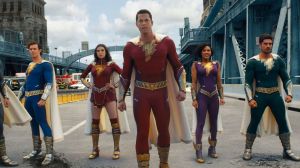 I think one of the most lacking elements of Fury of the Gods is that it loses its core appeal. The first movie was about a child fulfilling their adult dreams and leaping into maturity before their time. Levi (Apollo 10 1/2) was goofy and enjoyable in his broadly comical fish-out-of-water portrayal as a kid in an adult’s body. Now, the growing pains of being an adult, and a superhero, have been eclipsed. In fact, the amount of time we spend with Billy is pretty sparing. It’s all Shazam all the time, and this hurts presenting a worthwhile contrast between the mythic and the recognizably human. You forget the initial dynamic of this kid pretending to be an adult and what advantages this affords. At this point, being an adult is the same as being Billy Batson, who is approaching 18 and will age out of the foster system. This reality creates an existential crisis for Billy, as he’s afraid his family will move on so he’s eager to keep them together all the time, trying to maintain control. It’s about fear of change; however, I never fully understood why Billy was so worried. He’s already found a home with a loving mother, father, and extended clan of siblings, so why does aging out matter? He’s not going to be removed from his home. His siblings also aren’t talking about shipping out to the different corners of the world to begin careers or higher education. It’s a forced conflict to make the character uneasy about growing up. If the first movie was about a kid coming to terms with himself and letting others in, then this movie is all about a kid worrying his relationships will arbitrarily evaporate. This anxiety over losing something meaningful could have been an interesting storyline, but it’s all so contrived, and the whole body swap dynamic, the selling point of the first film, feels strangely absent.
Likewise, the villains have questionable motivation and character development. The movie begins with cloaked and masked figures wreaking havoc in a museum, and then it makes a big deal that these figures happen to be… women (also middle-aged and older at that). The opening is meant to be surprising in a way that feels out of date (what… g-g-girls can be powerful too?). It’s a strange point considering we’ve already had Wonder Woman. This same easily-satisfied, lowest common denominator plotting is disappointingly prevalent. These powerful gods want their father’s powers back but they already seem pretty powerful, so the movie lacks a fitting explanation of why these extra powers are worth all this effort. I suppose there’s a general revenge and righting of wrongs but the characters don’t play their parts too scorned. They’re more annoyed and tired, which doesn’t make for the most compelling villains. Another Daughter of Atlas has the power to mix and match the world like a volatile Rubix cube, but what is this power? It’s virtual obstacle-making but it feels arbitrary too in the world of superpowers. The ultimate scheme to conquer the world is as flimsy as the reasons it’s ultimately defeated.
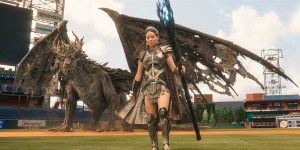 Let me dissect that part for a few words, the solutions to overcoming our vengeful gods. They raise an army of mythical creatures to destroy Philadelphia and it’s Ray Harryhausen character designs with cyclops and unicorns and the like. The way to reach through to the monsters and bring them on your side is to offer them a gift of “ambrosia,” some tasteful bounty that they can’t help but fall in love with. So what is the solution to this? One of the kids literally drops a handful of Skittles onto the street and the unicorn happily snarfs them down. Yes, through the power of Skittles-brand candy the heroes are able to save the day. There’s even a moment where the kid is riding the unicorns into battle and screams, “Taste the rainbow,” before the movie cheekily cuts her off before she can unleash an added “MF-er.” What is this? I’m usually agnostic on product placement in movies; characters have to eat and drink, etc. But when it’s egregiously transparent and played as the key to victory against all odds, that’s a bit much. If the joke is that contemporary food is a blast of flavor that nobody would have been prepared for thousands of years ago with their palettes, then any modern food could have worked. It didn’t have to be a brand-name candy with its brand-name slogan screamed in battle. This is but the first of several contrived and unsatisfying deus ex machina solutions that erase consequences.
Even with returning director David F. Sandberg (Lights Out), the enterprise feels like an empty retread relying too much on rote spectacle and missing the heart and perspective of its predecessor. There is an action sequence atop a collapsing suspension bridge and the song “Holding Out for a Hero” plays, and then we have a character comment on it, and it all seems like a desperate attempt to add some energy or style or fun to the sequence that is absent. The action relies on a lot of watching characters zip pedestrians to safety, but it’s the end result we see, not the whoosh and flurry of the arduous mission. The whole sequence feels like it’s going through the motions, as much of the movie does, falling back on a formula of superhero blockbuster autopilot. The CGI army of villains, the face-offs between characters shooting magic beams at one another, the overly quippy and tiresome dialogue and mugging cranked up to overdrive, the world-saving stakes feeling so minor. I was longing for some of the ’80s Amblin tone of the original, which got surprisingly dark. With Fury of the Gods, everything feels so safe and settled, with the stakes feeling inauthentic and the action reinforcing this with effects sequences that feel like Saturday morning cartoon filler.
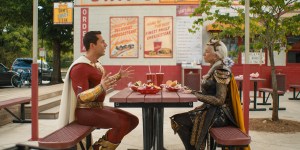 There’s a strange question with the family powers. The extended brothers and sisters can utter “Shazam” and turn into adult alter egos, but the character of Mary (Grace Caroline Currey, Fall) now transforms into a super suited version of herself with slightly different hair. In 2019, she transformed into actress Michelle Borth (Hawaii 5-0). Mary is the oldest sibling, and we’ve undergone a time jump of years to account for the ages of the kid actors, so does this mean that as the kids get older they will just turn into versions of themselves? Does this mean that the Zachary Levi-persona is set to expire once Billy turns legally an adult at 18? The implications of this casting choice made me question the very reality of the Shazam universe’s mechanics.
I can see certain audiences enjoying the slapstick and gee-whiz goofiness of Shazam! Fury of the Gods, and I have no doubt that the people making the movie wanted to tap into that childlike wonder of magic and myth. The problem is that this feels like the most inessential of the dozen DCU movies, going through the motions rather than exploring cogent and potent drama. Just take the character of Pedro (Jovan Armand) who is unhappy with his larger body and transforms into a handsome, slim, musclebound version of himself as a fantasy. That’s an interesting psychological exploration for the character, on top of his own self acceptance on a whole other front. Or take the sidekick from the first movie, Freddy (Jack Dylan Grazer), and his Romeo and Juliet-esque romance of a super-powered being from the other side of the conflict. There’s some drama there as well as his understanding of who the good and bad guys can be. Or simply take the perspectives of the parents trying to raise a household of kids who can transform at whim and what worries and joys this can offer. There’s material here to be finely explored, fun dynamics going beyond just repeating the Big-style body swap hi-jinks. Unfortunately, this is a sequel that feels like what made the original special has been replaced by blockbuster status quo.
Nate’s Grade: C


 nathanzoebl
You must be logged in to post a comment.