Blog Archives
Crimes of the Future (2022)
 David Cronenberg returns to the thing David Cronenberg is best known for. It’s been twenty-plus years since the director has gone back to his body horror roots, and Crimes of the Future is certainly a gross gross movie. If that’s what you’re hoping for, then the discomfort and bizarre sexual analogies might be a selling point for you. For me, I just felt nauseated without an interesting core to keep my mind from drifting away. In the future, people have evolved (?) pain tolerance and infection rates, so our protagonist Saul (Viggo Mortsensen) turns surgery into public performance as his assistant/lover (Lea Seydoux) removes the vestigial organs his body produces. Kirsten Stewart’s antsy, horny character states that “surgery is the new sex,” and you’ll get plenty of parallels as we watch person after person get all squirmy while being cut open. My problem with the movie is that there isn’t anything beyond the shock value. The commentarry about body experimentation as a form of sensuality feels trite and more an opening for weird moments, like when Saul gets a zipper installed across his pelvis and his assistant decides to open it and somehow pleasure this… pouch? There’s a hint of an interesting movie here. Saul is being asked to serve as a confidential informant for the government hunting down an extremist group trying to kick-start evolution so that children will be able to consume plastics. That would have put our main character into a discovery role for this world that would have provided more than shock value. The movie begins, literally, with a child being suffocated by his mother, so that sets the tone as to where Cronenberg is headed. Crimes of the Future is essentially a geek show of a movie absent meaningful social/sexual commentary and interesting characters. It’s more a movie of pliable body parts.
Nate’s Grade: C
Share this:

Cosmopolis (2012)
 David Cronenberg is a director that’s full of surprises. The biggest surprise about Cosmopolis, his new film based on the Don DeLillo novella, is how shockingly terrible it is. This may be Cronenberg’s worst film. It’s certainly one of the worst films of 2012.
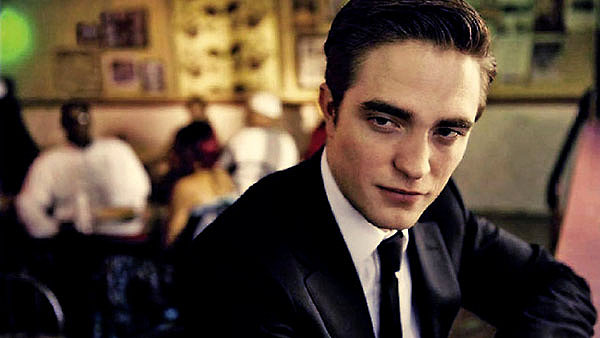
Eric Packer (Robert Pattinson) is a mega-millionaire currency trader. He’s got so much money he wants to outrightly buy a church just because. We travel with Eric over the course of one day as he travels through New York City in his stretch limo. Along the way, he hosts a colorful array of characters and fears that his high-stakes wagers will be adding up. He becomes more and more self-destructive and looks for new and exciting ways to waste money, talent, and time.
I hesitate to even use the term “film” with Cosmopolis because it’s truly more of an endurance test in didactic, pretentious art house masturbation. The script is really a collection of self-indulgent scenes with very little to connect anything together. Each new scene feels like the movie is starting over. Worse, the dialogue is painfully elliptical, stilted, and monotone, reeking of pseudo intellectual intent, lingering in ambiguity like it’s poetic. It’s not, it’s irritating and obtuse and characters talk in circles without ever really saying anything. It’s the kind of dialogue that reminds me of a pompous student play, something where the particulars involved think they’re making Artistically Daring Statements about Things That Matter. It’s such a mannered way of speaking, so labored in its affectations and superficially drawn to the mistaken belief that obtuse and redundant equals philosophical and thought provoking. The only thoughts I was thinking were of the murderous variety. I felt so pained that I had to check the time and only eleven minutes had passed. It felt like I had spent three times that. I stuck it out for you, dear reader, but otherwise I would have bailed. Here are a handful of dialogue samples to give you an idea:
 “Why do they call them airports?”
“I have an asymmetrical prostate. What does that mean?”
“Try putting a stick of gum in your mouth and not chew it.”
“Where do limos go to spend the night?”
I feel like I’m even doing a disservice to calling the people onscreen characters. They’re really more just talking heads, mouthpieces for cluttered ideology. The plot introduces new characters but they only last for a scene and then it’s time for someone new. This would be acceptable if it ever appeared that these interactions had any effect, positive or negative, on our protagonist. As it stands, it’s just a gloomy guy running into one meaningless encounter after another. Oh, and if that was the point of the whole exercise, then shoot me now. I literally cheered when the movie was over. Well, right after incredulously barking, “That’s it?”
Plot is another term, much like characters, that has next to no meaning for Cosmopolis. The plot is a wealthy guy who wants to get a haircut. Yes, that is the inciting incident. He stays in his limo as it slowly drifts down the bumper-to-bumper New York City traffic. He has encounters with people, sure, but mostly it’s the story of one man in his pursuit of a haircut. And you know what dear reader, spoilers be damned, but he gets that haircut too. The final half hour of the movie, almost a third of the whole running time, is spent with Paul Giamatti, an intense and angry man who wants to kill Eric. At least Giamatti’s performance kept me awake. The plot, much like the characters, is really a vehicle for the script’s ideas, so it becomes exasperating when the movie tries to pretend, at points, like now all of a sudden we should care about Eric and his journey. The ideas, as presented, are either on-the-nose or impenetrable. For every confusing conversation about death, you’ll get a leaden capitalism = rats metaphor.
 Pattinson (Breaking Dawn Part 2) seems like an apt choice as well as a craven marketing ploy for Cronenberg to get his weird arty movie greater exposure and financing. Pattinson gives a rather cold and detached performance, which I’m sure is also the point but it’s not exactly an outlet to showcase any potential range. I’m sure Pattinson leaped at the chance to work with Cronenberg, but he should have checked out his emotionally vacant character first. Oh I get it that Eric is a guy who seemingly has it all but now feels empty, and I get how it’s meant to be an analogue for the Wall Street set that’s hijacked our capitalism markets (rats!). I get it. It’s just lousy, and Pattinson could have been replaced with just about any young Hollywood hunk. The only enjoyable aspect of this whole movie, and this is simply a theoretical extension, is that plenty of diehard Twilight fans are going to watch this movie and be very very confused.
Cronenberg keeps us locked in that limo, at least for the first half of the film. We get to watch Eric host an array of guests. He gets serviced by a middle-aged woman (Juliette Binoche). He gets a prostate exam while conducting a meeting. He gets up-to-the-minute reports on the millions of dollars he’s hemorrhaging, and he doesn’t care. Money has lost all known value when everything is given to you. Look, I can make vague, self-important statements too. I’ll credit Cronenberg with finding creative ways to play around within the confined space of the limo, making the film less hermetic than it by all means should be. However, bad green screen effect work really proves distracting, so that you’re given another reason to check out when characters drone on as they do.
Strictly put, this was not a story that needed to be turned into a movie. I’m sure DeLillo’s novella has its own weight and power, but the big-screen adaptation of Cosmopolis is all flaccid pontification, empty verbal masturbation, and crushing dead weight. It was a Herculean effort for me to watch this meandering movie to the end and I know I can’t be alone in this regard. If only the characters were really characters, or the plot had any minute sense of momentum, or that the dialogue was less purposely obtuse, or if the movie felt like it was at least going somewhere or had some small recognizable shred of purpose. I won’t go as far to say that you should be worried if any of your friends gushes to you about how great this movie is, but you should probably keep an eye on them or see if they bumped their head. This movie is more like an insufferable lecture by the most boring people who confuse cerebral with impenetrable. If you’re not going to supply me any significant means of entry to engage with your art, then I’ll just go play with somebody else. Cosmopolis feels like the worst and most pretentious student film you’ll ever see. The rub is that a great director like Cronenberg made it.
Nate’s Grade: D
Share this:

A Dangerous Method (2011)
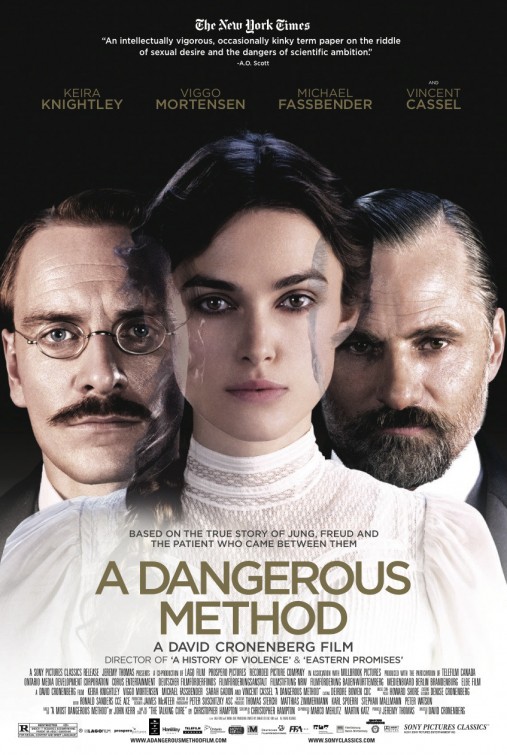 At first glance, the movie seems like an odd fit for director David Cronenberg, that is until you realize that, as Freud himself might approve, the entire movie is bubbling with sexual repression and kink. The movie showcases the friendship between the two titans of psychoanalysis, Sigmund Freud (Viggo Mortensen) and Carl Jung (Michael Fassbender), and the strange patient (Keira Knightley) who brought them together and tore them apart. This is a very intimate chamber drama, confined to lots of men in suits talking in great detail about psychology and philosophy and desire (there are three separate scenes of dream decoding and lots of letter correspondence voice over). Knightley is superb as a hysterical patient torn apart by her socially inappropriate desires. It may be a tic-heavy performance but my God can the woman act. She’s like a feral beast at points. The majority of the film follows Jung’s affair with Knightley and his friction with the single-minded Freud, who incidentally is never without a cigar clenched between his teeth. Jung wants to expand their field of study to include paranormal activities; Freud wanted to stay within the realms of science to give their movement credibility. Cronenberg’s period drama can be a bit too sedate at times given its aberrant sexuality. You don’t really empathize with either Freud or Jung, and thus the drama is a robust and intellectually stimulating exercise but only an exercise. For people who do not share an interest in psychoanalysis, they’re in for a long slog. A Dangerous Method is a rather short film, only 99 minutes, and would have benefited from being a bit more dangerous with its subdued subject matter.
Nate’s Grade: B+
Share this:

Eastern Promises (2007)
 Director David Cronenberg is an idiosyncratic director who explores Big Ideas through the context of creepy horror movies where the body is violated. He’s covered everything from evil gnome-like children, ravenous monsters in Marilyn Chambers’ armpit, and Jeff Goldblum’s face unfortunately peeling away. But then Cronenberg struck it big with 2005’s A History of Violence, giving him the highest profile of his long Canadian career. The auteur of ick is now back in a similarly themed tale of the true impacts of bloodshed with Eastern Promises, a gripping and thoughtful work.
Anna (Naomi Watts) is a midwife working in London and come across a young Russian girl who dies in childbirth. She leaves behind a diary that Anna seeks to have translated so that she can find family members to contact about the newborn. This brings her unknowingly to the doorstep of Senyon (Armin Mueller-Stahl) who runs a restaurant in London’s Russian district. She inquires if Senyon or any of the employees knew the dead girl, and as soon as Senyon hears about the reality of a diary he becomes more concerned. And he should be since he is the head of one of London’s most notorious organized crime families. His loose canon of a son, Kirill (Vincent Cassel), has authorized a hit behind his father’s back and repercussions may soon be approaching. Nikolai (Viggo Mortensen) serves as the family’s chauffeur but takes an interest in Anna and is willing to assist her as she stumbles into impending danger the more she translates from the diary.
 Much like writer Steven Knight’s excellent previous film Dirty Pretty Things, this is a film that shines a light on the underbelly of London and focuses on the immigrant experience and how apt they are to be exploited. Eastern Promises is both a straightforward crime thriller with an intriguing, albeit simple central mystery, but then as it moves along it transforms into something far richer. Through the diary, we uncover the hidden inner workings of the Russian mafia, which is a truly global enterprise. Women are promised with great riches and freedoms in their Slavic homeland, and then once transported will spend the rest of their lives behind the bars of a whorehouse, kept dependent thanks to a drug habit forced upon them. We’re immersed in the culture of this crime family. Eastern Promises takes its noirsh sensibilities and then gives us the foreboding and enigmatic Nikolai, a mysterious figure that the audience, like Anna, is drawn to. He spent time in a Siberian prison and is covered in telling tattoos that serve as a resume for the mafia. Nikolai is such a dominating presence and proves to be more intriguing than the central diary mystery, and it’s here where the film performs a balancing act and transfers our attentions fully to this brooding brute.
Cronenberg subverts his usual irony and weirdness to stay true to his tale, and this may well be, even more so than A History of Violence, the most accessible Cronenberg movie yet. We’re a long way from flesh-eating-monster-in-Marilyn-Chambers’-armpit. He still works with such compact efficiency so that no scene feels wasted, and Eastern Promises is a brisk 1 hour 40 minutes. Where Eastern Promises really succeeds is by layering in strong characters within a relatively genre movie. People are not exactly who they seem and the actors do their best to give remarkable depth to their roles.
Cronenberg seems to have found an actor that shares his artistic sensibilities. Scorsese has Leonardo DiCaprio, Wes Anderson has Bill Murray, Kevin Smith has Ben Affleck, and now Cronenberg has Viggo Mortensen. I never thought much of Mortensen as an actor until Cronenberg unlocked something deep and mesmerizing in their first pairing. With Eastern Promises, Mortensen establishes himself as an extremely capable actor. Nikolai is a complex figure and he Mortensen displays a mastery of understatement; his stony silences and piercing stares speak volumes, but you can practically watch the decision-making of the character pass through the face of Mortensen. He skillfully displays the good inside a man bred for evil.
 Watts is an actress with few equals and she dazzles once more in a role that requires her to do a lot of legwork. And yet, there’s a sad, haunting quality to her thanks to the back-story where she lost a child due to miscarriage. Cassel is also impressive in a complicated role that requires a lot of internal languishing. He’s at one an impudent child willing to live high off the power of his family name, and at other times he comes across as a severely wounded man who cannot thrive in his hostile family (both little and big F) environment. There are interesting revelations that make Kirill a much more complex and captivating figure, and Cassel plays the many dimensions very well. Personally, I’m happy to see Armin Mueller-Stahl in another high profile movie. There was a time shortly after his 1996 Oscar nomination for Shine where if you needed an old guy for a movie, you got the Armin. Lately, it seems James Cromwell has taken his place as go-to old guy. In Eastern Promises, he has such a sly menace to him from the moment his ears prick up at the notion of a diary. He insists upon inserting himself into Anna’s life and casually makes remarks like, “You know where I work, now I know where you work,” with just the right amount of finesse to sound intimidating and yet potentially harmless.
One scene I will never forget is when Nikolai is ambushed in a bathhouse by two revenge-hungry thugs. He sits there naked and exposed and these two unhappy gentlemen descend upon him (fully clothed) with knives. Nikolai fights like a wounded animal and manages to successfully take down both men even though he is unarmed and un-clothed. Up to this point the character has been something of a gentle giant, knowing the vicious ways of the Russian mob but seemingly at distance from them for whatever ethical decision. But it’s at this moment that we bare witness, no pun intended, to the cagey survival instincts of a man who must live his life looking over his shoulder. It’s a bravura scene that is played out in agonizing detail. Nikolai is slashed and thrown against tiled walls (much penis-related mayhem is glimpsed), but he keeps coming back and knows precisely when to strike. It really is the actors doing all the hard knocks and brawling, which heightens the tension. Cronenberg stages the violence in his realistic drawn-out style, which horrifies an audience while simultaneously fascinating them. This is by far one of the most indelible film moments of the entire year.
 Eastern Promises is an engaging character-based thriller, and yet I wish it finished as strongly as it began. This is the kind of movie where much is implied or said in silence, which works great at respecting the intelligence of an audience as well as staying consistent with a believable reality where everyone in such dangerous positions is not explaining everything aloud. However, one of the drawbacks of a film where much is implied is that when it’s over you may wish that they implied less and showed more. The climax to Eastern Promises is a little weak, especially when it comes shortly after the incredible bathhouse attack. There’s a very hazy sense of a resolution. From an artistic standpoint, I suppose I can appreciate a thriller that doesn’t feel the need to end with a pile of dead bodies and much blood being spilt, but at the same time, from an audience point of view, I was really left wanting for more when the film finally comes to a halt.
Thanks to a smart, twisty script, Cronenberg’s sharp yet quirk-free direction, and some stirring performances, Eastern Promises is a first-rate thriller with the added benefit of strong characterization to add richer depth to this tale of mobsters, retribution, and sex slavery. Mortensen is the real deal when it comes to acting, folks. Cronenberg may have found a true match with Mortensen, and the added cache may give the director greater financial opportunities to tell more intriguing tales that may or may not feature ravenous armpits.
Nate’s Grade: B+


 nathanzoebl
You must be logged in to post a comment.