Blog Archives
Warm Bodies (2013)
 Given the explosion in zombie culture and the avalanche of zombie movies, it was only a matter of time before a studio pitched the romantic possibilities. They may be dead but they still have needs. Based on Issac Marion’s young adult novel, Warm Bodies attempts to tell a love story from a zombie’s perspective. Writer/director Jonathan Levine, so skillful with tone in the comedy/drama 50/50, tackles an even trickier balancing act, making a zombie romantic. With some visual flair, an eclectic soundtrack, and a winning onscreen pair, Warm Bodies is a sweet love story that does enough right to leave you smiling.
In the aftermath of a zombie apocalypse, R (Nicholas Hoult) is a zombie who spends most of his days shuffling through an airport. Occasionally he has a series of conversations with his pal, M (Rob Corddry), which mostly amount to grunts. R can’t remember who he was before he became a zombie, or even what life was like before it all went to pot, but there is one thing that will make him feel alive again – human brains. You see, this tasty delicacy allows zombies to relive the memories of their victims. It’s a nice release from, you know, decomposing. The zombies that have completely given up all sense of self peel off all their skin, becoming the Bonies, a wraith-like band of creatures that will feed off anything, even the dead.
 This is R’s life until his chance encounter with Julie (Teresa Palmer). He’s smitten instantly and feels something weird in his chest. His heart has started beating again. He doesn’t want to eat her, just protect her. Of course he did also happen to eat her now-ex-boyfriend (David Franco). R whisks her to safety to his home in an airplane cabin. They listen to records and he instructs her on ways to pose as a zombie. She’s cautious but grows fond of her zombie protector (zombie Stockholm syndrome?). But R is proof that the zombies can change and that humanity can be saved. There’s just the matter of convincing Julie’s father, General Grigio (John Malkovich), who had to shoot his own wife after she turned. He wants them all dead and will do whatever it takes to protect the last bastion of the living.
Levine has found what may be one of the only optimistic zombie films out there. Usually these movies end one of two ways: 1) everybody dies (the preferred option), or, 2) the heroes manage a final escape but are most likely doomed beyond all hope (just pushes the inevitable off screen and into our imaginations). Tethered to a genial but winning romance, Warm Bodies is a zombie movie with a genuine sense of hope, revival, and even finds way to carve out a happy ending that, while predictable, feels right tonally.
The twee romance has a lot more in common with indie stylings than it does, say, Twilight, which will likely be invoked by many a critic and ticket-buyer alike. It’s not so much the brooding, sullen, exasperating kind of “romance” Twilight has primed people to expect when monsters date young girls. Thanks to the helpful voiceover, we see R as a thoughtful (being generous here considering his peers) guy who, like most teens, is trying to battle his inner urges and sense of awkwardness. He may be a zombie but Levine and Hoult have found a way to make R relatable and a likeable dead chap to root for. It also helps that he and Palmer (I Am Number Four) have above average chemistry together. Sure it’s a little weird that she takes the whole guy-crushing-on-me-kinda-ate-my-old-boyfriend, but like any relationship, there are just obstacles you’re going to have to overcome together. And as my pal Eric would attest, any Franco had it coming (his big bro did lead to the end of mankind in 2011, so maybe he’s responsible for the zombie apocalypse).
I appreciated that even with a PG-13 rating the movie still has a bite to it. Premise-alone, there is plenty room for some intriguing mismatched comedy. I enjoyed the aspect that consuming human brains unlocks that person’s memories. I like that R saves brains for later snacks. I liked that he used this absurd plot device to help him get closer with Julie and makes him feel guilty. Warm Bodies finds a way around the whole bodies decomposing issue, which is important since we don’t want our Romeo to be too disgusting for the teen girls. It refrains from overt gore, relying on implied carnage and preferring a chaste smearing of blood on lips, like he just got carried away eating a cherry pie. Honestly, I didn’t miss the gore. While the concept of a completely putrid corpse, with its flesh rotting and falling from its face, finding romance would be darkly comical, I think Levine chose the savvier path, forming a romance that doesn’t overdose on irony, which it would if the dead-boy-meets-girl romance were more grotesque. That’s the reason the Bonies exist, to provide a more grotesque and more evil foe that can provide perspective on the nobility of the not-all-the-way-dead people.
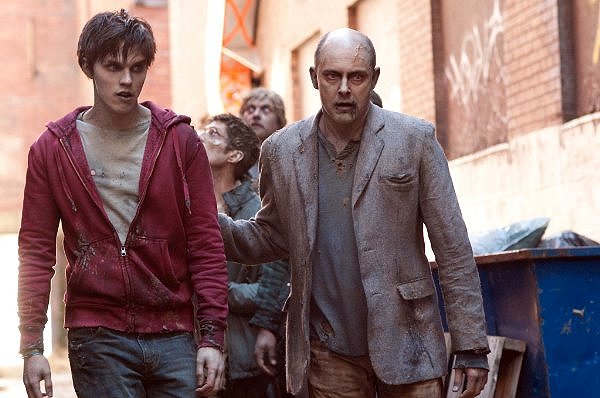 Levine works enough comic angles that the comic possibilities feel explored, although much like the horror and romance could have been pushed even further. As is, I found R’s musings wryly enjoyable, and his undead bromance with M provides some of the funniest moments in the film. Corddry (TV’s Children’s Hospital) is terrific in the movie and even finds what little room he can to add a touch of poignancy with his character. Often the humor, like the horror elements, is pretty relaxed but effective, refraining from oversized wackiness. You seriously would think that the movie would go bigger with its comedy considering everything at play.
Hoult (X-Men: First Class, TV’s Skins) does a credible job as a zombie, let alone an American zombie; it’s not all shuffling and caveman monosyllabic grunts. The actor is adept with communicating the awkwardness of his character in physicality. It’s funny how much you end of empathizing with a character that is dead. Hoult is also a pretty hunky guy, Vulcan eyebrows and all, but his amiable demeanor and young love clumsiness will win over as many guys in the audience as ladies. Palmer, also sporting an American accent, gets the blood pumping. Julie is underwritten but rises above just being a typical damsel-in-distress. It’s nice that later in the movie, when R breaks into the human camp, the roles are reversed, and Julie gets to protect him with her wits and will. Malkovich (R.E.D.) gets the worst of it just because his character is so rote.
I suppose I could lambaste the movie’s love-conquers-all logic with a dash of critical cynicism, but I feel like its low-key yet unfailingly romantic side is another of the movie’s charms. Sure, the idea that teenage love changing the world one beating heart at a time sounds like someone took the lyrics from an 80s power ballad and had it come to life (I’m reminded of the Patton Oswalt bit about the music video of an 80s hair band against the police: “He’d deflecting the bullets with the power of his rocking!”). There’s no real explanation why the zombies are getting better, though the concept of reclaiming their humanity appears to be contagious. I guess you could make some mild commentary on the healing power of human connection, but I don’t think Levine goes too far with any sort of subtext/social allegory, though there are enough slipshod Romeo and Juliet parallels. To the audience members who rankle at the unexplainable zombie cure, I would like to draw attention to the fact they are ignoring the fantastical logical puzzle of corpses coming back to life in the first place. If nobody minds why the zombie virus/crisis starts, then I don’t see why I should be sweating over what solves it.
Warm Bodies is a return to horror for Levine. Before his Sundance breakthrough The Wackness, the man got his start directing 2006’s All the Boys Love Mandy Lane. He’s made what may be the only zombie movie that I can say is “cute,” and that’s perhaps the best word for Warm Bodies. It’s a cute movie, perfectly pleasant, charming in its low-key sweetness while still managing to be clever. It’s dark but not too mordant, and sweet but not sappy. The last act doesn’t feel like it has the proper balance that the rest of the movie coasts with, but it wasn’t enough to ruin the film. At its core, it’s a cute love story, a zom-rom-com that’s much better than being relegated as “Twilight with zombies.” Yes it could have been darker, more macabre with its humor, and there are plenty of gloomy opportunities afforded by the premise of an undead boyfriend, but Levine and his actors have conceived a film that manages to be many things, chief among them enjoyable. It’s a zombie movie that might make you feel squishy but under completely different circumstances.
Nate’s Grade: B
Share this:

21 Jump Street (2012)
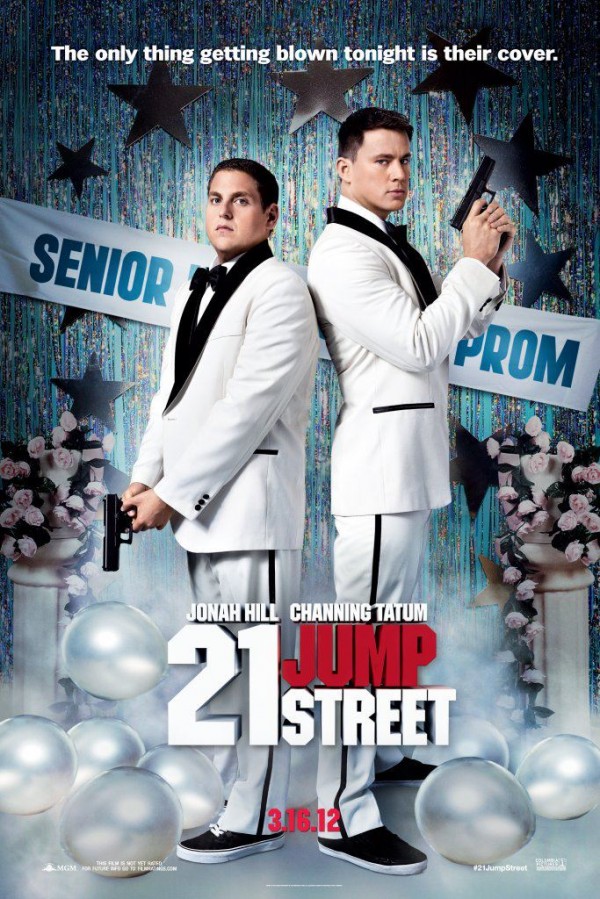 21 Jump Street ran on TV from 1987-1991 and is mainly known as serving as a launching pad for eventual mega movie star Johnny Depp… and Richard Greico too. Youthful looking police officers infiltrated high schools and tackled topical issues of the day (what snap bracelet goes best with my high-waisted jeans?). Why would anyone want to make this movie, let alone comic actor Jonah Hill? Surprising in just about every way, especially when it comes to overall quality, the 21 Jump Street movie is not just a great comedy but also a great movie. How the hell did this happen, Movie Gods?
Officer Schmidt (Hill) is smart but shrimpy (which is saying something considering how dangerous Hill’s weight has been before). Officer Jenko (Channing Tatum) is a stud but pretty dimwitted when it comes to tests. The two form a partnership and get assigned as bicycle cops, not exactly the position of command and authority they were expecting. After a few screw-ups, including failing to read a suspect his Miranda rights (“You… have the right… to be an attorney”), the duo gets bounced to an old undercover program at, you guessed it, 21 Jump Street. The pair is supposed to pose as high school students and find out who’s supplying teenagers a dangerous new club drug. Much has changed since Schmidt and Jenko were in high school together, and both of their profiles were accidentally swapped, meaning Jenko is given AP chemistry and the higher level classes, and Schmidt is given gym and acting courses, where he’s supposed to work his way into the popular circles. Molly (Brie Larson) is a gal in that popular inner circle and Schmidt struggles to accept that a pretty, smart, popular girl might actually “like like” him.
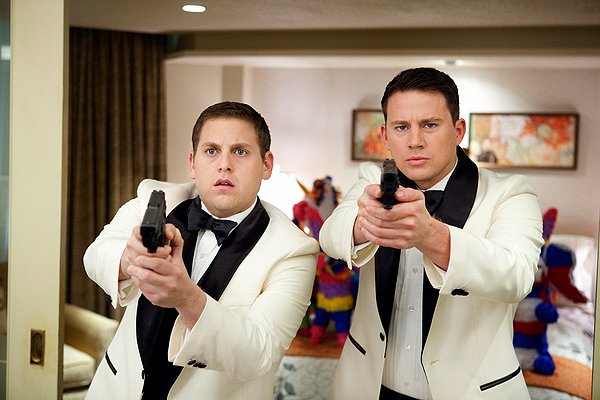 I knew I was in for something special when the movie itself lambastes the very idea of a 21 Jump Street movie, with the police chief (Parks and Recreation’s Nick Offerman) ridiculing the idea of unoriginal nitwits recycling something old that has name recognition and hoping the public will be too dumb to care. The movie beats the audience to the punch every time, mocking the absurdity of its own premise and plot points (many characters note how old Jenko appears). I should have expected more from screenwriter Michael Bacall (co-writer of the Scott Pilgrim movie adaptation) and especially from directors Phil Lord and Chris Hill, the same pair whose rambunctious comedic verve radiated from every frame of Cloudy with a Chance of Meatballs and their brilliant short-lived animated MTV show, Clone High. This movie had me laughing a lot and had me laughing hard, doubling over, with-tears-in-my-eyes laughter at points. Dickson spouts, “Some kid overdoses on drugs. And because he’s white, people actually give a shit,” showing that a movie with a mind-blowing number of male genitalia jokes can provide a few shrewd jabs of social commentary. There’s a great bit where on their first day back in school, Jenko points out the various school cliques. Then he gets to a group of students in skinny jeans, thrift store clothes, and floppy hats, and he looks puzzled. “I don’t know what those kids are?” Ha, because hipsters didn’t exist back in his (my) day.
21 Jump Street is cheeky, rowdy, quick-witted and playful in the best sense of an action comedy. It’s got fish-out-of-water moments as the duo struggle to fit in with a different high school setting. The one-liners and riffs can be gut-busters, but the film does an even better job layering oddball gags (Korean Jesus), loony slapstick, fun but telling character moments (Schmidt not knowing how to end a prayer: “The end, right? ‘The end’?”), strong setups that have stronger payoffs (using the reading of Miranda rights as a genuine emotional climax), and an overall raucous, anarchic spirit.
Here’s one sequence in particular that shows off the film’s clever comedic chops. The film finds a way to satirize the tropes of action movies, particularly buddy cop movies, with such nimble precision. Schmidt and Jenko are on the run but their car chase keeps butting heads with the fabricated reality of Hollywood movie chases. For one, they keep finding themselves getting stuck in traffic on the highway. This forces them to have to keep abandoning cars and finding a new set of wheels ahead of the gridlock. Then, as the bad guys chase them down on motorcycles, the chase causes all sorts of chaotic collateral damage, including oil trucks riddled with bullet holes and dripping the flammable substance all over the road. Then one of the motorcycles skids into the flammable muck, and our heroes wince in preparation of the expected explosion, and then nothing happens. “Huh. I really thought that was going to explode,” one of them remarks casually. And this setup is repeated again, denying us the explosive equation that action movies have pummeled into our brains (car + any tap of force = humungous fireball), and there is a payoff to this comedic tweak on the cliché, and it is silly and terrifically funny. Plus, I haven’t even mentioned that both Schmidt and Jenko are dressed in silly outfits and begin their car chase in a driver’s ed car. This sequence is just one example of the anarchic, robust, and self-aware comedic attitude that the movie flaunts.
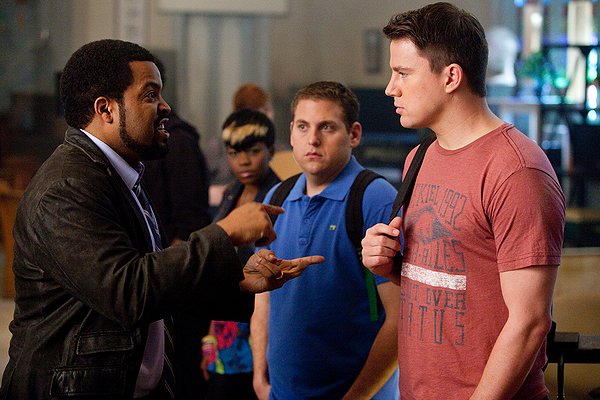 But more than being a hysterical action picture, 21 Jump Street works even better because at its core is a level of sweetness, a satisfying mixture of lewd and heart like the best Judd Apatow ventures. It’s a bromance of epic proportions even by buddy cop standards, the old school bromance vehicle of its day. The guys go back to high school and the movie’s bright switcheroo puts the characters in opposite social spheres, with Schmidt with the cool kids and Jenko struggling with the social misfits and bottom-dwellers, a.k.a. nerds. Of course the whole class assignment also shows the façade of being cool in high school. The movie could have mined this well-worn stereotypical class conflict with ease, but instead it decides to use its contrived scenario as a jumpstart for the guy’s emotional growth. The lessons may be simplistic (perils of ego, believe in yourself, teamwork, personal responsibility) but that doesn’t make them bad lessons, and the fact that the flick seriously uses covalent bonds as a metaphor, and does so in an almost poignant fashion, is worth applauding. The relationship between Schmidt and Jenko engages the audience, and we root for them even when they’re behaving like jerks. They’re misfits who are doubted and reprimanded, which make us hope for their eventual success even more. Refreshingly, the movie doesn’t put them in opposing camps in high school. Schmidt was a dweeb and Jenko was a dumb jock, but that doesn’t mean they needed to be adversarial. When they regroup in the police academy, they form a genuine partnership, realizing they can assist one another. They form an actual friendship and they’re both better cops, and better characters, together.
Hill and Tatum have preposterously good chemistry together as a comic duo. Hill, a co-writer himself, reportedly had to remain steadfast to convince Tatum to join forces, and thank god he stuck it out. Hill’s (Moneyball) already a comic pro at this point, though this role tones down his comical rancor and ups the spaz awkwardness. Tatum (The Vow) is the true revelation. Man does this guy have really great comedic skills; a sharp, instinctive sense of timing, a pliable physicality, and a genial charisma that doesn’t demand solo attention. He’s good at playing dumb without going overboard. He’s not just good, he’s flat-out terrific. Larson (Scott Pilgrim vs. the World) is an adorable and plucky love interest, sure of herself, down to earth, and accessibly quirky. The supporting cast shines in their small roles, notable Ice Cube (Lottery Ticket) as the typical brash and loud police captain, Ellie Kemper (Bridesmaids), in her randiest roll yet, as a chemistry teacher awkwardly flirting with the hunky Jenko, Dave Franco (Fright Night) as an eco-friendly drug dealer, Rob Riggle (The Other Guys) as an aggressive gym teacher, and a special cameo that’s worth leaving unspoiled.
21 Jump Street has some weaker points, namely when the action ramps up it’s pretty mundane when it’s not being funny, but the faults are minor. This is a silly, shrewd, salacious, and outright thrill of giddy entertainment, a comic blast. Hill and Tatum have a wonderful comedic dynamic and the clever screenplay gives them plenty to do with their talents. I didn’t think it was possible to adapt the cheesy TV show into a worthwhile studio comedy, but Hill and company have exceeded every expectation. 21 Jump Street isn’t the most nuanced or subtle comedy, though I will argue spiritedly that it has plenty of smarts in all the right places, but it’s an affectionate, witty, and rambunctious night out at the movies that will be hard to beat this spring.
Nate’s Grade: A-


 nathanzoebl
You must be logged in to post a comment.