Blog Archives
Antichrist (2009)
 Just in time for Easter, I watched notoriously sadistic filmmaker Lars von Trier’s (Dancer in the Dark, Dogville) controversial psycho-horror film, Antichrist, and wow, is this a loathsome, powerfully unpleasant experience. There’s about five minutes of worth in this whole film. In a beautifully shot black and white prologue, we watch a couple (Charlotte Gainsbourg, Willem Dafoe) have sex and, unbeknownst to them, their baby falls out a window and dies. It’s all downhill from there and at rapid speed. The remaining movie explores Gainsbourg’s trauma and grief and her husband’s therapeutic attempts to cure his wife. There’s a somewhat intriguing premise buried underneath the mounds of psychobabble — a husband blurring the lines of professionalism to become his partner’s therapist. There are some complex ethical and emotional areas to explore there, but alas, von Trier takes his characters to a spooky cabin in the woods (named “Eden” for maximum metaphorical pretension) and the move becomes one long, incomprehensible, pompous trek into weirdness and pseudo-intellectualism. von Trier wants his movie to be disturbing, so he packs it will strange images like a dead talking fox (“Chaos reigns”) and a stillborn baby dear handing from the back of its mother, intending to convey the ruthless brutality of the natural world that his characters must navigate. Except I never cared about these characters at all. We never get to know them, so we can’t really feel for them, so when they start becoming unhinged it has no dramatic weight. Their lengthy conversations are a drag, and one psychology exercise after another doesn’t make much sense. The von Trier narrative model (woman is relentlessly tortured) is alive and well and leads to some shocking scenes of over-the-top sexual violence. von Tier’s attitude toward women, and female sexuality, has always been somewhat sketchy; is he an exploitative misogynist or a cloaked feminist arguing that the male-dominated world cannot handle feminine sexuality and independence? I feel like von Trier is an artist that could be diagnosed with Munchausen’s by proxy syndrome.
Nate’s Grade: D+
Share this:

Watchmen (2009)
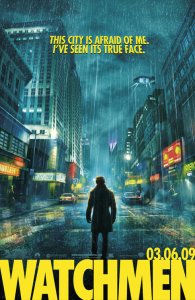 In the realm of comics, Watchmen is tantamount to the Bible. It consisted of 12 issues released between 1986-1987 but it arguable changed the medium forever afterward. TIME magazine listed the book, by author Alan Moore and artist Dave Gibbons, as one of the 100 greatest 20th century novels. Therefore, there has always been heavy trepidation within the geek community when Hollywood came courting the Watchmen property. Different directors have tried tackling the material, going back to the late 1980s when Terry Gilliam was hired to direct and producer Joel Silver was adamant about getting Arnold Schwarzenegger to portray Dr. Manhattan (back then, they totally just would have painted him blue — like they did when he was Mr. Freeze). The movie would seem like a tantalizing possibility and then the production would collapse, most recently in 2004 with director Paul Greengrass attached. Director Zack Snyder (300) understood all of the concerns from the notoriously vocal geek community and attempted to make the most faithful Watchmen film possible. He accomplished that goal. But was it the right goal?
In this alternative account of history, masked crime fighters exist and were even bankrolled by the U.S. government. President Nixon is re-elected to a third term, thanks in part to superheroes winning the Vietnam War, and then he outlaws all masked vigilantes. Flash forward to 1985, and Nixon is on his fifth term and staring down Soviet aggression into Afghanistan. It appears that the world on is on the brink of nuclear annihilation by the dueling super powers engaged in a staring contest. Edward Blake, a.k.a. the Comedian (Jeffrey Dean Morgan), is thrown from his apartment window and killed. Blake used to belong to a second-generation superhero team in the 1970s called the Watchmen. The other members consisted of Dan Dreiberg, a.k.a. Night Owl (Patrick Wilson), Rorschach (Jackie Earle Haley), Adrian Veidt (Matthew Goode), a.k.a. Ozymandias, the glowing blue man Dr. Manhattan (Billy Crudup), who was transformed into a god-like figure of power after a laboratory accident, and then there’s Laurie Jupiter, a.k.a. The Silk Spectre (Malin Akerman), who was following in her mother’s (Carla Gugino) footsteps, the first Silk Spectre. The death of the Comedian brings the old team back together and rekindles some interest in putting on the super suits and fighting crime one more time. It seems someone out there is trying to knock off the retired superheroes, and Rorschach is convinced that a bigger conspiracy is unwinding.
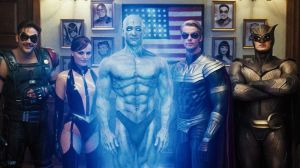 It’s difficult for me to formally express my feelings and reactions to the Watchmen film adaptation. Count me among the throng of fans that feels that Moore’s source material is a remarkably dense and witty deconstruction of the superhero mythos. Imagine a Superman that can’t be bothered to help out humanity because he feels life is overrated, or a group of super heroes that don’t necessarily do anything heroic; when they beat up the bad guys it’s because they get a sexual thrill from the rush of violence. My voice was among the cacophonous crowd screaming, “Don’t you dare butcher this great work! Keep it as close to the comic as possible!” And that’s pretty much what Snyder delivers. But now I’m left to wonder if a literal-minded interpretation is truly what I wanted all along. Watchmen is not like Sin City, a comic that was already a movie in panels. Frank Miller’s ode to film noir was ready and waiting to be a splashy action movie with style to spare. Watchmen is not a ready-made action vehicle, as it really only has about two extended pieces of action. Moore’s story examined what kind of people would become vigilante crime fighters if the government approved the practice. Surprise, it’s a bunch of sociopaths that are now getting checks from Uncle Sam! Watchmen is a nihilistic account of human behavior and far more cerebral than any superhero film that has ever graced the screen. Seriously, what other superhero movie opens with a fictitious episode of PBS’ political yak fest, The McLaughlin Group? So I suppose this paragraph is a sheepish way of admitting that perhaps Watchmen should have stayed place on the page unless, gulp, it was advantageously adapted for the medium of film.
It’s not that Snyder does a bad job or that the film itself is poor. While Snyder isn’t the best man to handle actors, he is certainly a skilled visual tactician and knows how to make some immensely pleasing imagery. He breathes great life into the images of the comic book and filled in the blanks nicely, and his one big artistic addition is one of the film’s best moments. In the opening credits we get a series of shots that perfectly establish this alternative universe, where JFK shakes Dr. Manhattan’s hand on the White House lawn only to be later gunned down by none other than the Comedian in Dallas. The segment is cleverly set to Bob Dylan’s “The Times They Are A Changin'” and is a terrific intro into a re-imagined America. I wanted to spend more time exploring the differences, like watching a giant Dr. Manhattan win the Vietnam War in one week’s time. In many ways, Watchmen is Snyder’s epic pop commentary on the history of the United States. Dr. Manhattan takes the first pictures of the astronauts on the moon. It is a female crime fighter that swoops a woman off her feet for that iconic celebratory kiss marking the end of World War II. The flick even has a period appropriate, synth-aided score, which is fine, though the use of period pop songs can be distracting. Watching Laurie and Dan make love to the raspy tunes of Leonard Cohen’s already overused tune “Hallelujah” is a deeply uncomfortable moment. Also, the aging makeup is horrendously bad. Gugino looks like she has a turkey waddle and the older Nixon looks like a freaking Halloween mask.
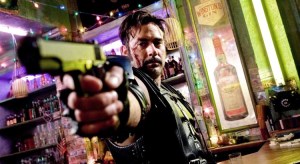 At what cost did Watchmen make it to the screen? Wacthmen plays as an adaptation like the first two Harry Potter movies, like there was an assigned checklist rather than a fully developed script. I achieved a brief understanding with the characters and each central figure provides a glimpse of the trouble beneath the surface. Laurie is a girl with daddy issues who’s been pressured to follow her mother, a rape victim who still loves her rapist. Dan is a self-pitying putz who has never felt more alive than when he puts on a costume. Rorschach has the same pessimistic view of mankind that Travis Bickle did, viewing many people as vermin clogging the gutter. Yet Rorschach also is the most single-minded of all the characters and abides by an innate moral code and sense of duty, never mind the fact that he may have lost his mind. Dr. Manhattan has been turned into a supreme being and has lost his connection to humanity. The Comedian is a man of wanton desire who declares himself to be the epitome of the American dream: giving in completely to the id. Watchmen has been deemed as an unfilmable book, and perhaps they were right. It feels like Watchmen and looks like Watchmen, but the movie never seems to become anything grander than the sum of its parts. The Dr. Manhattan back-story, where we see him live life in the past, present, and future simultaneously may be one of the best moments in the movie, but it doesn’t add up to much more than an interesting aside. The trips to Mars and Antarctica provide nice visual landscapes but do little else. The other quandary is that everything Snyder cut from the comic (the side characters, the pirate comic, the alien squid) is something that ultimately was unimportant. All of the important and memorable moments from the comic are here, though abbreviated and truncated. Even a 2-hour and 40-minute movie feels like too much of a sprint through such rich material probably better suited to the more accommodating narrative confines of a glossy HBO miniseries. The movie ends up becoming a handsomely mounted and reverent homage to the source material, but I question if the movie serves any other purpose than as an advertisement to go read the book. Will people unfamiliar with the book enjoy a movie practically tailor-made to appeal to fans of the book? Who will watch the Watchmen?
Make no mistake, Watchmen is a hard R-rated movie and if any parent takes their child to this flick because it has men in capes, then that parent should have their child removed. Snyder has ramped up the book’s adult elements, which were originally a commentary on how comics flirt with sex and violence but never get their hands too dirty. Snyder has gotten his hands dirty all right. Instead of zapping others into poofs of smoke, Dr. Manhattan turns them into explosions of human goo that stick to the ceiling. Instead of the Comedian being thrown from the window, we see an extended fight sequence that seems to indicate that the Comedian’s apartment is full of nothing but breakable glass tables. When Dan and Laurie get into a street brawl where bones pop through skin. The sex scenes now involve an almost-agonizing level of thrusting. This is an adult tale in a very simple sense: there are boobs and blood. But the movie is also adult in the fact that it trades in complex political, psychological, and philosophic ideologies, asking hard questions that do not come with easy answers. Do the ends ever justify the means or is mankind destined to always destroy itself? Is humanity worth saving and at what cost? This is probably the most subversive studio-backed movie to come out of Hollywood since 1997’s pro-fascism melodrama, Starship Troopers.
 The three best performances in the movie all come from the three weirdest and most messed up characters. Haley (Little Children) fully inhabits the grisly character of Rorschach and growls his way through the movie. You can tell just by the man’s face how much he has weathered. Crudup (Big Fish) and his gentle voice make Dr. Manhattan an intriguing yet beleaguered super being. Morgan (TV’s Grey’s Anatomy) makes the Comedian one consummate bastard but a bastard that you cannot stop watching, nonetheless. The rest of the cast does suitable jobs and I don’t feel that Goode (The Lookout) or Akerman (27 Dresses) deserve the drubbings they’re getting through the critical community. I actually liked Goode’s portrayal of Ozmanydias, though he fails to express the heavy crown the smartest man in the world must bear. Gugino (Sin City) is terrific when she’s the young, spunky Silk Specter and the opposite of terrific when she’s the troubled, alcoholic older version on screen.
Snyder has served up the Watchmen that fans have been demanding for years, but is this really what everyone truly wanted? Snyder made an adaptation for the fans but what do the fans know except for lavish loyalty? The book utilized the medium of comic books to accentuated its story while commenting on the history of comics and superheroes, and when translated to the big screen as is Watchmen can feel like an artistic stillborn. I’m now more curious than ever to read the previous drafts out there, the ones that directors like Darren Aronofsky and Greengrass were going to film until the financing got pulled. One of the drafts transplants the world of Watchmen to modern day and replaces the nuclear brinksmanship with the Russians to the ongoing War on Terror. It may not be faithful to the fabulous source material, and it quite possibly would have made a terrible movie, but it would have been more interesting as a film project because it would have been an adaptation. Snyder’s Watchmen is reverent to a fault but I cannot complain too much. This is likely the most faithful recreation of a complex book that fans could hope for. I feel satisfied and yet unsatisfied with the finished product. It was everything I was looking for in a Watchmen movie and maybe, in the end, that was the problem. I think instead of buying the DVD I may just read the book again.
Editor’s Note: I have warmed up to this film much, much more on Blu-Ray, especially the 3-hour director’s cut. It’s Snyder’s best work to date.
Nate’s Grade: B
Share this:

Sweeney Todd: The Demon Barber of Fleet Street (2007)
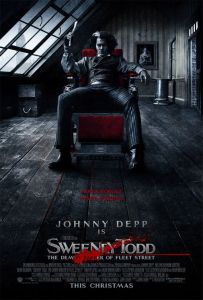 Famed musician/lyricist Stephen Sondheim’s tale of murderous barbers, cannibalism, and poisoned hearts first debuted on Broadway in 1979. Sondheim has been very protective of his material when it comes to film rights, but it wasn’t until the combination of visionary director Tim Burton and acclaimed actor Johnny Depp that Sondheim allowed his revered musical to be made into a movie. The result is faithful production that expands the scope of the musical while maintaining an intimate, chamber-music feel. Sweeney Todd flirts with being a masterwork but settles for being incredibly damn entertaining.
Benjamin Barker (Johnny Depp) returns to London after 15 years in prison on a flase charge. Judge Turpin (Alan Rickman, suitably creepy) wanted Barker’s wife for his own and conspired to have the barber sent away. Now under the auspices of Sweeney Todd, Barker has come back to seek his wife and daughter. He sadly learns that his wife is dead and his teenaged daughter, Johanna (Laura Michelle Kelly), is the ward of the Judge. Sweeney reopens his barber business above a flagging pie shop run by the eccentric Mrs. Lovett (Helena Bonham Carter). Sweeney plots his revenge against the Judge and his henchman, Beadle Bamford (Timothy Spall, suitable rat-like). Anthony (Jamie Campbell Bower), who traveled with Sweeney back to London, has set his sights on Johanna and intends to run away with her as soon as she can escape the Judge. Meanwhile, a rival barber named Pirelli (Sacha Baron Cohen) recognizes Sweeney from the old days and wants his silence paid for. It’s not too long before things get dicey, throats get cut, and people get turned into meat pies.
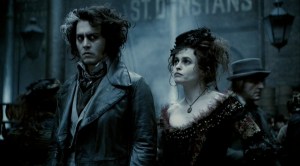 People unaware of the Sondheim musical are going to be in for a big shock. The film is about 80 percent sung, and the singing never rises to big, show-offery numbers of crescendo power vocals; the songs are more in the variety of speaking and vocals frequently overlap. The movie has greater clarity to the lyrics, and for the first time I as able to actually decipher Joanna’s words in the song “Green Finch and Linnet Bird.” Fans of traditional musicals, the kind that feature songs centered on female deer or large corn exporting states, may be aghast at how adult and violent the musical is. It’s just as much a grand horror movie as it is a musical. No doubt people are not generally accustomed to soaring medleys set to gashed throats and spurting blood. Sweeney Todd is captivating tale where almost all the characters are villains in some sense, and yet you do build sympathies even after innocents are killed and baked into flaky desserts.
Unlike other recent big screen versions of popular Broadway song-and-dance shows, Sweeney Todd is not simply the stage version transported to a bigger stage. This is a movie, through and through, and a perfect marriage. Burton is the perfect visionary to filter the twisted sensibilities of Sondheim’s masterpiece onto the silver screen. As a director, his work has been artistically backsliding since the start of this decade, but Sweeney Todd puts a firm stop to that. The technical aspects of Sweeney Todd are brought to life with great care and imagination. The Gothic sets are gorgeous and the costumes and cinematography are fitfully drab and dour, like everyone is living in a silent movie devoid of color; it takes a lot of hard work to create a near monochromatic playing field for the actors. And so when the blood does splash, and oh does it splash, the film pops with vivid color. Sondheim’s playful lyrics and rapturous music has never sounded better; it practically swoons.
The movie opens up the play in ways that a staged performance never could. Instead of keeping a distance from the bloodletting, usually something symbolic or as graphic as coloring a red line across a victim’s neck, Burton thrusts the audience right into Sweeney’s shop. The blood sprays in bright geysers and the violence is fully realized, fully felt, even if it’s never terribly realistic. The full weight of Sweeney’s vengeance and eventual destructive madness can be felt when the audience is witness to its wrath, and that includes the graphic murders. The medium of film ups the horror elements and transforms Sweeney Todd into a stronger work by amplifying the tension. The last scene with Mrs. Lovett is far more haunting than anything that could have been achieved on a stage. Burton also adds lots of dark humor thanks to his open visual palate, like during the song “By the Sea” where Mrs. Lovett fantasizes about her and Sweeney cozying up together in different scenarios. The film transports the viewer to the different pretend locales all the while Depp remains gruff and indifferent. He maintains the same curmudgeon from fantasy postcard after fantasy postcard. It’s the cheeriest segment in a grimly perverse musical that could rival Hamlet for dead bodies.
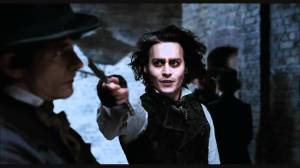 In an effort to slice a three-hour musical to a manageable two-hour movie, screenwriter John Logan (The Aviator, Gladiator) has pruned the story down to the essentials, namely everything that impacts Sweeney’s ultimate pursuit of vengeance. Johanna and Anthony, the hopeful lovers, have been pared down the most. Their only scenes now revolve around intruding upon Sweeney or helping him meet his venomous goals. The lecherous songs the Judge sings to himself about his lust for Johanna has also been cut (my wife was severely disappointed by this cut, saying, “You’ve got the Rick, come on!”). The most notable omission is the opening medley “The Ballad of Sweeney Todd” that serves as a Greek chorus-like overview of the sordid tale ahead. The song provides a lot of back-story and exposition that can be more easily covered by Burton fashioning visual flashbacks of Sweeney’s former life. The ballad and other absent songs are still used instrumentally throughout the film. Logan has also turned Toby (Ed Sanders), Pirelli’s assistant, into a much younger character, turning him into an urchin boy with fresh memories of life in a workhouse. I’m not entirely sure Toby’s protective song to Mrs. Lovett “Not While I’m Around” becomes an ode to puppy love and loses some believability. Also, normally Toby is played as a man-child who isn’t entirely whole in his mental faculties; however, the movie version turns him into a plucky Oliver extra. It seems less devastating and tragic.
But what about the singing? Depp won’t be knocking down doors on Broadway anytime soon but he delivers a very satisfying baritone that, while lacking in power or refinement, delivers in spades with emotion. His singing is full of great texture. His song “My Friends,” an ode to being reunited with his razors, is full of brio and nuanced longing, but he really shows his talent when Sweeney loses it. He’s a man obsessed with vengeance and when it escapes his grasp he snarls with scary intensity. When he launches into “Epiphany,” where he determines the whole human race is fit to have their throats slit, he barks at strangers on the street and howls at the sky, smiling at his glistening razors in hand. What can be forgotten with musicals is that there is so much more to a performance than simply an adept ability to sing the right notes. With Sweeney, Depp spins an incredibly rich performance that plumbs the dark recesses of a man whose only purpose is vengeance. In the end, when he’s saturated in blood and the full reality of his actions is upon him, Depp goes from remorse to psychosis to horror to acceptance in, like, a minute flat. Seeing such a classic Broadway character done justice by an actor of Depp’s immense talent is thrilling and a bit of a relief to Sweeney fans.
 Carter has the weakest, thinnest voice of the cast. Mrs. Lovett is a larger than life figure that has been played on Broadway by the likes of Angela Lansbury and Patti LuPone. The role is usually played more boisterous, more comically broad. It’s a juicy part and full of brash bravado. Carter stumbles through “The Worst Pies in London” and she seems to step all over her lines, rushing through and losing the comedic flavor. But like I said before, a performance is so much more than singing, and it is here where Carter imbues great complexity to her role. Her unrequited love for Sweeney consumes her and her relationship with Toby places her in an awkward predicament. Carter flashes a wealth of emotions through the power of her eyes. It’s a battle between maternal and sexual urges. Stylistically she resembles a rag doll someone tossed in the trash but it all works.
It’s refreshing and exhilarating to see a perfect marriage of material and artistry. Burton has transported Sweeney Todd into a faithful and jubilantly dark movie that doesn’t shy away from the grotesque. It’s a stirring, wonderfully Gothic rendition of Sondheim’s masterpiece. Sweeney Todd is blissful, spirited entertainment that’s not exactly for the squeamish, but this is one musical that can simultaneously touch the heart while turning the stomach.
Nate’s Grade: A
Share this:

No Country for Old Men (2007)
 Joel and Ethan Coen are two of cinema’s most talented oddballs. Together, they’ve created some of the most intricate, eclectic, and best movies of the last 25 years. Their last two efforts, 2003’s Intolerable Cruelty and 2004’s remake of The Ladykillers, didn’t feel like Coen movies; they felt like they were compromised and missed the artistically deft touch. As a result, both movies were mild failures for filmmakers that have a series of genre-spanning masterpieces to their name. No Country for Old Men is the first time the brothers have adapted someone else’s work, in this instance Pulitzer Prize-winning author Cormac McCarthy’s 2005 novel. Not too shabby if I say so. Fortunately for all lovers of film, the Coens have embraced McCarthy’s blood-soaked tale and crafted an exciting, honest, and intensely provocative modern Western that stands out as one of the greatest films of the year.
In dusty West Texas, Llewellyn Moss (Josh Brolin) is out hunting the lonely plains when he discovers a blood trail. It leads him to four empty cars riddled with bullet holes, dead bodies collecting flies, and a sack containing two million dollars in cash. The signs are all there that this was a drug deal gone badly, and two million will never go unnoticed, but Moss sees this as an opportunity of a lifetime and takes the money. The men in power have hired Anton Chigurh (Javier Bardem) to find their drugs and money and exact retribution. Chigurh’s preferred method of killing involves a high-pressured air canister that can blow out doorknobs and human brains. Chigurh chases after Moss all the while Sheriff Ed Tom Bell (Tommy Lee Jones) is following the trail of death to try and save Moss or any future innocent victims.
 What a fine-tuned, nerve-wracking, and engrossing cat-and-mouse thriller this film is. The action is brief but the buildup can be nearly unbearable to endure. The tension is magnificent. Chigurh chases Moss from hideout to hideout and some of the tensest moments are just waiting. There’s a moment where Moss is calling the front desk of his newest motel and we hear the phone ringing unanswered again and again from the hall, all the while Chigurh’s footsteps inch closer. But it’s the moments of silence that cause the most dread. When Moss is trying to recover his loot, all the while Chigurh is in the opposite motel room, it becomes a balancing act of sound and silence. No Country for Old Men is expertly orchestrated to involve the use of sound as a tool for high suspense. None of our main three characters inhabit a scene together. Sure Moss and Chigurh shoot at one another but even then it’s short and focused on waiting for response and counter response. Moss is no dummy and he sets up some traps for his would-be dispatcher. No Country for Old Men is unnerving, intelligent, near flawless entertainment.
Chigurh, as masterfully played by Bardem, is the stuff of nightmares. I was literally afraid to go home after seeing this movie and it is because No Country for Old Men fashions a villain so methodical, so cold-blooded, and so downright deadly and cunning that I felt as if he could very well be residing under my bed at night waiting. Bardem is hypnotically horrifying and the Coen brothers establish early on how ruthless their cinematic boogeyman is. The very first moment we’re introduced to Chigurh he escapes from police custody and strangles the inattentive officer on duty. He drags him to the floor and chokes the life out of him, but the Coens position the camera not on the last desperate kicks of the officer but on the face of Anton Chigurh, and it is nasty. His eyes are bugged out and his intensity comes across as sadistically jubilant. He seems like a caged animal finally let loose. It’s a scary yet fascinating introduction to a deadly character.
Chigurh is a humorless and determined man, and every scene he steps into instantly changes. A gas attendant casually asks Chigurh about the weather and gets on his bad side and the stone-faced killer in the Dutch boy haircut proceeds to press the poor man with increasing agitation, yet Chigurh always speaks in such a placid tone that makes him far creepier. He’s a maniac that never raises his voice. Chigurh then corrals the man into one of his signatures, having a victim decide their fate by the flip of a coin. Before the man can say anything the coin is flipped, Chigurh intones to “call it,” and the man nervously repeats that he needs to know what he’s at stake to win. “Everything,” Chigurh responds. This scene starts off so innocuous but becomes monumentally unsettling thanks to the rising dread and Bardem’s deeply committed portrayal. Bardem is alarming, ferocious, grimly efficient, mesmerizing, and deserves an Oscar win, not just a mere nomination, for what is his finest performance to date.
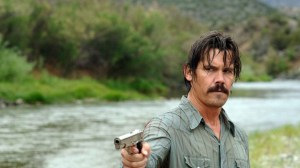 There are many ways to describe Chigurh, but it seems most appropriate to speak of him as nothing short but the full-tilt vengeance of God. He’s a hired killer, yes, but that doesn’t stop him from killing indiscriminately. He murders several innocent victims, he murders his competition sent out to nab Moss just because it insults him, and even after the money no longer becomes a concern, Chigurh still plans to continue his wrath out of sheer moral principle. He made a promise of swooping vengeance and he will stick to it. This means that anyone could die at any moment while onscreen with Chigurh, and No Country for Old Men has plenty of surprises as it toys around with our baited anticipation. When Chigurh gets the drop on his competition he doesn’t shoot the man immediately; instead the scene plays out for an agonizing length even after we listen to the room phone ring several times, and then blam! Chigurh answers the phone and casually raises his boots so the pooling blood doesn’t touch his feet. This is the most memorable incarnation of soulless evil I have seen in the movies since Hannibal Lector came to iconic form in 1991’s Silence of the Lambs.
Brolin is having quite a career year for himself after compelling turns in American Gangster (where he also shoots a dog), In the Valley of Elah, and Robert Rodriguez’s Planet Terror half of Grindhouse. Brolin gives the audience a figure to root for even though he never actually displays true heroism, just survival instincts. Jones serves as a wise and guiding father figure that feels out of place in a world that is becoming increasingly, shockingly violent. It’s a role that Jones has performed before but it’s a role that fits the actor exceptionally well. Woody Harrelson pops up as a charming and laid back handler trying to convince Moss to give up before things get worse. Kelly Macdonald, as Moss’ wife, cuts through the darkness in a refreshing performance.
The technical craftsmanship is on par with previous Coen excellence. Roger Deakins’ cinematography is exquisite, Carter Burwell’s score barely makes its presence felt, and the editing is tight and focused. The sound design, which I’ve already discussed in detail, deserves an Oscar. This being a Coen brothers’ film, it wouldn’t be complete without some dark humor to punctuate the bleakness. They have a perfect ear for local vernacular and Texas shorthand, so the dialogue feels sharp but realistically twangy without being condescending as some had accused Fargo (I do not agree with this accusation).
 What works in the favor of No Country for Old Men may perhaps be its undoing for a mainstream audience. The film works against conventions and this provides for some stellar surprises and upheavals, none of which is bigger than killing a certain character off-screen. No Country for Old Men definitely seems like it’s laying stage for a climactic showdown and then one key figure has been bumped off by a group of ancillary characters that have little overall bearing over the plot (I have read that the same gap happens in McCarthy’s novel). If this doesn’t perturb audiences then the final 10 minutes ought to do it. There’s no sense of closure for the movie and this will frustrate many, but it all fits rather nicely with the movie’s highly nihilistic tone. Like Chigurh’s coin, the film focuses much on the randomness and cruelty of fate. By sticking to this ethic, the Coen bothers are eschewing the traditional Hollywood rulebook and playing around with our expectations for characters and plot. The outlook isn’t too sunny for many involved. It works and demands an audience remain on edge for fear that anything could happen at any moment. However, don’t say I didn’t warn you if you walk out of No Country for Old Men and say, “What was that all about?”
No Country for Old Men is exactly the kind of material the Coen brothers needed to return to form. This is a lean and stirring thriller that plays to their strengths and echoes some of their most riveting and twisty work, like Blood Simple and Fargo. In many ways the film feels like a Western, a high-stakes drama, and a tragedy that takes its time to unravel. It may have taken some time but the Coen brothers are back, baby, and No Country for Old Men is fit to stand beside their hallowed pedigree of cinematic classics.
Nate’s Grade: A
Share this:

Children of Men (2006)
 Alfonso Cuaron is a master filmmaker and a gifted storyteller. He excels at telling entertaining stories whether they be about kids or adults. His Harry Potter film is still the most watchable and imaginative, and his earlier children’s movie, 1995’s A Little Princess, has enough power to still get me misty. Even when Cuaron sets his sights on a sex comedy (Y Tu Mama Tambien) he can’t help but turn it into an affecting art movie. This man just knows how to tell a good story. Children of Men, a bleak science fiction thriller, is just the latest example of how effortless Cuaron makes it all blissfully appear.
In the year 2027, and the world is on the brink of annihilation. It’s not plague or rampant warfare that are the obvious culprits. The reason for mankind’s end is something more natural and depressing — women have stopped being able to make babies. England seems to be the lone country with some fraction of stability. Illegal immigrants are rounded up and housed in refugee camps for deportation. Cages full of crying and pleading foreigners are on many street corners. In a world of danger and hopelessness, always count on the kindness of xenophobia.
Theo (Clive Owen) is a bureaucrat that combats the future with cynicism. He can barely escape getting blown up for his morning coffee. Theo used to be an activist and married to Julian (Julianne Moore), the current leader of the Fishies, deemed a terrorist group by those in power. She finds him and asks for one last favor. Her people need transit papers to get Kee (Claire-Hope Ashitey), a refugee, and Miriam (Pam Ferris), a former mid-wife, to safety. Then Theo discovers the importance of his assistance. Kee is eight months pregnant. The government would never admit that that the first baby in 18 years belongs to a refugee, and political groups would like to use Kee and her baby as a rallying point for an uprising. But first Theo must get her out of harm’s way.
 The idea of a world of infertile women is fascinating and full of big questions. This dystopian future must confront its own mortality in a very real way. Theo asks a friend hoarding classic art why he bothers. There will be no one alive in 100 years to even see them. Miriam says strange and heartbreaking things happen to a world that forgets the sound of children’s voices. Plenty of heady discussion is generated from a premise that affects every person on the planet. Why can’t women have babies? No explanation is given and none would seem credible. A religious faction believes this is the punishment of a vengeful God. People forget what babies even look like and what is commonly done for their care. The film also has a stark and timely portrait about the treatment of illegal immigrants. Children of Men is an intellectually stimulating movie that never rubs your nose in it. It trusts the intellect of the audience enough to leave many unanswered questions left to chew over and debate long after the movie ends.
The answers Children of Men finds seem reasonable and appropriate. Home suicide products exist for people that want to take back some control over their life, or at the least, are sick of waiting for the even more inevitable. It also seems entirely likely that this future world would turn the youngest living person (“Baby Diego” at 18-years-old) into a celebrity worthy of incredible mourning upon his untimely demise. These coping elements feel dead-on and only enhance the realistic tone of the film.
The film is a beguiling think piece but it also succeeds magnificently as a straightforward thriller. The majority of the second half is built around chase scenes and navigating to perilous outposts of safety that eventual crumble. Cuaron has a dizzying sense of believability as he puts together his world, and his roving camera feels like an embedded reporter on the front lines of chaos. The gorgeous cinematography and realistic set design contribute to the visceral sensation Cuaron sets alive with his visuals. There are long stretches where the camera continues rolling for nine minutes uninterrupted. I was left spellbound and felt trapped in this world just like the people onscreen. I was also wondering how much planning it took to coordinate and choreograph these long takes.
There are two very memorable scenes to quicken the pulse and both of them involve Cuaron’s mobile unblinking camera. The first involves a car chase perhaps unlike any I’ve ever seen before. Theo is leading an escape at dawn and robs the other cars of their keys. However, his own escape car refuses to start and the bad guys take notice. The sequence seems to last forever as Theo is forced to literally roll the car down a hill to outrun his pursuers who continually catch up with him. The second sequence follows Theo making his way through a refuge camp in the midst of a violent uprising being put down by heavily armored government troops. We watch every excruciating second of his survival as he navigates past gunfire, tanks outside a hotel, and then climbs through the different levels of the hotel being bombarded until we see, at a distance, where Theo’s trek all began. Exhilarating might just be the best word to describe Children of Men.
 But nothing feels cheap or too sentimental in this world. This is a harsh and dark world where anything can happen, so the audience is left in constant peril worrying about the fates of every person onscreen. Like Casablanca, it strips away idealized notions of bravery and duty and just shows humanity for what it is and what it can be. That is gutsy but then that’s Cuaron as a filmmaker.
Speaking of Casablanca, Owen seems like a modern-day Bogart in this role. He’s ruggedly good looking but also a sly charmer. I’ve stated before my undying man-crush on Owen and Children of Men has only added to it. Owen has a remarkable way of playing detached but still noble and conflicted. He has the best slow burn in movies. The moments of wonder for him become our moments of wonder and worry. The rest of the actors appear in limited functions but provide good work. Michael Caine practically steals the movie as a crude yet philosophical hippie.
This is science fiction at its best. Children of Men is stark and realistic and truly immersive; you really feel like a member of this tumultuous future. It works simultaneously as a thought-provoking what-if scenario and as an exciting thriller. Simply put, this is a highly engrossing movie that separates itself from the pack. Cuaron has created a disquieting and entertaining sci-fi think piece that succeeds on its numerous merits. I knew half way into the movie that the newly minted wife, Mrs. Me, was only going to want a baby more from what we were watching. At least she now has a new argument: “It’s for the good of humanity.”
Nate’s Grade: A
Share this:

Lord of War (2005)
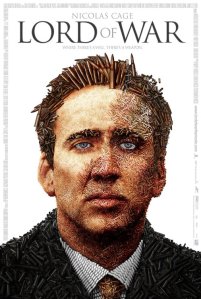 Andrew Niccol is back in my cadre of cool. He’s responsible for two awesome movies (Gattaca, The Truman Show) and one very lackluster Hollywood satire (Simone). But now the man is back and Lord of War is a startling look into the amoral world of international arms dealing. The film is enthralling as Uri (Nicolas Cage) narrates us about the ins-and-outs of his world a la Ray Liotta in Goodfellas. Not to be outdone by a juicy narrative by Niccol the writer, Niccol the director adds lots of stylish flash to his tale. The opening watches the manufacturing and journey of one bullet, it’s ending destination in the head of a little African boy caught in the crossfire. It’s jarring, it’s powerful, and it’s direct. That’s Lord of War in a nutshell.
Nate’s Grade: A-
Share this:

One Hour Photo (2002)
 Do we regularly invite strangers to view the picturesque and personal moments of our life like marriages, celebrations, and maybe even a handful of hastily conceived topless photos? Well we all do every time we drop off a roll of film for development.
Robin Williams continues his 2002 Tour of the Dark Side (Death to Smoochy, Insomnia) as way of Sy, your friendly photo guy working at your local Sav-mart superstore. Sy takes an intense artistic pride in the quality of prints he gives. He knows customers by name and can recite addresses verbatim. One family in particular Sy has become fond of is the Yorkins, mother Nina (Connie Nielsen), father Will (Michael Vartan) and nine-year-old Jake. The Yorkins have been coming to Sav-mart and Sy for over 11 years to have their photos developed. He tells Nina that he almost feels like Uncle Sy to the family. For Sy, the Yorkins are the ideal postcard family with perennially smiling faces and the happiest of birthdays. He fantasizes about sharing holidays with them and even going to the bathroom in their posh home.
 Sy is an emotionally suppressed and deeply lonely man caught in his delusions. In one of the eerier moments of the film we see that Sy has an entire wall made up of hundreds of the Yorkin’s personal pictures. When Sy attempts to become closer to the objects of his infatuation that’s when things begin to unravel at a serious pace. The more Sy learns that the Yorkins are not the perfect family he yearns for the more he tries to correct it and at any cost.
One Hour Photo is an impressive film debut by music video maven Mark Romanek (best known for the NIN “Closer” video). Romanek also wrote the darkly unrepentant story as well. One Hour Photo is a delicate voyage into the workings of Sy’s instability with lushly colorful metaphors. Romanek’s color scheme is a lovely treat, with vibrant colors popping out and Sy’s life being dominated by cold, sterilized whites. His direction is chillingly effective.
This may be the first time we can truly say Robin Williams has not merely played a version of Robin Williams in a movie. Sy’s thick glasses and thinning peroxide-like hair coupled with an array of facial pocks allow us to truly forget that the man behind the mask is Mork. His performance is unnerving and engrossing. The supporting cast all work well. Nielsen (Gladiator) is a sympathetic wife even if her hair looks like it was cut with her eyes closed. Vartan (Vaughn on ABC’s wonderful Alias) plays understandably wary of Sy’s friendliness. The great Gary Cole has a small role as Sav-mart’s manager who grows tired of Sy’s outbursts and peculiarities.
 One Hour Photo is rife with nervous moments and titters. Williams almost has an uneasy predatory feel to him when left alone with Jake. The greatest achievement the film has is that is depicts the scariest person youll ever see, sans hockey mask, and by the end of the film you actually feel degrees of warmth for this odd duck.
Not everything clicks in Romanek’s dark opus. A late out-of-left-field revelation by Sy feels forced and needlessly tacked on. The Yorkin family photos all appear to be taken by a third party, since the majority of them involve all three of them in frame. The climax to One Hour Photo also feels anything but climactic.
A compellingly creepy outing, One Hour Photo is fine entertainment with beautiful visuals and a haunting score. And maybe, in the end, it really does take an obsessive knife-wielding stalker to make us realize the importance of family.
Nate’s Grade: B
Share this:

Series 7: The Contenders (2000)
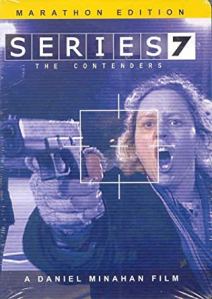 A scathing satire of our media and bloodthirsty society wanting something always pushing the boundaries. Writer-director Daniel Minahan has created a future where the most popular TV show is called “The Contenders” and selects five strangers at random in the same town as contestants. The problem is that these five people, including the winner of the previous season, are now on a manhunt in a kill-or-be-killed situation where the only prize of this game show is one’s own life. Series 7 is skillfully made to be indistinguishable from other reality TV shows except for the bursts of language and violence. If you were playing this and a friend walked into the room they would be convinced it was a TV show. The film gets a little soap operish toward the end with its characters dealing with haunted love but the film is a fast and entertaining warning piece that might provoke as many thoughts as cries for blood.
Nate’s Grade: B
Share this:

Requiem for a Dream (2000)
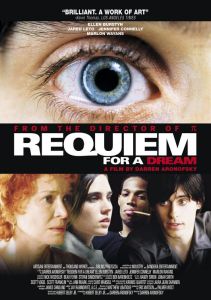 Rarely does a movie today affect you that when the end credits roll you’re left silent and unable to speak. Requiem for a Dream is an unforgettable and intensely harrowing experience. You can’t take your eyes away from it. Afterwards you’re left in disarray and unable to think straight for most of the day.
Requiem chronicles the lives of four individuals and their spiraling addictions and missed choices. Harry (Jared Leto) is a small time coke dealer along with his friend Tyrone (Marlon Wayans) who can’t help to taste their merchandise and eventually end up broke again. Harry has gotten into the habit of routinely pawning his elderly mother’s TV set for some quick cash to score with. This happens so often that the pawn broker has a special folder for Sarah Goldfarb (Ellen Burstyn) and her televison. Harry is in love with his more positioned girlfriend Marion (Jennifer Connelly). She’s given an annual allowance of money from her wealthy folks to spend in her own fashion, but she’s denied love or attention. It’s between these four main characters that we will go through hell with.
 Ellen Burstyn shows her grace with age and utterly blows your mind with her jaw-dropping performance as the lonely and strung out Sarah. Sarah has no husband anymore or a son to look after. She is alone and old, and those are two bad ingredients. She lives in an apartment complex overlooking the decaying ruins of Coney Island. Sarah has a different addiction than her child, she is addicted to food and is overweight. One day she mistakes a random junk phone call as her ticket to appear on television. She daydreams about gliding across the stage in her red dress that she doesn’t be able to properly fill anymore. With her elderly peers aflutter she tries her best to stick to a diet to fit into her slender dress. When the temptation becomes overwhelming she consults a friend’s doctor for some special “pills” to suppress her appetite.
Harry and Tyrone are embarking on their own dealing dreams to evetually move up the ladder and score some pure coke. Marion and Harry experience their love through simultaneous shoot-ups that space them out and turn them into romantic philosophers. Harry speaks of great dreams he has and the yearning to be something. Tyrone is haunted by thoughts of himself as a child and disappointing his sweetly loving mother who was proud of her son no matter what.
 The film starts off in the summer and we are in the good times for all four characters. Harry and Tyrone are successful and racking up profits. Sarah has an unusual amount of energy through her prescribed pills and feels good about herself when she sees actual results as the pounds begin to melt away. Marion dances in her love of Harry and is ambitious with plans for her own design store. Things never are as good as they are again. Fall rolls along and Tyrone and Harry lose their money and lose their ability to secure drugs to sell. Sarah is noticing her pills are not having the same effect they were earlier and decides to ignore guidelines and take them like M&Ms. Marion starts to lash out at Harry’s ineptness at scoring and begins to tear at their relationship. She gets pushed to the brink to score that she resorts to the practice of using her body to secure what she needs. This isn’t even the beginning of how dour and horrible events will become for these four.
One of the strengths of Reqiuem is the treatment of these characters. The film shows sympathy for them and their situations but never condone them. Harry and Sarah are a family that have much love between them they just don’t know how to express it. When Harry discovers his mother is on essentially speed when he pays her a visit he’s left a shattered and crying mess. Only an injection into his veins in that cab ride saves him from his emotions. The relationship between Harry and Marion is initially seen as puppy love or people brought together through a love of drugs, but there are moments where you see the true beauty they have. In the end when Harry is out of state and dramatically in the need of hospitalization he calls Marion just as she’s doing her make-up for a “special” get-together. In a hushed tone she asks when he will be coming home, to which he responds in a mix of pain soon. She then so sincerely and beautifully asks if he can come back today – to which through an array of tears he agrees. Her sincerity and emotion in this sequence is a powerful glimpse at the love that does exist between the two of them. The second time I watched this film I started crying at this moment.
 Burstyn is the stand-out star and if she doesn’t at LEAST get an Oscar nomination then that is the most unjust crime of them all. It’s been some time since her roles in ‘The Exorcist’ and Alice Doesn’t Live Here Anymore but she still shines like a true gem. She magnificently portrays Sarah’s descent into madness and chemical dependency and leaves us with a chilling and haunting figure. Leto and Connelly show that they aren’t merely pretty faces and deliver their best performances of their lives. Both show incredible warmth and emotion.
Requiem was directed and adapted for the screen by Darren Aronofsky who gave us the head trip that was Pi. Here he uses camera trickery like speed up and slowed paces to show Sarah’s journey through her drugs. Other items include cameras mounted on the actors, split screens, and hyper edits to show the process of every drug shoot-up. His camera moves and tricks are never out of place though, as many gimmicky video director’s are. Each effect has a specific purpose. Aronofsky brilliantly uses a scene where Leto and Connelly are lying in bed besides one another but split screen to show the closeness they can strive but the distance that still exists. While each talks we see shots of the other’s hand carefully caress the other’s body. It’s a scene that’s as powerful as it it thematically romantic.
The tragedy of this is this film has been rated NC-17 by the MPAA and of course anyone who sees it knows the exact scene. The film is being released unrated by Artisan because NC-17 is a commercial kiss of death. The shame is this movie needs to be seen. Make it mandatory in schools. DARE isn’t working but this film will. No one with an urge to use drugs will have that same urge after seeing this harrowing film.
Nate’s Grade: A+
Reviewed 20 years later as part of the “Reviews Re-View: 2000” article.
Share this:

Way of the Gun (2000)
 Way of the Gun is screenwriter Christopher McQuarrie’s follow-up to the twisty smash who-dunnit The Usual Suspects. This time he takes the reigns of directing himself and establishes that he is a born man behind the camera and in the chair.
Gun unfolds its tale through the center of two antisocial hoodlums “Parker” (Ryan Phillippe) and “Longbaugh” (Benicio Del Toro), two men brought to the point of selling plasma and sperm to pay the bills. One afternoon they overhear a conversation in the doctor’s office about a wealthy couple paying a woman (Juliet Lewis) to act as the surrogate mother for their child. It seems the real mother just doesn’t want to be burdened with a child hanging on her for nine months. The two men use this information to plot what should be their big break and their big score. After a scheduled doctor’s visit they get into a heated shoot out with the bodyguards (Nicky Katt and Taye Diggs) protecting her for their wealthy employer. Parker and Longbaugh kidnap their impregnated prize and hold her to squeeze a fat ransom.
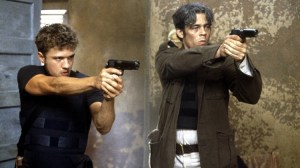 The story-telling Way of the Gun plays is a mix of older mature films where they would have room to breathe as well as Quentin Tarantino flicks. This is a story of characters and their devious multiple back stabbings, crosses, secret affiliations, and ultimate intentions. ‘Gun’ moves methodically with an armada of gaunt twists and turns keeping the audience alive and awake.
James Caan comes in mid-way to play a conniving intermediary in the exchange. His character is the wisest of the bunch and knows more then he’s always telling. It’s also quite a perplexing site to see Caan’s nipples through his shirt in an interrogation scene. Up to this point I never thought about James Caan having nipples.
The action in the flick is pulse-pounding. The shootouts are probably the best on film in a long while. You see and hear every effect a bullet has. The final climax which involves a drawn out gun battle in an empty Mexican brothel is a scene of sheer excitement and relentless entertainment that it may well be my favorite 10-15 minutes of film all year.
There can be a word to describe Way of the Gun and that word could be “ugly.” This is not a film for everyone. The violence and its after-effects can be gruesome at times, as I heard just as much groans and shrieks in my theater than anything else. There’s scenes of picking shards of glass from one’s own arm, performing stitches on one’s eyebrow, and even an impromptu hand done C-section. This will not be something to take grandma to.
Way of the Gun pacing is also a problem. There are moments of drag as we wait and wait. The languid pacing works for the story and the characters but the double-edge sword creates dry spells of interest. The score uses tympani to full extent, sometimes beyond that which it reasonably should.
McQuarrie has sold me with his re-spinning of tired cliches and familiar elements into gold. Way of the Gun is a flick I’ll see with my friends time and again.
Nate’s Grade: A-


 nathanzoebl
You must be logged in to post a comment.