Blog Archives
Young Adult (2011)
 The basis for the movie Young Adult sounds like writer Diablo Cody settling a few sore scores. You’d think winning an Oscar for Best Original Screenplay for 2007’s Juno would have sufficed. Reteaming with her Juno director, fellow Oscar-nominee Jason Reitman (Up in the Air), the duo takes aim at the bitchy, stuck-up, popular girl that seemed to rule the school. Young Adult is much more than a vicarious act of vengeance on mean high school adversaries. It’s a revealing, awkward yet compelling dark comedy about the perils and pitfalls of arrested development.
Life hasn’t turned out exactly the way Mavis Gary (Charlize Theron) would have thought. The former high school queen bee has left her small town for life in Minneapolis. She’s the ghostwriter for a successful series of young adult books, a series that is coming to an end. She’s divorced form her husband, facing financial ruin, and living alone with her tiny Pomeranian, Dolce, her only friend. Mavis decides to forgo writing the last book in the cancelled series and instead return to her hometown the triumphant mini-celebrity she knows herself to be. She’s determined to find her old boyfriend, Buddy Slade (Patrick Wilson), and win him back. The fact that Buddy is married and has a newborn baby is no real impediment to Mavis’s crazy plan (“Hey, I’ve got baggage too,” she reasons). Once home, she runs into Matt Freehauf (Patton Oswalt) in a bar. Matt and Mavis went to high school together, though she has long forgotten the likes of him. Matt’s claim to fame was that a bunch of jocks in high school savagely beat him thinking he was gay. Matt sees right through Mavis and the two of them become an unlikely pair as Mavis plots and schemes her way to victory.
 Young Adult is one of the most enjoyable squirmiest times you can have at the theater. Much of its humor, and it is very funny, is built around the pained awkwardness of Mavis’ self-involved, self-destructive mission. My friend was nervously fidgeting in his seat the entire time (he may have just had to go to the bathroom). The sense of dread is palatable; we’re watching a slow-moving car crash, waiting for the inevitable to hit. Every scene carries the apprehension of, “What is she going to say/do next? Is this it?” And yet Cody’s sharp, pointed writing makes the film compulsively watchable. We dislike Mavis, an irredeemable character who doesn’t even try to be likeable, and yet by the film’s conclusion most audience members will likely feel more pity for Mavis than outright hatred. I’ve had some friends ask me if Young Adult was anything like Bad Teacher, another movie about an abrasive, selfish, unlikeable bad apple. This movie is different. This movie is actually good. Mavis is not some wacky cartoon character, and Reitman has kept his reaction shots to a minimum, abstaining from having to remind us via public reaction how inappropriate Mavis can be. Unlike Bad Teacher, this grown-up meanie feels all too real, and her actions come across as believably threatening. This woman could do some serious damage on her way to massage her damaged ego. The movie never condones her actions, though Reitman and Cody make a point of piling on against Mavis. This woman is an ugly wreck, and Cody’s writing and Theron’s gutsy performance speaks volumes. Cody’s writing isn’t the hyper-literate, stylized dialogue we’re accustomed to from Juno. The dialogue and characters are eerily recognizable, miles away from the cuteness of Juno’s sunny, optimistic fairy tale inhabitants. Young Adult is a more nuanced, droll, mature work that deserves as much recognition as Juno and cements Cody, in my mind, as one of the most thrilling writers today (I can almost forgive her for Jennifer’s Body. Almost).
Along with all the bleak comedy, Young Adult lands a surprising number of poignant dramatic blows. Cody has crafted an exacting character study on a severe case of arrested development. Many of us can relate to knowing that one gal in high school, the pretty, popular one who had everything in life handed to her. In Young Adult, Cody shows the devastating consequences of a lifetime of entitlement and zero introspection. Mavis secretly knows that she’s past her prime, that all the people she left in her Podunk town have moved on to richer lives while she’s stayed in the same holding pattern her whole life. Some part of her has never left high school. She’s an emotionally stunted woman trying to live out the fantasy of one of her undervalued books (her misreading of the end of The Graduate into a love-conquers-all message is rather telling). Mavis’ life is hardly the stuff of Champaign wishes and caviar dreams, but to the people of her hometown, life in the “Mini-apple” is the Big Time. There’s a fabulous scene where Mavis goes into a bookstore and sees her series on a clearance stack. The bookstore employee tells her they don’t sell and will be most likely sent back to the publisher. Mavis takes out her pen and autographs one, informing this minimum-wage peon that she is the fabled author of the series. She’s expecting fawning admiration. The employee flatly tells her, “If you sign them, we can’t send them back to the publisher.” In her disgust, she tries to sign as many as she can as an act of defiance. Later in the movie, Cody sheds light on Mavis’ family life, offering intriguing clues for how this woman became so broken. Her parents just seem to shrug off Mavis’ admission of alcoholism, like they’re used to their daughter acting out, even if she might really be crying out for help. She’s a fascinating character to watch crash and burn.
What gives the film its most potent sense of heart (Grinch-sized though it may be) is the unlikely yet compelling relationship between Mavis and Matt. Unlike Mavis’ perceived slings and arrows, Matt has suffered real trauma from high school. His bones were shattered from that brutal beat down and he’s left to limp with a crutch. He hasn’t been able to mentally leave high school behind completely himself, but then again he has a constant reminder. Mavis is strangely her most open with Matt, possibly because she doesn’t view him as a threat or a credible alternative (the joys of high school revisited – the pretty gal ignoring the existence of the lower classes). He’s portrayed as the film’s voice of reason, voicing concern over Mavis’ kamikaze narcissism. Together they form what could charitably be described as a friendship. She seeks him out to talk at odd hours of the night and he’s straightforward with her. He thinks her plan is nuts, but he’s also secretly enjoying his unexpected friendship with the queen bee of high school, albeit twenty years later. “Guys like me are made to love girls like you,” he confides to Mavis. Oswalt has shown some dramatic skills in the underappreciated sports fanatic flick, Big Fan. With this movie, Oswalt gives an achingly felt performance, the most empathetic character in the whole movie and a joy to watch onscreen in a high-profile role that fits him like a glove.
 But the true star of the film is Theron, who gives a fully formed and entrancing performance as someone who is as ugly on the inside as she is beautiful on the outside. Her character could have easily slipped into being an unsympathetic monster; someone the audience wants punished (like Cameron Diaz’ character in Bad Teacher). But the actress finds her own twisted, tricky way to center the character. Every detestable glance, every pained inhalation, every rigorous attempt at seduction, it feels like the character coming alive before our eyes. Theron has dissolved into the abhorrent mess that is Mavis Gary. She’s convinced that Buddy could never be happy with such a mundane life in a mundane town (“There’s a restaurant that’s a Pizza Hut, Taco Bell, and KFC in one building” she says incredulously). Her perspective is so deluded that you start to see the manufactured world Mavis has so cautiously built around herself as a defense from reality. She watches wall-to-wall reality TV, the perfect metaphor of our times concerning the idolization of idiocy and self-absorption. She may not be likeable but she’s definitely compelling, and Theron is so good as that-girl-from-high-school all grown up, that she might even win over some slight sympathy by the film’s end. At one point, the inner fear of Mavis reveals itself, and she expresses her confusion about the attainability of happiness. Why can others find happiness with so little, and she cannot find it with everything that she has?
Young Adult is a dark comedy of squirm-inducing, uncomfortable bleakness and a drama of surprising poignancy and depth. It’s the good kind of uncomfortable, the kind where you can’t look away or leave the vicinity of your seat. Theron and Oswalt are fantastic. Cody’s gift with words, teamed up with Reitman’s gift with actors, makes a beautiful combination even when the end product is charting the misery or a miserable person. The measured tone is kept from start ot finish, meaning even when the movie appears on the precipice of life-lessons and Mavis might turn her life around, it pulls back. There will be no hugs and gained wisdom with this movie, a crackling comedy that’s also one of the best pictures of the year. Take that, popular girls who never gave me the time of day.
Nate’s Grade: A
Share this:

The Guard (2011)
 For fans of Brendan Gleeson, one of the best character actors around, a starring role in the profane dark Irish comedy, The Guard, is a starring role long overdue. The man plays an eccentric, self-destructive lawman that follows his own sets of rules and decorum: “Racist? I’m Irish. Racism is part of our culture.” Gleeson’s character gets teamed up with Don Cheadle’s Yankee FBI agent, and for a while it looks like the film might drown in fish-out-of-water gags. Writer/director John Michael McDonagh has a gifted wordsmith’s flourish with words. It may take some concentration to decipher through the thick Irish brogues, but there is a love of language and the witty, looping dialogue is almost musical in its sublime composition. His characters are pretty interesting too. The villains, a band of drug-runners, are introduced arguing philosophy, proving to be the most cultured big screen tough guys since Pulp Fiction. The hyper-literate stock roles trade plenty of insults, which had me regularly laughing. The characters do have a habit of feeling like they know they exist in a movie, so everything, even a man’s final moments, never seems to be that pressing. I just wish these richly drawn characters had a better movie plot to work with. There are too many subplots that don’t seem to reconnect to the main storyline. The Guard seems to lose its way in the middle of too many comic vignettes before going all serious action in climax, much like the similarly flavored In Bruges (written and directed by McDonagh’s brother). The movie feels like a first draft instead of a finished product, though for Gleeson fans, this will be worthy enough.
Nate’s Grade: B-
Share this:

The Hangover: Part II (2011)
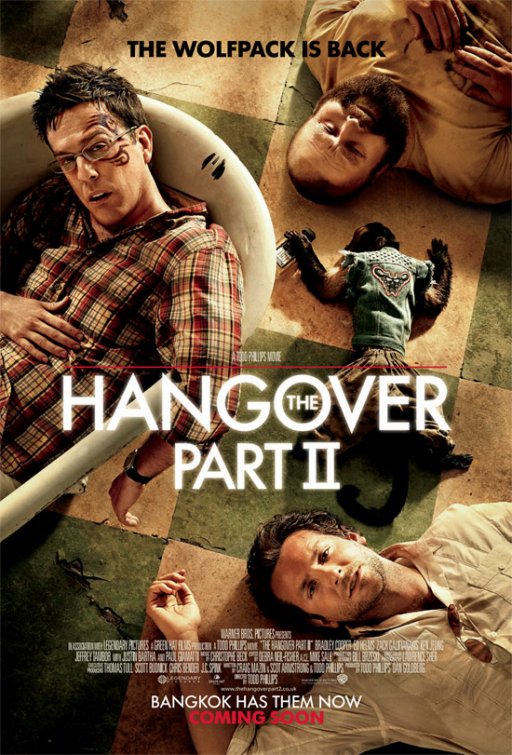 When you’re responsible for the highest-grossing R-rated comedy of all time, a film that grossed over half a billion dollars worldwide, then you don’t want to tinker with a winning formula of a surprise hit. Naturally, with that kind of money, a sequel was inevitable. Director/co-writer Todd Phillips (Old School, Due Date) is back and so is everybody and everything else. You’ll get a strong sense of déjà vu watched The Hangover: Part II. That’s on purpose. This calculated, rather soulless cash-grab sequel wants to recreate the organic experience of the first film. If you played The Hangover and The Hangover: Part II on simultaneous TVs, I would not be surprised if the same plot points happened at the exact same minute-marks. It might even be like a Pink Floyd/Wizard of Oz experience. I paid twice to see the same movie two years apart.
Stu (Ed Helms) is about to get married in Thailand to Lauren (Jamie Chung). Our favorite wound-up dentist is apprehensive about any sort of bachelor party shenanigans after the events of two years ago in Las Vegas. His pals Phil (Bradley Cooper), Doug (Justin Bartha), and the socially inept Alan (Zack Galifianakis) make the trek to attend the festivities. For Alan, it’s a reunion of the Wolfpack and an excuse finally to venture out of his parent’s home. Stu has some ground to make up with his bride-to-be’s father. Her father seethes about the prospect that his beautiful daughter is going to marry Stu, a man he compares to watered down rice. Lauren’s younger brother, Teddy (Mason Lee), a pre-med student and concert cellist, is left to the Wolfpack’s care the night before the wedding. They’ll just have one drink on the beach. What’s the worst that could happen? Flash to the next morning. The guys awaken in a strange apartment. Teddy is missing and missing a finger as well. Stu, Phil, and Alan must once again retrace their steps and solve the mystery of their hard-partying antics before the wedding ceremony.
The Hangover: Part II is a carbon copy of the original. Because the same joke is just as funny the second time around, right? This empty enterprise gives its audience exactly what they want, which is precisely the same experience they had with the first film. But so much of comedy is predicated on surprise, so how can you recreate the experience of discovery that people so heartily enjoyed with the first film? The Hangover: Part II is like a cheap comedy Mad Libs game: it reuses the same gags and just fills in the blanks. Hey, if Joke A worked before, why couldn’t we just have Joke A in this different location (instead of two guys walking into a bar, they walk into a different bar)? It’s like somebody copied and pasted the screenplay from the original movie, changed the locations and minor details, and cashed a check. Let me get into how stunningly indolent the screenwriting is (small spoilers to follow). Once again a person in their group goes missing before a wedding. Once again Stu has some self-inflicted wound to his face. Once again the guys have stolen someone else’s unorthodox pet. Once again they find themselves with a ward (baby in first film, Mr. Chow in second). Once again Stu has gotten involved with a prostitute. Once again Alan was secretly responsible for their drugging. Once again Justin Bartha gets left out of the escapades. Once again Mr. Chow shows his junk for shock value. Once again Mr. Chow jumps out of a locked container attacking the guys. Once again the guys have to return money to a gangster. Once again Stu plays a song of his own creation bemoaning their situation. Once again they have to race to the wedding minutes away. Once again we have a Mike Tyson cameo. Once again the guys find pictorial evidence of their debauchery and they play over the credits. Even directing touches like a time-lapse high-rise shot passing the time before they wake up is reused.
That’s what kills the movie is the lack of surprise. It throws the guys into a different setting, gets darker and meaner, but it’s rarely funny. I was surprised how many jokes left me in stony silence. Phillips and his screenwriters have gotten into the trouble of having to top themselves, so they rely on the “bigger is better” approach to match the outrageousness of the original. If Las Vegas is Sin City, then what would be even seedier? Bangkok, of course. Where would they go for a third film? What gets seedier than Bangkok (The Hangover 3 to be set in Rep. Anthony Weiner’s office). Yet the film curiously ignores much of what makes Bangkok the world’s preeminent hotspot in the sexual trades. The payoffs are darker and lack the bemusement of the original. Knowing some guy is missing a finger is not as whimsical as somebody missing a tooth. The movie has an unpleasant homophobia to it thanks to male genitalia being used to shock and horrify and humiliate. The horror of being involved with transsexual women made my theater audience groan with extra relish, like the presence of a penis or homosexual content makes everything automatically more disgusting to the common people, as if anything gay is the worst thing that could possible befall a man. Mr. Chang is an odious and fairly unfunny stereotype, and Jeong (Role Models, TV’s Community), so funny in just about every other role he’s ever had, is a braying, high-pitched annoyance. This go-round the jokes feel stale, the characters feel tired, and the payoffs seem too mean-spirited to be satisfying.
When you have a movie where the comedy is situation-based, then those situations better be funny because the characters are only serving as a means to an end. The premise allows the filmmakers to have it both ways. They can fulfill the hedonistic spectacle that will make people blush, and at the same time they can have button-uped, likable, relatively relatable nice characters that an audience will root for. If we watched these characters acting like irredeemable morons, then audience sympathy would wan. But having the guys investigate their previous dirty deeds, and react in horror, does not lessen audience sympathy. I enjoyed how the main trio played off each other in the first Hangover, and the central mystery was a solid glue to hold together a loose collection of mostly worthwhile gags. Just as the first film fell short of its potential, so too does the second movie. A monkey serves little purpose other than to get it to do things that seem outrageous just because it’s a monkey (it smokes, it mimes oral sex – hilarious!). But the second time around, the amusement of seeing Stu fly off the handle, or listen to Alan’s moony non-sequitors, doesn’t have the same draw. Galifianakis (Due Date) made the film watchable for me despite the fact that the screenplay makes his character a petulant and highly irritating character rather than a man-child doofus. And the women are once again relegated to the sidelines when it comes to being in on the comedy.
For The Hangover‘s legions of fans, more of the same will likely be exactly what was desired. But without the cheeky element of surprise, the comedy just seems like it’s hitting pre-ordained stops according to its formulaic cheat sheet. For the original Hangover I wrote: “Let’s face it; once you know the solution to the mystery and all the surprises, will this movie still play out as funny? …But once you knew who was behind what, and how the whole game was staged and operated, could you even watch the movie a second time? Would it still work now that a repeat viewer knew all the secrets? Does this comedy have a built-in expiration date?” Well, The Hangover: Part II is the answer. If the first film was a comedy with an expiration date, then The Hangover: Part II is one comedy that’s gone rancid.
Nate’s Grade: C-
Share this:

The Killer Inside Me (2010)
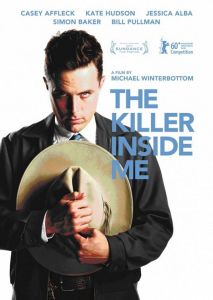 This is an unsettling thriller that takes us into the mind of a psychologically dangerous deputy policeman (Casey Affleck). He patrols the small Texas city by day and kills for pleasure by night. The movie runs into a problem because the character doesn’t have a semblance of any moral code, which sounds contradictory for a serial murderer. He doesn’t kill for profit or to cover a secret or anything that would come across as identifiably rational. He kills because he feels he has to; he’ll even kill the mistress he loves because he can’t control himself. It’s an upsetting premise that keeps the audience at a controlled distance throughout the film. There’s an ongoing theme of extreme sexual brutality, and director Michael Winterbottom (A Mighty Heart) seems to linger on extended sequences of sadomasochistic sex and ugly violence against women. There’s some ugly stuff here, like watching Jessica Alba get her face pummeled for a solid two minutes. You just feel sorry for what Alba and Kate Hudson go through (“voiding a full bladder” is amazingly low on the list of awful these women endure). Eventually Affleck has to keep killing to cover his tracks, and the threat of getting caught provides some moderate tension, a relief from wallowing in cruelty. All of this ickiness would seem worthwhile if it felt like we were learning something about our disturbed lead. Affleck plays his opaque character rather flatly, making him free of charisma, empathy, and sadly, insight. He’s just the same as a masked killer in a slasher movie. That’s the worst disappointment in a film with so much ugliness.
Nate’s Grade: C
Share this:

The Girl Who Kicked the Hornet’s Nest (2010)
 The worldwide publishing phenomenon comes to a close with the third and final film, The Girl Who Kicked the Hornet’s Nest. In the span of nine months, all three Swedish films, based on the late Stieg Larsson’s best-selling books, have been released stateside. Hollywood is already filming the first of three remakes directed by David Fincher (Fight Club), with Fincher’s Social Network star Rooney Mara in Lisbeth’s chunky shoes. Releasing three films in one year, mere months apart, has given the series the feeling of an event. The Girl Who Played with Fire left a lot to tie up, but audiences steeped in the Larsson’s sordid particulars should find something rewarding, albeit unspectacular, in this final chapter.
The third film picks up immediately after events from the previous story. Lisbeth Salander (Noomi Rapace), punky computer hacker and international badass, is being airlifted to a hospital. She is recovering from a brawl with her father that left her with a bullet in her skull and him with an axe lodged in his (surprisingly, both live. Credit Swedish healthcare). Her father, Zalachenko (Georgi Staykov), was a Soviet spy that defected to Sweden in the 1970s. He is a high-value informant, which means that anyone who would compromise or expose Zalachenko needs to be dealt with. And if Zalachenko is going to speak his mind, perhaps he needs to be silenced as well. Mikael Blomkvist (Michael Nyqvist), muckraking journalist and Lisbeth’s staunch ally, is trying to protect his friend and one-time lover by exposing the corrupt and powerful. Lisbeth is trying to be silenced, and if assassins don’t work then the state will try her for attempted murder and lock her away in a mental institution, the same institution that Lisbeth was committed to at 12 when she tried to save her mother by setting her abusive father ablaze. The sinister Dr. Teleborian (Anders Ahlbom) admitted Lisbeth when she was a child and is eager to have her back in his clutches. He and the other crooked government officials will stop at nothing to put her away and stop Mikael from publishing the truth.
 So at the axe-swingin’ conclusion of Girl Who Played with Fire, I felt that some of my conclusion had to be put on hold until I could see the third film, the conclusion to what seemed like one larger film. For Fire I wrote: “As such, it’s hard to fully analyze certain storylines at play. I imagine that the sex trafficking storyline will carry on with the third film because of the tease that high-profile figures in government and police offices were involved. It already establishes a conflict and a set of antagonists ready for the third film. Then again, I may be too hopeful and the storylines of interest in Part Two may be completely dropped or mishandled by Part Three (see: Matrix sequels, Pirates of the Caribbean sequels).” Guess what happened? Dropped storylines abound as well as a lack of follow-through on most everything but the major storylines involving Lisbeth’s tortured personal history.
Now that we can all witness how Lisbeth and Mikael have walked off into that Swedish sunset, I can finally and conclusively say that the second film is incomplete and will never be complete. The loose ends abound and characters are completely forgotten, like Lisbeth’s Asian friend/sometime-lover and her boxing pal who took a beating. Apparently their narrative purpose was to take Lisbeth’s licks (could this be the greatest double entendre in the history of film criticism? Yes). The brute that dished out those bruises is a blonde baddie named Neidermann who looks like he was ripped from a bad James Bond flick. He is a straggling loose end that circles the narrative like a lost child in a supermarket (“Are you my mother?”). The high-reaching sex trafficking ring featured in Fire has a tenuous connection to Hornet’s Nest; in Fire we talk about an Evil Shadowy Government and in Hornet’s Nest we see the faces of that Evil Shadowy Government Agents.
If the first film was a slow-burning and lurid thriller, the second film a preposterous action film, then the third film falls clearly into the genre of legal thriller. The majority of the plot revolves around the People vs. Lisbeth Salander. The sluggish opening gives way to a sluggish series of pre-trial preparations. Mikael assigns his sister to serve as Lisbeth’s attorney, and thus we see the behind-the-scenes arrangements as far as gathering evidence, building a case, plotting arguments and counter-arguments, preparing Lisbeth to confront the men who have caused her such suffering and anguish. And being a courtroom thriller, we also get a heavy dose of new characters, almost all of them elderly and somewhat menacing (a guy with cancer even becomes a hired gun for One Last Job). There are a lot of liver-spotted faces to try and sort through, so it helps when the filmmakers add touches to set them apart (one of them wears a bow tie, another has glasses). Given the lethargic nature of assembling a court case, the pacing can get pretty slack. Then there’s the issue of Lisbeth. She spends almost the entire movie in police custody and the first hour or so confined to a hospital bed. It doesn’t make for pulse-pounding stuff. Lisbeth is a willful, defiant, quick-witted creature so it feels like she’s like a caged bird in this third and final film.
 Rapace is starting to catch serious Hollywood heat and deservedly so because once again she commands the screen. At first when the series began I was unsure of her acting abilities considering her mysterious character is forced to respond through a prism of emotional reserve. She doesn’t speak much but her intense, cold stares speak volumes to the turmoil she has bubbling under the surface. Restrained to a hospital bed or a jail cell, Rapace is given even less to work with. The part is nearly mute for long stretches of plot. Yet Rapace finds new and interesting ways to channel her character’s intensity and allow the audience to view her thought process. It’s a sign of a talented actor when a character’s internal thinking can become transparent without the need for hyperactive expressions. Lisbeth Salander is a complicated character and the audience deserves to have such an intriguing presence fleshed out into three dimensions. I wrote about the disappointing downgrade of Lisbeth’s character in Fire: “We project the interest we felt for her from the first film to the Salander stand-in represented in the second film. She’s still a resourceful, loyal, and cavalier presence, but the plot corners her into being a creature of action. She becomes the fantasy bisexual ass-kicking protagonist that was merely hinted at previously. That sounds like a good thing, but trust me, it does the audience a disservice to box in such a fascinating character.” With Hornet’s Nest, we discover the extent of how men have damaged her, which focuses more attention on the person of Lisbeth rather than the Gothic aesthetics. It’s a return to form even if Lisbeth is still remote.
Luckily, The Girl Who Kicked the Hornet’s Nest does manage to offer a satisfying sense of closure. The series has several bad men doing bad things, so it’s rewarding that after sitting through close to seven hours of material yields some long-awaited justice for Lisbeth Salander. We yearn desperately for this pint-sized gal to get her vengeance and for the powerful to find their comeuppance. Watching the antagonists fall would be more fulfilling if they weren’t only introduced a mere hour ago in this movie. Salander doesn’t get to put on her Gothic war paint until her first court appearance. It feels like a triumphant return, complete with a towering and imposing mohawk. Blomkvist’s storylines will always be the movie’s weak point considering he has to compete with the likes of the audacious Salander. In Hornet’s Nest, his magazine team is threatened but you never really take any of it seriously, because of course the crusading journalist will stick by Lisbeth. The ending is less than desired and tries to recycle some of the same action tropes that lead Girl Who Played with Fire astray. The final scene leaves you with a sense of, “Oh, so that really is it? Better get my coat then.”
 The Girl Who Kicked the Hornet’s Nest works as a mostly fitting capper to a long-standing mystery series. The bad guys are punished, the good guys prevail, there’s an open-ended resolution that leaves you squirming for more, especially now that Lisbeth is a free woman. At a bloated 145 minutes, Hornet’s Nest can often feel like an overextended Swedish episode of Law and Order. There’s a good 45 minutes that probably could have been left on the cutting room floor. At times the movie feels like it’s lurching along, caught up in the mountain of details. But then it generally finds a way to regain momentum and head to a satisfying close. Still, it’s disappointing that for the majority of the two sequels Lisbeth and Blomkvist have rarely been onscreen together. They worked so well as a team in the original Girl with the Dragon Tattoo. I never would have thought that the sequels would take that concept and keep them apart for as long as possible. Too bad author Stieg Larsson isn’t around to write new adventures for his characters, though there are rumors about an unfinished fourth manuscript left on Larsson’s laptop. Until that gets sorted out between Larsson’s widow and his family in Swedish court, I guess the world will have to settle for the forthcoming Hollywood remakes.
Nate’s Grade: B-
Share this:

The Girl Who Played with Fire (2010)
 So in the few short months since The Girl with the Dragon Tattoo opened in the spring, the book series has catapulted to even new reaches of fame. It even appeared on the cover of Entertainment Weekly under the headline, “The hottest books on the planet.” I’ll take their word on that one. The Girl Who Kicked the Hornet’s Nest, the third book in late Swedish author Stieg Larsson’s series was finally released stateside, and depending upon when you read this, is probably still on the best-seller list. Larsson’s trilogy of novels is a global publishing phenomenon. The first film in the series made over $10 million dollars in the United States and was the top-grossing film in Europe last year. That says something about a 150-minute Swedish thriller with no-names attached. The Girl Who Played with Fire is the second film in the series and naturally couldn’t live up to expectations after the first smash movie. The second film is good, not great, but really whets the appetite for the concluding movie to come.
It’s been one year since the events of Girl with the Dragon Tattoo. The titular tattooed-girl, Lisbeth Salander (Noomi Rapace), has been living abroad. Her ally and one-time lover, Mikael Blomkvist (Michael Nyqvist), has been trying to get in contact with her but to no avail. Blomvist is about to publish a damning report about sex trafficking with some pretty high-profile names attached as members. The authors of the article are then executed and Lisbeth’s fingerprints are found on the gun left at the crime scene. Salander’s court-appointed guardian, the one who viciously raped her in the previous film, is also found murdered. Blomkvist is certain his companion is innocent and goes about investigating who is truly responsible. Salander comes out of hiding and back to Sweden where she tries to clear her name the best way she knows how. All roads seem to lead to a figure known as “Zala,” a Soviet spy who defected to Sweden ages ago but who has been carrying on in the shadows ever since.
 The focus with Fire in on Lisbeth Salander, which is exactly the character the audience wants to spend the most time with. Salander split duty with Blomkvist in the first film. They were equals, but a crusading journalist just isn’t as interesting as a five-foot Gothic ass-kicking computer hacker. As I wrote: “Mikael isn’t a blah character by any means but he seems to serve as an expository device, the guy who uncovers the secrets and gets to be the helpless foil to Lisbeth. I suppose for maximum narrative effect a straight man would be required to be paired with Lisbeth.” She is the star of the series so it’s a great pleasure to watch her receive oodles of screen time. The second film is significantly devoted to the history of Salander, her back-story, her father, what she did to get locked away in a mental ward (which was hinted at before). The sex trafficking murders are merely a narrative smokescreen. Being framed for the murders puts Lisbeth on defense, but the sex trafficking stuff and the high-profile johns quickly dissolve in the wake of a standard investigation into the mysterious “Zala.” The mystery of this film is really the mystery of Salander’s back-story and family tree. However, being focused primarily on Lisbeth Salander also means that everybody else gets sidelined. She’s on the run and trying to clear her name, but that doesn’t give much room for other people to contribute to the narrative. Blomkvist gets to pensively look at his computer screen a lot and always show up one step behind our heroine. The two are kept apart for nearly the entire movie.
Rapace is still the best reason to see the series. She inhabits the character with tremendous intensity and skill. If you stripped away all the aesthetics, the Goth trinkets, you would still have a vital character. As I wrote before: “There’s much more to this girl than a dragon tattoo and a spiked collar. Rapace doesn’t let the outfits overwhelm her. There’s a certain joyful recklessness to her character hidden beneath a veneer of steely coolness.” Because of her mysterious nature and painful past, Rapace must play all emotions through a prism of emotional reserve. Even though we get a lot more of Salander’s past explained, I felt like we got to know her as a character better in the first flick where she could breathe and behave “normally.” Thanks to being on the run for murder, it’s hard to argue that Lisbeth ever gets a chance to simply be her complicated self, which robs the audience of an appealing character. We project the interest we felt for her from the first film to the Salander stand-in represented in the second film. She’s still a resourceful, loyal, and cavalier presence, but the plot corners her into being a creature of action. She becomes the fantasy bisexual ass-kicking protagonist that was merely hinted at previously. That sounds like a good thing, but trust me, it does the audience a disservice to box in such a fascinating character.
 Girl Who Played with Fire is nowhere near the complete film experience that the first film offered. This movie feels like one half and the continuing half, The Girl Who Kicked the Hornet’s Nest, won’t be out until later in the fall. As such, it’s hard to fully analyze certain storylines at play. I imagine that the sex trafficking storyline will carry on with the third film because of the tease that high-profile figures in government and police offices were involved. It already establishes a conflict and a set of antagonists ready for the third film. Then again, I may be too hopeful and the storylines of interest in Part Two may be completely dropped or mishandled by Part Three (see: Matrix sequels, Pirates of the Caribbean sequels). Girl Who Played with Fire does a decent job of setting up a narrative base and establishing a one-shot villain, somebody to be dispatched by episode’s end. But the movie feels far from complete, and sadly I won’t know until later whether that incomplete feeling is from breaking up a continuing storyline or from deficits of filmmaking. There are too many loose ends with Girl Who Played with Fire for it to feel complete, and thus it cannot help but suffer in comparison to its predecessor.
Where the movie goes haywire is in its adoption of action tropes. The Girl with the Dragon Tattoo was more of a slow-burning thriller with some nasty flashes of violence. The second in the trilogy seems to take place more in the realm of action cinema, which means that things get a little preposterous. There are a lot more car chases, henchmen, fistfights, shootouts, and it almost unravels at the end. Slanader seems to transform into the Bride, sharing two key abilities from Uma Thurman?s character in the Kill Bill series (that’s about as spoilery as I want to get). Salander just becomes like a pint-sized Terminator; she’s indestructible and capable of amazing feats. It’s like the Swedes took the Hollywood edict that every sequel had to be bigger and better than the original. There’s even a lesbian love scene before the 20-minute mark, in case the audience was already getting bored (presented like something out of Cinemax late-night TV). I appreciated that the original film respected the intelligence of the audience, giving a deluge of information and characters to sort and trusting that in time we could follow along. The Girl Who Played with Fire is far less complicated in scope. In fact, it’s a fairly rote detective story that only dishes out clues when the characters need to progress. The first film actually utilized good detective work; the second film just has everything fall into people’s laps at predetermined points of need. The tension doesn’t manifest as ferociously as it did in Dragon Tattoo. For goodness sake, the chief antagonist has a hired goon that is actually a rip-off of a James Bond villain from The World is Not Enough, which was an awful Bond movie! The end focuses too much on the bloody confrontation between Lisbeth and a chief antagonist and an axe that apparently fails to mortally wound people when swung at their craniums.
 I think the switch in directors, from Niels Arden Oplev to Daniel Alfredson, has something to do with the slip in quality. To American audiences, this might not ever register, but the films have completely different tones. The turnover feels less abrupt thanks to the cast reappearing. The direction feels less focused, more casual and pedestrian, relying on that grimy green/orange cinematography that Dominic Sena (Gone in 60 Seconds) always favored so much. Here’s another thing I learned. When it’s not a snowy winter, Sweden looks pretty much like Canada. Seriously, the landscapes do nothing in this movie to distinguish it.
Now that sounds like a lot of quibbles, like I’m quibbling Girl Who Played with Fire to death. In short, it’s not as good as the first one, and the final 20 minutes proves it, but it is still a finely entertaining movie. Even with a less complicated plot, the movie manages to be smarter than most of its Hollywood brethren. It’s more an action movie than a dark, lurid thriller like its predecessor, which means there will be certain limitations on the use of your brain. But the movie plays off our residual good will from the last one, it’s interesting enough, and Lisbeth Salander is rightly the star, so it’s enough to forgive. We’ll see in the fall whether The Girl Who Kicked the Hornet’s Nest can provide a satisfying close to the popular series. As proven, never count Salander out.
Nate’s Grade: B
Share this:

Rampage (2009)
 When I heard that Uwe Boll was writing and directing a movie called Rampage, my thoughts immediately went to the 1980s arcade game of the same name. In the game you played as one of various classic movie monsters, like King Kong or Godzilla, and the mission was to obliterate a city building by building and avoid the military forces trying to take you down (edit: later turned into a 2018 movie starring The Rock). At first I thought there was no way that Boll could raise a budget big enough for a giant monster movie, then I paid closer attention to Boll’s Rampage and discovered it only had one cost-effective monster — man. Boll’s film revolves around a single man massacring a small town. Most surprising of all, Rampage is actually earning Boll a full slate of positive reviews. Critics have mostly taken a shine to this violent shoot-em-up, going so far as to all it Boll’s best film to date. I suppose Boll’s recent upgrade in ability he showcased with Stoic and The Final Storm raised my expectations that the prospect of a “good Uwe Boll movie” is actually a concept not just in the theoretical realms any longer. It could happen. I can honestly say that Rampage is not it.
Bill Williamson (Brendan Fletcher) is just a regular dude living at home with his parents and bouncing from dead-end job to dead-end job. That’s all about to change. Bill seems to have taken a cue from his friend Evan (Shaun Sipos), who has advocated radical measures be taken to make the world a better place. Bill has been building a bundle of arms and body armor for one mission — to kill as many people as possible in a day.
 I think the movie’s main weakness is that it’s too insular. We can never free ourselves from Bill Williamson’s head (really, Boll? William Williamson? Are you even trying?). I understand that Boll tries to drop us into the psychosis of a seemingly ordinary 23-year-old burnout that snaps. To that end, Boll effectively fills the background with an mélange of chatter; short news radio bursts are strung together noting the ails of the global ails of the world. It feels like an actual peak into the anxiety-riddled skull of the main character. But this guy just isn’t that interesting. We’re never given any real insight into his thought process because Boll holds back whatever Bill really thinks until the very end, which means for the majority of the movie we’re just watching a nut in body armor. A far majority of the movie is tagging along on Bill’s killing spree, watching person after person gunned down. Is this entertainment and for whom?
Boll assembles a better thesis about what makes people grab guns and lash out than he did in 2003’s school shooter rumpus, Heart of America, which also starred Fletcher as a chief bully. But that doesn’t mean that the pieces fit together any better. Bill’s rationale is that the world is overpopulated and could use a good pruning. So everybody goes. This is a pretty weak justification, especially when you consider that he’s slaughtering the denizens of a SMALL TOWN who has plenty of room for growth. Will purposely goes out of his way to gun down the servers who irritated him the day before, thus he seeks vengeance not ideological purity. Boll at least switches spree motivations late into something a tad more consumerist, but by then it’s too late. We need outside perspectives for this story to become more than a horror highlight reel of death. This movie could have worked from a Falling Down-esque narrative divided between the man on the rampage and the man in hot pursuit. That dynamic would provide for more thrills as well as a natural good guy and bad guy designation. But Boll doesn’t want any such designation. He wants us to be uncomfortable from beginning to end, to empathize with Bill early on and become horrified about what this says about all of us. A radio broadcaster says, without a hint of irony: “I don’t know how this could happen here or anywhere?” You’re uncomfortable but not because of what Bill is doing. You never empathize with the guy because he’s a loser and pretty hotheaded. It’s because the movie is bereft of commentary that makes it uncomfortable because then the violence becomes celebratory.
Rampage is set in a small town for some sort of ham-handed message about the unpredictability of violence, but could something of this magnitude truly go down in today’s technologically saturated world (for extra sledgehammer irony, the town is called Tenderville)? I will even give some leeway that a small town has a limited number of police officers and Bill blows up the police station as his first goal, but then where are all the neighboring cops? When we live in a world where everybody owns a cell phone, and every cell phone owner is an amateur journalist, it’s somewhat preposterous that news of this magnitude would remain so isolated for so long. As soon as a crazy guy walked down the center of town and murdering everybody, you better believe that CNN would have some cell phone video up in a manner of minutes. Surely the barrage of 911 calls would have informed emergency technicians that the police station was bombed and the killer is still on the loose. Where are the neighboring communities’ police officers? Where are the helicopters? In the age of information, nobody seems able to communicate anything. And why do people have trouble locking and barricading their doors? As Bill goes window-shopping for victims all the store doors remain unlocked, allowing him easy access to blow away customers. If Rampage was set in a violence-torn area that had become eerily accustomed to the sound of gunfire then perhaps people’s initial indifference to gunfire could be explained. But remember, this is a small town for maximum intentional dramatic impact. They should be extremely responsive to the sound of continual gunfire. And these people should be packing too.
 The scheme of Bill’s coalesces in the last ten minutes of the movie, attempting to offer clarity and advance the material. Beware gentle reader, spoilers will follow, but you’ve already come this far. In the end, Bill has planned his killing spree with the intent of framing his only friend, Evan. Bill has made sure all his mail-order purchases were delivered to Evan’s home, Evan is the one with the long YouTube rants about overpopulation and people standing up to make change, and Evan’s father is a former radical from the 1960s who justified violence in the name of good causes. Of course we only learn that last bit in the film’s closing seconds because why would something like that be relevant to know beforehand, right? Bill meets his buddy in the woods for their scheduled paintball date, tazes the bastard, then stuffs a gun in Evan’s hand and has him pull the trigger to fulfill his role as patsy. The cops will think Evan has killed himself after being pursued into the woods. This is why Bill had to come back and brutally gun down an entire salon of women because he took his mask off and exposed his real face. Bill then disappears with the money.
As you expect, there are more holes to this plot than Swiss cheese. First off, there’s a noticeable height difference between Evan and Bill (Fletcher is only 5’4″ tall). Take into account different boot sizes, massive amounts of security camera footage, the registration for the cars that Bill turned into suicide bombs, the fact that the stolen bank money would now be marked, an autopsy report that would discover the stun gun wound and the awkward position for the self-inflicted gunshot wound, and the eye witnesses that must have seen Bill roaming around his neighborhood head-to-toe in his armor, never mind the fact that a massacre of this size practically guarantees the FBI’s involvement, and you’ve got so many areas for this master plan to unravel. That’s probably why Rampage ends with a post-script informing us Bill took off and has yet to be caught because somehow he’s a criminal genius.
This is Fletcher’s (Freddy vs. Jason, HBO’s The Pacific) movie and he pretty much hides behind his character’s literal and figurative mask. It’s not too hard to glower and walk with purpose, which is what Bill does for most of the movie. He doesn’t come across as overtly threatening, which is probably the point, but nor does Fletcher ever show insight into Bill’s dark recesses. He just seems like an irritable child with guns who wants to settle some scores from a bruised ego. Fletcher has acting ability but his assimilation into the Boll Players should worry anybody who wants to see that ability again (four Boll films and counting). Curiously, Katherine Isabelle, the star of the clever teen-girl-werewolf Canadian horror series Ginger Snaps, has a near cameo appearance as one of the salon workers who gets murdered. Having an actress like her play such a small character with brief screen time seems bizarre. Maybe Fletcher, as the film’s co-producer, called in a favor from his Freddy vs. Jason co-star.
 Boll’s direction pretty much gets swallowed whole by the void of his main character. Every decision seems made to suit some kind of allegorical message that never seems to materialize. The camerawork is self-consciously shaky; there’s no reason a simple family conversation over the breakfast table should look like a 9.8 earthquake is going on simultaneously. The film also has the annoying habit of jumping forwards and backwards in time for split-second edits. I couldn’t tell if these flash edits were mere foreshadowing peaks at what was to come, trying to sate a bloodthirsty audience getting antsy, or if they were small fantasies playing out inside Bill’s head, showing his violent tendencies and delicate hold on reality. Well, they were just previews for the main attraction, which makes their use hard to fathom. If Boll wanted an audience to be shocked by what was to come, why give them previews? The film would have worked better without the non-linear quirks. Boll makes sure his camera is never far away from Bill, and during stretches the camera is pinned on Bill’s face as he huffs and puffs and kills people off screen. It’s Boll’s one somewhat interesting moment of artistic restraint. Boll is improving as an action director in certain regards. Rampage has some nice stunt work and some pretty well executed explosions.
Don’t believe the steady stream of good press for Rampage. I never thought I’d have an opportunity to write these words … but Rampage does not live up to the hype. It is not Boll’s first successful movie; I’d argue that his Vietnam movie Tunnel Rats came much closer to being a good and entertaining movie. Rampage is a rather empty vehicle to watch innocents get massacred. It lacks subtext and commentary, so the violence becomes gratuitous and meaningless, which is much more uncomfortable than anything Boll intends with his narrative. Obviously, Boll has modeled his story after recent incidents like the Virginia Tech gunman in 2007. Sadly, there is no shortage of crazed gunman stories in the news to pick from. If Boll attempted to squeeze some subtext into the various proceedings, satirizing the sensationalistic media turning people into fragile, potentially-lethal time bombs, or perhaps even the allure of fame through whatever costs, even the most infamous, then maybe watching countless people get shot would at least offer some meaning. I wasn’t expecting a Funny Games dissection level of violence and voyeurism and the participation of the viewer, but I expected more than watching a dude in a suit of armor kill fleeing civilians for an hour. If that’s your idea of entertainment than perhaps you should go play a video game that rewards such behavior. Don’t worry; it’s only a matter of time before Boll transforms that into a movie next.
Nate’s Grade: C-
Share this:

Stoic (2009)
 Until recently, it would have been unthinkable to associate Uwe Boll with the idea of social activist. This is the same man who has caused people so much pain and with his movies, ranging from bad to ridiculously bad to “You cannot unsee what you have seen” bad. The German director who has caused so many film and video game fans suffering seemed an unlikely candidate to seriously explore the suffering of others. And yet Boll’s heart grew three sizes and he directed a slate of movies with a social conscience. His movie about the genocide in Darfur is still circling around, awaiting a release date, but let me stop to remind you that Uwe Freaking Boll directed a movie about a topical humanitarian crisis. This is akin to… Eli Roth directing an Edith Wharton adaptation (“From the director of Cabin Fever comes … Ethan Frome!”). It just doesn’t seem like an organic pairing. Boll is used to blood and boobs (both of the mammary kind and of the idiot variety), not social relevancy. You don’t expect an exploitation filmmaker to shine a light on exploitation. While we await his Darfur movie, in the meantime is Stoic, a quick and cheap movie about three prison inmates (Edward Furlong, Sam Levinson, Steffen Mennekes) brutalizing their cellmate, Mitch (Shaun Sipos) when a bet goes wrong. It’s based on a true story from a German juvenile detention center, or so we’re told.
So what kind of movie is Stoic, actually? Well, for starters it’s an uncomfortable one. The movie aims to show the capability of human cruelty and how easy it is to become compliant within a group, to go along with the flow despite some murky moral hazards. The three cellmates end up kick starting a cycle of violence, each trying to top the last so as not to appear weak or to damage ego. Can this cycle of cruelty be stopped? The dehumanization leads to some rather brutal and disgusting acts of violence and degradation including forcing Mitch to eat his own vomit, dumping urine on the guy’s face, raping him, and sodomizing him with a broom handle (“Just curiosity, I guess,” explains one of his attackers). Despite all this, there are actual moments of restraint on Boll’s part, particularly during the rape sequence. The audio drops out, the edits become jump cuts stuttering ahead through time, and I thought perhaps Boll was maturing. Needless to say this thought was torpedoed a tad when Boll later showcased the inmates rubbing the bloody broom handle over Mitch’s unconscious mouth. Stoic is essentially a torture movie; it’s 80 minutes of literal torture with some extra psychological justification tagged along for safe measure.
 Where Stoic comes into issue is whether or not it possesses any merits to justify watching 80-some minutes or torture. The movie doesn’t offer much in the way of psychological insights or rich characters. Watching people become increasingly hurtful is not the same as exploring the habits that make such escalating acts of barbarity occur. Boll and the actors pound us with the message that we’re in prison and prison has its own operating system and everybody jockeys for position; Peter (Levinson) repeatedly tells us that he feels sorry but felt he had to participate or else they’d turn on him. It’s all about having somebody weaker to take the fall. I’ll give Boll credit that the amplification of events seems plausible given the circumstances, to the point that the three guys have come to the conclusion that there will be serious consequences for their actions unless they convince Mitch to go along with a fake suicide. The movie maintains believability even as things get more and more out of hand, which is commendable. But what isn’t commendable is that there seems little reason for Stoic to exist. Narratively the movie is simple: three guys pick on another guy. The characters are all slight variations of one another based upon the level to process guilt and deception. During the interviews, we’re given fleeting glimpses at denial and coping mechanisms, mainly lying (“I would’ve remembered something like that.”) to self-rationalization (“I kept saying to myself, ‘As long as it’s not me.’”). There aren’t many insights to be gleaned from the brief interviews, which serve as commentary.
Boll decided to make Stoic his Mike Leigh film, meaning that he had the basic outline of a story and told his actors to run with it while he filmed them. There was no script and all the dialogue was completely improvised. This does allow Stoic to maintain a naturalistic feel, however, it also means that the actors are beholden to tough guy clichés. The dialogue, particularly during the interrogation scenes, keeps falling back to a “you don’t know what’s it’s like, man!” mantra. Here are some examples of bland dialogue that the actors came up with:
“What choice did I have?”
“You’re either with them or against them.”
“What don’t you understand? If I didn’t seem like I was apart of it, they’d kill me.”
“I had no choice. They forced me.”
“I want to lie because I don’t want to be that person.”
“I felt like there was no way out.”
And because you knew it had to happen:
“I’m just as bad as the two of them because I didn’t do anything to stop it.”
 You’ll note that most of these dialogue examples belong to the Peter, the chattiest and most remorseful interviewee. Improvisation has its virtues but it can also lead to actors falling back on stuff they’ve seen in countless other genre examples, which means that the banal, cliché dialogue all gets stirred together one more time.
In defense of Stoic, it may prove to be Boll’s finest directorial effort yet. The handheld camera, sharp edits, and close angles copy the Paul Greengrass (The Bourne Ultimatum, United 93) style of visuals, and yet the docu-drama copy works. The visual aesthetic improves the quality of the film and allows Boll many opportunities for interesting compositions and smart stylistic decisions with the economical space of the set. The interviews are shot as one static camera shot to contrast with the shaky, reactionary movement from within the cell. It may not be an original style, but then again Boll seems to adopt (some might say rip-off) a new style with every film. For Stoic, Boll’s direction makes you feel in the middle of these awful incidents, and the pain feels even more real.
But is there any reason to really watch Stoic? The acting is mostly good, and maybe fans of Edward Furlong would like to see what he’s been up to since 1998’s Pecker and American History X. Perhaps the declaration of “Boll’s best directorial effort” will appeal to maybe six or seven curious, and questionably masochistic, film fans. Due to Boll’s German background, I can’t help but wonder if his country’s history influenced him to try a narrative experiment hat explores how easy it is to go along with something awful, how difficult it is to make a moral stand against the grain, and how easily circumstances can find momentum and get out of control. I wonder if Stoic is Boll’s personal act of penance, of trying to understand a nation’s actions (and inaction) and working through a lingering shroud of shame. Then again, I may be reading way more into this movie than was ever intended. It could have just been a lark for a quick buck/deutschmark. Stoic is a mildly interesting little filmic experiment from Boll. Due to its narrative simplicity and limited characterization, it can’t offer much more than another voyeuristic slideshow of human degradation.
Nate’s Grade: C
Share this:

Precious (2009)
 I can’t tell whether or not I liked this movie or if it simply beat me into submission. The heavy-handed tale of extreme suffering comes across like watching somebody get beaten for two hours. WAM! Your father rapes you. WAM! Your mother doesn’t intervene, in fact, she molests you too. WAM! You’re pregnant with your second kid from dear old dad. WAM! You have AIDS. The material is so unrelentingly dark that the constrained happy ending leaves you with feeling wholly naïve. Precious (Oscar-nominee Gabourey Sidibe) goes from having a hellish existence to having a 10% less hellish existence. It’s hard to find any light of hope within. Thank God that the movie is so well-acted all around, from Mo’Nique’s ferocious Oscar-winning turn as Precious’ monstrous mother, to Sidibe’s heart-wrenching portrayal of an abused and ignored soul, to even a makeup-free Mariah Carrey as a no-nonsense social worker (lack of makeup being the universal sign an actress wants to be taken seriously). Director Lee Daniels lays out the melodrama with the subtlety of a sledgehammer. You feel beaten down by the conclusion. I can’t decide if the fantasy sequences Precious flashes to as a coping mechanism are insightful or just embarrassing. I found Precious’ stoicism worth rooting for, but the movie seems to stop short of finding a way to make me care about her as a character rather than a victim. Her role is mostly impassive but she manages to find her character’s dignity, which is what the film asks us to ultimately fight for. By the end, I felt like I was watching an urban equivalent of A Serious Man, only it wasn’t intended for me to laugh at the misery.
Nate’s Grade: B-
Share this:

The Girl with the Dragon Tattoo (2010)
 Heating up the art house cinemas, The Girl with the Dragon Tattoo is two and a half hours, Swedish, in subtitles, and is absent any familiar faces, and audiences can’t seem to get enough. Based on the international best-selling novel, this independent thriller was the highest grossing European film for 2009 and deceased author Stieg Larsson’s two sequels, The Girl Who Played with Fire and The Girl Who Kicked the Hornet’s Nest (sounds like a lot of risky behavior for this girl) have also been made into movies with the same cast. So now that America is caught in the midst of Dragon mania, we all won’t have to wait long for the ongoing adventures of the journalist and the Gothic investigator. Both sequels are planned for release this summer, meaning that the entire trilogy will unwind in theaters over the course of only a few brief months. That’s one thing that has to please American audiences — instant gratification. For those unhip to the world of Lisbeth Salander, get ready to take notes because she’s likely to become an indie film icon, at least for an older, well-read demographic (think: your parents).
Mikael Blomkvist (Michael Nyqvist) is an investigative journalist sentenced to jail for 6 months after losing a libel case against a large shady corporation. Before he serves his prison sentence, Mikael is approached by a wealthy businessman, Henrik Vagner (Sven-Bertil Taube), convinced that his niece, Harriet, was murdered and her murderer is still taunting him 40 years later. Henrik Vagner lives with various other family members on a remote island. The mysterious clan has some serious skeletons in their closet, and Henrik believes ones of his family members, apart of the powerful Vagner Group, is guilty. Mikael takes refuge on the island and begins to comb over old police documents looking for any overlooked clues. Meanwhile, Lisbeth Salander (Noomi Rapace) inserts herself into the case. She’s an expert computer hacker and hired by Henrik Vagner to compile a background check of Mikael. But her interest did not end with her assignment. She has hacked into Mikael’s computer and furtively spies on Mikael’s progress. She e-mails him some key breaks in the case and joins Mikael on the island. Together they make rapid progress finding out what happened to Harriet all those years ago, and a serial killer makes note of their encroaching progress.
 Thankfully, The Girl with the Dragon Tattoo is a thriller that respects its audience’s intellect by not having to spell out every damn detail, and people, there are a lot of damn details. While the movie feels complete, it still leaves much to the imagination to fill in character back-stories, connect the plot dots, and interpret all those silent glances and meditative stares (granted, it might all get filled in following two sequels). A prime example is when Mikael covets Lisbeth’s photographic memory, telling her what a terrific advantage that must be, and a small pensive look from Lisbeth says all we need. It’s enough to make us re-examine what we think we know concerning her background, and the rest of the movie follows this model. I also appreciated that every break in the case came from good detective work and not some swishy super computer stuff. Though Lisbeth is an expert hacker, nothing these characters do is out of the realm of reality unlike other tech-heavy detectives. The plot is tied in knots and we have all sorts of various suspects and angles. The central mystery needs to be interesting for this movie to work, and it is … after it gets into a second gear. A girl’s disappearance 40 years ago isn’t enough to grab you until the more sinister and sordid elements come out into the fray. It also hurts that there’s a clear disparity when it comes to character interest. Mikael isn’t a blah character by any means but he seems to serve as an expository device, the guy who uncovers the secrets and gets to be the helpless foil to Lisbeth. I suppose for maximum narrative effect a straight man would be required to be paired with Lisbeth.
Lisbeth is an unorthodox choice for a researcher given the fact that she’s pierced, punky, and full of attitude and ink, including a certain titular dragon tattoo. But she’s also fiercely intelligent, resourceful, intuitive, and wounded, which makes her a fairly fascinating character. She’s an exciting mystery of a character. She’s wounded and defensive but cavalier and intentionally confrontational at the same time, an exciting conflict. Her attitude is roughly, “So what if I dress as I do? So what if I have a healthy sexual appetite? So what if I am a woman? I demand to be treated with respect.” Lisbeth commands attention even though she feels uncomfortable being gazed at. She’s more than some female fantasy protagonist, though a punky, bisexual ass-kicking gal will fit the bill for some, she is a full-bodied character and a terrific break from the traditional investigative heroes of mysteries.
 I asked myself midway through if the aesthetics were standing in for character; if you stripped away all that punk rock glamour and the shock value of a “Goth PI” than would there be anything compelling left (I was sort of thinking of the Gothic lab tech on America’s quizzically #1 TV show of the moment, the alphabet soup-friendly NCIS)? The answer, I found, was a resounding yes. There’s much more to this girl than a dragon tattoo and a spiked collar. Rapace doesn’t let the outfits overwhelm her. There’s a certain joyful recklessness to her character hidden beneath a veneer of steely coolness. Rapace has to play many different elements through a specific prism of emotional reserve, which makes her character, and her performance, less showy. It makes for a very good performance but ultimately leaves the final judgment of Rapace in question. Despite the international acclaim, Lisbeth isn’t exactly a star-making role. Yet, at least.
The story is awash in details, which is both a positive and negative reflection of the screenplay. There’s likely too many plot details for one screenplay and several elements feel like they may be integral when they really turn out to be incidental, like Nazi ancestry and the lone bridge off the island. Don’t get me all excited with Nazi ancestry and then have it become incidental to the plot. Nonetheless, it takes a good deal of time to process and familiarize all the numerous expository groundwork of the case, and time is what The Girl with the Dragon Tattoo has to offer. At 150 minutes, the movie follows a pretty languid pace and doesn’t get moving until an hour in when our two leads join forces. Echoing that deliberate sense of pacing are the sparse and snowy landscapes of Sweden communicating isolation and looming danger. I can pretty much guarantee that the Hollywood adaptation in the works will not be nearly as leisurely with its pacing. The film’s resolution is very drawn out but that’s due to the many niggling plot threads that need to be attended to. It makes for a satisfying albeit mildly exhausting conclusion.
 The book’s original title was “Men Who Hate Women” and that seems apt given what occurs on screen. Sure there’s a serial murderer on the loose but that’s par for the course. Even the grisly ritualistic killing stuff. But Lisbeth encounters a lot of malice and hostile male aggression, some of it very sickening. There’s a startlingly extended rape sequence, followed by some sadistic, if justifiable, revenge. It all contributes to an overall tone of queasy misogyny that seems to waver between intentional and unintentional. I’m not sure tone-wise whether the movie ever creeps into unsettling voyeurism at the behest of women in explicit sexual peril, but it certainly is a distraction. It can get pretty hard to watch at times in this disturbing Swedish thriller. I hope the eventual sequels don’t follow this same queasy, upsetting tone but I also worry that this may be unfortunately part of the books/movies appeal.
The Girl with the Dragon Tattoo is an arresting and entertaining thriller that occasionally ducks a little too low into the gutter for my tastes (I’m really taken aback at how rape-heavy it is). The mystery works, though it’s more complicated thanks to an excess of detail and not necessarily a complex narrative. The characters, in particular Lisbeth Salander, are what make this movie work. Lisbeth is a captivating lead character and only promises to get more interesting in those future sequels. In many ways, this is a mystery for grown-ups, not just in content but also in approach, with the relaxed pace, subtlety, and moral ambiguity. Having never read the books, I can now see what all the fuss is about, and most of it is warranted. Still, I’m holding out my final judgment until those other two editions of the Adventures of Lisbeth and Crew hit theaters. The movie adaptation of The Girl with the Dragon Tattoo is an exciting opening entry into the world of Lisbeth Salander, international woman of extreme ass kicking in fine fashion to boot.
Nate’s Grade: B+


 nathanzoebl
You must be logged in to post a comment.