Blog Archives
Child 44 (2015)
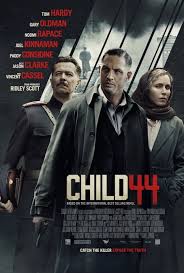 Unfairly cast out like some unwanted vermin, Child 44 is a police procedural based on a best-selling novel that the studio simply wanted to get rid of quietly. It was “dumped” into theaters and, as expected, began its disappearing act. That’s a shame, because it’s actually a rather involving mystery and an especially fascinating perspective into a little known world of being a cop on the other side of the Iron Curtain. Tom Hardy plays Leo, a member of the Soviet state police who is tracking a serial murderer preying upon orphaned children across the countryside in 1953. His wife (Noomi Rapace) is terrified of him and secretly a rebel informer. The two of them get banished to a Soviet outpost when Leo refuses to turn her in; he also refuses to accept the state’s conclusion over the dead children. In a weirdly perplexing turn, the Soviet Union believed murder was a Western byproduct. “There is no murder in paradise,” we are told several times, and since the U.S.S.R. is a communist worker’s “paradise,” whatever reality that doesn’t jibe with the party line is swept away. The murder mystery itself is fairly well developed and suspenseful, but it’s really the glimpse into this bleak and paranoid world that I found so intriguing. Child 44 is a slowly paced film thick with the details of establishing the dour existence of Soviet Union life. You truly get a sense of how wearying and beaten down these people’s lives were, how trapped they felt, how justifiable their paranoia was. The husband and wife relationship grows as they’re forced to reevaluate their sense of one another, and it genuinely becomes a meaty dramatic addition. Child 44 is a slow movie but the pacing serves the deliberate and oppressive tone of the film. It’s a film with some problems and missteps (certain antagonists make little sense in their motivations), including some incoherent action/fight scenes (fighting in the mud? Way to visually obscure everybody, guys). However, this is a better movie than the studio, and a majority of critics, would have you believe. It’s engrossing and taut and ambiguous and consistently interesting, with another standout performance by Hardy. Like many of the characters, this movie deserved a better fate.
Nate’s Grade: B
Share this:

Foxcatcher (2014)
 Haunting and engaging with great performances, Foxcatcher is a dark drama based upon real events that lead to tragedy with the United Stated Olympic wrestling team. Steve Carell immerses himself in the role of eccentric wealthy scion John du Pont, a man eager to carve out validation for himself. He bankrolls the U.S. team to train at his onsite facilities, notably assisting Mark Schultz (Channing Tatum) who is eager to get out of the shadow of his older brother (Mark Rufallo). This is a bleak drama that goes to some dark avenues but it’s not as applicable as the Cannes raves would have you believe. I was never bored but I did find the movie to be somewhat limited in scope. It’s really the life and times of a rich weirdo with a manufactured world around him thanks to his privilege. Du Pont sees himself as a mentor and a teacher, but really he’s just the guy writing the checks, and when his constructed view of reality is challenged, that’s when things get dangerous. He’s not as psychologically complex as advertised. Director Bennet Miller (Moneyball, Capote) ensures the film is overrun in dread so you anticipate that something very bad will happen, and as a result it can be something of a murky slow burn that isn’t necessarily worth the 130 minutes of wait. Foxcatcher is another example in the 2014 trend of the performances being better than the film itself. It’s an intriguing film with great performances, just don’t expect exceptional commentary.
Nate’s Grade: B
Share this:

Nightcrawler (2014)
 The surprise of Nightcrawler is that it works well on different levels: as a psychological descent with a deranged lead, as a media critique on sensationalism, and as a genre thriller. Jake Gyllenhaal (Prisoners) gives a truly transfixing performance as Leo Bloom, an ambitious sociopath who will stop at nothing to become the best at what he does. It so happens he films accident and crime footage to sell to the local news stations, and he’s not beyond getting his hands dirty if it means a better camera angle or a better payday. The actor reportedly lost 30 pounds and he appears otherworldly, his lanky frame and gaunt face making his bulging eyes pop. There’s a hypnotic intensity to his performance and a darkly comic irony that he speaks almost entirely in business buzzwords and jargon. The film chronicles his rise to power and how he uses his leverage to manipulate the people around him. The media satire is a little heavy-handed but still makes its points, especially in an age of scandal and hysteria. Rene Russo is also great as the desperate and bloodthirsty news producer who is charmed by Bloom but then gets too far in. Writer/director Dan Gilroy (brother of Tony) has crafted a haunting central figure that is morally repulsive yet entirely engaging, especially with a career-best performance from Gyllenhaal. He’s a fascinating psychological case, even if he remains relatively the same character from the start. He makes every moment an opportunity in suspense. Gilroy has a natural sense for visuals and especially how to pace his tension, drawing it out with precision in the final act as Bloom’s arrangements cause disaster. The nighttime Los Angeles setting and swirling tension remind me of Michael Mann’s Collateral. This is a movie that sticks with you long after thanks especially to the power of Gyllenhaal.
Nate’s Grade: B+
Share this:

Gone Girl (2014)
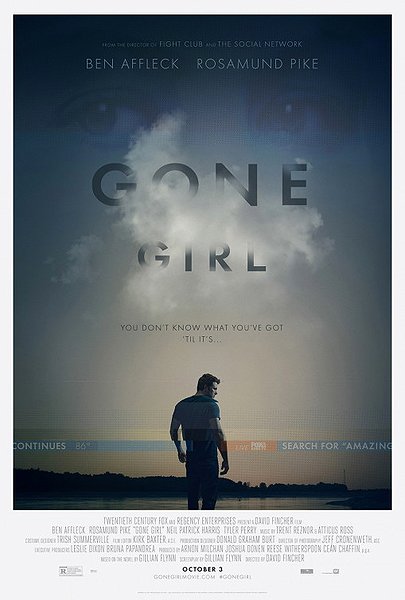 Rest easy fans of Gillian Flynn’s runaway bestseller, because Gone Girl the movie is pretty much exactly Gone Girl the novel. There were rumors that Flynn and director David Fincher had drastically retooled the controversial ending, but this was only premature speculation. Fun fact: it’s easy to tell the people who didn’t read the book in your audience because they will more than likely be the ones who groan once the end credits kick in. The fealty to the book is a relief because, as we book readers know from those late nights compulsively turning Flynn’s pages, the real star of the movie is the story, which was ready-made for a grand, pulpy thriller, and that is Gone Girl the movie. Whether it’s anything more than an exceptionally well made thriller is up for debate
Amy Dunne (Rosamund Pike) has gone missing from her supposedly perfect life. Her husband, Nick Dunne (Ben Affleck), starts off as the tortured, grieving husband. He comes home one day to find his home wrecked and his wife missing. The police (Kim Dickens, Patrick Fugit) are worrisome about Nick’s abnormal reaction to his wife’s disappearance. He doesn’t seem to know much about his wife. He seems like he’s hiding something. Even Nick’s twin sister Margo (Carrie Coon) has her doubts that Nick is telling the full truth. Amy’s diary paints a different portrait of her husband, a man prone to increasing anger, mostly stemming from the loss of his job and a relocation from New York City to Missouri. Most of Nick’s anger is focused squarely on Amy, enough that she fears for her life. As various clues keep piling up and Nick’s public behavior appears suspicious, the media spotlight transforms him from victim to prime suspect.
 No question having an artist of Fincher’s caliber raises the quality level to its highest degree, but it’s the perfect marriage of filmmaker and material that allows this movie to soar. Both Fincher and Flynn have a cold manipulative streak that twists an audience into knots. It’s a terrific whodunit with several booby-trapped surprises that only make you dig in more. It seems like every few minutes we’re learning more about Nick and what he’s been hiding from others. Flynn, who also adapted the screenplay, does a terrific job of playing with our loyalties, getting us to doubt what we see and who these people really are, and she does this even to the final minute, leaving us with no clear-cut answers to wash away our reservations. Flynn’s strengths as a writer are how she reveals her tale over time, how she makes us rethink the past and the characters and their sincerity. It’s a patient film, and just under two and a half hours perhaps too patient, but it’s not the least bit lackadaisical. Flynn’s story is wrapping a web around Nick and watching him get caught, and every perfectly timed reveal only widens that web. Gone Girl is a film bursting with intrigue. It snares you and then fiendishly plays with your expectations.
Affleck (Argo) was an obvious choice for the role of Nick Dunne, the charming man whose self-effacing smile rubs people the wrong way. He’s rarely been better onscreen, giving strong life to all the conflicting parts of Nick, from his calm aloofness at his wife’s disappearance to his cunning way with his own truths. He gets way in over his head, and watching Affleck navigate the tenuous situation is one of the film’s many twisted pleasures. Pike (The World’s End, Pride and Prejudice) is going to be an unfamiliar face to most American audiences but not for much longer. This is the biggest role of Pike’s career and much like Fincher’s other “find” Rooney Mara in Dragon Tattoo, she knocks it out of the park. In just a look she conveys Amy’s upper-class upbringing, her icy demeanor being interpreted as disdain. Through Amy’s journals, the character opens up to us, becoming better defined, making us fear for her, and Pike sells it. Hers is a performance of layers; it’s like she gets to play several Amy’s in this movie. Her demeanor is always so composed, so modulated and controlled, so the big moments that draw out her anger and horror register even more. It’s too early to determine what kind of awards buzz Gone Girl will have through the season, but if anyone has a chance, it’s her.
From top to bottom, the supporting cast adds great value to the film. Most surprising is Tyler Perry (yes, that Tyler Perry) as Nick’s high profile, slick, morally flexible defense attorney. It is no stretch to say this is Perry’s finest acting ever put to film, in or outside a dress. I wanted more of him, and that’s not something I’ve ever said before. Dickens (TV’s Treme, Footloose) would ordinarily be the best performance in most movies; smart, empathetic but no-nonsense, and wryly funny. In an ordinary crime thriller, she’d be our lead character. Coon (the breakout actress from HBO’s The Leftovers) is the audience’s voice of sanity, providing necessary gallows humor to punctuate all the discomforting dread. Casey Wilson (TV’s Marry Me) is a suburban housewife send-up and provides some laughs too. Even Emily Ratajkowski, otherwise known as one of the topless models in the “Blurred Lines” video, is pretty good as a naive coed. Thus is the power Fincher wields as a director of actors, a quality often overlooked by his technical prowess. The one casting question is Neill Patrick Harris (TV’s How I Met Your Mother) as Desi, Amy’s creepy ex-boyfriend who still very much clings to the notion they should be together. Harris tries too hard to be creepy, concentrating too much that his style becomes mannered and halting.
 With Fincher’s name attached it’s almost redundant to talk about the technical superlatives of the movie; it goes without saying. One of the finest visual stylists of his generation, Fincher impeccably composes his shots. The man finds a kindred spirit with Amy and her color-coded meticulous organization. The cinematography is crisp and suitably eerie and dreamlike (or nightmarish), the mood always pulsating with a beautiful dread to tap into the unsettling unease of Nick’s dire situation. The editing is rock-solid, keeping the audience guessing with the balance of Amy and Nick perspectives. There is a chilling sequence late that involves a mass amount of blood, but it’s made even more unnerving thanks to the judicious edits and fade outs, heightening the horror. The only technical aspect I found wanting is the same with Fincher’s Dragon Tattoo, namely the score by Atticus Ross and Trent Reznor. Twice now I’ve labored through musical scores of theirs that could best be described as ominous ambient noise. You keep expecting it to build but it doesn’t. Perhaps it’s just the change of material, as it’s also been two films in a row based upon dark and grisly crime paperbacks, but consider me disappointed yet again. There’s nothing memorable here and that’s a shame considering how buoyant their Oscar-winning score was for the still amazing Social Network.
But even with that Fincher polish and the sinister snap of Flynn’s plot, I can’t say that Gone Girl the movie rises to the level of its lofty ambitions. Much like Dragon Tattoo, this is a skillfully made crime thriller, but is it anything beyond that description? That’s not to say there’s anything particularly wrong with being a skillfully made thriller; Fincher’s Seven is one of my favorite films of all time, and yet despite its end-of-times philosophy about the dark hearts of man, it’s really nothing more than a exceptionally made thriller, and that’s fine because that movie is near perfect. With Gone Girl, the stabs at deeper analysis and social commentary feel just out of grasp. The tabloid news fixation, a landscape littered with missing wives and presumably guilty husbands, is ripe for satire, but it feels always on the peripheral, like Fincher is checking in to take the temperature and then going back to the muck. There’s much more that could have been done, but that’s fine. The larger missed commentary is with marital relationships. This is not, as some critics have labeled, a How We Live Now kind of film, a jarring wake-up call that human beings more or less suck. Nick and Amy are far from being relatable analogues for the masses, and that’s fine. They are allowed to just be interesting characters, which they are, rather than stand-ins for searing social commentary. The fact that five years into their marriage they’re both still strangers says something about them, but does it say something novel about marriage itself or human relationships in the twenty-first century? The idea of people wearing false masks isn’t exactly new. The average couple is not probably going to go to bed thinking, “Who is the real person I’m with?” The average couple is just going to go along for the ride and think, “Wow, these are some messed up characters.”
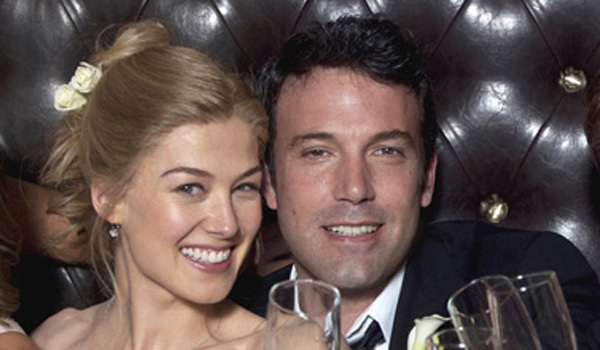 And now some spoilers as I delve into Gone Girl’s ending, so if you choose to remain clean please skip to the next paragraph. The ending is unsettling and disappointing for people because the only person who gets what she wants is our main antagonist, Amy. The final shot, a replay of the opening image but with clarifying context, is her triumph, staring coldly, head atop her husband, as if she were a cat purring. She has won. And this ending pisses people off. For my money, this is the absolute perfect ending for a story about toxic relationships and a morass of a marriage. Nick is rescued by Amy’s reappearance, engineered through some canny media manipulation by Nick, but now he’s stuck, and stuck with his lovely psychopathic wife. The police know she’s guilty but won’t proceed further thanks to looking inept on a national stage. Nick can’t leave because then his child will be raised by Amy, twisting him or her into mommy’s little psychopath. The only way he saves that child is by staying, by sacrificing his own freedom, to become prisoner to his wife, to play the part she has wanted him to play, and he does it. He is condemned. I find that to be poetic and darkly satisfying, and it’s very true tonally for this sort of sordid tale, but I understand why people hate it. I just think a happy ending or one where the villain is vanquished would feel trite.
Gone Girl is a toxic relationship movie, an involving and pulpy suspense thriller, a rewarding character study that plumbs some pretty dark depths, and most of all a sickly entertaining movie with excellent craftsmanship. It is everything fans of the novel could have hoped for with Fincher attached. As our tormented husband and wife, Affleck and Pike deliver career-best and career-making, in her case, performances. The ending will divide audiences sharply just as it did readers but I consider it the correct denouement. The movie doesn’t provide much in the way of stinging, applicable social commentary or media satire that hasn’t already been covered by the likes of Jon Stewart and Stephen Colbert. But does it have to be anything more than a terrific thriller? An exceptional thriller can be entertainment enough, and Gone Girl is definitely that.
Nate’s Grade: A-
Share this:

The Counselor (2013)
 The magnitude of author Cormac McCarthy’s involvement should not go understated in discussions over The Counselor. The acclaimed, Pulitzer Prize-winning author has written modern classics often exploring the darker side of humanity. McCarthy’s first screenplay must have seemed like a hot commodity for all of Hollywood. It attracted director Ridley Scott (Prometheus) and a score of A-list actors. The anticipation was that McCarthy could match the brilliance of his prose. The Counselor, a dreary and lackluster thriller in every conceivable way, proves that McCarthy still has an uphill learning curve when it comes to serviceable screenwriting.
The titular Counselor (Michael Fassbender) seems to have a nice life. He’s just proposed to his girlfriend, Laura (Penelope Cruz), and their sex life is vigorous. Then an old client, Reiner (Javier Bardem), invites the Counselor in on a shady drug transportation deal. The allure of easy money is too much for the Counselor to resist. Naturally, things do not go according to plan. A Mexican cartel intercepts the transport truck, bodies pile up, and the stakes get very personal for the Counselor.
 To be blunt, if McCarthy had submitted this script under a different name, it never would have made its way to the big screen. This is the award-winning author’s first screenplay and it shows. The pacing is shockingly slack, with the film rarely having any sense of life onscreen. I’m not a slave to the standard three-act structure of Hollywood screenwriting, but you need to produce something that keeps pushing the film forward, heading to a finale that seemed inevitable. McCarthy’s script is bogged down with pointless scene after pointless scene, little arias that get away from him, indulging his characters to monologue at length about philosophical nonsense. There are lengthy conversations about diamond shapes, the very nature of existence, and all sorts of Matrix Reloaded-like lingual excesses. These characters talk round and round; it feels like there aren’t even other characters in the room. Their lengthy, pretentious conversations also do little to push the narrative along or reveal essential bits of character. You get to hear one crime kingpin talk about his favorite poet. Great, but what can you say about him beyond the fact that he’s well read? Every character in this movie, from top to bottom, is a vapid space. Some of them have interesting aspects/quirks, like owning cheetahs or masturbating on car windshields, but not one character can be described as interesting. Beyond the terms “ruthless,” “pragmatic,” and “naïve,” I cannot even fathom a way to describe anyone in this film. They don’t even really work as plot devices because that would imply causality. When you couple the void of characterization with ponderous, rambling dialogue, then you’re already sabotaging your entertainment chances.
The plotting is muddled beyond all comprehension. I like to consider myself a pretty sharp moviegoer, but I was left scratching my head far too often. With a paucity of characterization and some idle pacing, I was confused as to what exactly was going on, sometimes even just at a literal level. What was this plan? How do all the players fit in? Why are the betrayers acting as they do? Who works for whom? Why should I be shocked about revealing the identity of a betrayer when it was made all too obvious in a previous scene (note: this is so directly transparent that it cannot count as foreshadowing)? Why does the appearance of a DVD signify finality after a previous phone conversation already did the same thing? And most of all why should I care? Watching this movie is like traveling through a long, impenetrable fog. There are serious, ongoing clarity issues, which make those florid digressions and overall pointless character nattering to be even more maddening. There are well known actors that come in just for single scenes, and then those scenes amount to little to nothing on the overall bearing of the plot. The Counselor doesn’t feel like a fully formed story; it feels like a collection of 30 scenes served as disposable sides for actors during preliminary auditions.
Even worse, for a film about drug deals gone badly, murder, and Cameron Diaz masturbating on a windshield, The Counselor is deathly boring. I grew restless before the halfway mark and just kept hoping beyond all evidence that the film was going to find some direction and pick up the intrigue. It did not. The film’s essential story structure, criminals getting in over their heads and paying a price, is a familiar one. This structure can work to marvelous results both grand (Goodfellas) and small (Things to Do in Denver When You’re Dead). Hell, even McCarthy’s own novel lead to the brilliant, Best Picture winner No Country For Old Men. Look at how the Coen brothers approach the macho, nihilistic material as opposed to its author. They created a sense of all-consuming dread with efficiency, elegance, and their characteristic macabre sense of humor. Watching The Counselor, it’s like the turgid knockoff of a McCarthy novel. When I got home I felt like I had to watch a Quentin Tarantino movie to wash the bad taste out of my mouth. Tarantino is given to long indulgences of elaborate dialogue as well, but he makes his characters interesting, with personalities that grab you and stand out, and listening to his dialogue is a pleasure unto itself.
McCarthy’s brand of ruthless killing has its peculiar intrigue, but again it only functions as morbidly fascinating little asides. The use of tripwire is given high priority by the killers onscreen, decapitating a speeding motorcyclist and cutting into the jugular with another character. It’s a strange, harrowing, and gruesome manner of death, but is it at all practical? I know I’m treading dangerous waters bringing the concept of reality to a murky film, but what killer decides to set up a wire approximately neck high across a road? It seems likely that another car would travel that same road in the hours of buildup. It also seems highly lucky to adjust the wire to the exact height to cut into the neck. I’m no professional killer but it seems like a lot of setup and guesswork. I have to imagine there are far easier ways to kill a speeding cyclist or a man walking along the street. Attention professional hit men of the movies: stop making your job more difficult than it has to be. Nobody is awarding you a ribbon for Most Inventive Kill.
 There are plenty of pretty faces in this movie, genuine acting talent, and to strand them with precious little characterization is an outrage. Fassbender (12 Years a Slave) is a little too sly to play naïve, and his later actions lack a necessary sense of desperation to sell his emotional plummet. Cruz (Pirates of the Caribbean: On Stranger Tides) is so effortlessly sensual but is put on the sidelines early and stuck in the damsel-in-distress box. Brad Pitt (World War Z) is the slick snake charmer we’ve seen plenty of times before. But the worst lot goes to Diaz (Bad Teacher). She’s supposed to be mysterious and threatening as Reiner’s sexually adventurous girlfriend but Diaz plays things so stone-faced serious. This poor woman is given the most unerotic, bizarre sex scene in modern history to enact, and I don’t know whether to applaud or pity her. Sure she gets to uncork some meaty monologues about Malkina’s trenchant world perspective, but this is the movie that will be defined by Diaz humping a windshield. At least the movie plays this out somewhat realistically, with Reiner more horrified than aroused. What did that outrageous scene add up to? Also, Penelope Cruz plays a “Laura” and Cameron Diaz a “Malkina”?
I know it’s a petty thing but it really irritated me how often people refer to Fassbender’s character as “Counselor.” The end credits do reveal this to be his name. If you thought it got irksome hearing Leonardo DiCaprio say “ole sport” after every other sentence in The Great Gatsby, then enjoy the repetitive declaration of Fassbender’s lone job title. “What do you think, Counselor? I don’t know, Counselor. I’d think things over, Counselor.” Do people really refer to somebody by this title as their name, and so frequently? He also doesn’t seem to be a competent lawyer at all.
The Counselor is such an unforgivably boring slog, languid and rudderless when it should be thrilling and complex. The characters are nonexistent, the plotting is muddled and confusing, the dialogue often laborious and roundabout, and the overall film is too meandering to properly engage an audience. Even talented people can produce bad movies, and here is further proof. With this cast, with this crew, there is no excuse for The Counselor to be overwhelmingly stilted and tedious. I cannot fathom what attracted the talent to this film beyond the cache of working on “Cormac McCarthy’s first screenplay.” If the results of The Counselor are any indication, I don’t know if we’ll be seeing too many McCarthy screenplays in the future, or at least McCarthy scripts that haven’t been vetted by other writers who better understand the contours of the medium. His florid arias and abstract, directionless plotting can be forgiven on the page but not on the screen. Scott doesn’t help matters, taking great care to film the luxury of the lifestyles on screen. What we’re left with is a tepid movie about bad people meeting bad ends, with little entry for an audience to care or even find entertainment. The art direction is given more care than the characters. In the weeks leading up to its release, The Counselor adopted a tagline from a quote by Laura: “Have you been bad?” It was turned into the Twitter hashtag promoting the film. Well, Counselor, you’ve been very bad.
Nate’s Grade: C-
Share this:

Compliance (2012)
 The day at a fast food eatery began like any other. Sandra (Ann Dowd), the manager of the branch, has to shepherd her small group of employees through a hectic Friday evening. Then she gets a phone call from an “Officer Daniels” (Pat Healy). He tells her one of her workers, Becky (Dreama Walker), has stolen money from a customer. Sandra takes Becky into a storeroom and confronts her. Becky is aghast and professes her innocence. This is where things start to get out of control in writer/director Craig Zobel’s potent indie pressure-cooker. “Officer Daniels” insists that Becky be searched, then strip searched, and then worse, and Sandra and the employees begrudgingly go along. After all, it’s an officer of the law telling them what to do. Except that “Officer Daniels” is no police officer. This whole incident is an awful prank, and the people involved will never be the same.
This really is an indie horror movie, flipping the oft-repeated cry, “Don’t go in there,” with, “Why are you still doing this?” You may have to watch portions of this movie between your fingers. I was squirming and crying out at numerous points. The tension and dread just continue to mount, and you watch the characters slowly degrade, as they’re asked to do more insidious acts of humiliation in the name of compliance, and to watch them carry on the path of shame. It’s a step-by-step process of human degradation, so that the more disturbing moments of sexual obedience don’t feel entirely implausible given the journey through hell the characters have endured. It is impossible to watch this movie silent and detached. This is a provocative film that will garner many reactions but it’s also something of an endurance test. How long can you watch? How far can you watch these characters descend? The movie hooks you early and then you almost feel complicit, but you’re completely taken over by morbid curiosity.
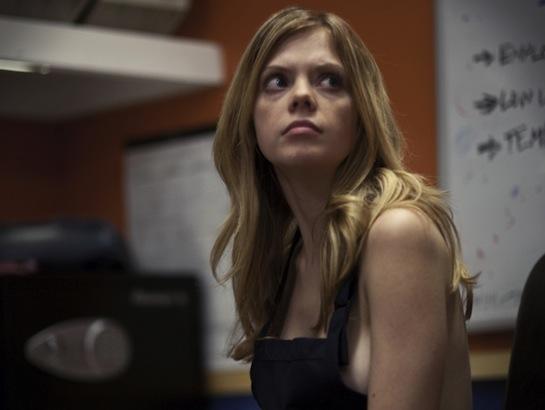 The movie is a powerful modern-day example of the Milgram experiment, the famous psychological exercise where a figure in authority, who assumes all responsibility, gradually gets average people to commit increasingly harmful acts to others. As long as people believe they are following orders, they can be convinced to do almost anything by someone in control. It’s easy to sit back and judge these characters, scoffing at how naïve they seem to be. It’s always easy for us to say what we would do in hypothetical situations, that is, until they happen. Compliance is an intriguing analysis of the shifting facets of power, authority, and manipulation. “Officer Daniels” enlists a host of tricks and verbal intimidation to persuade his victims to do things outside their better judgment (the caller’s true profession is a brilliant backstory). After a while, Sandra looks to be developing some slight Stockholm syndrome as she empathizes more with the plight of the phony officer on the phone than her employee. He provides just enough sympathy and validation she’s looking for to win her over. He also plays people against one another; he implores Becky to spare Sandra any extended grief, which often cows her into consenting. “Officer Daniels” isn’t the only one manipulating others; Sandra pressures employees to become involved in the situation, using her position of power to squeeze others into getting what she wants. There are numerous victims and culprits here.
Zobel could have easily given over to the exploitation elements of his story and made a very tawdry, voyeuristic exercise in sexual dominance. We watch as Becky bares all of herself and then goes even further, as “Officer Daniels” instructs male attendants to physically inspect her body cavities. It is a credit to Zobel’s sensitive direction that Compliance does not come across like a glorified S&M masturbation fantasy. He treats the incident very seriously, providing clear distaste without going overboard into preachy condemnation or superiority. It’s amazing that Zobel’s script finds so much empathy for his participants. You may be surprised at how relatable and “normal” these people seem. You may even recognize some of them. They’re all trying to do the right thing at heart, but that distinction gets extremely blurry as the night carries on. The point of Zobel’s script is that these people could be us. The added empathy makes the downward spiral all the more stomach-churning, as we want these characters to take a stand, to wise up and question the voice of authority.
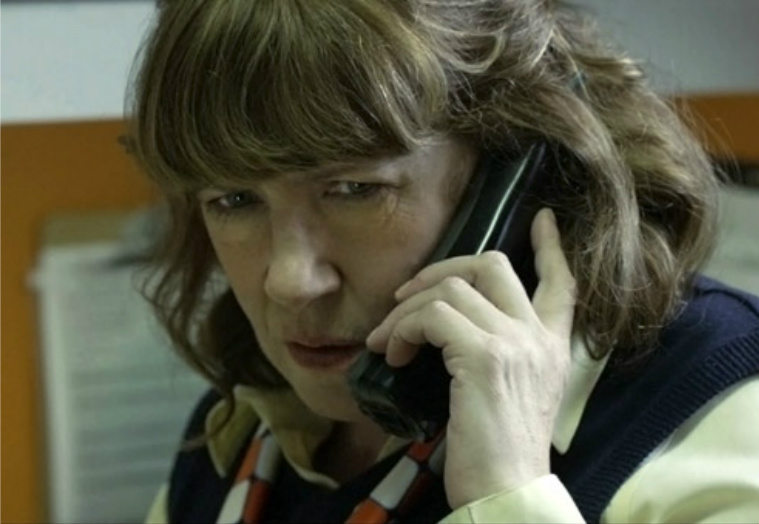 Dowd (Marley & Me) is downright heartbreaking and deeply frustrating in the movie. We get a clear sense of the pressure she’s under in her position, but she’s really the focal point of the movie. Walker (TV’s Don’t Trust the B in Apartment 23) is the martyr of the piece, and her slow resignation to the humiliation is deeply affecting, but this is Dowd’s movie. The longtime character actress takes the character of the dowdy Sandra, striving for respect, and transforms her into a figure worthy of Greek tragedy. She can be vindictive and, well, bossy, but she’s also a figure struggling for respect and validation and what she feels is morally just. We watch as her confidence starts getting chipped away, the flickers of doubt that she must tamp down because now she’s gone too far to reverse course. I don’t imagine that a movie as small as Compliance will be remembered around Oscar time, but I’ll certainly recall Dowd’s sad and transfixing performance.
I’d like to share a spooky bit of personal connection to the film. No I’ve never experienced anything this heinous before, but there was an offhand music cue that caught my interest. When we cut to the dining area early on, there’s an Admiral Twin song playing. Who is Admiral Twin? Why they’re a brilliant pop-rock band from Tulsa, Oklahoma that I’ve been singing the praises of since 2000. I’ve won over friends with my discipleship, but the band is still relatively unknown, playing few performances outside of their native Tulsa. Given the phonetic approximations of my name with the film’s writer/director, and the inclusion of an obscure indie band that few know (but should), it seems likely that Zobel may indeed be some far off relative of mine or, more likely, myself. I must have crafted an entire film without ever knowing about it. This seems like the most probable scenario.
I don’t want it sound like Compliance is some grueling exercise in group sadism. In lesser hands, it might have devolved to that. It’s a fascinating and provocative game that challenges and incenses an audience. The movie is a sickening but compulsively watchable dramatic experiment that will leave you talking for hours once it concludes. It’s an uncomfortable sit, yes, but that doesn’t mean it’s not worthwhile. The events in the film seem unbelievable and yet it’s based on a true story. This stuff happened, people. Not only that, it happened multiple occasions in multiple vicinities. What does that say about human nature? Will we only be as good as society lets us be? If we are absolved of responsibility, how far removed from our own sense of ethics will we go? Are we all susceptible to this moral failing under the right circumstances? I think that’s the truly terrifying and lasting lesson of Compliance. These people could be us, both victim and unwitting antagonist. Destined to stir debate and become a college ethics course favorite, Compliance is a gripping movie that will make you cringe but also give way to some scary introspection. How far would you go?
Nate’s Grade: A-
Share this:

Savages (2012)
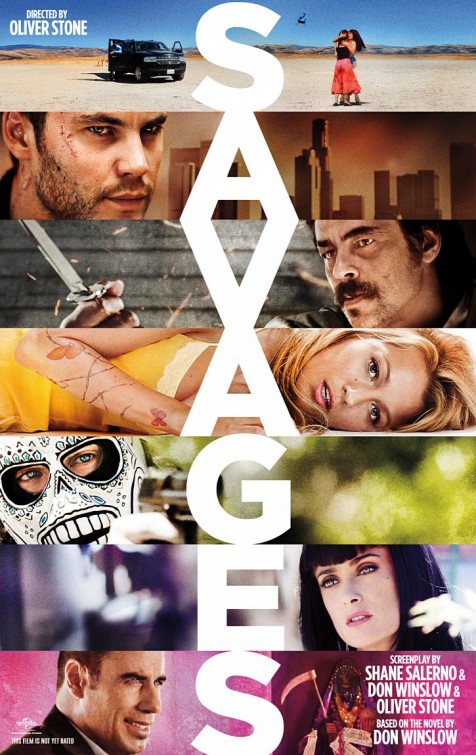 Savages has been described as a “return to form” from prolific director Oliver Stone, who has spent the last decade making straight biopics (W., Alexander) and safe feel-good movies (World Trade Center). The less said about Wall Street: Money Never Sleeps the better. You never thought one of the world’s edgiest filmmakers would follow such a square path. I can’t fault people for getting excited by Savages, hoping this drug-addled crime thriller can revive the gonzo sensibilities of the man. Well, Savages isn’t going to satisfy most people, especially those looking for a cohesive story, characters that grab your interest, and an ending that manages to stay true thematically with the rest of the movie. In short, Savages is a savage mess of a movie but not even an entertaining mess. It’s just a boring mess, and that is the film’s biggest sin.
Best friends Chon (Taylor Kitsch) and Ben (Aaron Johnson) are living the American dream. They began farming their own marijuana plants, using the best seeds form Afghanistan while Chon was on tour with the military. Together, the guys have produced a product high in THC that blows away the competition. They have flourished in California. Now a Mexican cartel, lead by Elena (Salma Hayek), wants in on their business, and they won’t take no for an answer. The cartel kidnaps the boys’ shared girlfriend, O (Blake Lively), and promises to hold her ransom for one year unless the boys agree to their terms. Chon and Ben decide to use their considerable resources to put the squeeze on Elena and her team of scumbags, all the while looking for a way to rescue their shared love of their life.
 It’s a lurid movie all right. Plenty of sex, drugs, and violence, but man oh man is it all just empty diversions because the movie cannot survive its trio of unlikable, uninteresting, and painfully dull characters. O, Chon, and Ben have a dearth of charisma; light cannot escape their black hole of charisma. What sinks Savages is the realization that it’s just a shoddy movie filled with a lot of skuzzy characters but hardly anyone that merits genuine interest. We’ve got skuzzy good guys, skuzzy bad guys, but where are the personalities? Where are the quirks or the hooks to drive our interest? Just having Benicio del Toro (The Wolfman) act weird and mumbly is not enough to cover the shortcomings of his character. I’ve read reviews where critics cite del Toro as “hypnotic.” I have no idea what they’re talking about. He’s just your average skuzzy bad guy you’d find in any mediocre crime picture; he just so happens to be played by Benicio del Toro. The DEA Agent John Travolta (From Paris with Love) plays is your typical skuzzy desk weasel; he just so happens to be played by John Travolta. And that’s where the movie falters. We have all these characters on all sides of the law but we couldn’t give a damn for any of them. O comes across like an annoying, privileged, faux intellectual. Chon is a meathead. Ben is an amorphous do-gooder. I don’t care about their problems and I especially don’t care about them retrieving O so they can return to their vague polyamorous lifestyle. She wasn’t worth all the effort, nor where these men worth dying over. At any point in the film, I wanted these characters to hastily die so that I might, just out of chance, come across a more interesting figure. I received no salvation.
Our trio of bland characters is made flesh by a trio of bad performances. First off, people have got to be realizing that the kind of lived-in, edgy, and compelling performance Lively pulled off in 2010’s The Town is more the exception than the rule. Stop casting her in gritty parts unless they are directed by Ben Affleck. As O, our zombie narrator, she does little to make us sympathize with her dumb plight. Then there’s Kitsch (Battleship) who is just having a record year of high-profile flops. He’s done fine acting work before, but as Chon he’s just another ramped-up hothead with little else on his mind. Johnson (Kick-Ass) has the most “flavor” of the trio, acting granola-y and with philanthropic ambitions, but he’s still just another meathead just in different clothes. All three of these characters are idiots and the young actors don’t find any way to redeem them.
Actually, I found Salma Hayerk’s character the most interesting and would have enjoyed a movie based around her dilemma. Elena’s husband was the head of a drug cartel. He was assassinated, so the duties would have fallen to her son, but in order to protect him she assumed power. She has an estranged relationship with her youngest daughter, Magda (Sandra Echeverria), who is ashamed of her mother. This, Elena tells us, makes her produ; she is proud that her daughter is ashamed. Now just look at all those contradictions and complexities inherent with this character. She’s assumed a duty she did not want, something she knows is morally wrong, but she does so in the interest of protecting her children, even if it means pushing them away and having them despise her. And because she’s a woman, any wrong move and her competitors would be ready to pounce. Plus you add the day-to-day anxieties of a life of crime, the threat of betrayal or some upstart wanting to make a name for himself, and you have the makings of a great character drama. But do we get even a little of this? No. Instead, Elena’s just portrayed as another colorful villain. The supporting cast is peopled with what should be seen as “colorful” characters, but really these people are just as skuzzy and boring and personality-free as our loser ménage a trois.
I suppose there is a certain pleasure seeing Stone return to his blood-soaked, violent, gonzo self. The man has a certain enviable madness when it comes to composing a movie, a mad fever of images and sensations. From that standpoint, Savages is at least watchable even though you would rather see most of the characters get hit by a car. I just wish if Stone was going to go nuts that he committed and went all the way, bathing this movie in his lurid predilections as we tumbled down the rabbit hole of the underground world of organized crime. If you’re going to assault my senses with excess then at least have the gall to be excessive. How can you make a lurid movie but EVERY woman onscreen engaging in sex is clothed? That seems unrealistic even for a movie this stupid. Stone seems to have no problem dragging out uncomfortable rape scenes, so who knows what the further implications of that are. There are several grisly torture scenes and some random brutality, so you’ll at least be kept awake in spurts by people screaming.
 Too much of this supposed crime picture is caught up in the oppressively irritating soap opera between O, Chon, and Ben (a little part of my soul dies every time I have to type “Chon” as a main character name). The script, based upon Dan Winslow’s novel, adapted by Shane Salerno, Stone and Winslow as well, is a mess but not even an enjoyable mess. Some of this dialogue is just laugh-out-loud bad. O opens the movie saying she has orgasms but Chon, you see, has… “wargasms.” Oh ye God, that one hurt. Every time we’re subjected to O’s protracted, monotone narration the movie loses whatever momentum it may have had.
She keeps saying, “Just because I’m telling this story, doesn’t mean I’m alive at the end.” Can you promise me that? Then there’s the very stupid ending, where the movie tries to have it both ways. It gets its bloody, operatic, tragic lovers ending…. and then in the next breath a happy ending as well, a ridiculously inappropriate happy ending. At least bloody and dead would have been satisfying. It’s a cop-out, a cheat, and a mystifying way to end a movie.
I wanted Savages to be a wild thrill ride. I never expected to be bored. Even when things go off the rails, the movie struggles to keep your interest. Blame the inane screenplay that eventually resorts to a cheap, cop-out of an ending, one that barely rises above the “it was all a dream” blunder. Blame the pathetic character and their lack of personality. Blame the strange feeling that Stone is holding back. Blame the bad performances. Blame the lack of fun. Blame the overwrought nature of the title the movie twists into knots trying to give some philosophical meaning. And finally, you might want to blame yourself for thinking that this movie would be any good in the first place. When movies are this mediocre, this lacking in intrigue, you almost wish they had tipped over completely into irredeemable garbage just so you’d at least have something worth watching. Savages is a strange crime thriller that manages to assemble all sorts of exploitation elements and then fumbles them all. If this is Stone in a “return to form,” I weep for what that entails.
Nate’s Grade: C
Share this:

Rampart (2012)
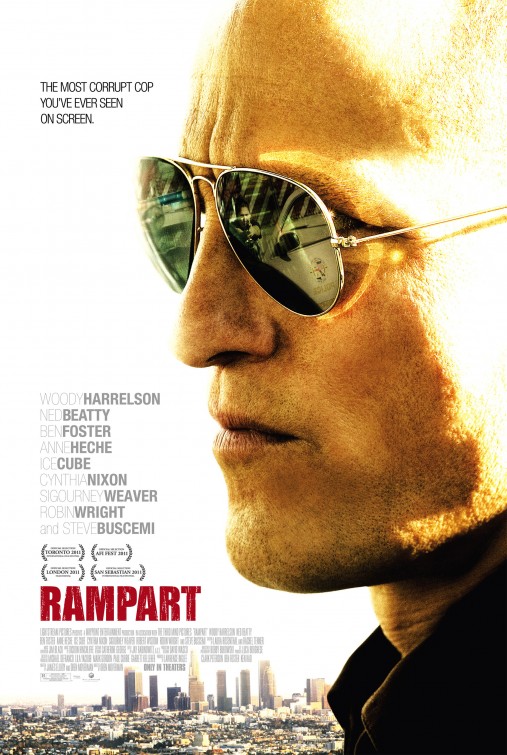 Stop me if you’ve heard this one before. A corrupt L.A. cop (Woody Harrelson) makes bad choices, alienated and frightens his family, and looks to be on the way out as a career of taking the law into his own hands is at long last catching up with him. Yeah, you probably stopped me after the third word in that sentence. This dour character-study showcases Harrelson nicely as a cocksure cop who’s so self-destructive and paranoid that he pushes everyone away. Co-written and directed by Oren Moverman, who made the terrific and searing drama The Messenger, this movie just about turns into high-gloss navel-gazing. The plot is quite loose and there’s very little traction. We get to see scene after scene of Harrelson behaving badly or violent, but what does it all add up to? We already know he’s a bad cop tortured by his own sins and the demands of the job. In a way, there’s an intriguing connection between law enforcement and soldiers who are often called to bear incredible burdens and just deal with it, forgotten by a public complacent with being safe. But really this movie is just one long trip with an angry man who keeps everyone, including the audience, pushed away. He’s complex but I can’t say we ever got to know him better. The film is well acted with plenty of recognizable stars, but why should I care? The central message about the prevailing influence of corruption is a bit heavy-handed as well; at one point Harreslon’s wife says, “You made us dirty.” Rampart is a disappointing venture for Moverman despite Harrelson’s best efforts. In the end, when you’re stuck with a dirty cop he better be worth the time.
Nate’s Grade: C
Share this:

We Need to Talk About Kevin (2011)
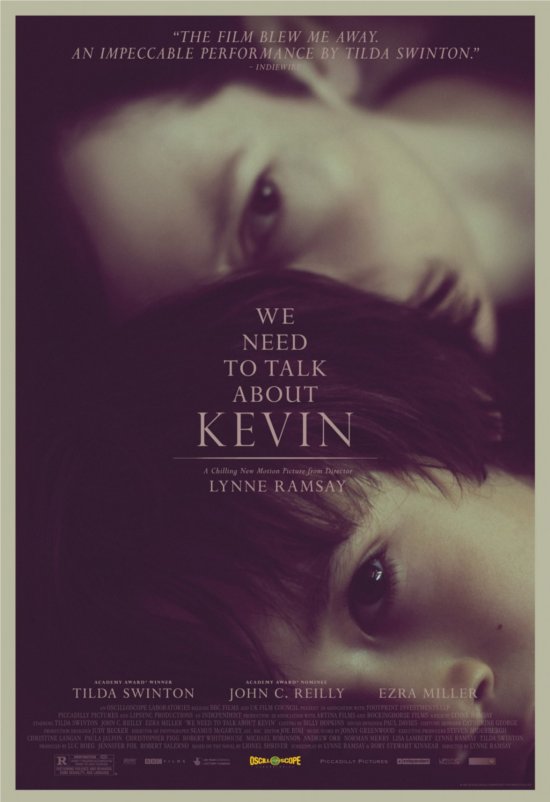 If you’re contemplating having children, then We Need to Talk About Kevin may not be the movie for you at this moment. It takes a stab at the nature/nurture debate and proposes that some children are just born broken and beyond the reach of even the most dedicated parent. It’s not exactly the cuddly message we get from most stories about the joys of parenting, but We Need to Talk About Kevin is a startling, provocative, and powerful portrait of grief, aggravation, and slowly dawning horror. Can even a mother love her monster?
Motherhood has not been the rewarding venture as promised for Eva (Tilda Swinton). Kevin (Jasper Newell at a child; Ezra Miller as a teen) wails so incessantly as a baby that she seeks out the sweet sounds of a jackhammer to drown out her shrieking babe. Even as a toddler, she knows there’s something just not right about her sullen, uncommunicative son. He seems to deprive her of any affection or attention she might find gratifying. Truly it seems much of Kevin’s motivation in life is to humiliate and torment his mother. It starts with being deliberately unresponsive as a child, and turning on a dime when in the presence of his father, then to delayed toilet training because he seems to enjoy making his mother clean up his mess (metaphor?), to the unexplainable massacre at her son’s hands. We Need to Talk About Kevin is an immersive experience, occasionally piling on how irredeemable Kevin is as a character. It also speaks to the unreliable nature of our shell-shocked point of view. It’s a disquieting film to say the least but I found it riveting and compelling at every second, artfully exploring a form of grief and social isolation that few will ever be able to fully understand.
 There’s tremendous psychological detail to this nightmarish parenting tale, and it’s those details that make the film feel eerily authentic and not exploitative. I found it fascinating to be drawn into this world, like I was watching an intimate, illustrated case study come alive. I found it very telling that after Eva accidentally injures her son in a fit of frustration, she apologizes but can only bring herself to do so under the shield of third person, saying, “Mommy shouldn’t have done that,” rather than, “I shouldn’t have done that.” And then when they get home, little Kevin unspools a perfectly believable story to cover-up what really happened. Even at six this kid is a shockingly adept liar, possibly because he’s a budding sociopath. Horror movies have been bringing us little pint-sized terrors for decades, from Bad Seed to the Village of the Damned, but those wicked kids seem like child’s play compared to Kevin, a startling, vacant child who is the scariest of the bunch exactly because he feels completely real. No Satanic imagery, glowing red eyes, or over-the-top associations needed; this is one messed up kid.
Watching this tumultuous and combative struggle for domination is equal turns compelling and terrifying. In many ways Eva adopts the role of Cassandra, the Greek figure cursed with visions of the future that nobody believed; Eva warns the people in her life that Kevin isn’t right, that he’s entirely capable of great evil, yet everyone ignores her dire warnings, and even Eva is culpable to some degree of enabling. Rather than discipline Kevin or stick to her principles, she passively accepts the situation and carries on with full knowledge that Kevin is going unchallenged. To everyone else he seems like a bright, helpful, normal teenage boy, which is why dear old dad (John C. Reilly) is so condescending and dismissive when Eva voices concern. Parenting is supposed to be instinctive, right? Eva feels like a failure, that this young soul has been steered to the dark side under her watch, and I think her hesitation to continue ringing alarm can be summed up by the fact that she’s just exhausted, tired of fighting a fight that everyone else ignores. I think she may also be desperately hopeful that she can ride this out, that it’s only a phase for her son, that somehow he’ll grow up to be a normal, loving child through some miracle, like a switch will be flipped. The only time Kevin ever shows his mother compassion is when she reads him a bedtime story involving archery, a hobby that would prove deadly.
The film is told non-linearly as we observe the fragmented memory of Eva. We have to pick up the pieces of life much like Eva recovering from her son’s destruction. It’s interesting to discover the symbolic connections between scenes, the connective tissue binding the memories together, and director/co-writer Lynne Ramsay (Ratcatcher) does an exceptional job of filling in key details to enrich this woman’s horrid life. The scenes don’t seem to last long, but Ramsay and her team provide all the meaning and weight we need so that the scenes matter. There’s a heavy amount of dread suffused into every scene in this movie, as the totality of events starts to become clear. The metaphors aren’t subtle but they are effective. Prepare for a lot of red in the color palate: squashed tomatoes, strawberry jam, splattered paint across Eva’s front porch as an act of vandalism. She spends the rest of the movie trying to clean away the red stains on her home (see what I mean about subtlety?). The splintered narrative also serves as a statement on Eva’s frame of mind, trying to move forward but haunted by a tragedy that goes down to the marrow.
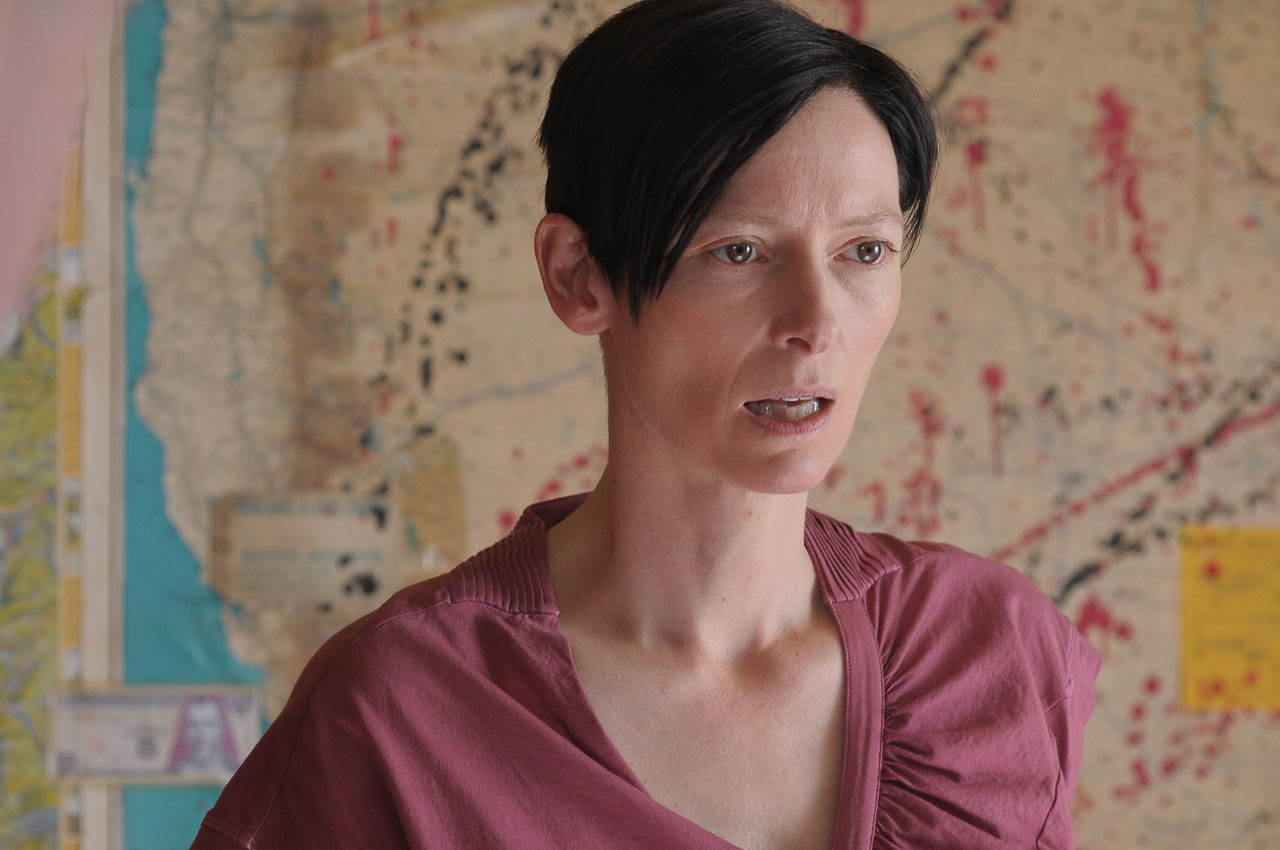 And of course all praise of the film needs to also be placed at he feet of versatile actress Tilda Swinton (Michael Clayton). She’s not given many lines of dialogue but what she is able to do to make her character feel fully lived-in is astonishing. There are so many different points of her life to play, from young exuberance to growing disdain to zombie-like pariah, and Swinton doesn’t strike one false note. Even during her grief and guilt she doesn’t go into hysterics. This is a woman that simply wants to waste away and be forgotten. Even when it looks like she might find some small measure of satisfaction or affection from another person, the movie sucker punches you. You realize that her son may be in jail but she’s serving a sentence all her own. Swinton is heartbreaking and subtle and nuanced even when it appears she’s simply staring off into space. You don’t really want to be in this woman’s head, and yet Swinton’s performance puts us there, hence all of my analytical assessment above. She’s a mixture of self-loathing, denial, bitterness, and penitence, and Swinton gives us telling glimpses of the storm below the surface. Her guilt is eating her away from the inside out. I’ll go on record and say it’s a crime that Swinton wasn’t nominated for a Best Actress Oscar (I personally apologize for not nominating her for the PSP Silver Cines).
I feel the need to talk and talk about We Need to Talk About Kevin, to sing its despairing praises, to encourage lovers of challenging, complex, and emotionally devastating film to experience this exceptional movie. It’s psychologically rich, bold, and revealing with even the smallest details to round out this hellish family scenario. It’s not an easy two hours to sit through, not by a long shot, but there are certain rewards for those who choose to wade through the darkness, Swinton’s haunting performance among them. This is a difficult subject and it’s produced a difficult film, but sometimes we need to be put in uncomfortable circumstances to get at a greater truth. What is the greater truth of the film? Maybe that parenting is really, when it’s all said and done, a leap of faith, maybe that avoidance of hard decisions is no solution, and maybe that some people are just beyond redemption. A movie that makes you think? Somebody ought to talk about this one.
Nate’s Grade: A
Share this:

Snow White & the Huntsman (2012)
 Snow White & the Huntsman is meant to be a darker, splashier, more action-packed retelling of the classic story, and when compared with the earlier 2012 Snow White venture, Mirror, Mirror, it certainly merits all those descriptions. With Twilight star Kristen Stewart at the helm, this movie seems tailored for teens looking for some girl power. I have no problem with reworking fairy tales to suit our modern-day cultural interest, but just giving a person a shield and a sword does not instantly make them a warrior. And just plopping Snow White into a medieval war does not instantly make this a movie worth watching.
The wicked Queen Ravenna (Charlize Theron) killed the king and installed herself on the throne. She sucks the youth directly from ingénues to keep those good Theron looks of hers. She is the fairest of them all but she is warned that one day the king’s daughter, Snow White (Stewart), will overtake her in fairness. Snow’s been living in a prison cell for about ten years since her evil step-mom took power. She escapes her imprisonment and flees to the Dark Forrest beyond the castle grounds. The Queen’s powers will not carry over into the Dark Forrest (for whatever unexplained reason), so she hires the Huntsman (Chris Hemsworth) to retrieve Snow White. The Huntsman changes sides, allies himself with Snow, and some dwarves, and then everyone bands together to retake the kingdom under Snow’s stout leadership.
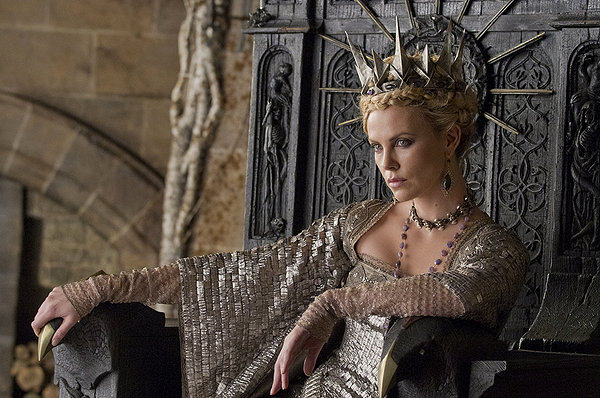 Snow White & the Huntsman falls victim to that age-old screenwriting curse of failing to show us its work. I get so sick of movies, or any narrative really, that heaps praise upon some person and then never shows us any convincing evidence. If somebody is said to be a great poet, I want to hear one of his or her great poems. If somebody is said to be a great leader, then I want to see him or her inspire. To make up for the plot shortcomings, the screenplay reminds us at every moment of downtime how special Snow White is, how glorious she is, how different she is, how she is the only one to bring down the tyrannical rule of Ravenna. At no point did I believe any of this. Just because I have characters tell me, ad naseum, that someone is special doesn’t make it so. I need to see the evidence, and from what Snow White has to show, it is not that impressive. She’s somewhat resourceful, escaping from captivity, but she’s not exactly a figure of compelling strength, magnetism, or inspiration. She gives one “rally the troops” speech that gets the townspeople all fired up to go to war; it’s no St. Crispin’s Day speech, but even if we’re grading on a curve, it’s a pretty weak motivational speech. There’s no reason these people would line up behind this displaced damsel other than the fact that the plot requires them to do so. This Snow lady has, much like the infamous Bella Swan, the personality of a dead plant, and all the proclamations to the contrary will not change that fact. Snow White is just not an interesting of compelling person, period.
There are two reasons why Stewart is completely wrong for this part. First off, when we’re objectively talking about one who is “fairest of them all,” and Charlize Theron is in your movie, you’re going to lose every time. I’m not saying Stewart is wretched looking; quite the contrary. Debut director Rupert Sanders finds ways to film her that make her look lush and vibrant. Some would argue “fairest of them all” is not in references to physical beauty, which it has always been, but to the fact that Snow’s heart is so pure and good. If that’s the case, that’s just stupid. Then why even make it Snow White if the nemesis to the evil queen is simply somebody who is morally just? You could have had a commoner play the role and that would have brought about more interesting class conflicts. Secondly, Stewart is such a modern era actress, someone who has so effectively channeled the rhythms of a blasé generation of young people, that dropping her into a medieval time period is jarring. She doesn’t fit. Everything about her aloof acting style screams modern times. Maybe that’s why her speaking is kept to a minimum. She can ride on horseback, dress in Joan of Arc armor, but she’ll never strike anyone as a fitting Epic Heroine. I feel that her acting has blended with the sullen nature of Bella Swan to the point that it’s hard to separate the two. I’m not a Stewart hater at all. I actually think she can be quite a capable actress (see: Speak, Adventureland, the upcoming adaptation of Kerouac’s On the Road) when paired with the proper material. Snow White & the Huntsman is not the proper material.
Aside from casting errors, this dark fairy tale doesn’t find any time to settle down and develop anything that could approximate characterization. Case in point: all we know about Snow is that she is a princess, everyone tells us how beautiful she has always been, she runs away, and then leads a rebellion, then she become queen (don’t pester me about spoilers). What else do we know about her? She’s defined entirely by outside forces, especially the charitable words of others. Snow White is not a character but a symbol, the prophetic Chosen One. She’s really a placeholder for every lazy archetype needed for epic fantasy. Stewart cannot connect with the material, so she seems to wander around, mouth agape, almost like she’s stumbling drunk through the whole movie. It seems that Snow White & the Huntsman just provides us the familiar elements of the story (evil stepmother, huntsman, dwarves) and expects us to fill in the rest with our own wealth of knowledge over the famous fairy tale. The rote insertion of a long-lost childhood friend/eventual love interest (Sam Claffin) is made tolerable only by the fact that he does not eventually become a love interest. This Snow doesn’t need a man, and good for her.
Sanders’ background in commercials definitely shows in his superb visual palate. The man knows how to frame a beautiful shot, and the visual highpoint is Snow’s hallucinogenic shamble through the Dark Forrest. Without the narrative traction, though, the movie starts to resemble one very long, very excruciating perfume ad, particularly when Snow comes across a white horse just laying down in the surf. Some of Sanders’ “ain’t nature great” creations deeper into the forest reminded me very strongly of Miyazaki’s Princess Mononoke, especially with the godly stag. Despite its considerable faults, Snow White & the Huntsman is a great looking movie. Sanders’ crisp visuals are further enhanced by wonderfully theatrical costumes from multiple Oscar-winner Colleen Atwood (expect another award on that mantle come 2013). Queen Ravenna has more eye-catching outfits than Cher in her heyday. They seem to be made out of interesting organic elements, like a gown accented with diminutive bird skulls. She may be a ruthless tyrant, but man does that lady know how to dress. The fashion choices became so exotic and intriguing that it provided another reason for me to hope we’d get more time with the queen. The production design by Dominic Watkins (United 93) is fittingly medieval. At least there’s always something nice to look at with this monotonous bore.
I don’t really get the geography of this kingdom. By all accounts, it looks like one poorly guarded castle, one poor mud town, and a deep expanse of forest. The fact that it’s labeled as the Dark Forrest seems shortsighted, since it takes a few hours continued walking to come across all sorts of other civilizations, including our scarred matriarchal society. And then there are dwarves too. It all feels so listless, lacking any sort of connective tissue to help round out this magical world. After a while, it just becomes an assortment of cool stuff just put into a movie because it’s cool. The fact that none of these magical creatures or assorted villagers ever pop back again, except for our coronation in the resolution, means they were meaningless to this story other than being a rest stop.
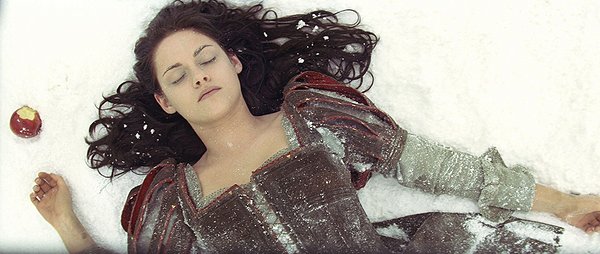 The screenplay is surprisingly rushed; rarely do we spend more than five minutes in any location. I was interested in a city of women with self-inflicted facial scars to protect themselves from Ravenna coming for them. Just as things start to get interesting, it’s like the movie gets antsy and has to keep moving, and we’re off again. It’s hard to work up any sort of emotional engagement for anyone when we just spend a few minutes with these characters. The brisk pacing also gives the impression that the characters really don’t matter in the end. If it weren’t for a scene where the Huntsman blatantly explains every feeling he has to a comatose Snow White, we’d know nothing about him. The Huntsman is grieving over the loss of his wife, and oh she just happens to have been killed by Ravenna’s creepy albino brother (Sam Spruell). The pigment-challenged dolt confesses this convenient bit of information at a strange time. Why confess to killing a man’s wife when you’re battling to the death? Confess afterwards. It’s another example of lame screenwriting and nascent characterization. Even the queen gets a bizarre throwaway bit of characterization. For whatever reason, we have a flashback to when she was a child and her mother forced her to drink the magic immortality elixir. Why did we see this? It’s too late to make her sympathetic. And yet, even this brief glimpse at Ravenna’s back-story makes her more interesting than our feckless Snow White.
The bleakly brilliant Young Adult renewed my fondness for Theron as an actress. For a while, she seems to really sink her teeth into the role, lapping up the villainy in a satisfyingly menacing manner. It’s at this lower level of burn, the quiet intensity, where Theron is most enjoyable. When the movie requires her to raise her voice is when things start to go bad. She shrieks in such a campy, over-the-top, weird overly enunciated style. Any hope of secretly enjoying this movie died with Theron’s stagy agitation. Hemsworth (The Avengers) adopts a thick Scottish brogue but does little else. At times I found that he looked remarkably like a cartoon tough guy; just something about his face lends itself to clean, burly definitions. The best actor in the movie is Bob Hoskins (Mrs. Henderson Presents) as a blind dwarf, and perhaps that sentence alone should say all that needs saying.
This film is more Lord of the Rings than fairy tale. It’s got some battles and some siege action to pacify the men folk, but this is obviously aimed at the ladies. It’s a feminist, Robin Hood-esque reworking of the Snow White tale, recasting the damsel as action heroine, and I’d have no problem with this revision if: 1) the film made her an actual character, 2) it had been played by anyone other than Kristen Stewart. It’s got all the familial elements but they have no context in this reworking; it lacks internal logic. If I did not have sufficient background knowledge about this tale, I’d be left wondering why any of this should make sense (apples are poisonous now?). At every turn, the movie has to tell us why things should matter rather than showing us. There’s no evidence onscreen why this Snow White lady deserves any fuss. Snow White & the Huntsman is a movie obsessed with appearance and precious little else. Snow White & the Huntsman is one boring, truculent, dreary chore of a movie that goes on far too long. Just because it’s darker doesn’t make it more mature or exciting. Fairest of them all, my ass.
Nate’s Grade: C


 nathanzoebl
You must be logged in to post a comment.