Blog Archives
Another Simple Favor (2025)
 The sly 2018 original was a tart breath of fresh air, chronicling a friendship between two moms, one of means and one of lesser means, that unraveled a conspiracy of death, lies, secret twins, ransom, and murder. It was an enjoyable diversion that was elevated by snappy banter, a combustible chemistry between Anna Kendrick and Blake Lively, and some dishy twists. I wasn’t expecting a sequel, but with the same director and principal cast returning, I was at least a little intrigued as to what they would cook up. Instead Another Simple Favor is a warmed-over retread of the original. This time we travel to scenic Italy where Emily (Lively) has been released from prison and is now marrying a wealthy Mafia scion and wants Stephanie (Kendrick), her old frenemy, to be her maid of honor. At its best, the sequel has glimmers of the spiky fun of its predecessor thanks to the serviceably witty banter and ongoing fun between its lead actresses. Mostly, it’s a tangled mess chasing after what made the original entertaining and adult. I can pretend I fully understood the plot with its assault of soapy revelations, character intersections, and convoluted machinations, but that would be a lie. There are times where the movie feels like an overburdened runaway “yes and…” improv game, where anything and anything is accepted and absorbed into the script. I wonder if every additional movie is just going to add more versions of a certain character. If you’re a fan of the 2018 original there might be enough here to prove fleetingly engaging, like the fabulous villas and extravagant costumes, but mostly Another Simple Favor doesn’t feel like it’s doing anyone a real favor.
Nate’s Grade: C+
Share this:

The Monkey (2025)
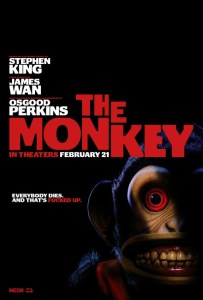 It was only minutes when I thought to myself, “I think I love this movie.” To be fair, this movie might only jibe for a very select few with a penchant for gory, outlandish horror and a demented sense of humor, but it just so happens that specific population includes yours truly. The Monkey is a dark comedy about the cruel indifference of fate disguised as a supernatural thriller adaptation of a Stephen King short story. It’s about two twin brothers (both played by Theo James as an adult) coming to terms with a family curse, a toy monkey that, when wound up, will beat its drum until the final blow correlates with the sudden, often shocking death of a random person. It’s essentially a death device and the brothers are haunted by it since losing both of their parents to it as teenagers, both grasping for meaning from their tragedy. One of them blames himself and the other blames his brother, and this has warped them into adulthood and how they view themselves, their responsibility as a parent, and their hostility to one another. The movie becomes a cagey reunion between the two brothers while also vying for power over a dangerous totem that loves elaborate Final Destination-style calamities. These deaths are over-the-top, often with bodies exploding in bloody heaps, and I found myself cackling along in response to the ridiculous violence. This is quite a change of pace for writer/director Osgood Perkins who just last year helmed the Satanic serial killer thriller Longlegs. Whereas that movie was a bit too lost in its slow-build atmosphere and a jumbled story burdened with underdeveloped plot elements, The Monkey is refreshingly straightforward and always entertaining in its contained madness. There are some bold and dark choices made and I appreciated every one of them. This is really a movie about trying to make sense of death and grief but it’s through the visage of spilled viscera and gallows humor. I didn’t think I’d walk away saying this, but I can’t wait to show my wife the movie about the killer windup monkey.
Nate’s Grade: A-
Share this:

Nightbitch (2024)
 Motherhood can be a real bitch, right? That’s the lessons for Nightbitch, a bizarre movie that juggles high-concepts and tones like a struggling new mother juggling time. Based on the novel by Rachel Yoder, Amy Adams plays Mother (yes, that’s how she’s credited), an artist who chose to become a stay-at-home mother to her two-year-old son, and her life has become an endless stream of days appeasing a small tyrant who she also unconditionally loves. Early on, Adams uncorks an imaginary monologue about demystifying the glamour of motherhood and the guilt she feels about not finding every tantrum and bowel movement a thing of bronze-worthy beauty. She’s grappling with significant changes, and that’s even before she thinks she’s turning into a dog. I can find thematic connection with motherhood and body horror, as our protagonist feels that she no longer recognizes her body, that she feels a lack of direction and agency in a life that no longer feels hers. The added body horror of transformation makes sense, but this element seems so extraneous that I wished the movie had exorcised it and simply stuck with its unsparing examination of parenthood. You would think a woman believing she is becoming a dog would dominate her life. The ultimate life lessons of the movie are rather trite: assert yourself, establish a balance to have it all, and fellas, did you know that being a stay-at-home parent is actually hard work? There are too many half-formed elements and plot turns that don’t feel better integrated, like flashbacks interwoven with Mother’s mother, not credited as “Grandmother,” as a repressed Mennonite in a closed community who disappeared for stretches. There’s also a few curious reveals relating to Mother’s perception of others that are unnecessary and obtusely mysterious for no real added value (“Why that library book died forty years ago….”). Adams is blameless and impressively throws herself into the demanding roll, going full canine with gusto as she trots on all fours and eats out of bowls. The problem is that all the dog material feels a little too silly when realized in a visual medium rather than a symbol of freedom and rebellion. Nightbitch is more bark than bite, and I’d advise viewers looking for an unflinching portrayal of motherhood to watch Tully instead and, if desired, pet your household dog at home to replicate Nightbbitch but better.
Nate’s Grade: C
Share this:

Kinds of Kindness (2024)
Yorgos Lanthimos might be one of the strangest filmmakers ever to fall into favor with the Oscars. Hot off the critical and commercial success of 2023’s Poor Things, we have a new Lanthimos joint not even six months later. This is a collaboration between his Greek co-writer from The Lobster and The Killing of a Sacred Deer, arguably the less “mainstream” Lanthimos movies. This movie is an anthology of three stories with the same actors playing different roles in each story. The problem is that I didn’t engage with any of the stories and found them long, meandering, and poorly paced. That Lanthimos specialty is a cracked-mirror version of the world, mixing the bizarre as if it were mundane, and it’s a trying tonal tightrope for most thespians to excel within that space. There just isn’t enough here, and each new story feels like starting over rather than fulfilling a conclusion. The prior Lanthimos movies had an interesting premise or turn of events that could sustain a whole movie; Kinds of Kindness doesn’t have stories that can sustain three vignettes. I can take weird, alienating, and challenging Lanthimos, as I’ve been a fan ever since his Dogtooth debut, but this is easily his weakest movie yet. The actors all do credible work having distaff conversations in, what appears like, people’s palatial homes and doctor offices. It’s hard to glean a larger theme, point of view, or even general entertainment value with this dull entry. It feels like Lanthimos and his collaborators had a couple free weekends, the use of some rich friends’ homes, and said, “Well, we’ll make it an anthology because then we don’t have to compose a full movie.” Instead of one disappointing movie, now you get three. Kinds of Kindness is, worst of all, mostly forgettable, and given Lanthimos’ track record, that really is the biggest sin possible.
Nate’s Grade: C
Share this:

Wolfs (2024)
 George Clooney and Brad Pitt star as rival fixers, unscrupulous men the rich and powerful call upon to clean up the messes of the rich and powerful, as Clooney portrayed in 2007’s Michael Clayton. It’s clearly playing upon the movie world depiction of these kinds of characters, whose titular name comes from the famous Pulp Fiction fixer played by Harvey Keitel. I don’t know what writer/director Jon Watts (Cop Car, Spider-Man: No Way Home) wanted to say or even achieve once he brings these two bickering and aging alphas together on-screen. The first ten minutes is played completely straight, as the drama of a high-powered woman in peril (Amy Ryan) leads to dueling fixers with different bosses being put in charge of disposing of a body and returning stacks of ill-gotten goods. You might assume with this premise that the movie will be a cantankerous buddy movie, with the professionals trying to measure their competition over the course of one long hectic night. It plays with this professional rivalry for a while, but then Wolfs gets bogged down by mafia wars, double crosses, and convoluted conspiracies the fixers are trying to untangle while bringing on an unexpected third wheel to the night of shenanigans. The plot gets easily lost, and the comedy feels lacking and underwritten, relying upon the star power of its leads to serve some kind of ironic undercurrent of energy. I kept thinking to myself that this premise, with these actors, should be a lot more fun. By the end, it feels almost like a setup for a wacky TV series for further adventures, but if this is the level of entertainment we’re getting from this pairing, let the old men die off-screen, thank you.
Nate’s Grade: C+
Share this:

Abigail (2024)
 Abigail feels very much like a spiritual sister for 2019’s Ready or Not, as it is a follow-up from the same writers and directors. It’s a bloody, funny movie about a hunt in a big mansion with a heroine who is battling against supernatural forces over the course of one long hellish night. We have a team of thieves kidnapping the young daughter of a man with money and having to hold her overnight. They don’t know one another and there’s an initial bristle to their discovery, like when an ex-police detective (Dan Stevens) and a recovering addict (Melissa Berrera) have equal measure not to trust one another. Things get worse when it’s revealed that their hostage, the titular Abigail (Alisha Weir), is not what she seems, a fact spoiled in the trailer. What follows is a topsy-turvy game of cat and mouse with some effective creepy moments and some lively humor without losing sight of the escalating stakes as well as the acclimation of new rules. The acting ensemble is highly enjoyable, particularly Stevens as a scuzzy authority figure, Kevin Durand as a himbo with an emotional core, and Weir, who has tremendous range to pull off the changes her character goes through. It’s not as fulfilling and finely developed as Ready or Not, one of 2019’s best films and one of the best endings to a movie ever, but Abigail is a first-rate bloody B-movie that might not hit as high but still satisfies.
Nate’s Grade: B
Share this:

Poor Things (2023)
 Poor Things is going to be a lot to many people. It is a lot, and that’s kind of the larger message because ultimately, for all its peculiarities and perversions, the movie is also an inspiring fable about living one’s life to the fullest and embracing the choices that make us happy and content. It’s a feminist Frankenstein allegory as well as an invitation to see the world with new eyes and a fresh perspective, to embrace the same hunger for a life that defines the journey of Bella Baxter from woman to child to woman again. Under the unique care of director Yorgos Lanthimos and screenwriter Terry McNamara (reuniting after 2018’s triumphant and irreverent The Favourite), Poor Things proves to be an invigorating drama, a hilarious comedy, a stunning visual experience, and one of the year’s finest films.
Bella (Emma Stone) lives a life of solitude with her caregiver, a brilliant but disfigured surgeon named Dr. Godwin Baxter (Willem Defoe), who Bella refers to as “God,” and for good reason. Bella is herself one of the doctor’s experiments. Her body belongs to an adult woman of a different name who killed herself. Her mind belongs to the baby that had lived through its mother’s suicide. “God” resuscitated the body of the mother by giving her the brain of her child. She’s curious and defiant and soon yearns for independence and discovering the outside world. A caddish lawyer, Duncan Wedderburn (Mark Ruffalo), is drawn to Bella and offers to take her on a grand adventure to parts of the world. She agrees, and from there Bella gets an education on the plentiful pleasures and pains and puzzles of being a human being. In many ways, Poor Things serves as a fish-out-of-water fairy tale that invites the audience to question and analyze the Way Things Are. Bella’s childlike perspective allows her to strip away the assumptions of adulthood and the cynicism of disappointment. Everything is new and potentially exciting, but she can also cut through the cultural hang-ups and repressive rules of polite Victorian society. This is expressed perhaps most memorably in her embrace of sexuality and the pursuit of physical pleasure. She’s told not to seek out this pleasure except for very specific settings and situations, and this confounds her. Why aren’t people doing this all the time, she asks after an extensive session of vigorous sexual activity. She is a person incapable of shame during a modest time of conditioned shame. This brashly hedonistic reality might prove too morally demented for many viewers uncomfortable with the premise. In context, it is a grown woman’s body being operated by the mind of a child. We are told that she grows and matures as she accumulates her worldly experiences, but the movie keeps it purposely vague how analogous her brain-age might be and whether that maturation is of a pace with traditional aging. It’s a reverse of 1979’s The Tin Drum, a German movie where a child refuses to grow up once he hears the drudgery of the adult world, and so he remains three years old in appearance but continues maturing intellectually and emotionally. There’s a cliche about looking at the world with a child’s unassuming eyes, and that doesn’t necessarily mean only looking at the things that are safe and appropriate for children.
Bella responds with wonder to the many pleasures of being human, but, sadly, it’s not all puff pastries and orgasms. The world is also filled with horrors and injustices, and Bella’s personal journey of discovery is also one discovering the human capacity for cruelty and selfishness. Some of this is a response to Bella wanting to assert herself and independence, as she very reasonably doesn’t understand why all these men get to tell her what to do or expect that they should. At one point, Duncan literally hurls her books into the sea so that she will not continue educating herself. This extends to later in the movie when Bella looks at prostitution in a Parisian brothel as a means of earning a living. Her same sexual appetites, that were enthusiastically encouraged by Duncan, are now paradoxically looked at by the same man as wicked. Absent riches, Bella is treated as a disposable commodity and she’s trying to make sense of why one version of her receives respect and adoration and another version is looked with disgust. It seems that an essential part of maturation is acknowledging the faults of this world and its entrenched systems of thought, but does giving in to these systems make one more human or merely more cynical? Is it a matter of learning or is it a matter of giving up on changing the status quo? These are many of the questions that the movie inspires as we join Bella on her fantastic journey of self-discovery. This movie would not work nearly as well without the fearless performance from Stone (Cruella). She gives everything of herself for this role and rewires the very movements of her body to better portray such a unique elding of a character at so many crossroads. Her early physicality is gangly like she’s learning how to operate this adult body of hers that appears too ungainly, and her expressions are without restraint, as if she’s peeled back every acting impulse to instead find a purity of perception. There is a transparent and transcendent joy in her performance as well as an ache when Bella discovers the awful shortcomings of this world. Lanthimos movies exist in a different world than ours, a cracked mirror universe of deadpan detachment and casual cruelty, so it requires a commitment to a very specific tone of performance. And yet, the requirements of this role work against that Lanthimos model of acting because Bella cannot be detached from this world. As a result, there is the same matter-of-fact reaction to the world but channeled through an idealistic innocence rather than the sarcastic skepticism that can dominate the director’s oeuvre.
The supporting cast contributes wonderfully. Dafoe (The Lighthouse) is a natural at being a weirdo, but he exhibits a paternal love for his creation that is surprisingly earnest. I laughed every time he went into one of his extended wails when he was disconnecting himself from a machine to handle his bodily gasses. Ruffalo (The Adam Project) is devilishly amusing as he abandons all pretense of likeability to play a deeply manipulative but fascinating louse, a character that is almost as transparent about his desires as Bella. His faux elitism is a constant source of comedy. Kathryn Hunter (The Tragedy of Macbeth) has a memorable and sinister turn as the brothel madame who teaches Bella about the nature of capitalism and socialism. Christopher Abbott (Black Bear) appears late as a privileged man from Bella’s past reappearing with his own demands, and his is the most terrifying portrait in the entire wacky movie, an antagonist that’s all too real and scary in a movie given to such brilliantly quixotic flights of fancy.  Under Lanthimos’ direction, the movie presents the world as an awesome discovery and the lurches into the surreal allow the viewers to see the marvels of existence with the same awe as Bella. The movie feels like it takes place in a science fiction universe of crazy visuals and the avant garde incorporation of past, present, and future. It makes every scene something to behold. This is his most visually decadent film of his career. The musical score by Jerskin Fendrix, a first-time film composer, and it works on a thematic level as trying to discover new kinds of sounds along with the journey of its heroine. However, there are sequences where the music feels like an assault on your ears. While intentional, the detours into abrasive dissonance can make one long for something less experimental and more traditional at least for the sake of your own sensitive eardrums.
Life can be decadent, it can be confusing, it can be ridiculous, it can be heartbreaking, it can be terrifying, but it’s an experience worth savoring and embracing, and this ultimately is the message of Poor Things. Stone is brilliant as she confidently carries us along for every moment of an exploration of what it means to be human, and with an ending that is so fitting and satisfying that I wanted to stand and applaud. For those squeamish from the heavy amounts of sexuality, Poor Things is at its core a very pro-life movie. It’s an inspiration to make you think one minute while making you snort laughing the next. May we all see the world with the voracious hunger and curiosity and boldness of Bella Baxter with her second chance at this one life.
Nate’s Grade: A
Share this:

Beau is Afraid (2023)
 Beau is Afraid is a ramshackle mess of a movie, and that is both the highest compliment and an indictment on its tremendous excess and lack of focus. It’s Ari Aster’s big swing after his modest successes in elevated horror (Hereditary, Midsommar), so the indie maven studio A24 gave him a thirty-million budget and three hours and full artistic reign to do whatever he wanted, and love it or hate it, one has to objectively admit, Aster really went for something all right. I’m still deliberating where that final something falls on the artistic merit equation. There’s undeniable ambition and artistry here, but there’s also so many ideas and moments and bloat, it genuinely reminded me of 2007’s Southland Tales (did your stomach just drop, dear reader?). It’s because both movies are stuffed to the brim with their director’s assorted odd ideas and concepts, as if either man was afraid they were never going to make another movie again and had to awkwardly squeeze in everything they ever wanted into one overburdened project (in Richard Kelly’s case his suspicion might have been correct, as he did only direct one more feature -so far). While I certainly enjoyed -if that is the right word- Aster’s movie more, Beau is Afraid is not an easy movie to love, or enjoy, or even simply sit through, and not just because of its bloated time.
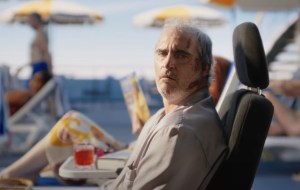 If I had to boil down this sprawling movie into one easy-to-digest concept, it’s about Jewish guilt. If you’re not a fan of feeling uncomfortable or anxious from the intensity of a movie, I would skip this one entirely. Beau (Joaquin Phoenix) might as well be a stand-in for the biblical figure of Job for all the cruel punishments and indignities he endures. Just when you think, “Well, it can’t get any worse,” Aster rolls up his sleeves and rises to the challenge and makes things even worse for his pathetic put-upon plebeian. This is a movie of escalating discomfort, chiefly meant to convey the constant state of anxiety that is Beau’s daily existence, and for the first hour or so, Aster works marvelously at making you squirm. It’s a movie less meant to reflect our objective reality and more a projection of one man’s anxious feelings and paranoia, the unsettling urge that everyone secretly hates you and something bad is always ready to lethally strike.
Beau is Afraid is an absurdist comedy of heightened almost screwball proportions, with Beau becoming increasingly frazzled and muttering “Oh no” hundreds of times as fate has it out for him. Small worries become all-consuming, like the simple task of trying to get water to swallow his new prescription medication, and how this eventually spirals to the ransacking of his apartment building, which is also all Beau’s fault, inadvertently, though that won’t mitigate the guilt. There are numerous fears and worries amplified to breaking points, inviting morbid chuckles and nervous titters. Beau sits in his bathtub to stare at an unknown man squeezed against the walls of his ceiling and about to slip and fall. Why is this man there? Why does Beau not immediately leap out of the tub? Why do both men remain fixed in their positions until the inevitable? It’s because it’s a ridiculous paranoid fear manifested into a ridiculous scenario made even more ridiculous. It’s the same with ignoring his mother’s calls only to have a stranger answer her phone to inform Beau that she has been killed and happens to be without a head now. It’s a realistic fear, avoiding phone calls and the draining emotional energy required to answer, and following it up with a consequence of darkly absurdist proportions to make him feel even worse. The movie leaps from one squirm-inducing, grueling sequence to the next, testing your limits and patience. There’s a post-coital revelation debunking, and then confirming, an outlandish worry that made me laugh out loud with tremendous auditory force. What else could I do? It certainly feels like Aster is inviting the audience to laugh at Beau’s pain and tragedy because what other human response can there be but to laugh in the face of unrelenting torment?
 Where the movie loses momentum is about halfway through, after Aster has established the drive of the movie, Beau’s attempts to get to his mother’s funeral so they can finally bury her. Every hour he is delayed, Beau is reminded that his mother’s body is rapidly decaying and only furthering her “humiliation” at the hands of Beau’s inaction. The second part of the movie involves Beau recovering from injuries in an upper class family’s home, the same family (Nathan Lane, Amy Ryan) that accidentally ran him over and is now kind of holding him hostage against his weakened will. We have an urgent goal, we have obstacles keeping him from that goal, and this is where the movie continues to work, as each new attempt to escape only confirms how much stranger and dangerous this family unit is. This dynamic plays into the established heightened fears and absurdist complications. It’s keeping him from his goal. But when he does eventually free himself from this hostage scenario, he literally wanders into the woods and discovers a troupe of thespians that refer to themselves as the Orphans of the Forest, and then a theatrical production may or may not present the rest of Beau’s natural life. This was where the movie’s momentum, which had steadily been ratcheting up along with the dark comedy, began to flag, and when I started to worry, then suspect, then confirm my sinking feeling that this all isn’t going to add up to something more cohesive and thought-provoking. It’s really more a movie of sustained memorable moments and unpredictable, tone-shattering twists and turns. Beau is Afraid is unpredictable, and that both works as an asset and eventually as a handicap. That’s because every scene is hammering the same overall thematic point just with a different stylistic arrangement of fears and anxiety. Following this redundant framework, a 130-minute version of this movie world would feasibly have the same thematic impact as the 180-minute version, merely eliminating some of the many detours.
Another nagging aspect of the movie that failed to add up to much more for me was how little Beau seems to matter in his own story. He’s more intended to be the universe’s lone fall guy rather than a person, a victim whose chief characterization is his ongoing victimization. He suffers and that is his identity. Considering the movie is more a loose fable, this can work since Beau is essentially a stand-in for all of humanity, but there are more personal aspects of him worth exploring in finer detail. The toxic relationship with his mother is worthy of further examination, especially the decades of emotional manipulation to ensure Beau would never replace her with another woman. I wish Aster had devoted more of his 180-minute run time to exploring Beau as a person rather than pitting him against a proverbial assembly line of pies to the face. Phoenix (Joker) has so little to do here except stare wide-eyed, helpless, and mumble as the world constantly befuddles and antagonizes him. It’s a performance purely of pained reaction.
 Can I recommend Beau is Afraid? For most viewers, probably not. It’s too long, too sporadic, and doesn’t come to anything cohesive or cumulative or even meaningful beyond a mean-spirited sense of pessimism directed at our titular human punching bag. It’s wildly ambitious and off-putting and bloated and outlandish and the kind of big artistic swing that artists usually only get so rarely in their careers. And yet I have to admire the sheer gusto of Aster making a movie this strange and alienating, a movie that’s constantly altering its very landscape of possibilities, usually to the detriment of Beau’s physical and mental well-being. It is an exhausting experience, so that when the end finally arrives, we, much like Beau, are simply ready to accept the finality we’ve been waiting for after so much abuse. There are moments throughout these ungainly 180 minutes that are sheer brilliance, and sequences that are sheer torture, some of which are on purpose. There’s also just way too much of everything, and without variance or finer exploration of its themes and specific characterization, it becomes a cosmic game of whack-a-mole where you might be the one actually getting hit over the head, and after so long I can’t blame anyone for not enjoying the prolonged experience.
Nate’s Grade: B-
Share this:

Saltburn (2023)
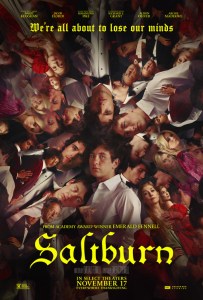
Promising Young Woman was easily one of my favorite films of 2020. It used the structure of a rape-revenge genre movie to tell a hard-hitting drama and pitch-black comedy. Writer/director Emerald Fennell was nominated for Best Director and won the Oscar for Best Original Screenplay, so I wasn’t alone in singing her praises (my critics group declared it the top film of 2020, huzzah). It was, in short, pastiche elevated into something jarring and relevant and daring. With her follow-up Saltburn, she has taken the British class drama of an outsider trying to fake their way in the world of the rich and powerful, a Vanity Fair or Brideshead Revisited if you will, and attached a whole lot of salacious campy nonsense. If Promising Young Woman was elevating a trashy genre movie with vision and daring, then Saltburn is taking the soapy costume drama and degrading it with cheap shock, and “degrade” is quite the appropriate term.
Oliver Quick (Barry Keoghan) is a young Oxford student who doesn’t quite fit in with his peers. He doesn’t come from money and instead from a broken home, but he’s set his sights on success, and that includes winning over the handsome Felix Catton (Jacob Elordi). He’s popular and athletic and from a rich family, and Felix takes a liking to Oliver, even defending him against his posh peers. Oliver is infatuated with Felix and convinced that he’s in love. After a personal tragedy, Felix invites Oliver to summer at Saltburn, his family’s enormous private estate in the country. Oliver amuses Felix’s parents (Richard E. Grant, Rosamund Pike) and sister (Alison Oliver) and settles into the black-tie dinners and racchous parties. He might not ever want to leave, and he might not be able to leave, and he might not ever want to be able to leave.

Saltburn is like if The Talented Mr. Ripley was made by the auteur of tawdry trash Larry Clark (Kids, Bully). It’s trashy nouveau camp that works as a sour class comedy until it becomes too sour and most definitely doesn’t work as any sort of engaging character piece or legitimate thriller. I don’t really know what Fernell was going for here and it doesn’t feel like she does either. I think back on the similar tale of Mr. Ripley as an advantageous upstart who got a taste of the good life and didn’t want to give it up. Like Saltburn, we know about our lead’s duplicitous and untrustworthy nature early, but with that movie we could see why others could be charmed by Tom Ripley, and we understood why he would want to stay in this privileged life. With Saltburn, when the rich are treated as shallow twits practically bored with one another from their opulence, the question remains what exactly is the appeal beyond simply attaining more? Also, the appeal of watching con artists slip into a world not their own includes seeing how they will get away with everything, how they’ll cleverly avoid all the traps that materialize. With Saltburn, there is no thrill of clever escapes because the insidious force is obvious and the other characters are too stupid to recognize because they’re meant to be satirical send-ups. It’s a would-be thriller that has gutted all its thrills by eliminating a foreboding sense of consequences.
However, the movie cannot work because all of the surprises were alleviated through poor character development of Oliver and in the performance of Keoghan. I don’t think anyone who ever watches this movie will be even the slightest surprised that Oliver isn’t quite the noble and honest young coed that he may have appeared to be. Except after maybe a couple of early scenes of nerdy awkwardness, Oliver has been depicted as an obvious predator. From the beginning, as he’s sharing his sad family back-story, I was already shaking my head in skepticism and predicting that the truth would be something ordinary and boring that he would choose to cover-up. It’s just too obvious where this scheming, covetous character is going, and Fennell doesn’t do anything to counter this overwhelming and, again, transparent assessment. If you have a character acting all weird and shifty and literally slurping up spent bathwater belonging to the target of his obsession, you shouldn’t then make the later machinations a big reveal. I wanted to laugh that Fennell thought the audience would need flashbacks to better clarify Oliver’s scheming nature behind a series of tragic events. I always assumed it was him because who else would it be? It’s an obsessive young man with oblique and yet obvious motivation to have what he desires from the privileged. We get it. The problem is that the movie never really better examines this desire from his outsider status. We already know he’s the malignant force.

Keoghan is a great actor but “naif” is not a comfortable role for the man. By his casting alone, you’re already looking at Oliver with measured distance and scrutiny. He’s already got a leer that will set people ill at ease. The way the character is written only further confirms this judgment. If Tom Ripley was acting this outlandishly bizarre and creepy from the get-go then he would have been arrested immediately. It’s not even a lack of nuance that hurts Oliver. Not all villains and screen psychos require a full three dimensions, but the characterization is just so lazy and unexplored. He’s just a font of unchecked lust. At least in 2017’s Killing of a Sacred Deer, where Keoghan also played a malevolent young man tearing apart a family unit, his character was meant to have a mythic quality of inescapable retribution, like the Greek tragedy its title was in reference to. With Saltburn, he’s just a creepy perv, but he’s also a boring and redundant creepy perv by the ongoing refusal to provide other context. He’s less a character than a proverbial set of hands to prod characters and poke the viewer in the eye. He’s a recycled program of tedious provocation.
Given how masterfully Fennell utilized and subverted salacious elements in Promising Young Woman, I’m shocked there wasn’t much more than empty shock value. Whatever intended satirical value of this movie is glancing and fleeting. Did you know rich people can be, wait for this, superficial? Saltburn becomes a gross-out game of how far this daft creeper will go with his deadly obsessions, and on that front it all feels too annoyingly flimsy, constructed merely to be transgressive for its own provocative sake. Watching the lengths Oliver will go to prove his disturbing bonafides, it overwhelms the movie and simply becomes the movie’s purpose itself, a measurement between how far Fennell can repulse you before you reach a breaking point. It’s not merely that the characters are easy jokes, it’s that they’re bad jokes. I will say though that the ending shot is so joyously performed that I wish the rest of the movie had this kind of entertainment.
I do think there is an audience for Saltburn, the kind of people who celebrate Harmony Korine’s art-trash movies (Gummo, Spring Breakers), the kind of people who love candy-colored stylistic excess and tongue-in-cheek provocations, and people that seek out twisted love stories and dark romances. Satburn styles itself as a romance, at least early, but it’s clear that there’s nothing romantic about watching a predator set his sights on his prey and work through the family. Sadly, there’s also nothing truly entertaining here either, other than wondering when the next extreme yet desperate attempt at shock value would appear. The characters are too thin and unexplored to support this movie, and the antagonist is too obvious, as are his machinations, though his motivation remains cloudy and also undeveloped. This movie would be akin to watching a bad flu work its way through a family for all the personality Oliver offers. Fennell is a talented storyteller and exceptional at spinning genre pastiche into something so much more, so it’s quite disappointing that Saltburn is so much less than even the sum of its sundry parts.
Nate’s Grade: C
Share this:

Cocaine Bear (2023)
 If you’re going to watch one movie with a cocaine-addled ursine killing-machine, it might as well be Cocaine Bear. In a lot of ways, this movie reminds me of Snakes on a Plane, a similarly deadly animal thriller sold on its bizarre concept and the promise of ironic entertainment, and both of the movies creatively peaked before anyone saw the movie. The true story is that in the 1980s, a drug-running plane dropped shipments of cocaine in Tennessee wilderness and a bear came across some cocaine, ate it, and died. The movie asks, “What if it became a coked-out slasher killer?” I wanted this movie to be more fun than it is, and I think the crux of my disappointment stems from the movie working one obvious joke into utter oblivion. The absurdity of a bear being high on drugs is about all you’ll get through 90 minutes. There are characters and subplots that you won’t care about, nor find terribly funny despite having Keri Russell, Alden Ehreneich, Brooklynn Prince, Kristofer Hivju, Isiah Whitlock Jr., Margo Martindale, and the final performance from the late Ray Liotta. It’s a lot of people, staring agog and saying, “A bear can’t do that,” and then we watch the bear do exactly that. There’s some impressive gore at turns and the CGI bear is workable for this kind of budget. The shame of it is too much just isn’t that funny. The movie is too content to rest upon its arch premise without adding enough additional comedy development to actively engage. If you’ve seen the trailer, you’ve seen the movie. This movie needed to be funnier, darker, weirder, or just anything in addition to the simple premise of a bear high on drugs and running a rampage. Is the joke ultimately on me for expecting more from a movie called Cocaine Bear?
Nate’s Grade: C


 nathanzoebl
You must be logged in to post a comment.