Blog Archives
Gangs of New York (2002) [Review Re-View]
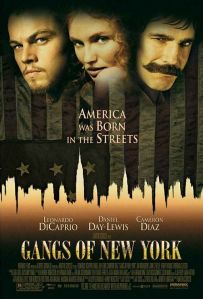 Originally released December 20, 2002:
Watching Martin Scorsese’s long-in-the-making Gangs of New York is like watching a 12-round bout between two weary and staggering prize fighters. You witness the onslaught of blows, see the momentum change several times, and in the end can’t really tell which fighter is victorious. This is the experience of watching Gangs of New York, and the two fighters are called “Ambitions” and “Flaws.”
The film begins in the Five Points district of 1840s New York among a vivid gang war over turf. Amsterdam (Leonardo DiCaprio) witnesses the slaying of his father, Priest Vallon (Liam Neeson), at the blade of William “Bill the Butcher” Cutting (Daniel Day-Lewis) and his “Native” Americans gang. So what does this son of a dead preacher-man do? Well he grows up, plots revenge by making a name under the wing of the Butcher becoming like a surrogate son. But will vengeance consume him?
 Watch Leo DiCaprio assemble toughs, rake heels, and ne’er do wells to his Irish gang of rapscallions with facial hair that looks to be tweezed! Witness a one-dimensional Leo suck the life out of the film like a black hole! See Leo become the least frightening gangster since Fredo. Watch the horribly miscast Cameron Diaz play pin-the-tail-on-an-accent! Witness as she tries to play a pickpocket with a heart of gold that falls hopelessly and illogically in love with Leo! Marvel how someone looking like Diaz would exist in a mangy slum! See the brilliant Daniel Day-Lewis upstage our stupid hero and steal every scene he inhabits! Witness one of the greatest villains in the last decade of movies! Watch Day-Lewis almost single-handedly compensate for the film’s flaws with his virtuoso performance! Admire his stove-top hat and handlebar mustache!
Witness a wonderful supporting cast including John C. Reilly, Jim Broadbent and Brendan Gleeson! Wish that they had more screen time to work with! Wonder to yourself why in all good graces this film took nearly two years of delays to get out! Speculate away!
Gangs has the sharp aroma of a film heavily interfered with by its producers. The whole exercise feels like Scorsese being compromised. Gangs is a meticulous recreation of 1860s New York that often evokes an epic sense of awe. The story has more resonance when it flashes to small yet tasty historical asides, like the dueling fire houses and the Draft Riots. But all of these interesting tidbits get pushed aside for our pedantic revenge storyline with Leo front and center. You know the producers wanted a more commercial storyline, which probably explains why Diaz has anything to do with this.
 The script is credited to longtime Scorsese collaborator Jay Cocks, Steven Zallian (Academy Award winner for Schindler’’s List) and Kenneth Lonergan (Academy award nominee for You Can Count on Me). So with all these writing credentials, don’t you think one of them would realize all of the dumb things going on with the story? The ending is also very anticlimactic and ham-fisted. Just watch as we segue from a graveyard to present day New York, all thanks to the Irish rockers of U2!
I know this much, Day-Lewis needs to stop cobbling shoes and act more often. Gangs is his first visit to the big screen since 1997’’s The Boxer. He spent part of this hiatus in Italy actually making shoes. I don’’t know about everyone else but this man has too much talent to only be acting once every five years. Somebody buy his shoes and get him a script, post haste!
Scorsese’s Gangs of New York is at times sprawling with entertainment in its historic vision and at other times is infuriating, always dragging behind it a ball and chain called “stupid revenge story/love story.” I’’m sure the film will get plenty of awards and Oscar nods in prominent categories, and this seems like the Academy’’s familiar plan: ignore a brilliant artist for the majority of their career and then finally reward them late for one of their lesser films. So here’’s hoping Scorsese wins the Oscar he deserved for Raging Bull and Goodfellas.
Nate’s Grade: C+
——————————————————
WRITER REFLECTIONS 20 YEARS LATER
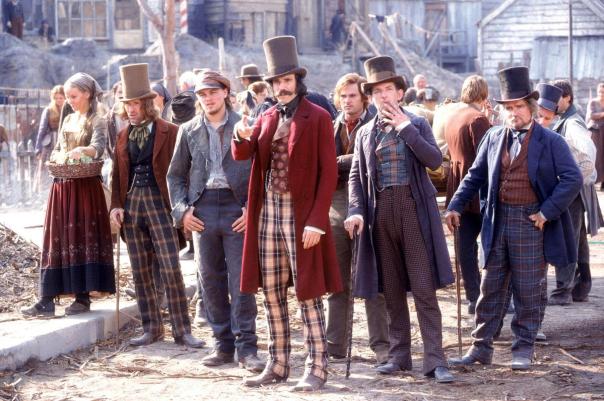
It is rare to find a movie that is almost exact in its percentage of good aspects and poor aspects. This 50/50 balance is best exemplified by 2002’s Gangs of New York. The ten-time Oscar nominated movie (and zero-time winner) was intended to be director Martin Scorsese’s epic, and twenty years later it’s still his biggest movie in size. Scorsese waited twenty years to tell this sprawling story of New York City’s early criminal underworld, so at 160 unwieldy minutes it’s no surprise how overstuffed and unfocused the finished product ended up. It’s a movie with so many engrossing historical anecdotes, amazing texture and supporting actors, and a stunning return to upper-tier acting by Daniel Day-Lewis, and yet it is hampered by Leonardo DiCaprio’s lackluster storylines, both for vengeance and for love (maybe a love of vengeance?). It’s so bizarre to watch this movie because there can be sequences where the movie just excels, and then there are sequences where I just want to sigh deeply. It’s like the movie is in conflict with itself, and you, the viewer, are ultimately the frustrated victim.
Let’s focus on the good first. Day-Lewis had essentially retired from acting and went to work in Italy as a cobbler until Scorsese appealed to him to reconsider acting. Every second this man is onscreen deserves your utmost attention. DiCaprio was the advertised star of the movie but Day-Lewis was the real star. The movie is almost a Trojan horse of sorts, luring you in with a standard revenge plot line only for you to lose all interest and root for the charismatic villain. Day-Lewis is so enthralling, so commanding as Bill the Butcher that every moment he is absent feels like an eternity. He remained in character for the duration of the shoot, spooking waitresses, and learned how to throw knives from circus performers and how to cut meat from an actual butcher. Considering the man’s famous Method-acting approach, I wonder just how many skills Day-Lewis has acquired over decades. This man could be the living embodiment of Michelle Yeoh’s character in Everything Everywhere All at Once, able to, at a moment’s notice, tap into a uniquely honed skill-set upon need. I wish that itself was a movie; Day-Lewis filming a role when terrorists invade the set, and now he has to utilize every lesson and skill of his past acting roles to defeat the baddies and save the day. He may be the most interesting man in the world. Since Gangs, Day-Lewis has only appeared in five other movies, and amazingly he has been nominated for Best Actor three times, winning twice (that averages an Oscar every 2.5 movie roles). This man has become like an acting Halley’s Comet, waiting for him to swing around again and burn brightly and then, just as suddenly, pass back into the lengthy waiting period.
I loved the historical asides in this movie. I loved the scene showing, in one unbroken take, Irish immigrants stepping off the boat into New York harbor and getting immediately signed into service, given a rifle and uniform, and lined up to board another boat to fight the Confederacy. I loved the entire character of Boss Tweed (Jim Broadbent) and how transparently corrupt he is, reminding me of Claude Rains in Casablanca. I loved him competing with the dozens of other firefighting units squabbling over turf while a house burned down to cinders. I loved him scrambling for some entertainment for the masses, and he asks Bill to gather up four nobodies that they can publicly hang, and then we cut right to these relatively innocent men saying their last words before being hanged, including one man’s young son watching. It’s an incredible sequence. The culmination of the 1863 Draft Riots is terrific and maximizes the messy nature of the movie best, communicating the many breaking points that lead to this notorious riot. The opening of this movie is wonderful and a terrific mood setter as we watch the members of the Dead Rabbits assemble for battle, with the rattling percussive score by Howard Shore (The Lord of the Rings), finally breaking outdoors and watching gangs advance like armies. I loved the narrated history of the different gangs settled in New York and their peculiarities and fixations. I loved the before and after stories of Happy Jack (John C. Reilly), who settled as a corrupt police officer, and Monk McGinn (Brendan Gleeson), a mercenary who tries to go straight through, of all things, politics. I loved that the movie reminds us that just because these people reside in the North doesn’t stop them from being racist (an archbishop is especially aghast at a black man being allowed in his church). I loved the occasional P.T. Barnum appearance. I loved the proliferation of so many tall hats amidst all the handlebar mustache-twirling villainy. I loved when the movie felt like a living documentary, soaking up the richness of the recreated history.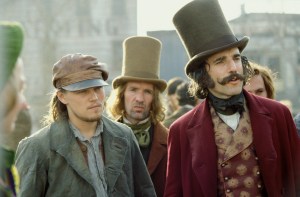
Where the movie sputters is with just about all that involves DiCaprio’s character, Amsterdam. The revenge storyline is just so boring compared to everything else going on, enough so that I think even the movie forgets about it. Amsterdam becomes Bill’s budding protege and literally saves his life at several points (if your goal is for him to die, why save the man?). He’s such a boring character because all he thinks about is vengeance, so every relationship he builds is only about how much closer to achieving his goal he can be. Amsterdam is a thoroughly dull character, and DiCaprio doesn’t come across as a credible tough guy yet, especially diminished in the large shadow from Day-Lewis’s Butcher. It wasn’t until 2006’s The Departed where I felt like he shed his boyishness fully to play a credible adult man. DiCaprio has been great with Scorsese, and this movie was the start of a decade of collaborations (four movies, two Oscar nominations), but he feels miscast here as a brooding hero given inordinate attention.
Worse is the romance with a pick-pocket prostitute played by Cameron Diaz. I pity Diaz. She’s been given the spunky love interest role in the Oscar-bait movie, which is generally underwritten and only viewed as aiding the hero’s journey of our male lead or being the offramp not taken (“Don’ get y’er refenge, Amsti’dam, ‘stead come wit me to San Fran in Calyfer’nia”). This is not a good character and she’s meant to give voice to the female underclass perspective, so it’s even more irksome when her headstrong, defiant nature gets sublimated as a rote romantic option. Diaz is also woefully miscast and my 2002 quip of her playing “pin-the-tail-on-the-accent” is accurate. I might argue that maybe dramas aren’t her strong suit, but she was great in Being John Malkovich and In Her Shoes and The Holiday, though all of those had notable comedy elements. She has the ability but this might just have been too unfamiliar for her, and so she struggles throughout with a character defined by her sexual connections to the villain and the hero.
While these characters and the performances are the biggest misses in Gangs of New York, there are other misguided or poor elements adding to that 50/50 margin. The opening sequence is great until the actual gang warfare begins and you realize that Scorsese, arguably the greatest living American director, cannot direct action to save his life. The action is choppy and lacking any of the kinetic qualities we associate with most Scorsese movies. Not even the talents of editor Thelma Schoonmaker can help save this deficit. The movie’s overall scattershot nature also makes it rather uneven and difficult to build momentum. The ending plays out like a footnote to the Draft Riots and robs the viewer of whatever catharsis could be granted from the long vengeance plot. If the whole movie has been leading up to Amsterdam’s vengeance, well robbing him of it could be meaningful, if the self-destructive nature of vengeance had been a theme. It’s not like Amsterdam has suffered at all, beyond the occasional stab wound or black eye, so him learning a lesson about the futility of vengeance would seem inappropriate and trite. I also want it known for posterity that there is an un-credited actor listed online as playing “Hot Corn Girl.”
”Twenty years later, Gangs of New York is still a frustrating and sometimes exhilarating viewing. It began a road for Scorsese that led to him finally winning his first, and still only, Oscar for directing The Departed. The sprawling nature of the movie is both a blessing and a hindrance. It allows for a wider scope and cast of characters but it also means that if you’re liking a subplot or a supporting character, you’ll have to wait your turn before they re-emerge. My old review back in 2002 perfectly sums up the majority of my feelings in 2022. There’s much to see and much to like with Gangs of New York but also too much to restrain its potential greatness.
Re-View Grade: C+
Share this:

Phantom Thread (2017)

When the 2017 Oscar nominees were announced, one of the bigger surprises was the amount of love the Academy dished out for writer/director Paul Thomas Anderson’s Phantom Thread. In hindsight, maybe this should have been more obvious considering the Oscar-friendly pedigree (Anderson a.k.a. PTA), the acting phenom (Daniel Day-Lewis), the setting (1950s), and the subject matter (obsessive artists). I had no real desire to see Phantom Thread after enduring PTA’s last two movies. I strongly disliked Inherent Vice and The Master, to the point that when I read about the love for either I can only stare at my feet, shake my head, and hope one day these defenders of rambling, plotless, pointless navel-gazing will come to their better senses. While not nearly ascending to the heights of his early, propulsive, deeply felt works, Phantom Thread is for me a marked improvement as a PTA film experience and an intriguing study in toxic desire.
In 1950s post-war London, fashion designer Reynolds Woodcock (Day-Lewis) is famous for dressing movie stars, princesses, and the rich elite of the world. His sister, Cyril (Leslie Manville), acts as his business manager and personal manager, including kicking out the old muses who have overstayed their welcome. After a day out in the country, Reynolds becomes instantly smitten with Alma (Vicky Krieps), a foreign waitress. He pulls Alma into his highly secluded world. She lives in the Woodcock offices and he summons her at all hours, caught up in the madness of inspiration. Alma is overjoyed by the attention and adoration from such a famous and brilliant artist. It’s the kind of feeling she doesn’t want to end, and when Reynolds begins to lose interest with her, Alma will fight however she can to stay longer in this new and exciting world.
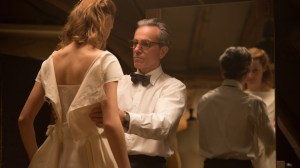
While this doesn’t have nearly the same amount of plot in comparison to early PTA, Phantom Thread at least held my interest and felt like what I was watching mattered. The character dynamics were compelling. Reynolds is a puzzle and we’re side-by-side with Alma trying to figure him out, suss his moods, and analyze why he is the way he is and how best to compensate. It becomes something like a portrait of a Great Artist who doesn’t operate on the same social and interpersonal levels as the rest of us, leaving Alma fumbling for stability. A breakfast in silence can become a battle of wills on the sound design team (you’ll never notice the sound of bread scraping like ever before). It’s not quite the thorough character study that There Will Be Blood purported to be, but Day-Lewis is as reliable an anchor for a movie as you’ll get in cinema. I was especially fascinated by the role of his sister, Cyril. She’s the gatekeeper to a very private world and knows the precise routines and preferences of her very fussy brother. She doesn’t necessarily approve of his actions but she sees them out, though occasionally she has to be more of the responsible one of the pair. Cyril is his lifeline, enabler, and enforcer. She treats Alma as a visitor into their home, further magnifying her worry about eventually being replaced by another muse for Reynolds. This insecurity is what drives much of the film’s second half as Alma tries everything she knows to assert power and influence so that she will not be unceremoniously carved out of this new special life for herself.
At its core Phantom Thread is an exploration of the stubborn artistic process and the toxic relationship of chasing those mercurial, waning affections. It’s very easy to feel for Alma, a relative nobody plucked form obscurity and whisked away to a glamorous world of the London’s fashion scene where she is the chief muse of a brilliant man. When he lays the full force of his attentions on her, it’s like feeling the warmth of the sun, and her world revolves around feeling that intensity. When his attention is elsewhere, Alma can feel lost and discarded, desperate to seek that warmth and fulfillment once more, though running into barriers because of Reynolds’ peculiar personal habits and demands. She plans a surprise romantic dinner that Reynolds resents, and he congratulates himself on the “gallantry” of eating his asparagus with butter instead of the salt he normally likes. Reynolds is a powerful figure who casts a powerful shadow. You feel for Alma as she tries again and again to find the exact formula for pleasing and comforting this obsessive man given to routines. She’s tying to crack the code back into Reynolds good graces. He’s an inscrutable force and one Alma is willing to genuflect to for his affections. Because of this dynamic, much of Phantom Thread is watching Alma try and fail to impress or win back the attentions of Reynolds, which is part fascinating and part humiliating. The film explores Reynolds’ history of burning through his shiny new muses, relying upon the iron-hearted determination of his sister to finally push out the discarded lovers/muses. For Reynolds, his muses follow the cyclical pattern of a love affair, the excitement and discovery of something new, the possibilities giving way to artistic breakthroughs, and then what once seemed en vogue is now yesterday’s old fashion.

Because of this tight narrative focus, the film does become repetitious in its second half, finding more ways to expound upon the same ideas already presented. Reynolds is a jerk. His process is of utmost importance and must not be altered. Alma is struggling to make herself more essential and less expendable in his orbit. She doesn’t want to end up like all the other prim women who have been elbowed out of the spotlight. She’s feisty and pushy and will challenge Reynolds, and this doesn’t usually work out well. While the strength of the acting never wavers, the plot does feel like it reaches a ceiling, which makes the film feel like it’s coasting for far too long (and it’s also far too long). It feels like Alma is fighting an unwinnable battle and after all her efforts she’ll just be another muse in a history of muses. That’s probably why Anderson gooses his third act with a thriller turn and with a specific plot device I’ve weirdly seen a lot in 2017. It feels like this plot turn is going to disrupt the cycle of Reynolds affections, and then as things begin reverting back to the old Reynolds, it all feels so hopelessly Sisyphean. And then, dear reader, the literal last few minutes almost save this entire movie’s lethargic second half. It’s a new turn that made me go, “Ohhhhh,” in interest, and it redefined the relationship and power dynamic between Alma and Reynolds in an intriguing way. It says a little something about the relationship between self-sacrifice and self-sabotage and how the power of giving can approach perverse levels of distorted self-fulfillment.
The biggest selling point of any movie with Daniel Day-Lewis is the man himself. He’s literally only been in four movies over the last decade, and in two of them he’s won Best Actor Oscars and was just nominated for another with Phantom Thread (Gary Oldman has that thing in the bag this year, though). The excellence of Day-Lewis is beyond dispute, and yet I would argue that Day-Lewis is pushed aside by the acting power of Krieg (A Most Wanted Man). This woman commands your attention enough that she can go toe-to-toe with Day-Lewis and win. She’s the worst at holding back her emotions and playing games, which makes her the most affecting to watch. When her romantic dinner goes badly, you can feel her reaching for reason, thinking out loud, her eyes glassy with uncertainty. When she’s speaking in an interview about her relationship with Reynolds, the warmth in Krieg radiates out from her. The other standout is Manville (Harlots) who does an incredible amount with mere looks. She can be withering. It’s a performance as controlled as Alma is uncontrolled, relying on the facade of calm to operate through a manufactured space of rules and expectations. And yes Day-Lewis is terrific. It’s also the first time he’s used his natural speaking voice in decades on screen.

Paul Thomas Anderson’s newest movie is about the world of fashion but it’s really about three characters jostling for understanding, attention, and control. We follow the tumultuous power dynamics of an artist-muse-lover relationship and the toxic implications it has on Alma as she struggles to maintain her position. The second half can get a bit repetitious and feel rudderless, but the eventual ending and wealth of great acting makes it an arguably justified journey. I lamented that Anderson was no longer making movies for me with the lurch he had taken with The Master and Inherent Vice in particular. He doesn’t have to make movies for me at all, but it was this sad realization that made me feel like I was undergoing a breakup with an eclectic artist I had loved tremendously in my younger days (Boogie Nights remains one of my favorites). Phantom Thread doesn’t exactly return things back to the way they used to be but it at least rights the ship, offering a mild course correction with a movie that is accessible and substantive. If this is indeed Day-Lewis’ last movie, at least it was better than Nine.
Nate’s Grade: B
Share this:

Lincoln (2012)

Steven Spielberg’s long in the works biopic of Abraham Lincoln could have easily been retitled, The Thirteenth Amendment: The Movie, such is the narrow band of focus. Lincoln is an engrossing, handsomely mounted study in the political machinations that went into passing the 13th amendment to outlaw slavery. Unless you’re a fan of history or politics, I can’t imagine that this movie is going to prove that engaging for you. This is a big movie about Big Moments with lots of people with beards giving speeches. Daniel Day-Lewis does a tremendous job as our titular sixteenth president, giving the man more foibles and traces of humanity than I can remember from any screen portrayal. Liam Neeson (The Grey) had long been attached to be Spielberg’s Lincoln, but I cannot fathom any other actor in the role after seeing Day-Lewis’s amazing work. I think he’s a shoo-in for his third Oscar. It’s intriguing to witness what a political animal Lincoln was, able to play off different sides to get his way. In the end, you may even feel a stir of patriotic pride, inspired by the good that government can grant with the right leaders for the right causes. The supporting cast all provide great performances, from Sally Field as the volatile Mrs. Lincoln, to James Spader as a conniving lobbyist, to Tommy Lee Jones as a stubborn curmudgeon… so basically Tommy Lee Jones. Just about every speaking part is a recognizable character actor. Who’s going to turn down the prospect of a Spielberg Lincoln movie? The tighter window of focus allows the movie greater depth as an important political juncture in our nation’s history, but Lincoln could have also been the 19th century equivalent of that Schoolhouse Rock song, “I’m Just a Bill.” This is an easy movie to admire but I think a more difficult film to love, to fully embrace.
Nate’s Grade: B+
Share this:

Nine (2009)
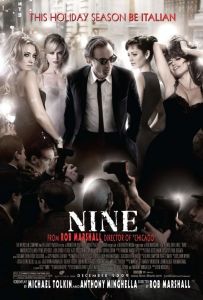 Filled with beautiful stars, beautiful Italian scenery, and beautiful cinematography, Nine has some significant sure-fire flash, but it’s missing the dazzle (or is it razzle?). The movie based on the 1980s Broadway musical based upon the Fellini movie, 8 1/2, is a pretty hollow enterprise. It’s all about writer’s block, and unless you’re the Coen brothers this is not a very interesting conflict to watch on screen. Daniel Day-Lewis plays Guido, a famous Italian director feeling overwhelmed by the impending start of his ninth movie, a movie he hasn’t written a script for yet. He tries to find inspiration from his wife (Marion Cotillard), his mistress (Penelope Cruz), his muse/lead actress (Nicole Kidman), his dead mother (Sophia Loren), a magazine journalist (Kate Hudson), and just about anybody else. The film is structured much like director Rob Marshall’s Oscar-winning musical Chicago, where the song-and-dance numbers are little mental asides inside the characters’ minds. So most actresses get one big number and then it’s arevaderche. Day-Lewis is good but his character is hard to emphasize with, especially as he bounces from woman to woman, whining about the duress of creativity while anybody minus a Y chromosome (and who isn’t Judi Dench) throw themselves at the guy. Despite the lackluster story and characters, Nine still could have succeeded from its musical numbers. Too bad then that the songs are instantly forgettable. Seriously, if you put a gun to my head mere minutes after I heard these tunes I wouldn’t be able to hum a bar. The dancing is lively, and Cruz and Cotillard prove to be infinitely and tantalizingly flexible, but the songs are truly unimpressive. I never would have guessed that in a movie filled with so many Oscar-winners that Fergie would be the highpoint. She plays a lustful figure of Day-Lewis’ youth, and her number exudes a vivacious sensuality. The playful choreography incorporates sand on the stage, which makes for several great images and dance moves. The song is also by far the catchiest, “Be Italian,” and the only thing worth remembering. The trouble for Nine is that there’s another hour left after this peak. I’m astounded that people thought, at one time, that Nine was going to be a serious awards contender. This has the “parts” of an awards movie but no vision or verve to assemble them.
Nate’s Grade: C
Share this:

There Will Be Blood (2007)
 Paul Thomas Anderson is one of the most gifted filmmakers working today, bar none. There Will Be Blood is only his fifth film and marks a radical departure from his intimate, inter-laced character dramas. Blood is an epic in size and scope and has been blessed with numerous awards and vehement praise. Critics say this film is one for the ages. My anticipation was fed to unhealthy proportions thanks to the hyperbolic praise and Anderson’s track record of audacious visionary cinema. There Will Be Blood is certainly audacious, and not just with its bladder-testing running length. This lethargic throwback to 1970 filmmaking exists for the purpose of a single performance and neglects other important tenets of storytelling. At 158 minutes, I can safely assume for many that there will be boredom with There Will Be Blood.
Our first glimpse of Daniel Plainview (Daniel Day-Lewis) is in the pit of a hole. It’s 1898 and Plainview is chipping away at the earth looking for scraps of silver. His meager beginnings set the stage for other mining prospects when, on the hunt for silver, he discovers even bigger riches – oil. Thanks to the advancing automobile age, the world has a thirst for oil that knows no bounds and makes Plainview a wealthy man. He’s an unscrupulous business figure that trots around his “son” HW (Dillion Freasier) as one more angle to fleece gullible townsfolk out of their property rights. HW’s father died in a drilling accident when he was a baby and Plainview has looked after him since.
One day Paul Sunday (Paul Dano) enters Plainview’s office and is willing to name a prime piece of land that oozes oil. Plainview agrees to pay Paul his sum and heads out with crew to Little Boston, California. The small town is easily enamored by Plainview’s promises of riches and prosperity. He purchases as much tracts of land as he can and begins drilling for that valuable black liquid. Eli Sunday (also Dano) is Paul’s twin brother; he wishes to build a church and become a prominent religious figure for his town. He sees the oil as his ticket to a throng of adoring congregants that will do his bidding. Oil is struck and several parties vie for dominance.
 I fear that Blood may be too languid for its own good. I’m all about allowing a film to take its time to establish a world and the people that inhabit it, and to its credit Blood spectacularly recreates turn-of-the-century America and the craze for oil. The cinematography and production design are stunning in gorgeously recreating a bygone era with such dusty detail. The film is packed with evocative imagery that will linger in your memory, like a burning oil derrick that feels like someone just drilled down to hell. The mixture of smoke, fire, and oil set amidst the hazy twilight is a remarkable sight. Visually speaking, this movie is close to flawless.
The nascent plot is what hampers Anderson’s Blood from reaching masterwork territory. The focus is on a misanthropic man who despises people and wants only to seclude himself, and yet he has genuine affection for his son until Daniel feels betrayed by his ambitions. I understand that the movie is a far-reaching character study, and Daniel Plainview is a fascinating and ferocious character, a perfect yet perplexing combination of greed and ambition, but I feel like Anderson has spent so much thought on his characters and forgotten to write a story around them. The silent, early portion of Blood gives us a quick summation of how Plainview rose to fortune and power and it’s rather compelling how much story comes across with no words of dialogue. This wordless pattern seeps into [i]Blood[/i] and there are stretches here and there where you may not hear a wisp of dialogue for, oh, 15 minutes, but by this point the movie is beyond setting up its storytelling universe. Again, I have no issues with the use of silence to convey meaning and metaphor, but it feels downright neglectful for Anderson to have concocted such intense, lively portraits of people and then to encase them in a void of speech.
Significant human interaction is kept to a minimum and I couldn’t help but feel that the movie was uncomfortably coasting without conflict for too long. Blood sets up Eli Sunday and Daniel Plainview as rivals, two men intent on grabbing power and the upper hand. The film takes a winding path to set these players in motion but I was encouraged that now, finally with two adversaries pitted together, the film would kick into another level and showcase a violent struggle worthy of a titan like Plainview. I recall every summary I read of There Will Be Blood noting that Eli is the thorn in Plainview’s side for many years and that their feud took up the bulk of the labored running time. This does not happen at all. Eli drops out for long stretches of plot and is forgotten unless Anderson feels that the character needs to be shoehorned back into the central drama at arbitrary points. This is no battle either, it’s all one-sided; Plainview handles Eli without breaking a sweat. With this in mind, I’m puzzled at how the conflict between Eli and Plainview was supposed to take center stage. Anderson had such wonderful potential to paint a doomed rivalry that eclipsed both men, but instead the external conflict only appears whenever Anderson desires some new sounding board for Plainview. That means that Blood can go for what feel like entire acts before it appears that conflict will be introduced or elaborated upon. There is a vacuum of story here and Eli Sunday, as written and performed, is far too submissive and easily beaten to present any formidable challenge.
 Why present characters at odds if you’re not going to push them further? Why write such vivid and amoral characters if you’re going to have them sit out or stay still? Plainview is the star of the show, I get that, but that isn’t an excuse for underwriting every single other character in an entire 158-minute movie. There are no intriguing character dynamics in this movie. Eli Sunday is forgotten. HW presents the closest insight into the humanity (what’s left) of Plainview, but the character is treated like a mute doll and when HW unexpectedly leaves the story so too does the only significantly interesting emotional relationship. Anderson establishes that greed comes in all shapes and sizes, be it an oil tycoon or a false prophet feasting on the coffers of his congregation. There is great thematic tension between the spiritual and the material but it never comes to a head. I kept waiting for confrontation but what Blood kept dishing out time and again was willful stagnation.
The extended ending forces a marginally contrived final reunion between Eli and Plainview but it doesn’t feel like any sort of payoff. The brutish and abrupt finale will cause many to scratch their heads and say, “That’s it?” until their scalps bleed. It’s a rather unsatisfying end for a film that boasted such grand ambitions.
The musical score by Radiohead guitarist Jonny Greenwood certainly wasn’t bad but it definitely did not mesh with the movie. Greenwood’s score consists mostly of a cacophony of violin strings buzzing about like a swarm of angry bees. The score seems to have a life of its own, intruding upon the scene at whim and upstaging character dialogue at times. The mixture of shrieking violins and some heavy percussion makes the movie feel less like a costume drama and more like a horror movie. The score seems to percolate and signify approaching danger. The score is also overly redundant and feels unnaturally paired to There Will Be Blood. It’s a marriage that doesn’t ever match.
 Day-Lewis doesn’t act often in movies and when he does it’s usually something special. His performance in Blood is outstanding, and it better be, because the film is built exclusively around his performance. He is an angry man bent on crushing opponents and making sure no one else gets sight of success. Day-Lewis is an immense talent and can dabble with multiple emotions with sheer, sightless subtlety. His distinct manner of speaking is finely attuned, though sometimes I felt like I was watching the world’s longest, and best, Jack Palence impersonation.
The other actors fall victim to the one-man show nature of the narrative. Dano comes across as miscast. He seems too youthful and ineffectual for the role. When he’s beaten and bullied his voice goes into a high-pitch squeal that is not becoming for the character. Dano’s acting takes the empty characterization one step further and removes any audience empathy.
Going by the repeated slam that Anderson is less a visionary and more a regurgitation of homage, if Boogie Nights was his Scorsese movie, Magnolia his Altman movie, Punch-Drunk Love his French New Wave movie, then There Will Be Blood is his Kubrick movie. It’s a plodding, challenging, and idiosyncratic movie that hits universal themes like family, greed, desire, and vengeance but does so in a small-scale story that feels intimate and epic simultaneously. The movie is dripping with artistic integrity and breathtaking filmmaking ability; however, it’s also a crushing disappointment. Anderson is a gifted writer/director with few contemporary peers, but he strands such vivid characters in a dessert of storytelling. There is little external conflict and the characters feel neglected or too easily forgotten. The focus is one misanthropic man but the film shortchanges him by not supplying additional substantial characters or conflict. Perhaps There Will Be Blood will stand the test of time and be the classic or landmark that critics are wetting themselves to declare it. It’s just simple economics in my mind: a character study cannot fully resonate without a strong network of supporting characters and/or lasting conflict. I have never been let down by a Paul Thomas Anderson film yet but I suppose there’s a first for everything.
Nate’s Grade: B-
Share this:

Gangs of New York (2002)
Watching Martin Scorsese’s long-in-the-making Gangs of New York is like watching a 12-round bout between two weary and staggering prize fighters. You witness the onslaught of blows, see the momentum change several times, and in the end cant really tell which fighter is victorious. This is the experience of watching Gangs of New York, and the two fighters are called Ambitions and Flaws.
The film begins in the Five Points district of 1840s New York among a vivid gang war over turf. Amsterdam (Leonardo DiCaprio) witnesses the slaying of his father, Priest Vallon (Liam Neeson), at the blade of William Bill the Butcher Cutting (Daniel Day-Lewis) and his Native Americans gang. So what does this son of a dead preacher-man do? Well he grows up, plots revenge by making a name under the wing of the Butcher becoming like a surrogate son. But will vengeance consume him?
Watch Leo DiCaprio assemble toughs, rake heels, and ne’er do wells to his Irish gang of rapscallions with facial hair that looks to be tweezed! Witness a one-dimensional Leo suck the life out of the film like a black hole! See Leo become the least frightening gangster since Fredo. Watch the horribly miscast Cameron Diaz play pin-the-tail-on-an-accent! Witness as she tries to play a pickpocket with a heart of gold that falls hopelessly and illogically in love with Leo! Marvel how someone looking like Diaz would exist in a mangy slum! See the brilliant Daniel Day-Lewis upstage our stupid hero and steal every scene he inhabits! Witness one of the greatest villains in the last decade of movies! Watch Day-Lewis almost single-handedly compensate for the films flaws with his virtuoso performance! Admire his stove-top hat and handlebar mustache!
Witness a wonderful supporting cast including John C. Reilly, Jim Broadbent and Brendan Gleeson! Wish that they had more screen time to work with! Wonder to yourself why in all good graces this film took nearly two years of delays to get out! Speculate away!
Gangs has the sharp aroma of a film heavily interfered with by its producers. The whole exercise feels like Scorsese being compromised. Gangs is a meticulous recreation of 1860s New York that often evokes an epic sense of awe. The story has more resonance when it flashes to small yet tasty historical asides, like the dueling fire houses and the Draft Riots. But all of these interesting tidbits get pushed aside for our pedantic revenge storyline with Leo front and center. You know the producers wanted a more commercial storyline, which probably explains why Diaz has anything to do with this.
The script is credited to longtime Scorsese collaborator Jay Cocks, Steven Zallian (Academy Award winner for Schindler’s List) and Kenneth Lonergan (Academy award nominee for You Can Count on Me). So with all these writing credentials, dont you think one of them would realize all of the dumb things going on with the story? The ending is also very anticlimactic and ham-fisted. Just watch as we segue from a graveyard to present day New York, all thanks to the Irish rockers of U2!
I know this much, Day-Lewis needs to stop cobbling shoes and act more often. Gangs is his first visit to the big screen since 1997’s The Boxer. He spent part of this hiatus in Italy actually making shoes. I don’t know about everyone else but this man has too much talent to only be acting once every five years. Somebody buy his shoes and get him a script, post haste!
Scorsese’s Gangs of New York is at times sprawling with entertainment in its historic vision and at other times is infuriating, always dragging behind it a ball and chain called stupid revenge story/love story. I’m sure the film will get plenty of awards and Oscar nods in prominent categories, and this seems like the Academy’s familiar plan: ignore a brilliant artist for the majority of their career and then finally reward them late for one of their lesser films. So here’s hoping Scorsese wins the Oscar he deserved for Raging Bull and Goodfellas.
Nate’s Grade: C+


 nathanzoebl
You must be logged in to post a comment.