Blog Archives
Dan in Real Life (2007)
 What is it about advice columnists that make filmmakers want to turn their lives upside down? I suppose there’s some karmic twist seeing someone who instructs others fall on their face when it comes to living their own life. I can readily think of several movies, mostly in the romantic comedy and sentimental weepie genre, that all involve an advice columnist who has their life torn asunder by fate. I suppose the extra dose of irony seems less cruel when dished out to someone who, supposedly, has all the answers. Dan in Real Life is an observant and enjoyable movie that centers on the stumbles and joys of the life of cinema’s favorite whipping boy.
Dan (Steve Carell) is an advice columnist raising three daughters on his own. His wife died years ago from an undisclosed illness and ever since he has been trying his darndest to be the best, if not slightly overprotective, dad. His oldest (Alison Pill) is eager for the car keys, his middle daughter (Brittany Robertson) is defiantly insistent upon her undying love for a boy, and his youngest (Marlene Lawston) is the kind of tyke that provides sage wisdom in time of need, usually at the very end of the movie. The lot of them head out to the family home along the Rhode Island coast to spend the week with the extended brood. Dan sleeps in the laundry room, is hated by his spiteful daughters, and forced into a blind date thanks to his concerned parents (John Mahoney, Dianne Wiest).
 While Dan is out trying to decompress he stumbled across Marie (Juliette Binoche) in a bookstore. They spend hours talking, well Dan does, and suddenly the rain cloud over his head seems destined to fade. He stammers to tell his family the good news when he discovers that his brother, Mitch (Dane Cook), has brought his new girlfriend to meet the folks and it’s, surprise, Marie. Dan respects his brother and tries to control his feelings of desire but still cannot help but flirt and pine for Marie, who is all too aware of the under the radar advancements.
I’m actually somewhat amazed at how well Dan in Real Life plays out in real life. The idea of a big family get-together as a source of comedy has been done to death, and this clan exists in an exaggerated world popularized by movies where families have spirited games of charades, robust sing-a-longs, and then perform a talent show complete with decorative furnishing. The family’s emphasis on togetherness plays out in expected wacky scenarios that would be regularly seen on TV sitcoms, but it is refreshing that an entire film based around an annual family reunion instills no fraternal bickering or bitterness. That’s got to be something new, and again, potentially a pure product of the cinema. Dan in Real Life has familiar staples and walks some dangerously sappy territory but the film manages to surprise and amuse because it all comes back to being character-centered. There’s a great scene where Dan is hiding in a shower and Marie is forced, in order to maintain the rouse, to step naked into the shower with him. Dan is thrown into some contrived situations, like the shower scene, but it is his wounded, deferential sensibilities that save him and also save the film from movie-of-the-week trappings.
Director/co-writer Peter Hedges (Pieces of April) knows how much anguish Dan can suffer before pulling back, and it gets to a point where Dan starts to seem like a comic Job (that might be redundant). Of course, like most sitcoms, lessons will be learned and wisdom will be doled out thanks to full and honest communication, and Dan in Real Life is no different in that regard. There’s a level of believability to the film that helps ground it even during the familiar sitcom moments, like the late rush to testify one’s feelings of true love.
 Carell isn’t a stranger to drama or comedy with some painful underpinnings to it, just look at his work in Little Miss Sunshine or the brilliant awkwardness of TV’s The Office. He’s very effective at communicating the exhausting exasperation of raising a trio of feisty females. There are some tender moments and Carell plays them well. He just has a physically natural look of sad befuddlement with his droopy yet piercing eyes and those bushy brows, so he knowingly underplays broad expressions and gestures and this works exceedingly well with the film’s un-sensational tone. When Dan does unleash the wilder, sillier side it’s usually a culmination of his pent up feelings; being denied happiness that appears within reach. He is a quietly becoming unwound as he tries to squash the feelings he doesn’t want to extinguish.
Binoche is a famous French actress who has an Oscar to boot, but she is simply radiant in this film and makes her character a prize worth perusing. She has an adorable sense of displacement and she and Carell exhibit a nice chemistry. Even in the tight timeframe, both the plot (3 days) and the film’s running length (93 minutes), Binoche manages to make us believe that someone could fall in love with her so easily.
Dan in Real Life is laid back, affable, and a sweet homespun comedy that escapes the sitcom trappings it very easily could have fallen prey to. What makes Dan so winning, ultimately, is how quietly and unassuming it goes about telling a familiar story of a sad man taking his first steps toward happiness. The movie has a gentle nature to it and succeeds thanks to an effective Carell performance and a really great turn by Binoche. Dan in Real Life is a feel-good drama that seems primarily aimed at adults, at least those with a working knowledge of the terrors of teenagers. This isn’t anything new or groundbreaking but it is heartfelt, somewhat moving, and very easy to like. My advice: give this movie a chance and prepare to be surprised.
Nate’s Grade: B
Share this:

Waiting… (2005)
 I have always respected restaurant workers; it’s just how I’ve been brought up. Short of elephant in vitro fertilization, being a waiter has got to be one of the hardest, most thankless jobs on the planet. The waiter (or server, the popularized non-gender specific term) is always the last responsible for food and the first to bear the brunt of a customer’s wrath. They’re easy targets. Their livelihood is also dependent on the idea of common decency in mankind. For these tortured, put upon, overlooked lot comes a new comedy aimed to ease the pain. Waiting… is a balls-out (pun very much intended) gross-out comedy that will make you a better, more sympathetic tipper (I generally start at 20 percent).
Welcome to the wonderful, family-friendly world of Shenaniganz. It’s another day of business for the restaurant staff and another day of enduring the slings and arrows of unruly customers. Monty (Ryan Reynolds), the leader of the pack, escorts a newbie (Freaks and Geeks‘ John Francis Daley) through the rules and customs of the Shenaniganz family. The cooks (Dane Cook, Luis Guzman) like to get randy at work, the bus boys (Max Kasch, MTV’s Andy Milonakis) like to hide in freezers and toke up, and the wait staff (Anna Faris, Justin Long) are all dating each other. Meanwhile, Dean (Long) is mulling over whether to take the manager’s job offered to him by his buffoonish boss (David Koechner). He feels his life is going nowhere and he’s stuck in a dead-end job. And there’s a store-wide game where workers try and get other people to inadvertently look at their genitals. God I hope this doesn’t go on when I order my food.
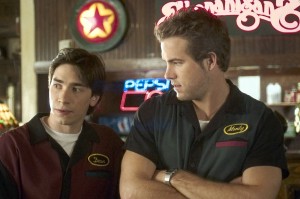 Bishop (Chi McBride) tells two other characters, “You guys are so one-dimensional.” It’s like the movie’s doing my job for me. Waiting… is stocked with underdeveloped characters that don’t even seem used properly. They all have one characteristic of note, from the white wannabe rappers to the bitchy self-loathing server that’s been there longer than anyone else. There’s a lesbian bartender and by the end of the movie that’s still the only thing you know or feel about her. Dean’s girlfriend (Kaitlin Doubleday) has nothing to add to her character, nothing to really say, no personality, she’s just “the girlfriend.” Waiting… has so many lame, poorly developed characters that go nowhere and shed little purpose or personality. It’s a general waste of talent, especially Faris and Guzman.
Reynolds is a charming and gifted comedic actor. He’s got the rat-a-tat-tat delivery down cold and adds a great polish to dialogue that ordinarily wouldn’t seem funny. He can seem at once jerky, knowing, charming, distasteful, and funny. Consider Reynolds a Vince Vaughn Jr. in the making. Long is supposed to play a character dissatisfied with his bearings in life, yet he comes across as disinterested in being in the movie. You almost expect him to shrug his shoulders and just say, “Whatever.” Long too is a very capable comedic actor but he needs far broader roles (Dodgeball) than something where he has to shuffle his feet and mope a lot. As stated earlier, Waiting… really wastes most of its talent by stranding them in thankless roles that don’t give them much to do or add. Koechner is the bright spot as a clueless, leering buffoon of a manager who keeps trying to connect with “the kids” and score with some as well.
 The story feels the same way. For a 90 minute movie so much of this feels unbearably plodding. Waiting… sets up the life of a restaurant well but then can’t find much to do. The story feels formless and the characters can?t provide any direction because of their limitations. The plot seems like a group of anecdotes looking for structure. Even the comedy is rather uninspired and bland. Waiting… attempts gross-out guffaws but just ends up becoming, well, kind of gross. Dropping food and serving it doesn’t exactly register on the Ha-Ha meter no matter how many times the act is repeated. The gross-out apex comes when vengeance is heaped upon a very hostile customer with an assembly line of new “additions” to her order. In this one instance the gross-out is transcended because the audience cares about the situation. Most of the humor is juvenile and not even good at it; the penis-showing-game is inherently homophobic and a running gag with little payoff. The best joke in Waiting… is the film’s production design; Shenaniganz looks nearly identical to those homogenized chain restaurants dotting the landscape. If you stay throughout the entire end credits you’ll discover that all the crap on the walls is actually an elaborate, Rube Goldberg-esque device.
Waiting… is a very knowledgeable film about the food service industry, what with writer/director Rob McKittrick spending years and years in restaurants. I think the only way you could seriously enjoy this comedy, while sober, is if you have experience working in food service. My fiancée has spent years as a server and she identified more with the characters than I ever could. There are scenes in Waiting… that are a server’s fantasy, like when Dean returns his measly one-dollar tip back to his customer. The movie is a safe release for people in the field, much like Office Space. McKittrick even thanks Kevin Smith in the closing credits, but Waiting… doesn’t have an iota of the wit, intelligence, and comedic savvy of Clerks. This is a bargain basement comedy that will largely appeal to fellow restaurant slaves yearning to have their beaten voice heard.
Waiting… is an aimless comedy with no characters to feel for, little personality beyond its knowledge of the restaurant environment, and a cast done in by one-note roles and bland gross-out jokes. Reynolds walks away with his dignity and adds a comedic polish to some otherwise ordinary jokes. Mostly, the film feels like a waste of time, energy, and talent. Waiting… will definitely appeal to people who have felt the wrath of working in food service, but objectively this is one comedy that just doesn’t order up any laughs.
Nate’s Grade: C
Share this:

Torque (2004)
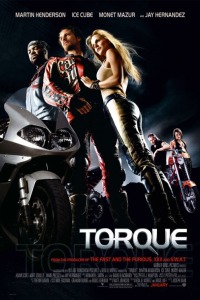 You want to know how bad Torque was? Until I began typing this article, I had completely forgotten I had even seen it. I suppose the film was an attempt to grab the attention and dollars of young, car-obsessed males who made The Fast and the Furious a hit. Somebody should have told that to director Joseph Kahn. A veteran of music videos, Kahn was more interested in making a collage of visually alluring shots than telling a story; not that Torque’s story would have excelled in other hands. This was a fast-forwarded video game populated with bland actors, bright colors and shiny bikes, which mean it’s only suited for moviegoers post-lobotomy.
Nate’s Grade: D+


 nathanzoebl
You must be logged in to post a comment.