Blog Archives
The Street Where We Live (2019)
 I was fortunate enough to actually hear co-writer/director John Whitney and co-writer/star Dino Tripodis discuss their hardscrabble indie drama, The Street Where We Live. It’s an Ohio indie that was filmed over the course of several weekends from the fall of 2015 to the summer of 2016, had its festival run throughout 2017-2018, and became available for the general public to watch via Amazon Prime in 2019. I was lucky to hear both men talk about their experiences making this movie on a small budget under a constrained time frame, as well as their hopes for it, paying homage in particular to the hard-working mothers that both men credit for their upbringing.
We follow Mary (Kristina Kopf), a recently unemployed factory worker, struggling to stop her family’s descent into greater financial ruin. Her children, Jamie (Katie Stottlemire) and Thomas (Dylan Koski), are trying to hide the shame of their living conditions, though it’s getting harder. Things go from bad to worse as this family tries to regain their stability.
 The film does a very good job of communicating the vulnerability and struggle of poverty as well as how susceptible a majority of people living on the fringes are. As has been said, many Americans are simply two paychecks away from disaster; in a survey, a majority of Americans would be unable to pay for a sudden expense of $400, meaning most Americans lack even that amount when it comes to personal savings. That day-to-day anxiety of simply getting by, of persevering and not prospering, is best expressed by the layers of sad, quiet resignation that hang on lead actress Kopf’s face. Hers is a performance steeped in quiet suffering (more on that later) and her fight for dignity and opportunity. This isn’t a very dialogue-driven movie and instead is more like one long sigh slowly eliminating all breath. One calamity leads to another in a succession of setbacks, and it’s clear to understand just how difficult it is to reset your life when that chasm seems more insurmountable by the day. You don’t have enough money to pay electricity leads to not enough money to pay for rent, leads to living in your car and washing in the bathrooms of gas stations, leads to having your car towed, leads to an impound that expects even more money if it cannot be immediately paid, and all the while that deficit grows and grows. The Street Where We Live is at its best when it’s opening up about the slippery slope of poverty and how it’s not some choice, not the result of trenchant laziness, but just bad timing, bad luck, and limited opportunities. In that way, the film works extremely well as an empathy project to convey the toll of poverty on the human condition and one’s hope.
Much like the mumblecore sub-genre of indie dramas, the observational little details and natural give-and-take are what help give the movie its sense of authenticity. This feels like a world where Whitney and his crew are well versed and can supply exacting insights. There are a few devastating moments in the movie, one of them being how out-of-touch a person can feel in a quickly changing marketplace. Mary has held her factory job for years and is applying for, what she has been told, is a simple secretarial position in an office, something she feels she can at least keep up with even if her typing skills are mediocre. Instead, she’s pummeled with questions of technical insurance jargon, and each one further shatter the idea that a “simple secretarial” job is within reach for Mary. Her sinking realization that this job is closed to her is such a hard moment to watch and Kopf, once again, plays it tragically and beautifully. It’s a small sucker punch of a moment, and from here she’s fighting even to get underpaid dish washing gigs. There are some aspects that are stretched a bit in order to maintain the family’s tragic desperation (one would think Mary wouldn’t have to venture all the way out of the state to contend for a paying job). It’s excusable because we’re meant to feel the crushing uncertainty of a character struggling with what is the best of her limited bad options. The only aspect of The Street Where We Live that didn’t feel realistic was the seconds before the factory workforce was about to find out their jobs were all gone, because I have to think everyone was suspecting the worst and wouldn’t be so amped for noisy chit-chat prior to the news.
The acting is another component that helps compliment the movie’s valued sense of reality. The Street Where We Live and its success hinges on two fulcrums: 1) its everyday realism, and 2) Kopf. The characters feel very recognizable and the performances rely on subtlety more than histrionics. More is gained by watching the pained expressions of ordinary people than listening to a character explode in a well-polished monologue about the hardships of living in poverty. There are a few emotional outbursts but they’re saved for the end, and even these moments are crafted to better maintain that well-earned sense of cinema verité.
 Much of the film’s impact is reliant upon Kopf (Constraint, Axe Giant) and the micro-expressions that cross her face. Hers is a role about suffering in silence, her weathered gaze its own shattering scream, and you study her to see how she’s coping with each new added indignity. A terrific moment is when Mary is trying to square a very personal, moral-crossing decision she made for the greater good of her family only to have a cruel man use his small amount of power to further wound. You feel how powerless this woman is and while you want her to punch the creep, there will be no release. You want the “movie moment” where she can upstage her tormentor but it won’t happen. Kopf has long been a staple of Ohio indies and there’s a very good reason why. Tripodis (Bottom Feeders) has an immediate well-worn charm that’s heartwarming. One of the best scenes in the movie is his character Ben and Mary sharing a small moment of compassion after hours of hunting for recyclables to turn in for meager money. This moment is so naturally written, with their interplay feeling relaxed, natural, and organic, that I instantly wanted more. Stottlemire (Tragedy Girls, My Friend Dahmer) has begun to branch out into bigger movies and her burgeoning talent is clear to witness. She follows Kopf’s lead and works in underplayed tones to great effect. Koski gets the least to do as Thomas, like him strumming his father’s guitar is all that is needed to communicate his longing to connect to his past. There are also small roles and cameos from other central Ohio indie faces like Ralph Scott (After), Daniel Alan Kiely (Bong of the Living Dead), Heather Caldwell (After), and Richard Napoli (After), and several others.
If there is one thing holding back the film from achieving a greater level of success and viewer engagement, it’s that the characters are defined entirely by their ongoing suffering. I call it the Lars von Trier School of Storytelling (not that it’s only associated to the Danish sadist) where you establish a character that takes the slings and arrows of their society, but this props up a protagonist as more of a symbol/metaphor/martyr than a human being. This approach can still work when given a major theme that is complex enough to take on the extra brunt of attention. However, this approach can also make the protagonist feel less active, more reactionary, and also less complex. If you were deconstructing Mary as a character, I know very little about her as a person. I know she had a job for many years. I know she lost her husband. I know she doesn’t feel comfortable asking others for help. I know she’s willing to make sacrifices for her children. Internally, I don’t know much about her, nor do I know much about her personality, interests, flaws, quirks, the things that make people more fleshed out, nuanced, and appealing. Mary certainly serves a purpose and she voices this in the film’s very last scene as Whitney unleashes his thesis statement about how our society should be better with its inherent social promises. For some, this will be a minor quibble and for others it will be, in essence, a cap for their empathy levels.
 The Street Where We Live is an affecting and honest little movie about the everyday hardships many people face when their lives are suddenly in free fall. It’s a potent drama packed with small, telling details that better create a world that feels lived-in, compassionate, and authentic. The acting is mostly sharp and anchored by a standout performance from Kristina Kopf. The technical details are pretty solid overall for a movie made for less than $13,000 and under the start-stop circumstances that the filmmakers had available. The cinematography and editing can feel like there wasn’t much in the way of additional options, but the look of the movie, muted greys and rusty browns, adds to the overall dreary tone. It’s a sparse film in execution but that’s because it doesn’t need bells and whistles and fancy camera setups to make its story felt. It’s a deeply empathetic movie that could open some hearts about the struggles of others. It’s so easy to fall down and much harder to get back up without a support system. The movie might be hitting repeated points without enhanced characterization but it still hits its marks. The Street Where We Live is the kind of movie where its small budget can actually be a plus, not just in forcing creative ingenuity from the filmmakers but also in lending a blue-collar validity. It’s a story that resonates because of its universal themes and lessons in empathy, and it’s worth watching to see what a group of well-meaning artists can do when inspired to do good.
Nate’s Grade: B
Share this:

Bong of the Living Dead (2017)
 I’m in a movie. That’s a pretty vain opening sentence but I wanted to get it out of the way. I was one of the very fortunate horror fans to attend the Nightmares Film Festival, which in two short years has already vaulted to being one of the top film festivals in the nation. I came to see the premiere of Bong of the Living Dead, a stoner zombie comedy that filmed in my hometown of Columbus, Ohio back in 2013 (oh what a simpler time). I had the good fortune to be a zombie extra, and wouldn’t you know, my shambling, bloody, stupid self made the final cut. I mention this not out of braggadocio but out of a desire for transparency. I am friends with many of the people in front of and behind the camera on this movie. I have personal connections to the production, Backwards Slate, and I’ve worked with several of the actors on other projects and plan to work with them again. I am going to write the most objective review I can for the film, as you would expect of me dear reader, but you should know of my potential personal biases. I was really dreading writing a review if the movie sucked. Happily, Bong of the Living Dead is still an enjoyably fun comedy even if you regrettably don’t happen to know anyone involved.
The zombie apocalypse is coming to Clintonville, Ohio, and our group of stoner friends has been waiting their entire lives for this moment. Childhood friends Hal Rockwood (Dan Alan Kiely), Christ Moser (Eric Boso), Tara Callahan (Laura E. Mock), and Jon Lance (Dan Nye) spend most of their time smoking pot and pontificating on the minutia of zombie pop culture. Christ is trying to hook up with a spacey new girl, Danielle DeWitt (Cat Taylor), and Tara and Jon seem to have something unspoken between them. Dr. Kate Mitchell (Tiffany Arnold) has been hearing strange cases of an infection passed through biting. Sure enough, the dead rise up and feast on the flesh of the living, and our stoners barricade themselves inside their house and gear up for the onslaught to come.
 This feels like it was plucked out of the 90s, and I do not mean that as a criticism at all. It feels like the kind of movie Kevin Smith would have made in his geeky prime (a mischievous recitation of randy porn titles seems wholly inspired from Smith). The core idea allows genre satire as well as genre self-indulgence: what if a group of pop-culture savvy potheads became embroiled in the zombie apocalypse? They speak in rapid-fire, hyper-verbal references because that’s how they process the world, as one long catalogue of pop-culture footnotes and influences. These characters are downright giddy with the prospect of finally getting to live within the realm of some of their favorite horror cinema, plus the added bonus of violence without a wider set of consequences. They get to be the stars of their own movie now. Except, to the credit of writers Tim Mayo and Max Groah, they don’t even know that they’re still the bit players. They oversleep a zombie cleanup mission and wake up late into the morning to discover much of their neighbors having already taken care of the task (one of them makes the entrepreneurial step of starting a zombie-aided car wash). Hal can’t hide his disappointment: “The whole point of the zombie apocalypse is that there’s not supposed to be any people around.” The apocalypse isn’t what it’s cracked up to be, and so the characters retreat and sulk, their knowledge of pop-culture raising their expectations to a level that could not be fulfilled.
It’s this clever undercutting of genre expectations where Bong of the Living Dead breaks from the mold of other zombie comedies. These characters are obsessively aware of zombie lore, and it’s a safe bet that a majority of the audience will have a loving knowledge base as well. They quickly accept their world-ending situation and it barely fazes them, perhaps still too inured by the inoculating effect of comparing it to the movies. It keeps the reality of the horror at a safe distance. Even while boarding up windows they can’t help but argue the merits of fast zombies versus slow zombies. A character makes a meta reference to breaking out a weapon that has never before been mentioned, and it was a big gut-busting laugh. Another clever undercutting is when the film transforms into more of a drama in the last act. I don’t know if enough has been established to make the leap from the Act One cartoon versions of the characters to the Act Three dramatic versions, but it was an interesting and unexpected development.
There’s one scene in particular that really exemplifies this dramatic pivot best while still undercutting the genre expectations (some spoilers). After all the close calls and zombie bashing, a character collapses and convulses not from having been bitten but simply from an ordinary and common medical emergency. The other characters are helpless and we watch the fear permeate the scene as everyone comes to the awful realization that this person is going to die from and there’s nothing that can be done. The panic in people’s eyes is genuine. This moment is without setup but I think it works better that way, placing the audience in the same confused and helpless position as the other characters. Groah, as director, gives the scene its necessary breathing room. In this world people can still die in ordinary, everyday ways, and death is not something that’s cool and distant. It’s terrifyingly real.
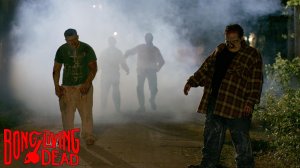 The loose, genial vibe of the overall production seeps into the script as well, especially during the lackadaisical second act that involves a lot of our characters just sitting around. Bong is a movie that finds time for little comic arias that other movies would blithely skip over. The loose feel allows the movie to find extra weirdness. There’s an ongoing run of silly media satire that reminded me of Paul Verhoeven’s social commentary. There’s a glib news anchor (Ralph Scott) trying to make the most of the dour news cycles, an opportunistic politician (Vidas Bardzukas) already promising to protect his constituency, a spookily spastic exercise host, a Spanish shopping channel host making love to the camera with his eyes, and a series of cheesy barbarian movies called Swords and Bitches with an evil whip-wielding arachnid queen (Brianne Jeanette). Bong of the Living Dead is chock full of little comical asides that you wouldn’t expect to be so good.
Though it’s also during the second act that I wish more had been going on. I wanted more examination on the difference between their perception of a zombie apocalypse and the reality they’re stuck with. I wanted a bit more setup for the payoffs, like maybe revealing that smoking pot slows down the zombie virus, etc. I wanted more of the VHS-quality flashbacks with the perfectly cast younger versions of the main gang. There aren’t as many central plot elements to make the bridge from start to finish. For much of the middle period, our characters kind of just sit around. They hang out, debate cereal superiority, and even go to the last remaining video store on Earth. It feels a bit like the movie is stuck in neutral, which might have also been the point to communicate the characters’ general malaise. I understand the absurdity of asking for more plot in a stoner comedy but this isn’t any ordinary stoner comedy, as its dovetail into heavy drama indicates. The first act is a lot of fun, the third act is effectively dramatic, but I wanted a bit more connective tissue. The characters could have been better developed (what exactly do they do when not smoking?) but I still cared when things got serious.
The performances across the board are good to great, with every actor, no matter how small the part, finding their specific comedic lane to work within. The biggest breakout performer is definitely Kiely (Axe Giant, Horrors of War) who is, to put it in a topical and never-to-be-dated analogy, the Tiffany Haddish of this particular Girls Trip. He goes above and beyond the call of duty to keep you entertained. Hal is the character that gets the most excited about the zombie apocalypse. The other characters are interesting but fairly subdued for the most part, as one would expect prolific stoners to behave. When Hal first sees a confirmed zombie, his wide-eyed expression is like a child on Christmas morning, and it’s the biggest applause moment for the film. Kiely is a live wire of energy that jolts every scene he’s in. His eyes speak a devilish madness. He reminded me of Jason Lee’s raucous debut in Mallrats, a full force that sweeps you away. After watching Bong of the Living Dead, you’ll wish every movie had a Dan Kiely in it.
 The rest of the ensemble find their moments, giving all the other moments to Kiely and his glorious beard. Arnold (Born Again, Seven Hells) is playing the most straight-laced of all the characters, a doctor trying to make sense of the irrational. Arnold has an instant screen presence and poise that causes you to sit up and pay attention. Her softer moments shared with Hal also help provide a nice antidote for the no-nonsense doctor. As much as Kiely is the draw of our attention, it’s Arnold that is often the one who grounds the picture. Boso (Underground 35) relentlessly pushes his character outside the box of socially awkward outcast. There’s a heaviness he feels from the consequences of getting close to others, and he doesn’t know fully how to deal with his frustrations with himself and the apocalypse, so he embraces his darker, nihilistic impulses. Boso is such a memorable film presence that it feels like he stepped off the set of a Richard Linklater film. Cat Taylor has a charming sense of daffy innocence to her. You can’t tell whether she’s dazed, cheerful, or not altogether there, and it fits very well for her character joining the group. She reminded me of Hannah Murray from the BBC’s Skins series. Nye (Harvest Lake, Dark Iris) is movie star handsome and has some sharp moments of comic aloofness. The romantic undercurrent he shares with Mock (The Tribunal) allows both of them something at stake that the audience can invest in. Nye and Mock have good heated exchanges that wake up the audience and allow each actor to effectively broaden their character range.
And then there are the little performances that make the most of their abbreviated screen time, like Ralph Scott’s (Stitches) wonderful clench-jawed bravado, Bardukas’ (The New Mr. Phillips) hilarious loose-elbow springiness in front of a green screen, Bill Koruna’s (The Shoes) crotchety neighbor, Ben Brown (After) as a powerfully self-loathing jock jerk who is wonderful fun to hate, Sarah Starr as a ditzy and easily bored sex object prone to gratuitous nudity, and the entire team inside the Conan-esque barbarian videos are a hoot for how committed they are to being silly. Just thinking about the Spanish home shopping host and his faces makes me smile and giggle to myself.
Bong of the Living Dead is a shaggy, scrappy, loose and lively zombie comedy with a charm all its own. It’s reliably fun and finds hidden gems of comedy from its deep supporting cast of oddballs. The main characters do fine work pushing at the boundaries of their stock archetypes, with Kiely as the wild man standout. There’s a definite love for the material here, over zombies and dumb comedies and the bonds of friendship. It’s evident in the care taken to creating a movie that doesn’t seem like it was churned out of a Hollywood assembly line, or something calculatingly checking the genre boxes (though the nudity does seem to linger a bit long…). Not everything always works but it’s a movie that tries a multitude of options. Bong of the Living Dead zigs instead of zags, undercutting the characters and our own expectations, finding ways to surprise as well as elate, and that includes going all-in on drama toward the end. It’s a silly movie that just might make you feel something by the time the credits roll. I don’t know what the release plans are for this homegrown horror flick, so stay alert for it on the horizon. Toke up, Backwards Slate Productions. You’ve earned it.
Nate’s Grade: B


 nathanzoebl
You must be logged in to post a comment.