Blog Archives
Capote (2005)
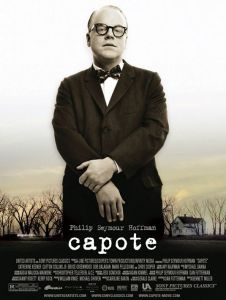 This is a really solid, probing movie about human relationships and the oversized personality of famous author Truman Capote. It’s a very illuminating character piece on its titular star. We see many different facets of his character; part of the connection is because Phillip Seymour Hoffman is so flat-out brilliant in his portrayal of Capote. He’s got that unmistakable nasal voice down, but Hoffman excels at the little things of character, his command of a crowd, his inflections, his physical movements, his ability to look exhausted and pained but embarrassed and prideful at the same time. Capote shows you why everyone wanted to rub elbows with him with how he tells a story and whips up an audience. This is another in the trend of warts-and-all biopics, and you see how calculating he is (he says he never lies). Every confession he offers is manipulative and meant for self-gain, like when he tries to get a witness to talk or get the Kansas P.I. to show him the murder photos. You see how the wheels work within this character. And then Capote shifts as he delves further into the case into his unlikely relationship with Perry Smith. Capote keeps them alive by providing money for their attorneys so he can get more for his book. But there can be only one ending to provide closure to his book — their death. There are several wonderful exchanges of dialogue between Smith and Capote and their quiet, smiling lies they give each other. All we see of Smith is the polite man who draws and read poetry in his jail cell, and the bond growing between him and Capote. The film’s climax eradicates any sympathy built and we see the unpredictable, unmerciful nature of violence. Capote really hammers home the dichotomy of persona, with each side playing the other. The cast is splendid and everyone makes their small roles click, particularly Catherine Keener as novelist Harper Lee and Chris Cooper as the Kansas P.I. What’s even more surprising is that Capote was even better the second time I saw it. There’s so much to find in this excellent character piece.
Nate’s Grade: A
Share this:

The Ice Harvest (2005)
 Imagine my surprise when I found out that a small crime novel I read years ago was getting the big Hollywood treatment. I read Scott Phillips’ The Ice Storm in one sitting back in 2003 during a plane trip from Ohio to San Diego. It was deliciously dark down to the very last page and I loved it, but then I am a sucker for a good crime story (check out Jason Starr’s Tough Luck and Hard Feelings if you are the same). The movie looked to be on the right track with names like John Cusack to star and Harold Ramis to direct. Ramis is responsible for starring, writing, or acting in or directing some of the most beloved comedies of the last 25 years including Ghostbusters, Groundhog Day, Stripes, and National Lampoon’s Vacation. That’s one illustrious comedic pedigree. So how could the movie go wrong?
It’s Christmas Eve and Charlie Arglist (John Cusack) is a self-loathing attorney that works for some of the shadiest folks in Wichita, Kansas. One of those bad customers is mob boss Bill Guerrard (Randy Quaid) whom Charlie and his partner Vic (Billy Bob Thornton) have just swindled over $2 million from. Unfortunately for them, Wichita is hit by an ice storm that makes the roads haphazard to travel. The two will wait until the morning thaw and then hit the road with their booty. Vic reassures Charlie to just, “act normal.” This means many ventures to some of Wichita’s finest strip clubs with alluring names like Sweet Cage and Tease-O-Rama. Charlie has a sweet spot for Renatta (Connie Nielsen), a bombshell and the operator of the Sweet Cage. He’ll also have to drive his plastered friend Phil (Oliver Platt) around, who is regretting having married Charlie’s cold ex-wife. Charlie would love to sail off into the sunset with Renatta by his side but first he’ll have to survive the night and a mob enforcer (Mike Starr) is already on his trail.
 The Ice Harvest feels like an episodic collection of ideas, too many of which have too little significance. The titular ice storm seems all but forgotten, only serving as a cheap plot device to keep our characters bottled up in the city. It has no bearing elsewhere on the plot. The reoccurring “As Wichita falls” passage has no payoff. The nosy police officer plotline looks like it might be building to something important but then is quickly disposed of. The Christmas setting has little impact except for giving the strippers something to complain about. The Ice Harvest wants to benefit from the juxtaposition of Christmas cheer with all these tawdry, violent asides and it just seems small and shallow. The movie also shifts the story’s time from 1979 to modern day one suspects just for the cheap out of cell phones.
Credit goes to Cusack for making his character as likable as he is. His character is a mob lawyer, a deadbeat dad, an increasingly drunk driver, and a man with his nose in whole lot of sleazy ventures, and yet you still pull for him to somehow succeed. Cusack, forever youthful, seems overly numb to all the horror around him and downplays the danger to a negative degree. Charlie seems like he’s in the wrong movie. Thornton plays yet another hedonistic louse and is quite good though not at his Bad Santa apex. He seems the most at ease with the physical comedy. Nielsen plays your typical femme fatale with a Veronica Lake haircut and breezy voice, which should both be instant red flags for students of film noir. The two men that steal the show are Platt and Quaid. Platt gives a brilliant uninhibited performance as quite possibly the drunkest man in movie history. Quaid is an honest surprise as a menacing mobster ruing the day he chose a criminal enterprise in Kansas. He chomps scenery with a violent exasperation that truly seems larger than life. This is a bad guy to fear and Quaid makes the most of his very limited screen time.
Ramis is out of his league here. The man cannot competently direct tension or action. Ramis doesn’t let the audience build suspicion because he’d much rather have characters just point-blank say, “Don’t trust this person” instead. He doesn’t give us time to piece clues of betrayal together so instead characters just keep running forward until they get smacked in the face by something made obvious. Ramis’ mishandling of tone really sinks the movie. The Ice Harvest doesn’t know whether it wants to be a thriller of a dark comedy and therefore just really sputters at both. The comedic elements and the thriller elements butt heads; because of the comedy the character never feel in danger, and because of the thriller/noir elements the characters and their situations never really seem funny. The Ice Harvest turns into some kind of two-headed beast that snaps at itself. I think maybe Ramis was watching Blood Simple and taking notes and then he accidentally taped over it with a Charles in Charge marathon and was at a loss.
P art of this problem is that the screenwriters don’t fully commit to the nastiness. Phillips’ novel is unrelentingly dark, cynical, and unsentimental and doesn’t give a damn if you like its characters. The movie, on the other hand, wants to get its hands dirty but is more interested in playing it safe. The film seriously reminded me of last year’s Surviving Christmas, another movie that wanted to be sweet and nasty and wound up just being really bad. You can feel The Ice Harvest reeling back several times to set up Charlie as a likable lad in over his head, going so far as a slightly contrived yet predictable finale. At least Bad Santa had the gusto to approach a happy ending on its own crude, unsentimental terms. Ramis needs to stick to broad comedies and leave the bleak neo-noir humor to the Coen brothers.
There are some plot elements from the book that just don?t work with this half-hearted adaptation. (Spoilers to follow for paragraph) At the very end of the movie Charlie has left the city with all the money and stops along the road to help a stalled camper. In the book, the camper backs up over him and kills him, thus ending with the ringing endorsement that crime doesn’t pay. It made sense, especially for a book that was dark to the very end. In the movie, the camper backs up and knocks him to the ground but doesn’t run him over. Charlie dusts himself off and that’s that. The scene feels pointless without fulfilling the end of the book. It doesn’t provide any last-second tension. Charlie just hops back in his car, dear hung over Phil pops up, and the two are set for one most excellent adventure. Unearned and misplaced happy ending? No thank you.
The Ice Harvest is only a mere 88 minutes long and yet the film still feels padded and draggy. The drunken Oliver Platt-heavy middle is a generously paced muddle, and though it’s rather funny it’s also rather extraneous. The Ice Harvest is really a handful of great moments that don?t add up to a satisfying whole. The movie is really episodic and too many of those episodes have little bearing on the plot. Character betrayals are spelled out to us and Ramis seems to lose interest in his own film as it slides further and further into dangerous territory. The Ice Harvest can’t commit to whatever it wants to be and the audience is the one to suffer. Read the book instead. It’s only 224 pages.
Nate’s Grade: C
Share this:

Kiss Kiss, Bang Bang (2005)
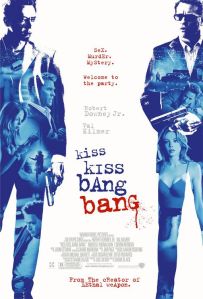 Shane Black was a Hollywood icon by the time he was in his early 20s. In 1987 he sold a script called Lethal Weapon to producer Joel Silver that put a jolt back into action flicks and gave the template for all buddy-cop comedies to come. He earned a then-record $1.7 million for his script, The Last Boy Scout, topped later by the $2 million paycheck he got for The Long Kiss Goodnight. It’s a shame both scripts were marginalized by their film directors. Black went underground for a long time, nursing his wounds over what had happened to his screenplays. Then in 2004, Black began his comeback vehicle, a modern day detective story that also lampooned Hollywood, and this time he’d direct his own material. The final product is called Kiss Kiss, Bang Bang, and Black’s comeback film is nothing short of a cinematic knockout and the most refreshingly entertaining movie of all 2005.
Harry Lockhart (Robert Downey Jr.) is a small-time crook on the run from the cops when he stumbles into an acting audition. They hand him a script, tell him his partner’s dead, and are so impressed with his “acting” that he’s immediately flown to Hollywood. Harry is teamed up with Gay Perry (Val Kilmer), a cop who does advisory work and just happens to be gay. During a house party, Harry reunites with a childhood friend, Harmony Faith Lane (Michelle Monaghan). They reminisce about their childhoods in Indiana and their fascination with the Johnny Gossamer detective novels, but she has much more on her mind: her sister’s gone missing and she needs Harry to find her. Trouble is Harry hasn’t told her he’s not a real detective. He’s gone from crook to pretend actor to pretend detective, and before Christmas is over he’ll be up to his neck in bodies, intrigue, double-crosses and all the stuff that would make for a rip-roaring Johnny Gossamer book.
 First and foremost, Kiss Kiss, Bang Bang is one deliriously fun party. The film moves at breakneck speed through its smart, cheeky gags. Black’s dialogue is hilarious and feels so effortlessly natural coming from Downey Jr. and Kilmer, like he’s got their speech patterns tattooed in his brain. In fact, the dialogue feels so robust and natural, never glib and self-conscious, that it almost comes across as feeling like a heavy improv session between two immensely talented actors. Kiss Kiss, Bang Bang, Black’s opus to the hard-boiled detective genre, has more twists and turns than a seizure patient doing the Hokey Pokey. You never know where this movie will head next or what joke will topple you over with unexpected laughter, and that’s what makes Kiss Kiss, Bang Bang so unabashedly thrilling to watch. Even when the movie does start to veer into more conventional material, Downey Jr. is there as our narrator to point out what we’re all thinking and to make fun of the expected. Kiss Kiss, Bang Bang can get jubilantly perverse at parts (a corpse getting a golden shower), but the macabre touches never deflect from the film’s boundless, inconsumable energy. Everyone is having the time of their lives in Black’s comic caper, and it shows.
Seriously, this movie is the definition of a laugh riot. It’s like a carnival ride through a gag factory (that sounds kind of spooky, actually), and Black has such an assured confidence to his writing, evidenced in his set-ups, reversals, and the insightful tweaking of Hollywood that could only come from one of its own (Harry laments that the nation turned over and shook and all the normal girls hung on while the crazies landed in L.A.). Here’s a conversation between Harmony and Harry about a promiscuous actress:
Harmony: Well, for starters, she’s been f***ed more times than she’s had a hot meal.
Harry: Yeah, I heard about that. It was neck-and-neck and then she skipped lunch.
Just re-reading it makes me laugh. How many comedies make you laugh just thinking about them in retrospect? Kiss Kiss, Bang Bang is one of those oh so rare delights. It even has a talking bear in it!
 The lone detraction for Kiss Kiss, Bang Bang is the movie’s overall lack of substance. It doesn’t reach for anything more than bold entertainment, and to that end it succeeds in spades. Some may argue the movie is spinning so fast to try and distract you from its empty center, but I say enjoy the ride while it lasts. I only wish this movie was longer, like Lord of the Rings-long. I did not want to leave this world and these characters. My claw marks might still be visible on the armrests where they had to throw me out.
Black also proves to be a very slick director with a natural eye for camera placement. His photography is very pleasing, relying on different light placements to add surreal touches that accentuate the narrative. Black keeps his movie at a breathless pace and knows how to handle his actors. His narrative side-steps enliven the film and grab our attention, and Harry’s voice over is never overused to explain the minutia the script cannot. The only drawback for Black might be that his film could be too smart for its own good. I mean, most of the movie going public will be stooped by a joke about adverbs. Black has an obvious love for detective yarns and film noir, that’s evident with the film’s style and the fact that chapter titles are Raymond Chandler novels, but some familiarity with this world will sharpen your experience. Kiss Kiss, Bang Bang never panders to its audience, and that may hurt Black as far as making a movie that will reach out to Middle America (Perry apologizes to the Midwest for using the “f-bomb” as often as they do).
The chemistry between Downey Jr. and Kilmer is incredible, positioning them as one of the finest comic pairings in recent cinema history. Their indelible camaraderie is the true heart of Kiss Kiss, Bang Bang. They bat insults and injuries with comic aplomb. Both characters are unapologetic, Harry as a nattering criminal screw-up way in over his head, and Perry as gay man who’s fine with that and will rip your testicles off just the same if you cross him. He’s not stereotypical swishy or flamboyant, but he’s very enjoyably dry and sarcastic. Both actors have a history of being troublesome to work with, but Downey Jr. and Kilmer have been two of our most amazingly talented actors … when they want to be. Kilmer is the coolest customer in the film, being nonchalantly badass even when he’s about to blow his top (this is NOT a gay joke, by the way). Downey Jr. is his usual charming, amiable, fast-talking self, but even his tiniest details speak comedic volumes, like his reactions and general awkward physicality. I cannot imagine anyone else doing as excellent a job in these roles, especially Harrison Ford who was sought by producers for the Gay Perry part (feel free to shudder at what might have been Hollywood Homicide 2.
 Monaghan is a break-out actress that could have been even more break-out-er by this time. She’s mostly had small unmemorable roles in films like Unfaithful and The Bourne Supremacy, but 2005 was set to be her year. She had roles in Constantine, Mr. and Mrs. Smith, and Syriana. Unfortunately, her scenes were cut from Syriana and Constantine, and her role was drastically pared down in Mr. and Mrs. Smith. The only thing Monaghan has to show for 2005 is Kiss Kiss, Bang Bang, and that’s all she’ll need. She’s bright and pretty, but she also gives Harmony a great sense of being run down, another girl getting off the bus to Hollywood with stars in her eyes only to find out the harsh reality. Her combative relationship with Harry as they reconnect and try and wonder how they went astray is another film high point. She’s a comedic asset and should be on Hollywood’s speed dial if they need a charming, funny, capable actress.
Kiss Kiss, Bang Bang is a wicked good time. It’s complex, twisting, riveting, unique, hilarious, and just about every synonym you can think for the word “awesome.” Black’s comeback may be too smart for its own good, and having a general understanding of film noir will enhance your experience, but this is one comic caper that’s so much fun, so stylish, so damned entertaining, who cares if it lacks substance? Kiss Kiss, Bang Bang is a refreshing blast of fresh air and should please anyone looking for a smart Hollywood film mixed with doses of their familiar sex and violence. But that’s what makes Kiss Kiss, Bang Bang so exhilarating, nothing about it could be classified as familiar. Seeing this flick is like being invited to the party of the year. Just make sure to head to your theater before your invitation gets lost in the mail.
Nate’s Grade: A
Share this:

Layer Cake (2005)
 Layer Cake may be the least intimidating name ever for a crime movie. It conjures images of bridal showers, cooking shows, and birthday parties. It does not necessarily bring to mind thoughts of gangsters, assassins, drug trafficking, and the seamy underbelly of London’s criminal underground. Unless you’re watching some really awesome cooking show I don’t know about. The “layer cake” in question refers to the hierarchy of criminals. This isn’t unfamiliar territory for Matthew Vaughn, who produced Guy Ritchie’s Lock, Stock, and Two Smoking Barrels and Snatch. This time it’s Vaughn sitting in the director’s chair and the results are exceptionally entertaining. Layer Cake is a cinematic treat.
Daniel Craig (Road to Perdition) plays our untitled lead, referred to in the end credits as “XXXX.” He’s a cocaine dealer but not a gangster by any means. He wants to make his money, not step on any important toes, and then walk away on top and without any gaping holes in his body. Craig is summoned by his boss Jimmy (Kenneth Cranham) and given two missions, whether he wants to accept them or not. The first is to relocate the missing daughter of a very powerful friend of Jimmy’s. The second, and far more dangerous job, is to secure a package of millions of stolen ecstasy pills and make a profit. Complicating matters is the angry Serbian mob that the pills were stolen from. They’ve dispatched a deadly assassin known as Dragan to track down their stolen drugs and kill anyone involved. Craig is left to juggle the investigation, find a buyer, stay ahead of Serbian hitmen, get some time in with a hot new girl, and all the while keeping his higher-ups content enough not to kill him themselves.
 Layer Cake should be the film that makes Craig the star he so rightfully deserves to be. This man is a modern day Steve McQueen with those piercing blue eyes, cheekbones that could cut glass, and the casual swagger of coolness. Craig grabs the audience from his opening narration as he explains the ins and outs of his business. We may never see Craig sweat but he still expresses a remarkable slow burn of fear so effectively through those baby blues. He’s in over his head and the audience feels his frustrations. In an interesting character twist, when Craig does resort to killing, he’s actually tormented and haunted by his actions.
As with most British gangster flicks, there are a batch of colorful characters that leave their mark. Dragan (Dragan Micanovic) is a wonderfully enigmatic ghost of an assassin always one step ahead of Craig and the audience. Morty (George Harris) and Gene (Colm Meaney) add heart and bluster as Craig’s trusted right hand men. But the actor who steals the whole film with a malevolent glee is Michael Gambon (Harry Potter and the Prisoner of Azkaban). He plays Eddie Temple, the man behind the men behind the scenes. Gambon delivers the harshest of speeches with a velvety pragmatic calm. We don’t know what runs deeper with Eddie, his tan or his scheming.
Sienna Miller plays the thankless love interest to Craig. She’s pretty, sure, but there isn’t much acting ability on display in Layer Cake beside some smoldering glances. We never really know what Craig sees in her besides being another cute blonde to choose over. Miller isn’t alone in the “underwritten character department.” Layer Cake is crammed with secondary characters that pop in and out when it’s necessary. It’s not too annoying but it does mess around with an audience?s ability to follow along coherently.
Layer Cake is not one of the slick, whack-a-mole ventures Ritchie has given us (pre-Madonna). No sir, this is a brooding, serious and nearly terrifying look at the old adage “crime doesn’t pay.” Very few crime centered films express the day-to-day anxiety of just being a criminal. Jimmy reminds Craig that he’ll never be able to walk away because he?s too good an earner for his higher-ups. In Layer Cake, you can get killed for being too greedy, being too careless, being too good at your job, and even just being in the wrong place. Eddie sums it up best whilst describing Faust: “Man sells his soul to the devil. It all ends in tears. These things always do.”
 Vaughn has a polished visual sensibility that doesn’t overwhelm the viewer. He keeps the camera fluid and steady with a minimal amount of cuts. A nifty opening scene involves an imaginary drug store (stocked with pot, cocaine, and the like) melting into a real drug store (one hour photo, impulse items at the register). When the tension does mount Vaughn knows just how to turn the screws. A late sequence involving a chase between the SWAT team and our batch of criminals had me on the edge of my seat. For a first time director, Vaughn also has great patience. He doesn’t rush his storyline and he doesn’t suffocate his movie with visual flourishes. He also has a great deal of faith in his audience’s intelligence. This isn’t as lively as Snatch or Lock, Stock, but that’s because Vaughn’s film is also much more serious and dangerous.
This is an intricate and gripping film but it might be a little too complex for its own good. Twists and double-crosses are expected in this genre, but writer J.J. Connolly has so many characters running around and so many hidden agendas that it’s nearly impossible to keep track. Some of the subplots and back stories add very little like the inexplicable “Crazy Larry” flashbacks. I left the theater still confused about plot points but refreshingly satisfied nonetheless.
Layer Cake is the most thoroughly exhilarating time I’ve had at a theater this year. This pulpy daylight-noir caper is full of memorable hoods, plenty of twists and turns, and a star making performance by the steely-eyed wonder that is Daniel Craig (rumored to be the next 007, though in my heart I’ll always root for Clive Owen). Fans of Ritchie’s frenetic gangster flicks should be entertained. Anyone looking for a clever and exciting potboiler that treats violence and crime seriously should start lining up immediately. If you’re suffering from the cinematic wasteland that 2005 has shaped up to be so far, then have yourself a generous helping of Layer Cake and thank the Brits.
Nate’s Grade: A
Share this:

Sin City (2005)
 Like film noir on steroids. Director Robert Rodriguez has made the most faithful comics adaptation ever; giving life to Frank Miller’s striking black and white art. The visuals are sumptuous but the storytelling is just as involving, a perfect mix of noir/detective elements and subversive, highly memorable characters. Sin City may be the most violent studio film … ever, but the over-the-top tone keeps the proceedings from becoming too nauseating, even after limbs are lost, heads roll (and talk), and dogs pick away at living bodies. This is a very ball-unfriendly movie; lots of castrations. The blood even looks like fluorescent bird crap. The stories become somewhat repetitious (anti-hero saves distressed woman), but Miller and Rodriguez keep their tales tight, pulpy, comic, and unpredictable. My friend turned to me after it was done and said, “That was a great movie.” I could not argue.
Nate’s Grade: B+
Share this:

Inside Deep Throat (2005)
 I find that there are generally two requirements that make a really great documentary: 1) have an interesting story, and 2) have an interesting way of telling it. I’ve seen documentaries on ripe topics squandered because of the dull and unimaginative ways they tell their tales. The skilled documentary team behind The Eyes of Tammy Faye and Party Monster has set their sights on a little smut film that changed the world in the early 1970s. Deep Throat was a “dirty movie” made for peanuts (25 grand) that ended up becoming the most profitable film of all time, eventually grossing more than $600 million. The story behind its meteoric rise, cultural acceptance, and damnation hits both requirements, thus making Inside Deep Throat a sensationally entertaining documentary.
It all started in 1971 when Gerard Damiano wanted to make an inexpensive pornographic film. Back in those days, many aspiring filmmakers actually got their start in porn (Wes Craven admits it). Damiano was in the planning process when he was visited by a man who wanted his girlfriend, Linda Lovelace, to appear in the eventual porno. He swore his girlfriend could do the most amazing trick. Lovelace demonstrated her trick, the full swallowing of an erect penis. Damiano was dumbstruck. He was determined not just to involve Lovelace but to base an entire film around her stunning ability. Deep Throat was written in three days, filmed in six days, but the furor it would bring would be irrevocably long lasting.
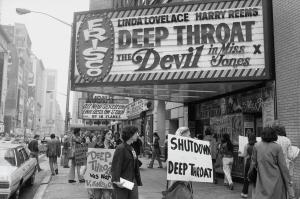 Deep Throat, as many of the crew will happily report, is not exactly a good movie. In fact, some call it the worst pornographic film of all time. Lovelace’s character found sex joyless, that is, until a doctor (Harry Reems) discovers that she has her clitoris all the way in the back of her throat. Thus to orgasm she has to swallow head-on (oh the double meaning). When the crew actually witnessed Lovelace’s cavernous abilities firsthand, they too were flabbergasted. But they wouldn’t be alone. Inside Deep Throat makes smart use of archival footage to prove how mainstream a small smut flick became. We see clips of Bob Hope and Johnny Carson cracking jokes about the film, and most amusingly of all are one or two interviews with little old ladies who “wanted to see a dirty picture.” Deep Throat crossed over and people went out in their Sunday finest to watch a hard-core porno.
Inside Deep Throat is rated NC-17 and with good reason. We do get to see Lovelace strut her stuff and the film almost playfully teases an audience with anticipation. We hear interviewees discuss their amazement; we see a close-up of Reems face as he gets pleasured. By the time the scene in question is shown uncut, we’re eager to witness this feat of fantastic fellatio ourselves. Let’s be honest, you can?’t have a documentary about Deep Throat‘s impact without showing the goods.
Filmmaking duo Fenton Bailey and Randy Barbato have a very visually satisfying way of telling their story. Images tear across the screen and animation pops, all set to what must amount to most of the soundtrack to Boogie Nights. The glossy visual flair reminds me of the swirling, near-pop-out book imagery of The Kid Stays in the Picture. The pacing of Inside Deep Throat is near break-neck, with the film clocking in at just over 90 minutes. I wish that the filmmakers had spent more time on their subject and gone more in depth into certain areas like Lovelace’s turnaround from girl next door goddess to anti-porn crusader back to fifty-something nude model (she was killed in a car accident in 2002).
 The cultural splash Deep Throat made is interesting enough, but the meat of the story is in the battles that would ensue. Damiano openly talks about how the mob controlled the early porn industry. He admits that he refused his share in the millions out of fear that he might have had his legs broken, or worse. There’s a long tangled web of mafia influence in the proliferation of Deep Throat. It was banned in over 30 states, but everywhere it went it became a hit. A Mafioso says that they were making so much money that they had to count it by the pound. Mob hits would materialize over the film’s profits and territory.
Even more fascinating, the U.S. government, to no one’s surprise, declared the film indecent. They couldn’t prosecute the director, or the distributors (unless they liked sleeping with the fishes), or anyone really making money off of the success of Deep Throat. So what’s a stubborn government to do? They prosecuted Reems for his involvement in a pornographic film. It was the first time an actor was ever prosecuted for his participation in art after the fact. Celebs like Warren Beatty and Jack Nicholson came to Reems’ aid, fearful of what might happen if a government could retroactively punish artists. Sadly, Reems was found guilty and sentenced to years in prison and was really never the same afterwards.
But instructional films on sexuality were still okay as far as government was concerned, and we see clips of them in all their medical film hilarity (apparently some positions are not meant for the obese we’re told). These were acceptable because they were meant to help and inform, whereas porn is meant to entertain.
The film’s interviews comprise some of its best and worst moments. Most of the Deep Throat crew is in their 60s or 70s now, and hearing them talk about porn and sexual acts does make you titter a bit. The crew provides funny anecdotes and some of the juiciest material. However, the film also curiously interviews people like Dick Cavett and Bill Maher. The expected talking heads are here like Dr. Ruth, Camille Paglia, John Waters, Hugh Hefner and Larry Flynt, but they regularly don’t have anything insightful to say.
 Inside Deep Throat goes back and forth with its objectivity. It’s obviously pro-freedom of speech and doesn’t mind ridiculing the government agents who tried taking Deep Throat down (oh the double meaning). Particularly telling is an FBI agent who wishes that terrorism could be tidied up so that he could finally get to the real importance, which is stopping people from seeing pornography. One of the main points of the prosecution of Deep Throat was that it “wrongly” purported the idea of a clitoral orgasm (I think many will find some error with this judgment). It’s easy in retrospect to chide government officials ruling on inaccurate information or just plain ignorance. It may be too easy for some viewers, but for me it’s fair game to lambaste any idiot trying to strip me of my Constitutional rights.
Inside Deep Throat is an engrossing if light-hearted look at a moment in time. Some of the seedier elements feel skipped over, but this is a documentary on a fascinating subject told with a pleasing visual style. Don’t be put off by the NC-17 rating or the subject matter. Inside Deep Throat is more than a behind-the-scenes featurette on a wildly successful porno. It’s a fast, funny, and greatly entertaining time capsule of an era where boundaries were still being pushed, both by artists and by censors. And in today’s FCC-fearing landscape, maybe not everything has changed since Deep Throat brought porn into the mainstream.
Nate’s Grade: B+
Share this:

Maria Full of Grace (2004)
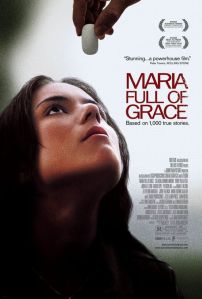 No other actress stood out to me this year as 23-year-old Catalina Sandino Moreno. She plays the movie’s Maria, a Colombian woman who agrees to carry 60-something condoms filled with heroin in her gut to the United States. The first half of the film is unjudegmental and nerve-racking, especially when Maria gets snagged by U.S. customs. The second half revolves around Maria trying to land on her feet in an unfamiliar land. The greatness of Maria Full of Grace relies on debut writer/director Joshua Marston framing his story like camera is an invisible voyeur. The film suggests that Maria is only one of thousands that have turned into drug mules to make ends meet or seek better lives. Maria Full of Grace is startling, immersive, delicate and quietly touching as Maria rediscovers the promise of the American dream.
Nate’s Grade: A
Share this:

Man on Fire (2004)
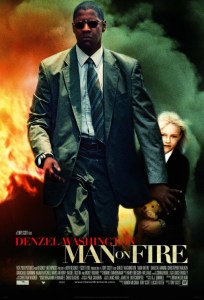 By far, the most entertaining moment of Man on Fire occurs shortly after the movie ends. A message comes on screen more or less saying, Mexico City is a very special place and we thank them. Now, after having watched a lengthy 2 hour and 25 minute film that shows Mexico City as a chaotic equal to the Middle East, a city that experiences four kidnappings a day we are told, these ending sentiments feel like a mea culpa. To say a place is great after showing it to be a corrupt war-zone is hilarious. I doubt Mexico City will be using Man on Fire to lure tourism, just like I doubt Germany uses Hogan’s Heroes for its tourism.
The man on fire is Creasy (Denzel Washington), a former soldier with a drinking problem. Hes hired dirt cheap to be the bodyguard for Pita (Dakota Fanning), the daughter of a wealthy Mexican politician (Marc Anthony). Creasy is pragmatic about his job and shirks Pitas attempts at friendship. Eventually, the precocious tyke gets the better of him and Creasy forgoes his self-loathing for coaching Pita on how to swim better. Creasy has found his recovery in the form of Pita’s love, but his world is ripped apart when Pita is kidnapped and Creasy is left for dead. When he recovers, he vows merciless vengeance on anyone involved in Pita’s kidnapping.
 Denzel Washington is competent in his role, but there aren’t many films that wouldn’t be better by having a Denzel Washington performance in it. Fanning has a robotic nature to her delivery. The wacky Christopher Walken is in this movie somewhere, but you would be hard-pressed to find him in the last hour or so. It’s kind of nutty that Walken of all people plays the voice of reason in a revenge movie.
Director Tony Scott (Crimson Tide, Top Gun) has flat-out forgotten or lost interest in telling stories. His direction of Man on Fire is erratic and heavy on stop-the-action-dead visual flourishes. Scott is a slave to visuals, but so many of them are jarringly miscalculated that the audience can never fully immerse themselves in the film. It’s like a kid fiddling with a new camcorder and wanting to try all the super cool special features (Whoa, I can make things slower … now grittier stock … now sepia … now I can make a mirror of things … etc.).
It takes over an hour to get to the key kidnapping plot point. Until then the audience is relegated to watching scenes of Creasy find redemption through the eyes of a child. Denzel and Fanning have a nice mentor camaraderie, but after an hour the audience is impatiently waiting for the inevitable kidnapping that the movies foreshadowing has been tripping all over.
 When Man on Fire does hit the kidnapping, the ensuing movie gets very messy, and boy does it get ugly. Creasy goes on a grisly killing spree that turns him from a sympathetic loner into a one-man wrecking crew. Vengeance is an easy emotion for an audience to get behind a character, but Man on Fire goes way beyond audience empathy. Are we to cheer when Creasy goes about ruthlessly killing unarmed people and threatening families, pregnant women, and kids? I didn’t cheer. I was somewhat appalled that the filmmakers expected us to revel in this violence as if it was more than justified. It’s just ugly, plain and simple. It is also sickeningly sadistic.
The most bizarre thing about Man on Fire is the subtitles. When I think back on this film in the future, that is the one thing that will stand out for me. These arent your ordinary stay-at-the-bottom-and-do-as-you’re-told subtitles. Oh no. These subtitles dance, jump around, float, fade, expand and shrink in size, and do about everything but make balloon animals (or, I should say, subtitle animals). It’s like a living comic book; however, this is yet another visual trick that draws the audience out of the film. The unusual subtitles call too much attention to themselves, especially when they just pop up for a single word, spoken in English, as if to clue in the audience that this point of information will be vital somehow.
Man on Fire is a sadistic action film that is too full of itself for amusement. By the time that mea culpa comes onscreen its almost a relief to laugh again. The hard-driving ugliness of Man on Fire might make you forget how to. Fans of revenge films may find some redeemable qualities, but Man on Fire is one gruesome 145 minutes to squirm through.
Nate’s Grade: C-
Share this:

Mystic River (2003)
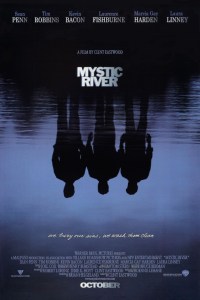 The acting is phenomenal. The story is twisting and layered with incredible amounts of depth. The direction is calm and focused. This is a great Greek tragedy and a great crime story and human drama. Eastwood scores again.
Nate’s Grade: A
Share this:

Kill Bill Vol. 1 (2003)
 Breathtaking and stylistically amazing. That’s all there is to it. Can’t wait for part two.
Nate’s Grade: A


 nathanzoebl
You must be logged in to post a comment.