Blog Archives
I, Tonya (2017)
 Back in 1994, popular culture was rabidly obsessed with figure skating thanks to Tonya Harding (Margot Robbie), the “bad girl” who was accused of coordinating an attack on her skating rival, Nancy Kerrigan. Tonya’s skuzzy husband, Jeff Gillooly (Sebastian Stan), had hired a friend to “intimidate” Kerrigan, and the end result was a broken knee and the world-famous outcry of, “Why?!” I, Tonya takes a look at the players of this media circus and lets them tell their own stories in their own words.
I,Tonya feels brazenly like a Scorsese movie populated with kooky Coen brothers characters. Director Craig Gillespie (Lars and the Real Girl) cribs from the best and uses all those propulsive camera moves, voice over leading to fourth-wall-breaking, and music needle drops to draw an audience into this crackling crime story. The biggest decision made by screenwriter Steven Rogers (P.S. I Love You) is the dueling perspectives of Tonya and Jeff being given equal treatment. They both sit for a series of on-camera interviews and will even interrupt the flashbacks to object. Jeff will recount a time Tonya chased him around with a loaded shotgun, and then Tonya will turn to the camera and argue that this moment never happened. I, Tonya doesn’t tell you who to believe and who to doubt. The account will purposely contradict one another, often demonizing the other party and painting themselves as a larger victim of fate. The movie is steadily entertaining as it mixes moments of light and dark. Tonya breaking the fourth wall to talk about her domestic abuse is another way of showing just his disassociated she’s become to a life of abuse. It turns fourth wall break into coping mechanism. I was laughing at the buffoonery of Jeff’s goons and moved by the relentless torment of Tonya. It’s a story that’s worth revisiting and is given an invigorating sheen of inept crime thriller. Gillespie goes a little too hard with the Scorsese speed ramp zooms and quantity of literal song selections, but it doesn’t detract from the film’s overall entertainment impact.
 This is a film about reassessing preconceived notions about who the characters are, what the story exactly is, and where the truth lies amidst all the madness. Tonya scoffs, “There is no such thing as truth,” as if she were channeling the forty-fifth president of the United States of America. This becomes a foundational thesis of the movie as we’re presented with conflicting personal accounts where characters will break the fourth wall to criticize the validity of what they are doing or saying. All of these conflicting accounts force the audience to constantly reconsider what we are seeing and being told. We have to consistently think about the source and how there might be bias at play. As expected, Tonya and Jeff’s differing versions of events paint the other as more knowingly duplicitous. Tonya flat-out accuses Jeff of years of physical abuse, the kind of relationship Tonya’s vicious mother had primed her for. LaVona Golden (Allison Janney) would say all of her cruel hostility was valuable in an ends-justify-the-means crucible. Through fighting to earn the approval of an abusive authority figure, Tonya became one of the greatest figure skaters in the world, the first to achieve the vaulted triple axle. LaVona shouts that “nice” doesn’t get you anything in this world (her own mother was nice and LaVona became a waitress). People throughout I, Tonya are reshaping worldviews, angling for sympathy, and spinning history for personal advantage. Everyone wants to be a victim, a martyr, or at least the person who was right in the end. By the end, you don’t know what exactly to believe and whose truth is closest.
This was a media scandal that the public gladly gobbled up every new morsel, bringing out the knives to carve up a villain served up on the Olympic stage, but I, Tonya is a very empathetic portrayal that still doesn’t take the edge off of its title heroine. She grew up poor and scrappy and had to make her own costumes for her skating performances. From a technical standpoint, Tonya Harding could out skate anyone, but she didn’t fit into the cookie cutter beauty pageant image of what a wholesome girl should represent. The same bias against her, the trailer trash girl who couldn’t catch a break, was still dragging her down even when her skating was superior to her competitors. It definitely helps to paint a sympathetic portrayal for the woman, and that’s even before the years of abusive relationships, and a husband she may have returned to in order to appear more “wholesome family.” It’s easy to castigate Tonya Harding as a villain, but it’s even harder to see the person inside the caricature that was sold for mass media consumption.
The use of humor has to be very delicate because of all the controversial material. We have naturally offbeat characters doing incredibly stupid things, and then we have a husband repeatedly hitting his wife. This seesaw of tone means that the comedy needs to be precise or else it will undercut the drama or, worse, cross into gross mitigation of abuse. LaVona is a popular source for verbal abuse, and it’s meant to be shocking, but at no point do I think the film trivializes the conditions of Tonya’s childhood for ironic comic fodder. It’s presenting an abnormal treatment of an abnormal upbringing, and the later detours with “The Incident” are highlighting the naturally cracked criminals. These people were not good at what they were doing and were easily caught. The nimwits-try-their-hands-at-crime subgenre is ripe for laughter, in particular Shawn Eckhardt (Paul Walter Hauser) and his self-professed masterful skills at counter terrorism planning. The Tonya Harding scandal is so inherently sensational and with so many bizarre, colorful characters that to treat it without its penchant of natural humor would be a disservice. Crazy people doing dumb things are going to tend to have some humor value. Where the film falls short is in the realm of media satire. There are a few tasty morsels sprinkled throughout, like LaVona forcing reporters to stand behind a rope line if they wanted to snap her picture, but overall the media satire feels flat. Bobby Cannavale (Spy) feels completely wasted as a Hard Copy reporter/exposition device. He offers few insights and fewer colorful anecdotes. The most pointed the film gets with media commentary is when Tonya looks directly into the camera and accuses each person of being her abuser. It’s a stark turn that stops the action cold, and the audience has to think about their own tacit approval through media consumption. By rewarding this coverage and the easily packaged version of events, have we all played a part in Tonya’s suffering and shame?
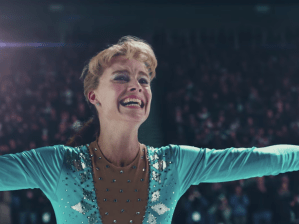 Robbie (Suicide Squad) is sensational in the role, eliciting so much emotion that it can instill whiplash. One moment you’re impressed by the depth of her vulnerability and the next you’re whistling at her hard-as-nails persona and sheer tenacity. It’s an unapologetic performance that goes dark places and serious places, but Robbie doesn’t stoop to pander. Tonya wants your empathy but she doesn’t want your pity, and she sure as hell isn’t going to pretend to be somebody she’s not. The tricky part is the question over who is Tonya Harding. With Robbie, she’s a profane firebrand who is impatient with a world that refuses to accept her and her talents. The scene where Tonya is stripped of ever competing again in professional figure skating is a dazzling piece of acting on Robbie’s part. Tonya has sacrificed much of her own life for this sport, and by her own admission she doesn’t know how to do anything else. To see it all go away with the pound of a gavel, she pleads for jail instead as a more humane punishment. This feels like Robbie marking her grand entrance into the next acting echelon in Hollywood.
The supporting roles nicely serve their purpose, with Janney (The Girl on the Train) being the obvious standout. Her hellish mother is overpowering in every sense. Janney is abrasive and fierce and a crutch for the screenplay when it needs something shocking. I do not doubt the voracity of what the Tonya and other participants have said about LaVona, but the filmmakers don’t know when to leave enough alone. There are insights to be had through LaVona’s relationship with her daughter but it’s too often one-note. She’s the angry older woman berating people for shock, comedy, or a transition.
I, Tonya might change your mind about Tonya Harding. She’s definitely unrepentant in the movie while at the same time asking you to view her with an empathy that was lacking during the parade of 1990s tabloids. She’s an abuse survivor who had to claw for every advantage she could earn. You might not like her, or maybe you’ll grow to appreciate her, but you will understand her better. Robbie is outstanding, Janney is highly memorable and perfectly cast, and the direction provides plenty of jolts, from electric camerawork to the energetic propulsion through its diverging viewpoints. The dark comedy works, the serious drama works, and the domestic violence is not trivialized with so many ironic winks. I, Tonya is an unflinching expose that forces you to question the validity of everything. It’s a movie that dares you to question your perceptions while you’re keenly watching. Perhaps twenty years later, Tonya Harding will get whatever she is due.
Nate’s Grade: B+
Share this:

Fright Night (2011)
 Horror is a genre that’s been notoriously cannibalistic, especially as of late. I don’t mean flesh-eating, I mean the glut of remakes that has polluted the horror market in recent years. After remakes of Halloween, A Nightmare on Elm Street, Friday the Thirteenth, The Hills Have Eyes, House of Wax, Prom Night, My Bloody Valentine, The Amityville Horror, The Fog, The Texas Chainsaw Massacre, Black Christmas, Sorority Row, Dawn of the Dead, The Crazies, Don’t Be Afraid of the Dark, I Spit on Your Grave, Last House on the Left, The Thing, and scads more, you’d be forgiven for believing that the remake of 1985’s Fright Night would be another soulless cash grab. It turns out that it’s way better than even the original and quite an entertaining movie that got lost in the shuffle.
In a quiet little suburb outside Las Vegas, students are going missing. Ed (Christopher Mintz-Plasse) suspects that there is a vampire in town. Ed’s former friend, Charley Brewster (Anton Yelchin), dismisses this idea, especially since the would-be vampire in question is his new neighbor, Jerry (Colin Farrell), a home construction worker who seems to work at night mostly. But lo and behold, after Ed goes missing, Charley concludes that his old friend was right all along. Jerry has his eyes set on Charley’s single realtor mom, Jane (Toni Colette), and maybe even Charlie’s sprightly girlfriend, Amy (Imogen Poots). The only ally Charley can muster is a drunken Vegas magician in the Criss Angel tradition. Peter Vincent (David Tennant) has been studying vampires for years due to his tragic personal connection to vampires, notably Jerry.
 Fright Night finds that horror sweet spot, equal parts scary and funny. Credit screenwriter Marti Noxon who cut her teeth on TV’s seminal show (yeah, I said it) Buffy the Vampire Slayer; there’s even a reference to a “Scooby gang” for we Buffy fans. Noxon does a terrific job of establishing a suspenseful situation and then developing it nicely, teasing it out. There’s a sequence where Charley is trying to rescue a neighbor lady that just involves a series of hiding places but uses a simple setup of ducking around corners so well. When our plucky protagonist checks in with Vincent for some assistance, we’re introduced to an array of exotic vampire-hunting weapons and artifacts that the Vegas magician has under glass. With a setup like that, you better believe we’re going to be using those weapons later, and how. The character development is richer than most teens-battle-monster genre films. The relationship between Charley and Ed, and the awkwardness and resentment of two friends growing apart, feels rather believable even dropped into the middle of a vampire adventure. The standard girlfriend role is given a bit more weight, as she’s the one who feels confidant and aggressive. She knows what she wants, and as played by the adorably named Imogen Poots (Solitary Man), you want to be what she wants. Seriously, this actress is striking in her Grecian features and I like a woman who knows how to handle a mace. There are also small touches that I really enjoyed that helped round out the movie. At one moment, a woman is being fed on by Jerry and she spots Charley hiding behind a door. Rather than cry out for help, she carefully draws a shaking finger to her mouth, wishing him to keep quiet and not to save her. The resolution of this rescue attempt is shocking in all the right ways. It’s a surprise that feels completely within reason, and organic twists and turns are always the most satisfying.
Noxon’s script continually surprises even when it starts to follow a by-the-numbers plot. Instead of an axe lopping off a vampire’s head, it just goes about halfway through thanks to the rigidity of bone. That’s a nice touch, but then when that same vampire tries to bite our hero and can’t move his fairly severed neck closer, then that’s when Noxon has capitalized on her cleverness. And she capitalizes often enough for Fright Night to be a real step above most vampire action flicks. Noxon also finds clever spins on vampire mythos; to get around the whole can’t-enter-without-an-invitation rule, Jerry just attempts to blow up the Brewster’s home to drive them out (“Don’t need an invitation if there’s no house”). There’s a particularly ingenious method to light a vampire on fire. And the entire character of Peter Vincent, played brilliantly by Dr. Who actor David Tennant, is a hoot and a great addition. He’s a riot as a cynical, profane, and selfish stage performer. His character is such an enjoyably comic foil, and Tennant plays him with aplomb, that you almost wish for a Peter Vincent spinoff movie.
Director Craig Gillespie shows that he is shocking adept when it comes to staging a horror film. I would not have expected this level of competency from the director of Lars and the Real Girl. It embraces its R-rating and the bloodshed is plentiful though the gore is restrained. Gillespie draws out scenes with judicious editing, letting the dread build steadily. The tension of something simple like Jerry standing in a doorway, waiting for any verbal slipup to come inside, can be terrific. Gillespie also has some nifty visual tricks up his sleeve to complement Noxon’s crafty screenplay. There’s one scene where Jerry walks into a hotel lobby and is confronted by a security guard. The camera pans over a series of security monitors that do not pick up Jerry. Then in the background we see Jerry hurl the guard to the ground to bite him and in the foreground we see the security footage minus Jerry. There’s an ongoing tracking shot inside a fleeing minivan that’s not exactly Children of Men but still a good way to feel the fever of panic. The final showdown between Charley and Vincent versus Jerry is suitably climactic and rewarding, nicely tying back elements that were introduced earlier and giving Poots an opportunity to vamp out, literally and figuratively.
 Farrell (Horrible Bosses) is a charming, sexy, alluring menace as Jerry, which is exactly what you’d want in a vampire (sorry Twilight fans). Vampires are supposed to be seductive; they’re inherently sexual, what with all that biting and sucking and sharing of body fluids. If Jerry is going to be dangerous, he also has to be seductive, and Farrell is exactly that. With his swaggering walk, with his pose-worthy stances, with his grins, he’s a great ambassador for vampire kind. But this guy does more than preen; he’s also a credible threat. He’s the bad boy that is actually quite bad. Farrell’s enjoyment of his villainous role is noticeable. Jerry taunts Vincent: “You have your mother’s eyes.” He shoots and misses the big bad vamp. “And your father’s aim,” he add, chillingly. Having a strong villain can do wonders for an action movie, and Jerry is a formidable foe played with great relish by Farrell.
Not everything goes off without a hitch. The special effects can be dodgy at times, especially when Jerry goes into full CGI vampire face. The vampires tend to look like shark people, with long exaggerated jaws and rows of gnarly teeth. It’s not a particularly good look. While Noxon’s script excels in most areas, there is still enough dangling plot threads. Charley’s mother is really never a figure of significance. Her potential romance of her neighbor/vampire is a storyline that is never capitalized upon, oddly enough. That seems like the kind of storyline you’d build a whole movie around. She’s written out of the movie in hasty fashion, immediately going from a sequence of driving to being unconscious in a hospital bed. How did that happen exactly? After the Brewster house explodes, nobody seems to make a big deal out of this, like it’s just some regular neighborhood occurrence. What kind of neighborhood watch is this?
Fright Night is just a fun night out at the movies. It’s got plenty of laughs thanks to Noxon’s clever script, plenty of scares thanks to Gillespie, and plenty of sex appeal oozing from Farrell (though “sex appeal” and “oozing” don’t sound like an advisable linguistic match). It’s not much more than a vampire action flick but it’s a really good vampire action flick, clearly a cut above the dreck that usually just relies on its audience’s understanding of genre convention to cover up for its shortcomings. There’s no reason you cannot be a good movie with this genre, and Fright Night is proof of that. Convincingly acted, cleverly staged, and surprisingly well-executed, this is one genre movie that hits the right vein.
Nate’s Grade: A-
Share this:

Lars and the Real Girl (2007)
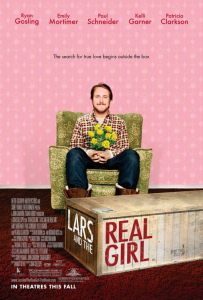 In order to be affected by the sweet romantic spell of Lars and the Real Girl, the viewer must accept everything as a fable; to try and apply real world logic would destroy the film’s magic. Lars (Ryan Gosling) is a painfully shy man still haunted by the knowledge that his own birth killed his mother. He lives in his brother’s garage and has difficulties interacting with regular folks. Then one day comes Bianca who just happens to be made of silicone; she’s a Love Doll, though Lars’ relationship with the upgraded Barbie is completely platonic. Lars is using the doll to deal with his own intense loneliness and his family and the town, a.k.a. the most understanding town in the world, play along to help Lars along on his emotional recovery. Gosling, in short, acts the hell out of this movie. His performance is a bit mannered but he channels so much pain and unresolved emotions that it’s a marvel to watch. He makes Lars more than just a weirdo with a weird coping mechanism; he makes Lars deeply, excruciatingly human and filled with unmet desire for affection. Gosling is so immensely talented that I don’t know if there are any limits to what he can bring to a character. The film has just enough psychology to it that the slew of characters deepen as we progress and the audience grows attached. By the end, I was amazed at how much genuine emotion I felt for a giant hunk of silicone. Give credit to the filmmakers who play Lars out with conviction and grace, and give major credit to Gosling.
Nate’s Grade: B+


 nathanzoebl
You must be logged in to post a comment.