Blog Archives
The Tragedy of Macbeth (2021)
 At this point, William Shakespeare’s tragedy of witchy regicide has been adapted into over 30 movies, most recently in 2015 with Michael Fassbender and Marion Cotilard, so with any new Macbeth the question arises: what will this one offer? The pedigree behind this 2021 film is mesmerizing: Denzel Washington, Frances McDormand, and director Joel Coen. That’s enough reason to see another rendition of the Bard, although the best acting comes from a surprise, theater vet Kathryn Hunter who portrays all the witches as one person (plus more). She’s captivating and haunting and the highlight of the movie. This is the most, for lack of a better term, ordinary film in Coen’s quirky career and his first without brother/collaborator Ethan. It finds a dreamy middle ground between film and theater, utilizing imposing and stark sound stages and striking chiaroscuro black and white photography to feel otherworldly. The eerie, shifting imagery and alien presentation makes the movie feel like a transporting dream oiled by the lugubriousness of Shakespeare’s brilliant words. This version also demonstrates some of the more violent actions typically reserved for offstage implications (poor Macduff son). This Macbeth is also shockingly fast-paced, barely clocking in at 105 minutes, about half of the running time for the unabridged stage play. The acting is uniformly good but I was slightly let down by the leads. I guess I was expecting more indulgence in the sheer thespian feast and was surprised they made more of a tiny meal of things. If you’re familiar with the source material, there should be enough here to appeal to you, though I still hold the Patrick Stewart BBC production as the best film adaptation yet. Go into The Tragedy of Macbeth expecting good, not transcendentally great, and lean back and enjoy the aural pleasures of theater.
Nate’s Grade: B
Share this:

In the Heights (2021)
 Weeks ago, I listened to the original Tony Award-winning 2008 Broadway recording for In the Heights, the first major musical by multi-hyphenate artistic virtuoso, Lin-Manuel Miranda. I had never heard the music before and I found that, over the course of a couple hours, little of it stuck with me. There were a handful of tracks where I thought it was nice but nothing grabbed me the way that Hamilton’s soundtrack did from the very start. Because of that musical dip, my expectations lowered slightly for the long-anticipated movie musical of In the Heights. Well, dear reader, let me say what a monumental world of difference seeing the songs in their proper context, with character relationships, and the able performances of the actors can do for making the music come alive. In the Heights is an exuberantly joyous experience, one brimming with energy and good vibes and a warm-hearted welcome that serves as the best argument movie theaters can have to come back and experience the pleasures of the big screen with your friends and family.
Usnavi (Anthony Ramos) is a twenty-something bodega owner in New York City’s Washington Heights neighborhood and dreaming about returning to his home in the Dominican Republic. His young cousin Sonny (Gregory Diaz IV) helps him stock the shelves and keep the family business going. We follow the many faces of the neighborhood, like Abuela (Olga Merediz), who has helped raise everyone as a sweetly matronly figure, Nina (Leslie Grace), returning home from her first year at Stanford as the “girl who made something of herself,” Benny (Corey Hawkins) who was in a relationship with Nina and is looking to work his way up as a cab dispatcher, Daniella (Daphne Rubin-Vega) who is moving her popular salon into another neighborhood, and Vanessa (Melissa Barrera), an aspiring fashion designer who dreams of relocating into Manhattan’s fashion district. Usnavi has been nursing a crush over Vanessa for ages, but will he finally make a move before leaving the country for good to return to the Caribbean?
 This is such a positive and overwhelmingly optimistic story that it becomes infectious, a pleasing balm to sooth all that ails you. It’s very easy to get swept away in the enthusiasm and energy of the movie, enough so that after the exemplary opening number setting up our characters, our setting, and our relationships and goals, people in my theater actually clapped, and I almost felt like joining them. In the Heights succeeds through how relatable and specific it comes across, lovingly showcasing the diverse population of Washington Heights and the community that feels at home here. It’s built upon the celebration of its specific, Latin-American heritage and culture but the movie is also constructed to be so accessible and welcoming to others to learn and join in. The themes and conflicts of these people have specific touchstones to their community, like the threat of deportation and the encroachment of gentrification taking away their neighborhood, but the inner conflicts like feeling the pressure to succeed and questioning whether your dreams are practical are worries that anyone regardless of ethnic background can relate to. In the Heights finds that sweet spot where it’s reverential to its own cultural background and open for anyone.
Naturally, in a musical, much of the appeal will live or die depending upon the quality of the music and the vitality of the performances. With In the Heights, the music and lyrics are quite good and the presentation is phenomenal. If you’re a fan of Hamilton, and if you have ears I assume you would be, it’s fun to listen to the early seeds that would become the signature sound for Lin-Manuel Miranda. There are similar salsa/merengue melodies and hip-hop-infused syncopations that will be familiar to the legions of Hamilton fans, including some rhymes (“Eyes on the horizon” among others). In many ways it’s like watching a junior thesis project of a genius. The opening number does a fantastic job of table setting as well as bringing the audience into this world and getting us excited for more. Usnavi, and Ramos especially, takes full control of our attention and command of the world with fast-paced delivery and extra charisma. There are more bouncy, humorous tunes like “No Me Diga” set in a salon replete with literal bobbing weaves, more traditional Broadway ballads like “Breathe” about a character expressing her doubts and guilt, and the Cole Porter-esque smooth jazz of our young lovers dancing and declaring their affection for one another like “When the Sun Goes Down.”
 But the best moments are the ones that open up the big space and bring the whole community of Washington Heights into the mix. The electricity of the opening number is rekindled in “96,000” where a trip to the local pool turns into a jumping jamboree where everyone dreams about what they would do with a winning lottery ticket sold at Usnavi’s bodega. It allows each character an opportunity to share their dream and what is important to them, providing each person a platform to be more defined. It also taps into that bubbling optimism that permeates the entire movie. The grand finale also has the same effect as characters sing their hearts out about lessons learned and wisdom gained and, thanks to the medium of film, it provides a happy ever after resolution that was unavailable on stage. Miranda is excellent at weaving musical themes to come back into multi-harmonic convergences and crescendos, and it all comes to a rousing and uplifting conclusion.
Another concern about big screen musicals is whether they can translate to the visual landscape of cinema, whether they can escape the trappings of the stage, and In the Heights is exactly how musicals should be filmed. Director John M. Chu (Crazy Rich Asians) got his filmmaking start with the Step Up dance franchise and knows, whatever the film, how to keep things moving swiftly and full of vivacious energy. Even at nearly two-and-a-half hours long, In the Heights doesn’t feel like it has any noticeable down time. The filmmaking choices adapt with the needs and intents of the songs, so when we have a fast-paced multi-part song and dance, the editing adopts this speed, and when we have large ensembles the cinematography widens to take in the expansive group choreography. When things need to slow down and become more intimate, Chu’s camera adopts to this and relies on longer tracking shots and close to medium shots. The pool choreography in “96,000” is splashy fun and lively and very colorful, and the quick visual cues and edits of “In the Heights” incorporates the neighborhood into the music to make New York City feel like a living participant. Chu’s direction takes full advantage of what film can offer but still makes the viewer feel the same intimacy and vibrancy of live theater.
 There are two standout movie moments. The first is the song “Paciencia Y Fe” that does so much symbolic heavy lifting about the immigrant experience, discrimination, and the long struggle for personal dignity, that it made me tear up by the end for a character that, only moments before the empathetic expose, was a nominally nice old lady. The other is “When the Sun Goes Down” between Benny and Nina, which begins with them gazing out a fire escape and takes a magical turn into dancing along the walls of their building like Spider-Man. That transitional moment, from the ordinary to the extraordinary, is the only real magical realism in the show, so Chu has been saving it up for his big moment. The dance is beautiful to behold, and the perspective has an Inception-style spin that alters their balance and perspective of what is up. It’s a beautiful movie moment, captured in long takes, and reminiscent of Fred Astaire’s fanciful fantasias.
Ramos (A Star is Born) played John Laurens in the initial stage show of Hamilton, and its filmed production on Disney Plus, and now he gets his own starring vehicle. He is tremendous as Usnavi, convincingly laid back and charming while also being amusingly anxious around his crush. The awkward romantic fumbles are adorable. Ramos’ singing and skill with the flow of rap lyrics is impressive, but he’s also providing a performance first and worrying about the singing second, not that he should be worried on that front. Hawkins (Straight Outta Compton) surprised me with the range of his singing, and he’s such a pleasant presence to have along. Gregory Diaz IV (Vampires vs. the Bronx) is hilarious at times, like when he’s adopting a macho voice to ask Vanessa adult questions, but he can also break your heart like when he reveals his own legal vulnerability. His poolside solo is also a delightful interjection about what his own rap skills comprise. Merediz (Godmothered) is the only holdover from the original stage show and she is so captivating in her signature number that it’s easy to understand why she was nominated for a Tony Award. There are so many amusing and enjoyable supporting characters populated by familiar faces, like the women of the salon (Rent’s Ruben-Vega, Brooklyn 99’s Stephanie Beatriz, and Orange is the New Black’s Dascha Polanco) providing comic relief and a playful attitude, Jimmy Smits as the noble father giving of himself for his daughter’s future, and Miranda and Hamilton’s Christopher Jackson as dueling sweet treat vendors vying for summer supremacy. You’ll enjoy your time in Washington Heights thanks to these fine folks.
It’s unfair to directly compare In the Heights to Hamilton, like looking at an artist’s portfolio and complaining it isn’t quite up to the standards of Da Vinci, but one area where In the Heights does come up short is the depth of its characterization. The film exudes good vibes as it skips over topical and important political issues with an optimism that might, arguably, borderline on naivete. This feels almost like the opposite-minded compliment to Spike Lee’s Do the Right Thing, another tale of a New York City block one very hot day. The characters are kept at a genial level of interest that makes them enough to feel for and root for, but they’re not exactly deep portrayals with complex conflicts. All the characters have a singularly defined personal conflict that can be resolved by the end, and the lessons about learning to listen to others, appreciate family and self, and find home where you feel it are not exactly revolutionary or complex. Again, this stuff works, and I understand why the story needs characters that have lesser complexity and definition to fulfill the different levels of life. It’s just when compared to the depth of the real people of Hamilton where you realize that maybe the colorful characters of Washington Heights are held to a lesser standard and simply not as multi-dimensional.
 In the Heights is a joyous experience that I think I’ll enjoy more upon re-watching and listening to the soundtrack over the summer months. I can completely understand why people fell in love with this musical upon its initial release and touring, and I can also acknowledge that it’s clearly an earlier artistic steppingstone to greater later achievements for Miranda. That’s not to take anything away from the pleasures of this particular story, these particular characters, and especially these particular songs. In the Heights is a lively and welcoming musical experience that carries a deep affection for its cultural roots and invitation for others to join that celebration. It’s powerfully optimistic that it’s so easy to be swept away and smile with its charms and uplift. In the Heights takes advantage of its cinematic opportunities, the charisma and energy of the talented cast, and the soaring and lovely melodies and catchy rhymes from Miranda. In the Heights is a great way to kick off a return to a summer season at the movies.
Nate’s Grade: A-
Share this:

Straight Outta Compton (2015)
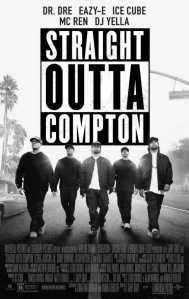 In 1987 in Compton, Eazy-E (Jason Mitchell) was selling drugs, Dr. Dre (Corey Hawkins) was spinning records in a club, and Ice Cube (O’Shea Jackson Jr.) is writing lyrics in the back of a school bus (the movie significantly downplays DJ Yella and MC Ren). The guys have grown up in an environment of suspicions and harassment by the Los Angeles police. Their response was to compose angry and defiant songs illuminating their world. After a few early performances, the group is approached by record producer Jerry Heller (Paul Giamatti) who wants to get them signed and touring. Their music and their perspective catches on and soon NWA is awash in big shows and groupies. Heller puts more of his efforts onto Eazy-E, and Dre and Cube feel marginalized and doubtful that Heller has their best interest at heart.
It’s hard to reconcile the brash and challenging men responsible for NWA and this sanitized and rather rote rags-to-riches biopic that asks curiously little of its subjects when it comes to depth or reflection. Not every biopic needs to be as faithful as the most excoriating documentary on its subject, but we have become accustomed over the last decade to the warts-and-all approach, where the central biographical figures are celebrated for their achievements but care is taken to tell their lives with measured accuracy, not to hide anything that challenges our concept of who these people were. Imagine if Walk the Line had sanitized its portrayal of Johnny Cash, or worse, devoted most of its running time to his stint as a revivalist Christian musician? What if Ray had eliminated his womanzing? What if The Aviator said that Howard Hughes was the model of human sanity? A biopic doesn’t need to tell us every facet of its subject’s life because that is an impossible demand that only the densest of books can truly achieve, however, a biopic must instill the spirit of its subject in an honest representation, because that’s at best what you’re going to get when you apply a human life to the realm of narrative. Straight Outta Compton comes across as far too gentle with its core subjects, portraying them as underdog anti-heroes who were pushed around by those trying to exploit them and their message. Of course this would be the approach when Dr. Dre, Ice Cube, and the widow of Eazy-E produce the film. At this point it’s about protecting the legacy, protecting the brand, and so the members of NWA become far less interesting.
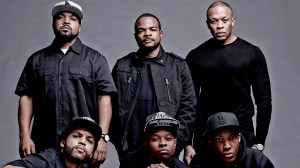 Nobody probably gets the biggest revision than Dr. Dre, especially his violent history with women. As depicted in the film, Dre is a talented and frustrated music producer who is trying to do his best to live up to his dreams but falling short and feeling the pressure of not being the support system for his brother, his girlfriend, his daughter. When the money starts rolling in, Dre embarks on a successful solo career and reconciles with Eazy-E. That’s about all there is to his character arc, a series of creative struggles and trusting the wrong people. There is one very brief moment that hints at Dre’s history with women, when his girlfriend expresses caution about getting too involved with Dre because she doesn’t want anything negative to happen to her young son. This woman doesn’t appear to be Michel’le Toussaint, a best-selling Ruthless Records artist who was with Dre for seven years and gave birth to their son in 1991. Toussaint has spoken about consistent physical abuse, including an incident where Dre shot at her through a bathroom door. Then there’s the glaring omission of Dee Barnes, a journalist who Dre brutally beat inside a nightclub in 1990 (Dre has finally come forward and apologized for this incident but only after the Apple overlords or Universal execs probably applied some pressure to make the bad PR from the press tamp down). Director F. Gary Gray (Friday, Law Abiding Citizen) has gone on record saying they had to focus on the “story that was pertinent to our main characters.” About that…
Straight Outta Compton has a renewed relevancy due to the increased attention in the news concerning police brutality, profiling, and harassment. It was from this combination of oppression and negativity that NWA honed their provocative message. The lyrics of gangster rap reflected the reality of their living conditions, and so they were bleak, angry, violent, and they spurred a sense of relatability across the country from others. It was a reaction against a system that had cataloged them as suspects from birth. The story structure of Straight Outta Compton shows the birth of gangster rap through a select sample of personal experiences. From there we see the rise, the backlash, and I suppose a “we told you so” moment with the aggravation over the Rodney King case turning into the volcanic anger and destruction of the L.A. riots. The aside highlighting the L.A. riots only really serves to underline the idea that NWA’s message of the beaten-down growing increasingly weary of their denigrated treatment. After that, the greater message of what NWA meant to the world of music and culture is lost midst the squabbles of the former friends. This is a missed opportunity at creating a stronger message and adding needed complexity to the main characters. What if Straight Outta Compton had explored the violent life of its stars after they had achieved their dreams? It creates a more damning theme about the consequences of a life under oppression; Dre grew up being harassed and antagonized, which is reflected in their music, but even when they escape that environment the consequences can still follow and entrap them. As it plays, the guys strike it rich, get waylaid by outsiders, and eventually find their footing again. It’s a narrative structure that places all the problems as external threats, be it Heller or Knight or HIV itself, and strips the main characters of their own agency. The movie doesn’t let them account for their own action and finds excuses when able. An incident where they brandish high-powered guns to chase off an angry boyfriend is treated as an unearned and questionable moment of levity. Gray said they could only focus on the “pertinent” stories, but I don’t see anything more pertinent than exploring the psychological trauma of brutality and oppression and how, even as an adult with seemingly the world at your fingertips, it still manifests in your life and personal relationships.
As a standard rags-to-riches biopic, Straight Outta Compton is consistently entertaining and well acted, though it can’t help but feel like we’re rushing through the events. A significant disappointment is the underdeveloped nature of the friendship of Dre, Eazy-E and Cube. There’s an early scene where they’re teasing one another and working out the beginnings of “Boys in the Hood” and this is the lone moment where we feel the dynamic of the trio. The early glimpse at the creative process is a high-point. After that, sadly, the only examination the movie affords on the relationships of the three is the jealousies and divisions. Strangely, the most interesting character relationship is between Eazy-E and Heller, which despite the predictable dissolution is the most heartfelt relationship on screen. Think about that: the most involving relationship depicted in the movie is between a former drug dealer-turned-musician and a Jewish music producer. It’s their opposites-attract dynamic that helps to make them so much more intriguing to watch.
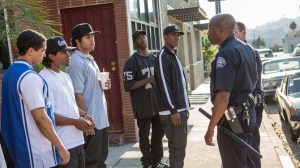 Straight Outta Compton treats Heller as a greedy predator who was cheating NWA out of their rightful earnings, though I’m still a bit skeptical as to these accusations. The movie even gives me a reason to support my skepticism. Once Cube goes solo, a record producer (Tate Ellington) promises to support him on his next record if the first is successful. Obviously Cube is a hit and he comes back to this producer, who explains that he can’t simply just write a check then and there and that it’s more complicated. Cube responds by trashing the guy’s office and the moment is treated as a strangely triumphant moment that the exec even awkwardly jokes about later when Cube returns. This moment made me think maybe, just maybe, the people in the industry weren’t explicitly cheating out NWA but the margins of the recording industry are a bit harder to explain.
While the characters themselves can be a tad boring, the actors do everything in their power to make them feel fully felt. The three lead actors impressed me. Mitchell especially wows in his greater emotional moments, like the discovery of being HIV-positive and only having a few reaming months to live. Jackson Jr. gives an eerily accurate portrayal of his father, and Hawkins (Non-Stop) hits his stride when Dre is most ambitious. The three of them have an easy-going camaraderie that adds to the authenticity. The actors are so good that the deficiencies in characterization are all the more frustrating. The talent was there but the characterization was not. I also want to single out R. Marcos Taylor for his strikingly imposing portrayal of Suge Knight. As soon as Taylor starts eating up more screen time, I couldn’t help but wish the movie’s focus jumped ship to the ruthless Death Row Records impresario.
Straight Outta Compton is already the highest-grossing musical biopic of all time, so surely the wider moviegoing public greeted its safe approach to its subjects with some level of approval. Enough time has passed to add a layer of nostalgia to the early days of gangster rap, as well as political relevancy with the increased media spotlight on overzealous police provocations and the growing Black Lives Matter movement. The time was ripe for this movie and it’s an undeniable hit. I was entertained throughout and found the performances to be involving, but I can’t shake off the feeling about what is being left out. It’s by no means a biopic’s requirement to include everything about its subject, but with the living members of NWA aboard and approving their movie versions, the sanitization of a complicated and contradictory reality is the best we’re going to get. The film doesn’t hold the band up for their behavior, whether it’s promiscuous sex that leads Eazy-E to getting infected (a plot point with no setup beyond some movie-friendly knowing coughs) or Dre’s violent history with women. The move doesn’t have to portray the members of NWA as villains but by treating them as misunderstood underdogs who were exploited by outside forces feels like a (forgive the term) cop-out. These guys didn’t ask to become spokemen for a generation of antagonized and discredited black men, but surely there’s something more interesting and deeper to explore than band in-fighting. Straight Outta Compton is a slick and entertaining film but ultimately just another product.
Nate’s Grade: B-


 nathanzoebl
You must be logged in to post a comment.