Blog Archives
R.E.D. (2010)
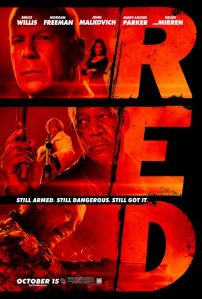 I can watch Helen Mirren fire high-powered weapons all day. RED is a jaunt throwaway that manages to be far more entertaining than it has any right to be. This isn’t excess on the level of The A-Team, nor is it all cynical and emotionless like Wanted. RED is the film that The Expendables could have been with a bit more polish and a little less muscle flexing. The premise almost seems worn out by this point in 2010: retired CIA agents are being hunted down and killed for some mysterious reason. Thus Bruce Willis must travel across the country and recruit his former spooks like Morgan Freeman, a daffy John Malkovich, and dame Mirren. He also gets a rather charming romance with Mary-Louise Parker (TV’s Weeds) as a pension customer service rep that Willis dials up for small talk. She gets whisked along this madcap adventure and enjoys it for the ride that it is. And I think that’s the best summation of the film. What other movie of this sort has actors of this caliber? Four Oscar winners, one nominee, plus solid work from Karl Urban (Star Trek) and beloved character actor Brian Cox to boot. The film definitely has a style, slick enough to please without being heavy-handed to rip you out of the film. The plot may be full of holes, the characters aren’t fully drawn, and certain action sequences are derivative, but thanks to the charms of its golden cast, RED is fun while it lasts.
Nate’s Grade: B
Share this:

Vampires Suck (2010)
 I anticipate and dread the arrival of each new spoof from the wretched comedy team of writer/directors Jason Friedberg and Aaron Seltzer. The pair are responsible for some of the worst movies of the modern era, blindly groping for some sort of fleeting pop-culture relevance. I vehemently oppose their idea of what constitutes comedy and I resent that these two nitwits get to keep making their reprehensibly awful spoof movies at the pace of one a year. They may have taken 2009 off but they released two regrettable spoof movies in 2008 (Meet the Spartans and Disaster Movie), and those two films tied for the honor of my Worst Film of that year. Think of all the exciting, groundbreaking, eclectic, and challenging independent movies that could be bankrolled with the budget of one of these self-indulgent, disposable, juvenile, pop-culture-saturated comedies. Each new Friedberg/Seltzer movie is like a slap in the face and a reminder that the lowest common denominator rules along with the almighty dollar. So I have an open slot at number one on my annual Worst Movies list for whatever Friedberg/Seltzer slap together. I anticipated that their spoof of the popular Twilight series would be more of the same. Vampires Sucks is another ghastly, failed attempt at parody that goes off the rails early and often, but it’s not as egregious as past Friedberg/Seltzer comedy abortions. It’s not even the worst movie of 2010 I’ve seen this year, which is a complete shock. After careful deliberation, that ignoble honor remains with The Bounty Hunter. I never thought a movie could out-suck a Friedberg/Seltzer suckfest.
The plot pretty much follows the first two Twilight films closely. Becca Crane (Becca Proske) is the new girl in Sporks, Washington (laughing yet?). She’s living back with her father (Diedrich Bader) and looking for a way to fit in. Then along comes Edward Sullen (Matt Lanter) and the two can’t resist each other. He’s a vampire, she’s a moody teen girl, blah blah blah. There’s also Jacob White (Chris Riggi) who turns into a little toy dog instead of a werewolf. He also chases after cats. How can you resist?
 There are less throwaway pop-culture references that have a predetermined expiration date soon approaching. Sure, there’s still references to pop-culture figures without any meaning of setup, context, or satire, like half-hearted momentary glances to the Jersey Shore goons, Gossip Girl, The Real Housewives of Atlanta, and an inexplicable reference to Alice in Wonderland. The heroine is seen getting shot by a stray bullet and falling down the rabbit hole. What makes that funny? Is it funny because we recognize the identity of who was shot? Would it therefore not be funny if it was an unknown victim? Wouldn’t it be more amusing if the figure who got clipped was someone who people secretly, or openly, wished would get injured? Does anyone hold such animosity against Alice? But this example also showcases the comedy construction issues that plague Friedberg/Seltzer movies. I just don’t know if these guys understand the fundamentals (fall down = funny) but they haven’t advanced beyond the infantile stage. Take for instance a scene where Edward promises Becca that he won’t ever let anything hurt her. Obviously we know what will happen next and sure enough the roof caves in on her while Edward stands and grimaces. The joke sort of works (I’m feeling charitable) as long as the onslaught of bricks keeps falling on the off camera Becca. But when Friedberg and Seltzer cut to a shot of legs kicking underneath an increasing pile of bricks and hold onto the shot for ten seconds, it kills the gag. Editing choices change the violence from cartoonish to uncomfortable, and realistic violence is rarely funny.
Friedberg and Seltzer litter their script with wandering setups in desperate search for punch lines. Take the line: “We’re just like any normal family, except we never go to sleep and drink blood.” The line is begging for a “like” reference to make a further connection. As is, it’s a setup disguised as a weak punch line, and they’re everywhere in Vampires Sucks. I kept waiting for punch lines that never came. The best example is Bella and her friend leaving a theater that is playing the final Twilight film, Breaking Dawn (unclear which half). They stroll along the theater loudly complaining about the absurd ending and then the Twilight fans waiting outside are upset that the ending has been spoiled for them. This joke stands in direct conflict with the Twilight subculture it intends to satirize. Twilight fans are obsessed about their brand and alliances (Team Edward vs. Team Jacob). And these people would not wait a nano-second to be surprised by plot. They voraciously consume all things Twilight and know every detail. The idea that obsessive Twilight fans would willingly abstain from knowing the ending of the book series is preposterous. This joke does not work at the construction level.
 Perhaps the reason why Vampires Sucks feels less scattershot and cannibalistic of pop-culture is because the film spends less time lampooning Twilight and more time replicating them. Many scenes play out in the same fashion as Twilight and New Moon, so you’re left scratching your head and waiting for when something deemed a “joke” in other contexts, though they don’t have the same feel here. What happens is that you end up with a Twilight movie that just ends scenes with people getting subjected to slapstick violence. A rule you can set your watch to: in a Friedberg/Seltzer movie, if a character throws something off screen, it will hit another character in the head or, if recipient of broadside is male, the junk.
Since the Twilight series is so overwrought with teenager hormones and old-fashioned yearning, it practically begs to be mocked. Because it’s so ripe a subject for ridicule every now and then Friedberg and Seltzer stumble upon a mildly effective shot at the goofy, gooey nature of the vampire series. It’s all criticisms that have been well established, including the pre-teen wish-fulfillment angle I’ve touched upon in all three of my personal Twilight reviews. One of the three and a half laughs I gave this movie was a faux alt-rock song by Magicwandos called “Panties” with lyrics like, “I feel so lonely/ Nobody gets me/ I feel so unhappy/ Why can’t I find a cool, alternative boyfriend?” and the chorus, “We can watch Degrassi/ Shop at Hot Topic/ Sexting dirty pics of me in my panties.” It’s pretty one-the-nose and not very nuanced but it got me to laugh, plus it’s a laugh I can credit to the band Magicwandos and not Friedberg and Seltzer. After five movies, Friedberg and Seltzer have made me laugh a total estimate of 8 times. At a combined 410 minutes, that’s .87 laughs per hour.
The lead actress is far, far too good for this movie. Proske delivers a spot-on impersonation of Kristen Stewart’s acting mannerisms, from playing with her hair, to lip biting, to the blink-heavy shifty eyes and mumbled monotone. Proske isn’t given much assistance from Friedberg and Seltzer but she still provides one reason to watch the screen for those painful 80 minutes. It’s too bad she isn’t given anything funny to do or say. It’s a waste of a perfectly good Kristen Stewart impersonation. You may also recognize Ken Jeong (The Hangover) and Dave Foley (Kids in the Hall) and openly wonder why good comedic actors would be duped into a Friedberg/Seltzer production. The answer can only be that of gambling debts. I’m shocked that Carmen Electra is nowhere to be seen, thus breaking her streak of appearances in 4 Friedberg/Seltzer movies.
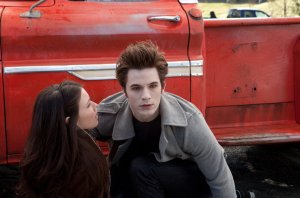 In the realm of crappy cinema, Vampires Sucks definitely lives up to its lofty title. Yet it’s not the outright creative abomination and entertainment vacuum that was Epic Movie (worst films of 2007), Meet the Spartans, and Disaster Movie. Does that qualify the film as good? Not even close. Relying less on Friedberg and Seltzer’s M.O. of disposable pop-culture references posing as “jokes,” Vampires Sucks manages to suck less by the sheer genius act of laziness. The film doesn’t attempt as many jokes therefore offering fewer opportunities for jokes to die horrible, excruciating deaths. The ratio of comedic failure is still the same depressing level of ineptitude, but less jokes equates to less mind-numbing torture disguised as comedy. It also makes the movie more pointless and an even bigger waste of time than previous Friedberg/Seltzer efforts. It’s the kind of accident that doesn’t even allow for rubbernecking.
I’m finding it hard to as incensed as other Friedberg/Seltzer movies have made me. These guys bring out something virulent from me. Maybe it’s my love of movies and comedy and my distaste for hacks being rewarded for repeated hackwork. Maybe I’m trying to take a final stand against the cultural shift that confuses situation-free pop-culture references as jokes. Whatever the case, the guys are at the top of my cinematic shit list. So you can trust me when I say that Vampires Sucks is easily terrible, poorly conceived, poorly filmed, and with limited aims that it still misses by a mile, but it’s not the abysmal, faith-destroying experiences that the last three Friedberg/Seltzer offerings were. It is simply just bad. Really, really bad. And yet with Friedberg and Seltzer, that is an improvement. It’s all about perspective, people.
Nate’s Grade: D
Share this:

Scott Pilgrim vs. the World (2010)
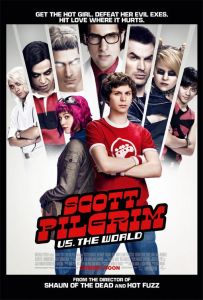 What happens when the millennial generation gets its own (attempted) seminal movie? It stays home and plays video games, letting the film, Scott Pilgrim vs. the World, languish at the box-office. I guess that’s what happens when you finance a movie whose target demographic will just as readily download the movie for free off the Internet.
Scott Pilgrim (Michael Cera) is a 22-year-old Toronto slacker. He?s the bass player for the band Sex Bob-Omb, along with lead singer Stephen Stills (Mark Webber) and acerbic drummer Kim (Alison Pill), a former ex-girlfriend of Scott’s from high school. The band’s biggest fan is 17-year-old Knives Chau (Ellen Wong), who also happens to be Scott?s new girlfriend. The world of Scott Pilgrim is abuzz with this scandal, especially Scott’s gay roommate Wallace (Kieran Culkin) and Scott?s younger sister (Anna Kendrick). Scott insists it’s all on the level and he has no ulterior motives for dating a high schooler. Then he sees the mysterious and alluring Ramona Flowers (Mary Elizabeth Winstead) who?s new to the area and American. Scott rabidly pursues her in what could best be described as stalking, eventually getting her to agree to date him. Trouble is, he hasn’t broken up with Knives just yet before starting this new venture. Scott is then confronted at the Battle of the Bands concert by a man who comes bursting out from the ceiling. He is the first of Ramona’s seven evil exes and Scott must defeat them all in order to earn the right to the violet-haired beauty. “Everybody has baggage,” Ramona says. “Yeah, but my baggage doesn’t try and kill me,” Scott wearily replies.
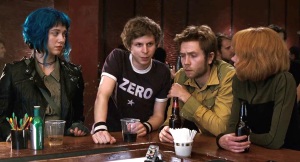 Visually, this movie showcases director Edgar Wright (Hot Fuzz, Shaun of the Dead) using every crayon in the Crayola box. This is a visually resplendent film where every scene seems crammed with details to delight the eyes and light up the senses. It’s a rush to watch the kaleidoscope of colors and motions. The Scott Pilgrim universe clearly differs from our own. This is a realm that borrows heavily from old school video games, where people burst into coins when vanquished, where life-decisions are met with “leveling up,” where people have onscreen pee bars that will deplete after a trip to a urinal. Sound effects will routinely be verbalized on screen, everything from a “RIIIIIIIIIIING” of a telephone to the “Ding Dong” of a door. It’s amusing, though also easily overused. Jobs and stuff like that are for the real world, hence too square to be depicted. It’s this entire idiosyncratic comic book world treated like everyday reality.
The enormous display of style is impossible to ignore. Scott Pilgrim is a slick, flashy piece of entertainment that is riddled with nostalgic references for a select crowd. I appreciated how a nice walk was accompanied by the theme song from The Legend of Zelda, or that sound effects and onscreen graphics echoed the fights from Street Fighter II (don’t ask me which of the 800 versions). Scott Pilgrim is an excellent pop pastiche of a specific culture, namely a slacker, hipster, amiable, comics and gamer group. I myself was an avid Nintendo gamer back in my day, but I admit to waning interest when the games got too complicated and grisly (“Back in my day we had two buttons to push, one to jump and the other to shoot, and that’s how we liked it!”). The movie is an explosion of color, light, and (lo-fi garage rock) sound, which also might sound like the description of a seizure or a stroke to some. Like those ailments, Scott Pilgrim will be seen by some as an infliction. It’s hyperactivity and eagerness to please via nostalgic reference points will be what drives people to this film and what drives them away in equal measure.
The Scott Pilgrim graphic novels total six volumes and approximately 1200 pages, which means it?s not the easiest fit for a two-hour window. It also hurts that the Pilgrim books have a wide supporting cast of characters to tussle with, plus there?s the whole seven deadly exes thing which means the movie has to provide about a solid 20 minutes of set-up before finding enough time for seven antagonists (or boss battles, following gamer parlance) and a reasonable amount of resolution. Add on top of this the fact that Wright keeps the movie moving at an outrageous, ADD-addled pace, like the plot conveyor belt lever got broken and the scenes speed one after another. Everything about this movie feels fast and over caffeinated. The editing in particular has characters holding conversations where every line is in a new location, implying an added sense of movement. So you shouldn’t be too surprised when the Scott Pilgrim film feels like a whole lot of a little; it’s moving at the speed of light to entertain.
 Because of the plot mechanics and oversized cast of characters, Pilgrim can give off the impression of shallowness. It seems like all style and little substance and that’s because the movie attempts to cram an entire series of stories, back-stories, and conflict into two hours. The film version only has enough time to attempt to give Scott and Ramona characterization, though both come across as weak-willed, tentative, and less than charismatic, wondering if either party is worth the trouble. The movie tries to paint over these differences through distraction and force of will. The large cast of supporting players all elbows each other just to be mouthpieces for one-liners. Knives actually comes across as the most complete character, consumed by her infatuation, heartbreak, and then quest for misguided vengeance. She’s somewhat dismissed and yet she is the most developed person on screen thanks to Wong’s endearing and relatable performance. The entire experience of Scott Pilgrim vs. the World can be somewhat fatiguing when there’s little evidence presented for emotional investment. The books supplied the reasons for caring besides the whole underdog angle.
The movie aims to be a battle over love, but it’s not entirely convincing. Scott appreciates Knives because she’s simple, a relationship he doesn’t have to invest much within, something casual and enjoyable while it lasts or until it becomes too taxing. Then he goes ga-ga for Ramona and stalks her, wearing down her defenses. He’s purely smitten with her and willing to do whatever it takes to earn her affections, though he can?t explain why he feels this way. Here’s a note to screenwriters: when characters are asked why they love somebody, do not have them say, “I don’t know.” But for Ramona, Scott is her Knives. He’s something easy that won?t break her heart, an escape from the jerks she’s been dating before. He?s low maintenance. He’s something to pass the time. There’s an interesting dynamic here, made even more complicated by the fact that Scott’s time with Knives blended with his time with Ramona. There was not a clear end point. The movie takes a literal approach to the idea of love being a destructive force of nature. Scott is punished throughout because of his infatuation with Ramona, but he persists despite the bruises. And he doesn’t even really know much about her. There’s an interesting statement somewhere there about the punishment we endure, sometimes foolishly, over the affections of people we may love, or convince ourselves of, but not even like.
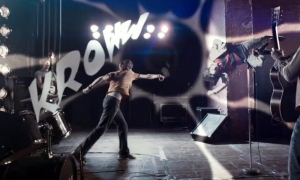 It may sound peculiar but I’m paying Michael Cera a compliment by saying his performance in Scott Pilgrim is the least Michael Cera the actor has ever been on screen. Gone is his gawky, awkward, ironic shtick that has fast become the Cera persona in films like Superbad and Year One. Scott is unjustifiably confident in his life’s pursuits, and Cera gets to act cocky and quippy, even if it?s done with a wink. He?s an unlikely kung-fu star but then again he?s also an unlikely leading man. Winstead (Live Free or Die Hard) is cute but plays her part a bit too toned down, like Ramona’s still searching for the right medication combination. Culkin and Pill are both scene-stealers of the first order, doing so with unabashed and flippant sarcasm. Every scene is made better by their presence. Among the evil exes, Brandon Routh (Superman Returns) has plenty of fun as a dim-witted super-powered Vegan bassist (“Vegans are just better than other people”), and Jason Schwartzman epitomizes hipster snark with such relish. The film is exceedingly well cast from top to bottom.
I’ve read some reviews positing that Scott Pilgrim vs. the World is an elaborate fantasy taking place in the mind of its titular hero, that he blends his knowledge of comics and video games to help make sense of the troubled waters of relationships and lingering hurt from the demise of love. I think that’s a nice explanation but perhaps trying too hard to frame this film as some form of psychoanalytical commentary on modern youth’s interpersonal relationships and the value of love. Scott Pilgrim vs. the World is really just a spastic, hip, clever wank that, as presented, gives little room or emotional investment. It?s a blurry, messy, prankish good time at the cinema that doesn’t translate into much more than the equivalent of sensory button mashing (video game reference). It’s fun while it lasts but it doesn’t have much beyond those astounding visuals to make it feel lasting, and I say this as a genuine fan of the graphic novels by Bryan Lee O’Malley. Alas, heavier discussions about the thorny, maddening issues of love are better left to more dramatic, and romantic, movies like Brokeback Mountain, Eternal Sunshine of the Spotless Mind, and even WALL-E. This movie is more preoccupied with spinning as fast as it can and then vomiting.
Nate’s Grade: B
Share this:

The Other Guys (2010)
 Surprisingly consistent in its belly laughs, The Other Guys proves that Will Ferrell is at his best when he re-teams with his greatest collaborator, co-writer and director Adam McKay (Anchorman, Step Brothers). The duo takes on the cop genre with a loving parody that manages to send up the genre while celebrating its excesses. Ferrell and his partner (Mark Wahlberg) stumble onto a mostly convoluted financial scam with banks, traders, and the police. The movie takes scene after scene and gives it a little twist for the self-aware characters to comment, usually to great comedic effect. There were some stretches that I was near tears from laughing so hard (the tuna vs. lion argument is an instant classic). I expected to be amused by the movie since nobody does silly smarter than Ferrell with McKay, but I was not prepared for how much I genuinely liked this movie. From scene to scene, I found something different to laugh at. There’s an undercurrent of rage from McKay concerning the economic stickup Wall Street got away with in 2008. The end credits are an animated statistics presentation on how large Wall Street firms screwed over the American public and are still profiting off of pubic misery. It’s a bit odd tonally to cover at the end of the film, like McKay wanted his legions of fans to get some morsel of education by the end of a film with goofy action and juvenile sex gags. The joke is on us all.
Nate’s Grade: B+
Share this:

Date Night (2010)
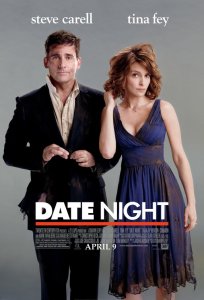 Here is a classic example of two game comedians elevating substandard material. The contrived premise revolves around an ordinary if somewhat bored married couple (Steve Carell, Tina Fey) being chased all over New York City in an extreme case of mistaken identity. Carell and Fey have a terrific comedic dynamic and watching them play and riff is when the movie feels sharp and alive. Sadly, this is another action comedy that thinks people will lap up action that’s slightly skewed. Note to filmmakers: most action sequences are not inherently funny without effort made via context and surprise (see: Cop Out, Bounty Hunter, Killers, or better yet, don’t). The more bad action comedies I see from 2010, the better The Other Guys keeps looking to me in the rear view mirror of memory. When Carell and Fey switch into action mode is when the comedy takes a back seat to lame mayhem. When the movie manages to squeeze in small moments where the actors have space to breathe and the banter is amusing. At best, Date Night is an amusing excursion when it lets the adults get to behave. When they have to go bug-eyed and yell at all the noise, then the movie just becomes exasperating. Good enough for a rainy day, with some lowered expectations, but this movie wouldn’t be nearly worth watching without the resolute comedic efforts of the two leads.
Nate’s Grade: C+
Share this:

The Bounty Hunter (2010)
When a woman runs out of a trunk and is chased down by a man who then tackles her and drags her back to said trunk, how would you react? Horror, right? This scenario is the opening minute of The Bounty Hunter, an abhorrent romantic comedy that fails in every regard. The opening scene is supposed to be funny because it’s two stars and we learn, via onscreen text, that the guy and gal are formerly married. Somehow this knowledge makes the scene… funny? Because in real life no spurned ex-spouses inflict punishment on their former halves. This disastrous and bizarre opening clued me in that The Bounty Hunter was going to be one hell of a slog to sit through. It made me want to put a bounty on the filmmakers who made this mess possible.
Milo (Gerard Butler) is an ex-cop who currently pays the bills as a bounty hunter. Nicole (Jennifer Aniston) is an investigative reporter looking into a series of suicides that might not be what they seem. She’s also due in court for hitting a police horse with her car (the reveal of her actual crime is intended to be a payoff; you?re welcome for having it spoiled). Nicole gets too close to a crime conspiracy that has connections inside the New York City police force, so goons chase her down to kill her. Naturally, she misses her court date and becomes a wanted fugitive, which brings her ex back into the picture. Milo is elated that he gets to drag his ex-wife to jail and get paid for doing so. Along the way, the couple improbably rekindles their old romance while being chased by hordes of goons with guns.
First off, The Bounty Hunter is one of the more unpleasant, tone-deaf comedies I’ve seen in years. It assumes if two people, with obviously zero chemistry, will bicker long enough in shrill voices, eventually comedy will emerge. This is the comedic equivalent of the faulty scientific theory of Spontaneous Generation. The comedy just isn’t coming. I never laughed once during the entire painful 115 minutes. I failed to crack even a smile. I sat dumbfounded, looking back and forth between the screen and my then-partner’s reaction, to gauge if I was truly missing something, mainly the “comedy” part. These people are unlikable and not once do you ever believe that they are capable of even expressing a realistic human emotion. These are people that shouldn’t even exist in a crummy romantic comedy. These are the background players in a crummy romantic comedy, given starring roles and proving with every exhalation why they should have remained Angry Dinner Couple #2. Milo is a jackass who’s full of himself and Nicole is whiny and annoying and they both have massive egos. Butler and Aniston have various acting abilities, though both seem to be in rapid decline, but their hammy acting is trying to overcompensate for the film’s numerous shortcomings. They’re playing broadly, but now they’re just broad, unlikable idiots rather than unlikable idiots. The only way anybody could like these characters is imagining that they’re completely different people.
 The premise itself routinely destroys any plausible sense of believability. Milo chases down his ex-wife in scene after scene, taunting her, spitefully laughing at her misfortune, harassing and threatening her. At NO POINT WHATSOEVER in the entire movie does a single person look at this ongoing relationship and cry foul. Nobody calls the police, nobody intervenes, nobody notices what explicitly looks like a woman being stalked and kidnapped by a creep. At no point does Milo flash a badge to at least provide some context or explain his actions, so scene after scene looks like a blatant kidnapping with the female captive kicking and screaming. There is nothing wacky or amusing in watching a world of apathetic rom-com extras ignoring what is obviously somebody in trouble. The fact that Milo can get away with this behavior in a gala of public venues only makes the movie, and every living being within it, infinitely dumber.
The very nature of the comedy oddly results in plenty of cruel slapstick. Nicole has an officemate, Stewart (Jason Sudeikis), who is smitten with her after a drunken bout of making out. He follows her to Atlantic City and eventually gets hijacked by the goons after Milo. There are several astonishing scenes that just involve the goons torturing Stewart. They hit him in the leg with a golf club, they inject a horse tranquilizer into his neck, and all of this is somehow supposed to be funny. It’s really just mean and rather distasteful. The fact that The Bounty Hunter thinks that this situation is a comedy goldmine speaks volumes to me. Watching a dweeby character repeatedly get injured is not funny on its face, and it’s even less funny when the film just lets it keep happening without comment. Stewart doesn’t deserve his pain and neither does the unfortunate audience watching this garbage.
Director Andy Tennant (Hitch, Fool’s Gold) and screenwriter Sarah Thorp (Twisted) wouldn’t know comedy if it chained them to a car door. Tennant’s idea of comedy is to stretch the comedy, play things as big and as long as possible. There are plenty of moments that have a rather slipshod comedic setup (oh look, they’re chasing a guy on a golf course in a golf cart! This has to end well right?), and then the movie just keeps going and going, long after what was designed to be funny crashed, burned, and had its ashes scattered at sea. His visual style also leans on bright pastel colors that heighten the cartoonish atmosphere. The comic set-ups are along the lines of? Milo chains Nicole to bed. She crawls over him to reach for gun. Sexual dialogue about a “gun.” Milo chases a guy on stilts. Stilts! How could you resist that? And then at one point Nicole tries to make a break for it in a rickshaw. I’m already not laughing. And then the movie wants to be an action caper and lo does it fail miserably at this as well. Nicole is being chased by a bevy of goons because she knows too much. Milo is also being chased by his own bevy of goons that want to collect on his gambling debts. Then there’s a mutual friend/cop who may be dirty or might not be, but it’s just way too many extraneous characters chasing after the likes of Milo and Nicole.
 Thorp lacks an ear for dialogue. She seems to have some basic grasp on the ingredients of funny, but she can’t make them come together and work. Every line alternates between being clumsy, obvious, or clumsily obvious. We’re supposed to be amused by Milo and Nicole’s banter. It’s grating, like you’re stuck in someone else’s miserable family vacation. There’s a moment in the end where Milo has distracted the bad guys and come to save his ex-wife, and then instead of bolting they sit and glumly talk about the failed state of their relationship. Could that not have waited until you were safe? The tone is decidedly uneven and the second half of the film feels like an eternity. The comedy completely gets smothered in the last half because now the movie wants to be taken seriously and we’re supposed to care about the characters getting back together, as if their reconciliation was ever in doubt. Thorp’s screenplay feels like a pastiche of 1000 different movies. There isn’t an original thought anywhere inside this movie. Even worse, there isn’t anything funny. This is the kind of movie that you say, “Well, it had its moments,” except The Bounty Hunter doesn’t even have those “moments.”
The Bounty Hunter is a colossal miscalculation on the part of everyone involved. It is neither funny nor romantic in any sense, it’s weirdly cruel and very casual about it, and the entire movie exists in some contrived, sketchy realm of reality that only exists in the furthest reaches of the rom-com universe. I find it funny (much funnier than anything in this movie) that Butler and Aniston were rumored to be dating after filming this movie. They have no screen chemistry whatsoever, though they can argue in annoying tones effectively. As the film neared its merciful end, I thought about calling somebody to round up those responsible for such an egregious waste of time and money. It’s not just that The Bounty Hunter is a bad movie; it’s a woefully clumsy and excruciating movie even considering the depths of romantic comedies. And if anybody sat through The Ugly Truth, or Over Her Dead Body, or anything with Freddie Prinze Jr. in it, then you know exactly how alarming that statement is.
Nate’s Grade: D
Share this:

She’s Out of My League (2010)
 This is a fairly lackluster, flaccid, infantile comedy that aims to follow the same Judd Apatow formula of equal parts heart and raunch. Where this movie utterly fails is its choice of lead. Jay Baruchel (Tropic Thunder) is not a good leading man (his voice is very nasally and hard to listen to at times), but worse, his character, Kirk, is a callow, simpering, snot-nosed dolt. He has a dearth of a personality; he’s constantly berating himself or groveling for support by his oblivious family and mean ex-girlfriend. You simply don’t care. Kirk is not a guy worth watching. There’s empathy and then there’s pity. The movie wants to be a “nice guy gets the girl” story, but instead She’s Out of My League is a “guy with zero self-esteem and charisma gets the magazine cover model” story. At least in Apatow productions, the schlubby leads had personalities and redeeming qualities. I started enjoying the respites away from Kirk, time spent with his callous family members or his annoyingly juvenile friends. Anything to escape. The jokes have a pretty low ratio of hits to misses (an early ejaculation actually almost becomes an act break that keeps the couple apart), becoming subservient to a clichéd romantic comedy that wants to teach us that looks don’t matter. It’s what’s on the inside that counts. Have you heard that one before this week? If what’s on the inside is what matters, then She’s Out of My League has little to offer.
Nate’s Grade: C
Share this:

Micmacs (2010)
 So what exactly does Micmacs even mean? A cursory search online brings me a few definitions: 1) a Native American Algonquian group living in Canada and upper New England, 2) the Algonquian language of the Micmac. That doesn’t exactly clear things up, especially considering that Mimacs is a French movie by the famed filmmaker Jean-Pierre Jeunet. An interview with the director has him explaining that the title is French slang for a mixture. That seems appropriate since the film is a mélange of the director’s other works, high on inventiveness and visual whimsy. Except the one thing Jeunet strangely left out this time was a reason to care amidst the high-powered shenanigans.
Bazil (Danny Boon) is a bit down on his luck. A landmine killed his father when Bazil was a child. He drifted through life, got a job at a video store, and then got a bullet in his brain thanks to a drive-by shootout. The doctors decided to leave the stray bullet inside or else Bazil will become catatonic. Bazil eventually is adopted by a batch of homeless misfits living in a junkyard. They accept Bazil and encourage him to seek vengeance against the warring arms dealers responsible for the land mind and stray bullet. Bazil and his colorful new family plot to antagonize the arms company CEOs. They come up with crazy schemes to then frame on the rival CEOs to escalate tensions. Bazil and crew intend to expose these men and their corporate crimes to the world.
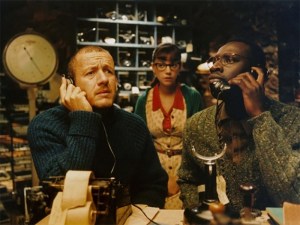 Micmacs succeeds where Rian Johnson’s Brother’s Bloom dangerously came close, and by that I mean that Micmacs overdoses on whimsy and I pronounced it clinically dead about an hour in. It’s too much; it’s just too much. Jeunet has always created movies that existed in rich, idiosyncratic worlds but those worlds always felt lush and lively and bursting with wonder. What saves a movie from whimsy is an emotional connection to the proceedings. 2001’s Amelie is a perfect example of cinematic “magic realism” but it’s also a moving and emotionally rewarding love story that transcends the plucky heroine. 2004’s A Very Long Engagement was a rapturous, old-fashioned love story with flights of fancy. Now, after a long six-year absence, Jeunet seems to have lost touch with the heart. There is no real emotional entry point for Micmacs. The protagonist is pretty much a blank. Yeah, you want him to get justice and you pull for the underdogs, but at no point did I care whatsoever for any character. Most of the junkyard characters are just ideas, walking-talking heist components (the human cannonball, the girl whose brain is good at math, the toy maker). Several characters barely exist except for their specific roles in Bazil’s schemes. There’s a romantic angle with the female contortionist (Julie Ferrier) and Bazil, but that comes off as less a function of the narrative and more of a desperate “Well, who else is gonna get together?” necessity. Jeunet has put together a movie that is all surface and no polish. Sure, the movie is intermittently entertaining and has plenty of imagination, but Micmacs is without a doubt the least involving and least accomplished film from a man responsible for a fantastic output.
The tone of the film seems to hew to something like a silent movie, which might explain why all the older members in my audience were constantly giggling while I just occasionally snickered under my breath. The comedy never rises above the chuckle level. There’s plenty of controlled wackiness, nothing gets too out of hand or edgy despite the fact that the plot revolves around getting vengeance on arms dealers. I was expecting something a little darker than the cutesy oddballs that I got. The best and darkest moment in the film is when we see that one of the arms dealers collects body parts of dead celebrities (Marilyn Monroe’s molar, Mussolini’s eyeball). It’s an interesting quirk that actually reveals something about the dark heart of the antagonist. There should be more moments like this. The bullet in Bazil’s brain is barely referenced. I have no issues with whimsy when it doesn’t overwhelm the narrative, and that’s the problem with Micmacs. The story is merely the vehicle for the inventive hijinks. The story is suffocated by whimsy and visual energy, therefore there’s no room for character development. All that inventiveness takes center stage. If playfulness is all you seek in a movie, then Micmacs will likely satisfy. Jeunet still makes movies that nobody else does, but he’s fallen fall short of his own lofty standards.
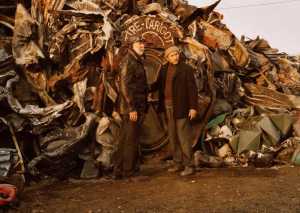 The movie moves along so quickly that it seems like every character just naturally intuits what must be done next, like they all have the screenplay in hand just off camera. Bazil is so quickly adopted by the junkyard gang. He so quickly discovers who is responsible for his life’s troubles. The schemes are so quickly thrown together. They aren’t even that complicated, mostly distracting and framing. The movie just feels like a spinning plate that has to keep moving or else everything will just break. I suppose Jeunet and his longtime co-writing collaborator Guillaume Laurant are trying to keep things busy so people won’t notice that they don’t genuinely care what happens.
This being a Jeunet film, of course it’s spectacular from a technical standpoint. Every frame of a Jeunet film can be used as a mural. His compositions delight the eye and the colorful cinematography by Tetsuo Negata (Splice) makes Paris seem like a dream city. The production design looks like it was taken directly from the Steampunk Architectural Digest magazine. You’ll never have to worry about the visual aesthetics or ingenuity of a Jeunet film. But there are plenty of artists that can master technical craft (you can find them in the world of commercials) but it takes something much more to marry technical precision in the service story and character. Micmacs is a strange film not because of plot, character, tone, or energy, but because Jeunet spent six years in absence and returned with a film that’s got plenty of style but no heart inside all that artifice.
Nate’s Grade: B-
Share this:

Get Him to the Greek (2010)
 How many scene-stealers get spin-offs? That sounds like something you’d more likely find in the realm of TV, but it does happen occasionally in cinema. In 2008’s Forgetting Sarah Marshall, comedian Russell Brand played British rock star Aldous Snow. He stole Sarah Marshall and he also stole the movie. Now the stringy Brit with the crazy hair gets is own movie, Get Him to the Greek, a semi-sequel to Sarah Marshall.
Aldous Snow (Brand) has had his career hit a bit of a snag. His latest album, and lead single, “African Child” has been met with a tidal wave of bad press. Critics are calling it the worst thing to strike Africa after famine, war, and apartheid. His longtime girlfriend and fellow recording artist, Jackie Q (Rose Byrne), has dumped him and gotten full custody of their son. His life, and he, has gone off the wagon. Music exec Sergio (Sean “Puff Daddy” Combs) is desperate for ideas to help make money for his company. Aaron Green (Jonah Hill) suggests to the boss man that it will be the 10-year anniversary of Snow rocking out at the Greek Theater in Los Angeles, a seminal concert event. The boss tasks Hill with traveling to London, retrieving Snow, getting him to a Today Show performance in New York and then to the Greek in L.A. for an anniversary concert. Of course babysitting a drug-addled rock star and getting him places on time is easier said than done.
 Get Him to the Greek is ultimately a buddy movie. Brand and Hill play off each other so well. In fact, I might say that Hill’s character is a tad too dull when he’s not around the hyperactive and impulsive Snow. You sort of feel for the guy and you’d like life to turn out well for him and his girlfriend, but you’re not completely committed to the character. However, when he’s bouncing off Brand, the movie transforms into a wild comedy with many funny moments and a few that miss the mark. Green has been entrusted to handle his high-maintenance rock star and this presents a few stellar comic setups. Green has to make sure that his star is not impaired when he performs on the Today Show, so he steals Snow’s flask of booze and joint and downs them both to protect his star. The resulting appearance on the Today Show then flips the script, having the flaky star be the straight man to the highly impaired handler. The funniest sequence for my taste involves a drawn-out drug trip in a Vegas hotel. Things spiral out of control and involve furry wall groping, mass amounts of property destruction, and Snow stabbing Green in the chest with an adrenaline needle, then being chased by an incensed Sergio who will not be stopped even after being hit by a car. It’s an exhilarating, madcap sequence that picks up comedy momentum and plows ahead. You may not be able to relate to either character, but when you put them together the movie comes alive with comic mischief and misfortune.
Being a Judd Apatow (Knocked Up, Superbad) production, Get Him to the Greek has got to bring the heart with the raunch. Even though we spend the majority of the running time with two characters, the film is less character-based than other Apatow-produced products. The sentiment slips in at the end. Obviously, given the setup, you expect Green to become more aggressive motivated, Snow to become more mellow and conscientious, and we’re all better for it in the end. The two characters do begin to bond in their unusual way, which elicits much of the film’s enjoyment. I enjoyed spending time with these two guys, especially when they were together. That likeability factor got the film through some of its rough patches. As far as supporting casts, a hallmark of an Apatow-produced film, Sean “P. Diddy” Combs is the movie’s scene-stealer, mostly through sheer force of will. He’s not the funniest guy but man does he chew scenery with gusto. He’s so loud and crazed that he practically scares you into laughing as a defensive impulse.
 Brand is a terrific comedy discovery. He has such an electric energy and his wild-eyed hijinks and deadpan delivery had me in stitches. I was worried that a full movie for Aldous Snow would wear thin, but Stoller and Brand have deepened the character. It would be extremely easy, and almost understandable, for Snow to just be this caricature of the rock and roll lifestyle, an easy send-up for easy jokes. But just like with Sarah Marshall, the more time you spend with Snow the more you start to like him. He’s genuinely charming. His onstage persona evokes memories of Mick Jagger, Led Zeppelin, and Freddie Mercury. He’s self-destructive and egotistical but he’s not as shallow as he may appear to be (his vocabulary is a notch above, too). He’s unpredictable but he’s not stupid. He’s fairly vulnerable with some real feelings, lamenting his failed relationship with Jackie Q and yearning to be the father for a son that may not even be his. His life is filled with hangers-on and leeches, including his own parents. Brand can be good at being ridiculous but he can also be very good at being miserable. His vulnerability and attempts to be something more than the sum of his lifestyle allows for some tender moments between the babes and booze.
Hill has graduated from supporting player to “regular dude” lead in the Apatow Academy. He’s presented almost as a brazenly average everyman, albeit one who appears to be dangerously overweight (seriously, Hill has ballooned like a blowfish and I worry for the guy). This role allows Hill to showcase the most range he ever has yet. He believes in the power of music and has a personal stake in what goes down at the Greek. He sells his dramatic parts better than expected. He and his girlfriend, Daphne (Elizabeth Moss from TV’s Mad Men), make for an unconventional couple via Hollywood’s superficial standards. It’s an interesting match and somewhat refreshing that Hill isn’t dating some knock-out (Moss is quite fetching, don’t get me wrong).
Greek doesn’t measure up to Sarah Marshall and part of that is because the story is a bit too shaggy, housing gags but lacking a stronger driving plot. Many of the scenes don’t connect so much as independently exist. Also, writer/director Nicholas Stoller (who also directed Sarah Marshall) sometimes doesn’t know when to leave well enough alone. The drug-addled sequences tend to get a little tedious after the third or fourth time. Granted, drugs and alcohol are all apart of the modern rock and roll experience, but watching people act weird on drugs can get tiresome unless given a different context to work with. Some of the comic setups are a tad lazy but are saved by the efforts of Brand and Hill. When Aldous orders his lackey to smuggle heroin in his rectum, it feels strained even by the standards of wacky comedies. It feels like one episode that doesn’t lead to anything other than a quick, almost absurd, comedy dead-end. And for a movie with a ticking clock constantly running down the hours before Snow needs to be at the Today Show and then the Greek Theater, there sure is a strong lack of urgency. When they run late or miss planes, you don’t really care because you know it’s a matter that will be easily solved.
 A fact I really enjoyed with Sarah Marshall was that the girls were given something to do — they were allowed to be more than the joke, they could be in on the joke. Mila Kunis and Kristen Bell’s characters were allowed to be nuanced, mature yet able to make mistakes, and both were funny while being central to the story. With Greek, the female characters are mostly one-note and then given a little polish. Jackie Q is all brash sexuality and Daphne is prim and constantly exhausted. They’re extremes made for easy laughs. When Jackie Q tries to get serious, we don’t really buy it because she seemed rather pleased to soak up the unhealthy riches of fame. Her behavior is inconsistent. With Daphne, her wet blanket personality is supposed to be the joke, and then when she cuts loose toward the end, requesting a three-way between her, Green, and rock star Aldous Snow, it feels wrong for her character and weirdly reminiscent of Chasing Amy. I know Get Him to the Greek is primarily a boys movie, but it lacks the same generosity of character that aided Forgetting Sarah Marshall.
Get Him to the Greek is a solid comedy helped by two strong lead performances. It’s a nice addition to Apatow’s family of character-based comedies even if it doesn’t live up to its ambitions. The movie is consistently funny throughout, which is integral to being a comedy. The character dynamics lead to some entertaining comic set-ups and sometimes some lazy ones, but the troupe of actors makes it all work. Brand and Hill are a fine team and the movie has plenty of surprises and cameos to keep things fresh when a gag misfires. I wouldn’t mind seeing the further exploits of Aldous Snow, or even listening to some of his recordings (his Sarah Marshall tune “Inside You” was criminally left off the Oscar nominees in 2008). But this movie just made me realize how much more I appreciate Sarah Marshall, and how that movie has grown on me over time. I suppose like Hill’s character, it took an extended detour with Aldous Snow to make me realize what I truly appreciate in life.
Nate’s Grade: B
Share this:

Sex and the City 2 (2010)
 Sex and the City is a cultural phenomenon that women around the globe celebrate. When the show first premiered on HBO in the late 90s, it chronicled the lives of professional women that wanted to have it all, and they wouldn’t apologize for their sexual appetites or fashion splurges. The successful show then launched a very successful movie in 2008, but the movie tied up everyone’s storylines in fairly nice little bows. So now where to? For the fans, it hardly matters. Sex and the City is a cause of celebration, a girl’s night out with cosmo in hand. The content of the movie seems almost like an afterthought. Fans aren’t going to be too picky but there is a lot to pick at with Sex and the City 2.
It’s two years after the events in the first film. Carrie (Sarah Jessica Parker) and her husband, John James “Mr. Big” Preston (Chris Noth), are settling into married life. Miranda (Cynthia Nixon) feels mistreated and unappreciated by her boss because she’s a woman. Charlotte (Kristin Davis) has her hands full with two young children, and motherhood in reality isn’t at glamorized as she thought. She’s also worried that her husband (Evan Handler) might cheat with their busty Irish nanny (Alice Eve, the “10” from She’s Out of My League). They girls dub her “Erin Go-bra-less,” I think as a weird wordplay on Erin Brockovich. Your guess is as good as mine. And then there’s Samantha (Kim Cattrall) who is 52 and desperately fighting to look and feel young again. She has a regiment of hormone pills and creams she uses daily to keep the encroaching effects of menopause at bay. To give the girls an excuse to get away, a rich middle Eastern sheik wants to persuade Samantha to do some PR work for his hotel, so he invites the foursome on a fabulous all-expenses-paid trip to Abu Dhabi in the United Arab Emirates.
 I know coming from my non-demographic perspective that I’m going to have some difficulty relating to these main characters, but these gals are so self-absorbed in their petty, rich people problems, I question who could really relate to much of this drama. Charlotte is being driven mad by the toll of motherhood, which is relatable, except her toll involves staying at home in a rich apartment, never having to worry about money, and handing off her screaming kids to the nanny. Not relatable. Carrie’s dilemma is the most forced and therefore the worst of the bunch. After having her storyline tied up in the first film, where can she go? She has got the guy, she got her wedding, she has a luxurious apartment, and her man wants to spend time with her. She’s in her mid-to-late 40s at this point and wants to still go out every night on the town. She complains that they stay in TWO NIGHTS a week. When Big gets her a thoughtful anniversary gift, a flat-screen TV in the bedroom so that they can watch old romantic movies TOGETHER, she pouts and says, “Jewelry would have been nice.” Her main problem is that her guy, the one she married, wants to spend time with his wife in their comfy abode and relax TOGETHER. When Carrie asks for two days leave so she can get some work done on an article, Big allows her the time off and then wonders if that apply to their marriage: each takes a day or two off to concentrate on work, relax, catch up with friends, etc. It’s her idea, but when he voices it suddenly it becomes threatening and again all about Carrie. She responds, “Is this because I’m a bitch wife who nags you?” Well, at least she cuts to the chase. These are the problems that people have when they don’t actually have any real problems.
There is one, count ’em, one great scene in the movie and it doesn’t involve Carrie or the ever increasingly cartoonish Samantha. Charlotte and Miranda are by themselves sipping from cocktails and confessing about the hardships of motherhood. Both take sips and then admit a guilty secret. One says she feels like a failure at being a mother. Another admits that being a stay-at-home mom just isn’t enough for her in life. They both admit that they love their children dearly, but have enjoyed the time away from them. The scene feels genuine, with some heartfelt laughs derived from the situation. Charlotte bashfully admits that her first thoughts following the idea that her husband might cheat with the nanny were, “No, I can’t lose that nanny,” and it feels honest and right for her character, plus it’s funny. And then they admit something that the audience had fortuitously forgotten in that moment — they do all this with help. Charlotte has a nanny and Miranda has her grandmother-in-law living with them to help raise the kids. A really nicely written and acted moment that peels away to showcase the complexities of the modern mother is dashed. Even the universal concerns we can all relate to (infidelity, doubt, settling, getting older) take a backseat to the overly manufactured melodrama.
 The rampant consumerism hasn’t slowed down despite the economic meltdown of 2008. Carrie makes a quick comment about how it “wasn’t a good time to sell her apartment,” and so she keeps her spacious apartment along with the multi-million dollar one she lives with Big. The sheer celebration of consumerism has turned into blind worship; it’s all about the stuff. The characters have long since burrowed into their types (the fussy one, the career-minded one, the sexually voracious one, and the self-involved one), and those types have become entrenched, and the men have become just another accessory for a large closet of goods. The real star of this movie is the outlandish, sometimes garish, fashion, and there is heaps of it. One outing into the Arabic desert makes use of three separate costume changes. The name-dropping and product placement are aggressive. For the first film I wrote: “‘I’m not going to charge the film with setting back feminism or anything but why do the main characters have to be so shallow, brand-conscious, and live to splurge? The emphasis on buy, buy, buy to make yourself feel good is a rather sad and empty message.” The Sex and the City movies have morphed into consumerist, female wish-fulfillment fantasies, enabling Carrie’s princess indulgences and superficial demands. The girls are all panicked towards the end about he possibility of, gasp, flying coach, you know, like the rest of us. These women haven’t lived in anything resembling reality for some time. It’s a shame that in these cost-conscious times, the Sex and the City universe seems unaffected. I would have enjoyed seeing how these high-powered women dealt with the repercussions of an economic recession (not to mention Carrie dealing with the death of print publishing). Yes, I know, it’s designed to be escapism, and that’s all well and good, but I wanted to escape from these characters and their lifestyles.
But what will get the most attention is the extensively long escapade in the Middle East, like Sex and the City is planning to solve global politics. Obviously, there is something wrong with how women are treated in several majority Muslim countries, from the demands to cover themselves in heavy garments so as not to tempt men, to the void of rights, to honor killings and stonings, and murdering women just because they went to school. This is a serious matter. These countries are behind the times and women deserve an equal footing and an equal say, and several contemporary movies have dealt with these issues in a thoughtful manner. Sex and the City 2, on the other hand, takes a patronizing approach that is culturally insensitive at best and downright racially insulting at worst. These ambassadors of modern feminist thinking basically show themselves to the Arab world as the quintessential ugly Americans; the ladies of Sex and the City are exactly what radicals think about when they order women to cover up or else. These women are self-indulgent, materialistic, vapid, and riding high on Western self-righteousness. I am in no way apologizing for how large portions of the Muslim world treat women, but Carrie and company are quite possible the worst ambassadors to argue the case for feminine equality. And remember, they complain about their pity-party problems while on an all-expenses-paid vacation to a lifestyle of lavish luxury in the Middle East. They reduce the problem of Muslim women into simplistic, indignant quips. It’s more than a little insulting to have somebody wearing clownish outfits telling women in other countries how to dress. This foursome is brash and in-your-face with their strong sense of cultural superiority, practically baiting the locals into making a scene. At one point, Samantha is jailed and shocked that the authorities might be upset that she was caught having sex on their beach. Don’t these women understand culture clash? In the end the women are chased out of town and you almost (I repeat — almost) feel for the other side.

This is considered fashionable?
Even worse than the ethically dubious moralizing is the fact that this extended portion of the movie (about 100 minutes) grinds the plot to a halt. Most of the storylines are set up before the trip, and then they are all tied up somehow when the women return, though the time in Abu Dhabi seems to have had no effect. Miranda’s conflict with her boss is resolved before the gals ever get on a plane, so she becomes essentially tour guide and confidant for the trip. Samantha is denied her plethora of pills at the airport, so she becomes the slapstick comic relief trying to stave off menopause. Her pun-heavy dialogue is full of groaners like, “Lawrence of my labia.” Her sex kitten act is getting as tiresome as her futile attempts to keep Mother Nature at bay. Samantha is the same from the beginning of the movie to the end, and fans will probably rejoice at this lack of character development. The entire misadventure in Abu Dhabi feels like a Hope & Crosby road picture, or, worse, one of those lame TV-movie gimmicks from sitcoms (luckily Carrie is spared the curse of the tiki idol).
But whatever I say will be regarded with shrugs by the legions of Sex and the City fans. They’ve grown with these characters over 12 years, so I understand the attachment fans feel. Like I said before, the movie medium is not the ideal place for these ladies. In half hour doses their quirks and problems seem cute, but when stretched to a bloated running time they come across as vapid and whiny. The conflicts don’t seem too relatable and the humor is once again tied to slapstick and leaden puns. The problem is that after six seasons and one 145-minute movie, the characters feel tapped out. They’ve been through plenty and now the crew is just coming up with whatever excuse they can have to reunite the cast on the big screen (stay tuned for Sex and the City 3 … in Space!).
Nate’s Grade: C


 nathanzoebl
You must be logged in to post a comment.