Blog Archives
Chillerama (2011)
 Chillerama is the latest ode to the drive-in B-movies of old. Like the higher profile 2007 Grindhouse, this movie is a series of short films from four different filmmakers celebrating the exploitation spirit of schlock cinema. Cecil B. Kaufman (Richard Riehle) is closing his drive-in theater, and for the final night of operation he’s showing four movies never before seen: the killer sperm movie “Wadzilla,” the unexpected lycanthropy romance “I Was a Teenage Werebear,” the black-and-white monster movie “The Diary of Ann Frankenstein,” and a final fecal-filled adventure into the abyss, “Deathication.” However, during this final night the drive-in is also ground zero for a new zombie outbreak, a disease spread through sexual fluids. Tobe (Corey Jones) has to navigate through the sex-crazed corpses to save his crush, Mayna (Kaili Thorne), and escape the drive-in- of death and maybe lose his pesky virginity.
 Given its vignette nature, not all of the segments will be equal in quality. The absolute highpoint is indisputably “The Diary of Ann Frankenstein.” I laughed long and hard during this clever, cock-eyed satire. The absurdity of its premise and the assured demented sense of comedy of its creator, writer/director Adam Green (Frozen, Hatchet), had me laughing until I was in physical pain. The Frank family (formerly Frankenstein) is found by none other than Hitler (Joel David Moore, embracing the silliness with gusto) who dispatches them and steals the family journal. In one of the movie’s funniest lines, Hitler tosses a journal to a Nazi cohort and instructs: “Here, write some depressing stuff in this. We’ll say the girl wrote it and make millions after the war.” Hitler creates his own Jewish Frankenstein-like creature, though a missing film reel reveals his true motivation for reanimating this corpse (and he sings!). Green’s sense of comedy is evident in the pacing, construction of layered jokes, and genre spoofing. There’s one point where the monster is locked in the laboratory and just walks around the set, breaking down the fourth wall. Green even has the entire segment subtitled, though if you listen closely you’ll notice only about 10 percent is German. At one point Moore is screaming “No!” for a solid minute but he says a different word or phrase every time, including “Goldie Hawn!” at one point. The segment is so good that you may not even notice that joke at first glance. “The Diary of Ann Frankenstein” is wickedly hilarious and too tacky to be taken as a serious offense.
The other vignettes falls somewhere in the middle. “Zom-B-Movie” is the slickest looking movie, set in the present, and is a lot of fun. It adds a twist to the crowded zombie genre by adding in a sexual element, making the zombies a sex-crazed orgy (expect nudity that makes you feel funny). There are plenty of solid gross-out effects, and several sequences of penile endangerment, and there are some ingenious camera angles to match the segment’s electric energy. It’s the most self-aware segment, as characters openly discuss horror movie conventions and their own place in the movie Scream-style (“I’m the Final Girl,” one guy declares). A good percentage of the dialogue is comprised of movie quotes and catch-phrases brilliantly placed in this incongruous setting. During the climax, Riehle (Office Space) shoots round after round into the bands of zombies, ripping off like 20 anachronistic movie quotes as if they were action movie quips (“Nobody puts baby in a corner!” he yells and then shoots a zombie in the crotch). I was flabbergasted that the segment actually quoted Billy Madison, and well. The self-aware humor and the overall feverish energy, plus some characters we’ve been investing with in between the earlier segments, makes for a fun and satisfying sendoff for the whole trashy enterprise.
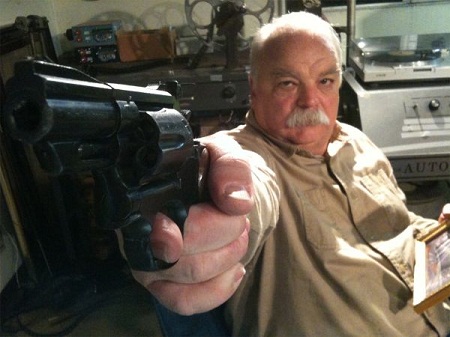 The first two segments rely more on base humor and seem to run out of gas midway through. “Wadzilla” is a one-joke segment about a man whose single sperm grows to monstrous, man-eating size. The cartoonish tone and low-rent visuals feel like a Joe Dante (Gremlins) homage. The segment does feature one truly inspired, wacked-out image: the giant sperm fantasizes the Statue of Liberty stripping out of her cloak and shaking her green goods (I think this segment just gave birth to a brand new fetish). But the overall concept is weak and the segment relies far more on shock value than wit. It’s more like a rejected Troma flick, though helped immensely by the presence of Ray Wise (TV’s Reaper). “I Was a Teenage Werebear” takes the 1950s beach blanket bingo teen films and gives it a gay twist, and to boot it’s a musical (territory covered well in Psycho Beach Party). The storyline of guy-meets-werebear doesn’t provide enough material to hold together the segment. Many of the actors cannot sing either, which adds to the joke but also makes the film more punishing to watch. The pacing is poor and the gags feel like they were the first things conceived. There’s not enough thought on display; the segment just peters out and becomes tiresome. The fact that Chillerama opens with “Wadzilla” and then “I Was a Teenage Werebear” makes it harder to appreciate the finished product.
Chillerama is certainly going to have a restricted audience interested in campy homages celebrating the trashy nature of cheesy low-budget, exploitative B-movies. Unlike Grindhouse, this collection lacks big names but it makes up for it with a cracked sense of humor. The segments all run about 25 minutes in length, which means even if you dislike one it’ll be over soon enough. The four segments vary in quality, though each has its moments. “The Diary of Ann Frankenstein” is easily the standout of the bunch, elevated by droll, absurdist, demented humor that’s skillfully constructed and deconstructed. “Zom-B-Movie,” the culmination of the film’s connecting characters, is a fun blast to conclude with. Chillerama is a messy, uneven, crude, occasionally brilliant, but most of all it’s a great way to spend a Saturday night with some friends and a supply of popcorn. Just watch out what’s in that butter topping.
Nate’s Grade: B
Share this:

Just Go With It (2011)
 Loosely based off the 1969 film Cactus Flower, the title of the latest Adam Sandler comedy feels like a transparent plea from the screenwriters and Sandler. He plays a womanizing plastic surgeon that has bedded many women under the false pretenses of being married to horrible women. Now he’s in a dilly of a pickle because he has to convince the new hottie in his life (Brooklyn Decker, former swimsuit model, clearly chosen for her acting “talents”) that he is getting a divorce from his fake wife, played by his assistant (Jennifer Aniston). Her real-life kids become Sandler’s fake kids, and the whole lot goes along for a Hawaiian vacation. At various points characters will talk about how confusing the lies are becoming. I wish. Just Go with It doesn’t have the ambition to embrace its farcical premise, instead settling on rom-com gooeyness even though most of the characters are lying jerks. Sandler’s been tricking women into sleeping with him for decades, but we’re supposed to view him as a good guy? What’s the point of throwing in Nicole Kidman, of all people, as Aniston’s college nemesis if the film doesn’t do anything with the different pretenses? Things don’t get too complicated because the characters really only assume one identity and one story, blunting escalating comic mishap. While Sandler and Aniston have a surprisingly natural chemistry together, and some of the jokes are decent in conception, Just Go With It is a wearisome rom-com weighed down with false sentiment and kicks to the groin.
Nate’s Grade: C-
Share this:

Cedar Rapids (2011)
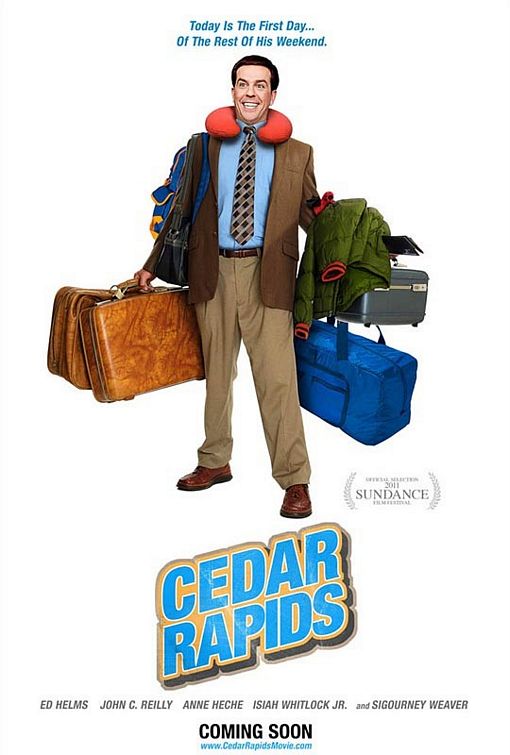 When people think about the temptations and sundry thrills of the Big City, most people are probably thinking of a sin-stained location like Las Vegas. Most people would not confuse Vegas with Cedar Rapids, and yet the Iowa city of note is the setting for a sweet and sometimes dirty, but still sweet, comedy of big-city adventures. To a guy from a town without a stoplight, Cedar Rapids is like New York City. It all depends on your perspective.
Tim Lippe (Ed Helms) is an insurance salesman from Brown Valley, Wisconsin. The town is small but the little insurance agency that could has won the coveted Two Diamond Award four years running at the annual insurance convention held in Cedar Rapids. Tim’s life is in a holding pattern. He wants to do big things but can’t find the oomph to get there. He’s involved in a romantic tryst with his (one-time) seventh grade teacher (Sigourney Weaver). Tim’s chance to make a name for himself comes when he’s selected to represent his company at the annual convention. He has to impress the right people to take home another Two Diamond Award. Never having been on a plane before, he leaves small-town Brown Valley for big-city Cedar Rapids. At the convention site, Tim rooms with Ronald Wilkes (Isiah Whitlock Jr.) and the more unsophisticated Dean Ziegler (John C. Reilly). The group meets up with Joan Ostrowski-Fox (Anne Heche), and together they work on helping Tim loosen up. Over the course of the weekend, bonds will be made, principles will be tested, and tom foolery of the first order will be had.
The premise is rather simple, small-town guy heads to the big city (well, bigger) and the culture shock that waits. But the film never looks down on Tim Lippe. While there is plenty of humor drawn from his naiveté, the movie doesn’t condescend or play up the small-town folks as rubes and squares. It’s funny to see Tim’s mild-mannered explosions of anger, mostly of the “horse pucky” variety of vulgarities, but the movie doesn’t say that the big-city folk are better than Tim. On the contrary, Tim is a principled and devoted insurance salesman, courteous to a fault. He could have stepped out of a Frank Capra movie from a bygone era (Mr. Lippe Goes to Town). Tim is sheltered, which provides some amusing fish out of water comedy, like when he initially is on alert because his roommate is African-American, a rarity in Brown Valley despite whatever the name may imply to some. Tim is a man out of time, but that can be small-town life in general. The Midwestern satire reminds me of the gentle yet knowing nudge of King of the Hill. Phil Johnston’s script sets up Tim’s dilemma as a crisis of conscience, the compromises we make in morality. Tim’s trip to the “big city” is the push the guy needs to get his life out of stasis. There’s something deeply satisfying in watching a character you care about triumph in the end, even if that triumph is a small victory befitting a small-town guy with a big heart.
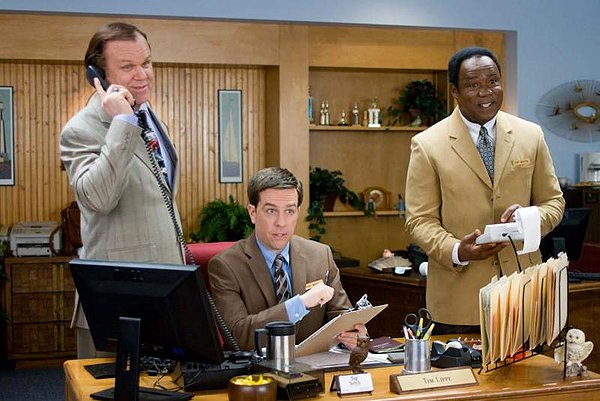 The real fun of the movie, however, is watching the effect the group has not just on Tim but on each other. They teach Tim to cut loose and live a little, but this is still Cedar Rapids, so cutting loose goes as far as nighttime pool escapades and drunken sex. His flirtatious fling with Joan brings the guy out of his shell, and the two of them are genuinely cute together without going overboard. It’s a reserved romance that feels true to the nature of both of the characters. Dean is the loudmouth knucklehead notorious for his oafish shenanigans, but once he feels accepted he goes to war for his friends. He’s a buffoon but not stupid. And then Ronald, though less developed than the other three, provides a nice foil as a straight-laced businessman who keeps it together impressively. Together it’s a team of likeable characters that have grown closer together over the course of that weekend in Cedar Rapids, and you’ll feel the same. You feel like they’ve formed a family around the earnestness of Tim.
Helms (The Hangover) is a suitable candidate for a nice, regular, Midwestern guy. Helms has honed his awkward comedy chops after several seasons on TV’s The Office, and here he sticks to what he knows. Tim Lippe is another in a line of embryonic men. Helms settles into his usual nervous tics that fans will be familiar with. His sunny naiveté wins over the audience and provides for several laughs in contrast with the jaded “big city” folk. Reilly (Step Brothers) can overdo his character’s intentional obnoxiousness. He’s chartered a successful second career as a winsome nitwit, so like Helms, Reilly relies on notes gleaned from past performances. Whitlock Jr. is mostly straight man to the others. His comedic highpoint is an impromptu impersonation of a character from The Wire to get the group out of a dangerous jam (Whitlock Jr. himself played a state senator on The Wire). Other than that, he’s more contrast than character. Heche (TV’s Hung) is a real surprise. She underplays her character, tantalizing us with tidbits that leave us wanting more, much like Tim. The way she plays Joan, you feel the connection.
 With all that said, Cedar Rapids still has its share of flaws. The naïve comedy can go so far before you start to question Tim’s senses, like his casual mistaking of a prostitute (Alia Shawkat, Whip It) for a fellow attendant. His relationship with his former seventh grade teacher is intentionally awkward, but the whole plotline presents an unseemly overtone that doesn’t fit. She’s made to be rather motherly, even when she’s rolling her eyes at her bedmate’s pie-eyed declarations of being “pre-engaged.” I think the motherly aspect makes the whole Oedipal mess even worse (Weaver just seems bored). Late into Act Three Tim goes on a drug-fueled bender that feels out of place for his character who, when first asked for a drink, requested a beer of the root kind. The character of Dean is given too many moments to just wander around and spout crude one-liners. It sometimes feels like the movie is resting while it lets Dean do his thing, and a little of this guy can go a long way.
The plot is relatively predictable and the ending is pretty pat. It works, but the actors and the characters were capable of more. The relationship between Tim and Joan also leaves something to be desired. There’s a great assembly of recognizable guests (Stephen Root, Thomas Lennon, Rob Corddry, Mike Birbiglia) that stop by but add little. Again, the potential for more feels missed. With a solid 80% of the movie taking place in a hotel, you can also start to feel a little cabin fever. And not that it matter much, but I’m disappointed that film with “Cedar Rapids” in its name was filmed in Ann Arbor, Michigan (Iowa did away with its in-state film tax credit).
The appeal of Cedar Rapids, the film, is much like the appeal of its central figure, Tim Lippe. It’s an unassuming, earnest charm, enjoying the company of likeable characters who we want to see succeed. I just wish the predictable plot had done more or trusted the actors’ capabilities. The core characters feel mostly authentic and easily recognizable, which makes the familiar, if at times bland, plot fairly forgivable. Helms and company are an easygoing bunch and you’ll be happy to tag along on their unspectacular hijinks in the “big city.” Cedar Rapids is the kind of low-key, charming little movies that often gets overlooked. It’s worth viewing for the pleasurable camaraderie of the core cast. Cedar Rapids, much like the city that bears its name, is worth a visit but does not require more commitment than that.
Nate’s Grade: B
Share this:

Scream 4 (2011)
 What do you do when your satiric self-aware take on pop culture becomes the MO for a generation? Back in 1996, Scream was a breath of fresh air by sending up dusty horror staples and having highly literate characters, with exceptional vocabularies, deconstruct genre elements while ironically falling victim to them as well. In 2011, Scream 4, an obvious paycheck grab, is showing its age. After a rather nifty series of opening fake-outs, which gave me hope that returning writer Kevin Williamson was going to finely skewer the conventions of horror since Scream last went dormant in 2000, but sadly this is not the case. “New decade, new rules,” one character says, but it’s all so much of the same. People run, they get stabbed, only the locations are truly different. There are a few witty jabs about the obsession with reboots and remakes, and Williamson does secretly work a crafty symmetry to the first film as far as characters go. The body count is much higher but the scare quotient is low. And then brining back the original cast (Neve Campbell, David Arquette, Courtney Cox) seems like a waste if they cede almost all screen time to a bunch of fresh-faced high school kids who were learning to walk when Campbell was learning to run for her life. The satirical elements feel so lazy; if you’re going to introduce technology-obsessed characters and the narcissism of social media, then do something with it. Don’t introduce an element like a webcam and then barely use it. The scares are about as flimsy as the commentary. The reveal of the killer(s) is stupid enough, as is the cracked motivation, but the ending just piles one absurdity onto another. It doesn’t know when to stop, and Scream 4 flirts with some daring possibilities to wrap up its bloodshed. Scream 4 is a drifting vehicle, wasting potential at every opportunity. The weight of all those red herrings, genre riffs, ironic twists, and self-aware characters has gotten to be too much. The Scream franchise has morphed into what it once parodied.
Nate’s Grade: C
Share this:

Rango (2011)
 It’s Chinatown remade with anthropomorphic desert creatures. It’s a Western by way of Hunter S. Thompson. It’s a loving parody of cinema’s wide canvas. It’s one of the most wild, anarchic, oddball animated films to ever be released by a major studio, and it is stupendous. Steeped in weirdness and bravado, Rango has a playful and occasionally macabre sense of humor that kept me in stitches. Director Gore Verbinski (the Pirates of the Caribbean flicks) translates his visual verve into a animated movie that dazzles the eyes with its magnificently drawn features as well as the pointed personality in every stroke. This is a movie with character, not to mention some pretty entertaining characters (including talking road kill). Johnny Depp delivers an idiosyncratic vocal performance for a household lizard that finds himself pretending to play sheriff for a town in need of a hero. When you think Rango will fade into familiar territory, or easy moral messages, the film keeps surprising, forging its own unique path. This is a lively, peculiar, and overall enchanting animated film that’s suitable for families but may well play better for adults with eccentric tastes. I’m still scratching my head, and celebrating, how something like this slipped through the system.
Nate’s Grade: A
Share this:

Conan O’Brien Can’t Stop (2011)
 You’d think that a behind-the-scenes documentary in the immediate aftermath of Conan O’Brien being paid $30 million to walk away from his dream job hosting The Tonight Show would have plenty of drama and revelations. It doesn’t. This thin documentary mostly just tags along on O’Brien’s multi-city comedy tour during the time he was contractually obligated to not appear on TV. O’Brien doesn’t go into much detail about the Tonight Show brouhaha, making only vague references to his ouster in conversations about confronting his anger. Fans of the gawky comedian will be put off by O’Brien’s often hurtful, prickly behavior toward his subordinates and co-workers. He has a biting wit but often that wit has a discernible edge, making everyone feel uncomfortable, and now you too at home. His bitterness always seems to be bubbling. He’s a conflicted man, bemoaning meeting and greeting fans, citing the exhaustive nature of always being “on,” but then in the next moment he’ll charge into a crowd to feel alive again. Conan O’Brien Can’t Stop is a lackluster documentary that has a few laughs since it does chronicle a road show about funny people, but it’s not too long before even O’Brien fans might wish that he’d just stop.
Nate’s Grade: C
Share this:

50/50 (2011)
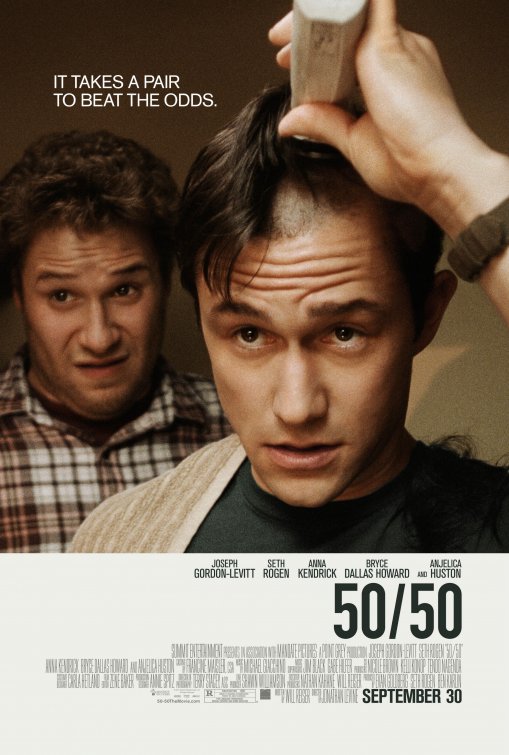 50/50 is based upon the experience of screenwriter Will Reiser, a writer for HBO’s Da Ali G Show who contracted cancer before his 30th birthday. Reiser’s real-life travails with his buddy Seth Rogen (who serves as executive producer) through the good times and bad. I guess when you get cancer it helps to have an established movie star as your good friend. It also helps when you write a terrific script, which Reiser has accomplished. Originally titled I’m With Cancer, I guess the studio felt that a movie with “cancer” in the title was a hard sell to mass audiences (On a related note, Showtime’s comedy-drama The Big C, about Laura Linney finding the humor through cancer treatment, was previously titled The C Word. I don’t know about you, but when I heard “the c word” the first thing that comes to mind is not “cancer.”). Even with a more oblique title, 50/50 manages to walk between comedy and drama with flair. It’s probably the funniest movie you’ll ever see about cancer. Definitely funnier than My Sister’s Keeper.
Adam (Joseph Gordon-Levitt) is a relatively healthy 27-year-old. He likes his job writing for a Seattle National Public Radio station. He likes his girlfriend, Rachel (Bryce Dallas Howard), an aspiring painter. He likes his best friend, Kyle (Rogen), a dude prone to speaking whatever is on his mind. Then one doctor’s visit changes everything. Adam has a very serious form of spinal cancer. He begins chemotherapy to try and stop the tumor’s growth. Rachel drives him to his hospital treatments, helps him during his long nights of nausea, but ultimately it proves too much to bear. She leaves him. Luckily, Adam has a young therapist, Katherine (Anna Kendrick), helping him put his life in order. Adam’s chances of surviving this rare cancer are exactly as the title proclaims, 50/50. As he comes to grips with the measures needed to survive, Adam finds himself growing closer to his therapist in a completely unprofessional degree.
50/50 may be the least sentimental movie I can recall about the realities of living with cancer, and that is its greatest attribute. That doesn’t mean that the movie doesn’t cover serious issues in a flippant manner. Instead of hitting cheap sentiment and milking cancer for easy tears, the movie, thanks to Reiser’s sharp script, forgoes false feelings and finds something more rare and true. There’s no real playbook for something as unexpected as a person in their 20s being diagnosed with terminal cancer. It seems like a cruel irony to be stricken with an illness so young. Adam doesn’t drink, doesn’t smoke, and doesn’t even drive due to the danger. He’s pretty mild-mannered and a bit of a pushover. Adam tries to not let cancer get to him, to shrug off the heavy implications, and to just make it seem like any other personal setback. If he doesn’t treat it like a big deal, maybe it won’t be and his friends and family can follow his lead. This kind of self-manufactured blasé attitude, even in the face of cancer, seems like an apt approach for a younger relaxed generation. Naturally, this denial-heavy approach doesn’t exactly work. It’s too easy to confuse numbness with acceptance. Fortunately, Reiser does not let his story slip into easy maudlin theatrics. We don’t need anybody reminding us, or Adam, how serious his situation is. On the other hand, we also don’t need anybody moralizing about any self-help slogans. Not everyone sees adversity as a blessing into Discovering Who You Truly Are. Reiser refrains from his characters making anything approximating Big Life Statements. Cancer does not lead to automatic personal epiphanies. If it did, we’d have a lot more people inhaling carcinogens and volunteering to work in the Chernobyl ruins.
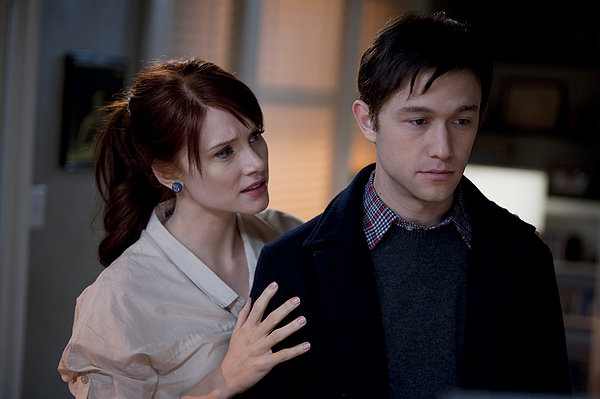 50/50 doesn’t ignore the sometimes odd and dark humor that arises from life’s predicaments. That means this is the only cancer movie where the guys try and use the disease as a way to convince girls to sleep with them. At no point do I remember this occurring with Terms of Endearment or Beaches. And this opportunistic babe hunting doesn’t make the boys come across as sleazy. Adam can’t even enjoy the one-night-stand as his back pain robs him of the pleasure of his nubile well-wisher. The tone is very controlled. The raunchy comedy is not a distraction; at no point does any situation feel like a comedic setup. The comedy comes from the characters being genuine to who they even through the trying circumstances. If your friends are funny, chances are they’ll still be funny talking about cancer. The humor doesn’t make light of things nor does it just play everything for laughs. Humor is how we humanize, how we make the insurmountable digestible.
50/50 also treats its characters with a bittersweet sense of reality; these people are flawed and relatable. They are not instantly made into self-actualized saints thanks to cancer. Adam’s girlfriend actually breaks down because she cannot handle the extra responsibilities and emotional wear and tear. Their relationship fizzles. This seems far more realistic considering many people will feel like they did not sign-up for sleepless nights, 24-hour care, and watching their loved one waste away. It’s a strong individual that can endure that kind of collateral pain, but the movies make it seem like every romantic partner is unnaturally selfless. They become ideal partners, but really most of us would just bail. Reiser easily could have easily written his ex-girlfriend as an insensitive shrew. While she does cheat on the guy, thus making her easy to dispel, Howard makes her vulnerability relatable. She even comes back trying to make amends, forcing kisses upon him to weaken Adam’s resolve. Kyle relishes the opportunity to finally be able to tell off Rachael, a girl he admits to disliking from the start. I don’t get the instant hate, but maybe it’s my complete adoration for Howard even when she’s playing a bad girl that blinds me to her offenses. To dismiss her as a “bitch” seems unfair. How would you react if your boyfriend/girlfriend were suddenly diagnosed with cancer? Could you last?
I found all of the characters to be empathetic and relatable (though a lead who waxes about the glory days of radio and works for NPR seems a bit hipsterish), especially in their personal struggles surrounding Adam’s illness. Adam’s mother, Diane (Anjelica Huston), can be overbearing and would have easily been kept as a caricature in other movies. In 50/50, the film examines her own struggle – a husband with Alzheimer’s who can’t talk to her and a son with cancer who chooses not to talk to her. The isolation she feels, the loneliness, always putting other people’s needs ahead of her own, this is culmination of the caregiver, a role as I’ve stated that too often gets canonized. In 50/50, the reality of living with illness is dealt with in a meaningful manner. The people surrounding you are also affected by your illness. You cannot shut them out to spare them from pain. Adam realizes this too as the film progresses to its moving conclusion.
 The heart of 50/50 concerns two sets of relationships. The one that will catch the most attention is Adam’s budding romantic relationship with his therapist. Their romance feels like it emerges naturally, albeit in a slightly hurried up pace for our small timetable. It’s a romance built upon the chemistry of the two actors, the strength of their individual performances, and the fact that Reiser forgoes anything obviously romantic. He cleans out her car. She gives him a ride home. It’s little things that seem like they matter on a personal level, not the outsized theatrics of romantic gestures. The movements are small but they add up, and we can feel it too. So when Adam, at his lowest point, calls her and says, filter down and radiating in emotion, “I bet you’d be a good girlfriend,” it’s a moment that feels earned. I also greatly appreciated Katherine’s own insecurity about being a therapist. Too often movies depict therapists as omniscient beings that have a fortune cookie answer for all of life’s mysteries. Kendrick hides behind evaporating smiles as her character’s defense mechanism. In 50/50, we get to see a character that is honest about her insecurities about a job that advises others. It’s refreshing. The other main relationship is between Adam and his best friend, Kyle. His best buddy is his spark, the guy who gets him out, who shakes him from moping around. He cares but goes through unorthodox methods to show that care, including trash talking and ball busting. He remains likable to his shaggy core because he has Adam’s best interests in mind, even if that means scoring with girls.
Director Jonathon Levine (The Wackness) gives the movie an improbably beautiful look. This is one cancer comedy that is simply pleasing to watch for the cinematography alone. He doesn’t overpower the narrative with self-aware visual touches, though there is one that stands out. When Adam receives the news from his doctor, the audio becomes distorted after the shocking word “cancer” is uttered. The picture becomes blurred. The world seems to have been swept away. I imagine this sonic body blow is pretty much how Reiser recalls receiving the news, and if not it still feels authentic. The score by Michael Giacchino (Up, Super 8) is subtle and doesn’t intrude too often, ably assisting the drama instead of smothering it.
50/50 is an unsentimental film that manages to be moving and genuinely entertaining on its own terms. It can be rude but that doesn’t mean it lacks sincerity. The characters and their dilemmas feel all too relatable, even the ones we hope don’t become us. The 50/50 production has followed a subdued edict, forgoing sappy melodrama and easy pathos. These emotions are earned the old fashioned way, through characters we care about and drama that feels truthful. The mixture of the course and sweet gives the film a decidedly Judd Apatow (Knocked Up) flavor even though his name is nowhere to be seen. Gordon-Levitt, who at this point can do no wrong in my eyes, gives one of the best performances of his already accomplished career. The comedy, lead by Rogen’s obnoxious best friend, keeps the movie from being bogged down in melodrama. It’s the only way to stay sane, and 50/50 recognizes this and delivers a film that earns its tears and laughs.
Nate’s Grade: A-
Share this:

Paul (2011)
 This sci-fi comedy by the guys behind Hot Fuzz and Shaun of the Dead, though absent director Edgar Wright (Scott Pilgrim came a callin’), is an irreverently fun flick that lovingly sends up just about everyone in its sights. Simon Pegg and Nick Frost play a pair of British sci-fi geeks road tripping through the American southwest when they come across Paul (voiced by Seth Rogen), an alien on the run. Together they outrun various pursuers, from government agents to angry rednecks, and Paul transforms into a delightful road comedy with the different characters ping-ponging back and forth, narrowly missing but still in the hunt. It’s a cheeky even rollicking action comedy in the vein of a Midnight Run, though with way more stoner jokes. The plot nicely weaves these various elements and characters together, creating a satisfying escalation in suspense and comedy. The characters are pretty familiar and some of the gags are below the caliber of talent onscreen (really, more “people think we’re gay” jokes?), but the final product is unabashedly fun and it’s easy to feel Pegg and Frost’s enthusiasm. Paul is a light-hearted, funny, even tender sci-fi comedy that borrows from better movies but still manages to charm.
Nate’s Grade: B+
Share this:

The Guard (2011)
 For fans of Brendan Gleeson, one of the best character actors around, a starring role in the profane dark Irish comedy, The Guard, is a starring role long overdue. The man plays an eccentric, self-destructive lawman that follows his own sets of rules and decorum: “Racist? I’m Irish. Racism is part of our culture.” Gleeson’s character gets teamed up with Don Cheadle’s Yankee FBI agent, and for a while it looks like the film might drown in fish-out-of-water gags. Writer/director John Michael McDonagh has a gifted wordsmith’s flourish with words. It may take some concentration to decipher through the thick Irish brogues, but there is a love of language and the witty, looping dialogue is almost musical in its sublime composition. His characters are pretty interesting too. The villains, a band of drug-runners, are introduced arguing philosophy, proving to be the most cultured big screen tough guys since Pulp Fiction. The hyper-literate stock roles trade plenty of insults, which had me regularly laughing. The characters do have a habit of feeling like they know they exist in a movie, so everything, even a man’s final moments, never seems to be that pressing. I just wish these richly drawn characters had a better movie plot to work with. There are too many subplots that don’t seem to reconnect to the main storyline. The Guard seems to lose its way in the middle of too many comic vignettes before going all serious action in climax, much like the similarly flavored In Bruges (written and directed by McDonagh’s brother). The movie feels like a first draft instead of a finished product, though for Gleeson fans, this will be worthy enough.
Nate’s Grade: B-
Share this:

Horrible Bosses (2011)
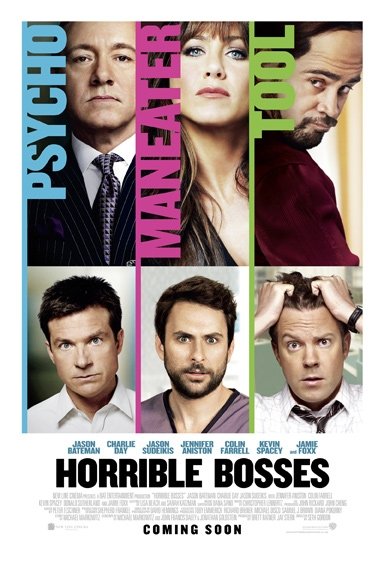 The true joy of Horrible Bosses, besides the vicarious premise, is the interaction and camaraderie of a rock-solid cast of comedians. Jason Bateman (Juno), Jason Sudekis (TV’s Saturday Night Live), and Charlie Day (TV’s It’s Always Sunny in Philadelphia) play the three put upon friends who conspire to kill their not so very nice bosses, respectively played by Kevin Spacey, Colin Farrell, and Jennifer Aniston. The comedy is amusing from start to finish, prone to plenty of guffaws and a few big laughs. The film strikes a delicate tone while being nasty without being too brutish or oft putting. This is not a scorched-earth sort of comedy despite its murderous implications. The guys are more bumbling than threatening, which makes even their criminal pursuits clumsy and endearing. It’s got plenty of surprises and I enjoyed how most of the storylines and players wound up back together. It’s a satisfying movie that veers in some unexpected directions. But the real reason to see Horrible Bosses is just how damn funny the cast is. The snappy screenplay establishes a solid comedic setup and lets the leads bounce off one another to great hilarity. Whether arguing over who would be most raped in prison, the ins and outs of killing on a budget, or the dubious nature of hiring hit men under the “men seeking men” section online, the three leads all bring something different to the comedic table, and watching them interact and play around with the situation is a delight. It’s a buddy comedy with a dash of Arsenic and Old Lace. While the characters are more exaggerated stock types, the comedy, kept at a near breathless pace by director Seth Gordon (King of Kong, Four Christmases), is refreshing, smartly vulgar, and not afraid to get dark. Watching Aniston play against type as a sex-crazed man-eater is enjoyable, but hands down, no one does sadism with the same joy as Spacey. That man could melt a glacier with the intense power of his glare. Horrible Bosses is a relative blast of a comedy, one that maintains a steady output of laughs with some easy targets.
Nate’s Grade: B+


 nathanzoebl
You must be logged in to post a comment.