Blog Archives
The Campaign (2012)
 Broad and oafish for political satire, The Campaign has some decent belly-laughs to it with the main point that our national political environment has become a parody of itself. It’s Will Ferrell doing his usual boorish boob stuff and then there’s Zach Galifianakis as an effete, weird, family values doofus. When it gets looney, The Campaign is at its best. I loved a town hall that descended into a mob chanting their willful opposition to Rainbow Land. I enjoyed that Ferrell’s punching of innocent creatures was turned into a running gag. Having a racist old man pay his Asian maid to talk like an old black mammy because he misses the good old times? That is downright inspired and I giggle just thinking about it. The campaign commercials were perfect, and who knew Dylan McDermott could be this funny as a political ninja? The problem is that the movie works best as a series of scenes but doesn’t add up to much more. Some of those scenes are hilarious, and others are just passable lowbrow entertainment. Then the movie tries to foster a happy ending, with the evil business tycoons (an obvious avatar of the Koch brothers) foiled. I do not believe that satire can have a happy ending. It undercuts the angry, sardonic message of the movie. It’s just not the right fit for the genre. Alas, The Campaign tries to insert some pathos into the mix and it feels false and far too tidy. As for summer comedies, the movie has a few killer jokes and an amiable presence, plus a very short running time so as not to wear out its welcome. Like most politicians argue… you could do worse.
Nate’s Grade: B-
Share this:

One for the Money (2012)
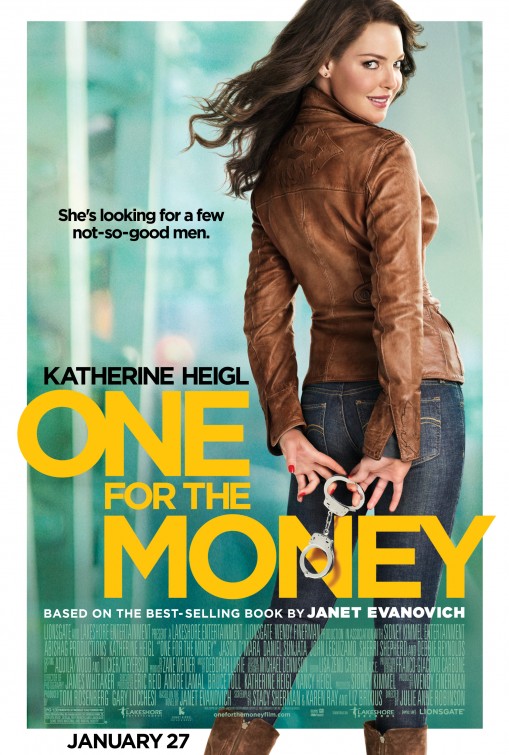 I think it’s about time we all conduct an intervention for actress Katherine Heigl, whatever it takes to stop her from starring, and producing, such middling junk like One for the Money. Heigl plays a novice bounty hunter, a Jersey girl on hard times who is tracking down her ex-boyfriend for a big payday. Yes, it’s essentially a gender reversal of the loathsome Jennifer Anniston movie, The Bounty Hunter, but at least this movie doesn’t foster a forced romance. I give the movie some credit for presenting two potential love interests for Heigl and by film’s end she’s still on her own. Bravo. The rest of the movie, however, is all strictly by the book, including the colorful characters that Heigl seems to collect. One for the Money isn’t particularly funny or particularly good. It also isn’t particularly offensive; it’s just the standard pap you expect from Heigl at this point. Here’s a confession: I really, truly enjoy Heigl as an actress. She’s terrific at comedy and has star-power charisma, and even in junk she’s still effortlessly enjoyable to watch. This woman has talent, she just doesn’t have taste when it comes to picking movie roles. Or maybe she’s content with churning out a mediocre rom-com every year or so for her fans. I just wish Heigl would gain some confidence and bounce from the ghetto of rom-coms, or at least poorly written, blandly formulaic ones. She’s taken the rom-com crown that once belonged to Julia Roberts, Meg Ryan, and Sandra Bullock, but look to them as example. You will have to adapt or die, because eventually Hollywood will find the next Katherine Heigl and supplant the old one.
Nate’s Grade: C
Share this:

Ted (2012)
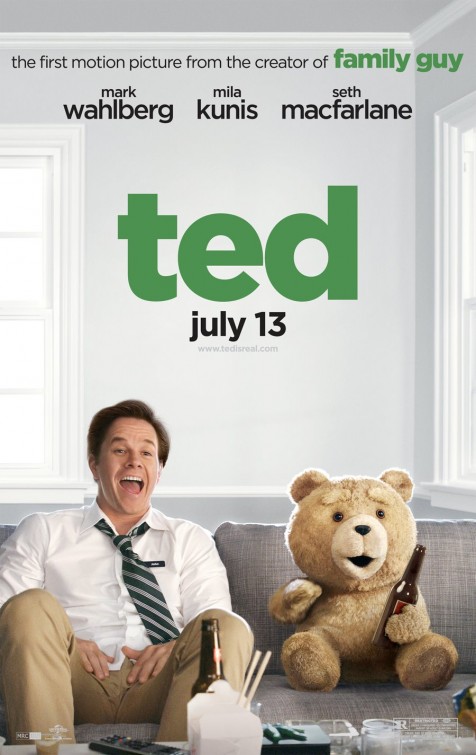 Seth MacFarlane has become an industry powerhouse. The man has three animated TV shows on air (Family Guy, American Dad, The Cleveland Show) and essentially carved an entire niche of modern comedy. His brand of irreverent, offensive, tangential humor has turned the man into a demigod among young audiences and helped him rake in millions. A journey to the movies seemed inevitable, and so comes Ted, which MacFarlane directed and co-wrote with two of his Family Guy scribes. The best assessment I can give is that if you enjoy MacFarlane’s brand of humor on TV, you’ll probably enjoy Ted. If not, then you’re in for a prolonged, obnoxious two hours.
One day when young John Bennett was a young boy, he wished his teddy bear would come alive so he’d always have a best friend. And as a narrator tells us, nothing is stronger than a young boy’s wish (curious gender is specified and then never touched upon for some kind of joke). The next morning Ted (voiced by Seth MacFarlane) comes alive. Flash forward 30 years and Jon (Mark Wahlberg) works at a rental car company, has a stunning girlfriend in Lori (Mila Kunis), and regularly gets stoned with his best pal, Ted. The two guys are inseparable, which causes friction between John and Lori. After another notorious incident of Ted behaving badly, Lori insists that he move out. John has to start acting more responsible and treating Lori like she deserves, but Ted’s influence usually leads to trouble. Both Ted and John are in desperate need of growing up.
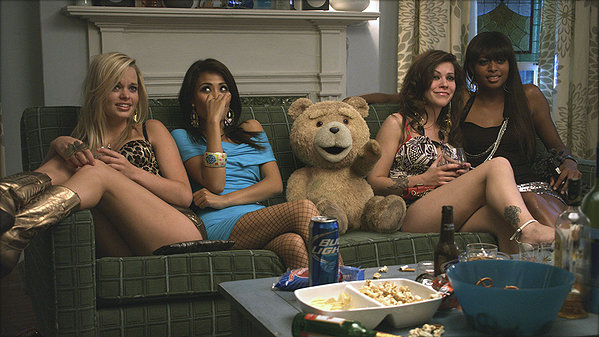 It was no surprise for me that Ted was exactly what I expected from Seth MacFarlane. It’s just a bigger, raunchier version of the style of humor he’s patented on television: tangential non-sequitors, scenes that go on far too long, obscure pop culture references, pointless shock material, and the basic premise that the jokes hinge around some creature merely doing things. Like Brian the Dog, or Roger the alien, Ted is a creature that shouldn’t necessarily exist, and thus so much humor is built around just seeing Ted exist. Is it supposed to be hilarious watching him drive? How about hit on women? Do bong hits? Far too often the only joke the movie seems to offer is that Ted is a teddy bear doing stuff. If you replaced him with, say, a normal human being, would any of those jokes work? Would it be funny watching a normal person drive, hit on women, and do bong hits? Maybe but probably not. It’s all one joke: look at something unnatural doing natural things. And that’s my issue with MacFarlane’s brand of humor. These jokes are not given proper attention, setup, and development. The film rarely subverts your expectations with how every joke will play out, and if you already know the jokes before the movie delivers them then what’s the point? The one joke I did laugh at, and a good guffaw at that, was Ted’s boss who kept responding to Ted’s screw-ups with good words and promotions. That was a surprise. But here’s the thing: once it’s established, you know what will happen the next time. So the second time it’s still funny but not as much. By the third time, his nonplussed reaction is completely expected and thus all traces of funny have been squeezed dry. In comedy, it’s all about surprise, and I find with MacFarlane that he rarely strays from his routine.
As far as jokes going on too long, let’s talk about a myriad of subplots that seemed to go on forever. There’s an entire storyline where an obsessed fan played by Giovanni Ribisi (Contraband) kidnaps Ted. This storyline makes up almost the entire third act and occurs after the reconciliation between John and Lori, so the movie already feels like it should be over. And then it keeps going. And it keeps going longer. And then there’s a car chase and a foot race through Fenway Park, which serves no purpose other than to probably fulfill a childhood wish of MacFarlane’s to film on said hallowed grounds. And it’s during this final act where the crass movie tries to become… sentimental? It just doesn’t work. You can’t have 100 minutes of rude, offensive, vulgar humor and then try and then try and go all gooey and soft and make people feel something akin to emotion. The reason that the Judd Apatow films can work with emotion is because from the get-go they make you care about the characters and their relatable conflicts. But there’s a difference between emotion and cheap sentiment, and Ted hasn’t earned genuine emotion. I didn’t like any of these characters. They all seemed like louts and jerks and dolts, none of them charming. Thus the end and its wish-upon-a-star conclusion are cheap sentiment and the kind of conclusion that you believe without a doubt that the characters in Ted would mercilessly mock.
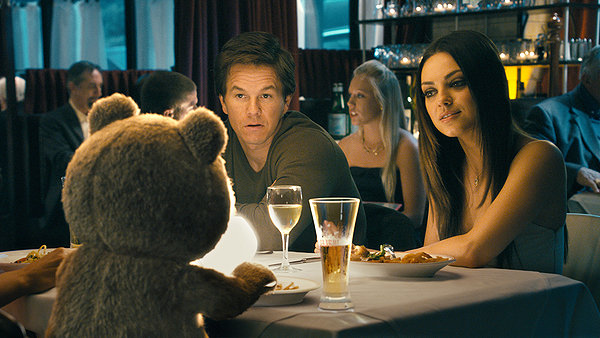 Let me specify for the moment that there is a distinct difference between gross-out gags and gags that are just gross. There is also a difference between jokes that are shocking but funny and jokes that are just desperate to offend. In my experience with MacFarlane’s brand of humor, as well as McFarlane’s fratty devotees (if I was rushing a fraternity, I have no doubt Ted would be my favorite movie, bro), that difference is not understood. Watching an over-the-top racist Asian stereotype is merely offensive without proper context to draw out humor beyond the odious and obvious. Just punching a child in the face isn’t funny. Just having someone defecate on the floor isn’t funny, though the panicked removal of said feces was humorous in flashback. I may have chuckled and giggled from time to time with Ted, but most of the time I was just saddened by how desperate McFarlane and his writers were to shock rather than to entertain.
Thank God Wahlberg (The Fighter) was in this movie. While Ted is best left in small doses, the boorish best friend archetype, Wahlberg has been sharpening his comedic muscles (the only muscle in need of work it seems) and has become a terrific straight man. Anyone who remembered 2010’s The Other Guys knows that Wahlberg can be flat-out funny when given great madness to play off of. With Ted, Wahlberg’s commitment to the innate absurdity of the movie goes a long way. His breathless rendition of an exhaustive list of white trash girl names had me laughing harder than anything else in the movie, and I admit I was also impressed by Wahlberg’s speedy delivery. The character of John is a pretty standard role at this point in American comedy, one of arrested development. However, it seems to take so long, blown chance after blown chance, for John to finally find some sense of responsibility. Just like everyone else, he is at the mercy of Ted’s corrosive influence.
I probably wasn’t the ideal specimen for MacFarlane’s first foray into movies. I’ve never been more than a mild fan of his TV work and its hit-or-miss-but-mostly-miss brand of tangential humor, though I admit American Dad has grown on me (the only MacFarlane show where the jokes seem related to the story situations). MacFarlane unleashes the vulgar material he’s been holding back from TV, which makes for some laughs. The obviously stoned guys sitting in front of me thought the movie was hilarious, even during quiet moments where nothing was going on. I’m disappointed that a MacFarlane movie is pretty much exactly as I would have suspected, essentially a MacFarlane TV show blown up to a bigger screen. The jokes here are so limited, mostly deriving from Ted the teddy bear just doing things a teddy bear normally doesn’t. I wish the comedy were more developed, more nuanced, more concerned with doing something other than shock. The most shocking aspect of Ted is how utterly forgettable the whole enterprise is even with a magical talking teddy bear.
Nate’s Grade: C
Share this:

Safety Not Guaranteed (2012)
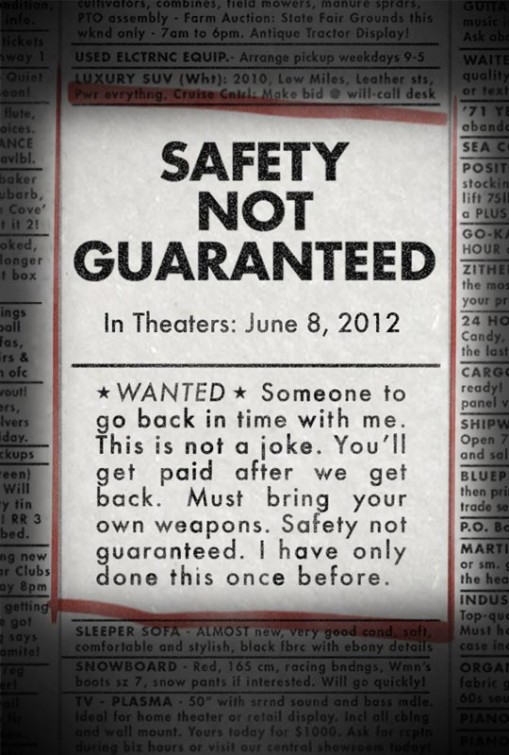 A man puts a classified ad in the newspaper asking for an unusual companion. No, it’s not some weird sex thing. Kenneth (Mark Duplass) intends to travel back in time to correct a few regrets. He’s looking for a partner, though he specifies his traveling companion must bring his or her own weapons and that safety is not guaranteed. This quirky ad grabs the attention of Jeff (New Girl‘s Jake Johnson), an egotistical writer for a Seattle magazine. He takes along a pair of interns, the surly Darius (Aubrey Plaza) and the nerdy Arnau (Karan Soni). Together, the gang heads out of town to seek out Kenneth and determine whether or not he is for real. However, Jeff’s real intention for this “work vacation” was to travel back to his hometown and try and score with Liz (Jenica Bergere), an old high school flame he is horrified to discover has… aged. Darius is the only one who can get close to Kenneth, but what starts as an opportune assignment into investigating a weirdo becomes something more. The guy, sweet if a little off, may be on to something… big, and Darius may be falling for him despite her own misgivings.
Safety Not Guaranteed is a modest film but does it ever sneak up on you and deliver an emotional wallop. I’m a romantic at heart, and so I’m generally affected by seeing two lonely people find their special something in the world reserved for them, and it’s even more affecting when these people are oddballs, and thus it’s even more resonant and meaningful for them to find that connection so elusive before. At its heart, Safety Not Guaranteed is a quirky yet naturally developing love story, and those are my favorite kind. I found my heart melting every time Darius couldn’t help herself and smiled. Perhaps it’s because Darius is our outside heroine or that Plaza is best known for her stone-faced deadpans on TV’s Parks and Recreation, but every one of those smiles felt so richly earned and rewarding. These aren’t the typical rom-com characters that are going to lapse into great speeches about love at key clichéd moments; while dabbling in some fantastical elements, Safety Not Guaranteed exists in our own recognizable world. And with that established, the unguarded moments of genuine happiness for characters we care about translates into a surprisingly touching experience. My heart felt so full at different points, melting and swelling and doing other non-medically accurate things. I honestly had tears in my eyes at different points. By the perfect end, I was so hopeful and overjoyed and left the theater soaring on my good vibes. I can’t guarantee everyone will find the same level of engagement in the romantic relationship, but I believe that the movie is inspired, clever, and authentic enough to deliver a crowd-pleasing finish. It’s earnest without being hokey.
 I’m trying to tiptoe around spoilers, though for those critical readers out there I’m sure you can infer a thing or two about the end of the film given my positive, beaming response. I’m sure my reaction would have been quite different if, say, Darius and Kenneth died in a horrible fireball because he was criminally insane from the start. All I’ll say is pay attention to certain discrepancies and see if they might prove to be a conversation-starter when you leave the theater.
Have I mentioned how truly funny this movie is? I’ve been talking all about the “rom” portion of the equation, but Safety not Guaranteed is a consistently funny movie, with a few big laughs. The movie’s sharp sense of comedy is more than everyone simply derisively laughing at the nutball. To be sure, Kenneth provides plenty of comedy in his super serious demeanor, and the movie doesn’t overplay the idea that he may be mentally unbalanced. The jokes come from the character interaction more than any contrived set piece, and the pleasure is in watching conflicting personalities bounce off one another. Every character contributes nicely to the comedic rhythms of this picture, adding a line here, a reaction there, to assemble one very funny movie. In movies where one character enters a relationship under initial false pretenses, usually you just keep waiting for that particular shoe to drop. You wait for the truth to come out and then deception reconciliation dominates the third act. Thankfully, the movie speeds over this narrative trap and gets us to the good stuff. We don’t need an entire act for people to be contrite and prove their love when what we see onscreen is obvious enough.
What elevated Safety Not Guaranteed for me was that beyond the oddball romance, there’s careful and compassionate attention paid to a slew of supporting characters. Now with a scant 80-minute running time, and the attention-grabber of a guy who thinks he can travel through time, naturally the supporting characters have minimized roles, but what I enjoyed was that they were not just relegated as stock players. The film has two stock roles, Nerd and Jerk, and fleshes them out further (though, to be assured, those are still defining characteristics). Arnau is a guy who is convinced any interaction with girls will ultimately lead to personal embarrassment. He’s only focused on the future and what he needs to get there, barely living in the present. It’s nice to watch him grow some confidence, albeit a small amount, and find some degree of enjoyment. And then there’s self-described asshole Jeff, who only submitted the story so he could come back and bang his old high school girlfriend. Some will find Jeff’s minimal personal growth to be disappointing and stagnate, but I thought anything substantial for this character over a three-day period of time would be unrealistic. Jeff is chasing his past memories, a faded time that had so much possibility when he was a stud in high school. The movie explores this notion of returning to a period of innocence as well. Going back to a time before overwrought cynicism, before settling, before compromising, before life became work, it’s something of a wish that the characters seem to be chasing. Jeff realizes how truly empty his life is, yet he’s probably too set in his ways to alter his path, which is a shame because Liz certainly seems like a lovely, caring, and capable romantic opportunity. Hey, she bakes, too (Bergere is great and easy to fall for). The unlikely friendship that emerges between Jeff and Arnau is also quite enjoyable and disarmingly sweet.
 I also need to single out the score from first time composer Ryan Miller, the lead singer and guitarist for one of my favorite alternative rock bands, Guster. The music has a lilting, dreamy quality to it but then follows a steady melodic rock path, reminiscent of the melancholic score for Little Miss Sunshine. The strumming guitars, plinging pianos, and swelling violins come together in harmony with little sci-fi touches. The score gives the film another sense of enchantment. I’ve been listening to “Big Machine,” the song Kenneth plays for Darius, on a loop for over an hour, if that gives you any indication on how much I enjoyed the original tune. The fact that “Big Machine” plays over the end credits when the movie meets its perfect end has got to account for some of my positive association. I think Miller has a bright future in crafting film scores.
Plaza (Funny People) deserves to break out in a big way after this film. She’s the heart of the movie and deeply vulnerable, covering it up with nonchalant cynicism. Darius is well within her surly comfort range so it’s no surprise that she excels with the hipster character, but the moments of dramatic weight are not given flippant treatment. Duplass (TV’s The League), just about everywhere in 2012, delivers a committed performance, though it seems mostly committed to the goofiness of his character. Yet when Duplass is able to show you some of the edge to his character, that’s when the performance walks a line between dangerous and exciting. The movie hinges on the two actors working together and they have good chemistry; the goofball and the cynic.
It’s so nice to discover a movie that lifts your spirits, that touches your heart without reaching for the treacle, and delivers a funny experience without compromising its modest aims and modest tone. Safety Not Guaranteed obviously plays a deliberate dance with the audience, vacillating between moments that make Kenneth seem crazy and moments that make you question whether he’s legit. The movie reminded me in a lot of ways of the underrated 2000 flick Happy Accidents, which featured Vincent D’Onofrio as a romantic suitor who also might be a time traveler or just plain nuts. Safety Not Guaranteed is a charming movie that seems to work a spell on you while watching; you get so invested in watching lonely people find meaningful human connections that you are compelling the movie to end under some happy scenario. Director Colin Trevorrow and writer Derek Connolly deserve to make waves in Hollywood with what they’re able to accomplish with a tidy budget and some clever yet earnest writing. This beguiling love story is all about stretching out of your comfort zone and taking a plunge into the unknown. Just like Kenneth, we’re all looking for a partner worthy of that plunge (not necessarily a romantic partner, mind you). Take the plunge and go see Safety Not Guaranteed, one of the best movies of the year. Not bad for a movie potentially based upon an Internet meme, huh?
Nate’s Grade: A
Share this:

Jack and Jill (2011)
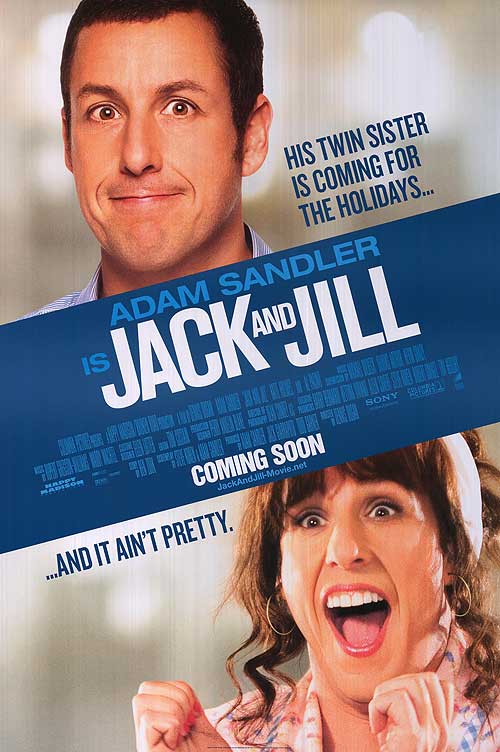 I was anticipating bad, I was anticipating outlandishly bad, but nothing can prepare you for how stunning and jaw-droppingly awful Adam Sandler’s reported comedy Jack and Jill truly is. The movie swept the Razzie Awards in all categories this year, a historic feat. Sandler plays a rich ad exec and his braying, boorish twin sister, who Al Pacino, in a strangely committed performance as himself, falls in love with for no discernible reason. I’ve seen my fair share of craptacular cinema, and yet this movie is bad on a rarely seen level of human tragedy; it feels like the movie came from a different dimension, where they had no concepts of human relations, reactions, expectations, or senses of humor. It feels like you’re watching a cultural artifact of a civilization in decline. I haven’t been a fan of Sandler’s brand of naughty-yet-safe humor for a while, but this movie is weirdly cruel to all sorts of people, like Mexicans, atheists, adopted kids, Jews, and human beings with working senses of humor. The quality of comedy includes gems like, “Play twister with your sister,” and, “These chimichangas are making a run for the border.” The rampant and nakedly transparent product placement for Carnival Cruise and Dunkin’ Donuts is obscene. This is a charmless, witless film, and when it tries to wring actual emotion out of its daft scenario, the whole enterprise just implodes. Jack and Jill is so odious, torturous, reprehensibly bad that it feels like one of the joke movies that Sandler made in 2009’s Funny People. You feel like the entire movie is one long joke put on by a contemptuous Sandler. I think my good pal Eric Muller had it right; we’re on the tail end of Sandler’s deal with the devil. Jack and Jill is why the terrorists hate us.
Nate’s Grade: F
Share this:

Bernie (2012)
 The last person the residents of small town Carthage, Texas would expect to be tried with murder would be Bernie Tiede (Jack Black). He was an assistant funeral director, a “born natural” we’re told at comforting others, but he was really the everyman glue of the town. He lead the choir at church functions, loaned his time and money to those in need, directed the town’s fledgling drama productions, coached the Little League team, and went out of his way to spend time with the town’s lonely little old ladies. It was a shock then, in 1996, to find out that Bernie had shot one of those little old ladies, Marjorie (Shirley MacLaine), the meanest one of them all, and stuffed her body in a freezer and kept it all a secret for nine months. During that time, Bernie used Marjorie’s considerable fortunes to help every community project he could. Despite the macabre nature of the crime (she had to thaw out for two days before an autopsy could be performed), the residents of Carthage rallied around their boy, Bernie. District attorney Danny Buck (Matthew McConaughey) had to move the trial to a different venue, not because the accused couldn’t get a fair trial, but because everyone in town wanted Bernie free.
Bernie is Richard Linklater (School of Rock, Dazed and Confused) returning back to his local color roots. The man is excellent at taking the natural peculiarities of regionalism and credibly establishing a slightly skewed yet authentic portrayal of small town Middle America that feels like it was lifted straight from the pages of Mark Twain. Aiding Linklater is the fact that the movie is composed like a true crime special replete with on camera interviews from many of the real townsfolk of Carthage who knew the real Bernie and Marjorie (what a strange experience it must have been acting with the fictional counterparts). They are all amusing, unassuming characters in their own right, many natural scene-stealers, and they’re still fiercely protective of Bernie 15 years after the events of the movie. The town’s unswayable loyalty and adulation for Bernie pretty much becomes the film’s own point of view. Despite confessing to murder, we find ourselves liking the guy. It’s hard not to love the guy when we see him lift the spirits of the bereaved, volunteer around town, and bring so much pride and joy to the citizens of Carthage. When forces are circling around him, we want him to escape. We want him to keep the illusion of Marjorie being alive just a little bit longer, especially when, in death, she is helping so many more people. Even when we reconcile the facts our gut still wants him to get slapped on the wrist for what is, after all, a capital crime. It’s a fascinating emotional journey for the audience in that regard, to ignore the reality of the offense because of how genuinely nice Bernie is, except for that time he killed an old lady and stuffed her in the freezer.
 Black (Tropic Thunder) does something completely different from his usually manic routine. By God, the man inhabits this character. The part plays to his strengths as a performer, his energy and natural likeability, but allows him to mellow out and try a very different tact. For the first time in perhaps his acting career, he’s not playing some variation of Jack Black. He’s playing a real-life person, though that doesn’t necessarily mean the actor is indebted to completely mimicking the living inspiration. Told from the perspective of fawning townsfolk, and one completely mystified prosecutor, Bernie remains something of a mystery as a character. He’s deeply repressed, probably closeted as well, and it’s that distance that keeps us from better understanding him. For all intents and purposes, the people of Carthage loved Bernie, but did any of them really know him? He was a genial presence, charitable and kind, but could anyone really say they truly knew him? Who is the real Bernie, the guy who would break his back helping his neighbors out of the good of his heart, or the guy who shot a little old lady four times in the back? Black doesn’t overplay the fey mannerisms or go to camp levels; he hides behind his friendly veneer and hints at more at work. Bernie’s canny salesmanship with funerals, as well as his lavish spending when he got in control of Marjorie’s finances, give a glimpse at a darker side of Bernie. It’s subtle work for a role that tempts him to go larger. I have no reservations when I say that Black’s controlled yet charismatic performance is worthy of Oscar attention. He’s that good, folks.
Supporting Black are two other great performances from established stars. MacLaine (Valentine’s Day) hasn’t had a role this good since the underrated In Her Shoes. She has great fun as the old sourpuss in town, but she too shows us glimpses of the real Marjorie, the one behind the wall of negativity. There’s a scene where she’s watching Bernie’s musical practice and she can’t help herself but smile. The very act has to break through the scowl that she has so permanently etched into her face, but break through it does triumphantly. MacLaine could have easily been portrayed as a caricature of the grouchy rich old lady, but she’s better than that. You don’t exactly sympathize with her but you do feel Marjorie’s budding comfort, even if it’s slathered in her usual contempt, and you feel her desperation at clinging to the one person who has shown her any personal interest. Likewise, McConaughey (The Lincoln Lawyer) could have been the one-note daffy lawman, and he’s certainly presented as such early on with his attention-seeking theatrics. We don’t really like Danny Buck, but from an objective standpoint he is the voice of reason. He counters the easily forgiving townsfolk, “If he killed you and stuffed you in a freezer, would you not want him to go to jail?” We know he’s right. And yet, strangely, we don’t seem to mind that much. It’s nice to see McConaughey flourish in a role that shows you he can be a real fine actor instead of just a real fine shirtless torso.
 Linklater balances a lot of different tones here but manages to find a satisfying middle ground. Bernie is a chuckler, a movie that will continuously make you laugh but leave your sides safe from splitting. I chuckled and guffawed my way through from beginning to end with great amusement. The comedy is dark but not unrepentantly (hence the PG-13 rating) or mean-spirited. Linklater doesn’t make light that a real woman was murdered, but his film raises a cracked mirror at the absurdities of our culture and the power of charisma/celebrity. There’s a mordant amusement to the entire movie, and you know you shouldn’t be laughing but you cannot help the urge. The constant interviews with the actual Carthage townsfolk add a nice color commentary to the proceedings, filling in the edges of the blanks left over by the screenplay. Some may feel that the constant commentary undercuts the movie, interrupts its flow and turns the movie into one of those grisly TV true-crime specials gussied up for the big screen. The movie does follow a similar trajectory but Linklater balances the small-town satire, tragedy, courtroom drama, and general morbid curiosity into one persuasive, cohesive whole.
Bernie is one of those stories that are so bizarre that it could only come from real life. Buoyed by strong comedic performances, a mordantly compelling story, and some rich supporting turns from real-life witnesses, Bernie is an amusing breath of fresh air amidst the summer movie-going extravaganza. It’s gentler than I would have anticipated, and funnier, and Black’s wonderful performance is worthy of serious awards attention, though I know it will be long forgotten come the fall. I don’t think Linklater was trying to make some kind of larger statement about the powerful allure of charisma, or our malleable sense of what constitutes right and wrong, but Bernie the movie is all about the fronts people put out there and the human willingness to be deceived. Or it’s just a really fun, country-fried slice-of-life comedy. Why not both? Bernie is worth discovering.
Nate’s Grade: B+
Share this:

Men in Black III (2012)
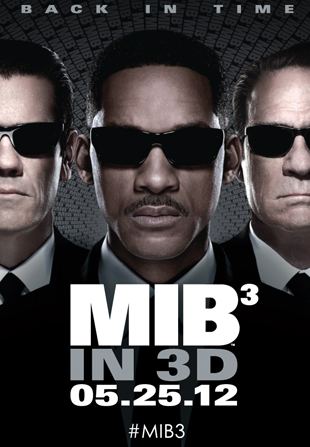 It wouldn’t be a Men in Black film without script problems. The first film languished for some time, originally taking place in Kansas of all places, before director Barry Sonnenfeld became attached and insisted upon a New York City location. The 1997 sci-fi buddy cop comedy was a hit, and rightfully so, and Will Smith became a megastar. Then the 2002 sequel’s climactic action sequence had to be rewritten due to the fact that it was originally going to take place in the World Trade Center. If only that lackluster sequel had gone through more extensive creative revisions. However, these past hiccups don’t seem to come close to Men in Black III, which to Sonnenfeld’s admission, started shooting in late 2010 without a finished script. It had a beginning, an ending, but nothing definite to tie together. So the whole production took eight months off to work on the meat of that movie sandwich. Hollywood movies, especially modern films of huge-scale budgets and set release dates, have routinely started production without completed scripts, including Gladiator, Jaws, Apocalypse Now, and Lawrence of Arabia. Naturally, those are the exceptions to the rule.
Boris the Animal (Jermaine Clement) has escaped from pison and out to seek revenge on the man who put him away and took his arm – Agent K (Tommy Lee Jones). Boris travels back to July 1969, when a young Agent K (Josh Brolin) thwarted the big bad Boris. Boris kills Agent K and alters the future. The Earth is now vulnerable to an alien invasion from Boris’ species. Agent J (Smith) has to travel back in time to save his old partner and the planet.
It’s been ten years since the spotty Men in Black II and almost four years since Smith has been seen in a movie. Where did the time go? Fortunately, this third movie hews closer to the droll brilliance of the first film. Part of that is a sharper story with a more clearly defined goal and a return of the playful exuberance that belies the franchise. Also, I must say that absence has made the heart grow stronger, because I’ve missed Smith’s effortless charisma onscreen. Agent K is such a natural fit for the guy and it’s just fun to watch him stumble through strange alien encounters (this time we learn all super models are aliens; listen good, young women of America who punish themselves to fit this image of beauty). Time travel is usually employed when a franchise seems like it’s all out of gas; it’s usually more focused on the comic fish-out-of-water possibilities, which there are a few in Men in Black III. As one characters notes, 1969 wasn’t exactly a great time for black people in America, and J combats casual racism, black panic, and ignorance with a defiant attitude that is amusing to watch. I’m glad the whole race-relations reality was addressed, though it’s also for the best that the movie doesn’t get bogged down with scenes of Agent J conflicting with bigoted authority. Men in Black III remembers that we’re here to have fun, and the screenplay by Etan Coen (Tropic Thunder) has a light-handed touch. I enjoyed the opening jailbreak sequence with Boris, though I would have thought a lunar prison would have better security. Bill Hader (Superbad) has a fun cameo as a self-hating Andy Warhol, really an undercover MIB agent, though the idea that Warhol’s Factory artists as aliens seem a tad simple. The glaring cameo omission was Jon Hamm (TV’s Mad Men) as a scotch-drinking MIB ladies man of legend.
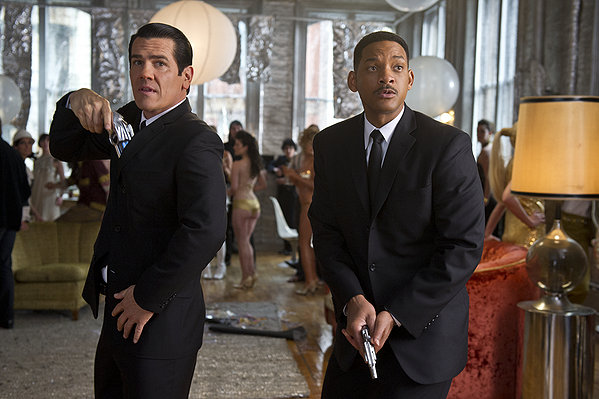 As evidenced from the trailers and marketing, Men in Black III is really Brolin’s movie. The guy establishes an uncanny Tommy Lee Jones impersonation. The eerie brick-faced stoicism, the melodic lilt of his voice, the syncopation of his speech patterns; Brolin nails it all. Watching his interaction with K are the film’s most enjoyable segments. At this point in the series, Agent J and K have gone beyond the rookie/mentor phase and now have something of a friendship, though their arguments at year fifteen of their partnership sound more like the arguments they would have in year two (you need to “open up” and be less grumpy, sounds elementary). Still, there is a personal connection to this case that eluded the last movie, and it gives the film a sense of urgency even when the comic shenanigans seem to hog the spotlight. The personal reveal in the last act didn’t have as much emotional power for me, mostly because I did the math and realized whom a certain unseen character of significance was before we got their true identity. The end does give the film series a circuitous sense of finality.
For a franchise that seems like it can go anywhere at any time with limitless possibilities, the worst thing you can do is be shut off to better avenues of storytelling. Take for instance the climax at Cape Canaveral, which itself is a rather anticlimactic sequence involving the launch of Apollo 11 (don’t they know that alternative 1960s history was sooo summer of 2011?). J has his time travel doohickey that lets him travel back. He gets to use this device once during the climactic fight, allowing him to travel back one minute in time so he knows how to properly duck. That is it. What a fantastic waste. If you’ve got a device that essentially allows for unlimited do-overs, then I want this device to be an integral part of the climax. I want J to have to regularly use it to fix past mistakes and learn more and more from each time jump. Just memorizing how to duck is lame. The entire subplot with Agent O (Emma Thompson in the present, Alice Eve in the past) and her dalliance with K is so carelessly thrown away that I wonder why the filmmakers even bothered to include it. Then there’s our villain, Boris, whose name itself is even lazy. He’s just a bad dude with some sort of insect that lives in his hand and shoots spikes. That is it. He’s a guy who can fire projectiles. So what? What about that makes him interesting? An unrecognizable Clement (Flight of the Conchords) does his best but the character just doesn’t have anything about him that deserves special attention; he could have been any villain (I think Vincent D’Onofrio was undervalued in his go-for-broke physical performance as the first film’s villain). I did like the idea of Present Boris arguing with Past Boris, but like most promising ideas in Men in Black III, this space-time sparring is never fully realized. While enjoyable, there’s little you’ll be able to think back on with Men in Black III and say, “That was well developed.”
Paradoxically, I think Men in Black III has a character that might simultaneously be the best and worst thing about the film. Allow me to explain. About halfway in, we’re introduced to the alien Griffin, played by the great Michael Stuhlberg from A Serious Man and TV’s Boardwalk Empire. He’s a creature who can see nigh unlimited timelines, all the variations of choice and possibility play out before his eyes, one after another. He never knows which timeline he’s in until the moment occurs, thus he’s constantly worried about every moment to come in his life. This foreknowledge sounds like a wretched curse, and with Stuhlberg gives a forlorn edge to his character’s eccentricity. So when J and K meet the guy, there are some clever moments, like when Griffin details every peculiar aspect of chance that lead to the 1969 Mets World Series victory. The moment, and by extension the character, is a nicely reflective idea that every moment is a miracle of causation. Griffin is just an interesting character. Here’s where the worst part comes in. Rarely is he treated as a character because, you see, Griffin is really a magic plot device. He can tell the Men in Black agents whatever they need to do at any point, instantly providing a narrative cheat. When in doubt, just ask the guy who sees the future and he’ll steer you without fail to the next necessary plot point.
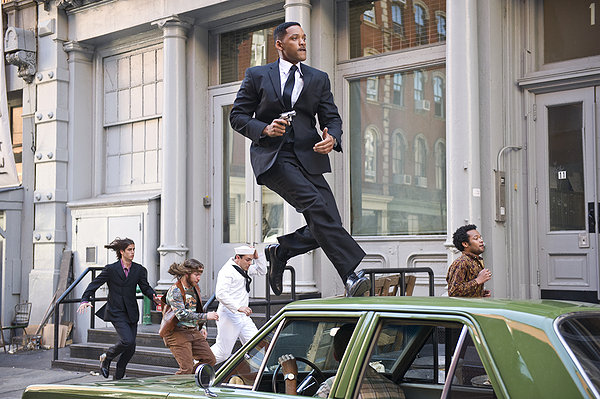 I saw this movie in 3D, not by choice mind you, and for the first half hour it felt like one of the better 3D conversions out there. Sonnenfeld’s camera plays a lot with depth of field and primarily forward-backwards movement, which made for a slightly elevated viewing experience. But somewhere around the halfway mark, I swear the movie forgot it was supposed to be 3D and the dimensional differences became negligent. It never really recovers, and so I advise all potential ticket-buyers to skip the 3D screenings.
With most time travel escapades, there’s going to be some plot holes. Working with a flurry of alien technology, it would have been exceptionally easy for the filmmakers to just explain away the plot holes with some magic device, much like the Paradox Machine in Dr. Who. Hey, there’s a machine that makes sure we don’t have paradoxes? Good enough for me. It’s like in Thank You for Smoking when Rob Lowe’s character explains why actors would be able to smoke in an all-oxygen space environment: “It’s an easy fix. One line of dialogue. ‘Thank God we invented the… you know, whatever device.’” The fact that Men in Black III doesn’t even address its biggest plot hole astounds me. If Agent K is killed in 1969, then he was never alive to recruit Agent J into the service. Let’s even assume that J’s credentials would still get him noticed and staffed with the MIB; if Boris killed Agent K in the past, then there was no reason for Boris in the future to travel back in time to kill Agent K. Again, these aren’t nit-picky gripes, these are major, easily understood plot holes, and I’m dumbfounded why no characters even address them. I could nit-pick over why Boris decides to go to 1969 when he just as readily could have gone to a time when K was a child and thus more vulnerable. Surely a child is easier to dispatch than a 29-year-old man.
Men in Black III is a far improvement over its stilted predecessor, but it still ends up falling well short of the potential it flashes. It’s intermittently amusing with some fun cameos and some visual panache, but this movie should have been stronger, stranger, and more playful with its central time travel conceit. It’s hard to work up that much distaste for the movie, especially since it has such a lively, jocular feel. Not all of the jokes work, but enough do, and the movie maintains an overall pleasant sensibility, zigzagging in imaginative directions that most Hollywood movies never beckon. It’s the stuff that works that illuminates the potential left behind as it goes into summer blockbuster territory. Men in Black III is an example of diminished returns, yes, but some franchises start so high that even latter, lesser sequels will have more entertainment value than their competitors. While it won’t set the world on fire, Men in Black III exceeds expectations and provides enough entertainment that it’s worth a look and little else.
Nate’s Grade: B
Share this:

Dark Shadows (2012)
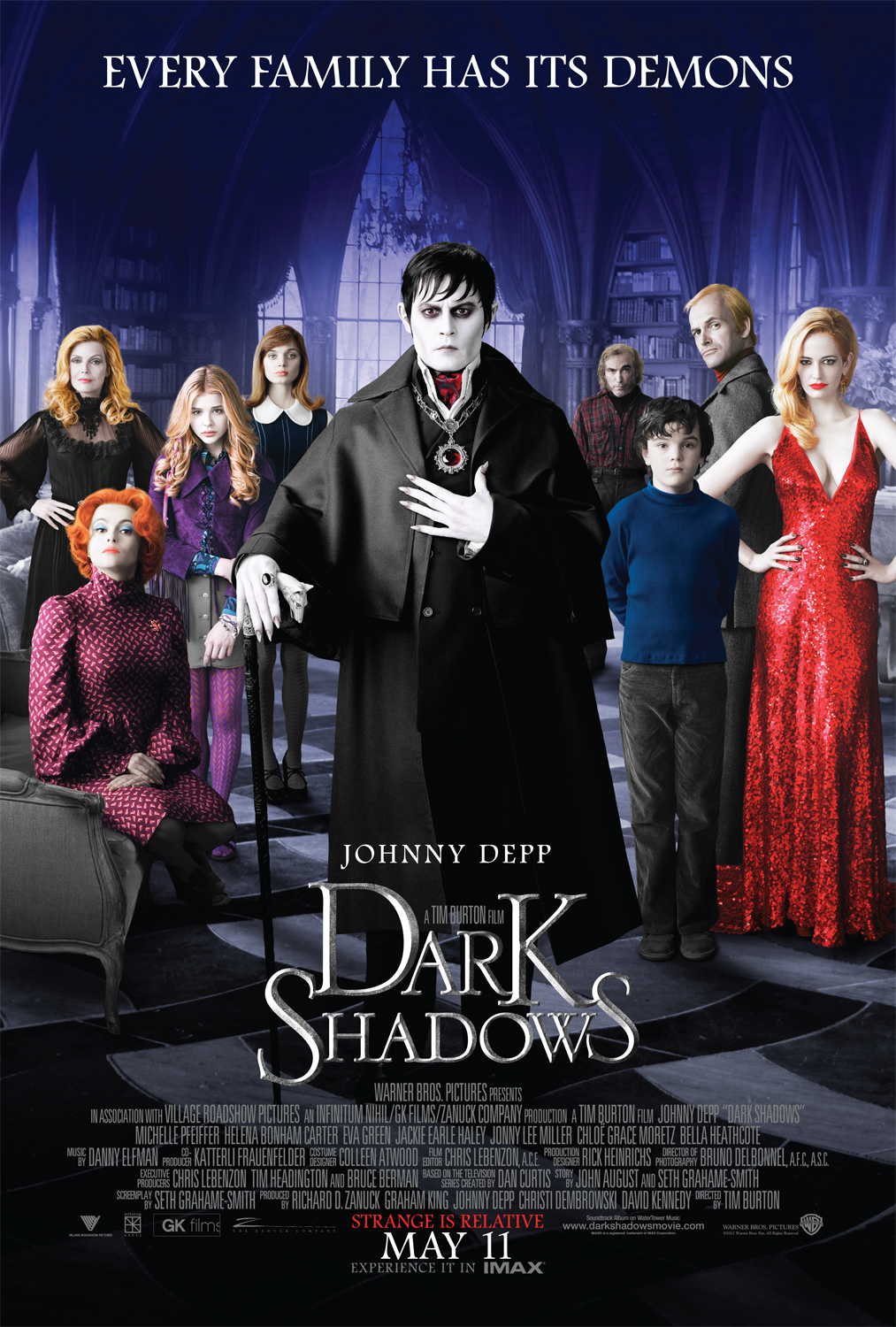 Dark Shadows was a daytime soap that aired for only a brief period of time as far as soaps are concerned, 1966-1971, but it was enough to make a lasting impression. The supernatural soap featured vampires, werewolves, and other creatures of the night, entangled in high-stakes drama and romantic excursions – it was the Twilight of its day. Director Tim Burton and his attached-at-the-hip collaborator, actor Johnny Depp, were fans as children and have kicked around a big-budget big screen version for years. Now that Dark Shadows hits theaters, you’ll be left wondering whether they really ever liked the original show or secretly despised it.
In the 1770s, Barnabus Collins (Depp) is the son of fishing and canning magnate in colonial Maine. He has a fling with Angelique (Eva Green), one of his family’s servant girls, and unfortunately for him, the gal is also a witch in her spare time. She curses the Collins family, killing Barnabus’ mother, father, and the woman he loves. She then turns him into a vampire, riles the villagers into mob mode, and Barnabus gets trapped in a coffin and buried for good.
Two hundred years later, a construction crew unearths an old coffin and out pops Barnabus from his prison. The world is a very different place. Elizabeth Collins Stoddard (Michelle Pfeiffer) is running the Collins family manor and canning company, which has fallen on hard times. A rival canning company is snapping up fisherman contracts, and this company is led by none other than the same ageless Angelique. Elizabeth tries to conceal her distant relative’s unique “condition” from the rest of her family, her brother Roger (Johnny Lee Miller), and his son David (Gulliver McGrath), grieving the loss of his mother, moody 15-year-old daughter Carolyn (Chloe Grace Moretz), and caretaker, Willie Loomis (Jackie Earle Haley). The Collins family also has a new hire, Victoria Winters (Bella Heathcote), who looks strikingly like Barnabus’ lost love from 200 years ago. He becomes smitten with the new lass, who may be the reincarnation of his lost love. That’s enough to rev up Angelique’s wild sense of jealousy, as she tries to get her long-desired man and destroy anyone that stands in her way.
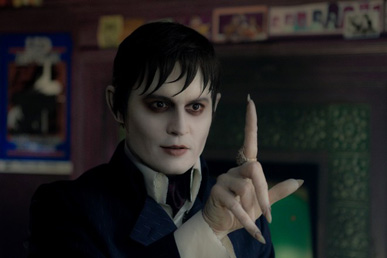 Is this ever one ghoulish mess of a movie. It never settles on a tone; is it supposed to be a larky tongue-in-cheek send-up, a Gothic melodrama, a dysfunctional oddball family comedy? What is this supposed to be, because whatever it is, it isn’t entertaining. Oh sure, it’s entertaining in a, “Where the hell is this going?” kind of way, but so is being kidnapped by a drifter. The movie feels like it has a box filled with ideas, and every so often it just shakes up that box, reaches inside, grabs one and says, “Let’s give this a try.” The screenplay, credited to author Seth Grahame-Smith (Abe Lincoln: Vampire Hunter), is awash with half-baked ideas and poorly developed characters. The live-in doctor, played by the second stalwart of the Burton Repertory Players, Helena Bonham Carter, is a hoot. Carter (The King’s Speech) has got an edge to her and an interesting dynamic with Barnabus, but sadly her storyline is tied up far too quickly. The character of Victoria is a rather interesting one, a girl who could communicate with her ghostly former relatives, who happen to look just like her. The gal was sent to a mental asylum by her parents and escaped, compelled to come to the Collins mansion. Why in the world wasn’t she the movie’s protagonist? That is a far more compelling perspective than a goofy vampire who speaks all old timey. Seriously, the Barnabus stuff is your basic fish-out-of-water comedy, lazily commenting on the times. There is no joke that is too obvious for this movie (Barnabus inquires why Carolyn has no husband; Barnabus is fascinated by a lava lamp; Barnabus thinks Alice Cooper is an ugly woman – sigh). A lot of the shapeless narrative would be forgivable if the movie was just funnier. Barnabus is just not that fun of a character. His anachronistic verbiage gets dull when you discover that seems to be the movie’s one joke. You may start tuning him out like I did.
The movie feels like a collection of subplots and no main storyline to gather traction. We’re told that the youngest Collins, little David, is enamored with Barnabus, though considering we’ve only seen the two together in like one previous scene, this seems like quite a leap. Unless David has gotten particularly skilled at hiding behind rocks, we haven’t seen any of this. The entire character of David and his sleazy father could be eliminated and they would only minimally affect the story. And then there’s the late revelation that one of our characters has a hidden secret identity, a revelation that fostered no setup. When the character looks into the camera to explain and ends with a curt, “Deal with it,” it’s like Grahame-Smith himself is speaking directly to the audience, mocking it for hoping that the movie would actually do a good job of setting up and paying off character development and relationships. Stupid audience. Why can’t you just be happy with all that neat Tim Burton set design?
 The final melee between the Collins family and Angelique keeps reminding you of the dashed promise of the flick. Angelique, in her witchy withiness, summons dark forces to make statues come alive. Well, sort of. They flail their arms a tad. And then she makes the walls bleed. Well, sort of. The dripping blood stops after just a few inches from where it began. If you’re going to make the house bleed, I want Shining-level torrents of the red stuff. The tonal inconsistency, matched with the muddled plot and scant character work, makes for a pretty frustrating bore of a movie.
You could usually count on Depp (Alice in Wonderland) for at least committing himself to another bravura weird performance, but the material fails him. He’s caked with alabaster makeup, given claw-like hands thanks to additional knuckles (why…?), and he’s trying his best to transform a list of peculiarities into a character, but like most things concerning the movie, it does not coalesce properly. I actually think the most entertaining actor in the movie is Green (Casino Royale). There’s not much to her role but at least she has fun with it, bringing an admirable level of energy while her peers remain laconic, content to submerge into the 70s scenery. She shows a nice flair for comedy heretofore unseen. Strangely, Green adopts a slightly raspy voice that sounded like an imitation of, none other than, Helena Bonham Carter. If Burton’s note to his film’s young, frisky, sexy antagonist was, “Sound more like my wife doing an American accent,” then I think we’ve butted into something personal best left between husband and wife.
Ultimately, I have no idea who this movie is going to appeal to. The fans of the original soap will surely not be pleased with the jokey, tongue-in-cheek manner that Dark Shadows treats its source material. Fans of Burton’s stylized, dreamy, Gothic fairy tale visuals will find the film tedious and a poor waste of the man’s talents. Even the casual Depp fan will probably find the movie mostly unfunny, weird, and boring. The tonal whiplash never settles down, and the plot is replete with half-developed characters, ideas, and plot points. It just seems to throw everything at the wall to see what sticks, but that’s not the best way to tell a story. Not even Burton’s visuals or Depp’s performance can save this movie. Dark Shadows is unquestionably amongst Burton’s worst films (2001’s Planet of the Apes debacle takes the crown), made all the more inexplicable by the fact that Burton and Depp are self-described fans of the TV show. Maybe we all have different definitions of “fan” that I am not privy to. This movie deserves a quick death.
Nate’s Grade: C
Share this:

The Cabin in the Woods (2012)
 The Cabin in the Woods has been building an avalanche of buzz in the time it’s been sitting on the shelf. Originally filmed in 2009, the horror comedy from Buffy the Vampire Slayer creative heavyweights Drew Goddard and Joss Whedon has been patiently waiting to unleash its wicked Jack-in-the-box of surprises. Directed by Goddard, and written by Whedon and Goddard, The Cabin in the Woods is a brash enterprise, a blast of entertainment and a breath of fresh air in a genre that typically teeters into self-parody. If you haven’t seen the movie yet and have a strong, or even curious, desire to do so, then stop reading. Go in as blind and unspoiled as possible. Then you can come back and read my witty words. It’s okay. I won’t take offense. In the meantime, I’ll keep myself busy. Back? Good, let’s get started then.
You know the setup. A group of dumb teenagers spend a weekend at a friend’s cabin in the middle of nowhere. There’s the jock (Chris Hemsworth), the slutty girl (Anna Hutchinson), the stoner (Fran Kranz), the bookish one (Jesse Williams), and the mousy girl-next-door virginal type (Kristen Connolly). There’s the scary old guy at the gas station, there’s the promise of debauchery and sweet oblivion. But we’re not the only ones watching the gang. A group of lab techs, led by Hadley (Bradley Whitford) and Sitterson (Richard Jenkins), is watching their every move. They control the cabin and its surroundings and are manipulating events to lead to slaughter. But why are they going to all this trouble? That’s just the tip of the iceberg here.
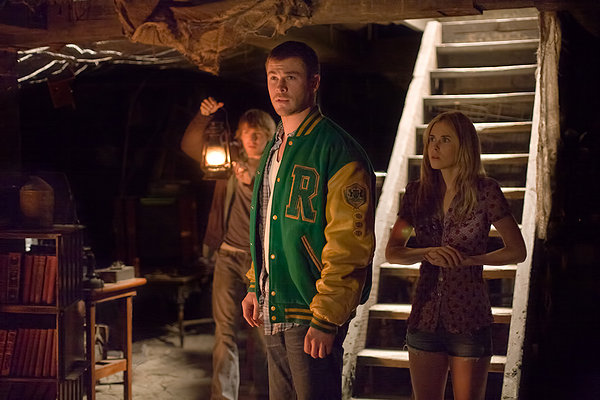 The macabre sense of humor is what will immediately separate Cabin in the Woods from its blood-and-guts brethren. The sharp dialogue is routinely laugh-out-loud funny, absurd in the right parts. Whitford’s downbeat reaction during a joyous moment of celebration had me howling. The movie is so smart, sometimes too smart for its own good. If you’re going to level one major charge against the movie, it’s that it isn’t really ever scary. Oh sure it has some stuff that should be scary given the particulars, and its 31 flavors of horror should find something that tingles everyone’s spine on some level. But this is much more of a deconstruction of the horror genre and its audience than an actual horror movie. Whedon and Goddard undercut their horror almost at every turn, settling for the ironic laugh or satirical tweak and repeatedly cutting back to the lab guys to provide a few good laughs and commentary (Jenkins has a terrific foul-mouth rant aimed at children that left me doubled over in laughter). Do not be mistaken; the lab stuff is easily the best part of the movie. Upon my second viewing, I found myself growing weary with the teens-in-a-cabin stuff and anxiously waiting our next detour into the weird and wonderful lab. The duo of Whitford (TV’s The West Wing) and Jenkins (Friends with Benefits) makes for some terrific and biting middle management corporate satire, as well as satirizing the jaded, bloodthirsty audience of slasher movies. You can tell that Whedon and Goddard love horror movies and are frustrated with the nihilistic rut the genre has found itself mired in. And as a deconstructive exercise, Cabin in the Woods is first-class. Roger Ebert succinctly called the movie a “fanboy final exam.”
It can be a tad clinical at times, failing to give us any true attachment to the characters even in an ironic sense, but when a movie is this fun, this wild, and this clever with its deconstruction of genre, I concede the point of having to root for somebody. The characters break the stereotypical mold; the jock is on academic scholarship, the smart guy happens to also be a hunky jock, the slut isn’t really slutty, the virgin isn’t squeaky-clean, and the stoner is the smartest guy in the group, aided by his cannabis (As one character later reasons, “We work with what we got”). He’s the only one who seems to be able to notice the strange manipulations at work. Once you dig into it, the very nature of how and why we watch horror is analyzed by Cabin in the Woods (get ready for some voyeurism parallels). The nature of fear and sacrifice is given some thought, though this stuff gets a bit lost in the madhouse of a final act. The movie becomes a funhouse of horrors and the frenetic carnage and chaos elevates the energy level. I cannot think of a movie that ended in such a whirling dervish of excitement and deep, demented satisfaction. This is one movie that doesn’t just end with a bang; it ends with every bang you can think of. Horror fans are going to be hopping out of the theaters, foaming at the mouth, desperate to tell every one of their friends what they just witnessed. I wish several of my friends would hurry up and see Cabin in the Woods so I had somebody to talk about its many pleasures, thrills, and surprises with. The movie has several terrific payoffs. This is the most fun I’ve had with a horror movie since 2003’s Cabin Fever. Must be something about cabins that brings out the meta-ness.
 Considering this was on the shelf for over two years while MGM worked out its bankruptcy dealings, it’s fun to see how fate has been to this lot of actors. The biggest name has got to be Hemsworth, better known as the flaxen, hammer-wielding God of Thunder Thor in the Marvel movies, and Whedon’s upcoming Avengers ensemble. He’s rather enjoyable onscreen and his hero moment is one that will definitely be a talking point. The two standouts from the cast, other than Jenkins and Whitford of course, are Connolly (“iGirl” on the Web series, iChannel) as the nubile Final Girl and Kranz (TV’s Dollhouse) as the clever pothead. Connolly has got a great face for movies, looking like the younger sister of Ellie Kemper (TV’s The Office) or Jayma Mays (The Smurfs), and I’m always a sucker for a redhead. Kranz is so good with the comedy that you may fail to notice all the work he’s actually putting into his role, which quickly becomes the audience’s voice of reason.
But the strangest quirk for a movie knotted with them comes to the casting of its resident “slut” played by Hutchinson. The woman has a sultry side that comes through without going overboard into parody. Scanning through her resume, I see that Hutchinson portrayed the Yellow Power Ranger (Lilly) for 32 episodes in Power Rangers: Jungle Fury. Now here’s where things get interesting. Being the movie aficionado that I am, I recognize that Cabin Fever also had an actress, Cerina Vincent, who portrayed the Yellow Power Ranger (Maya) for 45 episodes in Power Rangers: Lost Galaxy. Here’s where it gets even weirder. Both Hutchinson and Vincent are the only cast members in their movies to go nude in their respective films. So two actresses, both different versions of the Yellow Power Ranger, both get naked and star in horror genre deconstructive movies with “cabin” in the title! Is this one of the Mayan signs? Should I contact Dan Brown? Does it say something that the yellow ranger appears to be the most comfortable with nudity? This may be the greatest and most obscure observation I’ve ever made.
Of course there are so many fun surprises that it puts me in a bit of a critical bind. I don’t want to go into too much detail because that would spoil the fun, though rest assured that The Cabin in the Woods does not live or die based upon unknown plot twists. You may think you know given what’s already been revealed via the trailers, but really you have no idea how deep this thing goes and to what ends. Unless you just happened to be me, which at last count there was only one of (my evil twin long since slain… or was he?). I say this not as some point of pretentious bragging, but it’s because I wrote a horror screenplay a year ago that also satirized the genre tropes (for those few interested, it was called Blood Wake). I won’t go into spoiler detail, but both of our bad guys were called into question as being bad, from a greater good standpoint, and the killers had more on their minds than simply punishing dumb, horny teenagers. Well, after watching Cabin in the Woods, I know that screenplay goes back in the shelf now where it will live in eternal slumber thanks to core similarities. But if somebody’s got to be wielding the knife, at least it’s my man crush Joss Whedon.
Nate’s Grade: A-
Share this:

21 Jump Street (2012)
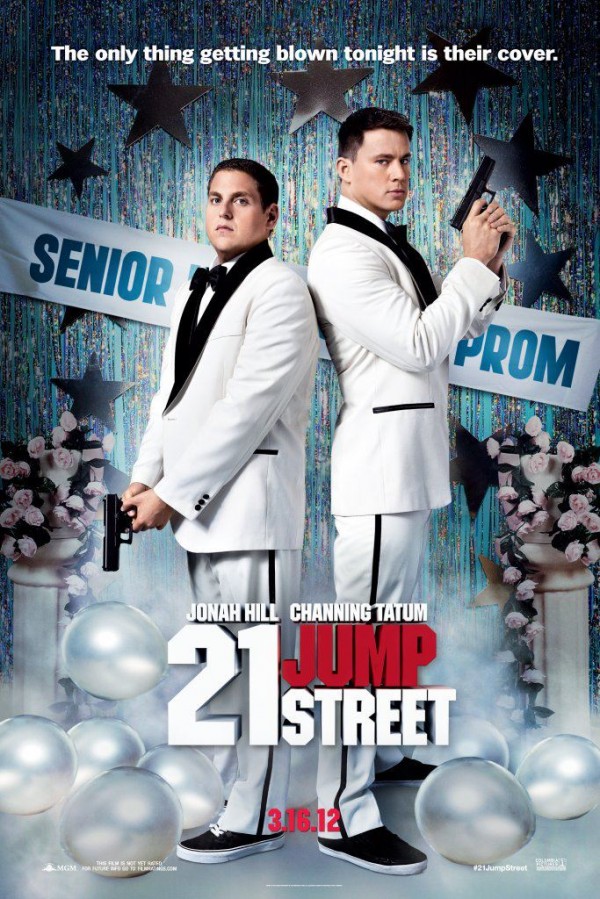 21 Jump Street ran on TV from 1987-1991 and is mainly known as serving as a launching pad for eventual mega movie star Johnny Depp… and Richard Greico too. Youthful looking police officers infiltrated high schools and tackled topical issues of the day (what snap bracelet goes best with my high-waisted jeans?). Why would anyone want to make this movie, let alone comic actor Jonah Hill? Surprising in just about every way, especially when it comes to overall quality, the 21 Jump Street movie is not just a great comedy but also a great movie. How the hell did this happen, Movie Gods?
Officer Schmidt (Hill) is smart but shrimpy (which is saying something considering how dangerous Hill’s weight has been before). Officer Jenko (Channing Tatum) is a stud but pretty dimwitted when it comes to tests. The two form a partnership and get assigned as bicycle cops, not exactly the position of command and authority they were expecting. After a few screw-ups, including failing to read a suspect his Miranda rights (“You… have the right… to be an attorney”), the duo gets bounced to an old undercover program at, you guessed it, 21 Jump Street. The pair is supposed to pose as high school students and find out who’s supplying teenagers a dangerous new club drug. Much has changed since Schmidt and Jenko were in high school together, and both of their profiles were accidentally swapped, meaning Jenko is given AP chemistry and the higher level classes, and Schmidt is given gym and acting courses, where he’s supposed to work his way into the popular circles. Molly (Brie Larson) is a gal in that popular inner circle and Schmidt struggles to accept that a pretty, smart, popular girl might actually “like like” him.
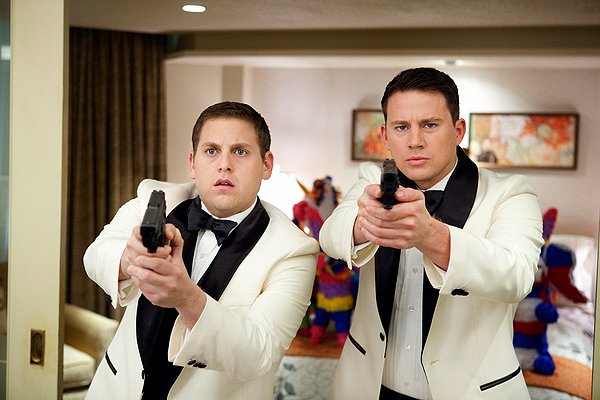 I knew I was in for something special when the movie itself lambastes the very idea of a 21 Jump Street movie, with the police chief (Parks and Recreation’s Nick Offerman) ridiculing the idea of unoriginal nitwits recycling something old that has name recognition and hoping the public will be too dumb to care. The movie beats the audience to the punch every time, mocking the absurdity of its own premise and plot points (many characters note how old Jenko appears). I should have expected more from screenwriter Michael Bacall (co-writer of the Scott Pilgrim movie adaptation) and especially from directors Phil Lord and Chris Hill, the same pair whose rambunctious comedic verve radiated from every frame of Cloudy with a Chance of Meatballs and their brilliant short-lived animated MTV show, Clone High. This movie had me laughing a lot and had me laughing hard, doubling over, with-tears-in-my-eyes laughter at points. Dickson spouts, “Some kid overdoses on drugs. And because he’s white, people actually give a shit,” showing that a movie with a mind-blowing number of male genitalia jokes can provide a few shrewd jabs of social commentary. There’s a great bit where on their first day back in school, Jenko points out the various school cliques. Then he gets to a group of students in skinny jeans, thrift store clothes, and floppy hats, and he looks puzzled. “I don’t know what those kids are?” Ha, because hipsters didn’t exist back in his (my) day.
21 Jump Street is cheeky, rowdy, quick-witted and playful in the best sense of an action comedy. It’s got fish-out-of-water moments as the duo struggle to fit in with a different high school setting. The one-liners and riffs can be gut-busters, but the film does an even better job layering oddball gags (Korean Jesus), loony slapstick, fun but telling character moments (Schmidt not knowing how to end a prayer: “The end, right? ‘The end’?”), strong setups that have stronger payoffs (using the reading of Miranda rights as a genuine emotional climax), and an overall raucous, anarchic spirit.
Here’s one sequence in particular that shows off the film’s clever comedic chops. The film finds a way to satirize the tropes of action movies, particularly buddy cop movies, with such nimble precision. Schmidt and Jenko are on the run but their car chase keeps butting heads with the fabricated reality of Hollywood movie chases. For one, they keep finding themselves getting stuck in traffic on the highway. This forces them to have to keep abandoning cars and finding a new set of wheels ahead of the gridlock. Then, as the bad guys chase them down on motorcycles, the chase causes all sorts of chaotic collateral damage, including oil trucks riddled with bullet holes and dripping the flammable substance all over the road. Then one of the motorcycles skids into the flammable muck, and our heroes wince in preparation of the expected explosion, and then nothing happens. “Huh. I really thought that was going to explode,” one of them remarks casually. And this setup is repeated again, denying us the explosive equation that action movies have pummeled into our brains (car + any tap of force = humungous fireball), and there is a payoff to this comedic tweak on the cliché, and it is silly and terrifically funny. Plus, I haven’t even mentioned that both Schmidt and Jenko are dressed in silly outfits and begin their car chase in a driver’s ed car. This sequence is just one example of the anarchic, robust, and self-aware comedic attitude that the movie flaunts.
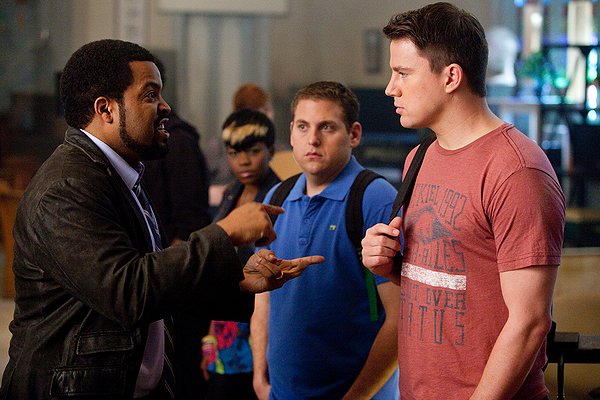 But more than being a hysterical action picture, 21 Jump Street works even better because at its core is a level of sweetness, a satisfying mixture of lewd and heart like the best Judd Apatow ventures. It’s a bromance of epic proportions even by buddy cop standards, the old school bromance vehicle of its day. The guys go back to high school and the movie’s bright switcheroo puts the characters in opposite social spheres, with Schmidt with the cool kids and Jenko struggling with the social misfits and bottom-dwellers, a.k.a. nerds. Of course the whole class assignment also shows the façade of being cool in high school. The movie could have mined this well-worn stereotypical class conflict with ease, but instead it decides to use its contrived scenario as a jumpstart for the guy’s emotional growth. The lessons may be simplistic (perils of ego, believe in yourself, teamwork, personal responsibility) but that doesn’t make them bad lessons, and the fact that the flick seriously uses covalent bonds as a metaphor, and does so in an almost poignant fashion, is worth applauding. The relationship between Schmidt and Jenko engages the audience, and we root for them even when they’re behaving like jerks. They’re misfits who are doubted and reprimanded, which make us hope for their eventual success even more. Refreshingly, the movie doesn’t put them in opposing camps in high school. Schmidt was a dweeb and Jenko was a dumb jock, but that doesn’t mean they needed to be adversarial. When they regroup in the police academy, they form a genuine partnership, realizing they can assist one another. They form an actual friendship and they’re both better cops, and better characters, together.
Hill and Tatum have preposterously good chemistry together as a comic duo. Hill, a co-writer himself, reportedly had to remain steadfast to convince Tatum to join forces, and thank god he stuck it out. Hill’s (Moneyball) already a comic pro at this point, though this role tones down his comical rancor and ups the spaz awkwardness. Tatum (The Vow) is the true revelation. Man does this guy have really great comedic skills; a sharp, instinctive sense of timing, a pliable physicality, and a genial charisma that doesn’t demand solo attention. He’s good at playing dumb without going overboard. He’s not just good, he’s flat-out terrific. Larson (Scott Pilgrim vs. the World) is an adorable and plucky love interest, sure of herself, down to earth, and accessibly quirky. The supporting cast shines in their small roles, notable Ice Cube (Lottery Ticket) as the typical brash and loud police captain, Ellie Kemper (Bridesmaids), in her randiest roll yet, as a chemistry teacher awkwardly flirting with the hunky Jenko, Dave Franco (Fright Night) as an eco-friendly drug dealer, Rob Riggle (The Other Guys) as an aggressive gym teacher, and a special cameo that’s worth leaving unspoiled.
21 Jump Street has some weaker points, namely when the action ramps up it’s pretty mundane when it’s not being funny, but the faults are minor. This is a silly, shrewd, salacious, and outright thrill of giddy entertainment, a comic blast. Hill and Tatum have a wonderful comedic dynamic and the clever screenplay gives them plenty to do with their talents. I didn’t think it was possible to adapt the cheesy TV show into a worthwhile studio comedy, but Hill and company have exceeded every expectation. 21 Jump Street isn’t the most nuanced or subtle comedy, though I will argue spiritedly that it has plenty of smarts in all the right places, but it’s an affectionate, witty, and rambunctious night out at the movies that will be hard to beat this spring.
Nate’s Grade: A-


 nathanzoebl
You must be logged in to post a comment.