Blog Archives
Unbroken (2014)
 Angelina Jolie is one of the biggest stars on the planet but as a director she’s still a mystery. Jolie was so enamored with Lauren Hillenbrand’s best-selling novel Unbroken that she felt like she was the only person who could translate this story to the big screen. Somehow that passion got lost in translation.
Louis Zamperini (Jack O’Connell) is a man who ran for his country in the Olympics. He fought on a bomber plane over the Pacific. He was shot down and survived in a raft for over 40 days at sea. He was taken to a Japanese P.O.W. camp and endured harsh and cruel treatment, and he still persevered and returned home a hero.
It’s hard not to feel a general calculation about the entire film. I’m not trying to say that Jolie or her crew had any sort of nefarious ulterior motives, but the entire product seems like it was made in an Oscar Bait factory. This is the kind of movie that the Academy typically salivates for, and it’s based on a true story, and it’s set during World War II! There’s a reason that, sight unseen, Unbroken was often at the top of the prediction lists for Oscar pundits. It is those same Oscar-friendly elements, though, that act as a detriment to the story, because the thematic elements stand in for the story and sense of commentary. The movie is so caught up with Louis’ dilemma that it forgets that it needs to make you care about him as a person rather than a martyr. The biggest hindrance for Unbroken is just how little it develops its protagonist. The only emotion he seems to exhibit in the two-plus hours is suffering. The guy ends up being a human punching bag with the movie clobbering the audience with the same message again and again as well, the will to survive. Unlike other war stories or concentration camp survival tales, Louis doesn’t survive through any great networking of allies, skill, scheming, or prescient decision-making. We do not see him adapt and outsmart his adversaries. He merely outlasts them as he wastes away. Like what I wrote in my review of last year’s Best Picture winner 12 Years a Slave, I need more characterization than suffering. It’s a frustrating experience because you know there has to be more to this character.
 The danger with any film that purports to tell a true story of a hero is making sure the audience doesn’t lose sense of the person beneath the hero. We glorify their positive qualities and what we admire but when placed upon a pedestal, our heroes can start to become otherworldly, separate from the rest of us mortals. A biography that idealizes its subject is called a hagiography, and that is where Unbroken falls. Louis Zamperini is lost in this story, instead replaced with Louis the Survivor or, occasionally, Louis the Runner. Amidst the swelling music, the pretty cinematography, and the supporting characters channeling the audience with their encouraging mutterings of, “Come on,” and the like, Louis is painted more saint than man, which is a shame. Considering all of the peril he survived, it would make sense for him to struggle with his own doubts and fears. The most we get a sense of him and his internal struggle is when he prays aloud to God during a thunderstorm at sea and Louis promises to serve Him somehow if he survives. The movie forgets about this moment until the end credits text. If Louis Zamperini is going to be the focal point for a true story of heroism, then the movie needs to do better to make him human rather than resorting to having him only bleed.
The entire first act flashbacks could likely have been jettisoned. Watching Louis as a young man learn to run and then eventually compete in Berlin’s Olympics (way to take all of his luster away, Jesse Owens), we expect these moments to have relevance again, pointing toward some kind of grit or training regiment or lesson learned that will become useful or comforting solace during his internment. It all boils down to one skill, endurance, and that’s all we keep coming back to. We don’t need to see the Olympics or his younger life to establish as back-story in the P.O.W. camp, just as we didn’t get back-story for the prisoner who was revealed in the moment to be a concert musician. The flashbacks do little to flesh out Louis as a character. He was a troubled son of immigrants and found popularity and purpose with running, which he did to the Olympics, and then… the war. Too bad running doesn’t really come into play during his torment in Japan. I understand that we’re working with a true story but what has been added by including 20-30 minutes of flashbacks, particularly when they fail to illuminate our main character? Skipping right to the war, with perhaps a smattering of brief memories during physically and mentally fraught times, would have been preferable and more useful.
The other aspect that makes Unbroken frustrating is the potential it does flash in sparse moments. For the majority of its running time, the film is a perfectly decent war drama with an extra glossy sheen to it provided by expert cinematographer Roger Deakens (Skyfall). When adrift at sea, there’s an inherently interesting survival story there. Louis and his comrades are still in an active war zone. In one scene, a plane approaches and the guys realize late it’s no rescue but a Japanese fighter plane. They leap into the ocean as the plane fires bullets after them. This scene is made all the worse by the fact that sharks are swimming below. There’s an extra kick of dread worrying what will happen next if anyone gets wounded or killed by that gunfire. It’s a great sequence, but then it’s over and the film goes back to autopilot glorifying the resolute nature of Louis. Likewise the opening with Louis crawling along and having to manually close the bomber plane’s doors during a dogfight is great. Unbroken does get a lift when it introduces its main antagonist, Watanabe (played by rock star Takamasa Ishihara), nicknamed “The Bird.” The film now has a sense of direction and a renewed sense of danger with “The Bird” eager to break down his Olympic prize runner. The story feels more personal and interesting and it feels like this fresh antagonism will allow us to develop Louis more as a character. Sadly, he remains the same film martyr.
 This is Jolie’s second film as a director and she’s revealing some pretty old-fashioned tastes and instincts. Actors are judged at a somewhat harsher standard when they turn to directing, but the audience must simply ask if this person elevated the performances of their actors and whether they found an incisive and insightful way of telling a story. The jury’s still out on Jolie as a directing talent. The direction is more than adequate and quite fine, especially aided by having a team of gifted technicians. If you had taken Jolie’s name off the film I wouldn’t be any more or less effusive. Perhaps a more experienced director would have insisted on fixing the screenplay’s development, but then again, perhaps that director wasn’t going to get the gig of a major Oscar bait film for a studio.
I’ve spent the majority of this review criticizing Unbroken and may have given the impression that it’s a bad movie. It isn’t. It is a perfectly fine film by all accounts and a movie that will likely find a welcoming audience this holiday season. It’s got emotions and survival and danger and all set to a rousing score. It looks the part of an Oscar contender and that will be enough for many ticket-buyers. Unbroken is a perfectly good-looking tale of survival that unravels upon reflection. The necessary work of building up strong, complex, interesting characters takes a backseat to setting up a series of punishing obstacles for our protagonist. It’s like the filmmakers wanted to make an inspirational tale but didn’t want to complicate that with ambiguity and nuance and doubts. Louis is canonized in the movie’s flattering glow, and his suffering is shrugged off as “character-building.” Cogent or potent commentary on war, man’s capability for evil and good, or the nature of forgiveness, are absent, which means the film can only go as far as the immediate impact of its plot beats. Supposedly the whole movie was about forgiveness but I got no sense of that until the end credits. Unbroken is a by-the-book rendition on how to make a movie that looks good and about Important Things. It just lacks the deft storytelling, characterization, and subtext to make it important on its own.
Nate’s Grade: B-
Share this:

Intolerable Cruelty (2003)
 Miles Massey (George Clooney) is the preeminent divorce attorney in Los Angeles. But after years of bankrupting homes after people have broken them (this allusion may be too tricky), hes grown tired of the same old same old. Enter Marilyn Roxroth (Catherine Zeta-Jones), a conniving gold digger who has been ruined by Massey defending her dimwitted hubby (Edward Herrmann). Now shes out for revenge, which could be in the form of romancing Massey while bringing him down.
Intolerable Cruelty is something of a strange breed. It’s the Coens most striving foray into mainstream success, with the weight of the world on Clooney and Zeta-Jones exchanging sparks and verbal repartee. For the most part, things work: the leads do have a winning chemistry; Zeta-Jones is positively glowing in Roger Deakins’ beautifully milky cinematography (she found out she pregnant late in the shoot, which could explain the glow).
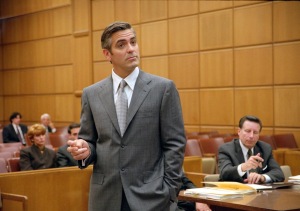 The stumbling block for Intolerable Cruelty and its central romance is that neither of the leads, though at times charming, isn’t exactly likable or able to root for. An integral part of any romantic comedy is empathy for the leads so much that we want them to get together, possibly with swirling crescendos. But in Intolerable Cruelty, both leads make a living off deceiving and taking advantage of others. So while their War of the Roses-esque pursuit to out-scam the other can provide some entertaining twists (and some forced and out of place), the whole duplicitous one-upsmanship doesn’t blossom credible love between the leads or the audience.
I have a strong feeling that Intolerable Cruelty was a story the Coens hopped on late, did some rewrites and invited old Coen friends to join in the jubilee. This is the first time the Coens have worked with other writers (the people who brought us such duds as (Big Trouble and Life), and certain storylines or subplots that glaringly feel disjointed from the screwball-comedy tone of the film. An asthmatic hit man named Wheezy Joe (who got the biggest laugh with his demise) is funny but in the wrong Coen film. When Clooney and Zeta-Jones both hire the services of Wheezy Joe to off the other, you know the story took a fantastical wrong turn. A creepy decrepit owner of Clooney’s law firm also feels like a leftover from a different film. This movie also has the most ripping up of legal documents I’ve ever seen in a movie.
Clooney is quite funny as a chattering legal eagle with a Cary Grant edge. Hes ready and willing to play against his movie star image, which works wonders for comedy, though the running gag where he must look at his teeth in any reflective surface never takes off. It took me until Intolerable Cruelty to realize how much of a beautiful woman Zeta-Jones is. Her warm smile could light up an auditorium. The supporting characters are all underused but very memorable. The opening with Geoffrey Rush’s TV exec walking in on his canoodling wife is very funny, and he plays the long-haired arrogant type well. Cedric the Entertainer is hilarious as a private eye determined to ”nail yo ass” that I started privately wishing the film would spin to follow his life and not Clooney’s.
Intolerable Cruelty is a nice diversion for the Coens, with some good laughs here and there (my favorite being the courtroom scene where Clooney and Zeta-Jones go head-to-head for the first time), but one would hope that the Coens will get back to doing hat they do best, which is quirky yet beautiful independent films. In the end, it seems that the Coens have created an oddity for themselves — a normal movie. We expect more Joel and Ethan.
Nate’s Grade: B-
Share this:

The Man Who Wasn’t There (2001)
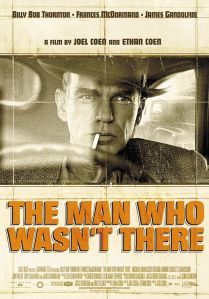 The Coen brothers dark, twisty entry to the world of film noir looks mind-blowing with its black and white lensing. And the story is great too. Billy Bob Thronton plays a barber who gives new definition to the word passive. One day a customer lets him in on an up-and-coming financial project and if Thronton were to provide some dough then surely he would rake it in. As with most film noir, the normal man is thus pulled into the web of intrigue and crime. The ball gets rolling after Thornton blackmails his wife’s tryst (James Gandolfini), who also happens to be her boss and his friend. Things get far more complicated from there and nothing seems to go right as Thornton makes one bad decision after another. The Man Who Wasn’t There is an engaging and smart drama with game bits of comedy strewn at key moments. The Coen brothers are a pair not very easily topped when it comes to excellence in films, and this latest entry is a wonderful addition to their resume.
Nate’s Grade: A-


 nathanzoebl
You must be logged in to post a comment.