Blog Archives
Promising Young Woman (2020)
 “I’m a gentleman,” says a man at his bachelor party, trying to bashfully turn down any sexual antics with the women paid to entertain him and his friends for one boozy night. He’s also trying to indicate he’s “not like those other guys” and genuinely respects women. He gets it. “Well,” says the woman in the shiny fetish outfit, “I’ll have you know in my experiences that ‘gentlemen’ can often be the worst.” This line summarizes Promising Young Woman, a revenge thriller in a post-Me Too era that is unsparing to all those who would proudly say, “Well, I support women.”
Cassandra (Carey Mulligan) was the top of her class at med school. Then her best friend was sexually assaulted at a party while she was inebriated, which allows the university to paint her as guilty and the accused as blameless (“What do you expect when you get drunk?” kind of victim-shaming). Years later, Cassandra has never been the same. She poses as a drunk at clubs and waits for her knight in shining armor to take her home, and often these modern men of chivalry prove to be creeps looking to take advantage of women and in needing of some harsh medicine.
 This is a movie that walks a fine line to stay out of the shadow of becoming just another exploitation film with a higher gloss. I was yelling at the screen early about the choices men were making with susceptible women in their care. Admittedly, it plays upon that icky genre and taps into our inherent feelings associated with it as well as vengeance thrillers, and writer/director Emerald Fennell (TV’s Killing Eve) smartly subverts our expectations and loyalties. We want Cassandra to achieve her righteous vengeance regardless of the moral or psychological effect it has upon her because vengeance is satisfying. We want to see bad people who have escaped punishment suffer, but Fennell challenges the audience to see how far we’re willing to go for this goal. There are moments where it appears that Cassandra is going to go the extra step to antagonize her targets, and this might involve facilitating other innocent women into potential danger. It’s a sharp turn that asks the audience how badly they want to hold onto that righteous sense of indignation. Do all ends justify the means? Now I won’t confirm whether or not Cassandra follows through for the sake of spoilers but this is one very knowing movie about how to make its audience uncomfortable. Obviously, dealing with the subject of sexual assault and predatory men, it should be uncomfortable because of the nature of the subject, but Fennell has a wicked sense of when to twist her audience into knots. She doesn’t let anyone off the hook easily and that includes her heroine and those close to her. Nobody looks clean here. It makes for a truly surprising experience. When I say that Promising Young Woman makes some bold choices, it really makes some bold choices. There were points I was sighing heavily and others where I was stunned silent. It brought to mind No Country for Old Men. The commitment that Fennell has to her excoriating artistic vision is startlingly provocative and effective.
One early scene stood out to me and let me know that Promising Young Woman was going to have more on its mind than bloodshed. Cassandra is walking home from a night out in her same soiled clothing and eating a sloppy hotdog with ketchup running down her body. A group of construction workers watch her and begin yelling from across the street, harassing her with unwanted sexual advances while they yuk it up. Cassandra stops, turns her head, and simply stares them down. She doesn’t glare at them or shout at them; all she does is look in silence. The workers get quiet very fast and then after several seconds they become angry and defensive, uncomfortable from her attention, and they walk away insulting her. Didn’t they want her attention? Weren’t they boasting? By merely drawing her focus onto these men and making them mildly reflective of their behavior they became uncomfortable and elected to leave. This scene only plays out for like twenty seconds and yet it serves as a symbol for what Fennell has planned with the rest of her thriller. She is going to take what you want and make you re-examine it with a fresh perspective that might just make you rather uneasy and disgusted with yourself.
The first half of the movie establishes a routine that explains what Cassandra has been doing since dropping out of med school. She’s never been able to move on from the trauma of her past and so she seeks out new potential perpetrators to inflict pain upon or scare straight through tests. By the second incident, we adjust to her formula and lie in wait for Cassandra to strike back. She’s the smartest person in the room and it’s deliciously enjoyable to watch her enact her plans. This avenging angel routine runs into a roadblock when she reunites with a friend from med school, Ryan (Bo Burnham), a pediatric surgeon. They share a meet cute that involves Ryan drinking a coffee that Cassandra has spit into as a declarative sign of his interest (trust me, I’m making it sound far creepier than it plays onscreen). They go on several dates and have a palpable romantic chemistry together. This is aided by Fennell’s excellent dialogue, which can be cutting when it needs to and also supremely charming when it wants to be. It’s a peculiar rom-com but on its own terms, including unashamedly reclaiming a forgettable Paris Hilton pop song with full sincerity. At this point, Promising Young Woman is sizing up a choice between following vengeance and following romance. It’s a formulaic fork in the road and Fennell completely understands this, as she’s also testing the audience how much they are willing to sacrifice to see Cassandra check off her guilty names. This storyline doesn’t feel like a cheap alternative either. I liked Ryan and Cassandra together. However, Fennell stays true to her poison-tipped plans and this storyline becomes another chapter in her larger thesis on the condemnation of “boys will be boys” rationalization.
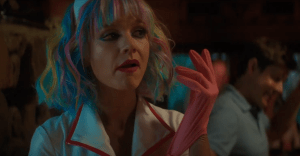 There is another scene worthy of being hailed because it goes against your and the character’s expectations (some spoilers). Cassandra tracks down the lawyer responsible for defending the university and discrediting her friend once she came forward with her rape accusation. Alfred Molina (Spider-Man 2) is this man and he’s quite antsy because he has been waiting for months for a visitor he anticipated would inevitably arrive. He’s been let go from his firm after having what they refer to as a “psychotic break” and what he refers to as a crisis of conscience. He’s made a career over sliming victims’ reputations, a fact he confesses has been made infinitely easier by modern technology. “We used to have to go digging through the trash,” he says, “But now all we need is one picture on Facebook of the girl at a party and you’ve got jury doubt.” Cassandra is taken aback by how eager this man is, not for absolution which he believes he will never earn, but to be punished. It’s not like a weird fetish but a genuine accounting of what he feels he deserves. It’s a short scene but it challenges Cassandra and the audience about the potential of redemption and forgiveness. This is what she wants after all, people to account for their part in the injustice that happened to her friend and to make amends for their guilt.
Mulligan is ferocious and on another level with this performance. She’s listed as a producer so I assume she had a personal connection with the material because she feels so aligned with the character that she can make you shudder. Mulligan has been an enchanting and empathetic actress since her breakout in 2009’s An Education, the source of her lone Oscar nomination. I’ve never seen her quite like this before. She has a natural sad-eyed expression, which made her perfect for Daisy Buchannan in the new Great Gatsby. With this role, she’s taken those natural sad-cute instincts and carved them out and replaced it with bile. Mulligan gets to play multiple false versions of Cassandra as she adopts disguises and personas to dupe her prey. This also makes the viewer subconsciously question which version they see is the real Cassandra. Is it a distortion upon a distortion? How well can we ever get to know this woman? I think Mulligan is most deserving of her second Academy Award nomination for this bracing, incendiary turn.
This is Fennell’s directorial debut and it will not be her last time in the director’s chair. Her command of pace and visuals can be sneaky good, framing figures to squeeze in potent symbolism as well as ratchet up tension and discomfort. The visuals can also be comedic poetry, like the opening images of men in khakis gyrating and thrusting on a dance floor. She also demonstrates supreme restraint where needed. The sexual assaults of past and present are never visualized but they are not mitigated either. She also has a tremendous ear for music. This soundtrack is sensational from the club bangers to the old timey country ditties. It feels as exceptionally selected as any Wes Anderson or Quentin Tarantino movie soundtrack. The score by Anthony Willis is deeply emotive with its use of strings and cello. They deliver a cello cover of Britney Spears’ “Toxic” and it’s as if the filmmakers made this choice specifically for me.
 If there is one slight downside, I’d have to say many of the supporting characters are under developed. There are plenty of famous faces in this enterprise, like Adam Brody, Laverne Cox, Clancy Brown, Connie Britton, Max Greenfield, Chris Lowell, Jennifer Coolidge, Christopher Mintz-Plasse, but most of them are deposed for a scene and then vanish. It starts to feel like a series of guest appearances from actors as they’re passing through town. Alison Brie (Happiest Season) has a longer and slightly more nuanced part as a former college friend who betrayed Cassandra when she needed her most. This character, along with Birtton’s school dean, illustrate that just because you happen to be a woman does not automatically mean you will be a helpful ally. I view it less as a snide “girls can be bad too” equivalency and more an indication just how insidious and prevalent rape culture can be and condition people into gross excuse-making complacency. I will say that it was nice to have Clancy Brown play a normal dad role and he was sweet too.
Beware, men of the world, the next time you size up a pretty young thing who looks meek and helpless. Promising Young Woman wears the skin of an exploitation movie but it’s so much more. Fennell has created a tart, twisted, and powerful film that is coursing with righteous fury. It’s a female revenge vehicle but with far, far more ambition than simply providing tingles to baser instincts. The artistry here is special and transforms the iconography of exploitation movies into a contemplative and jolting experience. Promising Young Woman is a definite conversation-starter and the first thing you might say upon its conclusion is a breathless exclamation of, “Wow.”
Nate’s Grade: A-
Share this:

The Ballad of Buster Scruggs (2018)
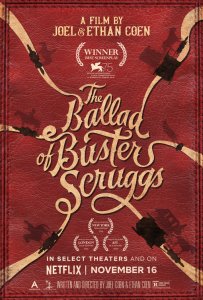 Netflix might just be the best pasture yet for brothers Joel and Ethan Coen. The Oscar-winning filmmakers were reportedly creating a Western series for the online streaming giant but that has turned into an anthology film, The Ballad of Buster Scruggs. The Coens’ love of the beautiful, the bizarre, the bucolic and the brazen are on full display with their six-part anthology movie that serves as reminder of what wonderfully unique cinematic voices they are. The Ballad of Buster Scruggs is uneven, as most anthology films tend to by design, but it reaches that vintage Coen sweet spot of absurdity and profundity.
The best segment is also the one that kicks things off, the titular adventures of Buster Scruggs, a singing Gene Autry-style cowboy who manages to get into all sorts of scrapes. The tonal balancing act on this one is pure Coen, at once inviting an audience to nostalgically recall the Westerns of old while kicking you in the teeth with dark, hilariously violent turns that veer into inspired slapstick. There is a delightful absurdity to the segment thanks to the cheerful sociopath nature of Buster Scruggs, the fastest gun in the West that’s eager to show off at a moment’s notice. He’s a typical Coen creation, a wicked wordsmith finding himself into heaps of trouble, but through his quick wits and sudden bursts of violence, he’s able to rouse an entire saloon full of witnesses to his murder into a swinging, carousing group following him in song. I laughed long and hard throughout much of this segment. I was hooked and wanted to see where it would go next and how depraved it might get. Tim Blake Nelson (O Bother Where Art Thou) is wonderful as Buster Scruggs and perfectly finds the exact wavelength needed for the Coen’s brand of funny and peculiar. He’s like a combo Daffy Duck and Bugs Bunny breaking the fourth wall to let the audience in on his merry bravado. The segment ends in a fitting fashion, another song that manages to be hilarious and strangely poignant at the same time. The Coens allow the scene to linger into a full-on duet of metaphysical proportions. I could have watched an entire series following Buster Scruggs but it may have been wise to cut things short and not to overstay its novelty.
 The other best segments take very different tonal destinations. “All Gold Canyon” is a slower and more leisurely segment, following Tom Waits as a prospector who systematically works the land in search of a hidden trove of gold he nicknames “Mr. Pocket.” The step-by-step process has a lyrical nature to it, and it reminded me of the opening of There Will Be Blood where we follow Daniel Plainview’s initial success at unearthing the beginning of his fortune. Waits is fantastic and truly deserving of Oscar consideration as the prospector. He’s hardscrabble and resilient, and there’s a late moment where he’s narrating a near escape from death where he’s tearfully thankful, possibly losing himself in the moment, and so grateful that it made me tear up myself. The segment ebbs and flows on the strength of the visual storytelling and Waits. It’s a lovely short with a few hidden punches, which is also another fine way to describe the other best segment, “The Gal Who Got Rattled.” It stars Zoe Kazan (The Big Sick) as a woman making her way to Oregon with a wagon train. She’s heading west for a new life, one she was not prepared for and only doing so at the urging of her pushy brother who dies shortly into the journey. Now she’s on her own and struggling to find her own place in the larger world. There’s a very sweet and hopeful romance between her and Billy Knapp (Bill Heck), one of the wagon train leaders who is thinking of settling down. It’s also a segment that slows down, accounting for the longest running time of the six. It goes to great care to establish the rhythms of life on the road, where many people walked the thousands of miles across the plains. The budding courtship is at a realistic simmer, something with more promise than heat. It’s such an involving story that its downturn of an ending almost feels criminal, albeit even if the tragic setups were well placed. Both of these segments take a break from the signature irony of the Coens and sincerely round out their characters and personal journeys and the dangers that await them.
 The remaining three segments aren’t bad by any stretch (I’d rate each from fine to mostly good) but they don’t get close to the entertainment and artistic majesty of the others. The second segment, “Near Algodones,” has some fun moments as James Franco is an inept bank robber who seems to go from bad situation to new bad situation, getting out through miraculous means until his luck runs out. The interaction with a kooky Stephen Root is a highlight but the segment feels more like a series of ideas than any sort of story. Even for an anthology movie, the segment feels too episodic for its own good. The third segment, “Meal Ticket,” is about a traveling sideshow in small dusty towns in the middle of winter. Liam Neeson plays the owner and the main act is a thespian (Henry Melling, best known as Dudley Dursely in the Harry Potter films) with no arms and no legs. The thespian character says nothing else but his prepared oratory. It makes him a bit harder to try and understand internally. I was also confused by their relationship. Are they father/son? Business partners? It’s also the most repetitious short, by nature, with the monologues and stops bleeding into one another, giving the impression of the thankless and hard life of a performer trying to eek out a living. It’s a bit too oblique. The final segment, “The Mortal Remains,” is like an Agatha Christie chamber play. We listen to five characters engage in a philosophical and contentious debate inside a speeding stagecoach that will not slow down. It’s an actors showcase with very specifically written characters, the Coens sharp ear for local color coming through. The conversation takes on a symbolism of passing over to judgment in the afterlife, or maybe it doesn’t and I’m trying to read more into things. You may start to tune out the incessant chatter as I did. It’s a perfunctory finish for the movie.
 Being a Coen brothers’ film, the technical merits are mesmerizing. The cinematography by Bruno Delbonnel (Amelie, Inside Llewyn Davis) is sumptuous and often stunning. The use of light and color is a gorgeous tapestry, and some of the visual arrangements could be copied into ready-made scenic postcards, in particular “Meal Ticket” and “All Gold Canyon.” The isolation, hostility, warmth, majesty of the setting is expertly communicated to the viewer. The production design and costuming are consummate as well. The musical score by longtime collaborator Carter Burwell is classic in its use of melancholy strings and motifs. It’s a glorious looking movie made with master craft care.
Before its release, the Coens had talked about how hard it was to make their kind of movies within the traditional studio system, even with their 30 years of hits and classics. Netflix is desperately hungry for prestige content, so it looks like a suitable match. I’d happily welcome more Coen brothers’ movies like The Ballad of Buster Scruggs, a goofy Western that’s equally heart wrenching as it is heart-warming, neither shying away from the cruelty and indifference of the harsh setting nor neglecting to take in its splendor. Just give them whatever money they need Netflix to keep these sort of movies a comin’.
Nate’s Grade: B+
Share this:

Stronger (2017)
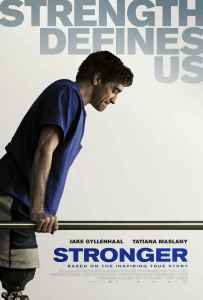 An inspiring true-life story that still manages to stay grounded on its own terms, Stronger is an emotionally affecting movie buoyed by two sensational performances. Jake Gyllenhaal plays Jeff Bauman, an ordinary guy who is present at the 2013 Boston Marathon bombing and loses his legs in the attack. He was there to support his on-again off-again girlfriend, Erin (Tatiana Maslany). Needless to say, his whole world changes and he has to adjust to a new life, a new identity, and the hardships placed upon others within his family sphere, especially Erin. This is a very solid meat and potatoes kind of drama. It’s not flashy or inventive but it has serious human drama and it treats it as such. I was on the verge of tears for a solid thirty minutes. Gyllenhaal delivers yet another Oscar-worthy performance, burrowing into an average screw-up thrust into the national limelight. Everyone tells him he’s a hero, but he doesn’t feel it. Everyone wants a piece of him and his doting mother (Miranda Richardson) often blurs the line between pride in her son and exploitation. The colorful, coarse, dysfunctional family dynamic will remind many of 2010’s The Fighter. I greatly appreciated that even after the terrorist attack Jake is not canonized. He’s no saint just because something terrible happened to him. Director David Gordon Green (Pineapple Express) takes great care to keep the movie grounded even as it hits the standard inspirational notes, finding moments of grace in unexpected places and people. The backbone of Stronger is the thoroughly moving relationship between Jake and Erin. They have exchanges of both ferocious anger and deep tenderness. A post-amputation sex scene between them is so intimately filmed by Green that you almost feel like you’re intruding. Maslany (Orphan Black) can break your heart or make it melt just with an expression. The non-verbal acting in this movie is truly exceptional. Stronger is a strongly developed drama with characters that earn every one of your hard-fought tears.
Nate’s Grade: B+


 nathanzoebl
You must be logged in to post a comment.