Blog Archives

Evan Almighty (2007)

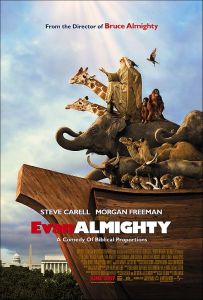
This big-budget sequel goes heavier on slapstick and poop jokes but also crams in environmental messages. I was wondering how the filmmakers were going to angle the whole Noah flood thing without it being world destroying, because nothing says funny like everyone drowning to their deaths. Steve Carell tries hard to make the material work and I give him points for trying. This sentimental comedy has some moments of lively levity, mostly from Carell being bewildered at what is happening, but the film eventually succumbs to some weak, half-hearted messages about treasuring family and producing acts of kindness (I won’t bother spoiling the regrettably inane acronym of ARK). The supporting cast is wasted, none more than Lauren Graham as Carell’s underwritten wife. The Lord works in mysterious ways and so too do movie executives. Upping the budget doesn’t mean the laughs have been super-sized as well. Evan Almighty is passable entertainment thanks to Carell. It’s hard to be preachy when you have so many jokes about poop.

Nate’s Grade: C+

Jesus Camp (2006)

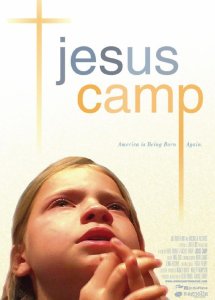
Every year Pastor Becky holds a camp in North Dakota called “Kids on Fire.” It isn’t your typical summer camp where they weave baskets or go swimming. This is a Christian-based camp with one objective: to brainwash impressionable children. Jesus Camp is nothing short of startling and eye opening. These people mean well, I hope, but what we’re witnessing is nothing short of child abuse. I was watching these kids’ childhoods vanish right before my eyes as grown-ups recruit them to be foot soldiers in the army of God. These kids are shoveled dogma to the point that they become robots, and it’s because kids are so impressionable that the adults know it will stick. I defy anyone not to die a little when they hear a kid say he was “saved” at age five because he wanted more out of life. FIVE! Another little girl, around 10, uneasily admits she finds herself dancing “for the flesh” at times instead of for the Lord.

The most heartbreaking moment of the film is when we see one kid share his faith. He so badly wants a religious experience, to feel the touch of God in his life, but he regrets that doubt keeps setting in and life has a habit of making faith a hard commodity to grasp. All around him are kids writhing on the ground, bleating in tongues, weeping because they feel God inside them, and here?s this poor kid dealing with the same struggles that most adults go through when it comes to religion and spirituality. There’s a moment when he?s even rocking back and forth with his hands open, tears down his face, desperately wanting what the others seem to so easily be channeling. My goodness, it’s hard to watch. You just want to hug the kid.

Where things get really scary is when the people supporting the camp blur the line between religion and politics. His mother home schools Levi, and there’s a moment where he’s reading his textbook and his mother says, “Did you get to the part where they say science hasn’t proven anything?” His mother then dissects global warming as myth and propaganda. What does the Bible have to do with global warming? Absolutely nothing, but it’s a conservative Republican talking point to question the validity of science and climate change. And that’s when the realization dawns: this camp isn’t creating soldiers for God but a broader voting base for the Republican Party. That’s why they debunk global warming, that’s why they ignore science, that’s why they learn about aborted fetuses, and that’s why they’re reminded of the “murder” of Terri Schiavo. I’m sorry but it is just entirely inappropriate to berate 6 and 7-year-old kids about abortion practices. One camp leader instructs the kids to smash a cup representing “government” and to pray for righteous Supreme Court nominees. These items have nothing to do with the actual Christian religion but they sure have a lot to do with how the Republican Party courts the religious vote. At one point Pastor Becky dredges up a cardboard cutout of George W. Bush and the kids are instructed to kiss it and bless him. Excuse me madam pastor, isn’t that idol worship?

The idea is that taking away a child’s reason and ability to think is in their best interest. I do not subscribe to the theory that ignorance is a defense against the world. But that’s exactly what these children are being forced to become — ignorant. They will become true believers and there’s no debate with a true believer, because they know they’re right no matter what evidence is set before them. Personally I don’t understand why science and religion have to be butting forces that cancel each other out, but that’s because I reason my beliefs with the realities of the observable world. These kids will never have that chance.

But what these people are doing is fear mongering and preying on a child?s instinct to belong. Pastor Becky condemns Harry Potter: “[He’s] an evil warlock and in biblical times he would have been burned!” She breaks down these kids and then rebuilds them just like the military. However, I don’t think the army of God needs wee ones knocking on doors to say the Earth is 6000 years old and fossils were just something the Jews hid as a hoax (this is a joke, but who knows what these kids could be led to think). One girl walks up to a group of older black men and asks if they know where they’re going when they die. “Heaven,” they simply reply. She questions if they’re sure and then leaves, and as she walks across the street she quietly tells her friends, “I think they were Muslim.” Sigh.

The movie also has the best unintentionally hilarious moment of 2006. Pastor Ted Haggard is interviewed in depth and we see him preach to a congregation of hundreds. He says that as long as evangelicals vote, then no one can topple them. Months after the theatrical release of Jesus Camp, and a week before the 2006 midterm elections, a gay prostitute came forward confessing that Haggard had paid for sex on numerous occasions and even used meth. Haggard released a statement saying he had a lot of demons that made him do vile acts. In Jesus Camp, we see Haggard looking directly into the camera where he speaks as his conscience, saying, “I know what you did. I’m going to tell your wife.” The transparency is amazing and quite funny.

From a technical point of view, Jesus Camp doesn’t have a lot going for it. The music is pretty keen and the editing has a nice narrative to it, framed by a pastor on talk radio denouncing tactics and proselytizing. Mostly the filmmakers have such a harrowing scene that they just point their cameras and let their subjects be. There’s not a lot of commentary from their part, instead they choose to convince their audience through the power of what they see. The documentary is even-handed and could be commended by both sides of the political aisle. Some will be infuriated while others will be stimulated.

Jesus Camp is the scariest movie I’ve seen all year and also one of the saddest. Children should be allowed to be children and enjoy the time they have before the world gets complicated. They are not to be used as pawns in someone?s attempt to steady their political status quo. I know people mean well, but this isn’t helping. Pastor Becky is in awe at the Muslims who are willing to die for their cause. She wants the exact same thing from a Christian point of view. And that’s where she fails. You don’t fight fundamentalism with fundamentalism. You create a dialogue and try to reason, but how can you reason when all you know is that you’re right at all costs and everyone else is wrong? Jesus Camp did have a positive impact. Pastor Becky has decided to close the camp. I feel it may be a small victory though. There will be plenty more that pop up in her wake. These people want to “take back America.” Does that mean for the rest of us that our country is being taken away?

Nate’s Grade: B+

The Da Vinci Code (2006)

Dan Brown’s The Da Vinci Code has been a best selling novel for three years running. Continents of trees have been felled to produce the 50 million published copies worldwide. Brown’s novel details a centuries long cover-up of some crucial background on Jesus Christ, as well as certain omissions about the role of women in Jesus’ discipleship. The book has been condemned by Christian watchdog groups as heresy, never mind that it is clearly labeled “Fiction.” Debunking fiction is simply redundant. Now Hollywood has adapted The Da Vinci Code into a massive movie, directed by Ron Howard. I must be one of eight who have not read the book, so I entered the theater with little expectation and no idea where the story would take me. Is this a great threat to the Christian church, as some argue, or is it just another dime-store thriller that lucked into becoming a national phenomenon?

Robert Langdon (Tom Hanks) is a Harvard professor of symbolism lecturing in Paris. He’s called in by a police captain (Jean Reno) about a local murder. The curator for the famous Louvre museum has been killed and his death leads to a series of coded clues about a deeper conspiracy involving Leonardo Da Vinci. Sophie (Audrey Tautou) is an investigator, and the granddaughter of the museum curator. She helps Robert escape and the two of them set off on an adventure through France and England, finding clues that lead them closer to the location of the Holy Grail. They get help from Leigh Teabing (Ian McKellen), an old friend of Roberts that has his own theories about what the Catholic Church may be so desperate to keep hush-hush. All the while Silas (Paul Bettany), an albino monk, is on the warpath to dispatch all who know too much, including Robert and Sophie.

There are just so many harebrained, hokey moments in The Da Vinci Code that can rip you right from the movie. Why does Sophie have to pay someone to leave a park bench when she and Robert can just walk out of earshot? Why does a bank teller, with his own devious intentions, drive Sophie and Robert to safety and then threaten them at gunpoint? Surely letting them be captured by the police would have served his needs better. Oh, the bank also has a payable escape clause, like it was a Scooby-Doo mansion. But the hokiest moment comes in the opening minutes. The museum curator, an old man who couldn’t hobble away from his attacker, gets shot in the gut, a quite painful place for a bullet to lodge itself. So he’s fatally shot in the stomach, but the man still has time to scribble coded messages on three separate paintings at different points in the museum, strip down, pose, write a message on the floor and a symbol on his chest. And remember, he’s an old man on top of all this. It’s like he had a checklist he pulled out in case he was ever mortally wounded at the Louvre.

The characters aren’t any better. There’s little to any depth to these people and most of them are irrational stock roles. The Jean Reno cop character is laughable in how doggedly he’s convinced Robert is his man. Apparently, a priest told the cop Robert confessed. Case closed? Perhaps the cop, in his furtive rush to judgment, should do some outside research. The museum curator?s time of death, something any crime scene tech could denote, would prove that Robert would be ruled out, given that the man was giving a lecture in front of hundreds of alibis. That’s verifiable science, but no matter. Would not a place as heavily trafficked as the Louvre, with so many priceless pieces of art, have security cameras? I think that alone would tell you who murdered the museum curator. These details make the Reno character stupid and unbelievable. The police work hasn’t been this sloppy since the Police Academy saga.

There’s a late scene where a character addresses another and more or less says, “No one will suspect us, my partner. Let us split our winnings together. I will take your identity to my grave. What? Yes I will take a drink from your flask you’re offering me but not drinking from yourself.” The film could not hit you over the head harder with what is to come. I’d expect these kinds of half-hearted character turns from a rote made-for-TV thriller, but The Da Vinci Code has too much intended intellectual prestige to wallow in this manner.

This is not a good film adaptation. This isn’t structured like a thriller, let alone a movie. There?s no sense of momentum and the story is really an ongoing series of mini-climaxes, sputtering out to no payoff. Puzzle-solving and word games can work on the page, with the reader feeling like they’re right along, but onscreen it cannot work in a story of images. Howard highlights certain letters a la A Beautiful Mind, but then it simply becomes less a puzzle and more just witnessing how a character’s mind breaks down the code, nothing more. As a thriller, Brown seems to do just enough to push his narrative further, but he frequently writes himself into a corner and relies on plot contrivances to save his ass. There’s a scene at Leigh Teabing’s mansion involving a gun standoff, and how does Brown get his characters out of it? By conveniently having a bird fly and distract the evil gun-bearing monk. Talk about a cheat. The Da Vinci Code‘s lame behavioral explanations and short cuts are expected in a rote thriller, but Da Vinci doesn’t want to be seen as one.

But that’s the fundamental error of The Da Vinci Code: it wants to have it both ways. The film, and I’d judge that the novel as well, wants you to shut your brain off and swallow these trite lapses in judgment and reality, forgiving the movie for zero character development and polluting the narrative with stupid genre stock roles, but then it also wants you to pay close attention and activate your brain to untangle the origins of symbols, conspiracies, and church doctrine. This flick was destined to fail at birth. You can’t be a brainy thriller and fill the story with hokey moments and lapses in thought, and likewise you can’t be an enjoyably straight forward thriller if you bookend all your action sequences with talky sit-downs to explain the minutia of your story. The Da Vinci Code is thusly pulled in two directions and grinds its gears to the very end.

This is not a very entertaining flick, in fact is nearly put me to sleep a half dozen times. The Da Vinci Code has tiny bursts of action, and most are easily swept away before the viewer can get a grip. These moments are then succeeded by lengthy, ponderous sessions of heavy exposition. It’s like characters will breathe a sigh of relief at another ludicrous escape and then say, “Well, now let’s discuss in detail some more convoluted theories.” The dialogue reeks, and characters spout plot points whenever they’re needed. The conspiracy doesn’t even make sense. Why would the Church protect a secret that could supposedly destroy its hierarchy? If Jesus was not divine then what difference does it make to go after relatives 2000 years removed? And if Jesus did have heirs would there not be thousands in 2000 years time, not one convenient individual? Even The Da Vinci Code‘s ending seems to soft peddle its “dangerous” message, where Robert, after learning all he has, says it’s all about what you believe.

If it wasn’t for Bettany and McKellen I really would have nodded off. Silas is by far the most interesting character in the whole film, and the only one with a penetrable personality. A deeply religious albino killer monk is a great character, and Bettany makes him scary but also frightfully sympathetic. I was rooting for Silas to knock off the film’s heroes and go on a better adventure of his own. McKellen is handed most of the monologues and he gives his character all the gravitas needed. Thank God for these two actors, because Hanks is miscast and Tautou isn’t nearly as endearing as her work with Jean-Pierre Jeunet. There’s a really good international cast assembled for The Da Vinci Code and the movie manages to mishandle most of them.

The Da Vinci Code played out on the big screen is ponderous, talky, boring, poorly adapted and poorly written. Some things work better on a page than onscreen, and I guess if this is the final product than the whole damn things works better on the page. The story is brimming with lame, hokey moments you’d see in a lazy TV thriller, but then the story also wants to talk you to death with its convoluted storyline. The action sequences are brief, the dialogue is smothered by lengthy exposition, and the plot just isn’t that entertaining. The cast is mostly wasted in thankless stock roles. So let me get this straight. After seeing The Da Vinci Code, the biggest threat the Christian church is facing is … bad movies? I think they’ll be alright.

Nate’s Grade: C-

The Chronicles of Narnia: The Lion, the Witch, and the Wardrobe (2005)

I have never read one single word from C.S. Lewis’ classic children?s tales, The Chronicles of Narnia. I have never read one word from J.R.R. Tolkien’s Lord of the Rings tomes either. I read five pages in Dune and returned it to the library (50-page glossary of vernacular my ass!). I have also never read one word of any Harry Potter book, and I’m quite all right with that. I have several friends that were consumed by Lewis’ series in their childhoods and now are consumed by J.K. Rowling’s series. I don’t confess to be geek-free; I read the Shanara series by Terry Brooks when I was in junior high. I collected comic books, I watched cartoons, I still do both to an extent, but I suppose I left the fantasy genre with my appreciation for flannel all the way back in junior high (I also discovered women). Whenever I enter a fantasy film I bring with me no baggage. And so I strolled into The Chronicles of Narnia: The Lion, the Witch, and the Wardrobe ready to be entertained by a good story, whether Lewis, a big Christian theologian and author, was advancing some kind of Christian allegory or not. After seeing all 125 minutes, it’s safe to say I’ll be in line for any potential sequels.

In the heat of WWII, the Pevensie children are being transported out of London to live with a kindly professor (Jim Broadbent) on a safe rural farm. Peter (William Moseley) is the oldest and assumes the leader position vacated by their departed father. Susan (Anna Popplewell) is the brainiest, Edmund (Skandar Keynes) is the moodiest, and little Lucy (Georgie Henley) is the precocious true believer.

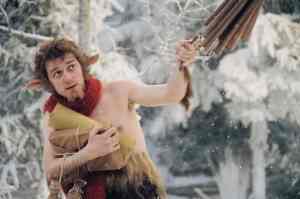
One day during a game of hide and seek Lucy hides in an upstairs wardrobe. To her delight and amazement, she is transported to a magical, snow-covered realm known as Narnia. She encounters a faun, half man-half hoofed animal, named Mr. Tumnus (James McAvoy). He’s shocked to see a live human girl before his eyes and invites her for tea. There’s an old prophecy that says when two Sons of Adam and two Daughters of Eve arrive then the 100-year winter will end. The evil White Witch (Tilda Swinton), the one ruling Narnia with an icy fist, wants the humans captured and dead so she can rule forever. Lucy tells her siblings about her amazing adventures but they don?t believer her, that is, until they all tumble forth into the land of Narnia. The older kids mostly want to return home, but Edmund has sold them out by aligning with the White Witch. Now they’re on the run from her pack of wolves and the Pevensie children must seek out the powerful Aslan (voiced by Liam Neeson), a heroic lion who is all that stands in the way of the White Witch.

I declare my undying love for Tilda Swinton, truly the best character actress we have working today. Swinton already gave one bizarre yet outstanding performance this year as the androgynous angel Gabriel in Constantine (Swinton does androgyny better than anyone else; hell, she was convincing as a man and a woman in Orlando). In Narnia, Swinton exhumes a chilly command that could make you stand at attention. She’s such a hostile, icy, stone-faced villain, and Swinton has such calm confidence the whole time. She preens like a rock star and has the oversized ego to boot. She’s the kind of bad girl you could really fall in love with, especially if you have monstrous maternal issues.

The rest of the actors are mostly good. Henley steals every scene she’s in, and I’m not talking about the added attention of her suitable British choppers (my apologies to U.K. readership). Neeson seems a little bored with yet another wise teacher role just this year. I would be more interested in hearing the original voice of Aslan, the stupendous Brian Cox (Troy). McAvoy has a gentle sweetness to him.

Director Andrew Adamson integrates the flashy computer effects with surgical-like precision. Adamson?s experience as co-director for the Shrek films has given him the know-how to coordinate massive effects sight unseen and still coherently direct his live-action actors (ahem, George Lucas, ahem). The special effects in Narnia are outstanding. The characters move and behave with staggering authenticity (I know most of these creatures are mythical and have no comparison). The vistas and landscapes are beautiful, particularly the winter wonderland of Narnia. Adamson has a keen eye for visuals and lavishly recreates his visions; the climactic battle is bloodless but no less exciting.
Most of the story flaws come from the source material. Narnia lacks the epic scope of the Lord of the Rings movies as well as the seriousness. As a result, no one feels very much in danger even during the more harrowing moments of battle. Lucy’s gift of “resurrection juice” kind of let’s the air out of the tension balloon. What suspense is there if a character has a magical healing elixir they can just whip out? The two girls are removed from the final battle and have little impact on its outcome. The White Witch’s tactic of freezing her enemies instead of killing them seems to be foolish, especially when they can be thawed at inopportune times. A major character’s sacrifice seems a tad superfluous if he can just reappear, lickity split like he had an extra life. Lots of secondary characters get the shrift when it comes to characterization, so you feel less than you should when something happens to them; this is even further hampered by Lucy’s Jesus Juice.

There’s a real genial sense of magic to Narnia. When little Lucy first transports to this magic realm, her face lights up in that adorable cherubic way, she wafts through the falling snow, catching it with her hands. Her moments with Mr. Tumnus are note-perfect from the dialogue, to the vocal inflections, to where the scene leads. Their relationship is very tender and provides some of the film’s best moments. Looking back, I can pick apart the movie, but while I was sitting in my theater I was deeply surprised how affected I was. I felt their fear, I felt their sorrow, and most of all I felt some sense of magic. The logic part of my brain was telling me how silly it was to see Santa Claus, let alone witness jolly ole Saint Nick handing out weapons for all the little good girls and boys (“Ho ho ho, kill ’em good for Santa.”). Yet while I watched I never questioned these things. The power of Narnia had taken full hold of me and I was swallowed whole by its tale.

Narnia is a good entry point for children in the world of fantasy. It’s suspenseful without being scary, and familiar without being too simplistic. Unlike Tolkien’s complicated worlds and heavy tales, Narnia is more a children’s story, what with the inclusion of unicorns, centaurs, fauns, and a menagerie of talking animals. There’s the suitable kid fantasy, like becoming king and fighting monsters, but there’s also a focus on family reconciliation and being accountable for your own actions. This isn’t a story that will overwhelm its audience but will leave them hungry for more adventures. The characters are mostly sketches (the leader who doesn’t want to be a leader, the overly logical one, the disaffected youth constrained by too much discipline, the little believer in the unknown), so it’s a testament to the filmmakers that the story and the characters have as much resonance as they do. The Lion, the Witch, and the Wardrobe sets up the parameters of the Narnia universe and its inhabitants and now future sequels can add meat to this bare skeleton. Narnia is a fantasy film the whole family can enjoy.

The Christian allegories and metaphors mostly fly under the radar, with the exception of one extremely obvious scene that might make Mel Gibson wince. I even think Narnia is better enjoyed as a straight-up story than as an elaborate series of codes and messages harkening toward Christianity. If you view Narnia with the intent to break down its meaning and supplant connection to the Bible, then you’re really missing out on some great storytelling. And Narnia isn’t outwardly religious; it’s mostly a film preaching good values rather than simply good Christian values. Most of the lessons and values taught within Narnia are universally applicable to all people.

The Chronicles of Narnia: The Lion, the Witch, and the Wardrobe is a superbly entertaining retelling of C.S. Lewis’ classic children’s series. Adamson connects all the expected fantasy dots while seamlessly incorporating awe-inspiring special effects. The bountiful imagination up onscreen is the film’s biggest charm, rendering a divine touch of magic to the finished proceedings. Despite any better judgment pointing out the simplicity of the tale and characters, the production is first class and compelling. I was completely surprised how affecting I found the film and how immersed I became. This is great storytelling aided by gifted storytellers. Narnia is bigger than a family film, more accessible than a “Christian movie,” and more entertaining and endearing than most films released this year by Hollywood.

Nate’s Grade: B
The Passion of the Christ (2004)

The Passion of the Christ is a retelling of the last 12 hours of Jesus Christ’s life (perhaps you’ve heard of him?). In these final hours we witness his betrayal at the hands of Judas, his trial by Jewish leaders, his sentencing by Pontius Pilate, his subsequent whippings and torture and finally his crucifixion. Throughout the film Jesus is tempted by Satan, who is pictured as a pasty figure in a black hood (kind of resembling Jeremy Irons from The Time Machine if anyone can remember). The Passion spares no expense to stage the most authentic portrayal of what Jesus of Nazareth endured in his final 12 hours of life.

For all the hullabaloo about being the most controversial film in years (and forgive me for even using the term “hullabaloo”), I can’t help but feel a smidgen of disappointment about the final product. The Passion is aptly passionate and full of striking images, beautiful photography and production values, and stirring performances all set to a rousing score. But what makes The Passion disappointing to me is the characters. You see, Mel Gibson’s epic does not devote any time to fleshing out the central characters. They are merely ciphers and the audience is expected to plug their feelings and opinions into these walking, bleeding symbols to give them life. Now, you could argue this is what religion is all about, but as far as a movie’s story goes it is weak. The Passion turns into a well-meaning and slick spectacle where character is not an issue. And as a spectacle The Passion is first-rate; the production is amazing and the violence is graphic and gasp-inducing. Do I think the majority of people will leave the theater moved and satisfied? Yes I do. But I can’t stop this nagging concern that The Passion was devoid of character and tried covering it up with enough violence to possibly twist its message into a Sunday school snuff film.

photo_11(2)For my money, the best Biblical film is Martin Scorsese’s 1987 The Last Temptation of Christ (also a film mired in controversy). Last Temptation, unlike Gibson’s spectacle, was all about Jesus as a character and not simply as a physical martyr. Scorsese’s film dealt with a Christ consumed by doubt and fear and the frailties of being human. But the best part is the final 20 minutes when Jesus is tempted, by Satan, to step down from the cross and live out a normal life. Jesus walks away from the cross, marries Mary Magdalene, fathers children (this is where the controversy stemmed from but they were married) and dies at an old age. Jesus is then confronted by his aging apostles who chastise him for not living up to what he was supposed to do to save mankind. Jesus wakes up from the illusion and fulfills his mission and dies on the cross. Now, with the story of Last Temptation an audience has a greater appreciation for the sacrifice of Jesus because they witness his fears and they witness the normal life he forgoes to die for man’s sins. There is a sense of gravity about what Jesus is sacrificing.

With The Passion Gibson figures if he can build a sense of grand sacrifice by gruesomely portraying the tortures Jesus endured. Even if it is Jesus, and this may sound blasphemous, torturing a character to create sympathy and likeability is the weakest writing trick you can do. Yes Jesus suffered a lot, yes we should all be horrified and grateful, and yes people will likely be moved at the unrelenting violence he endured, but in regards to telling a story, I cannot feel as much for characters whose only characterization is their suffering. Sure, The Passion flashes back to some happier moments of Jesus’ life, which I like to call the Jesus Greatest Hits collection, but the movie does not show us who Jesus was, what he felt (beyond agonizing pain) or the turmoil he went through in finally deciding to give up his own life for people that despised him. The Passion is not about character but about spectacle.

So let’s talk about the violence now, shall we? Gibson’s camera lovingly lingers on the gut-churning, harrowing, merciless level of violence. But this is his only message. It’s like Gibson is standing behind the camera and saying to the audience, “You see what Jesus suffered? Do you feel bad now? FLAY HIM MORE! How about now?” What was only three sentences of description in the Gospels takes up ten minutes of flogging screen time. Mad Mel has the urge to scourge. After an insane amount of time spent watching Jesus get flayed and beaten the violence starts to not just kill whatever spiritual message Gibson may have had in mind, but the violence becomes the message. The Passion does give an audience a fair understanding of the physical torture Jesus was subjected to, but the movie does not display Christ as fully human, enjoying life and love, or fully divine. The only thing The Passion shows us about Jesus is that the son of God sure knew how to take a whuppin’. For Gibson, the violence is the message and the point is to witness what Jesus endured. Some would call that sadistic.

photo043omThe actors all do a fine job and it’s impressive that everyones’ lines is in two dead languages (Latin and Aramaic, though for the life of me I can’t tell them apart). But the acting is limited because of the nature of the film. Had there been more moments of character the acting would come across better. As it stands, the acting in The Passion is relegated to looks of aguish or looks of horror, interspersed with weeping. Monica Bellucci (The Matrix sequels) really has nothing to do as Mary Magdalene but run around in the background a lot. Jim Caviezel (Frequency, Angel Eyes) gives everything he has in the mighty big shoes he tries to fill. It’s too bad that his Jesus spends most of the screen time being beaten, which kind of hampers his acting range.

Now let’s address the anti-Semitic concerns. Let’s face facts; you are not going to have a film about the crucifixion of Jesus and have some Jews coming off in a good light. Just as you would not have a film about the Holocaust and have some Germans coming off in a good light. It is unavoidable. The Passion does portray a handful of Jewish religious leaders as instigators for Jesus’ eventual crucifixion, but there are also Jewish leaders who denounce their actions and just as many people bemoaning the torture of Jesus as there are calling for it. Who really comes off looking bad are the Romans. Excluding the efforts to make Pilate look apprehensive, the Roman soldiers are always seen kicking, punching, whipping, spitting on Jesus and laughing manically with their yellow teeth. How anyone could watch The Passion and come away anti-Semitic and not anti-Italian is beyond me.

And like I said before, most people will be extremely satisfied with the film because it’s hard to find a person who doesn’t have an opinion on Jesus. Gibson is counting on audiences to walk in and fill in the holes of the character so that The Passion is more affecting. Gibson’s film is worthy spectacle, and despite the vacuum of character I did get choked up four separate times, mostly involving Jesus and his mother. The Passion is a well-made and well-intentioned film that will hit the right notes for many. I just wish there were more to it than spectacle. I really do.

Nate’s Grade: C

The Magdalene Sisters (2003)

There’s a certain genre of films as well-defined as say, the Western, Film Noir, or even Romantic Comedies. The genre I’m speaking of is “I-can’t-believe-that-happened cinema.” This is a genre made up of little-known true stories where people with power abuse those below them. These include films like Rosewood, Rabbit Proof Fence, Matewan, Mississippi Burning, and just about every movie with a Holocaust setting. These films are intended to antagonize the audience and to get them to ask, “How could something like this happen?” The Magdalene Sisters is a film that an audience will walk away with very much wondering how something so cruel, amoral, and heartless could carry on in our modern world.

In 1960s Ireland, the Catholic Church was life. The Magdalene Sisters sheds light on the little known work asylums, which were institutions set up to help girls who had transgressed against God. The girls admitted to the asylum, a kind of extreme reform school, are there to work away their sins and reach forgiveness, thus saving their immortal souls. Rose (Dorothy Duffy) had a child out of wedlock. Bernadette (Nora-Jane Noone) was caught by school officials for being too pretty and “tempting” teen boys. But perhaps the most startling admission is Margaret (Anne-Marie Duff), admitted to the asylum by her own father for the grievous “sin” of being raped by a cousin. The Magdalene Sisterhood asylum is run by Sister Bridget (Geraldine McEwan), an old nun who subscribes to the “cruel to be kind” theory in spades. The girls at the asylum toil tirelessly in sweatshop conditions, are physically abused by the nuns, sexually abused by the asylum’s priest and are left hopeless of escaping. Girls who run away are turned back in by their parents or cooperative police. Some of the women at Magdalene have been there for their entire lives. It seems the only ways out are death or joining the convent. Get thee to a nunnery indeed.

The Magdalene Sisters is full of sadistic moments that will shock an audience. One of the most disturbing scenes transpires late into the film. The girls of the asylum line up completely nude, shivering and crying. Two nuns, with a nauseating smugness, chortle and play a “game” seeing who has the largest breasts and the smallest nipples, among other things. When the “winner” of this sick experiment stands forward and clenches her teeth from crying so hard, one of the nuns asks, “”What are you crying for? It’’s just a game.”

The young ladies at the film’s core deliver magnificent performances tinged with honest emotional devastation. Noone is the standout as Bernadette. She utilizes steely rebellious gazes that speak volumes about her character’s resourcefulness. Noone can convey more poignant emotion in the raising of an eyebrow or the biting of her thumb than most starlets can ever hope to express.

McEwan is terrifying as the head nun and head source of torment. Her grandmotherly voice, tinted with an Irish brogue, is enough to send shivers down your spine. She is surely 2003’s greatest movie villain, next to Johnny Depp in Once Upon a Time in Mexico.

Writer/director Peter Mullan keeps the suffering at an almost unbearable level but allows the spark of human resistance to keep us going. His film is one brimming with anger and disbelief; ensuring the audience will experience that same burning anger before the credits roll. Mullan’’s passionate story can be deemed one-sided, but then again, what exactly is the other side going to say about the abuse of innocent girls for life-long slave labor? Not much I suspect.

The Magdalene Sisters is a somber, unflinching look at the abuses of the church as well as the upward battle for equality women faced. This film is tough to sit through. It might be too much for some, especially if they don’t have a strong relationship with the Catholic church to begin with. The decades of abuse The Magdalene Sisters sheds light on is incredible, but it’s also a beginning for healing. Before we can overcome atrocities we must acknowledge them, and this is something I’m sure Mullan is arguing that the Church is failing to do. In fact, the Catholic church has denounced The Magdalene Sisters for its portrayal of church abuses. Something tells me Mullan is not surprised.

Not only is The Magdalene Sisters an eye-opener, it’s also great cinema. The characters, pacing, realistic sharp-eyed direction, and superb acting render it more than just a snuff film. This film is more than watching people mistreated and suffer; this is a film about perseverance and resolve. It’s about the enduring human spirit. I’ll gladly (well, not gladly) watch sequences of misery in order to see human triumph. This isn’t just a sad story, it’s exceptionally well told and acted and it bathes you in the pain of its characters. You feel their heartbreak and tragedy, but you also feel their victory.

The Magdalene Sisters is, without a doubt, the must-see feel-bad movie of this year. Now, there will be plenty out there saying, “Why should I pay to see a movie that will make me feel bad?” This is my defense: because the movie is so good at having its fears, tortures, and ultimate triumphs resonate that it makes you authentically feel something. And isn’’t this the purpose of art, to feel something? The Magdalene Sisters is unflinching, passionately powerful and unforgettable. Just one more item to get your blood boiling: the last of these Sisterhood work asylum closed in 1996.

Nate’s Grade: A

Luther (2003)

Certain things can pass under my radar. Previously it’’s been items like female flirtation and the due dates of papers. So imagine my befuddled surprise when last weekend my father, himself a Lutheran minister, said the family was going to hop on over to the movie theater and catch a historic bio-flick about Martin Luther, plainly titled Luther. I had no idea this movie existed. And after seeing it, it left no strong memory that it did.

Luther (Joseph Fiennes, Shakespeare in Love) is a 16th century German monk with some quibbles with the Catholic Church. Seems Luther doesn’’t like how the Church is preying upon people’’s faith for money, most notably its chief indulgence seller Johann Tetzel (Alfred Molina, with a criminally scant appearance). He makes up a list of 95 grievances, nails them to the doors of a church, and thus Protestantism is born. Luther’’s ideas catch on wit the lower classes through rampant publication, thanks to the newfound printing press. The princes of the German states also like what this monk is cooking, and they decide to hold him in safety. The Catholic Church, however, is none too pleased. They threaten excommunication and eventually death, and keep pushing for Luther to recant. But Luther feels he must stand strong in his convictions.

The acting is fine, and the direction is passable, but the pacing of Luther is like tracking the movement of a glacier. Some representative decisions are also fairly stupid. To try and communicate Luther’s internal struggle he hits his head and yells like at voices. The first time it’’s funny. The next five times, it’’s dumb. There’’s also a dirty peasant child who’’s crippled but still a big fan of the Luther Man. Her gaping tooth smile has more screen time than some characters. Later in the film the peasant revolts ravage through the country with thousands massacred. Luther visits the ruins and comes across the little girl’’s broken crutch and breaks down and cries. If you were in my theater you probably heard me hitting my forehead repeatedly (no voices though).

The film is an admirable effort, but Luther ultimately fails because of the measures of film. To try and tell the story of Luther would be more appropriate for the confines of a miniseries, not a two-hour movie. The Reformation and its players lose its impact in such a shrift retelling. What the audience gets is a pared Cliff notes version that misses the richness, and gives lip service to the historical importance. What we’re left with are endless scenes where people dress up and talk and talk and talk. Without a sense of weight for character or story, the countless talky moments blur into tedium. If I had a sleeping bag with me I would have curled up into it.

Another problem is the lack of makeup. The film spans thirty-some years and yet Fiennes doesn’’t age a day. My mother proposed that maybe he didn’’t want to look old and decrepit in the film. I responded by saying, “He let them shave his head but he didn’’t want anybody to splash some gray in his hair?”

I guess if you judge movies on costumes or production values, Luther would be competent. But does anyone go to a film saying, “”Man, I sure hope those costumes and sets are incredible! Fingers crossed!”?” Luther is a well-meaning bore that only historical enthusiasts and Lutherans might enjoy.

Nate’s Grade: C

Dogma (1999)

In a time where simply having faith in anything, let alone religion, is scoffed at, Kevin Smith daringly and passionately expresses his personal search for answers and understanding. But while the zealots decree Dogma as blasphemy, what they truly miss is the biggest commercial for faith and God that American audiences have seen in decades of cinema.

The story of the religious epic causing all the hubbub begins with a pair of fallen angels (Ben Affleck and Matt Damon) spurned from the pearly gates of Heaven and banished to Wisconsin. One discovers a re-dedication of a church imploring a little used Catholic practice of plenary indulgence allowing whoever to enter through the church’s arches to have their slate cleaned of all sin. The two seize this opportunity of a dogmatic loophole to sneak back into heaven. The only slight problem is that by doing so they reverse a decree of God and disprove the Almighty’s unfallability, and thus will wipe out all of existence. The voice of God (Alan Rickman) recruits a lapsed Catholic named Bethany (Linda Fiorentino) for a Holy Crusade to halt the scheming angel’s plans for the good of the universe. Along the way she is aided by two unlikely prophets (the dynamic duo of Jay and Silent Bob), an racially discredited 13th Apostle (Chris Rock), and a shapely strip-teasing muse (Salma Hayek) as they engage with demons, seraphims, angles, and all sorts of celestial “who’s who” to stop the end of existence.

Smith’s direction has taken strides since the point-and-click days of his earlier works; however, there’s still an awkward flatness to his framing and action. Fiorentino plays the role of a grounded character well. Rickman as the bitter Brit shows why he can still take anyone toe-to-toe for acting chops. Affleck and Damon have terrific chemistry together and play off one another for great comedy. Jason Mewes has never been funnier as the terminally stoned and foul mouthed Jay. Rock shows he can restrain his abrasive personality. Salma shows… well she shows she can dance. Jason Lee as an air conditioning-adoring demon and George Carlin as a used car salesman type Catholic Cardinal are so commanding in their presence and excellent in their performances that it’s a sin most of their scenes were cut during editing. Even Alanis Morrisette works as a humanly childish God. She’s given no lines but expresses great feeling and humor anyway.

Dogma is rambunctiously hilarious and a never ending joyride of fun as it jumps from jokes about demons made of excrement to “Buddy Christs” to insightful and sensitive thoughts on religion. Rarely does it bore even with the large plot it must always keep in successive movement. The only drawback Dogma suffers from is the amount of religious points it desires to make. The characters will reach a subject, chat, then directly move on to the next. The sporadic nature can easily keep an audience’s head spinning, but is brought back down to gentle rest from Smith’s Divine wit and sharp writing. Some of the opus’ many characters appear for only brief stretches as Hollywood’s A-list battle for valid screen time among each other.

Smith is not one to shy away from controversy, or his quota of sexual innuendos and profanity. But the protestors for this film attacking its vulgarity are beyond missing the point; Dogma is reaching people the church hasn’t and can’t. It may be an audacious tweaker of a flick, but ultimately it’s bringing up religion into open debate and discussion amongst the masses where there was none before. And isn’t that in itself glorifying some type of achievement?

It would do well the opponents of Dogma to venture into a darkened theater sometime to see the movie and realize it is a humorous affirmation of faith and beliefs. The story of a crisis of faith is relatable to a society too jaded and cynical. Smith’s wrestle with theology is the public’s gain, and his halo only glows a little brighter for having the courage to do so.

Nate’s Grade: A-

This movie also revisited and analyzed in the article, “1999: The Greatest Year in Film? A Review Re-View.”

Stigmata (1999)

From the director of Blank Check comes the latest religious up-in-arms controversial picture billed to your local theater. While being wrongly labeled a horror flick, this movie is nothing to get excited over if you take your religion seriously. Because this movie sure doesn’t, and the only ones that will be influenced by this hour and forty minute music video of blood would simply be the gullible.

Patricia Arquette plays Pittsburgh’s young and nubile atheist hero and the finest hairdresser in town, when she isn’t bleeding over her customers that is. Well the party girl gets in touch with some rosaries and has violent seizures and fits, as well as experiencing strange wounds and lashes akin to the wounds of Christ. Faster than you can say “Mulder and Scully where are you?” the Vatican dispatches priest Gabriel Byrne to investigate the bizarre goings on. What he soon discovers turns him into a believer and turns the Catholic church scared that Christ is coming back and brandishing some mean hickory. Paddlin’ line starts west of Rome.

It’s not that the idea is totally repellent or half-baked, but the movie is turned into an MTV video with legs. With all the hyper-editing and pounding electro music from Pumpkinite Billy Corgan you’ll be thrashing in your seat having a violent seizure yourself. The over stuffing of cuts and more blood than a Red Cross drive can’t cover up a head scratcher of a storyline.

The script has so many glaringly logistical problems stacked up everywhere trying to present themselves as pious dogma. Stigmata is merely the recreation of Christ’s wounds, not soul possession. How in the world Arquette becomes the working girl version of Linda Blair is beyond logic. The movie also perceives that stigmata can be transmitted by touch. It’s not an STD people, we don’t need pamphlets trumpeting safe religious reenactments in schools do we? But the biggest hole is not the notion there’s a Catholic conspiracy hiding valuable works of Jesus that may be a threat to their job security. After all the fuss and the build up the hidden passages and books are nothing more than a basic Sunday School lesson. Is this what everyone’s shaking in their gowns over? I’ve seen more religious danger in a Denny’s breakfast menu.

Stigmata is a glitzy and loud poison pen letter to religion. It’s got an incomprehensible storyline and wastes the great actor Jonathon Pryce for the role of a villainous Catholic Cardinal always within reach of his cell phone. Stigmata is an example of what the movie industry is serving out these days: all style, no substance if any, and without any semblance of common sense. So of course it’s destined to make a killing at the box-office.

Nate’s Grade: C-

The Prince of Egypt (1998)

Holy Moses, a Bible story made for a mass audience? The first animated feature from the folks at Dreamworks is ambitious, and crazy enough… it just might work. I’ll start right off by saying hands down this is great animation. The scenes are constructed with beauty and at certain times I did had something stirred inside me from the wondrous eye-candy. People look like people, not sketched cartoons. The animation and movement are so lifelike and fluid that you’ll easily be lost inside it and forget you are indeed watching a film people drawn by hand.

But while the visuals are lavish and splendid and just about every other adjective you can think of, the story suffers. The head folks had difficulty using the story of Moses because three separate religions use that story for their own purposes and beliefs. The trick is not pissing off any of the religions, and the end product is a very vague and gentile Sunday School lesson. They give you the message to believe, but believe in what? It’s never explained. The main characters tread over the thin ice of religious ire, and because of that intimidation they are often vague in descriptions and purpose. The idea of faith is pretty much gagged and taken away to be replaced with the supposedly more noble (and note; more universally agreed upon) issue that slavery is bad. You can’t help but feel a little like the producers chickened out with the material and hid behind the idea of slavery to not rise anyone’s blood pressure over a cartoon tale.

By making Ramses (Ralph Fiennes actually getting his second chance this decade to persecute Jews in a movie) and Moses (Val Kilmer, who also surmises the voice of God, but if God were Kilmer don’t you think he would’ve passed on The Saint?) not so black and white you have established that they are indeed people and both have their reasons for what they each do. You can see the motives and understanding for each, plus the tension and drama gets a shot in the arm.

While the music and message can be easily passable they can’t detract from the greatness that this movie projects with its simple and marvelous visions. You may gasp when the Red Sea is parted. I must confess though after multiple viewings on DVD the story and songs are indeed growing on me as is my impression of the film. This movie is more effective on your TV screen than the big screen.

Nate’s Grade: B