Blog Archives
Avengers: Age of Ultron (2015)
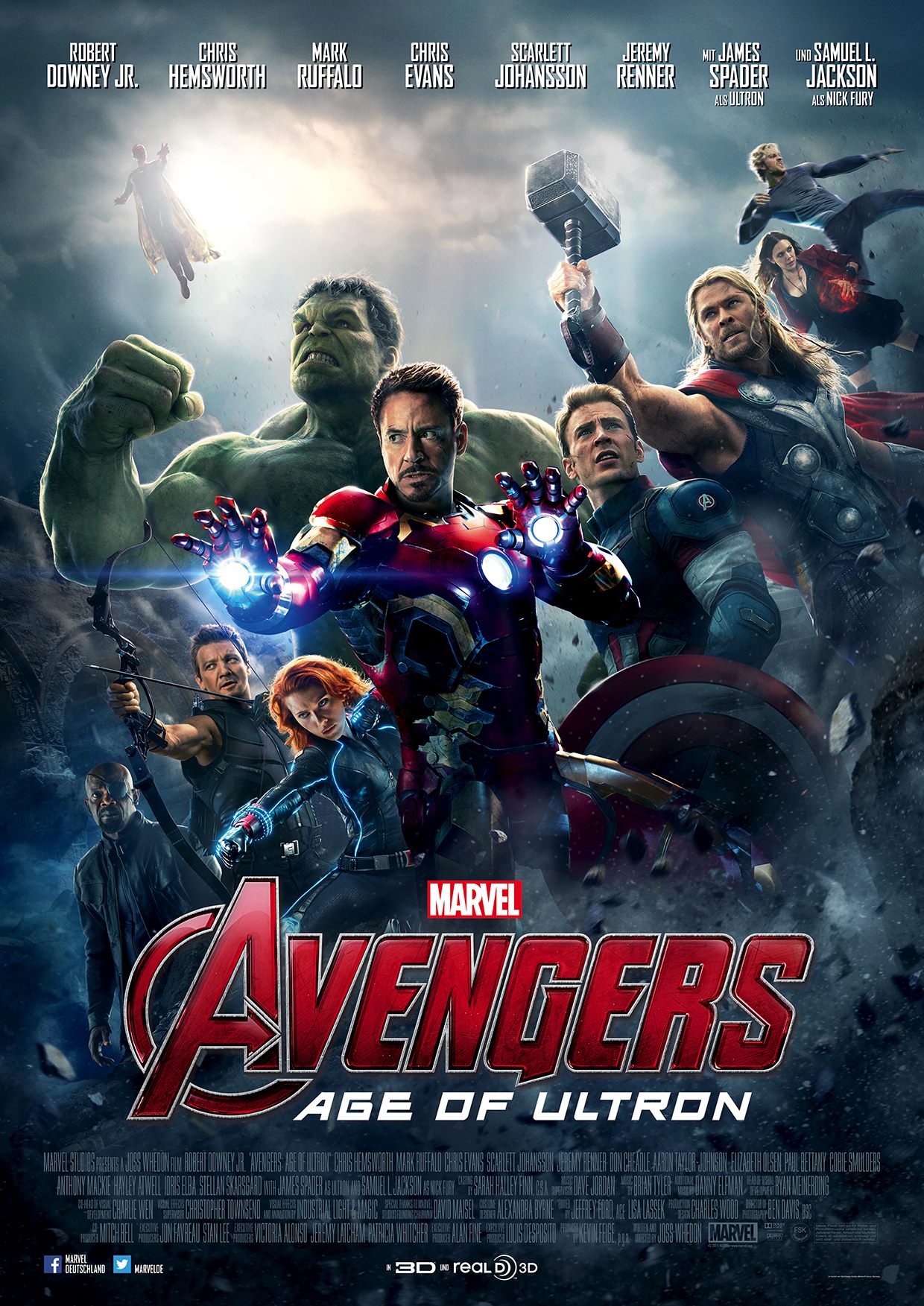 The Avengers wasn’t just a blockbuster it was a mega-blockbuster and rewrote the Hollywood playbook in the summer of 2012. It wasn’t just about powerful franchises anymore. Now it was about franchises that would link into a super franchise. Sony got anxious to expand their Spider-Man universe in a similar fashion as Marvel had done in buildup to The Avengers. After one poor movie, that plan was scuttled and now Spider-Man is being rebooted for the second time in five years, this time with active help from Marvel itself (look for Spidey to appear in Captain America 3). Writer/director Joss Whedon (TV’s Buffy the Vampire Slayer) was the mastermind behind the jaunty smash-em-up fun of The Avengers and was quickly signed on for a sequel after the billion-dollar mark was crossed. With great success comes great risk of upsetting that continued success. It feels like Whedon’s hands were tied to the greater forces at work. As a result, I shouldn’t be surprised but I’m still disappointed with how muddled and overstuffed as Age of Ultron comes across.
The Avengers are cleaning up the last remnants of HYDRA, taking them to a castle in a fictional Eastern European country. The HYDRA doctor has been genetically experimenting on volunteers, birthing Wanda “Scarlet Witch” (Elizabeth Olsen) and Pietro “Quicksilver” Maximoff (Aaron Taylor-Johnson). She can tap into people’s minds and he can run super fast. They’ve got a grudge against the Avengers, particularly industrialist Tony Stark/Iron Man (Robert Downey Jr.). Stark takes a piece of alien technology and plugs it into his home system to build a super fleet of automated robots to patrol the world. In no time, the A.I. has taken form in the shape of an insane robot named Ultron (James Spader) whose mission is to save the planet by eliminating mankind. He builds an army of robotic soldiers with the assistance of the Maximoff twins. Tony, along with Captain America (Chris Evans), Thor (Chris Hemsworth), Hawkeye (Jeremy Renner), Black Widow (Scarlett Johansson), and Bruce “The Hulk” Banner (Mark Ruffalo), must stop Ultron while not destroying much of the world themselves with their collateral damage.
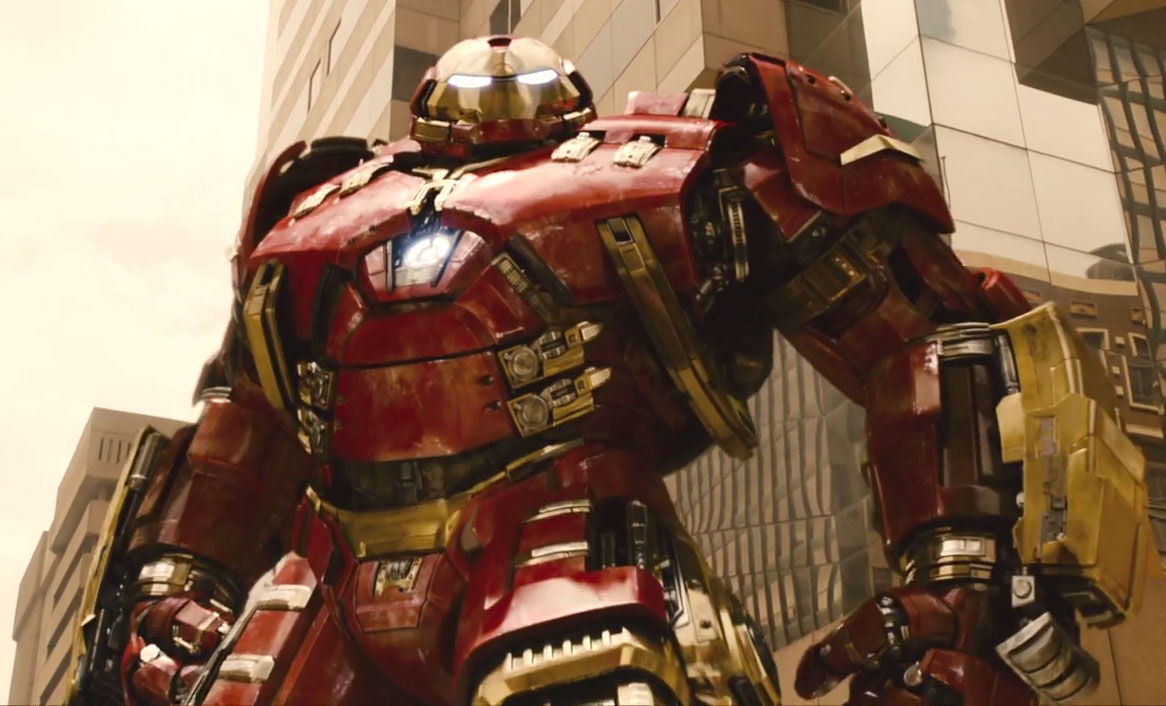 Eleven movies into the Marvel Cinematic Universe (MCU), a movie of the size of an Avengers sequel cannot simply be a movie. It’s too important to the overall vision of the MCU, and so it has to set up and establish other characters, franchises, and the many monetary tributaries that keep the world of superheroes going. It’s already got a slew of superheroes and it adds even more new faces into the mix (I guess we needed an Avengers B-Team). The development of Ultron is also far too rushed; it’s literally minutes from being plugged in that he’s already settled into kill-all-Avengers mode. The movie barely has any time to even contemplate the perils of artificial intelligence before Ultron is already proving their fears correct. While Ultron is a fun villain (more on that later) his plan feels quite haphazard. His biggest strategic advantage is his duplication, the fact that he can exist without a physical body and can inhabit many bodies at once. Except for a hasty escape via the Internet and a climax stuffed with CGI robot mayhem, this advantage isn’t really explored. Why does a self-replicating creature beyond the bounds of physicality need or even desire a physical body? If you’re made from a nigh indestructible metal and can control numerous beings at once with a hive-mind intelligence link, why would you want to be turned into flesh thanks to what amounts to a 3D printer? The introduction of The Vision (Paul Bettany, this time in the flesh) is quite muddled and confusing. The incorporation of the Maximoff twins is awkward and they feel more like accessories than needed additions. This Quicksilver doesn’t come anywhere close to the memorable prankish Quicksilver from Days of Future Past. The pacing of the film is so ramped that it feels like the movie is falling over itself to get to the next large-scale action set piece. At 140 minutes, they could have removed one or two action pieces and devoted more time to streamlining and cleaning up the narrative.
And the action sequences start off with a bang but they invariably fizzle out. The opening sequence begins with a Birdman-styled tracking shot to connect all our fighters, and it’s a fun way to kick things off while visually tying together the team. The Hulk vs. Iron Man brawl is fun for a while, partly because it harkens back to the pleasures of the first film, namely watching our heroes battle each other as much as the villains. After a while, the CGI onslaught becomes overwhelming and just dulls the senses. You’re watching CGI smash into other CGI and then keep smashing, with little variation. The disappointment with the action is that it too often feels weightless and hollow. It has glimmers of fun but it can’t hold onto these glimmers because the action doesn’t change. It gets bigger and more chaotic, yes, but it doesn’t develop with organic complications and real attention to setting. These big battles could happen anywhere because they almost all descend into simply fighting amidst rubble. Even Iron Man 3 found ways to spice up its action set pieces through complications, limitations, and clear differentiation. Perhaps this is a larger outcry of fatigue with the overall state of CGI overkill in effects-driven films. The concluding fight versus Ultron and his many copies just feels like the same scene on repeat but in slightly different locations. Whedon has shown an affinity to coordinate exciting and satisfying action sequences, but you just feel like the pressure and demands get the better of him.
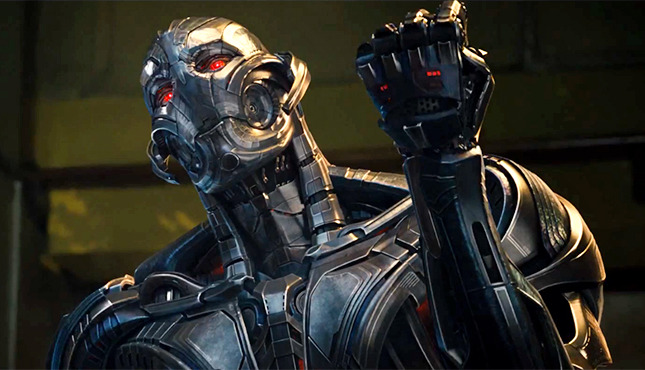
However, every moment with Ultron onscreen is a highpoint because of the malicious cattiness of Spader (TV’s The Blacklist). He’s a perfect fit for a character who is at turns childish and petty, bonkers, and condescending. In some ways he’s like a giant robotic teenager who thinks he’s just above the rest of these so-called adults. It’s such an enjoyable villain, an area of real need in most MCU films (Loki can’t be everywhere for every movie), that I wanted more and more of him. My friend and critical colleague Ben Bailey describes Ultron as the villainous alternative Tony Stark, and Whedon does a fine job of laying out the parallels, especially with regards to ego. It’s a weird reunion for the stars of 1987’s Less Than Zero.
The most boring characters, i.e. the humans, are the ones that get the biggest expansion for character development, with mixed results. Let’s face it, Hawkeye is never going to be anyone’s favorite Avenger. I think even he acknowledges this in a moment that almost breaks down the fourth wall (“None of this makes sense. I’m fighting with a bow and arrow.”). Hawkeye’s personal life is given a spotlight and it sets up an obvious worry that he’s going to bite it by film’s end. If there was an expendable member of this team, it would have to be Hawkeye. The added attention and personal attachments seem like a dead giveaway that he’s going to be dead. I don’t think I was any more invested in his character knowing about his hidden life outside the Avengers, but I certainly played a game of, “Is this gonna be it?” as the film continued. Black Widow started as an interesting character, a spy trying to make amends for her bloody past, or the “red in [her] ledger,” as they referred in the previous film. Her budding romance with Banner makes some sense but it still feels like the character is being forced into Romantic mode not because of her character but mostly because she has a vagina. Any romance with a guy who turns green and monstrous seems like it might be best as unrequited. She’s also defined by a past trauma that, while upsetting and cruel, is also a bit too tied into her identity as Woman/Mother. It’s an unfortunate positioning for what is an inherently interesting character (the slut shaming of the character in promotional interviews by certain Avengers cast members is also highly unfortunate). Can’t we get a Black Widow movie yet, Marvel?
 An aspect of Age of Ultron I did enjoy was how conscious the heroes are about mitigating collateral damage and especially human casualties. At every turn, the Avengers are thinking about saving those caught in the cross-hairs first. They go out of their way to save those left behind. I think, and I’m not alone in this conclusion, that Whedon is directly responding to the disaster porn that was Zack Snyder’s miserly Man of Steel. The latest Superman movie bothered me with how callous it was with human life, treating devastating city-wide 9/11-style destruction as mere entertainment. As Superman and Zod were colliding through every damn building in Metropolis, you knew thousands if not millions of unseen people were perishing in this rather pointless melee. Whedon’s band of heroes places a priority on human life regardless of region.
It would be disingenuous of me to say Age of Ultron is not entertaining. Whedon is still a terrific storyteller and that still shines through the troubled areas and spotty plotting. The action makes good use of the various heroes and their abilities, providing fun combos like Cap hurling his super shield so Thor can redirect it further with his hammer. The use of humor was one of the bigger enjoyments of the first Avengers, and while it’s still abundant and enjoyable here as well I’d say it’s overdone. When every character is cracking quips every fourth line of dialogue, it pulls you out of the movie and the stakes feel lesser. The running joke where the Avengers make fun of Captain America for his prudish sensibilities on profanity is a joke that works at first but then loses all sense of fun as it’s pounded into the ground on repetition. The larger set pieces each have their moments to delight, especially the opening and the Hulk vs. Iron Man battle. Age of Ultron isn’t a bad movie and it has some truly great moments and great character moments and payoffs, but it’s only moments. The plot meant to connect the dots is too labored with the burden of setting up several Marvel franchises. In the MCU pecking order, I’d place Age of Ultron right around Iron Man 2 quality (another movie compromised by the extra burden of setting up other movies, namely The Avengers).
It’s sure to set box-office records and I imagine fans of the original will happily lap up another super team-up, but Avengers: Age of Ultron is something of a disappointment for me. The more I think about it the fun parts become a little duller and I find more areas of criticism. It’s just not as fun a movie experience, and that’s due to the rushed and muddled story and too many characters. After the critical and commercial success of the first film, I doubt that Whedon could have produced a film that would live up to the sky-high expectations, but that doesn’t excuse the finished product. It feels like Whedon had to struggle to pull this one off, especially with the added demands, and I can’t blame him for wanting a break from the MCU. The Russo brothers who so dazzled audiences with their direction of Captain America: The Winter Soldier will be stepping in to direct the next Avengers sequel(s). I hope they’re up to the task because the burden of carrying a billion-dollar franchise with its tendrils connected to other franchises appears to have been overwhelming for one of the greatest storytellers of a generation. Enjoy Age of Ultron but be wary of what the future holds for the larger MCU.
Nate’s Grade: B-
Share this:

Snowpiercer (2014)
 I have seen Snowpiercer twice and it’s still a hard movie to describe. It’s the English-language debut of Korean filmmaker Joon-hoo Bong, notable for The Host (the good one) and Mother. It’s based upon a French graphic novel only printed in France and South Korea. It’s an international production, filmed in the Czech Republic, and populated with recognizable actors like Octavia Spencer, Tilda Swinton, John Hurt, Ed Harris, and Captain America himself, Chris Evans. It’s a dark dystopian allegory about class warfare, it’s a stunning sci-fi action movie, it’s a parable about humanity, it’s a stylish thriller that puts most of Hollywood to shame; it’s many things, chief among them, an incredible movie that demands to be seen on the big screen when able.
To combat global warming, world leaders disperse a chemical to lower temperatures, and oh boy does it work, inadvertently causing a new Ice Age that kills almost all life on the planet. Almost, because a few hundred got aboard the train owned and operated by Wilford (Harris), a rich and secretive industrialist. He built a train that can circle the globe, running on a perpetual motion motor. The last of humanity is housed on Wilfrod’s train. After seventeen years aboard, the class system has become rather rigid. The important and wealthy are at the front of the train, and the poor are crammed in the back, given gelatinous protein blocks to eat, and kept in line by armed guards. Curtis (Evans) is plotting a revolt, biding his time, consulting with the wise Gilliam (Hurt), an aging leader missing several limbs. Together, they storm ahead, capturing effete Wilford spokesman Mason (Swinton) as a hostage, rescuing an engineer (Kang-ho Song) with a drug addiction who will help them open the train cars, fighting car by car to take control of the train. Naturally, those in power fight back in force to maintain the uneven status quo.
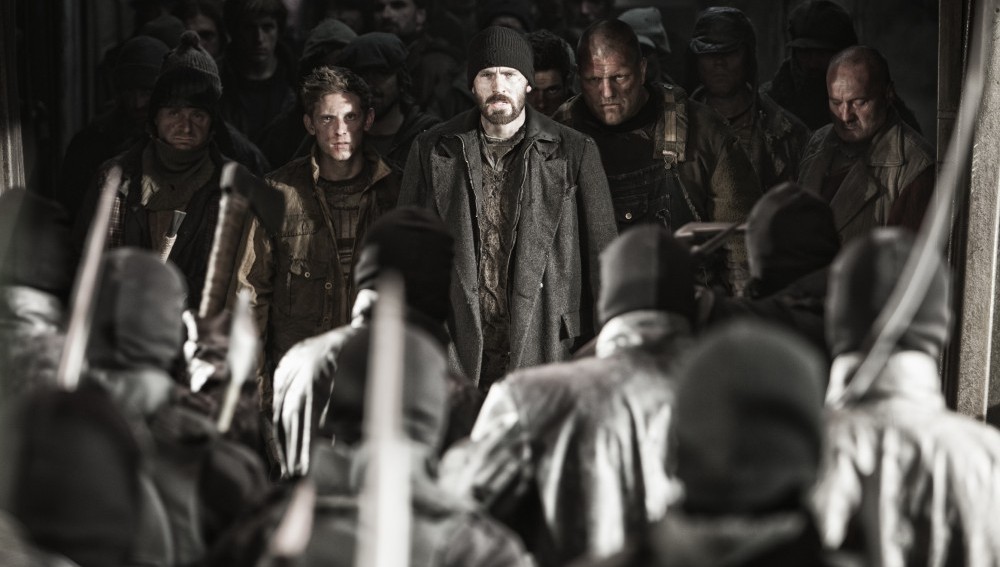 Short of the adrenaline-soaked Raid 2, there hasn’t been a better action movie this year than Snowpiercer. It starts slow, drawing the audience in, setting up its initial burst as a prison break of sorts where the tail section passengers have to figure out a way past the guards and several security doors open for only a few seconds. When the break does happen, in a clever fashion, you feel the full rush of the new opportunity thanks to the movie properly setting up the stakes and obstacles. Each new car presents a new world and a new obstacle. There’s one car where Curtis and his revolutionaries are met with fifty ski-mask wearing grunts with axes. This is the standout action sequence because of how it keeps changing. At first its brawn versus brawn, complete with swinging axes. Then the fighting stops briefly and all the grunts put on night vision goggles. The train enters a long tunnel, condemning Curtis and company to the dark. The grunts then go to town, spearing and slashing the hapless passengers blindly swinging in the dark. I won’t spoil the solution to this scenario but it too is properly set up and leads to some extremely satisfying action imagery, the kind of stuff that pops in a trailer. There’s an entirely different sequence later that also stands out. As the train goes into a long curve in the track, certain train cars are visible from others. Our chief heavy, listed as Franco the Elder (Vlad Ivanov), sees Curtis in the car ahead and starts firing. Eventually Curtis and Franco blast small holes in the protective glass and wait, wait for their moment, for their shot. It’s a tense neo-Western standoff moment, and another delightful addition. The accumulative action has a surprising degree of variety and development.
Snowpiercer is a stirring action movie that keeps your eyes glued to the screen, but it does an equally impressive job of building its world and adding dimension to its storytelling. Reportedly, Harvey Weinstein wanted to cut twenty minutes out of the 126-minute film, but I’m puzzled as to where those edits would come. Every scene in this movie drives the film forward or imparts crucial pieces of information or metaphor that will play out later. Even something as comical as stopping for sushi in the aquarium car (balancing the ecosystem) has greater meaning and subtext when you look back at the film as a whole. Joon-hoo Bong and his co-screenwriter Kelly Masterson (Before the Devil Knows You’re Dead) have given serious consideration to how this world operates and what life would be like when all of humanity is confined to one long train. The past is revealed incrementally, gingerly allowing the audience to become consumed with this odd dystopian landscape, our fascination brewing with each new puzzle piece being added. I was enthralled with the rich details, the cruel methods of keeping those in the tail section in line, the regular head counts, the protein block bars and what they truly are made of, the annual celebration of passing a certain bridge marking their own New Year, and especially the deification of Wilford. The characters worship the engine, and why not since it is the source of life for them, or as the chirpy schoolteacher (Alison Pill) sings: “What happens if the engine fails? We all freeze and die!” The later reveals are the best, giving full explanation why tail section children are important and, particularly, why Curtis is so ashamed at having two good arms. That monologue by Evans, looking back on the earliest and most cruelly chaotic days on the train, is a whopper. I truly hope that aspiring actors will use it during future auditions. It will make an impression.
 Its dark sense of humor and political and philosophical subtext provide an even richer texture to this strange, bleak world. The political commentary isn’t exactly subtle, I’ll admit, but it’s exceedingly better executed and integrated into its plot than, say, last year’s Elysium. The class-consciousness provides a greater depth to the proceedings, providing a new spin on the have/have nots that’s just as relevant today. It’s not just tacked on, either. The political commentary is intertwined with the mechanics of the plot, as we’re witnessing class warfare against inequality, how barbarous acts can be co-opted for personal gain. When Curtis and his small company finally reach Wilford and the engine, it’s a moment akin to visiting the Wizard in Oz, the man behind the curtain they’ve heard so much about. There’s a great degree of incredulous humor from Wilford’s vaulted perspective, but the longer you listen, the more you start to follow his twisted logic and why exactly the status quo must be upheld despite the bloody consequences. Then there’s the macabre humor, which can be bracing at points, none more so than the school car sequence with Alison Pill (TV’s The Newsroom). Also doing plenty of comedic heavy lifting is Swinton (Only Lovers Left Alive, We Need to Talk About Kevin) with such an odd authority figure character. With a mouthful of fake teeth, some owlish glasses, and a peculiar speech pattern, it feels like she stepped out of a Terry Gilliam movie, and we’re all the better for it. Often she’s the only source of humor in what is otherwise a dreary story about the strong preying upon the weak.
Stylish, intelligent, rewarding in surprising ways while still being thoroughly entertaining, with tremendous technical attributes such as production design, Snowpiercer is a sci-fi flick that borrows from many but creates its own unique and enthralling landscape. Rare is the movie going experience where you sit at the edge of your seat, completely taken in by the creativity of the artists at work, transported to somewhere new and exciting, and you dread the approaching end credits. Snowpiercer is an experience that’s hard to describe beyond an unrelenting checklist of positive, glowing adjectives. Simply put, it’s movies like this that make going to the movies special.
Nate’s Grade: A
Share this:

Captain America: The Winter Soldier (2014)
 A welcome addition to the Marvel Cinematic Universe, the second Captain America film brings the square superhero to our modern-day and presents a complicated national setting where the enemy is the U.S government. The challenge with a Captain America (played by Chris Evans) movie is just how outdated his whole sensibility seems, an irony-free nationalistic hero. Smartly, the filmmakers have pushed his loyalties to the test, and the movie transforms into something along the lines of a Jason Bourne thriller, where the government is hunting down a rogue fugitive. It’s certainly the most timely superhero film since 2008’s The Dark Knight, and the political commentary on the NSA spying and drones is a welcome big screen subversion. But the action is still what people come for and in that the Winter Soldier is quite an entertaining movie. Directed by the Russo brothers, known mostly for their comedy work in TV like Community, the movie packs quite a punch with a variety of action/thriller sequences, each well staged and well developed. My favorite might be Nick Fury under assault and desperate to escape in his car from overwhelming enemy forces. An opening sequence rescuing hostages on a boat serves as a great reminder why Captain America is indeed so super. The movie does have some issues but nothing so large as to derail the enjoyment. First off the villain is way too obvious, but also the movie lets the U.S. government off the hook, falling back on a select evil group that has been undercover perverting the government. Secondly, the Winter Soldier of the title is one plotline that doesn’t feel needed or well integrated. It’s another super soldier for Cap to combat and this guy has a mysterious link to our hero. It feels like one plotline too many, a story that deserves better attention on its own. Still, Captain America: The Winter Soldier is an engaging, thrilling, intelligent, and altogether entertaining addition into Marvel’s sprawling cinematic canvas.
Nate’s Grade: B+
Share this:

The Avengers (2012)
 For the past four years, Marvel has been seeding its all-star super hero collective in the storylines of its summer blockbusters. And with six super heroes, The Avengers carries some super expectations. The creative mind behind the film is none other than Joss Whedon, best known for creating and shepherding cult TV shows like Buffy the Vampire Slayer, Angel, and Firefly. Not exactly the first name you’d think Marvel would assemble to front a $200 million movie. For geeks, Whedon has become a reliable standard of quality (the patchy TV show Dollhouse notwithstanding). Here is a man who can marry big ideas with sharp characterization and delightfully skewed dialogue. In Whedon, geek nation has a savior, and Marvel knew this. The Avengers is 142 minutes of geek arousal stretched to orgasmic heights.
Nick Fury (Samuel L. Jackson), head of the agency S.H.I.E.L.D., has a dire need for Earth’s mightiest heroes. Loki (Tom Hiddleston) has traveled through a portal and plans on conquering Earth thanks to an approaching alien army. Fury has tasked Tony Stark (Robert Downey Jr.) a.k.a. Iron Man, Steve Rogers (Chris Evans) a.k.a. Captain America, and special agent Natasha “Black Widow” Romanof (Scarlett Johansson) with stopping Loki and rescuing one of S.H.I.E.L.D.’s own agents, the skilled marksman Clint “Hawkeye” Barton (Jeremy Renner), who is under Loki’s devious mind control. Loki’s brother, Thor (Chris Hemsworth), would like to cite jurisdiction and bring his wicked brother back to his home world. The only person who may be able to locate Loki’s path is Dr. Bruce Banner (Mark Ruffalo), a guy with his own anger issues. With this many egos, it’s bound to get dicey. As Banner puts it, “We’re not a team. We’re a time bomb.” Can they put aside their differences to unite to save the Earth? Does a Hulk smash?
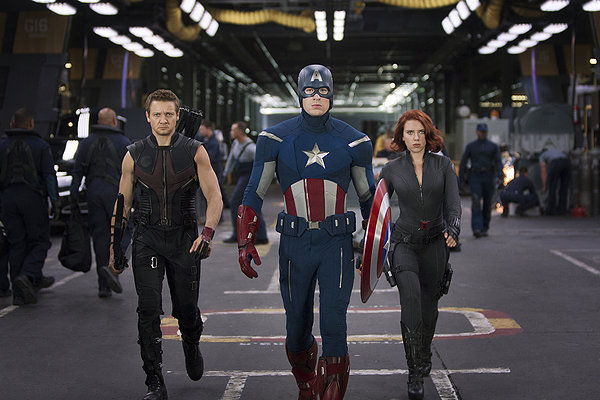 Whedon, the king of clever genre deconstruction last seen in the excellent meta-horror film Cabin in the Woods, plays it relatively straight, giving his big, effects-driven film a straight-laced sense of sincerity. It’s not making fun of these sort of big-budget, effects-driven smash-em-ups, it just wants to deliver the biggest smash-em-up yet. To that end, The Avengers achieves maximum smashitude (trademark pending). By its rousing finish, the movie has become so massively entertaining that you forget the draggy first half. The scope of this thing is just massive. The last thirty minutes is solid action across miles of crumbling, just-asking-to-be-exploded city landscape. But the trick that Whedon pulls off is how to orchestrate action on a monumental scale without losing sight of scale, pacing, and character. You’d think with a full deck of superheroes that somebody would be shortchanged when it came time for the rough and tumble stuff. Not so. Instead of fighting one another, the prospective Avengers work together in all sorts of combinations. The characters are well integrated into the fracas, making particular use of their abilities, and finding new locations of focus every few minutes. This expert hero shuffling keeps things feeling fresh amidst the constant din of chaos.
In fact, the movie finds time to give every hero his or her due, finding a small moment to reveal some characterization. I thought Whedon’s biggest challenge was going to be the juggling act of balancing so many heroes and so much screen time, but the man found a way, like he regularly does, to squeeze in character with ensemble action. The Hulk fares the best. After two movies, it feels like Whedon has finally nailed the character; granted, this success may be credited to the fact that Bruce Banner (all hail Ruffalo) is kept as a supporting character. The struggle of the character being likened to a recovering addict is a smart way to present the character without getting too morose (I enjoyed the revelation that the “Hulk” half prevented Banner from killing himself). When he’s told his mission is to smash, you can feel the exuberant joy of an unleashed Hulk id. The Hulk had two great audience-applause moments that made my theater go berserk. I also really liked the attention given to Black Widow and her lonely back-story. Hawkeye was a complete badass, though he only gets to do fun stuff in the madcap finale. The trouble with the hero team-up franchises is that not everyone’s on the same level of power. Thor is a god for crying out loud, Iron Man has super weapons, Hulk is Hulk, Captain America at least has superhuman strength but what do Hawkeye and Black Widow bring to the team? When you’re competing with all that power, being good with guns or a bow seems pretty puny. And with Hawkeye, there’s going to be a limit to his effectiveness unless he has a magic bag of replenishing arrows. Still, Whedon finds ways to make the heroes badass and humane in equal measure, and surprisingly funny, which is welcomed.
It’s hard to believe that Whedon had only directed one feature film before (2005’s Serenity, based upon Whedon’s canceled Firefly show) being given the keys to the Marvel universe. He’s directed several TV episodes of his signature shows but the man has never produced anything on this scale before. Given a gigantic canvas, Whedon delivers the goods. His action sequences are rollicking and fun and, best of all, shot and edited in a fashion where you can understand what is happening (take some notes, Hunger Games franchise). The action is well choreographed and elevated with organic complications and particular attention paid to location, like the Nicky Fury airship. Whedon is a master of the plot payoff, setting up his elements and then piloting the narrative to satisfying conclusions and integrations (Cabin in the Woods is also a pristine example of this gift). If you’re going to introduce an airship, you better believe that sucker is going to threaten to crash. I’m glad that Loki was brought back as he was the best Marvel big screen baddie yet, though I’m disappointed they essentially put him on ice for an hour.
 The technical elements are ably polished even for this kind of film. The cinematography by Seamus McGarvey (Atonement) is terrific, utilizing bright color in a way that the visuals pop. The special effects are top-notch and you just feel immersed into the action. The destruction is cataclysmic but rarely does the movie feel phony. I was impressed by the Hulk designs and the sequences in inky space with our alien adversaries. For that matter, are these aliens robots? It’s unclear whether the giant flying centipede-like ships are creatures. The 3D conversion is one of the better outings due to the fact that it doesn’t keep throwing stuff in your face. Plus, viewing Johansson’s leather-clad assets in 3D certainly has its own appeal, as does Gwyneth Paltrow in jean shorts. Hey How I Met Your Mother fans, Cobie Smulders looks practically smoldering in her S.H.I.E.L.D. agent outfit too. Okay, I swear I’m done with the female objectification.
I hesitate calling The Avengers the greatest super hero/comic book movie of all time, as the teaming hordes of Internet fanboys foaming at the mouth are wont to do. If your definition of a comic book movie is a giant sandbox with all the coolest toys, then this is your film. This is a comic book turned flesh. The Hulk and Thor fight and prove who is the strongest Marvel man, that’s got to be a geek’s wish come true. Many of the infighting sequences felt like, servicing the tastes of the fanboys, and after a while the constant hero on hero action felt tiresome. I get that we have a clash of egos going on here, but the movie suffers from a lack of narrative cohesion, by which I mean that the first hour of the movie feels like a series of guest appearances by heroes on loan. The movie doesn’t fully come together until the point where the team comes together; I doubt Whedon intended that symbiotic relationship. The movie feels more like a patchwork of standout scenes and memorable moments that a fully formed and cohesive story. If you haven’t seen the previous four Marvel movies (Iron Man, Iron Man 2, Thor, Captain America), you’ll be pretty hard-pressed to follow the story. Loki’s motivation and plan seems rather sketchy other than causing discord amongst the heroic ranks. His powers seem inconsistent and vague. Also I found the musical score by Alan Silvestri to be bland and unworthy.
The Avengers is sure to be geek nirvana for many of the comic book faithful. It’s an audience pleaser of mass scale, and I’m sure that your theater will be cheering in abundance. Whedon has pulled off the near impossible. The movie is a thoroughly entertaining, exciting, and witty popcorn spectacle of the first order. But where the movie hits the ceiling, at least for me, is that it ONLY wants to be the best super hero movie and this seems like limited ambitions. It’s like making the very best possible women in prison movie (great, but is this really all you set your sights on?). I had a great time watching Whedon’s handiwork but I wish it mined the outsized territory for bigger themes, a little more than audience-satisfying pyrotechnics, something I feel that X-Men: First Class did a better job of handling. Don’t get me wrong, I greatly enjoyed The Avengers and it’s a fantastic start to the summer movie season, but by no means is it The Dark Knight or even aspiring to be, and that’s okay. Enjoy the busy escapades of Marvel’s next smash franchise. Who knows when they’ll be able to wrangle everyone together for another adventure, but judging by the sounds of ringing cash registers, the answer is sooner than we think.
Nate’s Grade: B+
Share this:

Captain America: The First Avenger (2011)
 In the summer of superheroes, you’ll be excused for feeling some fatigue when it comes to men in tights. Captain America: The First Avenger is a surprisingly enjoyable sepia-tinted action film that flexes enough might to pleasantly hark back to the days of 1940s adventure serials. Taking place almost entirely in the era of World War II, the film, and its hero, and unabashedly square and earnest. Steve Rogers (Chris Evans) begins as a 90-pound weakling determined to fight for his country and gets transformed into a behemoth of beefcake by the Army. Captain America is devoid of the dark brooding that has come to encapsulate modern superhero movies, but it’s also playing its B-movie silliness straight. The flick has more in common with Raiders of the Lost Ark and Sky Captain than most other superhero product. Better yet, the movie finesses the in-your-face patriotism of the title character. I mean the guy is called Captain America. Yet the film finds a way to resonate a sincere nationalistic pride without falling back into Michael Bay-level jingoism. And who’s going to make for better villains than Nazis? Director Joe Johnston (The Rocketeer, Jurassic Park 3) turns out to have been the perfect choice to helm this rah-rah retro enterprise. The pacing is swift, the acting is engaging, the special effects are terrific particularly Evans’ transformation into a weakling, and the film is unexpectedly emotional at points. This is a comic book movie that would appeal to an older generation not normally interested in superheroes, namely people like my dad.
Nate’s Grade: B
Share this:

Scott Pilgrim vs. the World (2010)
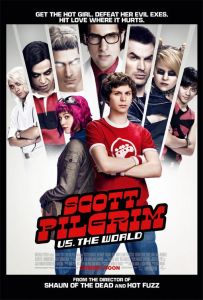 What happens when the millennial generation gets its own (attempted) seminal movie? It stays home and plays video games, letting the film, Scott Pilgrim vs. the World, languish at the box-office. I guess that’s what happens when you finance a movie whose target demographic will just as readily download the movie for free off the Internet.
Scott Pilgrim (Michael Cera) is a 22-year-old Toronto slacker. He?s the bass player for the band Sex Bob-Omb, along with lead singer Stephen Stills (Mark Webber) and acerbic drummer Kim (Alison Pill), a former ex-girlfriend of Scott’s from high school. The band’s biggest fan is 17-year-old Knives Chau (Ellen Wong), who also happens to be Scott?s new girlfriend. The world of Scott Pilgrim is abuzz with this scandal, especially Scott’s gay roommate Wallace (Kieran Culkin) and Scott?s younger sister (Anna Kendrick). Scott insists it’s all on the level and he has no ulterior motives for dating a high schooler. Then he sees the mysterious and alluring Ramona Flowers (Mary Elizabeth Winstead) who?s new to the area and American. Scott rabidly pursues her in what could best be described as stalking, eventually getting her to agree to date him. Trouble is, he hasn’t broken up with Knives just yet before starting this new venture. Scott is then confronted at the Battle of the Bands concert by a man who comes bursting out from the ceiling. He is the first of Ramona’s seven evil exes and Scott must defeat them all in order to earn the right to the violet-haired beauty. “Everybody has baggage,” Ramona says. “Yeah, but my baggage doesn’t try and kill me,” Scott wearily replies.
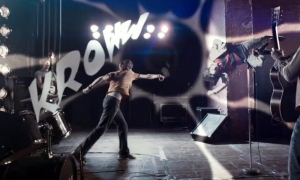
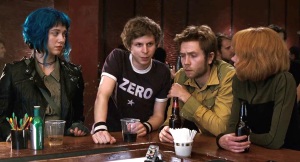 Visually, this movie showcases director Edgar Wright (Hot Fuzz, Shaun of the Dead) using every crayon in the Crayola box. This is a visually resplendent film where every scene seems crammed with details to delight the eyes and light up the senses. It’s a rush to watch the kaleidoscope of colors and motions. The Scott Pilgrim universe clearly differs from our own. This is a realm that borrows heavily from old school video games, where people burst into coins when vanquished, where life-decisions are met with “leveling up,” where people have onscreen pee bars that will deplete after a trip to a urinal. Sound effects will routinely be verbalized on screen, everything from a “RIIIIIIIIIIING” of a telephone to the “Ding Dong” of a door. It’s amusing, though also easily overused. Jobs and stuff like that are for the real world, hence too square to be depicted. It’s this entire idiosyncratic comic book world treated like everyday reality.
The enormous display of style is impossible to ignore. Scott Pilgrim is a slick, flashy piece of entertainment that is riddled with nostalgic references for a select crowd. I appreciated how a nice walk was accompanied by the theme song from The Legend of Zelda, or that sound effects and onscreen graphics echoed the fights from Street Fighter II (don’t ask me which of the 800 versions). Scott Pilgrim is an excellent pop pastiche of a specific culture, namely a slacker, hipster, amiable, comics and gamer group. I myself was an avid Nintendo gamer back in my day, but I admit to waning interest when the games got too complicated and grisly (“Back in my day we had two buttons to push, one to jump and the other to shoot, and that’s how we liked it!”). The movie is an explosion of color, light, and (lo-fi garage rock) sound, which also might sound like the description of a seizure or a stroke to some. Like those ailments, Scott Pilgrim will be seen by some as an infliction. It’s hyperactivity and eagerness to please via nostalgic reference points will be what drives people to this film and what drives them away in equal measure.
The Scott Pilgrim graphic novels total six volumes and approximately 1200 pages, which means it?s not the easiest fit for a two-hour window. It also hurts that the Pilgrim books have a wide supporting cast of characters to tussle with, plus there?s the whole seven deadly exes thing which means the movie has to provide about a solid 20 minutes of set-up before finding enough time for seven antagonists (or boss battles, following gamer parlance) and a reasonable amount of resolution. Add on top of this the fact that Wright keeps the movie moving at an outrageous, ADD-addled pace, like the plot conveyor belt lever got broken and the scenes speed one after another. Everything about this movie feels fast and over caffeinated. The editing in particular has characters holding conversations where every line is in a new location, implying an added sense of movement. So you shouldn’t be too surprised when the Scott Pilgrim film feels like a whole lot of a little; it’s moving at the speed of light to entertain.
 Because of the plot mechanics and oversized cast of characters, Pilgrim can give off the impression of shallowness. It seems like all style and little substance and that’s because the movie attempts to cram an entire series of stories, back-stories, and conflict into two hours. The film version only has enough time to attempt to give Scott and Ramona characterization, though both come across as weak-willed, tentative, and less than charismatic, wondering if either party is worth the trouble. The movie tries to paint over these differences through distraction and force of will. The large cast of supporting players all elbows each other just to be mouthpieces for one-liners. Knives actually comes across as the most complete character, consumed by her infatuation, heartbreak, and then quest for misguided vengeance. She’s somewhat dismissed and yet she is the most developed person on screen thanks to Wong’s endearing and relatable performance. The entire experience of Scott Pilgrim vs. the World can be somewhat fatiguing when there’s little evidence presented for emotional investment. The books supplied the reasons for caring besides the whole underdog angle.
The movie aims to be a battle over love, but it’s not entirely convincing. Scott appreciates Knives because she’s simple, a relationship he doesn’t have to invest much within, something casual and enjoyable while it lasts or until it becomes too taxing. Then he goes ga-ga for Ramona and stalks her, wearing down her defenses. He’s purely smitten with her and willing to do whatever it takes to earn her affections, though he can?t explain why he feels this way. Here’s a note to screenwriters: when characters are asked why they love somebody, do not have them say, “I don’t know.” But for Ramona, Scott is her Knives. He’s something easy that won?t break her heart, an escape from the jerks she’s been dating before. He?s low maintenance. He’s something to pass the time. There’s an interesting dynamic here, made even more complicated by the fact that Scott’s time with Knives blended with his time with Ramona. There was not a clear end point. The movie takes a literal approach to the idea of love being a destructive force of nature. Scott is punished throughout because of his infatuation with Ramona, but he persists despite the bruises. And he doesn’t even really know much about her. There’s an interesting statement somewhere there about the punishment we endure, sometimes foolishly, over the affections of people we may love, or convince ourselves of, but not even like.
 It may sound peculiar but I’m paying Michael Cera a compliment by saying his performance in Scott Pilgrim is the least Michael Cera the actor has ever been on screen. Gone is his gawky, awkward, ironic shtick that has fast become the Cera persona in films like Superbad and Year One. Scott is unjustifiably confident in his life’s pursuits, and Cera gets to act cocky and quippy, even if it?s done with a wink. He?s an unlikely kung-fu star but then again he?s also an unlikely leading man. Winstead (Live Free or Die Hard) is cute but plays her part a bit too toned down, like Ramona’s still searching for the right medication combination. Culkin and Pill are both scene-stealers of the first order, doing so with unabashed and flippant sarcasm. Every scene is made better by their presence. Among the evil exes, Brandon Routh (Superman Returns) has plenty of fun as a dim-witted super-powered Vegan bassist (“Vegans are just better than other people”), and Jason Schwartzman epitomizes hipster snark with such relish. The film is exceedingly well cast from top to bottom.
I’ve read some reviews positing that Scott Pilgrim vs. the World is an elaborate fantasy taking place in the mind of its titular hero, that he blends his knowledge of comics and video games to help make sense of the troubled waters of relationships and lingering hurt from the demise of love. I think that’s a nice explanation but perhaps trying too hard to frame this film as some form of psychoanalytical commentary on modern youth’s interpersonal relationships and the value of love. Scott Pilgrim vs. the World is really just a spastic, hip, clever wank that, as presented, gives little room or emotional investment. It?s a blurry, messy, prankish good time at the cinema that doesn’t translate into much more than the equivalent of sensory button mashing (video game reference). It’s fun while it lasts but it doesn’t have much beyond those astounding visuals to make it feel lasting, and I say this as a genuine fan of the graphic novels by Bryan Lee O’Malley. Alas, heavier discussions about the thorny, maddening issues of love are better left to more dramatic, and romantic, movies like Brokeback Mountain, Eternal Sunshine of the Spotless Mind, and even WALL-E. This movie is more preoccupied with spinning as fast as it can and then vomiting.
Nate’s Grade: B
Share this:

Street Kings (2008)
 This is a wildly overwrought and sleazy drama is hoping to come across as edgy but everything is so overdone. It fulfills all the requisite elements of the modern crime picture; double crosses, forlorn anti-heroes, bloody violence, but Street Kings misses the mark big time when it comes to any nuance. Every beat of this murky, convoluted dirty cops mystery is plain and obvious. If you cannot guess within minutes who the eventual culprits will be then you haven’t seen enough movies. Every character is a cliché of a cliché, every unrestrained actor is constantly speaking in nothing but exclamation marks, and the dialogue is some of the worst I’ve heard all year. Keanu Reeves is a listless leading man who is blank and lifeless, unable to wrestle the dark and complicated emotions needed for a “cop on the edge” role. I can practically feel Forest Whitaker’s spittle every time he speaks. Street Kings feels like a route retread of rogue cop pictures, which are director David Ayer’s specialty. It wants to shine a light on the seedy underbelly of the law but it can’t stop from feeling like a lobotomized version of L.A. Confidential (Note to Ayer: Jay Mohr + mustache = an arrangement that benefits neither party).
Nate’s Grade: D
Share this:

Fantastic Four: Rise of the Silver Surfer (2007)
 No better or no worse than the original, this less than fantastic follow-up to the cruddy 2005 superhero dysfunctional family melodrama ups the apocalyptic ante with the emergence of the powerful Silver Surfer, the herald for a cosmic cloud, yes cloud, that consumes the life forms of planets. The special effects run the gamut from fake and awful to passable, but what ultimately kills this movie is how little substance there is. It’s lightweight, shallow, and more interested in making the kids giggle. Example: The Human Torch, after touching the Surfer, can now switch powers with any of the members after they touch him. The Thing, covered in spongy orange rock, is lamenting his state but finds solace in his relationship with a blind woman. The Human Torch asks what Mr. Rock Dude what would do if he had but a few moments left in this world. Now, I’m thinking that the Human Torch is going to swap places with his buddy so that The Thing can enjoy even one night as a regular flesh-and-blood human being with his sweetheart. Maybe they could even knock boots without her getting serious rug burn. But no, the movie does nothing and just moves along because it doesn’t have the scope, the interest, or even the time to flirt with anything outside its limited plot. The storyline, what little there is, is predictable from beginning to end and the action sequences, while expanded from the first film, still fall far short of eliciting tension or tickling the imagination. I swear the only reason the flying jet thing is introduced was to sell toys. You have a bunch of people with unique super powers; the least the script could do is think of exciting things to do.
Nate’s Grade: C
Share this:

Sunshine (2007)
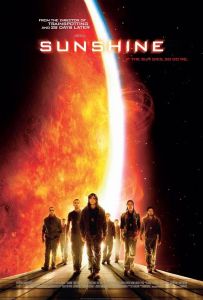 Danny Boyle is one of the more interesting film directors out there today. He seems to dabble in every genre. He’s done paranoid thriller (Shallow Grave), substance abuse drama (Trainspotting), zombies (28 Days Later), and a genuine family film (Millions). Boyle has a bountiful imagination. Now he and his 28 Days Later partner, writer Alex Garland, are going where many have gone before in the film world – outer space. Just don’t confuse the film with the 1999’s Sunshine where Ralph Fiennes plays three generations of a Jewish family with rotten luck. Come to think of it, both Sunshine movies fall apart in the final act. Note to filmmakers: just stay away from this title. It will doom your ending.
Fifty years into the future, the sun is dying. Earth is under a solar winter as it undergoes less and less light. The crew of the Icarus II has a very important mission: restart the sun. Attached to their spacecraft is a giant bomb intended to create a new star inside an old one. They have a giant reflective shield to protect them from the direct heat of the sun. The ship has eight crew members, including the physicist responsible for the bomb (Cillian Murphy), a botanist (Michelle Yeoh) with a garden to provide recyclable oxygen reserves, and a hotheaded handyman (Chris Evans) that believes nothing could be more important than their mission. As they drift closer to the sun they pick up a distress call that belongs to the previous Icarus I spacecraft which vanished under mysterious circumstances seven years ago. The crew decides that two bombs are better than one and changes course to intercept the Icarus I. anyone who has ever seen a horror movie knows you don’t go poking into the spooky place when you don’t have to.
 Boyle sure knows how to make things look pretty, or interesting, or pretty interesting, and this helps because Sunshine is rather shopworn with familiar sci-fi staples. The premise itself almost seems identical to a 1990 film called Solar Crisis, a movie I only remember marginally because of the female nudity my young eyes caught glimpse of (in those days we didn’t have any of yer fancy Internets). Besides this, the film borrows liberally from 2001, Solaris, Star Trek, Alien, Event Horizon, The Core, and the super crappy Supernova. Most every aspect of Sunshine can be traced back to a different science fiction film, but sci-fi is one of the few genres that don’t necessarily suffer from being derivative. A cookie-cutter sci-fi movie is forgivable as long as the filmmakers treat the audience with respect and attempt to be smart with their story. I don’t care that Sunshine reworks plot elements that have been worked since giant alien carrot people frightened necking teenagers in the 1950s, and that’s because the genre is built for being borrowed.
Sunshine is often beautiful to watch with awe-inspiring images of that great ball of fire, our sun, but even better is the fact that the film is pretty much the opposite of Armageddon – it’s smart. The movie discusses the realities of space travel, communication, oxygen levels, trajectories, sub-zero temperatures, sacrifice, and how to live so close to the sun where the human eye can only safely look at 3.1 percent of its light emissions for 10 seconds. It’s a bit slow but rather fascinating just to witness how day-to-day life functions for the crew and how the time, or lack of discernible time, plays with their psychology. This respectful intelligence helps when the crew debates altering their mission to inspect the mysterious space vessel. The audience knows that only bad things will happen but the crew argues with reasonably sound logic about the potential benefits.
Sunshine is a thinking man’s sci-fi treat for its first two acts and then it completely devolves with a disappointing turn of events; it becomes a slasher film in space. There’s genuine awe and intrigue, along with some brainy scientific discussions and some considerable religious/philosophical pondering… and it all just stops dead for a madman chasing people with pointy things. Sigh. It’s an artistic free-fall that Sunshine never quite fully recovers from. Boyle makes the strange decision to keep his space slasher out of focus so the audience never gets a clear look; even stranger are camera shots where the killer will walk into frame and then transform his area to an unfocused blur like a blurry infection. It’s an artistic choice that doesn’t quite work (“The blurry man’s coming to get you, Barbara!”). The film then morphs into your standard race-against-time and then balloons with trippy computer effects and snazzy light filters. Sunshine was exceedingly more entertaining prior to picking up the unwanted visitor.
 The cast does a fine job mulling their life-or-death options, but the two standouts are Murphy and Evans. Murphy and his piercing baby blues make for a strong lead. He provides soulful glimpses into his stock scientist role. Evans is the surprise of the film. Best known as the Human Torch in the dreadful Fantastic Four films, he exhibits a wider range of emotions from macho hardass to duty-bound soldier. This is a film heavy with noble sacrifices, and Evans is the reminder of all that is at stake.
Sunshine is visually pleasing and intellectually stimulating, especially for a sci-fi film built from the discarded pieces of other films. It’s a tense and exciting time, that is, until the movie just throws up its hands and transforms into a laughable slasher film. This movie did not have to go this tiresome route; there could have been an on-board mutiny when they discussed the idea of killing one of their own so they had enough oxygen to complete their mission, there could have been further psychological torments from within the crew, or even easier, the spaceship could just have undergone more malfunctions. Sunshine is a thoughtful, slightly meditative sci-fi thriller, but then it loses all of its better senses.
Nate’s Grade: B-
Share this:

Cellular (2004)
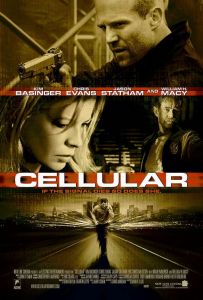 Cellular, a new thriller, relies on the simple device of a cell phone for the crux of its plot. With cell phones becoming ever more present, and ever more an eyesore in our daily lives, it was only a matter of time before they had their own movie. They’ve slimmed down from their heavier 1980s days, and become more useful, allowing one to surf the Web, take candid pictures of people in gyms, and are able to ring in the tone of the new hot rap song of the week. The premise for Cellular may be pitch-perfect for our modern society, but will an audience answer its call?
Jessica Martin (Kim Basinger) is a high school biology teacher caught up in some scary events. She’s been kidnapped by a gruff man (Jason Statham), and locked in an attic. She’s informed that her son and husband will be found and kidnapped, unless she tells him what he wants to know. Unfortunately, she’s clueless as to what her kidnappers want. There is a wall phone in the attic, and one kidnapper smashes it with a sledgehammer and walks away satisfied. Jessica goes to work re-configuring the shattered phone pieces, tapping wires until she can reach out and touch somebody.
Ryan (Chris Evans) is a hunky beach bum who’s chastised by his ex (Jessica Biel, I know, I didn’t believe it too) for being too irresponsible. He’s driving around in his cool ride when he gets a panicky phone call from, you guessed it, Jessica. At first he thinks it’s a practical joke until he overhears her kidnappers threaten her. Reluctant to help, Jessica asks him to stop the kidnappers from reaching her family. Ryan runs around town all day scrambling to help Jessica’s family and solve the case. He also enlists the help of a retiring police officer (William H. Macy), who’d rather open a day spa than do desk work.
 The premise for Cellular is near-genius and provides an abundance of smart, problematic possibilities. Ryan runs around and is always in danger of losing the signal. At one moment his cell phone is about to die from low battery charge. Another time the lines get crossed. Every step seems believable and the characters’ reactions seem credible. With Cellular, the audience thinks along with the characters step-by-step. When Ryan encounters stumbling blocks, the audience is with him in solving them, and this makes for a very engaging and thrilling movie.
The acting in thrillers is usually a minimal speed bump but the actors in Cellular do fine work. Basinger attempts to make up for her role in The Door in the Floor and plays harried and teary like a pro, but her best moments are when she uses her biology teacher know-how in precarious situations. She’s like a female MacGyver. Cellular is really a coming-out for Evans as a leading man. He’s had small roles before in The Perfect Score and Not Another Teen Movie, but this is his first leading-man role, and he handles the running, shouting, and panting with aplomb. Statham does his usually fine work of sneering and acting menacing. It’s also fun to watch William H. Macy, usually playing an every-man or a sadsack loser, play a bloodhound cop that morphs into an action hero.
The pacing in Cellular is breakneck. In the first 10 minutes, we witness Jessica’s kidnapping, and the momentum built up from that point is exhilarating. There is rarely a moment to catch your breath in Cellular. The action sequences are exciting but not redundant, and the tension readily mounts, especially when the audience is given more information than our heroes. There’s also some fun jabs at our country’s cell phone lifestyle.
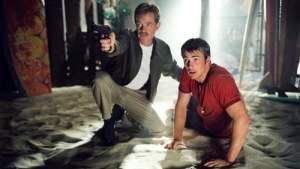 Director David R. Ellis worked as a stunt coordinator for 20 years, before advancing into the director?s chair and helming 2003’s schlocky gore-fest Final Destination 2. Ellis knows how to keep his plot moving, and something is always happening in Cellular to draw our attention or to push us on edge. Cellular was written by Larry Cohen, who also penned Phone Booth and probably won’t rest until he’s the Robert Rodat of telecommunications (Rodat wrote Saving Private Ryan and The Patriot, and seems destined to write a movie about every American war). Might I envision an erotic thriller with the “Can you hear me now?” Verizon guy just around the corner? Only time will tell.
As with any thriller, there are going to be lapses in logic that have the possibility of stopping the story dead in its tracks. Cellular‘s biggest logic loophole occurs right at the start, and if you can get behind it then you can enjoy the rest of the ride. Instead of smashing a telephone, why not yank it out of the wall and fully decommission it? Or, even better, why leave your kidnapped victim in a room, out of your sight, with a phone? Would it not have been easier to just tie her to a chair in plain sight? The mind boggles. The real answer we all know, of course, is because then we wouldn’t have a movie. There’s also a sequence late in the film where the bad guys discuss their evil plan on cell phones, which seems a tad careless considering anyone with a police scanner could listen in. As I said, gaps of logic are expected in this movie terrain and it’s your ability to rise above them that will determine if you enjoy the film.
Cellular is a thriller that dials the right numbers. It may have some gaps in logic, but it delivers when it comes to sharp suspense, smart action and a great premise. Fans of action thrillers should lick their lips with what Cellular has to offer. Just remember to keep your cell phones turned off during the movie, unless, of course, you’re surfing the Web, sneaking pictures of some girl, or jammin’ to the rap song of the week.
Nate’s Grade: B


 nathanzoebl
You must be logged in to post a comment.