Blog Archives
Syriana (2005)
 Written and directed by Stephen Gaghen, Syriana is very reminiscent of his Oscar-winning work with Traffic. It’s very dense, complex, and demanding of its audience, which is both its best and worst aspect. I needed a notepad to keep up with the multiple criss-crossing storylines. It’s similar to Traffic in scope and texture, but this film seems a whole lot angrier. Whereas Traffic felt like it was trying to hold a mirror up to society, show us the truth of the failing War on Drugs, this movie feels like a wake-up call as well as a call to arms. Syriana is desperate to shake people out of complacency and show them how the world is running. I love the fact that the “Free Iran” committee in the film that preach Iran’s desire for democracy are not backing the emir’s son that wants to educate his country, install democratic freedoms, put women on equal footing as men because … he wants to open the oil fields to China because they’re offering more money. They are backing the less-enlightened son because he’s willing to give America what it wants: oil. The movie is a mostly potent microcosm about questioning who has our best interests at hand. It’s a bit slow at parts and incredibly rushed at others, and your head will be left spinning trying to keep track of the wealth of information it throws at you. It is thought-provoking even without an emotional connection. This flick reminded me of The Constant Gardener, also a screed against the evils of big business though grounded in an evolving love story. This is a movie I admire more than I can say I enjoyed.
Nate’s Grade: B
Share this:

Capote (2005)
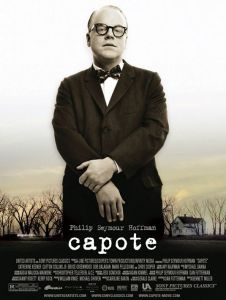 This is a really solid, probing movie about human relationships and the oversized personality of famous author Truman Capote. It’s a very illuminating character piece on its titular star. We see many different facets of his character; part of the connection is because Phillip Seymour Hoffman is so flat-out brilliant in his portrayal of Capote. He’s got that unmistakable nasal voice down, but Hoffman excels at the little things of character, his command of a crowd, his inflections, his physical movements, his ability to look exhausted and pained but embarrassed and prideful at the same time. Capote shows you why everyone wanted to rub elbows with him with how he tells a story and whips up an audience. This is another in the trend of warts-and-all biopics, and you see how calculating he is (he says he never lies). Every confession he offers is manipulative and meant for self-gain, like when he tries to get a witness to talk or get the Kansas P.I. to show him the murder photos. You see how the wheels work within this character. And then Capote shifts as he delves further into the case into his unlikely relationship with Perry Smith. Capote keeps them alive by providing money for their attorneys so he can get more for his book. But there can be only one ending to provide closure to his book — their death. There are several wonderful exchanges of dialogue between Smith and Capote and their quiet, smiling lies they give each other. All we see of Smith is the polite man who draws and read poetry in his jail cell, and the bond growing between him and Capote. The film’s climax eradicates any sympathy built and we see the unpredictable, unmerciful nature of violence. Capote really hammers home the dichotomy of persona, with each side playing the other. The cast is splendid and everyone makes their small roles click, particularly Catherine Keener as novelist Harper Lee and Chris Cooper as the Kansas P.I. What’s even more surprising is that Capote was even better the second time I saw it. There’s so much to find in this excellent character piece.
Nate’s Grade: A
Share this:

The Bourne Identity (2002)
 If you were in a fight who would you want to back you up? Ben Affleck has some heft. He has taken on a meteor, lesbians and even a crazed Sandra Bullock. Or maybe you’d take Matt Damon. “Wait, the same Matt Damon who stars in all those overly-serious period piece dramas?” you might reasonably ask. Well the very same Damon proves himself quite feasible as a thriller hero in The Bourne Identity and might just open a few new doors for himself – in between those overly-serious period piece films.
The flick starts off with a fishing vessel pulling a floating Matt Damon out of the Mediterranean. He has two bullets in his back; a Swiss account number embedded in his hip and no idea who he is or where he came from. He journeys to a Zurich bank where he uses the account number to unlock a safety deposit box. Inside he uncovers a series of different passports, stacks of all kinds of currency and a loaded gun. The box does however yield a name in Paris, Jason Bourne. He offers Marie (Franka Potente) a slew of dollars if she’ll transport him out of the country to where he can find his true identity and flee any police pursuits. It seems Bourne’s previous handlers do know his identity but are hurrying to dispatch other European assassins to make sure that no one else does. They’ve posted pictures of Bourne and Marie for any of their many eyes and ears to report back on.
 Damon does begin to recover certain memories and reflexes. Early on he dispatches two Zurich police officers in a park quite handily but still remains clueless to his identity. Once in Paris Damon and Potente become an inseparable team trying to elude snipers, police, and any sort of danger while attempting to fit the puzzle pieces together. The film then descends into a series of great chase scenes and action pieces with bits of story in between. We as an audience root for Damon’s triumph, even if he may well truly be a cold-blooded killer.
The Bourne Identity is a loose translation of the Robert Ludlum spy novel of the same name. The 1980 Cold War novel has been retooled to where the bad guys aren’t Ruskies but CIA bureaucrats (Chris Cooper and Brian Cox) wanting to save face. But in today’s age I think most people would actually wish that the CIA is as powerful and technological advanced as portrayed in the movie.
Damon is a stranger to the action ropes. He’s more accustomed to ride pretty horses in picturesque Texas or gaily kill people in picturesque Italy. While Affleck’s saved the world, like, three times in cinema already Damon has been playing golf. You get the idea. That’s what makes it so surprising how capable Damon is in this unfamiliar territory. He scales walls, he drives a stick shift through a high speed car chase and man does this guy know kung-fu. You just better not have any ball point pens lying around. Run Damon run!
Franka Potente, is there a lovelier woman in the world than you, of the fire head variety in Run Lola Run? She is more than just a “romantic interest” even if that’s the lot she’s been given. She’s a surprising choice to coincide with Damon but a gamble that works marvelously. Hey, it bought my ticket. The chemistry between Potente and Damon doesn’t exactly speak of sparks but they look beautiful onscreen alongside each other.
 Doug Liman is the director who put the swinger in Swingers baby. He also directed 1999’s most free-spirited thrill ride Go, so the man knows how to stretch a budget and propel an exhilarating vicarious feeling off the screen. The Bourne Identity is Liman’s first studio backed adventure and he should make his financial parents proud. He has a direct sense of mood and scale, setting the entire film amongst the wonderful backdrop of European cities. The look of the film is great, from the cool colors, the wet snow, to the luscious locales.
The film actually tries to shoehorn more profanity into a PG-13 movie than might be allowed. Potente, while in a hairy situation, will often keep muttering German profanities. After like the 30th time it becomes almost comical that studio execs or the MPAA would just let it slip through just because it wasn’t in English.
Damon eventually does come to learn of his former self as a trained CIA assassin and, as with all memory-recovery movies where the person’s previous life was dubious; they decide to be a better human being. If only more people would lose their memories.
The Bourne Identity is a slick spy caper with arresting visuals and some great propulsive action sequences, in particular a standout car chase through the back streets of Paris. Liman has crafted an intelligent spy thriller for the post Cold War era that makes perfect use of an anti-hero and his conflicts of memory.
Nate’s Grade: B+
Share this:

American Beauty (1999)
 American Beauty balances between dark comedy and moving drama not only well but tremendously on target. It’s a slice of life showing the dark side of a faceless and cold suburban life. The deterioration of a family and the escape of one man as he realizes the trivial nature of the things that get in the way of seizing life. American Beauty is not a rose for everyone but it’s one standing out from the pack screaming to be picked.
Kevin Spacey plays Lester Burnham, the husband and father of our story’s family. Life has been sucked dry from his system and he’s lost interest in everything he holds around him.
Annette Benning plays Carolyn Burnham, mother and wife. She breaths the mantra, “To be successful one must present an image of success at all times.” like she was beating a Bible until it bled. She’s a woman whom image is everything, and looking good is all that matters. She has become so detached from her family and life that she has actually lost her humanity in the hunt for success while waving her cheerful smile as a mask that eludes to the superficial inside. Carolyn is a woman who refuses to let herself fail or have weakness, and those around her to make her seem weak.
 Thora Birch, of Alaska and Now and Then fame, is the estranged daughter to Spacey and Bening. She feels alienated from her parents, and despises them from easily seeing through each. Thora discovers new ways to feel contempt for her parents with each day. She is a repressed child who is looking for an outlet of understanding and help. Enter pot dealing creepy new neighbor Wes Bentley. He sees true beauty where no one could, and is the escape and shoulder that young Thora has needed all her life from her monstrously neglectful parents. Wes videotapes everything in an effort to keep the memories of beauty alive to venture back and relive the moments. He shares his prized image with Thora one day, that of a plastic bag inflating and deflating with the autumn breeze as it swirls around almost balletic dancing. The image is mesmerizingly hypnotic and you understand that Wes is a character who looks beneath the surface and most likely the most noble in the entire movie.
Mena Suvari switches from sweet choirgirl from American Pie to ditzy teen vamp. She is a person who feels such insecurity for herself that the only happiness she can arrive is from being wanted by other people. She must have acceptance in some form or another, and “ordinary” to her is a worse word than “ugly.” She acts like a teen nympho but in the end reveals that she is really an innocent young girl desperately wanting to be liked and wanted.
There are other characters that round out the cast; a brief appearance with Scott Bakula who makes a quantum leap into a gay neighbor, Allison Janney as the mother to Wes and the silent hollow image of a wife she has become to socially hide her husband’s secret, Chris Cooper again as an abusive father who’s maliciously homophobic but hiding a devastating secret deep within, even Peter Gallagher with the biggest eyebrows you’ve ever seen as a suave real estate mogul that knows how to cater to Carolyn’s thematic problems.
 The basis of the story hinges on Lester’s reawakening. He is a man going through the motions of life like a walking dead man. A man who tells people that even he wouldn’t remember himself. Lester is an unhappy cog until viewing his daughter’s friend Angela (Suvari) at a high school basketball game. At first glimpse she becomes the intense object of his desire and obsession, and his focus on life centers around this young gal. But with that moment Lester’s life is broken, and his eyes are opened for the first time in a very long time. He sees the trite redundancy with the day-to-day grind of ordinary suburbanite life. Lester breaks free and does what he wishes, he is a free man. Free of his job, his nagging ice queen of a wife, free of all worries and fears.
As far as Oscar races go, all others don’t even bother filling out an application for an invitation – Spacey has Best Actor locked. He might as well start clearing a space on his shelf next to the one he got for The Usual Suspects. Spacey is so wonderfully wry and self degrading that he transforms into an actually likeable almost laid back hero for the audience. They know his tragic fate and feel good when he gets the most he can with each day, and not letting himself be pushed around anymore. Benning is also delightful and wickedly hilarious in her materially overzealous soccer mom. Birch is excellent showing the pains of alienation and showing that despite what her character thinks she is really the last person on earth who needs a boob job. Director Sam Mendes’ first feature after touring the theater circuit shows his devotion to characters and actors with subdued symbolism layered between every frame of film. I say Oscars should go all around and this movie deserves a good swapping of gold statuettes.
I could go on talking about the depth and characters for hours but I’ll just stop here and say that you won’t see a more engaging, compelling, and brutally honest and sadly funny film in the entire year of 1999. One of the best films not only of this year but of the entire decade.
Nate’s Grade: A


 nathanzoebl
You must be logged in to post a comment.