Blog Archives
White House Down (2013)
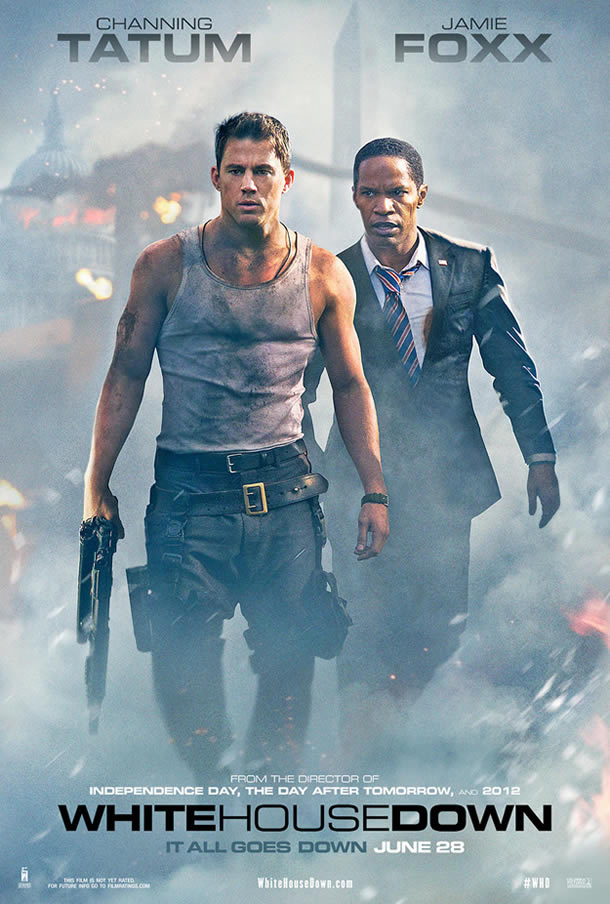 Director Roland Emmerich, the maestro of the dumb fun blockbuster, is never going to get the credit he deserves but the man is something of a mad genius when it comes to putting together spectacle-rich, low-calorie but still satisfying summer entertainment. Take White House Down, the second of 2013’s Die-Hard-in-the-White-House movies. It’s really more of a buddy film contained to that famous structure. It’s not a smart blockbuster by any means but it makes up for any and all flaws with its sheer overpowering sense of fun. Stuff gets blown up real good, the action is brisk, and there are satisfying payoffs for story elements that felt like they were, at first glance, merely thrown together. You may walk away surprised at how much you’re enjoying the comedic interplay between Secret Service agent Channing Tatum and president Jamie Foxx. Plus it’s fun to see the president in on the action instead of merely as a hostage, like the earlier Olympus Has Fallen. In direct comparison, I’d have to say White House Down is the better of the two movies, both in payoff and action. It’s nice to have a movie that’s just fun to watch, that goes about its blockbuster business with precision, supplying a few decent twists, and giving us heroes worth rooting for and action sequences that are well developed and that matter no matter how ridiculous. Emmerich movies are blissfully free of self-serious malarkey, though his weakest hit, 2004’s Day After Tomorrow, got a bit preachy. His movies know what they are and know the demands of an audience. What I needed this summer was a movie designed to make me cheer the impossible. White House Down is a romp.
Nate’s Grade: B+
Share this:

Magic Mike (2012)
 After all the hype and the derision from my friends, I finally saw Steven Soderbergh’s male stripper opus Magic Mike, and it does not pain me to say, as a red-blooded heterosexual male, that I found it mostly enjoyable. I understand the detractors, many of whom were let down by the relentless, frothing hype generating the film’s box-office success. The characters are fairly shallow, and almost all of the supporting players are one-dimensional; many of the male strippers only have their abs and a name to work with as far as characterization. There’s also the general absurd nature of the world of male stripping, where women are whipped into a frenzy and men almost comically gyrate atop them, or in some instances, literally pick them in the air to swing their junk into. The last act also rushes all sorts of storylines: the rookie’s fall from grace, Mike (Channing Tatum) coming to the realization to leave the business, a hastily thrown together romance. With all that said, I was always interested in just watching the ins and outs of this profession put on screen. And when the plot falters, there are always the impossible charms of Tatum to bring me back. Matthew McConaughey is also fascinating to watch as a mixture of showman, zen artist, and sexual being. I even found the dance/stripping sequences to be worthwhile as few insights into the various characters. While being less than magical, Magic Mike’s shortcomings don’t take away from what it has to offer. That may be the most unintended inuenduous statement I’ve ever written for a film review.
Nate’s Grade: B-
Share this:

Side Effects (2013)
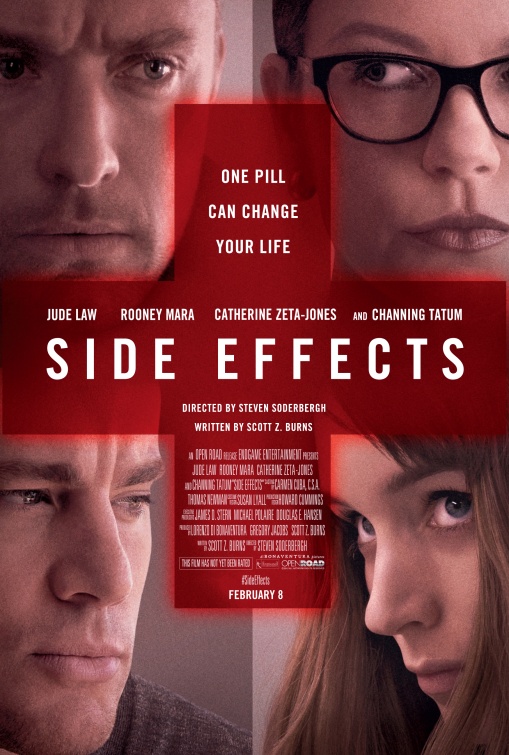 Steven Soderbergh’s supposed last stop before retirement is another of his genre exercises, but Side Effects feels like a firmer success, albeit modest, for the director to go out on. It’s the story of a woman battling depression, played with terrific cageyness by Rooney Mara (The Girl with the Dragon Tattoo). She gets prescribed a new drug and… does some very bad things. Who is culpable? The doctor, being funded by the drug companies? The woman who was sleepwalking at the time? The industry for blanketing patients with ads to demand their drug? After a rather slow start, the movie gets interesting and starts to try out different genres like hats. It appears for a good while we’re now going to be following her doctor (Jude Law) and his downfall as the industry turns on him and the media coverage intensifies. Written by Scott Z. Burns (Contagion), the movie has that same enticing sense of realism about how all the moving parts of a complicated industry would come into sync and conflict. Then the film tries out another identity, that of traditional thriller, with wronged parties orchestrating vengeance. I was invested until the end and felt sufficiently satisfied with the end results. Soderbergh’s smooth camerawork and cool color palate are well suited for a film about the battles of depression, and for a good while, before the thriller aspects take over, the movie is a fairly mature look at the struggles of depression and the industry that profits off it. Side Effects doesn’t seem like a closing statement for an artist as varied and unpredictable as Soderbergh, but as far as a Saturday afternoon goes, it’ll sure pass the time nicely.
Nate’s Grade: B
Share this:

21 Jump Street (2012)
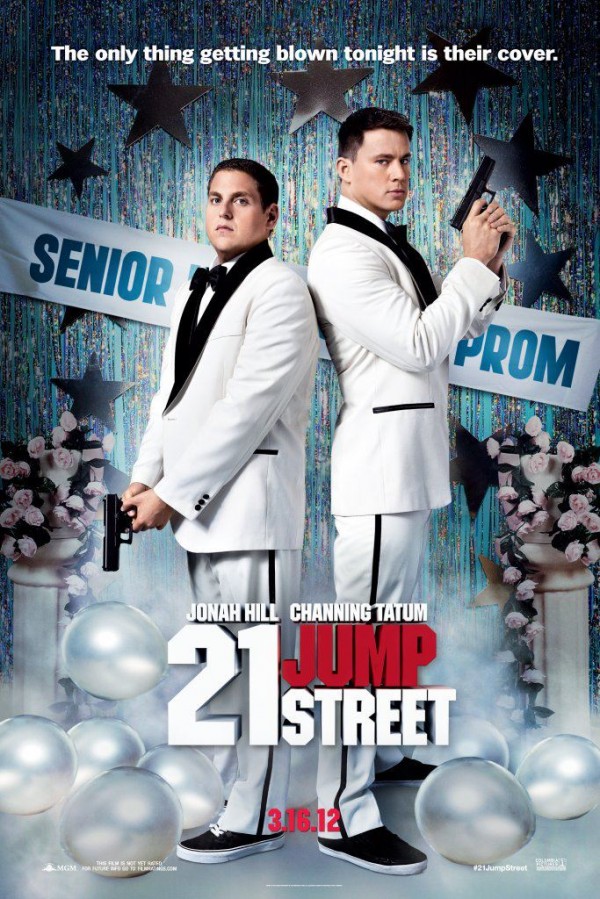 21 Jump Street ran on TV from 1987-1991 and is mainly known as serving as a launching pad for eventual mega movie star Johnny Depp… and Richard Greico too. Youthful looking police officers infiltrated high schools and tackled topical issues of the day (what snap bracelet goes best with my high-waisted jeans?). Why would anyone want to make this movie, let alone comic actor Jonah Hill? Surprising in just about every way, especially when it comes to overall quality, the 21 Jump Street movie is not just a great comedy but also a great movie. How the hell did this happen, Movie Gods?
Officer Schmidt (Hill) is smart but shrimpy (which is saying something considering how dangerous Hill’s weight has been before). Officer Jenko (Channing Tatum) is a stud but pretty dimwitted when it comes to tests. The two form a partnership and get assigned as bicycle cops, not exactly the position of command and authority they were expecting. After a few screw-ups, including failing to read a suspect his Miranda rights (“You… have the right… to be an attorney”), the duo gets bounced to an old undercover program at, you guessed it, 21 Jump Street. The pair is supposed to pose as high school students and find out who’s supplying teenagers a dangerous new club drug. Much has changed since Schmidt and Jenko were in high school together, and both of their profiles were accidentally swapped, meaning Jenko is given AP chemistry and the higher level classes, and Schmidt is given gym and acting courses, where he’s supposed to work his way into the popular circles. Molly (Brie Larson) is a gal in that popular inner circle and Schmidt struggles to accept that a pretty, smart, popular girl might actually “like like” him.
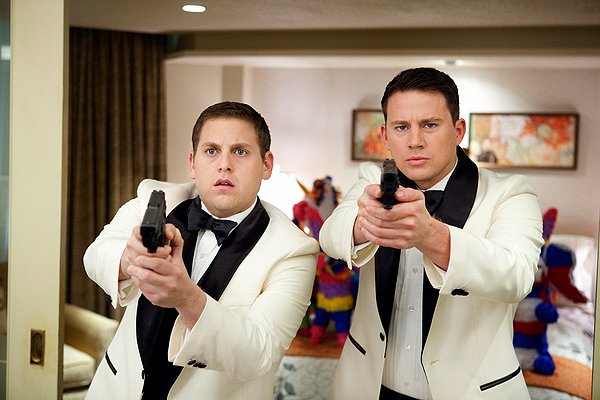 I knew I was in for something special when the movie itself lambastes the very idea of a 21 Jump Street movie, with the police chief (Parks and Recreation’s Nick Offerman) ridiculing the idea of unoriginal nitwits recycling something old that has name recognition and hoping the public will be too dumb to care. The movie beats the audience to the punch every time, mocking the absurdity of its own premise and plot points (many characters note how old Jenko appears). I should have expected more from screenwriter Michael Bacall (co-writer of the Scott Pilgrim movie adaptation) and especially from directors Phil Lord and Chris Hill, the same pair whose rambunctious comedic verve radiated from every frame of Cloudy with a Chance of Meatballs and their brilliant short-lived animated MTV show, Clone High. This movie had me laughing a lot and had me laughing hard, doubling over, with-tears-in-my-eyes laughter at points. Dickson spouts, “Some kid overdoses on drugs. And because he’s white, people actually give a shit,” showing that a movie with a mind-blowing number of male genitalia jokes can provide a few shrewd jabs of social commentary. There’s a great bit where on their first day back in school, Jenko points out the various school cliques. Then he gets to a group of students in skinny jeans, thrift store clothes, and floppy hats, and he looks puzzled. “I don’t know what those kids are?” Ha, because hipsters didn’t exist back in his (my) day.
21 Jump Street is cheeky, rowdy, quick-witted and playful in the best sense of an action comedy. It’s got fish-out-of-water moments as the duo struggle to fit in with a different high school setting. The one-liners and riffs can be gut-busters, but the film does an even better job layering oddball gags (Korean Jesus), loony slapstick, fun but telling character moments (Schmidt not knowing how to end a prayer: “The end, right? ‘The end’?”), strong setups that have stronger payoffs (using the reading of Miranda rights as a genuine emotional climax), and an overall raucous, anarchic spirit.
Here’s one sequence in particular that shows off the film’s clever comedic chops. The film finds a way to satirize the tropes of action movies, particularly buddy cop movies, with such nimble precision. Schmidt and Jenko are on the run but their car chase keeps butting heads with the fabricated reality of Hollywood movie chases. For one, they keep finding themselves getting stuck in traffic on the highway. This forces them to have to keep abandoning cars and finding a new set of wheels ahead of the gridlock. Then, as the bad guys chase them down on motorcycles, the chase causes all sorts of chaotic collateral damage, including oil trucks riddled with bullet holes and dripping the flammable substance all over the road. Then one of the motorcycles skids into the flammable muck, and our heroes wince in preparation of the expected explosion, and then nothing happens. “Huh. I really thought that was going to explode,” one of them remarks casually. And this setup is repeated again, denying us the explosive equation that action movies have pummeled into our brains (car + any tap of force = humungous fireball), and there is a payoff to this comedic tweak on the cliché, and it is silly and terrifically funny. Plus, I haven’t even mentioned that both Schmidt and Jenko are dressed in silly outfits and begin their car chase in a driver’s ed car. This sequence is just one example of the anarchic, robust, and self-aware comedic attitude that the movie flaunts.
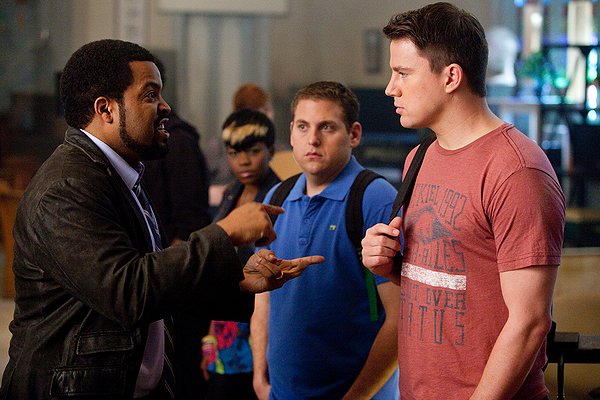 But more than being a hysterical action picture, 21 Jump Street works even better because at its core is a level of sweetness, a satisfying mixture of lewd and heart like the best Judd Apatow ventures. It’s a bromance of epic proportions even by buddy cop standards, the old school bromance vehicle of its day. The guys go back to high school and the movie’s bright switcheroo puts the characters in opposite social spheres, with Schmidt with the cool kids and Jenko struggling with the social misfits and bottom-dwellers, a.k.a. nerds. Of course the whole class assignment also shows the façade of being cool in high school. The movie could have mined this well-worn stereotypical class conflict with ease, but instead it decides to use its contrived scenario as a jumpstart for the guy’s emotional growth. The lessons may be simplistic (perils of ego, believe in yourself, teamwork, personal responsibility) but that doesn’t make them bad lessons, and the fact that the flick seriously uses covalent bonds as a metaphor, and does so in an almost poignant fashion, is worth applauding. The relationship between Schmidt and Jenko engages the audience, and we root for them even when they’re behaving like jerks. They’re misfits who are doubted and reprimanded, which make us hope for their eventual success even more. Refreshingly, the movie doesn’t put them in opposing camps in high school. Schmidt was a dweeb and Jenko was a dumb jock, but that doesn’t mean they needed to be adversarial. When they regroup in the police academy, they form a genuine partnership, realizing they can assist one another. They form an actual friendship and they’re both better cops, and better characters, together.
Hill and Tatum have preposterously good chemistry together as a comic duo. Hill, a co-writer himself, reportedly had to remain steadfast to convince Tatum to join forces, and thank god he stuck it out. Hill’s (Moneyball) already a comic pro at this point, though this role tones down his comical rancor and ups the spaz awkwardness. Tatum (The Vow) is the true revelation. Man does this guy have really great comedic skills; a sharp, instinctive sense of timing, a pliable physicality, and a genial charisma that doesn’t demand solo attention. He’s good at playing dumb without going overboard. He’s not just good, he’s flat-out terrific. Larson (Scott Pilgrim vs. the World) is an adorable and plucky love interest, sure of herself, down to earth, and accessibly quirky. The supporting cast shines in their small roles, notable Ice Cube (Lottery Ticket) as the typical brash and loud police captain, Ellie Kemper (Bridesmaids), in her randiest roll yet, as a chemistry teacher awkwardly flirting with the hunky Jenko, Dave Franco (Fright Night) as an eco-friendly drug dealer, Rob Riggle (The Other Guys) as an aggressive gym teacher, and a special cameo that’s worth leaving unspoiled.
21 Jump Street has some weaker points, namely when the action ramps up it’s pretty mundane when it’s not being funny, but the faults are minor. This is a silly, shrewd, salacious, and outright thrill of giddy entertainment, a comic blast. Hill and Tatum have a wonderful comedic dynamic and the clever screenplay gives them plenty to do with their talents. I didn’t think it was possible to adapt the cheesy TV show into a worthwhile studio comedy, but Hill and company have exceeded every expectation. 21 Jump Street isn’t the most nuanced or subtle comedy, though I will argue spiritedly that it has plenty of smarts in all the right places, but it’s an affectionate, witty, and rambunctious night out at the movies that will be hard to beat this spring.
Nate’s Grade: A-
Share this:

The Eagle (2011)
 In 140 AD, the Roman Empire has spread its reach across the European continent. Commander Marcus Aquila (Channing Tatum) is stationed in northern Britain. 20 years earlier, Marcus’ father led a legion of Romans into the northern British territory. The natives attacked them and Rome’s golden eagle, a significant idol under the guidance of Marcus Senior, was lost to history. Marcus has endured shame and vowed to redeem his family name. After surviving a nightly attack at the fort, Marcus displays great bravery but is injured. He’s honorably discharged from the Roman military. While he regains his strength, Marcus plans on venturing into the northern British highlands and finding that missing eagle. He teams up with Esca (Jamie Bell), a slave whose life he saved, and the duo goes beyond the wall that separates civilization (Rome) for the wilderness (native Britons).
Too often The Eagle feels like its wings were clipped. With such life and death stakes, the movie feels curiously adrift and prosaic. It never feels like it has any rush to go anywhere. In some regard, that makes the film feel like a product of the Hollywood of old, where a plot was allowed to meander and marinate to build to something worthwhile. But The Eagle is hardly worthwhile. It begins with some amount of excitement but that quickly dissipates with an interminable middle that feels like it’s still going on even as I write this. The plot is far too lean to cover a wide canvas, and the characters are far too shallow and incurious. They say so little, and what they do say means so little. It’s general variations on the idea of honor and sacrifice. They’re just focused on retrieving the prize. Meaningful conversation would just get in the way of things. The character dynamics between Marcus and Esca is stilted and kept at a distance. The class struggle and history of foreign occupation is never really addressed beyond a superficial nod. It’s like being stuck with two boring guys on a long, uninteresting road trip. Director Kevin Macdonald (State of Play, Last King of Scotland) gives the proceedings a docudrama touch thanks to his background in nonfiction films; too often this means he goes on half-baked Terrence Malick-like asides to admire a grain of wheat or some old artifact. The docudrama approach seems to conflict with the relatively old fashioned feel for this film, like Macdonald is trying to do his best to lift up material in want. There’s just so little at the core of this movie.
 Tatum (G.I. Joe, Step Up) tries some form of an accent, though I’m not exactly sure what region of the Roman Empire the man is hailing from. He still has an imposing presence that manages to fill in the gaps of his acting ability, much in classic Hollywood tradition. And yet the man seemed more masculine in a Nicholas Sparks movie from last year. Bell (King Kong, Jumper) takes his haunted, submissive character to heart and gives a performance that confuses submission with understatement. He main mode of acting is the power of serious staring. The two actors don’t ever develop any onscreen sense of camaraderie or warmth. Even during the climax, you never feel like these guys have anything more than a civil employer/employee relationship. That’s why the laugh-out-loud, tonally jarring ending seems so out of place. Instead, Marcus and Esca strut through the halls of Rome, music triumphantly rocking out, and says, “What do you want to do now?” like they’re lining up weekly wacky adventures to be had. You’ll be surprised to see actors like Donald Sutherland, Mark Strong, Denis O’Hare, and even A Prophet‘s Tahar Rahim littered among the cast. Why are they in this movie when they have such insignificant parts compared to their bland leads?
The colonial perspective also started rubbing me the wrong way. Now colonial tales have long been featured in pop culture. I don’t on the surface have an issue with a storyteller utilizing a massive horde of natives to stand in as an antagonistic force. But sometimes that dynamic creates a skewed rather culturally tactless portrayal. Are the overpowered, conquering empires always blameless? Do the natives, who have been displaced and killed, not have a respectable grievance? Do they not have a right to fight for the lands that have been taken? Too often, the natives are viewed as blunt brutes (just watch the “cowboys and Indian” pictures from the 1950s) and the figures of expansion are viewed as heroic pioneers. The Britons come across as, essentially, the Indians. The filmmakers always want us to side with our hunky hero Marcus and his quest for honor at every turn, but the movie takes great turns to make the natives seem extra villainous. For a while they just come across like another culture. They have community, customs, and the like; it’s just not the dominant culture’s community and customs. And then, in an appalling moment of cheap melodrama, the Briton chief kills a child to send a message to Marcus and his Romans. This material is handled so indelicately that an unsettling undercurrent emerges and gains steady traction.
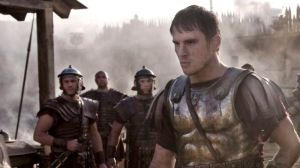 So what if the Britons stole one gold eagle 20 years ago? “It’s not just a piece of metal. The eagle is Rome,” we are reminded by Marcus. Symbols are great, but a one-man search in a land as large as Scotland seems impractical so many years hence. And then you have to take into account the time passage. It’s been two decades seen this beloved bauble went M.I.A., and damn near anything could have happened to it. It could have been thrown into the ocean. It could have been buried. It could have been smashed to smithereens. It could have been taken to another land. It could have been melted down into smaller, gift-shop sized eagles on sale to the general public. I’m just saying that in the ensuing 20 years anything could have happened to this bird. The fact that one guy can traipse on foot through Scotland and the first group of natives he runs into happen to possess the artifact that went missing 20 years prior is just insulting. First chance and he lucks in? I was eagerly waiting for an ending where Marcus, brimming with pride at having returned the eagle to Rome, is informed by one of the politicians that it’s the wrong eagle (“Here we go again!”).
The Eagle is dressed up to be an old time adventure story, but it’s just too slovenly paced and generically plotted to work. The lead characters are bland, distant, and noble to the point of annoyance. When a character is defined entirely as forward thinking, exceptionally lucky, ethically straight figure of honor, excuse me when I start to yawn. And when all he’s tasked with is finding an old relic that miraculously happens to be with the first freaking group of people he finds, then excuse me for eyeing my watch. The Eagle has some workmanlike action and suspense to it, brief moments of activity over what is in essence two hours of silent walking (it’s like somebody cut out the middle of a Lord of the Rings movie and sold it). The Eagle, both the film and the titular hunk of metal, are simply not worth the effort.
Nate’s Grade: C
Share this:

Dear John (2010)
 Best-selling author Nicholas Sparks is probably a perfectly reasonable human being. I’m sure he’s great at parties and that people love him. He may even have a dynamite recipe for sugar cookies. But I don’t know what happened to Sparks to turn him into the romance genre’s angel of death. His novels have followed a familiar practice of big Third Act deaths that usually deny readers their cherished happy endings. Is the motive to push people to make the most of our preciously little time spent on Earth? Is Sparks just sadistic and has found the secret to eternal life — the tears of millions of housewives and teenager girls. Whatever his rationale, another commonality for Sparks is that the film adaptations of his books are pretty corny and dreadful. A Walk to Remember, Nights in Rodanthe, Message in a Bottle; all about romance ultimately denied, none coming close to watchable. Dear John can at least be called watchable; however, watching should be limited to the confines of your living room TV when there’s nothing else on.
It’s the spring of 2001, and John Tyree (Channing Tatum) is enjoying his two-week leave from the military. He’s out surfing the fine North Carolina beaches when he rescues the handbag of Savannah (Amanda Seyfried) from being washed away. They two of them casually chat and soon those chats lead to barbecue invitations, parental visits, and kisses in the rain (a romantic movie tradition). Savannah takes an interest in John’s eccentric father (Richard Jenkins) because she recognizes his condition as autism. She’s been helping to watch her neighbor’s autistic child. Savannah would like to start her own horse camp for the autistic (sounds like an insurance nightmare). Life seems so full of promise and John promises to be back as soon as his military commitment expires in six months. Then 9/11 happens. John re-enlists and extends his tour another two years. This places great strain on his relationship with Savannah, but they write each other countless letters that manage to find John no matter what far-flung village he’s stationed at. Can their love exists on a series of hand-written letters? Well, look no further than the classic implications from the film’s title.
 Dear John goes through all the traditional Nicholas Sparks waterworks trademarks: young love leads to yearning, which leads to heartbreak, which leads to more yearning, which then inevitably leads toward one of the leads dying and everyone learning some sort of shallow profound meaning about life, blah blah blah. There are plenty of heightened melodramatic elements thrown into a fairly traditional, unspectacular love story, but all potent potential moments of drama feel underwhelming pretty much because the audience doesn’t care. John and Savannah are perfectly nice people and their love has that hopeful bloom, but their relationship is no more involving than watching a pretend couple in a commercial for greeting cards or life insurance. These people are vanilla. It makes it astounding, then, that such highly charged elements like cancer autism, and 9/11 fail to leave any impact. Dear John confuses listing dramatic events as drama itself. The dramatic stakes feel entirely too mellow and the film generally has a detached feeling, like it’s purposely distanced from the material for fear of getting too involved. This is a relationship movie that has its own commitment issues.
The military angle is respectfully explored, though not in much depth. John is torn apart by the pull of returning to his beloved but also of serving his country and, more personally, keeping his band of brothers in arms together. It’s a complicated scenario but the military commitment is another item in a list that should grab your interest but fail to do so. 9/11 isn’t given any deeper consideration other than the fact that it serves as a roadblock between our two lovebirds. If you want to see a more nuanced, complicated, and empathetic view of today’s overburdened military, check out the movie Stop-Loss, which also stars Tatum.
 The film drops any facade of being a romantic drama about midway through when Seyfried gets completely sidelined. She’s less a character and more an agreeable plot device; she’s self-aware and kind and knowing and receptive yet also naive. This makes her sudden character shift rather jarring, which seemingly paints Savannah as extremely co-dependant. Dear John then transforms into a serviceable father/son drama. There are some nice and moving moments between John and his father; this should have been the real focal point of the movie. Jenkins acts circles around everybody in this movie. It’s wonderful seeing a grown-up in these kind of movies show the kids ho this acting thing is done. Tatum actually might become a pretty good actor. He convincingly plays the more emotional moments well. He may very well prove to be the Patrick Swayze of his generation. Tatum can dance (Step Up), make the girls cry, and also handle some rock-socking action (G.I. Joe, Fighting, most of Tatum’s other movies). I think there’s an actor buried beneath that daunting physique waiting to blossom. Don’t disappoint me, Channing.
Dear John is a formulaic romance trained to seek pre-programmed audience responses (“Now you will laugh. Now you will cry. Now you will cry again. Now you will once again continue to cry…”). Lasse Halstrom (What’s Eating Gilbert Grape, Cassanova) directed this movie but you’d never be able to notice. I don’t want to be too harsh on the film because the acting is pleasant the story isn’t repulsive and does have some good moments, but mostly the movie comes across as bland and remote. The romance seems absent a beating heart to keep things moving. It’s all too lifeless. The character of Savannah best summarizes Dear John as a whole: mild pretense of wisdom, pretty to look at, genial, but fairly bland and difficult to convince is worth your valuable time.
Nate’s Grade: C
Share this:

G.I. Joe: Rise of Cobra (2009)
 While plenty stupid, the big-budget G.I. Joe movie is actually passably entertaining. Sure the characters are one-note, the motivations and romances are strained, the acting is abysmal, Dennis Quaid looks to be in particular pain, the plot has too many unneeded flashbacks, the special effects are cheesy, and the movie is crammed with deliberate toy merchandizing connections, but I had fun with this flick. Director Stephen Sommers (The Mummy) works the right kind of stupid, the loud noisy kind that manages to tickle a childlike sense of glee like watching an eight-year-old’s imagination blown up on screen. The scale of weapons and special vehicles and special suits and special ladies in special leather outfits for engaging in criminal activity should delight younger film goers. The action is frenetic (if there is a pane of glass within 100 miles, the movie assures that you will see it shatter) and the international collateral damage is colossal, so much so that G.I. Joe almost comes across as a goofy, straight-laced version of Team America. Certainly the benefactor of rock-bottom expectations, G.I. Joe: Rise of Cobra is a brash blast of acceptable action movie stupidity. Grab a big bag of popcorn, shut off your brain, and enjoy the film’s cartoonish yet entertaining qualities.
Nate’s Grade: C+
Share this:

Public Enemies (2009)
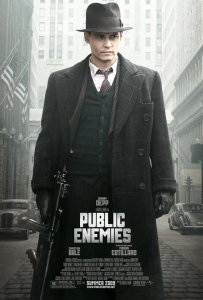 Considering the talent in front of and behind the camera, it’s hard not to describe Public Enemies as anything but a letdown. This Depression-era gangster film is heavy on period details and very tight-fisted when it comes to characterization. You’d think given 140 minutes and the natural charisma of Johnny Depp that an audience would come to some kind of understanding with notorious bank robber John Dillinger. Nope. The characters remain perfunctory the entire time, pushed into conflicts by a brisk pace that manages to squeeze in three bank robberies, two prison breaks, and many police shootouts. Because the movie barely takes time to breathe, the love story between Dillinger and Billie Frechette (Oscar-winner Marion Cotillard, a dead ringer for pop singer Katy Perry) is never credible, the tension never feels palpable, and director Michael Mann (Heat, Collateral) seems overly smitten with his distracting high def digital photography. You never really feel any sense of danger or interest. The characters on screen feel like strangers even after 140 minutes. Depp makes the movie more tolerable than it would be without his presence. Mann, one of three credited screenwriters, seems to assume the audience is well versed in Dillinger history and so he skips over plenty of fertile territory. Public Enemies certainly hums with plenty of polish but it comes across as mostly mundane due to such flimsy character work. It’s a collection of good scenes that fail to make up a satisfying whole.
Nate’s Grade: B-


 nathanzoebl
You must be logged in to post a comment.