Blog Archives
Hit and Run (2012)
 Hit and Run was a labor of love for actor Dax Shephard (TV’s Parenthood). He wrote the script, co-directed the film, did plenty of his own car stunts, edited the film, and got his longtime girlfriend, the irascible Kristen Bell (Forgetting Sarah Marshall) to co-star as his love interest. I just wish the movie were better. It’s something of a strange mix, a road chase that zips along to loping comedic rhythms, spending as much time having characters engage in self-aware conversations about a variety of topics. It’s like a rom-com with car chases. Shepard and Bell are terrific together and have a natural comedic chemistry to them, an ease that befits both of their acting styles. Then there’s some of the more troubling comedic moments, like when the villainous Bradley Cooper (The Hangover) literally ties a leash around a black man and forces him to eat dog food. It’s one uncomfortable scene to watch. Then there are sudden bursts of violence and nudity, to go along with the bizarre conversational tangents. The plot is a loose collection of near-misses and digressive asides. It wants to be one of those 70s car chase comedies, something along the likes of a raunchier Smokey and the Bandit. This movie does keep you guessing, but it rarely adds up to anything worth all the trouble. Car enthusiasts will probably enjoy all the vehicular eye candy, and I’m happy to see Bell tackle a meatier role than she seems to be offered at this time, but I can’t work up more than a half-hearted shrug for Hit and Run. It looks good but just has nowhere to go.
Nate’s Grade: C+
Share this:

Fast Five (2011)
 The fifth movie in the gearhead Fast and the Furious series unapologetically eschews logic and physics to deliver an energetic, over-the-top, stupidly entertaining action movie. This thing’s got swagger to spare. Credit Justin Lin, director of the last three films in the series, who has a tremendous knack for orchestrating mass chaos into eye-catching sequences. The plot is practically inconsequential but involves Vin Diesel and his team planning an Ocean’s 11 style heist against an evil Rio de Janeiro crime lord. Diesel, that black hole of charisma, sticks to what he’s good at: grunts and glares. It was a smart move to introduce The Rock as a dogged DEA agent. His added brashness and command of cool gives the series a boost in star power. The final act of this film is an exceptional chase sequence where Diesel’s crew drags a large bank vault through the streets of Rio, destroying just about every car in sight. The stunt work is phenomenal and the special effects feel seamless, never ripping the viewer out of this hyperactive, preposterous reality. Sure, it can get bogged down in its teenage horndog worship of hot cars and hot gals (Rio is in no short supply of physically ample women), but Fast Five delivers in spades when it comes to junky popcorn thrills. I can’t believe I’d ever write these words, but I’m actually looking forward to more Fast and the Furious hijinks. Just as long as Lin and The Rock return.
Nate’s Grade: B+
Share this:

Senna (2011)
 I have never been a fan of racing of any sorts, be it horse or NASCAR or Formula One, the subject of the biographical documentary, Senna. So naturally I never felt like I’d been interested in a documentary about Ayrto Senna, the brilliant Brazilian driver who was the head of the pack. I was wrong. Even non-fans like myself can get enjoy Senna, a lean doc that doesn’t waste a second. In fact, never do talking heads, interviews, or reenactments enter the frame. The movie is completely made up of archival footage, some of it astonishing like Senna’s dashboard recordings that immerse you into his world of speed. The vintage race footage is thrilling. The film ably portrays the driver’s life, his passion, his controversies with league officials who disliked the young man’s style, his competition with rivals, and his impact on the sport. Here’s an instance where being completely ignorant of the subject and its sport will come in handy, since you don’t know what befalls Senna, though most will be able to pick up the ominous tones and markings of tragedy. This is a doc that just flies by with skill, precision, and enthusiasm, much like its charismatic and confounding subject.
Nate’s Grade: B+
Share this:

Drive (2011)
 Driver (Ryan Gosling) is a Hollywood stunt driver who has a lucrative side-project. For the right price, he can be hired as a personal driver. He gives the client a five-minute window. Whatever happens in that window, he’s their driver no matter what. Miss it and he’s gone. As you can imagine, this kind of job offer is mostly filled with getaway driving duties. Driver takes an interest in his apartment neighbor, Irene (Carey Mulligan), a young mother. Her husband (Oscar Isaac) has just been released from prison and already feeling heat to pay his debts. He gets winds of a pawnshop holding a million in cash. Driver offers his services to square the guy’s debt and to keep Irene and her son safe. But of course things go wrong, as they tend to in these sorts of pictures, and Driver is left with a sack of money and two very angry gangsters. Nino (Ron Perlman) and Bernie (Albert Brooks) would like the money back and to eliminate the number of people that know about their involvement in this scheme.
Drive is being sold as one kind of movie, a high-octane action thriller with plenty of car chases, when it’s really a European art-thriller paying fawning homage to those kinds of movies. That means that Drive plays out much more placidly and contemplatively with sudden bursts of gruesome violence. My audience seemed to grow restless with the purposely plaintive pacing so when the violence exploded they would laugh or cheer, happy that something of conventional entertainment value was finally occurring. I was growing restless myself, not with the infrequent appearances of genre action or the artistic flourishes, but just with the prevalent pauses. Danish director Nicolas Winding Refn (Bronson) will have his camera hold onto a scene for several seconds longer than what feels necessary, or he’ll shoot dialogue between actors and Gosling will pause a full 20 seconds before answering. I understand that Refn is establishing a stoic loner akin to Clint Eastwood’s celebrated stable of strong silent types, a modern American cowboy. I’m sure that you could cut 10 minutes of out the film just from snipping these extended pauses and overlong shots, moments that seem to be filling time and giving the audience an opportunity to step outside the movie. I doubt that was ever the intent but it’s certainly the effect. When a scene or camera shot holds on longer than it should, we can feel it, and when it keeps going we start to wonder why, and when an answer is absent then we start to snicker or second-guess the artistic choices. I’m sure audiences that watched Drive will probably be scratching their heads wondering why there isn’t more, well, driving.
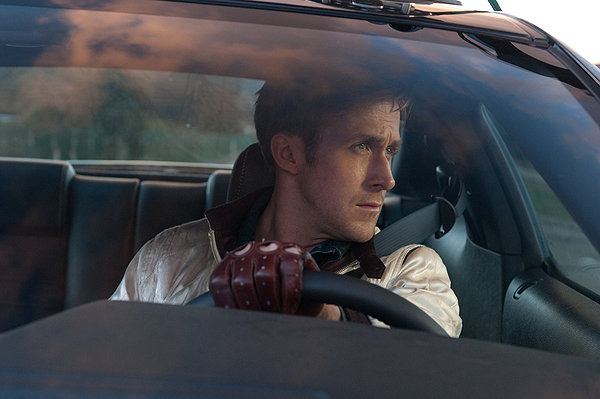 The action that does appear onscreen is extremely well choreographed. The car chases thrill and the edits allow for full audience orientation. You know what’s happening and you know what’s at stake. And we care. A car chase after a botched robbery is particularly exciting when Driver starts driving backwards to block his opponent’s view of the road. The opening chase sequence is notably almost an anti-car chase. Driver is listening to a police radio and choosing when to duck around side streets and wait out the patrolling cop cars. The tension isn’t watching one car chase another, it’s watching one car idly sneak away. What I’ve described, however, is about all the movie offers for car action, though Driver does ram one motorist off a ravine later.
You can tell Refn is a fan of Hollywood genre films, and Drive takes typical thriller tropes and puts them through an art-house prism, bringing a near Kubrickian level of beauty to the violence. Drive is a gorgeous movie to watch; the shot selections, the chiaroscuro lighting, the use of the 80s style Euro-synth score by Cliff Martinez (Traffic, Contagion), it all coalesces into a near hypnotic blend of visual and sound. It’s a beatific landscape even when horrible things are going on. There’s a sequence where Driver, Irene, and one of Nino’s thugs are in an elevator together. Driver notes the imminent danger and slowly motions Irene behind him. He then turns and kisses her, and while he does this the elevator lighting seems to brighten and darken, like it too is being charged through the power of a kiss. And then Driver sharply pivots, blocking the thug’s attack, knocks the guy to the ground and stomps on his head until it bursts. The looming violence is teased through slow motion, and then it hits with the power of a crescendo. The violence is always looming, always seeming to be just on the cusp of an explosion. But under Refn’s direction, the movie fulfills that audience bloodlust in unexpected ways. Instead of a big fight, Driver casually drowns one of the toughs in the surf of a beach. Instead of a brutal elimination, Bernie dispatches someone with what can almost be described as compassion, slitting a major artery and whispering, “It’s done. It’s all over. There’s no pain. Just let it happen.” Even the big showdown between Driver and Bernie plays out with flash-forward edits, giving the meeting an extra level of gravitas knowing what awaits when they leave the table.
Refn has created a beautiful movie, it’s just that it has so much empty space pretending to be nuance. And that’s the rub. I appreciate an art-house sensibilities elevating and celebrating classic American genre pictures. I though Joe Wright did an excellent job of this with Hanna earlier this year. However, Refn shortchanges his actors. The script by Hossein Amini (The Four Feathers) is light when it comes to character detail. Again, this might be because Refn wishes to make a statement on genre films by having his movie populated with genre types and sticking to this limited route of characterization. Whatever the rationale, it makes for some pretty elusive one-note characters. Irene is less a character than a symbol of innocence. It doesn’t help matters that Mulligan has little chemistry with Gosling. Nino and Bernie are interesting characters who have such unspoken histories. They’re mid-level criminals stationed out of a cheap pizza joint in a strip mall. Nino is tired of the criminal higher-ups always disrespecting him. Bernie used to be a movie producer in the 80s, and may have bankrolled something like Drive. He hates getting his hands dirty but he shows an eerie talent for violence. These small glimpses are hints at something more, but that is all Hossein and Refn leave us with.
 Gosling (Crazy, Stupid, Love) has very little to say in the film. He probably only ever speaks 80 words, but brevity does not mean he’s just sitting around. Gosling goes for understated in a genre known for histrionics. He plays things very close, a taciturn mystery man. The existential drifter. Gosling sure knows how to hone his flinty stares. Mulligan (An Education) gets very little to do in the film, so it’s another round of her crinkling her pretty face and blinking those glassy eyes. Christina Hendricks (TV’s Mad Men) also appears as a third wheel on the pawnshop scam. The real surprise is Brooks (The Muse). The famous comedian is shockingly believable as somebody you don’t want to cross. Even when he’s trying to be cordial there’s a veil of menace. If only there was more to his role. I would have loved to see him regrettably step back into his past, taking care of business with ruthless yet disdainful efficiency.
Drive is an action thriller that’s more a Euro-infused commentary on the genre. Fans of Hollywood action will likely be put off by the elusive characters, the sluggish pacing with numerous pauses, and the overall art-house nature of the finished product. Refn’s movie is beautiful to watch, with intricate precision taken to making the imagery and sound design mesmerize. If only that same level of care was paid to character and plot. We’re dropped into this criminal scenario and left to flesh out the characters given the hints and nods we accumulate in 100 minutes. I don’t need to be spoon-fed but I’d like my movie to have better attention to character than ambiance. Drive is a beautiful looking vehicle that just doesn’t have any particular place to go.
Nate’s Grade: B
Share this:

Cars 2 (2011)
 Universally regarded as the least involving and nuanced film in Pixar’s illustrious catalog, Cars was the last film I thought would get the sequel treatment. Was it a creative tale that yearned to be told on the big screen, or is this just a business decision motivated by the sound of merchandizing coffers? Those talking cars seemed pretty content by the end of the 2006 original film. It doesn’t take long to realize that Cars 2 was done strictly for the cash. A sequel to the least involving Pixar film, with an even less involving storyline and elevating the most annoying character (Mater the tow truck) to lead status provides little in the realm of adult entertainment. The storyline, a mistaken identity spy thriller, seems like a rejected plot for a lesser direct-to-DVD sequel. While the visuals are still outstanding, the humor is stuck in neutral, overloaded with motor vehicle puns and groan-worthy visual gags. The message about accepting your uncouth friends no matter what their bad behavior might be seems rather misguided. That’s the message? Congrats Pixar, for providing cover for irresponsibility and incivility. The environmental message and its connection to a Big Oil conspiracy feels tacked on as an afterthought to try and crowbar in something more meaningful than a mediocre spy farce. I think cars are rather limited in their anthropomorphic expressions. There’s only so much they can do. And a world populated completely by living, breathing, gas-guzzling (can they get drunk on ethanol?) vehicles begs for an examination on how this world operates without any opposable thumbs. After a magical slate of films that dealt with serious mature themes and danced with storytelling finesse, it’s a shame that daring run comes to an end with such a rudimentary roadblock. Little kids will be entertained by all the bright colors and simplistic storytelling, but I cannot foresee too many fans of Cars even justifying the sequel’s existence. It’s not out rightly bad it’s just so pitifully pedestrian. Cars 2 has so little going on under its hood, you’ll swear it came from a different maker.
Nate’s Grade: C+
Share this:

Drive Angry (2011)
 Without a hint of self-awareness, and not nearly enough tawdry camp, this exploitation throwback manages to be completely serious with a ridiculous plot and a celebration of muscle cars, gory violence, and women in hot pants. And yet for a film about Nicolas Cage literally escaping from Hell to save his baby granddaughter at the hands of a Satanic cult leader (Billy Burke), it’s awfully complicated. The plot is hard to nail down, rarely does it spell things out, which means the audience is left trying to piece together the scraps of logic in between fetishizing cars and violence. Amber Heard (The Informers) and her cut-off high-waisted jeans becomes Cage’s sidekick and she gets to hold her own. The 3-D elements are mostly distractions flying at the screen, the violence is extreme but with a distasteful nihilistic edge, and the tone lacks any traces of irony or appreciation of genre. There’s more potential here that never feels tapped, like Cage’s special “God-killer” gun that spooks even the Grim Reaper/Angel of Death (William Fichtner, having a blast). At one point, Cage is locked in coitus with an overly animated waitress, and he kills an onslaught of goons while still engaging in sex. While Shoot ’em Up did it too, it’s a sequence that hints at what the film could have been had it given in to more crazy impulses. Instead, Drive Angry isn’t nearly passionate enough to register as anything but a mundane retro, country-fried rehash of 1970s action movies.
Nate’s Grade: C
Share this:

Grindhouse (2007)
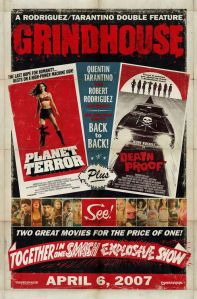 The movie going experience isn’t what it used to be, and Quentin Tarantino and Robert Rodriguez want to do something about it. There?s no denying that the joy of seeing a movie has been watered down a bit; there’s soaring ticket prices, floundering product, and let’s not forget the influx of teenagers with cell phones. Rodriguez and Tarantino grew up gorging upon the exploitation films at their neighborhood grindhouse, where they could see kung-fu, blaxploitation, gory Italian zombie movies, and nearly anything that promised to be titillating and shocking. These movies dealt in copious amounts of sex and violence on a shoestring budget and teenagers lapped it up. Grindhouse was designed to be a double feature with Rodriguez and Tarantino each writing and directing an 80-minute movie. This three-hour plus movie is stuffed to the gills with 70s reverence, right down to cheesy retro clips telling us the film rating via an animated cat. If Rodriguez and Tarantino could, they probably would make the floors stickier just to round out the experience. But that’s the marvelous thing about Grindhouse — it turns the filmgoing experience into an event once again.
First on the bill is Rodriguez’s Planet Terror. An outbreak is about to sweep across a small Texas town. A toxic green gas is causing people to break out in festering wounds that are spreading rapidly. Cherry Darling (Rose McGowan) is a go go dancer who runs into an old flame, Wray (Freddy Rodriguez), a badass drifter with a dark past. They get attacked by a group of “sickos” who take Cherry’s leg as a chew toy. At the hospital we’re introduced in rapid succession to Dr. Block (Mary Shelton) and her creepy husband (Josh Brolin) she plans on leaving for the lovingly massive cleavage of Fergie from the Black Eyed Peas (she gets eaten and can, one assumes, be described as being Fergilicious). The sheriff (Michael Biehn) has an unsettled score with Wray and refuses to trust him, even though the town is slowly being overrun by what appear to be zombies. The survivors take refuge at a Bar-B-Q joint, run by the sheriff’s brother J.T. (Jeff Fahey), located only two miles away from the military outpost that released the gas.
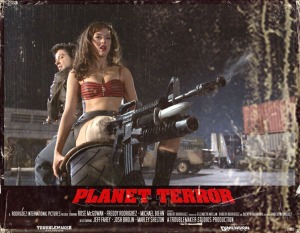 Planet Terror is a great blast of fun, a perfect ode to schlocky B-movies. Rodriguez creates action movies closer to cartoons, and the more over-the-top and crazy things get the more joyous his films generally turn out. This is a gonzo world cranked up to a wonderfully weird wavelength, where Cherry can have a machine gun leg without any nagging question on how she even gets it to fire let alone why it would be more accurate. It doesn’t matter because this movie is all about 80-minutes of awesome, twisted, gloriously gory fun. Planet Terror isn’t the first zombie comedy, and its inspirations are quite plain, but the film establishes a wide-range of colorful characters effectively and then ramps up the chaos. Rodriguez amuses with even small touches, like a woman trying to operate a car with a anesthetized hands, a pair of skimpy babysitters who clobber a car with baseball bats, and a bio-chemical scientist (Naveen Andrews) that has a penchant for collecting and bottling the testicles of the men who fail him (hey, we all need hobbies). Even amongst an exaggerated canvas there’s still plenty of humor and adoration for the grindhouse experience, like when the beginning of a sex scene is interrupted with a “reel missing” sign. Rodriguez also intentionally downgrades the look of his film, adding hairs and scratches and pops in the film to look like it had been dragged across the floor. Planet Terror even has a dreadfully dated synth score to compliment the full-tilt celebration of splattery schlock.
Tarantino’s Death Proof is going to sharply divide audiences. The action in Planet Terror is relentlessly paced, which makes the adjustment to Tarantino?s half all the more hard. Rodriguez is all about genre relevance and making a film that would excel in the grindhouse era; Tarantino, on the other hand, is all about taking the genre and catapulting it into something ambitious and different and greater.
 Death Proof is Tarantino’s take on the slasher horror genre, with the unique twist being that Tarantino?s roving killer takes out his prey with his car. Stuntman Mike (Kurt Russell) is a stuntman of the old guard. The youth of the day have no idea of the TV shows he worked on or the celebrities he rubbed elbows with. The only lasting visages he has from those removed days are a long scar decorating the side of his face and his stunt car. The vehicle has been outfitted to be death proof, meaning that Stuntman Mike can get into any wreck and come out alive. A group of women are visiting Tennessee for a film shoot. Abernathy (Rosario Dawson) is a makeup artist, Lee (Mary Elizabeth Winstead) is an actress, and Zoe Bell (herself) and Kim (Tracie Thoms) are professional stunt women. The stunt ladies are interested in test-driving a Dodge Charger, the same iconic car used in Vanishing Point. Zoe wants to play a dangerous game known as “Ship’s Mast,” which entails strapping herself to the hood of the car as it speeds along. This is when Stuntman Mike comes roaring with his death proof material and plays an extreme game of chicken.
The narrative structure of Death Proof is deliberately slow. The focus is on a group of Texas girls (including Sydney Poitier’s daughter named, rather unoriginally, Sydney Poitier). They dance to jukebox jams and drink. And they talk, and talk, and talk, and talk. The dialogue is clever but you worry Tarantino has been hypnotized by his own pithy writing. The movie drags a bit but mostly because it follows a film that had the pace of a runaway train. The slow buildup is an intentional correlation to slasher films, which would spend their first half hour setting up characters for the eventual slaughter. I liked how Stuntman Mike was seen playing with his prey and interacting with them. The wait is worth it, though, but then Tarantino turns around and repeats this same setup with a new batch of girls. Many will grow impatient going through the same process all over again and become irritated that they have to endure another round of talky pop culture diatribes in order to get to some more vehicular manslaughter. And at this point, the only character the audience has any affinity for is Stuntman Mike, so it’s a little tough to wait so long for his reappearance. When he does appear, the movie takes some unexpected turns and transforms into a female revenge thriller that left my audience cheering by its conclusion. My wife loved it. I married the right woman.
The makeup work is outstanding. Most of the effect work gets its spotlight during Rodriguez’s half, and Greg Nicotero and KNB have created the most gut churning, sickeningly inventive makeup work since John Carpenter’s The Thing. Rodriguez’s Planet Terror is dripping in blood, and the gore is heightened to such an unrealistic, comical degree that it becomes more tolerable and, in the end, another element in the overall outrageous vibe of the film. Some memorable gore work includes makeup pioneer Tom Savini being ripped apart like a child’s jigsaw puzzle, soldiers whose faces undulate and bubble until they look like close relatives of the Elephant Man, and a truck smashing against bodies like they were made of paper and filled to the brim with Kool-Aid. This is the kind of movie where entire hoses of blood explode from single gun shot wounds. It is a gory, gruesome, sticky icky movie but that?s part of the fun.
 Whereas the makeup work shines in Planet Terror, the stunt work in Death Proof is stupendous. Bell was Uma Thurman’s stunt double in the Kill Bill tandem, so by writing a part specifically for her Tarantino knew he could get up close and personal during the scary moments. Seeing Bell struggling to stay atop the hood of a car zooming at 80 miles per hour is nerve-racking and exhilarating, and you know there isn’t any computer trickery given how Tarantino’s own characters bemoan how computers have blunted action cinema output. That really is Bell and even though it’s all a movie a part of you does think, “Oh my God, this woman is going to die for real.” This killer bumper-car sequence in Death Proof will have you holding your breath. It takes much longer for Tarantino to rev up his action, but when he does he puts the pedal to the mettle.
But don’t get up for pee breaks once Planet Terror is over, because you may miss some of the best parts of Grindhouse. In between the feature films are three fake trailers directed by friends of Tarantino and Rodriguez, who made a fake trailer himself for Machete, about a Federale (Danny Trejo) out for revenge. The Machete trailer gave me the everlasting gift of a line, “They f***ed with the wrong Mexican.”
The best trailer, hands down, is Shaun of the Dead director Edgar Wright?s trailer for Don’t, a Dario Argento style horror film where a narrator instructs the audience lots of items not to do (“If you are thinking about turning this door… DON’T! If you think about going into the basement… DON’T!”). What makes Don’t so wonderful is that the trailer builds a thick head of steam, to the point where all wee see are bizarre rapid-fire images and the announcing repeating the message, “DON’T!” The momentum builds to a great comic high that left me giggling.
Eli Roth, who gave us Hostel and Cabin Fever, one of my all-time favorite filmgoing experiences, runs a close second with his slasher trailer for Thanksgiving. The concept is rather straightforward, a person dressed as a Pilgrim picks off residents around Turkey Day, and a great showcase for Roth’s sense of tongue-in-cheek homage and his warped sense of humor. This trailer has some gasp-inducing moments, chiefly among them a topless cheerleader who performs the splits right onto a knife blade. Wow. Then there’s a guy humping a stuffed turkey with a human head attached. I’ve said it before and I’ll say it again, Roth is one sick bastard but he’s my kind of bastard.
 Rob Zombie’s trailer for Werewolf Women of the S.S. sounds better on paper than how it turns out. There’s a subgenre of Naziploitation films (did you know you could add “-sploitation” to damn near any word?), most famously popularized by Ilsa, She-Wolf of the S.S. Zombie’s trailer has got hairy wolf boobs, Nazis, shiny fetish outfits and S&M, but it feels too new and doesn’t work on the same vibe of Grindhouse. It feels too polished and too happy with itself; it spends more time telling you who’s in this fake movie than delivering anything juicy. The trailer is saved by a brilliant cameo by an actor whom I will not spoil, but suffice to say that I was left in stitches.
Honestly, I cannot say another movie released this year that provides more bang for your buck than Grindhouse. Tarantino and Rodriguez’s double bill will leave you giddy. This is the fastest 3 hours and 10 minutes of your life, folks. Unfortunately, the film hasn’t been doing as well at the box-office and this has caused the Weinsteins to contemplate splitting the films into two to make the most of their investment. I suppose Grindhouse was never going to have a 300-sized audience, since the idea of making a sloppy three-hour love letter to trashy cinema seems destined for a limited appeal. This is a high-art tribute to high camp, and you really do feel you get more than your money’s worth even if you pay, like I do, 10 bucks a pop for a show. I can’t imagine having a better time at the movies this year than the one I had during Grindhouse.
Nate’s Grade: A
Share this:

Who Killed the Electric Car? (2006)
 The answer should be pretty obvious. However, this is not a slapped together bundle of liberal outrage. This is a lucid and refined argument that car companies, oil companies, and other interests essentially turned back the clock on invention and progress, something that is deeply upsetting. The market for an electric car was here and continues to be here, and this film shows that the car companies would rather destroy every electric car and pretend it never existed. This documentary relies on a lot of talking heads, many in the auto industry or former electric car drivers, but the information is easy to grasp and does not overwhelm the viewer. All I can say is, thank God for the Japanese. When the electric cars were up and zooming, car companies proposed their own cleaner-air alternative, the hydrogen car, something we’re told is never going to happen. But the Japanese were so scared by the amount of talk American car companies made that they themselves developed a hybrid car while their American competitors were just twiddling their thumbs idly. Well done, nation of the rising sun.
Nate’s Grade: B
Share this:

Cars (2006)
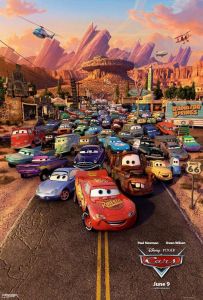 While I’d never call Pixar’s latest animated film a disappointment, it is the company’s first speed bump in their unprecedented reign of unmatched quality. Cars is technically dazzling; it’s almost redundant to say a CGI film is the best-looking ever because the technology keeps improving with time but Cars is incredible to watch. The lushly painted vistas, the way light gleams on surfaces, the blurs of color, the near-photographic likeness of cars themselves, this is a beautifully animated film, obviously. What isn’t as beautiful is the lackluster storyline. I can feel Pixar’s heart in the right place but they don’t put enough effort to touch our own hearts. Cars lacks the depth of Pixar’s other features. The two Toy Story films managed to take a kiddy concept of the secret life of toys when no one’s watching and infuse it with serious moral dilemmas and a mature insight into mortality and community. In Cars, the main storyline involves a cocky hot rod Lightning McQueen (voiced by Owen Wilson) who lives in a glitzy world that revolves around him. He goes off the beaten path and finds himself trapped in Radiator Springs, a tiny town that’s all but been dried up since the interstate took folks away from them. There, Lightning learns there’s more to life than material riches from this eclectic mix of good, honest small-town folk. What I’ve just described to you could be the plot of hundreds of movies championing the likes of small town folk. They surprisingly never really go much deeper, though Paul Newman is terrific as an old time car that had a taste of the glory and arrogance way back.
This is the first Pixar movie to exist in a world without humans, which begs the question how living automobiles were able to construct their world minus opposable thumbs. Cars themselves are weirdly inexpressive creatures.
The climax to Cars is suitable and heartfelt but the movie, at two hours in length, sputters a while in the middle. This is the first film directed by Pixar’s big cheese, John Lasseter, since 1999’s Toy Story 2, so excuse me for expecting a little more. Still, the movie is certainly fun, exciting, more cute than funny, and it has a genuine sweetness to go with its visual prowess. I just wish the 8 credited screenwriters, including Lasseter himself, had revved up their imaginations a bit more beyond the conceptual stage. Cars isn’t a great movie, but coming from Pixar, it’s still very good. Hey, anyone that can make the voice of Larry the Cable Guy tolerable deserves my thanks.
Nate’s Grade: B
Share this:

Gone in 60 Seconds (2000)
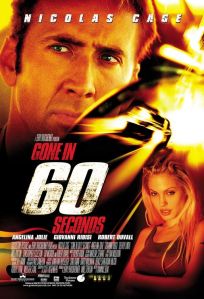 The movie I’ve seen trailers for since last summer finally hits theaters in a summer full of hungry patrons all wishing for the biggest explosion and coolest effects. But with its star heavy cast and array of sleek cars can Gone in 60 Seconds propel itself to the front of the race with audiences?
Nicolas Cage plays a reformed car thief forced back into the fray when his screw-up brother (Giovanni Ribisi) botches a deal for a local toughie. To rescue his delinquent bro Cage must steal 50 cars over the next three days for the man. So Cage wastes two days assembling his team of usual stereotype frat kids who are “the best and brightest” to aid in the mission. That leaves 24 hours for Cage and company to steal 50 cars and save the day minding any moral objections over grand theft auto.
 Gone in 60 Seconds is a living dream of testosterone with fast cars, sexy girls, and colossal explosions. But all the action is mercilessly loud yet surprisingly tame and empty. All the action lacks true tension or any real semblance of excitement. The director uses poor choices of rapid quick-cut edits that dull any build up of excitement. Most of the action doesn’t even center on the theft of cars, it just happens. Excluding one chase scene toward the end Gone in 60 Seconds is a popcorn movie with no flavor.
The script and characters take a back seat toward the effects and speeding cars but this to be expected from producer Jerry Bruckheimer, the man who gave us the equally boisterous Con Air and The Rock. This time the holes of the plot are easier to see and the dialogue no less cheesy especially when car talk turn innuendous. It’s easy to argue that story should be forgotten because audiences came to see cool cars and cool crashes, but it’s also easy to argue that those cool crashes and cars are distractions (as is Angelina Jolie) from the thinly strained story. When you have time to really analyze the plot in an action film you know the action isn’t up to par.
Gone in 60 Seconds could also serve as an apt description for Angelina Jolie’s running time. The recent Oscar winner dons bleached dreads and those pouty lips but is still seen less than Waldo – and that is a criminal mistake with someone like her. Gone in 60 Seconds has a bounty of Oscar winners with scant supporting screen time yet it can’t fool the crowd.
Gone in 60 Seconds may fit the criteria for a grand summer fireworks show but can never deliver the goods. It may be flashy, loud, and fast but this flick just isn’t running on empty, it’s past the “E.”
Nate’s Grade: C-


 nathanzoebl
You must be logged in to post a comment.