Blog Archives
My Sister’s Keeper (2009)
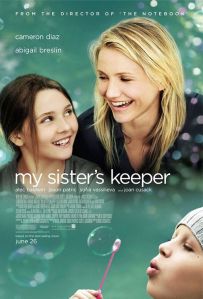 How could a movie about dying children be so schlocky? The best-selling Jodi Picoult novel, My Sister’s Keeper, is awash in drama but it never tipped the scales into absurd and tone-deaf melodrama. How does one botch a tear-jerker? You need only watch the big screen version of My Sister’s Keeper for a primer on how to turn a complicated, challenging book into maudlin mush (hint: make sure to have a sizeable budget for obtaining music rights for endless montages).
Kate (Sofia Vassilieva) is dying from cancer. Her little sister, Anna (Abigail Breslin), was conceived by her parents, Sara and Brian (Cameron Diaz, Jason Patric), to be a genetic match. Anna was born so that she might be “spare parts” for her ailing big sister. Jesse (Brennan Bailey), is the oldest child, and his needs have been overlooked because of Kate’s illness. Anna’s life has been one of prodding and pricking and testing and operations. Then one day, Anna consults with high-powered lawyer Campbell Alexander (Alec Baldwin). She wants to sue her parents for the rights to her own body. She’s tired of undergoing numerous medical treatments. She wants a life of her own, something more than being “spare parts.” Needless to say, Sara and Brian are horrified. Anna clearly loves her sister but by refusing to donate a kidney she is signing her sister’s death notice.
 The movie strikes one false, heavy-handed note after another. There is rarely a moment that feels authentic or genuine; everything comes across as powerfully manipulative and cloying and contrived and like a tuneless melodrama. Things are cranked to such a high degree of overkill. I swear to you that, no joke, at least seventy percent of the scenes in this movie involve somebody crying. People don’t argue, they flail and shout until they go hoarse. There is nothing subtle to be found here. I didn’t feel emotionally invested in these characters and one of them is a freaking teenage girl suffering with cancer! The first half of the movie feels far too rushed, and the majority of scenes last under two minutes, meaning that the plot lurches forward but the film fails to round out and establish its central characters. The movie’s idea of covering up its screenwriting shortcomings and lackluster character development is to produce an extended music montage. There are over five music montages (I lost count) and it possibly takes up a fifth of the movie’s total running time. I don’t know about you, but watching characters smile and laugh set to music that is so painfully on-the-nose literal does not make due. After so many matching lyrics, I was waiting for a song to literally describe everything I was watching on screen, like, “Heaven/We’re all gonna go/You’re gonna go sooner/Because you’re a little girl with cancer/Don’t you think your mother’s crazy?/So what’s on TV?” Is it better drama to hear a somber cover of Cyndi Lauper’s “Girls Just Want to Have Fun”? It’s just one of several flimsy filming decisions that rip you out of the story and make it perfectly obvious that you are watching a movie, and a poor one at that.
There is just way too much material here for it to succeed as a streamlined, two-hour weepie. There are complicated moral issues here about exploiting one child in efforts to save another. Grief can transform the nucleus of a family in small ways. This requires a delicate adaptation and this movie is certainly not it. This is an adaptation that alternates between syrupy music montages and falling anvils. My Sister’s Keeper is beset with convoluted flashbacks, and I often was confused as to where in the timeline several of the scenes were taking place. Is this before or after Sara shaved her head in solidarity? Is this before or after she Katie starts chemo? There are multiple characters that share voice over duties, often just offering up a line or two. What’s the point of having Jesse announce in voice over, “I wondered how much trouble I was gonna be in,” when he sneaks into his house late at night? Could we not communicate this effectively without the added voice over? And only for a single line? This is just shockingly lazy writing and proof that the filmmakers have no trust in their audience. In fact, Jesse as a character is entirely pointless. He adds nothing to the story except to make things more confusing. Why does he sneak out at night to drink milkshakes in downtown L.A.? Why are judges unclear why a lawyer of such fame and stature as Campbell Alexander has a helper dog? There are intriguing dramatic setups that just get overlooked. What kind of life goes on in a family home when one child is suing their parents? Show me this stuff.
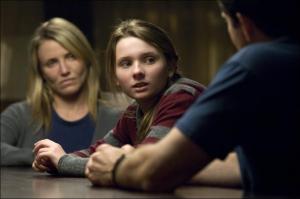 By far, the only believable part of this mawkish mess is a lengthy flashback to Kate’s boyfriend, Taylor (Thomas Dekker, sporting a good-looking dome if you ask me). This is the only segment that’s allowed to breathe and feel naturally developed. It is during this tender sequence where Kate feels like a character instead of a broadly drawn sketch of Cancer Girl. The interaction between Kate and Taylor is sweet and relaxed, until an obvious conclusion that has to spoil Kate’s small hold on happiness. The supposed twist ending is predictable and nullifies the court battle, which makes the ethical struggle of bio-engineered babies just a plot gimmick. In the end, I got the overwhelming impression that the screenwriters, Jeremy Leven (The Notebook) and director Nick Cassavetes, are projecting. We conclude on one character’s voice over, remarking, “I don’t know why she died. I don’t know why what happened happened. I don’t know why we did the things we did.” It’s like a thinly layered confession by the screenwriters that they were clueless. Any tears that manage to squeeze out are unearned and are only the byproduct of such gloomy material.
The acting is typical of such hyperactive melodrama. Diaz fares the worst as the overprotective mom who fights tooth and nail to save her daughter at the expense of everybody else. She’s abrasive and grating even when the movie tries to make her sympathetic. Diaz can do drama and can even manage understatement, as she showcased in the criminally underappreciated 2005 film, In Her Shoes. Cassavetes only knows how to direct actors when they’re being histrionic and unrestrained, as Alpha Dog and John Q. prove. The rest of the cast slogs through the overwrought material with plenty of tears to bailout the Kleenex industry. The lone bright spot amongst the cast is Vassilieva (TV’s Medium) who makes you feel her pain and manages to, at times, cloud your mind that you’re being shamelessly manipulated.
 My Sister’s Keeper is supposed to be one of those moving, heart-tugging episodes that allows us all to re-evaluate life. The movie, in actuality, is a maudlin and overstuffed melodrama (cancer kids, dysfunctional families, court disputes, secret schemes, last wishes, etc.) that is so poorly executed that it manages to make Lifetime movies look like grand art. Cassavetes grounds down all the tricky ethical questions and tortured feelings down into simplistic soap opera gunk. Nothing feels genuine or honest, everything comes across as incredibly forced and contrived, and enough with the music montages. Hitting the soundtrack button does not erase screenwriting deficiencies. My Sister’s Keeper is a malformed, overwrought, clunkily insensitive excuse to empty audience tear ducts. I suppose indiscriminate fans of the weepie genre will find the material forgivable, though fans of Picoult’s novel will find the changes to be unforgivable. I like my emotions to be earned and not strangled to death.
Nate’s Grade: C-
Share this:

Charlie’s Angels: Full Throttle (2003)
 More of the same, except this time all the verve and invention seems stale and reheated. This sequel subscribes to the bigger-better train of thought, so as it continues to get more and more outlandish and the girls become invincible super heroes on par with Neo, the movie tanks hard. Much has been made about Demi Moore’s “comeback” but apparently she wasn’t sharpening her acting muscles during her hiatus. No one said the first Charlie’s Angels movie was within the realm of reality, but in the sequel apparently the Witness Protection Agency has decided to store all their valuable information not in a computer mainframe, a system of files, no, on two magic decoder rings. What the hell? McG returns as director and cranks the style into overkill, set to a radio-friendly soundtrack, but it all seems so ho-hum and excessive at the same time. Quite an accomplishment. No more please.
Nate’s Grade: C
Share this:

Gangs of New York (2002)
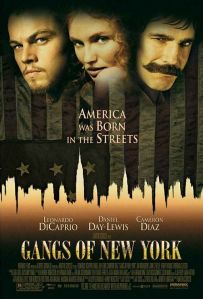 Watching Martin Scorsese’s long-in-the-making Gangs of New York is like watching a 12-round bout between two weary and staggering prize fighters. You witness the onslaught of blows, see the momentum change several times, and in the end cant really tell which fighter is victorious. This is the experience of watching Gangs of New York, and the two fighters are called Ambitions and Flaws.
The film begins in the Five Points district of 1840s New York among a vivid gang war over turf. Amsterdam (Leonardo DiCaprio) witnesses the slaying of his father, Priest Vallon (Liam Neeson), at the blade of William Bill the Butcher Cutting (Daniel Day-Lewis) and his Native Americans gang. So what does this son of a dead preacher-man do? Well he grows up, plots revenge by making a name under the wing of the Butcher becoming like a surrogate son. But will vengeance consume him?
 Watch Leo DiCaprio assemble toughs, rake heels, and ne’er do wells to his Irish gang of rapscallions with facial hair that looks to be tweezed! Witness a one-dimensional Leo suck the life out of the film like a black hole! See Leo become the least frightening gangster since Fredo. Watch the horribly miscast Cameron Diaz play pin-the-tail-on-an-accent! Witness as she tries to play a pickpocket with a heart of gold that falls hopelessly and illogically in love with Leo! Marvel how someone looking like Diaz would exist in a mangy slum! See the brilliant Daniel Day-Lewis upstage our stupid hero and steal every scene he inhabits! Witness one of the greatest villains in the last decade of movies! Watch Day-Lewis almost single-handedly compensate for the films flaws with his virtuoso performance! Admire his stove-top hat and handlebar mustache!
Witness a wonderful supporting cast including John C. Reilly, Jim Broadbent and Brendan Gleeson! Wish that they had more screen time to work with! Wonder to yourself why in all good graces this film took nearly two years of delays to get out! Speculate away!
Gangs has the sharp aroma of a film heavily interfered with by its producers. The whole exercise feels like Scorsese being compromised. Gangs is a meticulous recreation of 1860s New York that often evokes an epic sense of awe. The story has more resonance when it flashes to small yet tasty historical asides, like the dueling fire houses and the Draft Riots. But all of these interesting tidbits get pushed aside for our pedantic revenge storyline with Leo front and center. You know the producers wanted a more commercial storyline, which probably explains why Diaz has anything to do with this.
 The script is credited to longtime Scorsese collaborator Jay Cocks, Steven Zallian (Academy Award winner for Schindler’s List) and Kenneth Lonergan (Academy award nominee for You Can Count on Me). So with all these writing credentials, dont you think one of them would realize all of the dumb things going on with the story? The ending is also very anticlimactic and ham-fisted. Just watch as we segue from a graveyard to present day New York, all thanks to the Irish rockers of U2!
I know this much, Day-Lewis needs to stop cobbling shoes and act more often. Gangs is his first visit to the big screen since 1997’s The Boxer. He spent part of this hiatus in Italy actually making shoes. I don’t know about everyone else but this man has too much talent to only be acting once every five years. Somebody buy his shoes and get him a script, post haste!
Scorsese’s Gangs of New York is at times sprawling with entertainment in its historic vision and at other times is infuriating, always dragging behind it a ball and chain called stupid revenge story/love story. I’m sure the film will get plenty of awards and Oscar nods in prominent categories, and this seems like the Academy’s familiar plan: ignore a brilliant artist for the majority of their career and then finally reward them late for one of their lesser films. So here’s hoping Scorsese wins the Oscar he deserved for Raging Bull and Goodfellas.
Nate’s Grade: C+
Share this:

Vanilla Sky (2001)
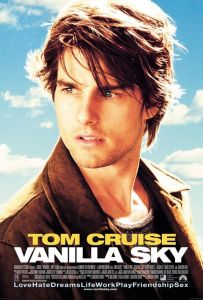 Talk about a film’s back story. Tom Cruise signed on to do a remake of the 1997 Spanish film Abre Los Ojos (Open Your Eyes) which was directed by Alejandro Amenabar. During the filming the romance between Cruise and Penelope Cruz (no relation) got a little hotter than expected onscreen and broke up his long-standing marriage to Nicole Kidman. At the time she was finishing filming The Others which is the second film by Amenabar. This, by the way, is much more interesting than Vanilla Sky unfortunately.
Cameron Crowe’s remake starts off promising enough with Tom Cruise running around an empty Times Square like a Twilight Zone episode. Afterwards the film begins to create a story that collapses under its own weight. David (Cruise) is a rich boy in control of a publishing empire inherited through his dear old deceased dad. He has the time to throw huge parties where even Spielberg hugs him, and even have crazy sex with crazy Cameron Diaz, whom he tells his best friend (Jason Lee) is his “f*** buddy.” David begins to see a softer side of life with the entrance of bouncy and lively Sophia (Cruz) and contemplates that he might be really falling in love for the first time. But this happiness doesn’t last long as jealous Diaz picks up David in her car then speeds it off a bridge killing her. Then things get sticky including David’s disfiguration, his attempts to regain that one night of budding love and a supposed murder that he committed.
 Crowe is in over his head with this territory. His knack for wonderful exchanges of dialogue and the perfect song to place over a scene are intact, but cannot help him with this mess. Vanilla Sky is an awkward mish-mash of science fiction. The film’s protagonist is standoffish for an audience and many of the story’s so-called resolutions toward the end are more perfunctory than functional. The ending as a whole is dissatisfying and unimaginative. By the time the wonderful Tilda Swinton shows up you’ll likely either be asleep or ready to press the eject button yelling “cop out!”
Seeing Vanilla Sky has made me want to hunt for Amenabar’s Abre Los Ojos and see what all the hype was about, because if it is anything like its glossy American counterpart then I have no idea why world audiences went wild for it.
Nate’s Grade: C
Reviewed 20 years later as part of the “Reviews Re-View: 2001” article.
Share this:

Shrek (2001)
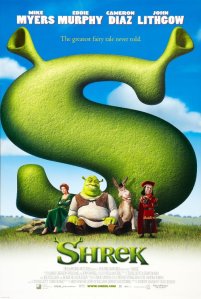 Shrek is Dreamworks’ kick in the pants to fairy tales and some of the staple creations of the Mouse house. There’s nothing a bug eating green ogre named Shrek likes more than his peaceful privacy. But this is brought to an immediate halt when all sorts of fairy tale creatures invade his swampy domain. To regain his privacy Shrek takes it up with Lord Farquad (say the name fast) who agrees to relocate the fairy tale creatures he outlawed to Shrek’s swamp in the first place if he travels to a castle and rescue a princess. Shrek agrees and along the way gets a buddy for the trip with a talking donkey, named appropriately enough, Donkey.
Shrek is amazing world of computer artistry. The characters move so life like and the detail is so magnified that it is a living and breathing world all its own. Mike Myers and Eddie Murphy are the comic duo of Shrek and Donkey and provide a good portion of laughs on their journey. With Mulan and now Shrek, Murphy seems like a natural when it comes to animation voicing. He gives it his all. Cameron Diaz is also a nice contributor as the voice of Princess Fiona, which kinda’ looks like her too creepily enough. Rounding out the cast is the always over-the-top John Lithgow as the stilted Farquad.
The humor of Shrek is enough to please kids with the fart and burp jokes, but lends its aim for more adult humor as well. There are a few jabs at the Disney Empire that are more than hilarious and the story keeps them coming. Shrek turns out to be a delightful tale of an ogre who’s a green softy at heart.
Nate’s Grade: A
Share this:

Charlie’s Angels (2000)
 These angels aren’t exactly what your father was enjoying when your mother was away fulfilling errands. These angels aren’t delegated as mere sex objects running around providing the jiggle entertainment that is (or was) supplied by today’s Baywatch. The 90s is a different decade after our minority movements and today’s woman is just as apt to do a flying kung-fu face plant into a baddie as any man. The angels of the film are action heroes for an armada of small girls needing some female empowerment when their only other choices consist of a barely clothed Britney or a barely covered Christina. These angels aren’t just the sex objects that the classic assortment of angelic 70s stars were; these angels are also tough-as-nails, resourceful, and not afraid to tussle or tango. Now that this exposition is out I can concentrate on the scattershot film Charlie’s Angels.
The film has been rumored to have at a minimum of 17 writers who tried shaping a story for Cameron Diaz, Drew Barrymore, and Lucy Lui. The story is pretty much shelved toward the back so the forefront is our trio of ladies kicking ass then shaking it with zig-zaggy and wild camera movements from debut filmmaker and video director McG.
Charlie’s Angels is whiz-bang dumb fun. The overall feel of the film is something more difficult to get a grasp on. At times it shows itself as tongue-in-cheek and satirical but then at other times it seems overly serious or overly dumb. The characters are non-existent and basically only discernible by hair color. The characters are very wooden and I actually found more enjoyment watching the villains and seeing more of them; call it the Austin Powers dilemma. Diaz makes the only notable attempt as her goofy and light-hearted angel connects with the audience best. Lui plays a techno-babe dominatrix but is easy to see that she was the last angel chosen and doesn’t exactly gel with the others as much as she could have.
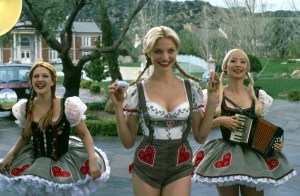 Charlie’s Angels is best when the action is pumping. The scenes are cut together in a jam-packing sequential way adding distinct flavor and style. McG is a true surprise in the effectiveness he can orchestrate his action motifs even if the Matrix effects and moves make absolutely no sense in the real world.
Crispin Glover shows himself as a silent assassin nicknamed “the thin creepy man.” Glover is so suave and slick in his role of the non-verbal Oddjob henchman role that he exhilarated me with every presence he made on screen. Goodness, he was too cool in this film and everyone gets brownie points for allowing him. He has such energy and charisma that I wanted the film to veer off into him and desert our angels. Seeing our ageless McFly perform action scenes and choreographed fights is something I will be pleased with until my grave. seeing Crispin in the excellent Nurse Betty and now huge exposure in this is a true joy. And man… he smokes a cigarette way too cool every time he’s in this film. Some people can smoke cool some of the time but Crispin does it all of the time. His mere presence almost cancels out the annoyance of Barrymore.
The line is drawn with Charlie’s Angels in that it’s sex-kitten jiggle and an acrobatic arrangement of (light) feminism and humor. These gals know they’re sex objects and they’ll use it to their advantage delighting in every second of it. Therefore, you could argue successfully that Angels is exploitation hiding as meaningful but hell… why think about this stuff? The movie rolls along at a fast pace where you don’t keep track of these issues. It’s just an easy sit down.
The gigantic success of Charlie’s Angels makes sequels and a possible franchise all but certain. I’d be happy for McG to hop back in his directorial chair but have a unique idea for Angels 2: Bigger, Longer, and Uncut… it involves Glover kicking a lot of ass really cool like.
Nate’s Grade: B-
Reviewed 20 years later as part of the “Reviews Re-View: 2000” article.
Share this:

Any Given Sunday (1999)
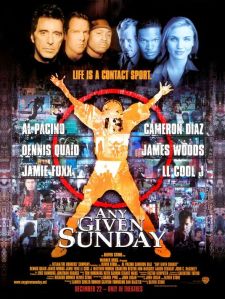 Oliver Stone is a seamstress of visuals and visceral noise. Any Given Sunday is perfect as he delves into the professional world of football and how it becomes a dance of testosterone and fury. But after awhile all the audience feels is a pounding and a ringing in its ears.
The biggest stumbling block may actually be its focal point – there’s too much football! The games last as long as actual games and there are multiple games through out. Though Stone captures the essence nicely that these spandex-clad athletes are the gladiators of today playing in a ballet of chaos, he just throws too many jangled cuts, quick shots, and extreme angles flashing around to hyper-decibel soundtrack fodder. After a while the viewer becomes dizzied by the rush of noise and flash of lights buzzing around their precious skull. It’s enough to cause a concussion simply from watching.
]Most of the action in Any Given Sunday actually happens off the field with some meaty drama delivered by multiple players. Stone focuses in on the people behind the catches and blocks and how the game can control or transform their lives. Finally a drawn-out story that covers football with respect. Diaz and Pacino get into screaming matches for roughly most of the movie, but it’s exciting to see two great actors throw the acting medicine ball back and forth trying to out-duel the one before. The supporting characters all have stories suitable to the game and interesting enough to warrant attention. Jaime Foxx has a nonchalant magnetism that keeps the audience pulling for him even after he vomits for the third time on camera.
Stone lets the viewer into the game of football in a manner truthful yet exaggerated. But with all the whiz-bang he throws out in Any Given Sunday one can’t help but have wished for more constraint in the excess and more minutes for the drama in between.
Nate’s Grade: B-
Share this:

Being John Malkovich (1999)
 I think I’ll simply surmise the emphasis of this review in one opening sentence: The most refreshingly and exhilarating original movie in years. MTV music video chief royale Spike Jonze directs a modern day fable that is a hallucinatory trip through the looking glass and into man’s thirst for celebrity. While Malkovich is stuffed with enough brilliant gags to kill the Austin Powers franchise, it is also a deeply articulate and insightful piece about the longing for love and fame. The movie is often thought-provoking while side-splitingly hilarious.
I will not spill one lick of Charlie Kaufman’s plot to ensure the viewing audience the pleasure of astute surprise, and there is plenty. Malkovich is the first film in a long time to have just as many unexpected twists and turns in the final 30 minutes as it does in the first 30 minutes. The acting is wonderful consisting of John Cusack’s greasy puppeteer loser, to Cameron Diaz’s frumpy animal loving wife, to Catherine Keener’s man-eating ice queen, to even a wonderful inspired parody of John Malkovich as himself playing himself.
Being John Malkovich isn’t afraid to tackle weighty subjects such as gender identity or the hunger to be somebody, but it never looks down upon the characters or the audience but instead treats each with nurturing respect. The movie is a breeze of fresh air in a field cluttered with too many formulaic fluff appealing to mass audiences and consumer goods. Malkovich is destined to become a cult classic and deservedly so. The flick is a spurt of creative madness bordering on genius that one wonders how it ever made it into release with today’s society and studio heads. God bless you Spike Jonze and you too Charlie Kaufman. Fare thee well.
Nate’s Grade: A


 nathanzoebl
You must be logged in to post a comment.