Blog Archives
Wake Up Dead Man (2025)
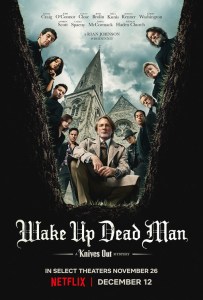 Being the third in its franchise, we now have a familiar idea of what to expect from a Knives Out murder mystery. Writer/director Rian Johnson has a clear love for the whodunit mystery genre but he loves even more turning the genre on its head, finding something new in a staid and traditional style of storytelling. The original 2019 hit movie let us in on the “murderer” early, and it became more of a game of out-thinking the world-class detective, Benoit Blanc (Daniel Craig). With the 2022 sequel Glass Onion, the first of Netflix’s two commissioned sequels for a whopping $400 million, Johnson reinvented the unexpected twin trope and let us investigate a den of tech bro vipers with added juicy dramatic irony. With his latest, Wake Up Dead Man, Johnson is trying something thematically different. Rather than adding a meta twist to ages-old detective tropes, Johnson is putting his film’s emphasis on building out the themes of faith. This is a movie more interested in the questions and value of faith in our modern world. It still has its canny charms and surprises, including some wonderfully daffy physical humor, but Wake Up Dead Man is the most serious and soul-searching of the trilogy thus far, and a movie that hit me where it counts.
In upstate New York, Pastor Jud (Josh O’Connor) has been assigned to a church to help the domineering Jefferson Wicks (Josh Brolin). The congregation is dwindling with the exception of a few diehards holding onto Wicks’ message of exclusion and division. The two pastors are ideologically in opposition, with Pastor Jud favoring a more nurturing and welcoming approach for the Christian church. Then after one fiery sermon, Wicks retires to an antechamber and winds up dead, with the primary suspect with the most motivation being Pastor Jud. Enter famous detective extraordinaire Benoit Blanc to solve the riddle.
 I appreciated how the movie is also an examination on the different voices fighting for control of the direction of the larger Christian church. Wicks is your traditional fire-and-brimstone preacher, a man who sees the world as a nightmarish carnival of temptations waiting to drag down souls. He sees faith as a cudgel against the horrors of the world, and for him the church is about banding together and fighting against those outside forces no matter how few of you remain to uphold the crusade. Pastor Jud rejects this worldview, arguing that if you think of the church as a pugilist in a battle then you’ll start seeing enemies and fights to come to all places. He’s a man desperate to escape his violent past and to see the church as a resource of peace and resolution but Wicks lusts for the fight and the sense of superiority granted by his position. He relishes imposing his wrath onto others, and his small posse of his most true believers consider themselves hallowed because they’re on the inside of a special club. For Pastor Jud, he’s rejecting hatred in his heart and looks at the teachings of Jesus as an act of love and empathy. It’s not meant to draw lines and exclude but to make connections. These two philosophical differences are in direct conflict for the first half of the movie, one viewing the church as an open hand and the other as a fist. It’s not hard to see where Johnson casts his lot since Pastor Jud is our main character, after all. I also appreciated the satirical tweaks of the church’s connections to dubious conservative political dogma, like Wicks’ disciples trying to convince themselves the church needs a bully of its own to settle scores (“What is truth anyway?” one incredulously asks after some upsetting news about their patriarch). It’s not hard to make a small leap to the self-serving rationalizations of supporting a brazenly ungodly figure like Trump. At its core, this movie is about people wrestling with big ideas, and Johnson has the interest to provide space for these ideas and themes while also keeping his whodunit running along pace-for-pace.
There is a moment of clarification that is so sudden, so unexpectedly beautiful that it literally had me welling up in tears and dumbstruck at Johnson’s capabilities as a precise storyteller. It’s late into Act Two, and Blanc and Pastor Jud are in the thick of trying to gather all the evidence they can and chase down those leads to come to a conclusive answer as to how Pastor Jud is innocent. The scene begins with Pastor Jud talking on the phone trying to ascertain when a forklift order was placed. The woman on the other side of the line, Louise (Bridget Everett, Somebody Somewhere), is a chatty woman who is talking in circles rather than getting to the point, delaying the retrieval of desired information and causing nervous agitation for Pastor Jud. It’s a familiar comedy scenario of a person being denied what they want and getting frustrated from the oblivious individual causing that annoying delay. Then, all of a sudden, as the frustration is reaching a breaking point, she quietly asks if she can ask Pastor Jud a personal question. This takes him off guard but he accepts, and from there she becomes so much more of a real person, not just an annoyance over the phone. She mentions her parent has cancer and is in a bad way and she’s unsure how to repair their relationship while they still have such precious time left. The movie goes still and lingers, giving this woman and her heartfelt vulnerability the floor, and Pastor Jud reverts back to those instincts to serve. He goes into another room to provide her privacy and counsels her, leading her in a prayer.
 The entire scene is magnificent and serves two purposes. This refocuses Pastor Jud on what is most important, not chasing this shaggy investigation with his new buddy Blanc but being a shepherd to others. It re-calibrates the character’s priorities and perspective. It also, subtlety, does the same for the audience. The wacky whodunit nature of the locked-door mystery is intended as the draw, the game of determining who and when are responsible for this latest murder. It’s the appeal of these kinds of movies, and yet, Johnson is also re-calibrating our priorities to better align with Pastor Jud. Because ultimately the circumstances of the case will be uncovered, as well as the who or whom’s responsible, and you’ll get your answers, but will they be just as important once you have them? Or will the themes under-girding this whole movie be the real takeaway, the real emotionally potent memory of the film? As a mystery, Wake Up Dead Man is probably dead-last, no pun intended, in the Knives Out franchise, but each movie is trying to do something radical. With this third film, it’s less focused on the twists and turns of its mystery and its secrets. It’s more focused on the challenging nature of faith as well as the empathetic power that it can afford others when they choose to be vulnerable and open.
Blanc doesn’t even show up for the first forty or so minutes, giving the narration duties to Pastor Jud setting the scene of his own. Craig (Queer) is a bit more subdued in this movie, both given the thematic nature of it as well as ceding the spotlight to his co-star. Blanc is meant to be the more stubborn realist of the picture, an atheist who views organized religion as exploitative claptrap (he seems the kind of guy who says “malarkey” regularly). His character’s journey isn’t about becoming a true believer by the end. It’s about recognizing and accepting how faith can affect others for good, specifically the need for redemption. Minor spoilers ahead. His final grand moment, the sermonizing we expect from our Great Detectives when they finally line up all the suspects and clues and knock them down in a rousing monologue, is cast aside, as Blanc recognizes his own ego could be willfully harmful and in direct opposition to Pastor Jud’s mission. It’s a performance that asks more of Craig than to mug for the camera and escape the molasses pit of his cartoonish Southern drawl. He’s still effortlessly enjoyable in the role, and may he continue this series forever, but Wake Up Dead Man proves he’s also just as enjoyable as the second banana in a story.
 O’Connor (Challengers, The Crown) is our lead and what a terrific performance he delivers. The character is exactly who you would want a pastor to be: humble, empathetic, honest, and striving to do better. It’s perhaps a little too cute to call O’Connor’s performance “soulful” but I kept coming back to that word because this character is such a vital beating heart for others, so hopeful to make an impact. It’s wrapped up in his own hopes of turning his life around, turning his personal tragedy into meaning, devoting himself to others as a means of repentance. He’s a man in over his head but he’s also an easy underdog to root for, just like Ana de Armas’ character was in the original Knives Out. You want this man to persevere because he has a good moral center and because our world could use more characters like this. O’Connor has such a brimming sense of earnestness throughout that doesn’t grow maudlin thanks to Johnson’s deft touch and mature exploration of his themes. O’Connor is such a winning presence, and when he’s teamed with Blanc, the two form an enjoyable buddy comedy, each getting caught up in the other’s enthusiasm.
Johnson has assembled yet another all-star collection of actors eager to have fun in his genre retooling. Some of these roles are a little more thankless than others (Sorry Mila Kunis and Thomas Haden Church, but it was nice of you to come down and play dress-up with the rest of the cast). The clear standout is Glenn Close (Hillbilly Elegy) as Martha, the real glue behind Wicks’ church as well as an ardent supporter of his worldview of the damned and the righteous. She has a poignant character arc coming to terms with how poisonous that divisive, holier-than-thou perspective can be. Close is fantastic and really funny at certain parts, giving Martha an otherworldly presence as a woman always within earshot. Brolin (Weapons) is equally fun as the pugnacious Wicks, a man given to hypocrisy but also resentful of others who would reduce his position of influence. The issue with Wake Up Dead Man is that elevating Pastor Jud to co-star level only leaves so much room for others, and so the suspect list is under-served, arguably wasted, especially Andrew Scott (All of Us Strangers) as a red-pilled sci-fi writer looking for a comeback. The best of the bunch is Daryl McCormack (Good Luck to You, Leo Grande) as a conniving wannabe in Republican politics trying to position himself for a pricey media platform and Cailee Spaeny (Alien: Romulus) as a cellist who suffers from deliberating pain and was desperate for a miracle delivered by Wicks. He’s the least genuine person, she’s hoping for miraculous acts, and both will be disappointed from what they seek.
Wake Up Dead Man (no comma in that title, so no direct command intended) is an equally fun movie with silly jokes and a reverent exploration of the power of faith and its positive impact, not even from a formal religious standpoint but in the simple act of connecting to another human being in need. This is the richest thematically of the three Knives Out movies but it also might be the weakest of the mysteries. The particulars of the case just aren’t as clever or as engaging as the others, but then again not every Agatha Christie mystery novel could be an absolute all-time ripper. That’s why the movie’s subtle shifts toward its themes and character arcs as being more important is the right track, and it makes for a more emotionally resonant and reflective experience, one that has replay value even after you know the exact particulars of the case. If you’re a fan of the Knives Out series, there should be enough here to keep you enraptured for more. Because of that added thematic richness, Wake Up Dead Man has an argument as the best sequel (yet).
Nate’s Grade: A-
Share this:

Alien: Romulus (2024)

I will maintain that over the course of forty years that there have been no bad Alien movies. While 2017’s Alien Covenant gets the closest, I think each of the four Alien movies from 1979 to 1997 are worthy of praise for different reasons. The Alien franchise is unique among most sci-fi blockbusters in that each of its movies feels so radically different. The groundbreaking first movie is the hallowed haunted house movie in space; the 1986 sequel set the foundation for all space marine action movies, with Sigourney Weaver earning a Best Actress nomination, a real rarity for any sci-fi action movie; the much-derided third film from 1992 is much better than people give it credit for, and while flawed it has really intriguing ideas and characters with a unique setting and a gutsy ending; the fourth film from 1997 might just be the most fun, going all-in on schlocky action and colorful characters. Each of them is different with a style and tone of their own, and each is worthy of your two hours. Enter director/co-writer Fede Alvarez’s Alien: Romulus, meant to take place between the fifty-year time span between Alien and Aliens. It was intended to be a Hulu streaming movie but got called up to the big leagues of theatrical release, and while it has some underwritten aspects and clunky fan service, Romulus is another worthy sequel for a franchise that admirably keeps marching to its own beat.
It’s 2142 and life on an off-world colony isn’t exactly the adventure advertised. It’s a mining colony that’s slowly poisoning its huddled masses. Rain (Cailee Spaeny) has just finished her two-year contract only to be informed by her greedy company that, because of worker shortages, she’s locked in for another two years of indentured servitude. She’s also in charge of her adoptive brother, Andy (David Johnsson), a malfunctioning android that her late father reprogrammed. An ex-boyfriend comes back into Rain’s life with a plan: there’s an old derelict research station that they can scavenge and retrieve the cryo chambers, which can make long-term travel to a new life in a new system a possibility. There’s also a catch: they need Andy because only he can open the ship’s locked gates. The ragtag crew flies out to the derelict ship orbiting a ringed planet and, of course, discovers far more than they bargained for as the ship, of Weyland-Yutani origins, is crawling with face-hugging fiends just waiting for new faces.

Despite my grumbles, I found Alien: Romulus to be a very entertaining new entry that had the possibility of genre greatness. The setting and central character dynamic are terrific. The Alien franchise hasn’t exactly been subtle about its criticisms of multi-faceted corporations and their bottom-line priorities, but it’s even more effective to see the dinghy world of this mining colony. It’s a bleak existence of dystopian labor exploitation and you get an early sense of the desperation that motivates the characters to flee at any opportunity. Eventually, the evil corporation’s big plans for the “perfect organism,” a.k.a. the xenomorph, are to replace the depleting labor force. Humans, it turns out, aren’t built to work in space long-term, and the human cost is felt effectively in Act One. Another key part of what made the movie so immediately engaging for me is the sweet surrogate brother-sister relationship between Rain and Andy. He’s vulnerable, an older android model who needs some repairs, but he’s loyal and kind and loves pun-heavy jokes. This central relationship hooked me and gave me something to genuinely worry over as things get more dire, and it’s not just the scary aliens. Once onboard, Andy uploads the programming of a different android, and the competing objectives make him become a different person, all wonderfully played by Johnsson, who was supremely appealing in Rye Lane. While literally every other character is remarkably underwritten (this one doesn’t like robots, this one is pregnant, this one is… Buddhist?), the genuine bond between Andy and Rain grounded me.
Romulus also has some sneaky good set pieces that kept me squirming in my seat or inching closer in excitement. Alvarez (Don’t Breathe, Evil Dead) can concoct some dynamite suspense sequences and knows how to draw out the tension to pleasingly anxious perfection. This is the best Alien movie yet to really sell the danger of the springy face-huggers. There’s a taut sequence where the humans have to slow their movements to walk through a face-hugger minefield lest their spike in temperature alert the deadly creatures. There’s another later sequence that ingeniously utilizes space physics to escape the xenomorph acid blood. I loved how well it was set up and then the fun visuals of zero-gravity acid blood. The practical effects make for lots of great looking in-camera effects, and the production design is incredibly detailed while achieving a chilling overall mood of dread. Alvarez leans upon the visual frameworks of Ridley Scott and James Cameron, as who doesn’t, but finds ways to make his Alien movie his own. I really appreciated the dedication to the sprawling vistas of space, like extended shots outside the ship that really translate the sheer majesty and terrifying scale of space. The last-second threat of demolition is made all the more arresting by crashing into the rings of the planet. I think most people confuse a planet’s rings like it’s some kind of water vapor when instead it’s like a crowded highway of debris.
However, there are some misguided nods toward fan service that go overboard and become groan-inducing. There’s a fine line between homage and back-bending fan service, and Romulus skirts over occasionally into the dangerous territory, given over to references to the other movies that lack better context to make them anything more than contrived callbacks. Take for instance a triumphant killing of a xenomorph where a character utters, “Get away from her,” which itself would have sufficed, as any Alien franchise fan knows this reference point. Then the character continues, in an awkward pause, almost stumbling over the words and translating the awkwardness directly for us, as they add, “…You bitch.” Why? Why would this character need to say this exact same line (although, timeline-wise, this is now the first use of the phrase as Ripley is still in hypersleep)? The moment doesn’t call for this specific line; it could have been anything else, but they made it the line we all know from Aliens. There’s also the familiar ending where the characters think they’ve won and, wouldn’t you know it, there’s one more tussle to be had with a xenomorph who has snuck onto the escape ship. I’m less bothered by this continuation as it’s almost a formula expectation for the franchise at this point, though keeping Rain in her sleeping undies for the final fight seems like another unnecessary nod to the 1979 original. They even tie back the mysterious black goo from the Engineers via Prometheus, though as a vague power-up when, if I can recall, it was a biological weapon of mass destruction, but sure, now it’s a power-up elixir.
But the worst and most misguided act of fan service is where the movie literally brings a performer back from the dead (some spoilers ahead, beware). When Rain and the gang stroll through the derelict company ship, they discover the upper torso of a discarded android, like Ash (Ian Holm) in the original Alien. Not just like Ash because for all intents and purposes it is Ash, as the filmmakers resurrect Holm (who passed away in 2020) and use Deepfake A.I. technology to clumsily animate the man. This isn’t the first instance of a deceased actor brought back to screen by a digital double, from Fred Astaire dancing with a mop to Peter Cushing having a significant post-death supporting role in 2016’s Rogue One. Here’s the thing with just about all of these performances: they could have just been a different actor. Why did it have to be Grand Moth Tarkin (Cushing) and not just any other obsequious Empire middle manager? With Alien: Romulus, why does it have to be this specific version of an android when it could have been anyone else in the world besides the dearly departed Holm? I just can’t comprehend why the filmmakers decided to bring back Holm in order to play A DIFFERENT android who isn’t Ash but might as well be since he’s also been torn in half. Why not have the android be another version of Andy? That would have presented a more direct dichotomy for the character to have to process. The effects reanimating Holm are eerie and spotty at best, apparently built from an old scan from The Lord of the Rings. It’s just a distracting and unnecessary blunder, the inclusion of which can only be justified by trying to appeal to fans by saying, “Hey, remember this character? Even though he’s not that character. Well. Here.” We used to readily accept other actors playing the same character before the rise in technology. Nobody watching The Godfather Part II wondered why Robert DeNiro wasn’t a slimmed-down Marlon Brando.

As an Alien movie, Romulus starts off great and settles for good, but it still has several terrific set pieces, its own effectively eerie mood and style, and a grounded character dynamic that made me genuinely care, at least about two characters while the others met their requite unfortunate ends. It doesn’t have the Big Ideas of a Prometheus or the narrative arcs of Aliens, or even the go-for-broke schlock of Alien Resurrection, but Romulus delivers the goods while also feeling like its own movie, a fact I still continue to appreciate with the Alien franchise. It’s an enjoyable genre movie that fits in with the larger franchise. I wish some of the clumsy nods to fan service, especially the resurrection of a certain character, had been reeled back with more restraint to chart its own course, but it’s not enough to derail what proves to be a winning sequel.
Nate’s Grade: B


 nathanzoebl
You must be logged in to post a comment.