Blog Archives
The King’s Speech (2010)
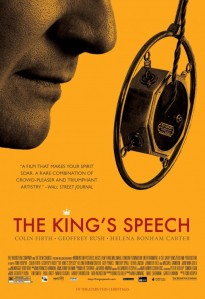 Public speaking is a nerve-racking position. Nobody wants to seem like a fool but it can be hard to do anything else when all eyes fall upon you with expectation. There was a poll a few years ago that asked Americans what their top fears were, and death came in second to public speaking. The Grim Reaper should feel relieved. Now imagine that you’re the leader of a country during a time of duress and you have a speech impediment. That’s the grueling circumstances for King George VI (affectionately known as “Bertie” to family), leader of Britain on the eve of World War II. The King’s Speech tells the inspirational true story of one of the most powerful men in the world finding his own voice.
Before becoming king of his country, Bertie (Colin Firth) was the Duke of York and a man suffering from a debilitating stutter. When stressed, it was difficult for Bertie to even read a statement. This speech impediment is made all the more troublesome now that the world has entered into the radio age; kings and presidents are now expected to speak to their peoples, no longer content to just be a striking figurehead. Elizabeth (Helena Bonham Carter), future Queen Mother, seeks out different speech therapists but the traditional methods are getting her husband nowhere. Then she comes across Lionel Logue (Geoffrey Rush), a self-taught speech therapist who worked with shell-shocked WWI soldiers in his native Australia. His methods are unorthodox but he’s the first to begin to get results with Bertie. The demands of his position get even greater when Bertie’s father, George V (Michael Gambon), dies in 1936 and Bertie’s older brother, Edward VIII (Guy Pearce) abdicates the throne. Now Bertie is expected to lead his nation, that is, if he can string two sentences together in public.
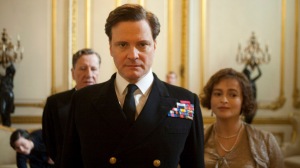 The King’s Speech is really the heartwarming story of the unlikely friendship between a king and a quirky Australian commoner. Their warm, humane friendship allows for several scenes of great humor and great drama. Watching the irreverent Lionel bounce off the proper and isolated Bertie supplies plenty of comedy. It’s essentially an odd couple comedy mixed with a true-life historical drama. There’s great pleasure in watching the chilly relationship between classes thaw, the men grow closer together, and Lionel’s unconventional tactics make progress. Each time Bertie discovers a new practice that removes his stutter, whether it is speaking while listening to music or speaking in the cadence of a song. This is a film that follows the English tradition of understatement even given the dramatic setting, principle characters, and a speech impediment. The characters don’t go around blurting their feelings, leaving the actors room to explore oodles of subtext. There’s a signature scene where Lionel coaxes Bertie into opening up by promising to allow him to paint a child’s model airplane (a treat for a man of title never allowed such toys). As he paints away, Bertie reveals a damaging truth about a neglectful childhood nanny. The truth is so painful that Bertie is forced to reveal it through the cadence of song, which somehow makes the revelation more sad and tragic. Their ongoing relationship is deeply satisfying and emotionally rewarding.
You won’t see a better-acted movie all year, thanks to Firth and Rush. More than following a checklist of gimmicks, Firth inhabits his character from the inside out. He feels like a living, breathing, somewhat broken person instead of a collection of ailments. Firth doesn’t overdo his stutter and treats the character, and the ailment, with a deep sense of compassion. Firth gives what is likely the greatest acting performance by any male in 2010. He is magnificent, commanding, and empathetic in every scene. Likewise, Rush doesn’t overpower as a personality foil. His character manages to be irreverent but without being flippant; he finds a reverent irreverence, if you will. Lionel is treating the future King of England, and the gravity of this stately relationship is not lost on him. Both men hide an inner melancholy, perhaps one of the things that ultimately bonds them together. Rush is flush with vigor and merriment, truly delightful to watch. This is his finest onscreen performance since he won his Oscar in 1996 for Shine.
The enormity of the king’s duties is given due care. You feel the weight of the crown that awaits Bertie and empathize with his quaking hesitation. Ever since childhood, his family looked down on Bertie. His father felt a stern tone would best aid the young stammerer, and his older brother would often belittle Bertie with cruel taunts. You see flashes of this unhealthy dynamic when Edward cuts down his little brother after their father passes.
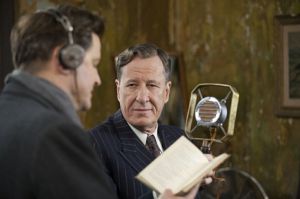 Bertie was seen as unimportant. Edward was the one set up for the throne. And yet Edward is the one who shirks his responsibilities in the name of love (a twice-divorced American woman). Edward refuses to become the leader of his people if the ancient rules forbid him from marrying a divorced woman. Bertie cannot buckle under the tremendous pressure and expectations that wait. Even when the rather passive Bertie lashes out, you feel like his anger is a moment of achievement. King George VI also had to deal with the fact that his brother is still alive and well and an alternative to the throne if Bertie is deemed incapable. Firth makes it easy to feel the remarkable pressure of being a leader not born or elected, merely expected. And even if an audience is clueless about British monarchy history and the rules of royal succession, The King’s Speech is easy to follow and comprehend for a daft American like myself.
Truth be told, The King’s Speech is a little stagy, a little square, and a little too fastidious for its own good. Hooper and crew are too content with making a pleasant moviegoing experience that the film lacks any slight form of edge. It’s all just a little too safe, a little too staid. While rated R, this movie could easily be a PG-13 family film, maybe even a PG one, sans the two sequences where Bertie unleashes a torrent of profanities in frustration (he discovers that he does not stutter while swearing). I feel like a curmudgeon for dinging a movie for being, essentially, too nice and gentle, but it clips the ambition of the movie when crowd-pleaser is the zenith of accomplishment. The fateful speech to the nation, on the eve of war with Germany, is even given an extra oomph thanks to the background music of Beethoven. A larger story of triumph seems reduced to the Oscar favorite storyline of Man Overcoming Physical Adversity. The direction by Hooper has some curious tics to it, like sequences of two people talking where they will never share the frame despite sitting side by side. I assume Hooper is trying to communicate some form of emotional distance or wariness, or perhaps it’s just a nod that different actors had unworkable schedules and could not be filmed together. Hooper is a talented director, as anyone who saw the massive undertaking of the masterful HBO miniseries John Adams can attest. However, like John Adams, Hooper is prone to TV-movie staging. His direction limits the cinematic power of the film. It looks like any ordinary episode of Masterpiece Theater.
The King’s Speech is pretty much everything you’d wish for in a movie groomed for awards consideration. This is prime Oscar bait. You may tear up at points, you’ll probably smile in many places, and your spirit will definitely rise. Plus it features some of the finest acting you’ll witness all year. And yet it’s that conscious need to please, to uplift, that can occasionally distract you from the many charms that The King’s Speech offers. The fact that the story is predictable is not a detriment, but the fact that the film doesn’t push harder, dig deeper, or expect more from its audience is a missed opportunity. The material is so rich, but a terrifically acted, smartly written film isn’t a bad consolation. Especially when that film happens to be one of the most rousing and rewarding theatrical experiences of the year.
Nate’s Grade: A-
Share this:

Never Let Me Go (2010)
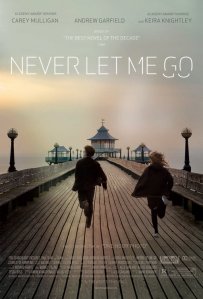 You’ll be excused for mistaking Never Let Me Go as one of those austere boardinghouse dramas the English are fond of cranking out. I mean it even has Keira Knightley in the thing for goodness sakes. Pretty lily-white British actors trying to find their place in a reserved society spanning the 1970s to the mid 1990s. You’d be forgiven for stifling a yawn. But then Never Let Me Go takes a sudden left turn into a realm of science fiction morality play. It becomes something much deeper and menacing. I am about to go into some major spoilers concerning the sinister premise of the movie, so if you’d prefer to stay pure then politely excuse yourself from the remainder of this review and come back at a later time. I won’t think less of you but only if you promise to come back.
Kathy (Carey Mulligan) and her pals Tommy (Andrew Garfield) and Ruth (Knightley) all grew up in the remote countryside school of Hailsham. It’s like any other school in most regards, except at Hailsham the children all wear monitoring bracelets, are afraid to leave the boundaries of school for fear of being murdered by outside forces, and are told that her physical fitness and internal health are of “paramount importance.” Figured it out yet? My then-partner leaned over and whispered, “Are these kids organ slaves?” Kathy and her friends find out their true identity when an outside third-grade teacher (Sally Hawkins) takes pity on them. She reveals that the students of Hailsham are clones whose sole purpose is to be raised into healthy adults who will then give “donations” to the ailing public at large. Most clones will go through one to four “donations” before “completing,” unless they so desire. You see Never Let Me Go exists in a realm where medical science has made momentous breakthroughs and now people can live to 100 years of age on average. Kathy and her friends are the dirty details.
 The rest of the movie flashes through our trio’s teen years. Kathy has always been kind and affectionate to Tommy, but before she could seal the deal Ruth swooped in and took Tommy for her own. Kathy has waited in vain for the two to break up, but that day just never comes. The trio ventures out to a small farmhouse in their teens to do some work and see the outside world. They’re living with a few other Hailsham alums that show them the knack for social interaction with outsiders. There are two rumors at play. One is that the Hailsham alums think they’ve found Ruth’s “original,” the person she’s been cloned from. The second rumor has greater significance: if two Hailsham students can prove that they’re in love, deep, honest love, then they can defer their donations for a few years. This idea takes hold of Tommy and consumes him. Except, we don’t really know whether Ruth or Kathy will be his partner in love.
So why don’t these people run away, or fight back, or do anything of defiance once they discover the horrible truth that will befall them? I have read several critics taking the film to task for being so painfully prosaic and passive, and Never Let Me Go can admittedly fall prey to those detractions at times. However, this is not the Hollywood version where the abused (clones) fight back for their survival and regain independence in a hostile world. That movie was called The Island, plus the several other films that Michael Bay sort of ripped off and then added extra loud explosions. Never Let Me Go has nary an explosion or moment of triumphant revolution. There is no revolt coming because the film doesn’t want to let anyone off the hook; these people are society’s collective collateral damage. They have been bred to be walking, talking, mostly demure, fleshy warehouses for spare parts. It’s only a matter of time before they leave everything on the operating room table, and these people benignly accept their doomed fate (“We all complete”). They march forward, trying to find some level of dignity and beauty before they get the call for “donations.” These people don’t know what it means to rebel; they have no real concept of liberty. They’ve been conditioned since childhood to obey, and that’s the whole point of the film. They have no self-preservation instincts. Likely any cloned child that was expressing strong feelings of boldness was removed, and destroyed, so as not to taint the rest of group. These people are like gown-up versions of veal. They’ve been cultivated since birth for the purpose of destruction, and their knowledge of the world is limited and cruelly self-serving. Watching innocent characters march off to a merciless fate can be very emotionally draining. It should also make you angry.
 These people are hopeless so that the movie’s full impact is absorbed. This isn’t some far off nightmarish scenario, because we as a society are already reaping the rewards of a lifestyle, a lifestyle that we’re loath to think about the mechanics of how we got so fat and happy. I can go to a Walmart and buy a T-shirt for a dollar. I am a happy consumer, but what did it take for me to get that product at such a discounted rate? Sure there are variables up the wazoo, but there are many negative factors that go into why that price stays low, invisible hand of the market be damned. Workers clock long hours in unsafe conditions in order to meet supply, earning a penance just enough to keep them alive and moving product. Environmental concerns are overlooked because that would mess with production. Long-term generational poverty can develop. The worker has ceased to be a person and is merely a dispenser of product, much like our clones in the film. This is not a definitive example of what goes on in the world, mind you. Never Let Me Go isn’t some far off scenario; we’re already there, albeit less explicitly. If the price of gas rose a dollar a gallon but it meant that people in other countries could have safe, uncontaminated water and enough food to stay healthy, what do you think would happen?
With all of that said, Never Let Me Go can’t fully fight the trappings of inert drama. For two hours we are watching somewhat nice, somewhat bland British kids gawk and smile their way toward the inevitable. The conceit calls for the breeding of rather milquetoast personalities. It simultaneously makes the characters more innocent and less emotionally involving. The screenplay relies on our sense of outrage and injustice to fill in the gaps of emotional connection. There are little molehills of characterization at best. You’re supposed to be choked up on indignation and sadness so as to not notice that the threesome of character are all rather good-natured but boring. That even may be an aim of the screenplay to accentuate the terrible fate that awaits, or maybe I’m just being overly analytical. Never Let Me Go reveals its awful truth fairly early at about the 40-minute mark, making sure that the audience is fully aware that we are definitely not headed for a happy ending. As it is, the actors are all lovely and talented but there’s only so much silent emoting and teary eyes can conjure.
 It’s credit to the talents of the actors that you do feel a storm of emotions from such otherwise frail characters. Mulligan (An Education) showcases her great gifts for communicating sadness. Her face just crinkles up, her eyes get glassy, and you want to hug her. She’s our dramatic linchpin. Her looks of conflict and yearning do well to communicate the inner struggle of her character’s abbreviated life. There’s a lot left to the imagination and Mulligan once again crushes it. Garfield (The Social Network) is stuck playing a wishy-washy character, which makes him seem a bit thick at times. He’s the most naïve and hopeful of the three, so when those hopes get crushed again and again his breakdowns have the most emotional heft. Knightley (Pride and Prejudice) has been in six period films since 2005, so she’s got this thing down pat. Ruth is a bit more assertive and angry than her friends, and it’s a pleasure seeing a more calculating side from the actress. It seems like the filmmakers had a troublesome time trying to downplay the attractive features of their cast. So it seems that they relied on the actors eating less. Knightley, and particularly Garfield, look rather gaunt and puckish, even before they begin “donations.”
I’ve gone this far without even mentioning director Mark Romanek’s (One Hour Photo) contributions, or the fact that the film is based off the 2005 novel by author Kazuo Ishiguru (Remains of the Day) and is adapted by Alex Garland (28 Days Later). Great artists that shaped the vision of this film. It’s a shame then that the impact of Never Let Me Go is blunted. It’s an intelligent, poetic, haunting, and emotionally wrenching film experience, and yet it could have been far more penetrating and devastating. The passive nature of the characters accentuates their doom and our sense of outrage. But that same passive nature makes them less than engaging characters. It’s been days since I saw the film and it still lingers in my memory, a testament to the moral quandaries and acting prowess. The existential drama of the film is better suited for the page where the questions of identity and morality can be given more careful and rewarding examination. The movie has an oddly detached feel to so much suffering. Never Let Me Go is a hard film to let go but also a hard film to truly embrace.
Nate’s Grade: B
Share this:

49 Up (2006)
 In 1964, filmmaker Michael Apted (Coal Miner’s Daughter, Gorillas in the Mist) interviewed 14 seven-year-old kids from different British backgrounds asking them about their futures. The half-hour TV special by Granada was called 7 Up and it aimed to show the world where the future politicians and doctors and trash collectors would begin. Every seven years since, Apted has returned to those same kids and peaked in on their lives, chronicling their lives. It’s one of the most famous documentary series in history. Thanks to the virtues of Netflix’s streaming service, I was able to watch six of the seven movies in the Up anthology (sorry 35 Up, the lone film not available for streaming). I spent the next twelve hours watching the lives of 14 complete strangers from childhood to middle age, and by the end they didn’t feel like strangers any more. They felt, weirdly, like family. And that’s the true appeal of the ongoing series: you are watching the evolution of human beings. It’s not everybody that gets a visual scrapbook of their life that’s viewed by millions worldwide.
 Finally, after many hours, 49 Up is the first in the anthology to address the ideas of selective editing and building storylines to suit the “characters.” Long before reality television smoothed away life’s edges to make everybody fit into archetypes, Apted positioned the Up series as his thesis on class struggle. He purposely selected a cross-section of English schoolchildren from private schools and public schools and even two from a boy’s school for orphans. You can see it at 14, 21, and 28 how Apted sticks to his same line of questioning about class advantages and disadvantages, peppering his subjects with questions about what they didn’t have and then showing their current situations in a specific manner to make the audience feel a specific emotion. It’s not deliberately diabolical or partisan but the class warfare ideology certainly can chafe. Do the kids at the top still get all the perks? Are the kids at the bottom suffering with limited opportunities? Has anybody transcended class? Apted starts attributing achievements by the upper class boys as part of their upper class advantages and not due to their hard work, dedication, or talent, which they have every right to complain about. John complains at 21 that when, at seven, they declare their education ambitions, and Apted follows it up with narration, “John did attend such and such,” that it creates the illusion that everything has been handed to them. The hard work and long hours are not shown, and fair point. A few of his subjects actually begin to challenge Apted over his perceptions. Suzy takes aim at his line of questioning, hinting at her life’s disappointments, and fights back, accusing Apted of trapping her into a small narrative box. She even brings up another heated conversation in the history of the series, when Apted questioned whether Suzy, at 21, had experienced enough of life to settle down (she eventually divorced years later). You witness her youthful indignation and she remarks, with some resignation, that Apted is free to edit this outburst as he will and she is helpless (obviously Apted kept this in). It’s the first time I’ve seen the stars of Up contest their onscreen portrayals.
It is also with 49 Up that the film series starts to finally reflect. Part of that comes with living half a century, and many of the 12 on camera subjects are now at an age where they have grandchildren and are setting up retirement (I wonder what the economic meltdown of 2008 did for those plans). They can reflect about the accomplishments of their lives, the past dreams captured on camera that never came true, the marriages that dissolved, the joys and struggles of rearing children, the pains of burying parents, etc. They seem to be at that stopping point where they can take stock of a life lived. On top of that, the participants now begin to reflect on what being apart of the Up series has meant to them. It certainly shapes public opinion about who they are as people, and Apted gropes for any new info to connect with the prior material in the earlier movies.
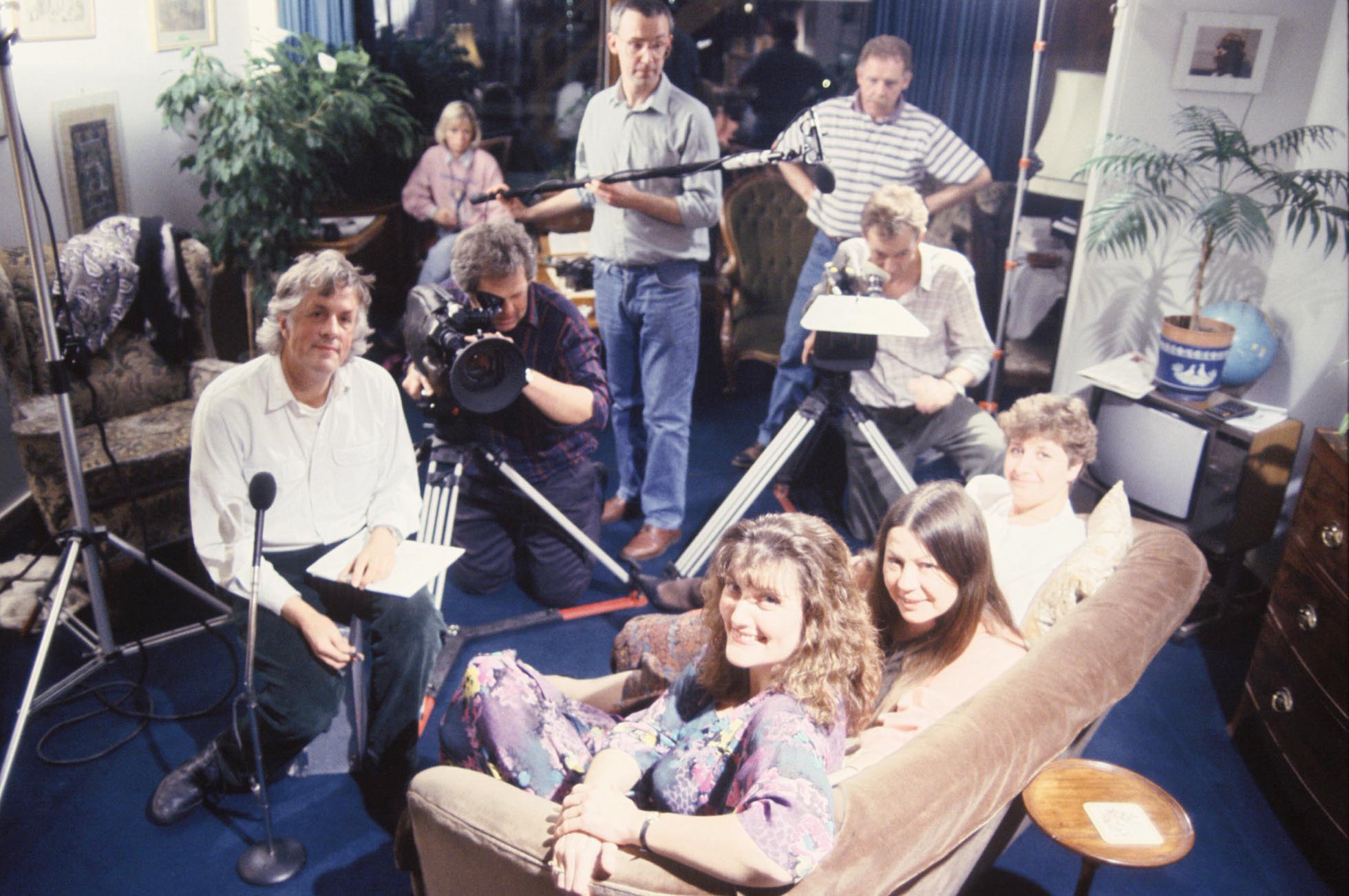 Perhaps Apted feels like he has to keep flogging his class thesis because most of his subjects are pretty regular, i.e. boring, people. They’ve lived lives of modesty and hardship and persevered, but they’re at heart no more interesting than your neighbors. The problem with selecting a bunch of seven-year-olds you plan to follow for the rest of their lives is that you have no clue what will happen. The narrative is completely up in the air. This is why Apted, early on in the series, sticks doggedly to his class thesis to provide some sort of framework he can revisit every seven years. That’s why the series starts to become something of an echo chamber. The exact same sound bytes get used over and over again, trying to find new relevancy. The adults get forever defined, and continuously redefined, by something they said at seven years old, like Neil’s worry that a wife would force him to eat greens and he “don’t like greens” (I’m in the same boat, kid). The echo chamber effect is even more obvious if you watch the Up series in a row. You will start to memorize the childhood catch phrase of everybody and then watch the same clips recycled from 7 to 42. Each is like a little stepping-stone to the present. When viewed as a whole, the series can almost come across as facile. Apted doesn’t probe very deep into his subjects and their lives, mainly sticking to the Life’s Checklist of Accomplishments of Being an Adult: school, job, spouse, family. Personally, I hate how we become defined by a profession. That seems to be the second question that rolls off our tongues when we meet a stranger: “Who are you and what do you do?” What do we do? That’s a loaded question and I object to the idea that our job is the only relevant thing that we “do.” But that’s just my hang-up, I suppose. Apted also lets his subjects reveal the biggest changes in their lives, meaning that if somebody doesn’t want to broach a topic then it gets left unanswered. It can get frustrating and makes for some opaque follow-up visits.
Not every participant is thankful for the Up series. In fact, many of them are wary and somewhat disdainful of participating. Every seven years these people have to rehash their life’s highs and lows, boil them down into a package, and then have it picked over by Apted and his leaning questions, stirring drama anew. It’s easy to see why this becomes a difficult and challenging experience for most, something akin to a cross-examination about your life. So why do most of the 14 return every seven years? Is it the secret hunger for fame? John Brisby ducked out of the Up series after the third installment, upset that he had been made into the series villain through editing. He came across pompous and like a prototypical “old money” sort who lived in a small privileged world (fox hunting!) and reinforced Apted’s thesis on class advantages. Of course his interviews didn’t help him, but I’ll give the guy the benefit of the doubt. I’d hate for everything I said when I was 14 and 21 to follow me for the rest of my life. Well, in 35 Up, John returned, though begrudgingly. He had a reason. His wife and he had begun a charity to raise funds to help the beleaguered educational state of Belarus, a country where John’s family once resided. In 49 Up, he travels once again to that ancestral country and he remarks, somewhat graciously, that it was directly because of exposure on the Up series that donations increased and the kids in Belarus today have books and school buildings and dedicated educators. John made the most of his fame and directed it to a worthy cause. Plus, it doesn’t hurt that John’s passionate desire to help Belarus (his wife is the daughter of an ambassador to the country) feels like the “character” of John has matured.
 Is there any sense of privacy when you know that cameras will be regularly scheduled to appear? There’s this enormous pressure to continue with the Up series, I imagine. But whom do these lives belong to? They were chosen by school officials and Granada at age seven, so they never really had much of a say in what has turned into a lifelong commitment. It seems that the world has a sense of ownership over these 14 individuals’ lives, an ownership that they never granted permission. They must feel an enormous obligation to keep informing the public about their lives, much like a nagging relative. We are a nosy, intrusive lot, human beings are. And I must say that I personally feel weirdly paternal about them. I feel happiness when they too reach happiness through whatever means. I was smiling from ear to ear when Nick, who at 14 was so shy and awkward, became a wonderfully charismatic, articulate, thoughtful, and rather handsome 21-year-old man (he looked strikingly similar to Andy Samberg). I feel despair as well when marriages don’t work out or once secure jobs vanish. Watching the Up series is like watching the evolution of a human being through time-lapse photography; it’s voyeuristic but at the same time it’s like having an extended surrogate family that requires no commitment. We can watch people grow up, mature, gain wisdom, and without anything more than the click of a button. We can watch hairlines get thinner, faces get larger, bodies get saggy, wrinkles multiply, all while playing the visual game of connecting the current iteration of participants with their past selves. We have these 14 people’s lives at our disposal for entertainment.
The Up series aren’t individually great documentaries. In fact, they’re pretty plain and not fairly insightful. As a whole, they present a fascinating document of the human experience and make for a great way to spend a rainy day. You can’t help but reflect on your own life after watching several of the Up movies, and curiously wonder what you have done with your own life at various intervals. As of this writing, all 14 original participants are still alive, which is somewhat amazing in itself. It will be morbidly interesting to see how the film series carries on after one or more of the participants pass away. Millions around the world will mourn what otherwise would have been a normal stranger passing. It’s probably selfish to keep hoping for future installments, and for the participants to keep updating me about their personal lives, but after a 45-plus year investment for some, it’s hard not to feel a sense of attachment to these people.
Nate’s Grade: B
Series Grade: A-
Share this:

In the Loop (2009)
 This is one of those movies that are so sharp, so bristling with intelligence, that you practically need to have a remote control glued to your mitt so that you can rewind and catch all the jokes. I turned the subtitles on myself just to make sure I could get everything. This British comedy is a wicked satire of the miscommunication and blunders that lead the U.S. and Britain into declaring war on a Middle Eastern country. There are some topical jabs but so much of the humor comes from the fractious character interaction; there is a real joy to watching these larger-than-life personalities clash over the course of two nations. It’s fascinating and biting and plays out like a more profane version of The West Wing. The cast is fantastic from top to bottom, with special notice going to My Girl‘s Anna Chlumsky all grown up and perfect with comic timing, and Peter Capaldi as the fearsome, fire-breathing British Director of Communications who can split an epithet like nobody’s business. You might expect his head to burst with how apoplectic he can get. This may be the most quotable comedy in years; every line of this screenplay is gold. There are Hollywood comedies that would kill for just one or two of the choice lines here, but In the Loop is chock full of the funny. It’s a machine gun spray of comedy. Something this scathing and this brilliant doesn’t come along every day.
Nate’s Grade: A
Share this:

An Education (2009)
 In 1961 Britain, Jenny (Carey Mulligan) is a 16-year-old schoolgirl plowing away at her education. She?s on track to enroll at Oxford “reading English” and her parents (Alfred Molina, Cara Seymour) have overscheduled the girl with hobbies and clubs to help build her academic portfolio. Then one rainy night she meets David (Peter Sarsgaard), a thirty something man who offers to give her and her cello a ride. This enchanting man keeps coming back around to see Jenny, sweeping her off her feet. He invites her to go to concert recitals with his older friends Danny (Dominic Cooper) and Helen (Rosamund Pike), trips to the country, and even a fabulous getaway to Paris. “You have no idea how boring my life was before you,” she confesses to David. But David is coy about how he can pay for such extravagances. Jenny’s grades begin to suffer and it looks like she may miss out on being able to enroll at Oxford. She has to make a decision whether to continue seeing David or going back to her primary school education.
An Education is a handsomely recreated period drama that manages to be very funny, very engaging, and very well acted. It’s also rather insightful and does an exquisite job of conveying that strange wonderful heartsick of love, maybe better than any movie since My Summer of Love. You can practically just drink in all of Jenny’s excitement. Jenny isn’t a silly girl prone to naivety. She’s a smart and clever girl, and not just because other characters say so or we see her stellar test grades destined for prime placement on the fridge. You witness her intelligence in how she interacts through different social circles. Since the movie is entirely Jenny?s story, we need to be convinced that she’s smart in order to believe her willingness to be duped. She has reservations about David’s habits but doesn’t want to risk going back to a dull life of books and family dinners. She has to be a smart, vibrant girl anxious to keep a good thing going, willing to ignore certain warning signs that otherwise might cause her pause. Even Jenny’s parents get caught up in the seduction, swooning over David and his upper class connections and comforts.
 The teen-girl-with-older-male aspect might make us squirm, but in the realm of 1961 Britain, it’s acceptable. Jenny and David don?t need to hide their affair in dank hotel rooms and avoid any suspicious eyes. We don’t get any agonizing inner turmoil over dating a teenage girl, mostly because it’s from Jenny’s perspective and that everybody else seems okay with it all. This acceptance means that the drama for An Education can focus on something less seamy. That doesn’t mean that everybody approves. While Jenny’s friends think she hit the jackpot, and hang from her every word about her amazing sophisticated boyfriend, her literature teacher (Olivia Williams) sees through David?s whirlwind of charms. This isn’t the tale of some girl being drawn into the dark side, turning into an unsavory, rebellious teenager flouting the law and good manners. Jenny is not that kind of gal.
Mulligan is fantastic and delivers such a sumptuous performance that you feel like a human being is coming alive before your eyes. She lights up with the dawning realization that a charming and worldly man is courting her, and you feel every moments of her swirling delight and awe. Mulligan even goes so far as to get even the small details right, like the way Jenny opens her eyes to peak during a kiss to make sure it’s all not just some passing dream, or the way she has to look away at times and break eye-contact because she’s just so happy, with those twinkling eyes and a mouth curling like a cherry stem. She’s bashfully coquettish in her physical attraction to David, though in my praise it also sounds like I, too, have fallen for the girl. Much ink has been spilled declaring Mulligan as a rising Audrey Hepburn figure, mostly because she sports that famous short bob of a haircut that many girls had in 1961. To me, Mulligan gives a stronger impression as being the luminescent little sister to Emily Mortimer (Lovely & Amazing, Match Point). Mulligan is a fresh young actress that delivers a performance of stirring vulnerability. It’s a breakout performance that will likely mean that Hollywood will come calling when they need the worrisome girlfriend role for the next factory-produced mass-market entertainment (she’s finished filming the Wall Street sequel, so perhaps we’re already there).
 Adapted by Nick Hornby (About a Boy) from a memoir by Lynn Barber, An Education follows the coming-of-age track well with enough swipes at class-consciousness. But man, I was really surprised how funny this movie is. An Education is routinely crackling with a fine comic wit, and Jenny and her father have the best repartee. Molina is an unsung actor and he dutifully carries out the role of “uptight neurotic father” with more than a stiff upper lip; the man puts his all in the role. While he can come across as hysterical at times, Molina is paternal with a capital P. It’s refreshing just to listen to smart people banter at an intelligent level.
The movie’s theme ponders the significance of education. There’s the broader view of education, learning throughout one’s life from new and enriching experiences. She gets to learn a bit more of the way of the world, and Jenny feels that she can learn more and have fun with David than sitting through lectures and slogging through homework. She values what David has to teach her above what she can find in a textbook. Jenny’s father stresses the virtues of learning and thinking but once Jenny has a chance to marry an upper class, cultured male then education no longer matters. She is now set for life through David. All that learning to become a dutiful housewife in a lovely, gilded cage. Is that the real desired end to personal growth: to snag a husband? The school’s headmistress (Emma Thompson in practically a cameo) doesn’t serve as a great ambassador to higher learning: she stresses the lonely hardships, internal dedication, and she herself is openly anti-Semitic, proving that an intelligent mind is not the same as being open-minded. To her, Jenny is jeopardizing her lone chance at a respectable life.
 Jenny rejects the traditional route of education and chooses to pursue a life with David, that is, until the third act complications beckon. Jenny finds out about David’s secret rather too easily, I’m afraid (secret letters should never be hidden the glove compartment). While the end revelations are somewhat expected, what is unexpected is that every character pretty much escapes consequences by the end of the film. No one is really held accountable for his or her decisions. Pretty much everyone is exactly where he or she left off just with a tad more street smarts. It’s the equivalent of learning not to trust every person after getting ripped off.
Despite all the hesitation, and the age difference, An Education is an actual romantic movie. It’s a coming-of-age charmer with all the preen and gloss of an awards caliber film. You feel the delight in the sheer possibility of life for Jenny. The story unfolds at a deliberate pace and allows the audience to feel every point of anxiety and bubbling excitement for Jenny. Mulligan gives a star-making performance and practically glows with happiness during the movie’s key moments, making us love her even more. The plot may be conventional but the movie manages to be charming without much in the way of surprises. Still, An Education is a breezy, elegant, and clever movie that flies by, even if its biggest point of learning is that age-old chestnut that something too good to be true must be.
Nate’s Grade: A-
Share this:

RocknRolla (2008)
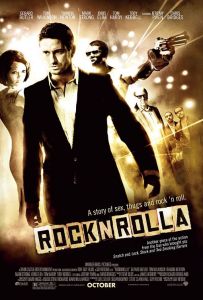 I’m a fan of Guy Ritchie’s convoluted cockney comedic crime capers (wow, check out that alliteration), but this movie is just plodding and dull. The trouble is that Ritchie works best when he has one foot in the fantastic, with comically over-the-top and menacing underworld personalities. A Ritchie movie usually involves a lot of crisscrossing characters, but this is his first film where I couldn’t keep the folks straight, I couldn’t understand much of the personal connections, I couldn’t understand the purpose of the various characters and their various interplay, and frankly, I never bothered to care. RocknRolla has maybe two colorful characters (all hail Tom Wilkinson as a sleazy real estate gangster), but the rest of the movie is overstuffed with bland and forgettable toughs. What the hell are Ludacris and Jeremy Piven doing here? You could eliminate half of the cast and the movie would barely be affected. This movie is just way too straight and square for its own good. Ritchie is still a top-notch visual stylist, and the movie has a terrific deep focus digital video cinematography, but there are very few moments or visual flourishes in this flick that prove to be remotely memorable. I hope Ritchie does not make good on his promise to continue telling more stories with these characters and in this style because this many needs to get back to what he does so well, and that is telling the darkly comic escapades of larger than life Dick Tracy-esque villains and scoundrels.
Nate’s Grade: C
Share this:

The Bank Job (2008)
 An intelligent and rather crackling heist movie that also happens to be based on a true story. The 1971 British bank heist has so many characters involved that you may need a helpful cheat sheet, especially when it comes to varied loyalties. There are three separate groups all playing their own game, and when the heist doesn’t go exactly according to plan, and then the movie gets even more complicated. It’s a flavorful and funny heist movie that also doesn’t ignore the severe repercussions and life-and-death stakes. The Bank Job is an engrossing crime caper that still manages to thrill and surprise an audience.
Nate’s Grade: B+
Share this:

Happy-Go-Lucky (2008)
 I wanted to turn this movie off for the first 30 minutes or so and that’s because of Poppy (Sally Hawkins), the deranged optimist that the movie follows. Writer/director Mike Leigh’s latest semi-improvised tale following the English working class centers on a primary school teacher who makes the conscious choice to be happy in life, no matter what life throws her way. Her presence is somewhat exhausting, like a customer who doesn’t know when making jokes has gone from fun to downright annoying. But you know what? Poppy eventually won me over, and I’m all but positive it was the scenes of her and her raging, pessimistic, tightly wound driving instructor (Eddie Marsan) that did it. Before their first driving lesson, I felt like the movie was giving me a slice-of-life that I was hesitant about; Poppy, like anyone who is insanely happy, can be grating. The humor is extremely dry and most of the clever dialogue exchanges will likely go by unnoticed because the actors aren’t delivering big punch lines. Hawkins goes all-out as the unflappable Poppy and she will make you smile through sheer force of will. This was a film I liked more by the time it was winding down, perhaps because Poppy might be easier to take knowing that time is coming to a close much like spending time with a distant relative during the holidays.
Nate’s Grade: B
Share this:

Elizabeth: The Golden Age (2007)
 This unanticipated sequel to the 1998 film that put Cate Blanchett on the map is pretty much the same setup from the original go-round. Once again, Elizabeth is trying to assert her authority, once again Catholics are plotting an assassination to place Elizabeth’s good Catholic sister on the throne, once again Elizabeth pines for a man she cannot have, this time in the dashing form of Sir Walter Raleigh (Clive Owen). Everything is cranked into overkill, which means there are plenty of speeches and plenty of bellowing. The romantic triangle between Elizabeth, Raleigh, and Elizabeth’s most beloved assistant to the Queen (Abbie Cornish) is a waste of time and does not dignify any of the three. The camerawork ranges from awe-inspiring to maddening, with the director relying on bird-eye-view long shots and always throwing some object in the foreground to obscure the action. It gets old quickly. Blanchett gets to suit up with armor and ride a horse around, but this Elizabeth redux leaves much to be desired. If they ever kick around an Elizabeth 3 in, oh, 10 or so years, hopefully they can move on to a new story structure while I watch the aging queen through a lattice 300 feet high.
Nate’s Grade: B-
Share this:

The Queen (2006)
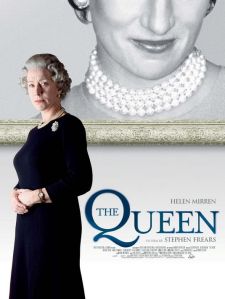
Long live the queen. In this instance Helen Mirren. After giving a majestic performance of Queen Elisabeth on HBO?s 2006 miniseries, here she is at it again this time as Queen Elisabeth II. Mirren is utterly magnificent in the role and burrows her way deep into her character, completely losing herself. Director Stephen Frears’ The Queen is a docu-drama examining the royals’ response to the tragedy of Princess Di’s death. It’s both a comedy of culture clash between the tradition-oriented world of the royals and the modern world that has moved beyond figureheads and symbols of monarchy and a drama exploring the grieving process. Frears and screenwriter Peter Morgan build great sympathy for the queen and the rest of these nutty royals, all stuck in a different age and hesitant and confused about mounting outcries for change. The royal family doesn’t understand the public’s demand to fly the flag over the palace at half mast in honor of Di’s passing; it hasn’t flown at half mast for over 400 years for anybody, kings and queens, let alone someone no longer part of that family. Even Prince Charles comes across remorseful, heartfelt, a little strange, but very identifiable. Plus, the actor looks a lot better than his real-life counterpart. It’s funny but also sad when the Queen Mum is hurt when her own funeral arrangements, the ones she picked out, will be used in a hurry for Di. The film pays equal attention to the rise of the new Prime Minister Tony Blair (Michael Sheen) and his frustrated relationship trying to save the royal family in a PR nightmare. Mirren, though, is absolute royalty. She plays a character prided in her decades-long approach to shielding emotion, to stoicism, to stiff upper lips, and Mirren displays the flashes of grief, befuddlement, and tenderness that register through that tricky prism. Queen Elisabeth II figures the public doesn’t want someone all weepy. She did, after all, begin her service around World War II when Winston Churchill was her first Prime Minister. The world has changed, she fears, and wonders if she’s fit to lead her people when she doesn’t even know what they want. The Queen is a sterling character piece with excellent direction and great performances. It’s quiet and moving but also a deeply fascinating behind the curtain view at a moment in time. And yet… I cannot help but feel some distance to the movie; I cannot put my arms around it just quite yet. The Queen is a very good film, of course, with an Oscar shoo-in performance by Mirren, but the free-floating plot and the intentional repetition and disconnect kept me from embracing this movie totally.
Nate?s Grade: B+


 nathanzoebl
You must be logged in to post a comment.