Blog Archives
A Christmas Carol (2009)
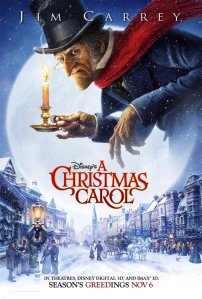 I still am at a loss over the appeal of the motion-capture system that director Robert Zemeckis fancies as of late. The creative mind that gave us classics Back to the Future and Who Framed Roger Rabbit? has embraced a technology that straddles the middle between live-action and outright animation. Motion-capture attaches electronic nodes to actors and digitizes their movements and facial features to later be conceptualized by computer wizards. And to this I say… so what? It seems like a whole slew of unnecessary work that adds little else than a vague starting point. Why not let the animators start from scratch? Why hamstrung creative professionals because Cary Elwes was feeling like making a certain gesture as “Portly Gentlemen #1?” I just don’t get it. To me, the motion-capture system is stranded in some artistic netherworld where it isn’t live-action and it isn’t animation. Zemeckis has cranked out his third mo-cap baby this decade, a retelling of Charles Dickens’ famous Christmas Carol. Why Zemeckis thought an old holiday chestnut would work best in this format, I’ll never know.
Cold-hearted Scrooge (Jim Carrey) is set to be visited by three spirits on a very magical Christmas Eve. The old man goes through Christmas past, present, and future to reevaluate his life and the true meaning of “peace on earth and good will toward men.” You know the drill, folks.
I like A Christmas Carol. I do. So do plenty of nice people. There’s a reason this oft-told tale still manages to resonate with generation after generation and that?s because it’s a good story. Of course it’s also an extremely familiar story to just about anyone outside of a womb at the moment. I expected Zemeckis and his crew to use their technology to jazz up the old story and give it a fresh new life on the big screen. Despite a handful of excursions flying through ye olde London, the extra slathering of special effects doesn’t enliven this holiday tale. I remember having great fun with Zemeckis’ previous motion-capture movie, 2007’s Beowulf (which does not play nearly as well in 2-D). That movie played around with the 3-D environment to great effect and made you feel apart of the experience. In contrast, A Christmas Carol does shockingly little with its depth of field, rarely placing distance between the foreground and the background. It’s a fairly lackluster 3-D experience. Maybe I wasn’t relaxing my eyes the right way, though I did notice how conscious I was of trying to elevate the 3-D experience myself. My disappointment is magnified by the fact that Zemeckis has been a pioneer for the 3-D playbook that Hollywood has now dubbed as the savior of the theater going experience.
 I wonder if Disney execs imposed limitations on the use of the 3-D immersion, not wanting to scare children by making them feel like they’re in the middle of a ghost story (there are some spooky moments already). The whole draw of motion-capture, and animation, is to transport an audience untethered by the limits of traditional practical filmmaking. This newest incarnation of A Christmas Carol fails to justify its existence. Why should I pay to see the most familiar story of modern day if there isn’t any new offering? At least The Muppet Christmas Carol gave me something different. And it had Muppets.
When I was younger in the mid 90s I was a huge fan of Carrey’s rubber-faced antics. I quoted Ace Ventura verbatim with my fellow seventh graders in 1995. So I understand the attraction of having him play multiple parts, but why exactly in a Dickens story? It’s not a comedy unless it’s adapted into one, and Zemeckis hews very close to Dickens and mostly recites the tale word-for-word. Scrooge isn’t funny, the ghosts aren’t funny, so why hire a renowned comedian to portray them all? This is a straight-laced adaptation and as such not the best use for Carrey’s talents. Is the move any better because Carey played all three ghosts? Is the movie any better because Gary Oldman gets to play Bob Cratchett and voice Tiny Tim? Is the movie any better because Elwes is credited for five inconsequential roles? Celebrity vocal casting is rarely effective in animation and so it seems the same in motion-capture.
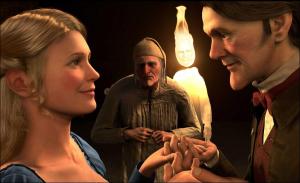 The technology has improved from the dead-eyed zombie children days of Polar Express, but it still seems like little more than less refined animation to my eyes. The movements are more fluid but the color palate is subdued into amber hues and candlelit locales. It doesn’t exactly use all the technological tools in the toolbox. It’s like a five-star chef toasting a Pop Tart: a waste of potential. I didn’t care for the skewed proportions on people either. Scrooge has a wiry frame with long spidery limbs and a triangular torso, and his character design kept reminding me of Jack Skellington. It’s too otherworldly considering nobody else comes across as a garish caricature in design form. The character designs for the three spirits are also fairly underwhelming. The Ghost of Christmas Past is a wispy flame. The Ghost of Christmas Future is nothing but a shadow. Is there a connection here? Otherwise, a shadow is pretty lame for the one ghost that can get really inventive and scary. Really, a shadow? I can do that myself without the aid of computers. And was it Carrey’s shadow to make it officially motion-capture? Because God forbid no other shadow could do or give the same performance of being draped over shapes.
I actually had to vehemently fight the urge to nap during A Christmas Carol. Maybe it was my poor sleep from the night before, maybe it was the fact that the 3-D glasses make everything darker (they still manage to hurt my eyes after prolonged use), but it was likely due to the fact that Zemeckis added a coat of polish to a holiday classic but declined to find purpose for doing so. Does this story get better with zooms through London, or Scrooge being shrunk and chased by demonic horses? It all seems like folly to me, like somebody’s idea to goose literary classics. Can you imagine Jane Eyre being shrunk and climbing through the walls of her Victorian era home? It all seems like an annoying distraction. Zemeckis? A Christmas Carol is exactly what you’d expect, which means you’d be just as well to flip through the TV channels and find any number of Christmas Carol versions. The Muppet Christmas Carol might even be on. Give that one a try instead. It even has some nice songs. And it’s got Muppets.
Nate’s Grade: C
Share this:

Beyond the Sea (2004)
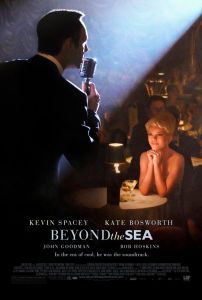 I really don’t think a lot of people know Bobby Darren. It seems that today most people would recognize him from singing “Beyond the Sea” over the closing credits of Finding Nemo. He wasn’t supposed to live past 17 but went on and wrote 400 plus songs including “Mack the Knife,” “Splish Splash,” and “Dream Lover.” Seems like there could be some interesting ground for a biopic. Kevin Spacey is one of our most celebrated actors and earned two very well deserved Oscars. Spacey has a strong passion for Darren and has been dreaming of portraying his life story for years. Passion is good for a role, right? Sam Raimi had passion for Spider-Man and look how those movies turned out. Well, with Beyond the Sea it seems that Spacey is less passionate about Bobby Darren and more passionate about his love of Kevin Spacey.
The film opens with the 37-year-old Darren (Spacey) reliving his life via a biographical movie he’s filming (yes, it’s a movie-within-a-movie). With the help of a younger movie self as a guide, Darren traces his rise from the streets of Brooklyn to headlining the Cococabana club. As a young child, doctors feared that Darren wouldn’t outlive his teens with his weak heart. Bedridden often, he found inspiration in music with his flamboyant yet supportive mother (Brenda Blethyn). Darren is driven to succeed and soon lands on top of the charts with a string of hits. Next he?s starring in movies with Rock Hudson and Sandra Dee (Kate Bosworth), a chickadee that Darren is just as determined to succeed with. They marry, have a child, but Darren doesn’t feel fulfilled. He needs to push his music further whether or not it alienates everyone around him.
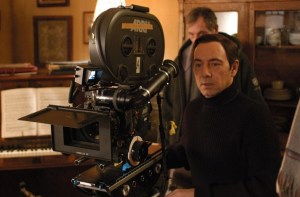 If you thought Beyond the Sea was the story of Bobby Darren, you’d be pitifully wrong. It’s really the story of Kevin Spacey, actor/writer/director/singer/dancer. That’s why we get to see flashy, superfluous dance numbers, that’s why we get to watch Spacey sing 12-15 times, and that’s why Spacey went to the trouble of re-recording all of Darren’s songs so that?s it?s Spacey belting out the tunes. Because, remember, this is a film about Spacey, not Bobby Darren.
Spacey is also much too old to be playing Darren, who died suddenly at age 37. He comes off lechery, especially during his courtship with the young Sandra Dee. Spacey isn’t unaware of this problem because in the opening minutes of Beyond the Sea someone accuses Bobby Darren of being to old to play himself in his movie. The response: “He was born to play this part!” There you go folks, case closed.
The acting in Beyond the Sea isn’t really an issue. Spacey has a genuine bounce to his song renditions and proves to be a capable dancer. John Goodman plays yet another gruff but lovable sidekick. It’s always good to see Bob Hoskins onscreen, no matter what the role may be. Bosworth comes away the best as she shifts from stars-in-the-eyes naiveté to a harder edge (you may rethink that whole song from Grease).
The dialogue is played so straight that it’s often hilarious: “Memories are like moonbeams, we do with them what we like.” With all due respect, what the hell does that mean?! I think I get the idea but what can anyone really do with moonbeams? If this line isn’t bad enough it becomes a central idea for Beyond the Sea which Spacey/Darren uses to excuse his flagrant gaps in time and fact.
Beyond the Sea gets so caught up in the Kevin Spacey Variety Hour that it fails to tell its audience why they should even care about Darren. Was he an inspiration because he outlived doctor expectations? Did he liven up old songs? Was he a remarkably versatile talent? Who knows? You’re on your own. Spacey’s too busy singing and dancing to explain the relevancy of Bobby Darren or why this movie should even exist.
There must be some interesting facts about Darren. I did not know that he wrote “Splish Splash” let alone that he wrote the whole song in 20 minutes. I didn’t know Darren required a toupee at such a young age. That stuff is interesting. It’s too bad it all takes a back seat because Spacey wants to emphasize his singing. Seriously, I get it; you can sing, Kevin Spacey. Can I see more of Bobby Darren and less of Spacey now?
 Beyond the Sea portrays Darren so single-mindedly. He’s always focused on his music and nothing else, whether that be a budding acting career (he was nominated for an Oscar), the advice of his friends, or the love of his family. Darren kind of comes across as a self-centered jerk a lot of the time in Beyond the Sea.
I don’t know which is worse, Spacey the director or Spacey the writer. It’s not that he’s inept at either end but he just makes decisions that kill the material. There has to be a better framing device than having Darren star in a movie about his life. There have to be better transitional ideas than having New York City explode into choreographed dances. To top it off, when the movie reaches its very protracted climax, we see the adult Bobby Darren in a tap duet with his younger self. Beyond the Sea loses whatever earnest intentions it had and melts away into one strange metaphysical song and dance revue.
Beyond the Sea has been a pet project for Kevin Spacey for so long that the focus has shifted from Bobby Darren to Spacey himself. This movie exists so that Spacey can celebrate himself. To say Beyond the Sea is a showcase of megalomania would be an understatement. Many scenes exist for no reason other than to give Spacey another opportunity to dance or sing. Re-dubbing all of Darrens songs seems a tad unnecessary and a whole lot about ego. Die-hard fans of Darren or Spacey may enjoy Beyond the Sea, but most people will grow tired of seeing Spacey congratulate himself for being an autuer. This is a self-indulgent nightclub act posing as a film. Memories are like moonbeams, and I’m forgetting this movie as fast as possible.
Nate’s Grade: D
Share this:

Enemy at the Gates (2001)
 Enemy at the Gates tells its tale over the pivotal Battle of Stalingrad where over a million Russians lost their lives to repel the German advancement. The Russians at this point were throwing boys as young as school kids into the battle and arming some of them with nothing. It was an attempt to create wave upon human wave to overrun the Germans. The Battle of Stalingrad was a decisive moment in WWII, but how Enemy of the Gates portrays it – the battle was nothing. The entire war was turned by two men.
The beginning to the film (and also the best part) shows the immediacy of the war and is very parallel to the Omaha invasion. People are shepherded into box cars onto a train, then arrive on the river and travel by barge to the ports of Stalingrad, then are sent up a hill one with a rifle and one with the rifle’s ammunition, and then thrown into the battle on the other side. Literally, an hour could pass from leaving home and death. Enemy at the Gates doesn’t paint a pretty picture of the Russians themselves (this is a Hollywood film after all) and displays the Russian war tactic of firing on your own men if they have the gall to retreat.
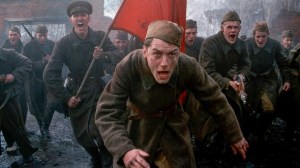 A survivor of the slaughter is Vassily Zaitsev (Jude Law), a rural farm boy with a great shot. He takes out a slew of Germans that have him and fellow Russian Danilov (Joseph Fiennes) trapped in the ruins of a city. Once back to friendly quarters Danilov decides to turn Vassily into a hero and prints numerous propaganda fliers and articles about his many triumphs to increase the morale of the faltering Russian army. Vesilly becomes a hero and a celebrity, though he continues to have his doubts if he can live up to his inflated image.
Rachel Weisz (The Mummy) plays the peppy patriotic girl who comes between our two mates creating an awkward Hollywood favorite: the love triangle. The very fact that she, and other women, are out there on the front lines defending their Motherland should not be taken as something in the advancement of feminist ideals in WWII Russia – at this point in the war them Ruskies would arm dogs and squirrels if they could.
Enemy at the Gates introduces its villain as an expert Nazi sniper played by recently Oscar nominated actor Ed Harris. Harris plays the character cold, yet sincere, like he is following the ways of war but not because he wishes to. He has a duty and he will accomplish it, down to the meticulous wire if he must. Harris’ sniper is sent in to assassinate Vassily Zaitsev and more importantly kill the morale of the Russians. This sets up the film’s showdown between the Law and Harris. Two men who are patient and silent killers dueling to see which one of them blinks first. A cat and mouse game amongst the fallen remains of a once proud city.
At least that’s how it happened in real life. The two men played a waiting game that went on for over two days to see whom would move first. The Nazi slipped and wound up dead. But this standoff where you couldn’t move for fear of being shot at any moment of weakness would’ve been fascinating alone to tell, especially if done straight. Instead we get Hollywood’s Saving Private Ryan.
 A rather peculiar aspect associated with Enemy of the Gates is the amount of people that die from being shot in the head. I mean, I actually looked and counted, there was maybe two people in this film that did not die from bullets that were not exploding through their heads. It gets a little silly as it goes and almost becomes an unintentional joke as we go on with 15… 20… 40 some CGI shots of bullets zipping through people’s foreheads. And the way the snipers are portrayed has it seem like a slasher film – you duck your head around that corner you are instantly dead!
Director Jean-Jacques Annaud’s previous film was the pretty but oh-so-mind-numbing-long Seven Years in Tibet. Here he takes the torch from Spielberg and plays with all the Ryan elements; dabbling with some blues, and muddy browns, and wreckage and what not. Annaud’s film is less a war film and more of a war propaganda film showing the strong effects it can attribute. Annaud also has the distinction of having the most awkward sex scene I’ve ever seen in a film. Weisz comes into where Law is sleeping and sneaks under his blanket. Except Law is sleeping in a row of other soldiers all lying on the cold cement ground with rubble all around them. The scene is very awkward to sit through and I feel will become notorious for it.
The movie isn’t all bad. Some scenes do have good tension and excitement. Law and Harris give credible performances, and Bob Hoskins appears for a very memorable role as Nikita Khrushchev. Enemy at the Gates is a war movie played with Hollywood elements that are as clear as day and weigh down whatever chance the film had. And would it have killed the cast if they could have tried a Russian accent!?
Nate’s Grade: C+


 nathanzoebl
You must be logged in to post a comment.