Blog Archives
W. (2008)
 Director Oliver Stone’s first draft at history is never boring but it’s rarely insightful. The film portrays George W. Bush (Josh Brolin) as a stubborn and simple man trying to live outside his abilities and the long shadow of his successful and emotionally distant father. George W. was not the favored son, as he is routinely reminded, and Ma and Pa Bush express their frustration. And yet the son who did not have his family’s support and acumen accomplished what no one else in the family had. He won reelection. He toppled Saddam Hussein. And then it all came crashing down. Ultimately, who was this movie made for? The detractors of Bush will view the film being too light, providing a psychological context that humanizes the man amongst his mistakes. You may even feel some sympathy as George W. repeatedly tries to earn his father’s approval. The movie is not a partisan or mean-spirited skewering. The fans of Bush will consider the film to be a cheap shot that restrings famous blunders and transplants Bush malapropisms into new settings. People may take offense at the idea of the current Iraq War being a result of unresolved daddy issues. Seriously, for a two-hour movie spanning the life and career of the most reviled modern day president, did Stone need to include the moment where Bush almost choked to death on a pretzel? Over the 2000 election debacle? Over the Air National Guard? Over 9/11?
W. lacks a strong point of view and the film’s timeline closes too soon, only going so far as January 2004, not even the halfway point for a two-term president who has only sunk lower in national approval from that moment. A miniseries would be a better medium to explore the failures and calamities and personalities of the Bush Administration. Brolin is terrific in the title role and he never dips into parody. The rest of the actors are hit-or-miss and the movie becomes somewhat of a game of identifying famous historical figures in their one-scene appearances. My biggest surprise was how much I felt emotionally connected to the first President Bush, played by James Cromwell in a performance that doesn’t even attempt to imitate the real-life figure. Stone and screenwriter Stanley Weiser (Wall Street) certainly don’t hide the characters they connect with (Colin Powell, often the voice of reason, is given a stirring speech calling for caution). Certain creative license is taken to provide dream sequences that can point toward the inner turmoil of Bush, like when his father admonishes him for destroying 200 years of the family’s name over the Iraq War. Overall, W. is an empathetic and sometimes dithering portrayal of the 43rd United States’ president that could have succeeded if it had more to say.
Nate’s Grade: B-
Share this:

Running with Scissors (2006)
 Ever since author James Frey imploded into a million little pieces, the memoir has come under intense scrutiny. At issue is the validity of the written word, whether these people are being honest as they recount their tortured yet inevitably redemptive lives. What is the difference between nonfiction and memoir, and does it implicitly imply personal bias? Running with Scissors is the 2002 best-selling book detailing the bizarre childhood of Augusten Burroughs. It’s a book with lots of out-there claims but they’re all held in check by Burroughs’ tart observation and witty writing. When translated to the silver screen, Running with Scissors loses credibility without the author’s voice. I doubt many people going in cold will even believe what they’re seeing.
In the 1970s, Augusten (Joseph Cross) is a gay teen growing up in the care of his alcoholic father (Alec Baldwin) and his deeply delusional, bipolar, wannabe poet mother (Annette Benning). When their marriage hits one of its many slags they seek out a therapist, Dr. Finch (Bryan Cox). He has a room he dubs his “masturbatorium,” a resemblance to Santa Claus, and a family just as whacked as he is. His oldest daughter, Hope (Gwyneth Paltrow), helps him in his practice and thinks that pets talk to her, even from beyond the grave. Natalie (Evan Rachel Wood) is the rebellious daughter who likes to play doctor via electric shock therapy. Agnes Finch (Jill Clayburgh) is the matriarch of this cracked family that also enjoys eating some dog kibble here and there. When Augusten’s mother signs over adoption papers he becomes the reluctant newest member of this dysfunctional family.
 The trouble with translating a book is that you lose the author’s voice and commentary. Running with Scissors maintains the horrifying living conditions for Augusten and the stable of oddballs, but lost is the author’s snappy humor that carried him through this tumultuous time. It’s definitely weird but it’s far from engaging. Without the wit and dark humor from Augusten’s voice we’re left with a series of loosely bandaged scenes about crazy characters and crazy anecdotes, little of which contains further importance. This is a fan of the book talking here, and I’m afraid that the film adaptation has heightened some of the weaknesses of the book, namely the loose storyline. When pieced together as a film, Running with Scissors can become slightly tiresome and overly reliant on background details. The film treats its wild, kitschy production design and 70s nostalgia as a character on par with anyone. It makes for great production design, true to the spirit of the book, but also serves as a narrative distraction. Too much attention seems to be put on getting things to look right than getting the screenplay to feel right.
Without the author’s voice the results lose credibility. It’s funny to see a Christmas tree up year round, and it’s funny when Dr. Finch is convinced God is communicating to him through his bowel movements, but it all just comes off as another joke like the art direction and nothing more. When fully added together without any sense of pathos, it all seems like a joke. The subplot involving Augusten’s sexual relationship with a much older schizophrenic patient (Joseph Fiennes) seems mishandled without much insight. Running with Scissors presents all examples of dangerous, sometimes illegal, behavior and doesn’t bat an eye, nor does it pass judgment. While this may irk some and seem irresponsible it’s just another case of little mattering. Running with Scissors, as an adaptation, presents little of consequence.
Director Ryan Murphy also adapted the screenplay and knows a thing or two about dysfunction and trashiness, having created the risky TV show Nip/Tuck. His adaptation has a blunted feel, but it also seems too broad. Then again, maybe only fans of the book would notice. He has a good feel for his actors and can stage some nice shot selections, but man, someone needs to slap his hand away from the AM radio. Running with Scissors is crammed with so many popular 70s tunes that it becomes a crutch, with Murphy hitting the soundtrack button whenever he needs some kind of character catharsis. It doesn’t work and comes across as indulgent and simplistic. There are so many zippy classic pop songs you may think Elton John is owed a writing credit.
 The acting is one of the elements that help give life to this adaptation. Benning has been generating Oscar buzz for her deeply self-involved portrayal of a mom held hostage by her illness. Benning digs deep and displays a comic range of absurd behavior and wild paranoia. She’s all over the place and you can’t help but loathe her, that is, if you ever take her seriously. But then, once overly medicated, she gives an entirely secondary performance as an emotionless zombie, and we feel a sliver of sympathy, a true surprise. It’s a good, meaty role, however, I actually think Clayburgh gives the more Oscar-worthy performance. In a lot of ways she’s resigned to her fate and yet manages to be the gauzy heart of the picture. She tells me more with her wrinkles than Benning does in her gesticulating outbursts.
The rest of the cast work admirably. Cross is our focal point of the story and does a fine job of, essentially, gawking and looking perplexed. He’s like a blank, gangly canvas, and I wonder what else Cross is capable of than a performance built around indignant reactions. Wood is developing into a lovely adult actress and has some of the best foul-mouthed lines. It’s just nice to see Paltrow in a movie again. Baldwin has transformed from leading man into incredibly versatile supporting actor that excels as comedic lunkheads. Cox remains one of my favorite character actors of all time. There’s nothing this man cannot do. The actors all do a good job of filling out their zany characters while leaving their own imprint.
The issue with Running with Scissors is that when you strip away the author’s caustic voice, then the movie strains credibility, even with the knowledge that it?s based on a personal memoir. The movie gets all the wackiness but misses out on some of the finer points and humor that helped save Augusten from his unorthodox housing. The story feels dulled and stretched too broad, and yet it still manages to be intermittently entertaining despite these flaws. The actors range from good to great and the art direction is fantastic, even if Murphy expects it to do more work than his screenplay. Running with Scissors isn’t as nervy, engaging, or provocative as its source material. Then again little else is. Consider the film Running with Safety Scissors.
Nate’s Grade: B-
Share this:

The Notorious Bettie Page (2006)
 A somewhat shallow biopic, The Notorious Bettie Page is kept afloat by an incandescent performance from Gretchen Mol, at one time the appointed future Hollywood It Girl. Mol imbues the same transcendent mix of girl-next-door sweetness and sex-kitten-in-training vivaciousness that Page was famous for; she was, in the same moment, both angel and temptress, and yet never understood the impact. We get your standard assembly of biopic moments but some intriguing past elements barely get touched on, like the potential sexual abuse Page may have experienced from her father. There’s a ripe conflict of sex vs. sin waiting to be explored that also seems to get the most cursory of exposure. Director Mary Haron (American Psycho) cleverly stages the movie as if it was a product of Page’s own time, but it also places the film in an artistic limbo because of its strident, possibly anachronistic forward thinking. Bettie Page is such an interesting person and had such a lasting impact, not just on the debate over what constitutes pornography, but the movies fails to tell us why she should still even be relevant. It feels somewhat of a shame that such a person, simultaneously a devout Christian and bondage pin-up queen, doesn’t get a better character showcase. Still, the movie is well made and Mol is luminous, imitating Page’s cheesecake poses and faces to perfection. The Notorious Bettie Page would have worked better looking harder at what made its title heroine notorious and memorable still to this day.
Nate’s Grade: B-
Share this:

Walk the Line (2005)
 I found this movie enjoyable but full of your standard, by-the-book biopic moments (rise/fall, addiction, famous faces, losing a brother at young age); still the performances were what the film hinged on and they were fantastic, especially with the added pressure of singing in their own voices. Walk the Line was good but didn’t really connect for me, and I think part of that is because the plot revolves around June Carter refusing to “be” with the Man in Black for 10 years. Yes they were each married to other people and their time on stage was like a forbidden courtship all its own, but it’s just not that compelling of a conflict, to me at least.
Nate’s Grade: B
Share this:

Capote (2005)
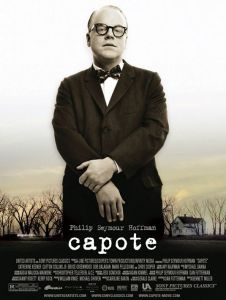 This is a really solid, probing movie about human relationships and the oversized personality of famous author Truman Capote. It’s a very illuminating character piece on its titular star. We see many different facets of his character; part of the connection is because Phillip Seymour Hoffman is so flat-out brilliant in his portrayal of Capote. He’s got that unmistakable nasal voice down, but Hoffman excels at the little things of character, his command of a crowd, his inflections, his physical movements, his ability to look exhausted and pained but embarrassed and prideful at the same time. Capote shows you why everyone wanted to rub elbows with him with how he tells a story and whips up an audience. This is another in the trend of warts-and-all biopics, and you see how calculating he is (he says he never lies). Every confession he offers is manipulative and meant for self-gain, like when he tries to get a witness to talk or get the Kansas P.I. to show him the murder photos. You see how the wheels work within this character. And then Capote shifts as he delves further into the case into his unlikely relationship with Perry Smith. Capote keeps them alive by providing money for their attorneys so he can get more for his book. But there can be only one ending to provide closure to his book — their death. There are several wonderful exchanges of dialogue between Smith and Capote and their quiet, smiling lies they give each other. All we see of Smith is the polite man who draws and read poetry in his jail cell, and the bond growing between him and Capote. The film’s climax eradicates any sympathy built and we see the unpredictable, unmerciful nature of violence. Capote really hammers home the dichotomy of persona, with each side playing the other. The cast is splendid and everyone makes their small roles click, particularly Catherine Keener as novelist Harper Lee and Chris Cooper as the Kansas P.I. What’s even more surprising is that Capote was even better the second time I saw it. There’s so much to find in this excellent character piece.
Nate’s Grade: A
Share this:

Beyond the Sea (2004)
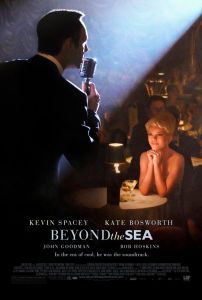 I really don’t think a lot of people know Bobby Darren. It seems that today most people would recognize him from singing “Beyond the Sea” over the closing credits of Finding Nemo. He wasn’t supposed to live past 17 but went on and wrote 400 plus songs including “Mack the Knife,” “Splish Splash,” and “Dream Lover.” Seems like there could be some interesting ground for a biopic. Kevin Spacey is one of our most celebrated actors and earned two very well deserved Oscars. Spacey has a strong passion for Darren and has been dreaming of portraying his life story for years. Passion is good for a role, right? Sam Raimi had passion for Spider-Man and look how those movies turned out. Well, with Beyond the Sea it seems that Spacey is less passionate about Bobby Darren and more passionate about his love of Kevin Spacey.
The film opens with the 37-year-old Darren (Spacey) reliving his life via a biographical movie he’s filming (yes, it’s a movie-within-a-movie). With the help of a younger movie self as a guide, Darren traces his rise from the streets of Brooklyn to headlining the Cococabana club. As a young child, doctors feared that Darren wouldn’t outlive his teens with his weak heart. Bedridden often, he found inspiration in music with his flamboyant yet supportive mother (Brenda Blethyn). Darren is driven to succeed and soon lands on top of the charts with a string of hits. Next he?s starring in movies with Rock Hudson and Sandra Dee (Kate Bosworth), a chickadee that Darren is just as determined to succeed with. They marry, have a child, but Darren doesn’t feel fulfilled. He needs to push his music further whether or not it alienates everyone around him.
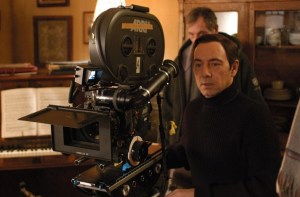 If you thought Beyond the Sea was the story of Bobby Darren, you’d be pitifully wrong. It’s really the story of Kevin Spacey, actor/writer/director/singer/dancer. That’s why we get to see flashy, superfluous dance numbers, that’s why we get to watch Spacey sing 12-15 times, and that’s why Spacey went to the trouble of re-recording all of Darren’s songs so that?s it?s Spacey belting out the tunes. Because, remember, this is a film about Spacey, not Bobby Darren.
Spacey is also much too old to be playing Darren, who died suddenly at age 37. He comes off lechery, especially during his courtship with the young Sandra Dee. Spacey isn’t unaware of this problem because in the opening minutes of Beyond the Sea someone accuses Bobby Darren of being to old to play himself in his movie. The response: “He was born to play this part!” There you go folks, case closed.
The acting in Beyond the Sea isn’t really an issue. Spacey has a genuine bounce to his song renditions and proves to be a capable dancer. John Goodman plays yet another gruff but lovable sidekick. It’s always good to see Bob Hoskins onscreen, no matter what the role may be. Bosworth comes away the best as she shifts from stars-in-the-eyes naiveté to a harder edge (you may rethink that whole song from Grease).
The dialogue is played so straight that it’s often hilarious: “Memories are like moonbeams, we do with them what we like.” With all due respect, what the hell does that mean?! I think I get the idea but what can anyone really do with moonbeams? If this line isn’t bad enough it becomes a central idea for Beyond the Sea which Spacey/Darren uses to excuse his flagrant gaps in time and fact.
Beyond the Sea gets so caught up in the Kevin Spacey Variety Hour that it fails to tell its audience why they should even care about Darren. Was he an inspiration because he outlived doctor expectations? Did he liven up old songs? Was he a remarkably versatile talent? Who knows? You’re on your own. Spacey’s too busy singing and dancing to explain the relevancy of Bobby Darren or why this movie should even exist.
There must be some interesting facts about Darren. I did not know that he wrote “Splish Splash” let alone that he wrote the whole song in 20 minutes. I didn’t know Darren required a toupee at such a young age. That stuff is interesting. It’s too bad it all takes a back seat because Spacey wants to emphasize his singing. Seriously, I get it; you can sing, Kevin Spacey. Can I see more of Bobby Darren and less of Spacey now?
 Beyond the Sea portrays Darren so single-mindedly. He’s always focused on his music and nothing else, whether that be a budding acting career (he was nominated for an Oscar), the advice of his friends, or the love of his family. Darren kind of comes across as a self-centered jerk a lot of the time in Beyond the Sea.
I don’t know which is worse, Spacey the director or Spacey the writer. It’s not that he’s inept at either end but he just makes decisions that kill the material. There has to be a better framing device than having Darren star in a movie about his life. There have to be better transitional ideas than having New York City explode into choreographed dances. To top it off, when the movie reaches its very protracted climax, we see the adult Bobby Darren in a tap duet with his younger self. Beyond the Sea loses whatever earnest intentions it had and melts away into one strange metaphysical song and dance revue.
Beyond the Sea has been a pet project for Kevin Spacey for so long that the focus has shifted from Bobby Darren to Spacey himself. This movie exists so that Spacey can celebrate himself. To say Beyond the Sea is a showcase of megalomania would be an understatement. Many scenes exist for no reason other than to give Spacey another opportunity to dance or sing. Re-dubbing all of Darrens songs seems a tad unnecessary and a whole lot about ego. Die-hard fans of Darren or Spacey may enjoy Beyond the Sea, but most people will grow tired of seeing Spacey congratulate himself for being an autuer. This is a self-indulgent nightclub act posing as a film. Memories are like moonbeams, and I’m forgetting this movie as fast as possible.
Nate’s Grade: D
Share this:

Luther (2003)
 Certain things can pass under my radar. Previously it’s been items like female flirtation and the due dates of papers. So imagine my befuddled surprise when last weekend my father, himself a Lutheran minister, said the family was going to hop on over to the movie theater and catch a historic bio-flick about Martin Luther, plainly titled Luther. I had no idea this movie existed. And after seeing it, it left no strong memory that it did.
Luther (Joseph Fiennes, Shakespeare in Love) is a 16th century German monk with some quibbles with the Catholic Church. Seems Luther doesn’t like how the Church is preying upon people’s faith for money, most notably its chief indulgence seller Johann Tetzel (Alfred Molina, with a criminally scant appearance). He makes up a list of 95 grievances, nails them to the doors of a church, and thus Protestantism is born. Luther’s ideas catch on wit the lower classes through rampant publication, thanks to the newfound printing press. The princes of the German states also like what this monk is cooking, and they decide to hold him in safety. The Catholic Church, however, is none too pleased. They threaten excommunication and eventually death, and keep pushing for Luther to recant. But Luther feels he must stand strong in his convictions.
The acting is fine, and the direction is passable, but the pacing of Luther is like tracking the movement of a glacier. Some representative decisions are also fairly stupid. To try and communicate Luthers internal struggle he hits his head and yells like at voices. The first time it’s funny. The next five times, it’s dumb. There’s also a dirty peasant child who’s crippled but still a big fan of the Luther Man. Her gaping tooth smile has more screen time than some characters. Later in the film the peasant revolts ravage through the country with thousands massacred. Luther visits the ruins and comes across the little girl’s broken crutch and breaks down and cries. If you were in my theater you probably heard me hitting my forehead repeatedly (no voices though).
The film is an admirable effort, but Luther ultimately fails because of the measures of film. To try and tell the story of Luther would be more appropriate for the confines of a miniseries, not a two-hour movie. The Reformation and its players lose its impact in such a shrift retelling. What the audience gets is a pared Cliff notes version that misses the richness, and gives lip service to the historical importance. What were left with are endless scenes where people dress up and talk and talk and talk. Without a sense of weight for character or story, the countless talky moments blur into tedium. If I had a sleeping bag with me I would have curled up into it.
Another problem is the lack of makeup. The film spans thirty-some years and yet Fiennes doesn’t age a day. My mother proposed that maybe he didn’t want to look old and decrepit in the film. I responded by saying, He let them shave his head but he didn’t want anybody to splash some gray in his hair?
I guess if you judge movies on costumes or production values, Luther would be competent. But does anyone go to a film saying, ”Man, I sure hope those costumes and sets are incredible! Fingers crossed!?” Luther is a well-meaning bore that only historical enthusiasts and Lutherans might enjoy.
Nate’s Grade: C
Share this:

Topsy-Turvy (1999)
 Mike Leigh’s latest might prove to be the old Brit’s most daring and ambitious spectacle of memory. It’s the tale of English musical maestros Gilbert and Sullivan chronicling their rocky yet firm relationship and the bustle of theater life. The period is set down exquisitely with massive amounts of elegant costumes and set designs, all of whom do well to distract you from the plot. Oh I forgot, there isn’t one. The drawback to Leigh’s Topsy-Turvy is that it is less a movie and more of a recreation of Gilbert and Sullivan musical numbers. Each musical piece lasts in its enduring entirety unyielding to be edited in the least. Thus in between each interlude is a snippet of theater life and the insanity displayed much more fluently by 1998’s Shakespeare in Love. Topsy-Turvy degenerates into a Fantasia style movie — a musical number here, a snippet in between, then another musical number, and repeat for two hours and forty minutes. To theater lovers, and especially Gilbert and Sullivan enthusiasts, Mike Leigh’s celluloid account should prove a triumph and brilliant in its startling recreation of 1880s English life. But to any other audience members out there, boredom will set in quickly enough and you’ll be asking yourself when you leave if you bought a movie ticket or a theater ticket.
Nate’s Grade: C
Share this:

Man on the Moon (1999)
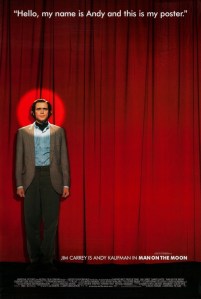 After many years the big screen biopic of one of comedy’s greatest figures of recent finally emerges to the awaiting public. Many never knew what to make of Kaufman or what he was attempting to do, and the movie displays this attitude to its core.
First things first, there is no Jim Carrey in this picture, only Andy. Carrey’s performance is pitch-perfect and swarming and enthralling that he becomes the glue of an otherwise sticky movie. Carrey IS Andy Kaufman, it’s like seeing dear Andy alive and well back on screen still terrorizing the easily duped. It almost brought a tear to my eye. Carrey takes the sheep skin and pulls off an incredible career best performance that demands attention come award time.
But without Carrey’s masterful performance Man on the Moon is not worth venturing out of the home for. The movie never delves beneath the surface to discover who the true Andy Kaufman was or why he did the things he did. And if the point is that there was no true Kaufman but merely a stage character then fine, but did we need a movie? Without any inner depth the flick becomes a shapeless reassembling of TV stints and clips Andy pulled. If I wanted to see this I’d watch Comedy Central at odd hours of the night.
Courtney Love pops her head in late into the running time to establish herself as the love interest, but her character like everyone else, is never fleshed out. Love just becomes a hollow foil to Kaufman’s antics in some vain attempt to add heart to the madness. The most lingering problem is that of the relationship between Kaufman friend and co-conspirator Bob Zmuda never being shown beyond communal frat brothers. Man on the Moon gives the reigns of the picture to Carrey, and rightfully so, but then seems to believe Carrey as Kaufman is the only substantial character in the story.
Man on the Moon is for the most part an entertaining retelling of the rise and fall of Kaufman, and his indifference all the way. Director Milos Foreman and his two Larry Flint scribes try their hand at uncovering the man behind the curtain, but stumble along the way. Maybe this is the film Kaufman would have wished, one that doesn’t answer any questions or is forced to entertain its patrons. But me thinks that the Hollywood version of Andy stays true to his stubborn nature, but trips its feet towing the mystery that was one of comedy’s most peculiar influences.
Nate’s Grade: C+


 nathanzoebl
You must be logged in to post a comment.