Blog Archives
Selma (2014)/ Black or White (2014)
 There’s a reason that race is regarded as the “third rail” when it comes to American politics. A half-century after the marches and protests, chief among them the influence of Martin Luther King Jr., the world feels just as fractious as ever when it comes to race relations. The inauguration of America’s first black president was seen as a significant touchstone, but optimism has faded and recent headline-grabbing criminal cases, and the absence of indictments, have prompted thousands to voice their protest from assembly to street corner. Race relations are one of the thorniest issues today and will be for some time. Two recent films take two very different approaches to discussing race relations, and they’re clearly made for two very different audiences. Selma is an invigorating, moving, and exceptional film showcasing bravery and dignity. Where Selma is complex, Black or White is a simplified and misguided sitcom writ large.
In 1965, Alabama was the epicenter for the Civil Rights movement. Martin Luther King Jr. (David Oyelowo) has his sights set on organizing a march from Selma to the sate capital in Montgomery. His wife, Coretta (Carmen Ejogo), is worried about the safety of their children, as death threats are sadly common for MLK. He needs to turn the tide of public perception to light a fire under President Lyndon Johnson (Tom Wilkinson) to get him to prioritize legislation that would protect every citizen’s right to vote.
 Without question, Selma is one of the finest films of 2014. It is powerful, resonant, nuanced, political, immediate, and generally excellent on all fronts. It’s a rarity in Hollywood, namely a movie about the Civil Rights movement without a prominent white savior. This is a film about the ordinary and famous black faces on the ground fighting in the trenches for their freedoms. There are compassionate white people who heed the call, don’t get me wrong, but this is a movie told from the black perspective. I suspect the portrayal of President Johnson had something to do with Selma’s poor showing with the Oscars, though I can’t fully comprehend why. Yes, Johnson is portrayed as a man who has to be won over, but he’s on MLK’s side from the beginning. He is not opposed to legislation to protect voting rights; he’s just hesitant about the timing. Johnson says, “You got one issue, I got 100,” and the pragmatic reality of pushing forward legislation through a divided Congress was real. Johnson was not opposed to MLK’s wishes; he just wanted him to wait until the political process would be easier. In fact, in my eyes, Johnson comes across as compassionate, politically savvy, and he clearly makes his stakes on which side of history he’s going to be associated when he has a sit-down with the obstinate Alabama governor, George Wallace (Tim Roth). Like the rest of the varied characters in Selma, it’s a nuanced portrayal of a man in the moment.
The march in Selma is a moment that seems like an afterthought in the narrative of the Civil Rights movement, dwarfed by the Montgomery bus boycott and the March on Washington. The movie does a great job of re-examining why this moment in history is as significant, an eye-opening moment for the nation to the brutal reality of oppression. The opposition is entrenched, thanks to a stagnant system that wants to hold onto its “way of life.” It just so happens that way of life meant very different things for black people. The movie is politically sharp, with dissenting perspectives arguing over the next course of action in Selma and the national stage. Selma is another in the current crop of biopics eschewing the standard cradle-to-grave approach to highlight a significant moment that highlights exactly who their central figure is (Lincoln, Invictus). With Selma, we get a battleground that allows us to explore in both micro and macro MLK, the man. The courage of ordinary citizens in the face of violent beatdowns and police bullying is effortlessly moving and often heartbreaking. There is a moment when an elderly man, reflecting upon a recent family tragedy, cannot find words to express his grief, and my heart just ached right then and there. I teared up at several points, I don’t mind saying.
 There isn’t a moment where I didn’t feel that director Anna DuVernay (Middle of Nowhere) was taking the easy road or pulling her punches. The screenplay respects the intelligence of the audience to sift through the politics and the arguments, to recognize when MLK is igniting a spark, and just how complicated and fragile the Selma situation was back then. Here’s a movie ostensibly about MLK but spends much of its time on the lesser known individuals like James Bevel and Congressman John Lewis, who walked alongside the man, taking time to flesh them out as people rather than plot points. MLK’s wife is also given an important part to play and she’s much more than just being the Wife of Great Man. DuVernay’s direction is impeccable; you feel like she has command over every frame. The sun-dappled cinematography by Bradford Young (A Most Violent Year) makes great use of shadows, often bathing its subjects in low-light settings. The score is rousing without being overpowering, just like every other technical aspect. This is a prime example of Hollywood filmmaking with vision and drive.
With respect to the Academy, it’s hard for me to imagine there being five better performances than the one Oyelowo (Lee Daniels’ The Butler) delivers as the indomitable Martin Luther King Jr. It is rare to see an actor inhabit his or her character so completely, and Oyelowo just sinks into the skin of this man. You never feel like you’re watching an actor but the living embodiment of history made flesh. This is a complex performance that shows refreshing degrees of humanity for a figure sanctified. He was a man first and foremost, and one prone to doubts and weaknesses as well. An excellent scene with top-notch tension and peak emotion involves MLK and Coretta listening to a supposed tape of Martin’s infidelity. In the ensuing tense conversation, both parties acknowledge the reality of his affairs. It’s a scene that’s underplayed, letting the audience know she knows, and he knows she knows, but not having to rely upon large histrionics and confrontations. It’s the behind-the-scenes moments with King that brought him to life for me, watching him coordinate and plan where to go with the movement. Oyelowo perfectly captures his fiery inspirational side, knocking out every single speech with ease. It’s a performance of great nuance and grace, where you see the fear in the man’s eyes as he steps forward, hoping he’s making the best decision possible for those in desperation.
There isn’t one bad performance in the entire film, and this is a deep supporting cast including Wendell Pierce (HBO’s The Wire), Tessa Thompson (Dear White People), Common, Giovanni Ribisi, Dylan Baker, Lorraine Toussaint (Netflix’s Orange is the New Black), Stephen Root, Cuba Gooding Jr, Jeremy Strong, and Oprah Winfrey.
It’s been weeks now since I watched Selma but there are still many moments that I can recall that still have a tremendous power on me even in mere recollection. The opening sequence of the Birmingham bombing, a moment of horror frozen in chaos and debris, is a gut punch of a way to begin a movie about human beings fighting for equality. The sheer brutality of the response from the Selma police force and associates is horrifying, and a true pivot point for the movement in the eyes of the public. More so than anything else, Selma brilliantly and beautifully recreates the suffocating reality of injustice that was so prevalent for many African-American citizens, especially in the South. This is an era where people are being lynched with impunity just for being “uppity.” There was a supreme danger in simply standing up for equal rights, and many suffered as a result. The movie recreates this mood, this permeating feeling of dread and outrage and sorrow, so expertly and so artfully. From an early scene with a middle-aged black woman jumping through hoop after arbitrary hoop just to register to vote, you quickly realize that this vehemently hostile environment was never going to settle things on their “own time,” as apologists are prone to citing in lieu of federal intervention. Selma makes it abundantly clear why MLK felt the movement just could not wait, as Johnson requested. People are senselessly dying and being beaten all for the right to fairly vote. You feel the same sense of urgency with every scene, whether it’s cold-blooded murder, noxious intimidation, or reciprocation that goes above and beyond any sense of responsibility, you understand exactly the terror it was to be black in the South during this time period.
 Another potent point of acclaim for Selma is how relevant it is to our own world today. While 12 Years a Slave was an often stirring and very professionally made biopic that exposed the ugly reality of slavery, it was not a film that screamed “immediacy.” Slavery ended in this country over 150 years ago, and while we’re still dealing with the repercussions of treating other human beings as property, it’s an easy film to dismiss in a backhanded, “Well, that was so long ago, and we’ve come so far” manner. The actions of Selma and MLK are still being felt to this day. We live in a world where many feel the justice system has its own separate-but-equal division, and the recent controversial grand jury decisions in the cases of Michael Brown and Eric Garner cannot be ignored. The reality for many black men in this country is statistically far more dangerous than others, fueled by a culture of entrenched racial bias that assumes the worst at first. The transit officer who executed Oscar Grant (detailed in the harrowing 2013 film Fruitvale Station) served eleven months in prison for a crime that had scads of witnesses. Garner’s death is captured on video, and yet even the Staten Island coroner’s report of “homicide” wasn’t enough to convince a grand jury that there was sufficient cause to at least go to trial. It’s been noted that prosecutors could get a grand jury to “indict a ham sandwich.” According to the U.S. Bureau of Justice Statistics, of the 30,000 cases that were not prosecuted in this country, only 11 were because a grand jury did not return an indictment (.0004%). However, grand juries rarely indict when a police officer is accused (In Dallas between 2008 and 2012, there were 81 grand jury investigations of officer shootings and only one actual indictment). It’s hard not to feel like these things don’t add up.
Then there’s the all-important struggle of voting, central to Selma and the plight of African-Americans in the South. You would think with Johnson’s passage of the Voting Rights Act that we wouldn’t be litigating the same issues of the past, but the Supreme Court determined that this country is far different then it was in the 1960s and there was no need for the Voting Rights Act today. Within hours of striking it down, scads of new legislation appeared in the (primarily Southern) states that had been limited beforehand because of their past history of discrimination. The right to vote is just as relevant as it was during MLK’s time and there are forces trying to stifle that right, to throw up new obstacles, new hoops, new challenges, all in the name of “polling security,” never mind that the cases of in-person voter fraud are so rare as to be one in every 15 million voters. It’s a solution without a cause, and it’s why many see it as a disingenuous political ploy. It’s the twentieth-century, and yet the struggle for equality frustratingly repeats too many of the same battles. It’s this historical and contemporary context that gives Selma its extra surge of relevancy, reminding how far we still have to go, reminding the world that MLK’s work is by no means complete and that it is up to the rest of the populace to fight for the kind of country that he spoke of in his “I Have a Dream” speech.
 It is this complex, complicated, and dire reality that hobbles another movie that tackles modern-day race relations, Mike Binder’s imprudent Black or White. The plot of the film, inspired by a true story reportedly, centers on Kevin Costner as Elliot Anderson, a rich lawyer who has custody over his biracial granddaughter Eloise (the angelically adorable Jillian Estell). Now that Elliot has lost his wife, Eloise’s other grandmother, Rowena Jeffers (Octavia Spencer), wants joint custody so Eloise can spend time around “her own people.” The two of them push and pull and lock horns over what’s best for their grandchild, which gets more complicated when her biological father (Andre Holland, who is actually in Selma as well) comes back into the picture.
Right away you can tell very early on that there will not be anything approaching subtlety in the world of Black or White, its own title serving as the first clue. The characters are sketched broad and the premise feels like a weird mishmash of Archie Bunker appearing in a court drama. It’s a preachy movie that doesn’t have a deft hand when it comes to crafting a message that rises above easy observations disguised as something deeper. Eloise’s father, Reggie, is so poorly underwritten that he feels like he stepped off the set of some after school special. He’s addicted to crack, a lifelong screw-up, and a general disappointment that has never been present for his daughter’s life. He even smokes crack out in the open on the front porch across the street from where his mother lives. At one point, Anthony Mackie’s character berates Reggie for being a walking stereotype. Just because Binder calls attention to it doesn’t excuse it. But he’s not alone, because Spencer’s sassy black matriarch character and Costner’s gruff and frequently soused character are right there with him. The frequent arguments feel like they should be punctuated by studio audience hoots and applause, that is, if you could hear them over Terrence Blanchard’s relentlessly overpowering musical score instructing the audience exactly how to feel with every clunky moment.
 In a way, the overbearing musical score gets at the major problem of Black or White, which is that a complicated case is being told from the safest point of view. Elliot is more akin to Clint Eastwood’s character from Gran Torino then, say, Archie Bunker. He’s irritable and prejudiced and old-fashioned and wary but balks if you call him a bigot. I mean he’s polite to his Hispanic housekeeper. The more you examine the character the more you realize this is a movie designed to coddle an older generation (my tiny theater was packed with patrons over 60). The movie doesn’t challenge anybody and actually rewards Costner’s character and his outdated viewpoints. The opening conflict over his refusal to share custody with Rowena makes no sense. She’s an excellent grandmother, caring, nurturing, a fine role model as well for her perseverance and starting several small businesses out of her home. Not only that but Rowena is surrounded by a large family of relatives that adore Eloise. It’s contrived that these two could not agree on shared custody when they both have much to offer the girl. The only way any of this works is if Reggie is somehow responsible for the death of Eloise’s mom. Perhaps he introduced her to crack and she overdosed. Unfortunately, it’s never explained in the slightest, and so Elliot’s hostility for the entire Jeffers clan seems petulant, especially with the happiness of his granddaughter in the balance. Without better context, his rampant anger seems to be guilt-by-association overkill. To his credit, Rowena has a major and annoying blind spot when it comes to Reggie’s stability as a parent. In fact he’s so obviously still on drugs that her ongoing refusal to accept reality harms her character irreparably.
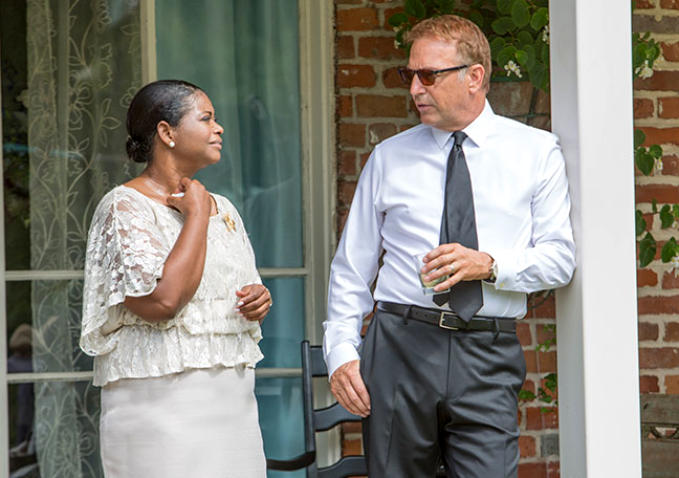 In the end, Black or White isn’t so much a film that about race relations as it is about privilege. Costner’s would-be bigot doesn’t have a problem with black people, just as long as those black people abide by his rules of conduct and expectation. It’s the same kind of qualification he’s never had to consider for himself, and one the intended audience will likewise miss. He comes from a wealthy position and Rowena and her family are likely lower middle class at best. He has a world of class privilege at his disposal that the loving Jeffers family does not, and because of that he feels they are less suited to raising little Eloise. Perhaps he’s worried about Reggie re-entering her life, but what animates Elliot Anderson is spite. He’s consumed with the overriding assumption that he must be right in all things. While the film draws many heavy-handed parallels between Reggie’s drug abuse and Elliot’s alcoholism, it clearly presents the both of them on completely different planes of judgment. One of them is ultimately redeemable and the other less so. Elliot’s perspective is essentially he can provide more and therefore more has to be better, but his definition of more is a private school, a housekeeper, a tutor who is treated as a caricature of initiative. Rowena provides a large and loving support system, but apparently they are less valued in the eyes of Elliot. And if you needed any more of a clue that Elliot and his sense of privilege are the unbeknownst star of the movie, he gets to deliver the big speech at the end that Says Something Meaningful. It feels a bit odd that the one character that uses the N-word in the film (albeit there is context) is the one telling lower-class black families how to live.
I don’t doubt the sincerity of writer/director Mike Binder (The Upside of Anger); I don’t think he purposely made a film to make older, primarily white Americans feel better about thinking what they do about these troublesome times. It’s not a nefarious movie but it is misguided and will provide cover for a certain selection of audience members who wonder why nobody is asking the old white guys their opinions on modern race relations. Even overlooking this charge, Black or White is just overblown melodrama that has to constantly explain everything to you at all times and guide you through every strained point. Selma and Black or White are both aiming at hearts and minds, looking to add to the conversation on contemporary race relations, but only one of them works as both an eye-opening message of empathy and as an exceptionally made film itself.
Nate’s Grades:
Selma: A
Black or White: C
Share this:

Big Eyes (2014)
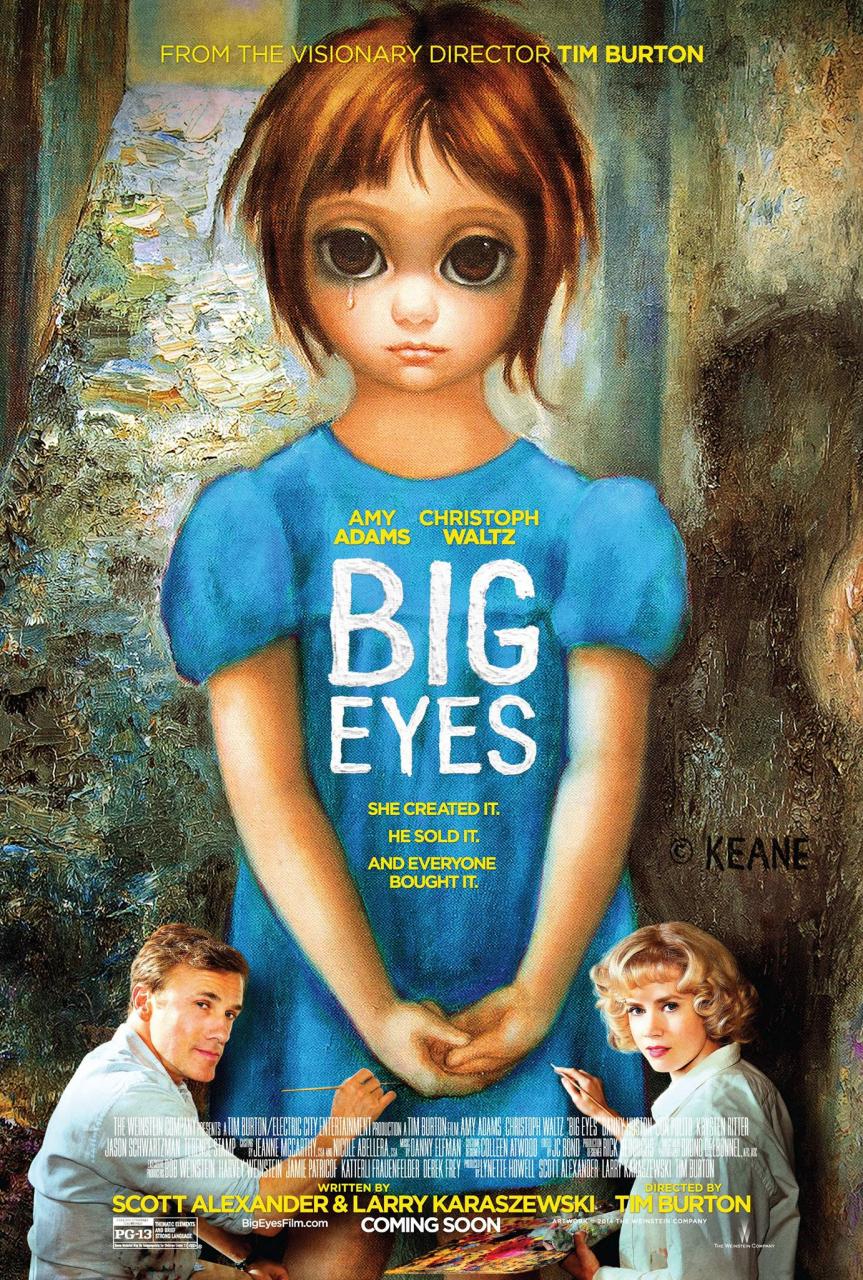 Like most people, Tim Burton is a filmmaker who likes working with a select set of familiar faces. Since 2001, Burton’s wife Helena Bonham Carter has appeared in every one of his films. Johnny Depp has appeared in every Burton film since 1999’s Sleepy Hollow, save for Planet of the Apes. It got to the point where you knew if Burton were attached as director, these two would be riding shotgun. No so fast, as Big Eyes is absent Depp, Carter, other longtime collaborators like editor Chris Lebenzon, and really any noticeable sign that Burton actually was the director. This bizarre biopic about a scandalous secret in the art world fails to justify more than a casual viewing.
In the 1960s, Margaret Keane’s (Amy Adams) portraits of waifish children with large, tragic eyes were the most popular art of the decade. They fascinated the public who couldn’t get enough, including clamoring for reprints so everyone could have their own Keane work of art. Except the world at large never knew that Margaret had painted them. Her husband, Walter (Christoph Waltz), was posing as the real creator. He appeared on television, ran with famous celebrities, and always looked for the next platform to elevate the Keane name, all while Margaret stayed home and painted. She agreed to go along with Walter’s version of events because the public was more accepting of a male painter, and Walter was such a natural salesman. The world could never know the truth.
 Being a true-life story, there are certain limitations inherent in sticking to the facts while still telling an engaging story, and Big Eyes suffers from this. There is an interesting story here, no doubt, and that is clear and on display when Margaret and Walter square off in court as a majority of the third act. Before then, the screenplay by Scott Alexander and Larry Karaszewski (Ed Wood, The People vs. Larry Flynt) plays in a very linear fashion, telling the story very conventionally except for the annoying narration of a news reporter (Danny Huston). The reason this character is clumsily inserted into being our narrator is because the real main character, Margaret, spends two acts being so passive and often hidden before she gathers the courage to challenge her husband and expose him. Naturally, there’s got to be a realistic character arc where our heroine goes from naïve and inactive to stronger and active, but it takes most of the movie. In the meantime, she paints and paints and literally hides herself from the world. It feels like the movie forgets about her while Walter is gallivanting around on her fame. Ironically, the movie actually becomes a series of men attempting to tell Margaret’s story; the first is her husband but the other is the invented and unnecessary narrator.
To make up for the time the film seems to paint a more flattering than deserved picture of Walter. I think perhaps they want the audience to fall under his spell just like Margaret and then slowly come to the same dawning realization. His initial argument is that female artists are not taken as seriously in their era, and I’m sure there’s truth to this. It was generally harder for a woman to be seen as legitimate in just about any capacity other than homemaker in the 1960s. We spend a full two acts with him charming others and hoodwinking the art world. He’s portrayed as more of a used car salesman con man than what could be described as a dangerous egotistical drunk who exploits his wife. The movie gives him a few nasty moments but it seems to portray Walter with light judgment, even after he endangers Margaret and their daughter’s lives. With Margaret figuratively and literally a kept woman cooped up for so long, Walter’s antics start to come across as vamping, filling time until Margaret hits that point on her character arc to leave him. It becomes tiresome then to just watch Walter sputter and spin his way to greater fortune and fame, though he deserves credit for popularizing the printing of painting reproductions that sell for cheap. Walter Keane, footnote in the art world for commercializing it for the masses. Waltz (Django Unchained) is an effortlessly entertaining actor and charming cads with a thinly veiled air of menace are his specialty. It’s a waste of his talents because Walter is kept as an ongoing mystery rather than an opportunity to explore a complicated character’s psyche. We find one falsehood after another, but in the end, he’s still just a mystery left unsolved.
There is amusement to be had at points as to be expected when it comes to keeping up a con, almost getting caught, the scrambles to continue hiding the big lie. This fun is at the expense of Margaret, which the movie wants you to think about and not think about at various points. There are streaks of comedy but I’d hardly call Big Eyes a comedy (sorry Golden Globes categorization). Terrence Stamp is enjoyable as a disapproving art critic who cannot believe what Walter is doing or why he is popular. The final act is easily its most entertaining as Margaret finally gets to call out her scoundrel of a husband for his bad behavior. It takes several unexpected turns that seem too fanciful to be true, and yet they are. The courtroom setting feels right for this script, and if there were a rewrite, I would have used it as the primary setting. The story could be introduced through a series of flashbacks. At least that way we don’t have to wait for Margaret to be the strong heroine we need, and we don’t have to be constrained by the wait of linear storytelling. This approach would strip away some of the redundancies of the plot and at least allow Margaret an opportunity to be the one telling her story.
 Another problem with Big Eyes is that at no point does it feel like a Tim Burton film. The man is better known for his dips into Gothic fantasy, but in 1994 he showed he could more than pull off a conventional film in Ed Wood. Just because the story doesn’t involve weird fantasy characters and violence doesn’t mean that Burton cannot still add value being the man to tell that tale. Unfortunately, there is no point while watching Big Eyes that feels like it was directed by Burton. The director could have been anybody. If you kept the identity of the director secret, I cannot imagine more than a slim number of participants accurately guessing who directed the picture. I wonder what attracted Burton to the script, which does have its share of true-life eccentrics and hucksterism, both appealing aspects for the man. It’s just lacking a sense of vision that Burton usually has in spades, even if that vision over three decades has become a tad commoditized. I won’t go as far to say the film is poorly directed because a majority of the problems remain with its script rather than the actors or shot selections. Still, Burton doesn’t bring much to elevate the material. Perhaps that’s a positive, he didn’t attempt to overpower the narrative with a superfluous detour in style, but then why hire Burton?
Adams (American Hustle) is a consistently good actress and she does her best with the part, but the limitations are even too much for her talents. By no means is she bad but she’s playing a passive character often given to worry. She’s stashed away for a majority of the movie. You feel like Adams is acting with one hand tied behind her back.
Big Eyes is a movie that intrigues you with its potential only to frustrate you with its eventual execution. The true story behind the film is juicy and outlandish, crying out for the venue of cinema. The struggle between husband and wife over the ownership of an empire is a conflict that hooks an audience. Thanks to a repetitive plot structure and character vamping, the film limits the heights it can achieve. Burton’s presence is not felt at all throughout the film. The comedy often sours when you realize the full context of what’s going on, a much more serious affair than the film often wants you to think about. The characters are kept at a distance and given arcs rather than deeper exploration. She will become active and find her voice, fighting for credit. He will be the con man who wants to keep everyone distracted, fueled by jealousy at his wife’s abilities. There’s more psychological complexity here, but Waltz and Adams are slotted in very narrow boxes. They have little to work with and their performances show it. Big Eyes isn’t a bad film but it’s one that deserved to be better in just about every regard. It’s a fleeting curiosity more than a fully developed film, and that’s a shame given the source material. Expect Burton to return back to the safe embrace of Johnny Depp’s arms at any moment.
Nate’s Grade: B-
Share this:

American Sniper (2014)
 When killing is a man’s gift, what effect does that have on the man? American Sniper follows the real-life heroics of the most prolific sniper in United States history. With director Clint Eastwood attached and awards buzz building, you’d expect that the film would get at the heart of a complex man who placed himself back into danger by choice. For a biopic on Chris Kyle, the man seems to get lost in the fog of war (movies).
Chris Kyle (Bradley Cooper) enlisted in the military right before 9/11 and served four tours of duty in Iraq. He served as cover for many missions, protecting thousands of soldiers. The troops just felt better knowing that Kyle had their back. Kyle got married and had several kids with his wife (Sienna Miller) but he kept leaping back into the fight, the place he felt he belonged.
 From the opening sequence on, American Sniper is often a gripping suspense piece. The opening moral dilemma sucks you right in. Should Chris shoot the mother and child? Are they a threat or is there just a misunderstanding? Will they change their minds and turn away? Is there time to debate all this with advancing U.S. troops? Eastwood does a great job of drawing out the tension with shot selections and the precise editing. The bulk of the movie hews closer to a conventional action movie, with Chris and his team clearing out Iraqi insurgents. We get to know a bit about the mechanics of sniper warfare. But Kyle gets restless being the guardian angel of death for the ground troops, and he goes down to their level and clears neighborhoods. This causes some conflict with his superiors because Kyle is far more valuable as a sniper. His reputation for killing is also getting him notoriety with his enemies. There is a price on Kyle’s head and skilled snipers are seeking him out for the prize. This is a natural way to build suspense as Kyle keeps returning back into Iraq with multiple tours, every tour increasing his personal danger. It allows for real consequences for the increasing prowess of our super sniper. There’s a sense of collateral damage to every kill, as every dead body creates more enemies and those enemies grow more incensed to take him out. Even if you know how exactly Kyle met his untimely end, there’s still plenty of suspense and well-orchestrated action sequences to please casual fans of the genre and true-life military thrillers.
It does feel like the complex story of Kyle, as well as the Iraq War, are being simplified into action movie fodder. There’s a steady supply of interchangeable supporting players, soldiers and spotters and the like, all of them without much to distinguish them as characters. They’re here to be sacrificed, to watch the splatter of red, and to increase the sense of loss because we know that Chris Kyle will not be taken down so we need other expendables. As expected, Miller gets rather short shrift as Kyle’s wife who gets to alternate between worry and unease. The screenplay by Jason Hall sets up some excellently harrowing suspense sequences but seems better engineered like its establishing video game stages of combat than complex people. As a result, when we lose characters it doesn’t feel like we’ve lost people we care about. It doesn’t have an impact beyond sudden shock, and even that is tempered in time with the sniper angle. You start expecting characters to get popped in mid-sentence.
 Where the film leaves you lacking is at its center with the man who is supposed to be the focal point of American Sniper. At the start we’re told that Kyle is the deadliest sniper in U.S. history and by the end that’s about all we know about the guy. He’s an ace killer. The movie has some top-notch suspense sequences with Kyle killing people. The early scenes with Kyle’s family do the bare minimum to establish a sense of pride in not backing down from a fight. There’s a scene where his girlfriend explains to him and the audience exactly why he’s difficult. It’s pretty transparent exposition but it’s also the last bout of clear characterization you’ll get until the end. There’s a slight nod to the mounting PTSD that is transforming Kyle into a man who feels whole only on the battlefield, but these are notes of characterization that are only cursory. It’s only at the very end does the movie remember to flesh out Kyle as a person rather than as an action hero, and by then there’s only enough time to hint at elements we’ve seen explored better in other war movies, particularly The Hurt Locker. As an action film, the movie works and works quite ably, but as a biopic on Chris Kyle it forgets what makes him human, instead focusing on his superhuman killing ability.
Cooper (American Hustle) bulked up a considerable amount of muscle to portray Kyle. He fits the part well and has the acting ability to communicate the troubled psychology of a man making sense of his old world after the trauma of war. It’s then a shame that he’s not given more opportunities to use those acting muscles. There is one phone call where Cooper wordlessly finally breaks down, allowing all the scar tissue to finally be seen on his haunted character, but it’s a moment rather than a culmination.
If you go into American Sniper hoping for an elevated thriller with some well-wrought suspense, then you’ll mostly be pleased with the film as a slice of entertainment. As a war commentary or a psychological study of the horrors of war, it comes up lacking, falling back on the action tropes of its genre and neglecting to properly build around its characters. The action is often biting, and a late sequence involving an oncoming sandstorm is an intense climax. However, it’s also emblematic of the shortfalls of the film. While it’s a sequence of action entertainment, it also reduces war into a video game and reminds you that the characters onscreen are not so much portrayed as people but holders of weapons. Kyle was a complex man who was more than his uncanny ability to kill, but you won’t get more in American Sniper. The nature of his death demands a more insightful exploration of the lasting effects of PTSD and what kind of treatment, or failure of treatment, many servicemen receive once they come home.
Nate’s Grade: C+
Share this:

The Theory of Everything (2014)
 A biopic on the life of Stephen Hawking, arguably one of the most brilliant men in the world, stricken with ALS and given only two years to live, should be resolutely fascinating and inspirational. And it is at points, but there’s still a gnawing dissatisfaction with The Theory of Everything, a sense that there isn’t more to it, that it lacks a center, that, primarily, it should be better. The film follows Stephen (Eddie Redmayne) as a PhD student who immediately falls in love with Jane (Felicity Jones). Shortly after their courtship, he is diagnosed with ALS and rather than preparing for the end, he pushes forward to great intellectual discovery and achievement, though the hardships and care for his physical disability places tremendous strain on his marriage to Jane. The film does a nice job of examining how a relationship comes to an end and without having to cite one party or another as a villain. It’s so measured and understanding and empathetic, but it’s also somewhat docile and hesitant, keeping its distance when it could dive deeper into Hawking and his family. Theory is far too reliant upon the tropes of biopics, speeding through significant moments for Stephen and Jane with an almost comical degree (watch how quickly the kids multiply). The moments that stray from this formula are the ones that stick the most, like a shocking moment where Stephen exits his chair to pick up a fallen pencil, a striking and poignant moment so effectively communicating the desires of its character. The film needed more creative detours. Director James Marsh (Man on Wire) has a good command of his visuals but I was left wanting a more daring approach to a story of human endurance, like 2007’s Diving Bell and the Butterfly. The real reason to watch the film is the amazing performance by Redmayne (Les Miserables). The physical control he’s able to have over his body in the latter stages is astounding, but his performance is much more than just a collection of tics. There’s a moment late in the film where, even in his limited facial configuration, he breaks your heart with the richness of his acting. It’s such a great performance that you just wish the rest of The Theory of Everything could measure up.
Nate’s Grade: B-
Share this:

Life Itself (2014)
 I would not be a film critic or even as ardent a lover of movies if it weren’t for Roger Ebert and his towering influence on generations of curious cinephiles. Every film review is likely going to touch upon their own personal relationship with Siskel and Ebert and this one will be no different (full disclosure: I contributed online to make sure this documentary would reach completion. You can find my name last in the end credits “thanks” section. The perks of being a Z-kid). When I was young, I would sneak into my parents’ room and wake them up, eager to watch not cartoons but the latest episode of Siskel and Ebert’s take on new releases. For me, Roger and Gene opened an entire new world for me, and hearing their spirited discussions over the latest Hollywood blockbuster or indie experiment would stimulate my imagination. Therefore, Life Itself, a documentary chronicling the life and death of Roger, including those difficult final months of his fight against cancer, is a tremendously emotional and personal experience for me. Even now it’s hard for me to write this review as I have a wealth of feelings churning. It’s like watching one of your heroes ride off into the sunset; eternally grateful for those years they had on Earth to inspire. It’s fitting that Roger become a part of the movies himself with a documentary that’s one of the year’s best and most poignant films.
This was never meant to be a film about Roger’s death. It was intended to be an adaptation of his 2011 memoir, the titular Life Itself. Filmmaker Steve James, best known as the director of Hoop Dreams (Roger’s #1 film for 1994), tackles the essential biography bits we’d expect tracing the cradle-to-grave approach. What makes this film more interesting is that it too follows Ebert’s own perspective he utilized in his memoir. Rather than writing from the point of view of being in the moment, Ebert acknowledges his age and looks back on the past not as it’s happening but as an older man reflecting upon his life. The thoughts are not so linear, the consideration more meditative, thoughtful, and overall thankful. This is a man looking back and taking stock of his life, grateful for the people that have elevated his experiences. The framing device of the movie happens to be Roger’s last five months of life, going in and out of the hospital and adjusting to the ever-mounting hurdles of his deteriorating health. It can be downright shocking and horrifying to watch this Ebert, his jaw hanging loose like an ill-fitting Halloween mask. Never has the man looked more vulnerable and so mortal. It’s not how you wish to remember him, and Roger is without vanity as he wants the cameras to have access to his day-to-day reality no matter the hardships. As the months pass and Roger’s communication starts fading, everyone has to come to terms with the inevitable, and the viewer is right there too, bidding goodbye with Roger’s grieving family.
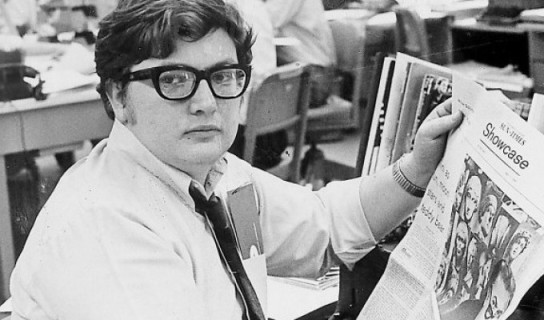 While tears will be shed, do not think of the movie as an elegiac tribute meant to fill your heart with dread for the demise of a great writer and a great man. As the title indicates, it’s a celebration of the man’s life, illuminating a figure that was much larger than his prolific publications (note: not a fat joke). Can you picture Ebert as a skirt-chasing Chicago Sun-Times reporter? How about as a guy who would get drunk and hang from the rafters, causing scenes? Many likely don’t know that Ebert has one screenwriting credit for Russ Meyer’s 1970 camp-tastic Beyond the Valley of the Dolls, a job Ebert likely took on so he could, in his words, “get laid.” There’s even a lengthy bit over their populist film critiques and whether the famous “Thumbs Up/Thumbs Down” model was helpful or harmful to film criticism. Life Itself does a fitting job tracing the roots of the man, with each chapter of his life given due development and consideration. I could have watched a four-hour documentary on the man’s life, but I’m not the general public.
The film is defined by two central relationships: Roger and Gene and Roger and his wife, Chaz. The first is the most famous. We track their initial growing pains taking the leap adapting their styles to the realm of TV. Gene was a natural, Roger less so, which only made Ebert more furious (photos of Gene “ladies man” Siskel gallivanting with Hugh Hefner are a hoot). The impact of their advocacy cannot be overstated. There are plenty of filmmakers that got their big break thanks to special consideration and publicity from these two. No matter the medium, these were the most famous critics of the twentieth century, opening up the world of movies to a new and hungry and appreciative audience. As enjoyable as it is to watch Siskel and Ebert in agreement, there was a special pleasure in watching them disagree because of the unleashed intensity. They really felt like they could convert the other person through sheer force of will. Their egos were both massive and Siskel knew exactly which buttons to push to set his cohort into aggravation. We see TV clips and unused rehearsal video and you feel like they might start a fistfight at any moment. And then that ire and ego forged into a deep admiration and love for one another, a love that Ebert reflects more tenderly of in the years since Siskel’s death in 1999. Gene didn’t want his loved ones to watch the clock, waiting for him to expire, and so he told nobody of his terminal brain tumor until the end. Roger was always wounded by this and vowed to be as open as possible if he suffered severe health setbacks.
The other relationship we get to witness come to a close right before our tear-stricken eyes. Roger met Chaz in AA, a fact she says she’s never publicly admitted before. He was over 50 when he married. He accepted her children as his own, whisking the family on faraway vacations and sharing his love of cinema with his stepchildren and grandchildren. Ebert credits Chaz with nothing less than saving his life, asserting he’d have drank himself to death without her. It’s a love story that forces us to watch the heartbreaking finale, namely Chaz coming to grips with the reality of losing her husband, of letting the love of her life go, something so profound. We’re right with her, wanting to fight on, try the next surgery, always hopeful, though in our circumstances we have the dread of foreknowledge. Then again perhaps Chaz and those close to the Eberts suspected as much as well, especially as his health faded so quickly in the spring of 2013. Just watching her talk about Roger in the past tense, you watch the ripples of pain reverberate through this woman. She’s the unexpected heart of the movie and one of many torchbearers when it comes to the legacy of Roger.
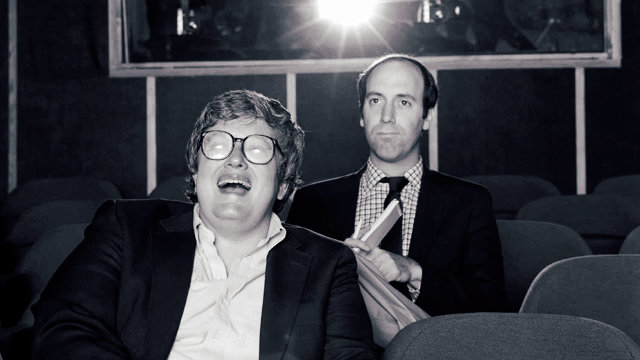 Ultimately, Life Itself is a love story. It’s a love story about two men who go from rivals to close friends. It’s a love story between a man and a woman. It’s also the love story of a man with the movies, a love that he felt eager to share with millions of his readers and television viewers, because in the end (danger: sentimentality approaching) it’s our love and passion that will ultimately outlast us all, and the people we touch are the living embodiment of our legacies. And Roger’s passing has touched many. As fans, those who grew up with him, I think we all felt like he was partly ours. Life Itself is a touching, engrossing, invigorating, and fitting tribute to a man larger than the movies.
Nate’s Grade: A
Share this:

Fruitvale Station (2013)
 In the early hours of New Year’s Day in 2009, 22-year-old Oscar Grant was forcefully escorted off the Oakland transit system by armed officers. He was believed to be involved in some sort of gang-related scuffle on the train. Over the din of confusion, shouting, and anger, Oscar was shot and killed by a transit cop. His death sparked waves of outrage in his hometown and grabbed national headlines. Ryan Coogler was so passionate about Oscar’s death that he decided to write and direct a movie detailing the last hours of Grant’s life. He snagged Michael B. Jordan and Octavia Spencer (The Help) to star, attached Forrest Whitaker (Lee Daniels’ The Butler) as a producer, and the ensuing film, Fruitvale Station, debuted at the 2013 Sundance Film Festival and won the top honors. Thanks to Coogler, many more people will have a chance to get to know Oscar Grant as a person rather than an unfortunate statistic.
Coogler creates a remarkable debut film for himself, one where the details of life feel richly realized and observed. Sure there are obvious symbolic metaphors introduced like boiling lobsters and a lost dog that dies in Oscar’s arms (yes, foreshadowing), but as a whole Fruitvale Station feels like real life transposed onto celluloid. Coogler also works hard to humanize all the participants in his film, save for the transit cops at the end. There is a refreshing lack of judgment throughout the film as people are allowed to be the ambiguous creatures we are. No more so than Oscar. He has moments that make you wince, but mostly we watch a man struggling to get his life in order. He’s terrific with his daughter, loving and naturally attentive; he puts his family’s needs ahead of his own when it comes to money; he even helps a stranger learn how flash fry a fish, though there’s a hint of flirtation guiding his actions. But he also can’t hold onto a job, has trouble being more actionable in his life’s decisions, and temptation is always banging on his door to lead him back to prison. He’s a complicated man and Jordan (Chronicle) masterfully brings the man and his complexities to life. This is a star-making performance by Jordan (as was his turn on The Wire) and I was stunned at how easily Jordan dissolves completely into his role. There isn’t a physical nuance or line delivery that feels false. It’s a sympathetic humanization and Jordan’s performance is a gift. Combined with Coogler’s deft handling, Fruitvale Station is engrossing.
 For much of the film I felt like I was attending a funeral. It’s hard to watch at times, especially watching Oscar’s family wait at the hospital for the news we already know is coming. It reminded me of 2006’s United 93, where the overwhelming sense of dread held over every scene, every innocuous moment held the extra weight that it would be the last time this person was doing this or talking to this person; the dread of waiting for the end we all know is coming. Coogler opens his film with real phone video recordings of the death of Oscar Grant, so from the first moment on we’re awaiting the horrible inevitability. I suppose it gives every moment an extra dimension of pathos, and to some this may be cheap and easy, but it all comes down to perspective. Surely if you knew the final day of your life, you’d likely find extra meaning in the simplest things, bidding goodbye in a thousand different subtle ways. This message isn’t exactly new; it was already old when Thornton Wilder hammered it home in his 1937 play Our Town. Carpe Diem, seize the day, live every moment like it’s your last, stop and smell the roses; you get the idea. And so, the entire running time of Fruitvale Station is a mournful examination on the contradictions, complexities, and connections of a single human life.
Oscar Grant is not lionized as a saint nor is he vilified as some mindless thug without redemption. Carefully, Coogler constructs a complicated man struggling to right his life. Through flashbacks we see he’s spent time in prison, and he’s got a quick flash of a temper that can lead him into impulsive and violent confrontations. It’s significant that we see this prison flashback to summarize completely the life Oscar is trying not to return to. The temptation is always present to fall back on old patterns of comfort, namely cheating on his girlfriend (he has a lot of girls’ numbers in his phone) and going back to selling drugs to make ends meet. Oscar’s ongoing struggle with personal responsibility has cost him his supermarket job (he was late far too often), and he’s kept this news to himself, choosing not to worry those close to him. But his options are limited as an ex-con, let alone a guy fighting his own demons, but he keeps fighting because the Oscar we see, the glimpses of what he could become, are one who wants to be better. He dumps his supply of drugs rather than go through with a sale. The gesture is noble but also partially self-destructive from a pragmatically financial way of thinking. He’s in a deeper hole, money-wise, but he seems committed to making the change. A late encounter with a kind stranger also provides the possibility of a new job, a new chance, one that seems all the more tragic because we know it is a promise that will never be captured. Oscar Grant was likely never going to be a man who changed the world. He was an ordinary man. But we still mourn the death of ordinary men, even those who have made mistakes and are fallible.
 It’s impossible to view Fruitvale Station without its relevant connections to the Trayvon Martin case of 2012. Both of these men were black youths deemed to be “up to no good” with quick judgment skewed by prevailing racial bias. Both men were killed for being viewed as threats due to their race and gender. However, unlike Trayvon, we have a litany of witnesses and video evidence documenting the senseless execution of Oscar Grant. That transit officer argued he mistook his tazer for his gun because, surely, a suspect who is already handcuffed, face down on the ground, and having his head pressed down with the boot of an officer, surely that man needs to be tazed just for good measure. That officer, by the way, served 11 months of a two-year prison sentence for involuntary manslaughter (justice served?). It’s senseless tragedy built upon miscalculated racial alarm, and the reason we have a movie, the reason there were riots in Oakland, is because this specific case had witnesses. How many other innocent young men die every year because someone wrongly and hastily deemed them to be “up to no good”?
Coogler isn’t trying to stir the pot of racial animus or deify Oscar Grant into some martyr for the cause. Fruitvale Station only follows the last day of Oscar Grant’s life but in doing so it becomes an illumination of a human life. Oscar was an ordinary man before he met so unfortunate an end, but Coogler wants us to remember him not simply as a newspaper headline, but as a person. It’s a worthy endeavor that succeeds heartily but may prove to be dull to many, including several of my own friends and critical colleagues. I can’t argue that the life of Oscar Grant is notable to follow beyond the sad final twenty minutes. But that doesn’t bother me, because with the talents of Coogler and Jordan and their indomitable sense of purpose, the film becomes a fitting portrait of Oscar Grant as a human being and a life lived, not just a life prematurely extinguished. It’s powerful, upsetting, brimming with emotion and fury, and it’s also eerily relevant to today and will, I fear, only continue to be more relevant as the next Oscar Grant or Trayvon Martin captures the national spotlight. Coogler’s excellently realized film is a eulogy to an ordinary man, flaws and all, but also a call to do better.
Nate’s Grade: A-
Share this:

Mandela: Long Walk to Freedom (2013)
 One of the most important figures in the twentieth century, you’d expect Hollywood to give Nelson Mandela his well-deserved close-up, and in 2013 we got a biopic on his wife and the man himself, with Mandela: Long Walk to Freedom. It is a respectful, reverent, and relatively inspirational biopic boasted by a pair of great performances. Idris Elba (Pacific Rim/everything cool ever) nails the voice but also inhabits the courage of the man, the toll of his decisions, and the doubt that crept in at his darkest moments. Harris (Skyfall) gives a fiery performance as Winnie Mandela. You may be surprised, as I was, how active she was in South Africa’s rebellion against the government. The problem is that the film plays like a greatest hits collection without much more insight than we could glean from a cursory new report. Cramming the man’s life into 140 minutes is obviously going to be insufficient, but the speedy narrative does little justice to the man’s hardships and the complexities of South Africa’s civil rights movement. The cradle-to-grave approach in biopics is somewhat passé now. Rather movies like Lincoln and Invictus, also about Mandela, focus on pivotal moments that encapsulate the person. I think I have the perfect rewrite of this movie: adjust the focus squarely on the series of meetings in the late 1980s Mandela had with the South African government about political reform. Let’s dig deep into the political conflicts, the government’s fear to equal rights and possible recriminations, the smoothing of tensions, the building of trust, the fragility of a country in the balance. It may seem like more of a stage bound approach, but I think it has more immediacy, nuance, and works to summarize his lifetime of struggle and the change of his country. Oh well. Mandela is a respectful biopic but the man and his legacy deserved something better than a speedy run-through of his life’s checkpoints.
Nate’s Grade: C+
Share this:

Fist of the Reich (2012)
 It’s been too long since I’ve last had the pleasure of viewing a Uwe Boll movie. The man is downright prolific when it comes to spitting out multitudes of projects every year sometimes three or four. And yet there’s no guarantee I’ll have a speedy and easily accessible avenue to watch the man’s finished products. Take for instance his biopic on Max Schmeling, finished almost three years ago, and undergone a title change for American audiences to Fist of the Reich. Americans might not know who Max Schmeling was but by God do we know ourselves some Nazis. I can understand why this one was put on the shelf for as long as it was. There’s the fact that it’s entirely in German, Boll’s first completely foreign-language film since 1997. There’s also the fact that it’s still a pretty dull and uninvolving movie, and given the figure and subject matter, that may be enough to make Fist of the Reich the most disappointing film of Boll’s career.
 From 1930-1948, Max Schmeling (Henry Maske) was Germany’s most prolific athlete. He boxed overseas in America quite often, earning the world title in a controversial bout where his opponent was disqualified after a below the belt punch. Schmeling romances a movie star, Anny Ondra (Susanne Wuest), and proposes to her the day their courtship hits the gossip pages. Schmeling also has to fight the growing nationalistic influence of Hitler’s Nazi party, which looks at him as a powerful propaganda opportunity. After a high-profile loss to Joe Louis, in a rematch no less, Schmeling loses value to the Nazi machine and he’s drafted into the oncoming war.
When I say “most disappointing” I know that’s going to strike a chord given Boll’s oeuvre of craptacularcinema, but I really mean it. The biggest failing of the two-plus hours of Fist of the Reich is that it does not provide adequate evidence why Schmeling is a compelling figure of history. It’s a biopic that doesn’t have enough juice to justify why its central hero should even earn a biopic. I don’t think I’ve seen too many movies based upon real people where I left thinking, “Well that person didn’t deserve a movie.” And the ridiculous thing is that Schmeling of course deserves his own movie. The man was an international superstar, the pride of a nation during a tumultuous time, one of only three men to beat Joe Louis in his career, and then became a propaganda pawn for the Nazis. The man was even forced into service in the war and was one of only two survivors during a hellish battle. His manager was Jewish, his wife a Czech movie star, and they had to flee their country home to escape from the advancing Russians. That is some compelling stuff even before you get into the psychological depth at play with a man being pushed as a tool of Nazi propaganda and how that constrictive, humiliating, and infuriating chapter would have taken its toll on Schmeling’s soul. There is a wealth of material there to stage a rousing and engrossing biopic, and the fact that Boll and screenwriter Timo Berndt cannot is just inexcusable.
There’s very little depth given to Schmeling as a character; all the edges are sanded off and we’re left with a rather bland do-gooder that really just wants to box. He’s sort of this nondescript, milquetoast nice guy who trudges from scene to scene, doing bland but nice things. You won’t dislike the lug but you’ll find it hard to explain why he’s interesting. This shallowness just compounds as the movie continues, going further into the war as well as the downturns in Schmeling’s boxing career. His relationship with Anny is also pretty bland. They’re nice together and loving in appearance but also mundane. It’s like the movie is progressing scene-by-scene establishing facts and plot points rather than exploring the relationships of characters. Max gets married. Max gets a big bout. Max wants to give Joe Louis a rematch. The film seems so devoid of passion, bled dry by going through the checklist of what audiences desire in their biopics. The movie even attaches a weak framing device where Schmeling and a war prisoner are walking to a border and Schmeling recounts his life. Except this framing device ends with thirty minutes left to go. Can it be termed a framing device if it doesn’t frame a quarter of the movie? It’s not even necessary except to throw in a bit of war violence at the opening to hook an audience. It feels like nobody knows what to do with Schmeling so they’ll just breeze through his life’s big events, make him seem like a charitable fella, and then pray the audience understands the man’s historical significance.
Another reason for the stilted drama is quite possibly the noticeable acting limitations of our lead, Maske. The man is a former champion boxer in Germany who reportedly underwent eight months of acting training to prepare for this movie. Well, apparently eight was not enough (did I just backend into a pun?). He may be a great boxer but he is a very poor actor. His monotone, caveman-like warble reminds me of the speaking tones of early Arnold Schwarzenegger. I don’t think the guy has more than two sentences at a time. Again, I’d rather have my actors learn how to do something rather than teach a non-actor how to act. Actors can fake singing or boxing, plus there’s editing. Was it really substantial to have an actual boxer in the role? I know Schmeling himself actually wanted Maske to play him in a would-be movie, so there’s some passing approval, but there’s a reason that Maske hasn’t acted in a movie since this one. Maske’s pained acting, limited emotional range, and overall stiffness, combined with the thin characterization, makes for a void at the center of the movie.
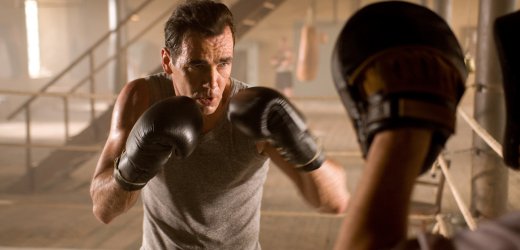 I also assumed given Boll’s own background in boxing (he famously boxed a group of critics several years ago in a publicity stunt) that the onscreen bouts would be thrilling to watch. The excitable German ringside announcer seems to be watching different fights than I am. The fighters just don’t have any fight in them, carefully going through the motions, but when they hit they do so like they’re timid, afraid to put any force behind it. The camerawork and editing also fail to mask this feeling. Boxing is such a ferocious sport and we need to feel the danger and ferocity within the ring, but all too often it just feels like another ho-hum occasion for Schmeling, one where he’s rarely put to the test. Even the boxing matches that go to 15 rounds show us two fighters without any blood on them or bruises or any sign, beyond a glistening coat of faux sweat, that these two men have spent over an hour beating the crap out of each other. This limited sense of realism handicaps the movie as well as drawing out the accomplishments of Schmeling.
Boll’s direction also seems rather remote on this movie, curiously so. He relies almost entirely on bobbling handheld camerawork that can get a bit tiresome when it feels like the camera rarely settles. The movie is almost entirely comprised of a series of medium shots, which further adds to the overall blandness of the movie. The cinematography by longtime collaborator Mathias Neumann is entirely lackluster and downright incompetent. The visual compositions are supremely lacking; I don’t think Boll and Neumann even stumble into one engaging visual shot. And we’re talking about a boxer’s career here. The colors of the movie feel so drab and restrained but not in any sort of elegant artistic manner. It just looks like a drab movie, which suits a drab script with a drab lead actor. I’m also fairly certain that Boll’s longtime musical collaborator Jessica de Rooij borrows liberally, if not outright lifts, the musical themes of John Williams’ score for Saving Private Ryan. Has anyone else caught this?
It may seem foolish of me to admit, especially after twenty movies reviewed, but I actually had some semblance of hope that Fist of the Reich was going to be Boll’s first actual good movie. As it stands, Tunnel Rats is still the best Boll film, relatively speaking. I really thought that Boll’s background and boxing experience would carry over and we’d get a handsomely made, reverent, and absorbing look into the life of Max Schmeling, but time after time, the movie settles for bland. There’s a lot of meat to this guy but it feels about as in depth as a child’s book report, skimming over the drama to cover the significant signposts of the man’s life. As a result, we get an overview of the guy’s life but lack the evidence why we even took the journey. Saying a guy’s a great boxer, or a great humanitarian is one thing, but we need to see this, we need to feel it, and that’s the saddest failure of Fist of the Reich, that it takes an important historical figure and squeezes out all the lingering resonance.
Nate’s Grade: C
Share this:

The Runaways (2010)
 This fizzy 1970s glam rock biopic on the teen girl rock group The Runaways is a fairly shallow tale elevated by a handful of strong performances. All but completely ignoring the other members of the famous girl group, the movie focuses on lead singer Cherie Currie (Dakota Fanning) and guitarist Joan Jett (Kristen Stewart). Both actresses slip under the skin of their real-life figures, imbuing the anger, desperation, and sheer nerve of pubescent rock stars being exploited. Watching Stewart’s attitude-filled strut, or how Fanning transforms from any other California girl into a slinking rock goddess igniting a Tokyo stage, is downright exciting to behold. But the chief reason to watch this film is Michael Shannon (Revolutionary Road) as the group’s flamboyant, lewd manager who put the girls together. Shannon is his typical bug-eyed sensational self, but the profane tirades he unleashes are downright poetic. He gives the movie a desperately needed pulse, and thus when he leaves the screen he also takes most of our interest. The biggest issue The Runaways has is that writer/director Floria Sigismondi doesn’t convince us why any of this matters. We watch the girls get together, play their first gigs, improve musically, and then all of a sudden they’re famous thanks to a magazine headline montage. Then they’re broken up. You neither feel the rise nor the fall, nor do you ever truly get a good feel for any of the characters. The Runaways spends too much time posing and trying to look fierce when it should have spent more attention on a decent script.
Nate’s Grade: C
Share this:

Milk (2008)
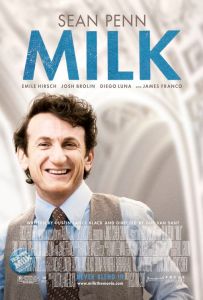 The biopic of America’s first openly gay elected official is stirring, thoughtful, and occasionally limited. Sean Penn gives a wonderful performance as the captivating and tragic Harvey Milk, assassinated in 1978 by fellow San Francisco councilman Dan White (Josh Brolin). He changes his look, his voice, how he carries his shoulders and moves his arms; it’s a terrific and transformative performance that only sometimes hits a few fey stereotypes. The movie mostly follows Milk’s path as a community organizer who successfully mobilized the gay rights movement. You’ll witness local politics in depth, and that’s my one reservation with this fine film – it focuses too heavily on the political formation of a movement and less on the man that kick-started it. You get little glimpses of Milk the man, and most of those glimpses happen to be his romantic relationships with annoying men. That said, director Gus Van Sant orchestrates real archival footage from the time including protestors and homophobic spokespeople, and it gives the movie an authentic relevancy. The deadly confrontation between Milk and White is played in a painful, very un-Hollywood approach that made me wince hard. It’s amazing to watch Milk and realize how far the American public has come since the 1970s and how much further we, as a nation, have to go.
Nate’s Grade: A-


 nathanzoebl
You must be logged in to post a comment.