Blog Archives
Religulous (2008)
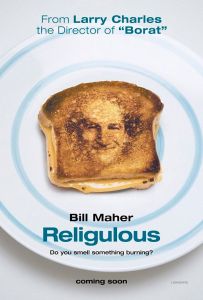 There is no topic in the world more volatile than religion. It dominates cultures, reshapes geography, inspires people to work with the poor, inspires people to attach bombs to their chest, and is as old as time itself. Most civilizations constructed a religion after they grew to a certain size. So who in the world would want to make a sacrilegious opinion-piece documentary that wants to open eyes as well as have a good laugh? Bill Maher is a comedian that respectfully never holds back his true feelings. He’s unflinching in his social commentary on his HBO TV talk show, and religion has often been a thorn in Maher’s side. He personally views it as a mental disorder. Religulous is his eviscerating and intriguing expose as he travels the holiest sites in the globe and asks, “Why?”
For the most part, Religulous doesn’t take a hammer to religion as it does the fundamentalist followers. There are several subjects that cry out for ridicule, like pastors living large and very un-Christ-like on the coffers of their congregations, egomaniacal televangelists that squeeze pennies out of lonely widows, those that babble in tongues, Joseph Smith, Scientologists, and people that celebrate scientific ignorance. Maher is attacking the hypocrisy of fundamentalism, but his condemnation isn’t only reserved for Christianity. He is an equal opportunity offender. In the most surprising venture, Maher takes a trip to the Holy Land and chats with Islamic practitioners about the double standard of its more ardent followers. I suppose repeatedly yelling “Death to Israel” is copacetic but an editorial cartoon that tweaks the religion over its extremist tendencies toward violence is an insult that cannot stand as freedom of speech? Maher really delves into un-PC territory and wants to know why he sees Islamic followers being so overly sensitive to criticism. I think given the fact that like 50 people died as a result of protests over cartoons, there may be room for discussion here. I credit Maher for not ducking away from provocative questions no matter the setting (he even got into the Dome of the Rock mosque!)
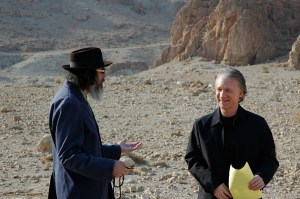 Maher and director Larry Charles follow the same documentary techniques Charles honed as he directed 2006’s Borat movie – a small shambling camera crew that ambushes rubes with tough questions and watches them sputter and squirm. This technique can be amusing when we feel that the harsh inquisition is deserved. Your regular Joe who believes that Jesus is his co-pilot is not deserving of Maher’s smug stares. There’s a moment where he asks a nice guy if he believes that he will reach heaven upon death. He believes he will. “Then why don’t you kill yourself?” Maher asks coldly. It’s uncalled for, and I say all this as a genuine fan of Maher. Still, the movie is regularly funny as it deconstructs religious traditions with quick-cuts to old Hollywood religious epics as cinematic rimshots. One of the better and more convincing moments is when the film compares the theological coincidences between the Egyptian god Horus and Jesus Christ, all set to the Bangles instructional song “Walk Like an Egyptian.”
I personally don’t believe that having faith in the unseen/unknown or being religious equals being stupid. Quite the contrary. However, it’s easy to gather a specious view of religion when all you talk to are ignorant yokels. Maher has perhaps one or two sit-down interviews with people educated in theology, but mostly he sticks to interview subjects that he can mock or those that share his opinion (his extended interview with the leader of Amsterdam’s pot-fueled “cantheism” is irritating). I think Maher is doing a disservice to his film’s target by not discussing theology with learned scholars, with people that can articulate lucid and complete thoughts, with people that have all their teeth. Did he seriously think he was going to able to find a defense for Biblical contradictions at the Holy Land amusement park or at the trucker church? I strongly doubt it. In many ways Religulous strictly sticks to the sideshow of Christianity, peering at the fringe elements. I’m all for grilling fundamentalists that cannot square science and God, but if Maher wants to expose all religious followers as wrong-headed, and not just the ones that think Jesus rode a dinosaur, then he needs to tackle more substantial figures in the field.
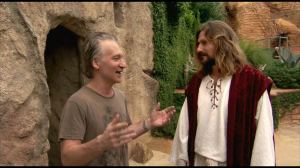 But then Maher fumbles his conclusion and loses me. It is in the closing five minutes that Maher attempts to string together his thesis statement, saying that in order for man to live that “religion must die.” Up until this point Maher has been irascible but committed to his ongoing ideology of “I don’t know.” He professes not to know what will occur after death and wants to press other people into a spirited discussion of the spiritual. But then comes the finish and Maher speaks with the same certainty that he castigated fundamentalists earlier. He is no longer preaching discussion but preaching immediate action to thwart belief. Maher becomes very agitated, his tone gets very sharp, and he steps on the soapbox to once and for all attest that religion of all shapes and measures is rubbish. It’s in these concluding moments that Maher sidesteps from his message of doubt and speaks in aggressive and alarmist hysterics. Maher spent most of [i]Religulous[/i]’ running time attacking hypocrisy but now he demonstrates his own.
I feel that Maher has many good points to make. Religion becomes extremely detrimental when it morphs into nationalism. The Founding Fathers did not envision the United States as a “Christian nation” and were mostly deists with little regard for traditional worship. Questioning and doubt are actually signs of a healthy relationship with faith, because it means that person is active with their faith. Maher showcases the well-known historical grievances caused by religion, or more accurately the followers of religion, but he brushes past the good of religion. It can be a unifying force that calls for people to love thy neighbor as thyself and to turn the other cheek (it’s amazing that the fire and brimstone Bible thumpers forget about the Be-attitudes). Religulous is an entertaining skewer of fundamentalism and close-mindedness, which is why it falls apart when it too turns close-minded.
Nate’s Grade: B-
Share this:

The Aristocrats (2005)
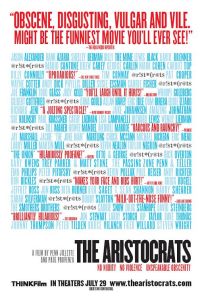 A man walks into a talent agency. He tells the agent he’s got a family act the likes of which no one has ever seen before. The agent tells the man to continue. The man’s wife, children, and pet come into the room and proceed to do the most vile, puerile, horrendously vulgar acts to themselves and each other. The agent is shocked. After a long moment of silence, the agent says, “What do you call this act?” The man replies, “The Aristocrats!” Ba-dum-dum.
It’s really not a good joke, but what makes it special is that the middle is entirely open for the comic to say whatever they want. Comedians will build and build in their obscenity so that the weak punchline is practically an afterthought. It’s a joke that goes all the way back to the days of vaudeville. Comics tell it to each other after shows like a secret handshake. The Aristocrats, an unrated documentary, gathers 100 comedians and lets them put their own crass spin on a classic dirty joke.
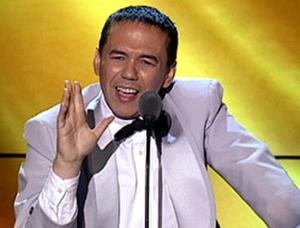
 The movie boasts plenty of well-known names getting down and dirty, like Robin Williams, Chris Rock, Whoopi Goldberg, George Carlin, the South Park creators, Jason Alexander, Eric Idle, Richard Lewis, Andy Dick, Fred Willard, Howie Mandel, Eddie Izzard, and Drew Carey (he insists the punchline should be accompanied by finger-snaps). Few comedians give a full rendition of the joke but the clips are just as potent. Judy Gold involves her unborn baby in the act and Carrie Fisher says her mother likes to sing in a very different kind of shower, but the filthiest mind of all belongs to Bob Saget, who can’t make it through without breaking up and saying, “What am I doing?” The Aristocrats also includes comics from different eras, including Larry Storch, the Smothers Brothers (one of which has never heard the joke before), and even Phyllis Diller, who pretty much just cackles at others. Dana Gould manages to pull together a very funny clean rendition involving the Amish version of the joke. The film opens on Carlin, closes on Gilbert Gottfried, and oh what a journey the film takes.
The Aristocrats is very very funny but also a rather incisive look at the nature of comedy. In between dishing the dirt, various comedians rhapsodize about the mechanics of comedy, the freedom in conquering taboos, and the intricacies of delivery (Paul Reiser stresses that any poo-related parts should be saved for the big finish). Penn Jilette says, “It’s the singer, not the song.” The Aristocrats displays comedy like it was jazz, each individual playing the same note a different way.
Things get a tad repetitious after awhile and the vulgarity starts to lose its impact once you’ve listened to countless unspeakable acts, mostly involving family members, the animal kingdom, and the loosening of bowels. As an example, my friend from college, Jason Davis, attended Mardi Gras in New Orleans one year, and as any viewer of late night TV will attest, the girls have gone wild. The ladies, it seems, will freely show you their bosoms in exchange for cheap plastic beads, and some don’t even want anything in return. Jason said the experience was amazing, at first, but after hours of non-stop frontal nudity, it all got a little tiring after awhile. The rampant nudity lost its effect and Jason started paying more attention to the women who actually kept their clothes on. So too is it with The Aristocrats, in a manner of speaking.
 The film’s unabashed vulgarity will spur guffaws and titters, especially in an “Oh-my-God-did-he/she-just-say-that?” way. But after so many tellings, things that were funny because they were taboo don’t seem as funny in repetition. It’s at this point that an audience can really appreciate comics that take unconventional routes toward telling the joke. Eric Meade does a card trick, Kevin Pollack does the joke as Christopher Walken, Mario Cantone performs the joke as Liza Minnelli, Sarah Silverman actually puts herself in the joke’s family (for my money, she gives the best performance), Penn and Teller do a magic trick with a soda bottle, there are jugglers, a ventriloquist, and even a mime. The Aristocrats still has its straightforward dirty pleasures, but it’s much more satisfying when certain comics work outside the box.
It should be obvious at this point but The Aristocrats is not going to be a movie for most people. The incredibly course language and graphic accounts of lewd acts will not sit well with most of the American public. This is a movie strictly for people that have a strong stomach and like hearing a dirty joke. For that group, The Aristocrats will knock you silly with laughter. My three friends whom I saw the film with said they were in pain from laughing so hard. Perhaps that speaks volumes about the company I keep.
The Aristocrats is a bawdy, filthy, hilarious documentary that becomes more than a bunch of funnymen retelling a dirty joke. This is a film for a very select audience, to say the least, and it does lag at parts when the continual vulgarity loses its impact. The Aristocrats also seems to be erratically edited; scenes will rapidly jump from different angles for little reason. Every comedian has their own style and every audience member will find something different to strike their funny bone. At the very end, The Aristocrats invites viewers to submit their own form of the joke for the eventual DVD. I don’t know about you but I’ve already got a goldmine of ideas.
Nate’s Grade: B


 nathanzoebl
You must be logged in to post a comment.