Blog Archives
The Wolfman (2010)
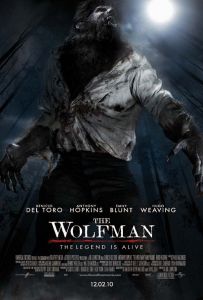 After re-shoots, reedits, a second director late in the process, and delayed release dates, it’s no surprise that The Wolfman is a bit of a shaggy mess.
In 1880, Lawrence Talbot (Benicio Del Toro) is an actor who returns home to England when he learns that his brother has been killed. Gwen (Emily Blunt), the fiancé to Talbot’s dead bro, writes that the departed brother was mauled, which points toward some kind of vicious creature roaming the woods. Inspector Aberline (Hugo Weaving) has been called in to clear the matter. Talbot’s father, Sir John (Anthony Hopkins), welcomes his prodigal son back but warns him of the dangers lurking in the countryside. The villagers are ready to blame the gypsy caravan and their chained bear when the feral creature strikes again, thus exonerating the bear. Talbot is bitten by the beast but survives only to transform into the cursed werewolf once every full moon.
Structurally, this movie feels like it’s all Act 1 and Act 3 with about ten minutes in between. By that I mean it’s all protracted setup and climax and little to connect the two. The beginning takes so long, with characters walking around like zombies who have no sense of wonder or fear given the extravagant circumstances. This is a movie that confuses set changes with plot advancement. Dour characters enter half-lit rooms and say little that isn’t cryptic or terse about the unusual happenings. This is what you have to look forward to for about an hour. The central mystery of who is the initial Wolfman is pretty easy to figure out when you play the economy of characters, which only compounds the movie’s sluggish pacing problems. You’re going to have definite pacing issues when your monster can only appear once a month, so say hello to massive time-lapse montages with the moon. It makes it hard to keep track of how much time is actually elapsing.
 There is little cogent explanation for why anything happens and the movie does an extremely poor job of maintaining a credible suspension of disbelief. What exactly are the rules here? What are the limitations for the Wolfmen? How far back does this whole thing go? The movie traces it back to an Indian kid, who looks like Gollum, in a cave, but where did he get it from? What is the history of this lycanthropy illness? When you turn into the monster, do you have any control? Are you a slave to your animal impulses? Are you culpable for what happens? Is it more like having multiple personalities except one of them is harrier? Nothing is really made clear and the movie just plows along while the unanswered questions continue to pile up, never to be addressed.
The Wolfman does a fine job of establishing an ambiance that feels ripped right from the old Hammer horror films, but fog and shadows and art direction can only take you so far. Every room looks like it’d be a prize-winning example of how to build a haunted house, though the lighting tends to be overly murky. Danny Elfman also provides a darkly lush score that mingles well with the onscreen atmosphere. But the refined sets only tease a better movie. An attack at the gypsy camp can get interesting. The beast flaring up at an insane asylum calls for something wickedly entertaining and scary, but everything is over before it really gets going, and we’ve moved on to the next scene of character sitting glumly in the dark. There’s nothing to startle beyond some overused jump scares. The movie lacks good scares because the film fundamentally can’t sustain a mood because the plot is never elaborated.
The character work is exceedingly shallow. Talbot is the main character but what do we learn about him? He’s an actor, he left town, he gets bit by a wolf, he skips stone’s with his dead brother’s girl, and that’s about it, folks. There’s an entire back story about Talbot spending time in a mental ward, which could prove to be fascinating but it’s just another set piece and nothing more. Talbot is pretty much a placeholder for a character; he’s the dude that has to get bit for there to be a story. He’s more catalyst than character, and you can feel that painful realization in how Del Toro (Traffic, Che) plays his non-character. Del Toro is a truly capable actor but he sleepwalks through the entire movie and mumbles most of his lines. Despite being a dead ringer for Lon Chaney Jr., he brings no energy to his role, nor does he ever seem truly concerned with his beastly transformation. You got more reaction and contemplation from Michael J. Fox in Teen Wolf.
The rest of the actors try and make good with the parts they’ve been tossed. Blunt (Sunshine Cleaning) can be a very good actress but she’s playing the thankless task of the underwritten love-interest-to-monster part. She’s no more fleshed out than the blonde damsel that screams and faints in the old classic monster movies. Blunt has the annoying habit of her voice turning into this simpering whine when she’s distressed. Hopkins (Fracture) pretty much gives the plot away with his maniacal cackling and incessant ear-to-ear grinning. You can pretty much faithfully assume where his character is going from the first malevolent twinkle in his eye. The screenplay exerts no effort to disguise its easily telegraphed character reveals. The person who comes out best is Weaving as the inspector, but that may be directly linked to the fact that he has the least amount of screen time of any of the main characters.
The special effects are fairly good and the practical makeup effects by screen legend Rick Baker are even better. The actual Wolfman is a snarling, spooky creature, but I wonder why we don’t get more shots allowing us to fully view the makeup work. Director Joe Johnston (Jurassic Park 3, Jumanji) seems to be more of a proponent of CGI, which means that we get scenes of Wolfie jumping from ye olde rooftop to rooftop like he’s any sort of wily creature. There’s nothing in the movie that really makes use of the specifics of being a Wolfman. We get a few POV shots of the Wolfman running extremely fast, but little else takes advantage of what makes the Wolfman a creature to be reckoned with. We only get a slew of decapitations and sliced innards that display the ferociousness of those wolf claws. Johnston isn’t afraid of gore but he doesn’t help his case when he fails to create any feeling of dread. It’s hard to dread what you can barely understand and with people you don’t really care about. Consider me stubborn, but when I got to a movie called The Wolfman I want some attention paid to the title animal.
 As I was watching The Wolfman I began to disassemble it in my head and piece together my own version of the film, an infinitely better version. For the sake or argument, I’ll explain my version and you can tell me which seems like the superior product. In my imaginary version, I completely eliminated Blunt, Hopkins, and most of the other side characters. I focused on Talbot and the Inspector and their relationship. Talbot has known about his lycanthropy for some time but he’s been able to control it for the most part, until recently. It haunts him, his inability to stop the sinister urges inside him that take over. The inspector is called in after the mysterious murders have picked up and they resemble some equally gruesome murders from 20 years prior (when Talbot first grappled with his hairy alter ego). The bent of the plot would then be on the relationship forged between the two men, how it turns into mutual affection and admiration all the while Talbot is trying to stay one step ahead of the investigation. Then my Act 2 break would be the Inspector finally realizing who is responsible for the murders (his friend!) and struggling with his own moral obligation to meet justice. Maybe this sounds too much like a crime thriller, but to me that sounds like a better film than watching two CGI werewolves claw at each other and spit.
The Wolfman is yet another misguided remake in a genre being gutted by horror remakes. The old monster movies of old were more than creature features and deserve better treatment than this bloody mess. I suppose few films can survive given the retooling process this one went through. This super serious monster movie has terrific production design, some alluring atmosphere, and a whopping void where a story should be. Characters will bumble about and the plot hums along with no explanation or elaboration given, meaning that setup often immediately crashes into climax. That’s not a satisfying recipe for a moviegoer. The Wolfman is mostly suspense-free and the actors are phoning it in; Hopkins is a kook, Blunt trembles her lower lip, and Del Toro seems to be drugged. This is mostly a costume drama with a little gore splashes in for good measure. It’s boring and half-baked and the best attribute is the scenery. If I wanted to watch scenery I’d flip through a Home and Gardens magazine. I was expecting entertainment here but instead it’s just another reminder to stick with the original.
Nate’s Grade: C
Share this:

Sin City (2005)
 Like film noir on steroids. Director Robert Rodriguez has made the most faithful comics adaptation ever; giving life to Frank Miller’s striking black and white art. The visuals are sumptuous but the storytelling is just as involving, a perfect mix of noir/detective elements and subversive, highly memorable characters. Sin City may be the most violent studio film … ever, but the over-the-top tone keeps the proceedings from becoming too nauseating, even after limbs are lost, heads roll (and talk), and dogs pick away at living bodies. This is a very ball-unfriendly movie; lots of castrations. The blood even looks like fluorescent bird crap. The stories become somewhat repetitious (anti-hero saves distressed woman), but Miller and Rodriguez keep their tales tight, pulpy, comic, and unpredictable. My friend turned to me after it was done and said, “That was a great movie.” I could not argue.
Nate’s Grade: B+
Share this:

21 Grams (2003)
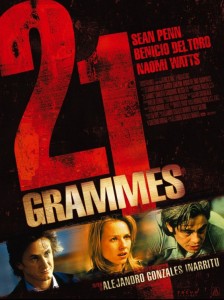 21 Grams (2003)
Premise: A mathematician (Sean Penn) in need of a heart transplant, a recovering addict (Naomi Watts) mourning the loss of her husband and children, and an ex-con (Benicio Del Toro) whos found redemption in Jesus, are all linked by a horrific car accident. The aftermath will bring them together out of grief, guilt, and revenge.
Results: The greatest asset 21 Grams has, bar none, is the trio of breathtaking performances. De Toro gives a powerful performance as a man consumed by grief and seeking answers in the unknown. Watts gives the definition of a raw performance. What isn’t cool is the structure, told out of order like the directors first film, the brilliant Amorres Perros, translated: Loves a Bitch. But the mixed-up structure of 21 Grams is needlessly complicated d frustrating, plus it pulls you out of the movie. Im sure theres a rationale reason for it, but the surprises and expectations it produces are minimal. The whole thing would have been better plunked in an old-fashioned linear structure. The sensational performances and intelligent story will stay with you long after the film ends.
Nate’s Grade: B+
Share this:

Snatch (2001)
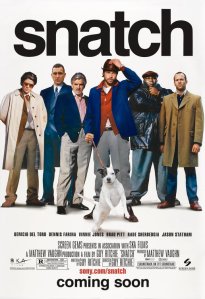 Snatch is really more of the same for writer/director Guy Richie as he retreats back to his magical land of London gangsters with Dick Tracy-esque names and thick cockney accents intermixing in comically violent and ironic ways. He’s like a more stylized version of Tarantino, if Tarantino ever got to have sex with Madonna. So if you like the niche Richie has trapped himself in for the moment (like myself) then you’ll like Snatch. The film is coursing with energy to spare and never loses its sense of fun, which carries over into audience smiles (at least for me and my gal it did). Brad Pitt is a riot as the hardly intelligible Irish gypsy and part time boxer.
Nate’s Grade: B+
Share this:

Traffic (2000)
 The war on drugs may be one worth fighting but it’s a battle that every day seems more and more impossible. Traffic is a mirror that communicates the fruition of our current procedures to stop the illegal flow of drugs.
Traffic is told through three distinct and different narratives. One involves an Ohio Supreme Court justice (Michael Douglas) newly appointed as the nation’s next Drug Czar. While he accepts his position and promises to fight for our nation’s children, back at home, unbeknownst to him, his daughter is free-basing with her bad influence boyfriend. Another story involves a wealthy bourgeois wife (Catherine Zeta-Jones) awakened to her husband’s arrest. Her shock continues when family lawyer Dennis Quaid informs her of her husband’s true source of income. He’s to be prosecuted by two DEA agents (Don Cheadle and Luis Guzman) unless she can do something. The final and most compelling narrative involves Benicio Del Toro as an honest cop in Tijuana battling frustration with the mass corruption surrounding the city. Each story weaves in and out at various points in the film.
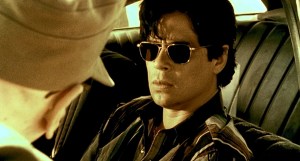 Traffic was photographed and directed by the man with the hottest hand in Hollywood, Steven Soderbergh. He uses a documentary feel to his filming that adds to the realism. Different color tones are assigned toward the three narratives as reflections of the emotional background. Soderbergh expertly handles the many facets of the drug industry and pulls out his typical “career best” performances from his onslaught of actors.
Benicio Del Toro is the emotional center of Traffic. His solemn demeanor and hound dog exterior reflect a good man trying to fight the good fight in a corrupt environment. He effortlessly encompasses determination, courage, and compassion that you’ll easily forget the majority of his lines are in Espanol. Benicio is an incredibly talented actor and one with such vibrant energy whenever he flashes on screen. It’ll be wonderful watching him collect all his awards.
Catherine Zeta-Jones also shows strong signs there may well indeed be an actress under her features. Her role is one of almost terror as you watch her so easily slip into her imprisoned hubby’s shoes. The ease of transformation is startling, but in an “evil begets evil” kind of fashion. The fact that she’s pregnant through the entire movie only makes the shift from loving house wife to drug smuggler more chilling.
 The entire cast does credible acting performances with particular attention paid toward the younger actors deservingly. Don Cheadle throws in another terrific performance showing he’s sublimely one of the best actors around today.
Traffic oversteps its ambitions and aims for a scope far too large. It is based on a 6 hour BBC mini-series, so trying to cram that material into a two hour plus format is taxing. As a result we get an assembly of characters, but too many with too little time in between to do any justice. Screenwriter Stephen Gaghan (Rules of Engagement) condenses the towering impact and influence drugs have well enough, but he intercuts the stories too sporadically that attachment never builds for either of the three narratives. He does balance the Douglas Drug Czar one carefully as not to fall into the cliched vigilante metamorphosis. But the mini-series had more characterization and depth to its tale.
Traffic is a good film but it has edges of greatness never fully visioned. Soderbergh shines bright yet again and all accolades will be deserved. Traffic is undeniably a good film, but it’s one you may not want to watch a second time.
Nate’s Grade: B
Reviewed 20 years later as part of the “Reviews Re-View: 2000” article.
Share this:

Way of the Gun (2000)
 Way of the Gun is screenwriter Christopher McQuarrie’s follow-up to the twisty smash who-dunnit The Usual Suspects. This time he takes the reigns of directing himself and establishes that he is a born man behind the camera and in the chair.
Gun unfolds its tale through the center of two antisocial hoodlums “Parker” (Ryan Phillippe) and “Longbaugh” (Benicio Del Toro), two men brought to the point of selling plasma and sperm to pay the bills. One afternoon they overhear a conversation in the doctor’s office about a wealthy couple paying a woman (Juliet Lewis) to act as the surrogate mother for their child. It seems the real mother just doesn’t want to be burdened with a child hanging on her for nine months. The two men use this information to plot what should be their big break and their big score. After a scheduled doctor’s visit they get into a heated shoot out with the bodyguards (Nicky Katt and Taye Diggs) protecting her for their wealthy employer. Parker and Longbaugh kidnap their impregnated prize and hold her to squeeze a fat ransom.
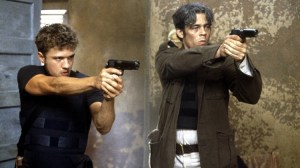 The story-telling Way of the Gun plays is a mix of older mature films where they would have room to breathe as well as Quentin Tarantino flicks. This is a story of characters and their devious multiple back stabbings, crosses, secret affiliations, and ultimate intentions. ‘Gun’ moves methodically with an armada of gaunt twists and turns keeping the audience alive and awake.
James Caan comes in mid-way to play a conniving intermediary in the exchange. His character is the wisest of the bunch and knows more then he’s always telling. It’s also quite a perplexing site to see Caan’s nipples through his shirt in an interrogation scene. Up to this point I never thought about James Caan having nipples.
The action in the flick is pulse-pounding. The shootouts are probably the best on film in a long while. You see and hear every effect a bullet has. The final climax which involves a drawn out gun battle in an empty Mexican brothel is a scene of sheer excitement and relentless entertainment that it may well be my favorite 10-15 minutes of film all year.
There can be a word to describe Way of the Gun and that word could be “ugly.” This is not a film for everyone. The violence and its after-effects can be gruesome at times, as I heard just as much groans and shrieks in my theater than anything else. There’s scenes of picking shards of glass from one’s own arm, performing stitches on one’s eyebrow, and even an impromptu hand done C-section. This will not be something to take grandma to.
Way of the Gun pacing is also a problem. There are moments of drag as we wait and wait. The languid pacing works for the story and the characters but the double-edge sword creates dry spells of interest. The score uses tympani to full extent, sometimes beyond that which it reasonably should.
McQuarrie has sold me with his re-spinning of tired cliches and familiar elements into gold. Way of the Gun is a flick I’ll see with my friends time and again.
Nate’s Grade: A-


 nathanzoebl
You must be logged in to post a comment.