Blog Archives
The Lobster (2016)
 When people decry the relentless slate of sequels, remakes, and redundancy from the Hollywood assembly line, they’re looking for something original and different, and there may be no movie more different this year than Yorgos Lanthimos’s The Lobster. David (Colin Farrell) is the newest guest at the Hotel, a place for singles to find their true love. He has 40 days to fall in love with a compatible mate or else he will be transformed into an animal of his choice (hence the title, David’s choice). The people at the hotel are all in competition to find their mate. Outside the confines of the hotel, in the woods, are dreaded single people, those who ignored the rules of society. They are to be feared and hotel guests are rewarded for capturing wild singles on weekly hunting trips. One way or another, David is going to have to decide his place in society as a person or animal.
The Lobster is daringly different, wildly imaginative, and drops you into the middle of its cracked, alternative landscape and expects you to pick things up as you go. It’s something that the writer/director already achieved with chilling, car-crash fascination in Dogtooth, a dark parable about extreme parental protection that crossed over into abuse. This is a world that opens with a distraught woman driving a long distance just so she can shoot a donkey in the head. Who is this woman? Why would she purposely murder this animal? Why is she so emotionally invested? And with that jarring act of peculiar violence, we’re off. We’re never told how this world came to be, it just simply is. There isn’t any extensive exposition save for one initial sit down David has with hotel management to determine what animal he’d like to turn into at the end of his stay if unsuccessful in love. There’s a genuine sense of authenticity to this deeply weird place and the characters all play it with straight-laced absurdity, which makes the satire land even harder. It sells even the most bizarre aspects, like the ongoing visual incongruity of wild animals just trotting around the background. You can sit back and think, “I wonder what that peacock’s story was, or that donkey, etc.” Its abnormal background pieces that add to the context of the world. I loved discovering new little wrinkles and rules to Lanthimos’ world that made perfect sense within its parameters. In a world where coupling is the only goal, of course masturbation would be a punishable crime. I enjoyed that there are other means guests have to stay at the hotel, chief among them hunting down the loners in the woods, which allow the more awkward or anti-social guests added time at the expense of others. Even in a world this bizarre, there are people who are making their own way, including the revolutionaries in the woods (more on them later). The movie is exceedingly funny and so matter-of-fact about its peculiarities to make it even funnier.
 The movie straddles the line between skewed ironic romance and cynicism, so I’m not surprised it’s rubbed people the wrong way. This can be a pretty dark movie and that’s even before the violence against animals/former people. It’s certainly written from the point of view of someone who is single and those currently in that category will likely relate the most to the film’s strident social commentary. “It’s no coincidence the targets are shaped like single people,” a man says in reference to target outlines. The pressures can seem absurd in their own regard, and the film has a clever concoction where the “happy couples” are merely two people who share a superficial physical trait. These two people are near-sighted. These two people get nosebleeds. These two people have a limp. Even the characters are named after their physical depictions, like The Limping Man and Short-Sighted Woman. It’s not exactly subtle but the satiric effect is still effective. The hotel manager says, to a newly cemented couple, “If you encounter any problems you cannot resolve yourselves, you will be assigned children, that usually helps.” The humor can be very dry and very dark, never stopping to inform you where to laugh. There’s a sad woman played by Ashley Jensen (TV’s Extras, Ugly Betty) who is desperate for companionship, offering sexual favors to any man who might just alleviate her loneliness. She is ignored and often threatens to kill herself, and then one day she does it by jumping out a hotel window, but she’s not successful. It’s one more dark, awful ironic point of suffering for this woman, and she screams in agony while others ignore her, including a clearly affected David, still trying to play indifferent to win over the hard-hearted woman he sees as his best way out of the hotel. It’s a hard moment to process but one that made me admire the film even more for the cold courage of its convictions.
Supplementing the dark satire is an off-kilter romance that emerges halfway through the film once David escapes the hotel. He finally meets up with the source of our narration, the Short-Sighted Woman (Rachel Weisz). It’s here that the movie shows glimmers of hope for the hopeless as David and this woman are drawn to one another. They’re in a world of outcasts but the rules of those in the forest do not allow coupling. They reject the expectations of the ruling order, and so they must remain resolutely single. the only time David and the Short-Sighted Woman can be open with their affection is when they go undercover into the city, posing as a couple, and getting a chance to kiss with abandon, all as a cover of course. They build up their own secret non-verbal language to communicate their feelings, much like a couple builds its own personal shorthand and inside jokes. The loners are only to listen to music individually and dance the same, but David and the Short-Sighted Woman synch their CD players to listen to the same track, to simulate like they are sharing a dance together even if not in proximity. It’s here where The Lobster becomes a beguiling and surprising love story and one where the heartless may grow a heart, watching two odd people find one another in such an odd world. However, Lanthimos does not let this emergence of romance blunt his message. The loner leader (Lea Seydoux) suspects coupling in her group and goes to some pretty drastic lengths to test the fortitude of feelings between David and his secret girlfriend. It’s like getting cold water dumped on the runaway spell of optimism. The fitting ending is left in ambiguity for the audience to determine whether they were meant to be after all.
It’s also in the second half of The Lobster that the movie loses some of its grandeur and momentum. We’re introduced to a new primary setting with new rules to adapt to and a new order to follow, and there’s a general interest to discovering another competing area of this landscape with a diametrically opposed social order. They punish people by mutilating parts that come into affectionate contact with another person. We see a couple with bandages around their red, swollen mouths, and then the reference of the “red intercourse” makes your imagination fill in the horrific blanks. David has left one regime dictating his life to another regime dictating his life, but they just aren’t as interesting. It feels like the film is starting to repeat itself. I would say the second half world building isn’t as compelling as the first but that’s why the romance emerges, something for the audience to root for. Now that he’s finally found someone he connects with they’re not allowed to be together. There’s never a shortage of irony in a Lanthimos movie.
 The actors are perfectly in synch with the strange rhythms of this world, and Farrell (Fantastic Beasts and Where to Find Them) and Weisz (The Light Between Oceans) deserve special attention for their committed performances. Farrell gained 40 pounds for the role, which seems to have translated right into his stint on season two of HBO’s True Detective. He’s a schlubby guy that’s still mourning the deterioration of his marriage and larger society is insisting he get over it. He has only 40 days to recover or he’ll be plucked from the ranks of humanity. There’s great sadness tinged in his nonchalant responses to the absurd realities of this world, and Farrell keeps finding ways to make you laugh and wince. Weisz is our placid voice into the strange new world and it helps establish a sense of grounding as well as connection to her character when she eventually emerges. She injects a palpable sense of yearning to her character, especially once David is in reach and they begin their relationship. It’s got the cute romantic comedy staples but on its own terms, and seeing Weisz smile warmly is a pleasure in a morbid movie.
The Lobster is a romance for our age and an indictment of the romance of our age, an era where the swipe of a finger on an app is the arbitrator of contemporary dating. It’s a satire on our fixation of coupledom and being in relationships even when they’re not sensible. It’s a cracked fairy tale that punctuates the romantic love we’ve watched distilled to an essence in Hollywood movies. It’s a surreal and dark movie that manages to become emotionally moving and poignant, leaving on a note of uncertainty enough for different factions in the audience to interpret as either hopeful or hopeless. The Lobster is a unique movie with a singular artistic voice that dominates every shape of the narrative, the characters, and the boundaries of this fantastic alternative world. I imagine my depth of feeling for the movie will only grow the more I watch it. This isn’t an overwhelmingly dark or unpleasant movie without the presence of some light. It’s not an overly off-putting movie without an accessibility for a curious audience, whether those people are single or in happy relationships. The movie is inventive, transporting, but still relatable, rooting the nexus of its weirdness on the same awkwardness and anxiety everyone feels with the prospects of prolonged romantic courtship. If 2016 was a year that celebrated the oddities of cinema getting their due, then The Lobster is a captivating and unusual creation deserving of its spotlight and surefire future cult status amidst lovers of the weird.
Nate’s Grade: A
Share this:

In the Heart of the Sea (2015)
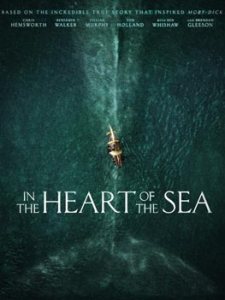 In 1822, the men aboard the Essex, a whaling ship sailing from Nantucket, Massachusetts, encountered a beast unlike any they have ever seen. Captain Pollard (Benjamin Walker) and his first mate, Owen Chase (Chris Hemworth), were at odds throughout the voyage, that is until they encountered a 100-foot long white whale. The creature destroyed the Essex, forcing the crew to drift at sea and hope to find land, but the whale follows them as well. Tom Nickerson (Tom Holland as a young man, Brendan Gleeson as the older version) recounts this traumatic survival tale to author Herman Melville (Ben Whishaw), who is desperate to write this true story.
There’s an old-school throwback vibe to In the Heart of the Sea with its high seas adventure, but there’s just not enough attention to adventure, character, or even plot for this movie to really set sail properly. The first act feels so sluggishly long. It’s trying to set up life on a whaling vessel in the early 19th century but I didn’t feel like we got a coherent sense of life aboard the seas or how the various components worked. I didn’t know that whalers row out from the main ship, so there’s that. The opening act sets up the dull conflict between Chase and Pollard, which can be summarized as blunt upstart vs. unchecked privilege. The conflict doesn’t evolve from this dichotomy. Both men are boring in their unyielding simplicity. Hemsworth (Avengers: Age of Ultron) made a stronger impression in Rush, but a humorless movie role is not in his best interests as an actor. When the action does arrive, it can be genuinely thrilling. Director Ron Howard does a slick job of conveying the danger and destruction of the whale attack. Sadly, it’s over too soon and then the remainder of the movie is 45 minutes of a survival drama adrift in the ocean reminiscent of last year’s Unbroken. This period of isolation forces the characters to make some hard choices, yet we don’t feel the impact of those choices because the narrative, too, feels adrift. Implausibly, the giant whale has followed them for thousands of miles. Are whales really this vindictive? The documentary Blackfish makes me wonder but it still feels unbelievable. What was the whale waiting for? For the men’s spirits to be completely broken before it might attack again? We’re told this whale is a “demon” but who exactly are the bad guys in this story?
 I believe another stopping point for this story is that the culture has moved beyond the acceptance of whaling as an honorable profession, to the point that I, and I assume others, was on Team Whale after witnessing a bloody hunt. It’s pretty gross, especially when they’re harvesting the whale body for the precious oil. Perhaps modern audiences, so far removed from hunting as an essential component of life have become more squeamish, or perhaps modern audiences just recognize something as barbaric when they see it. As a result, it’s hard to root for these guys. When the giant whale attacked it felt like retribution. My sympathies were more for the large mammal than the bipeds on ship. At the end of the film (some spoilers), the white-haired moneyed men of Big Whale Oil are worried what the truth will do to their industry. They want the surviving crewmen of the Essex to deny the existence of this gargantuan whale. This makes little sense to me other than awkwardly forcing a Big Business cover-up for relevancy. First off, whaling seems like a pretty unsafe working environment to begin with, especially considering voyages could last up to three years. Would the reality of one big bad whale destroy an industry? I doubt it since there is such money to be had. If anything it might rejuvenate the timber industry to reinforce the ships to make them more durable against larger whale attacks.
At first I thought a framing device was entirely superfluous; why do we need to watch Melville elicit this tale rather than simply just watching the tale itself? It seemed like a distraction, but as the movie progressed I understood that this framing device was its own sub-story and had its own complexity, namely the older Tom coming clean to the decisions that still haunt his soul. It’s an unburdening for both gentlemen, as Melville admits his deep fear that he is a mediocre writer (he’s no Nathaniel Hawthorne) and that he will be unable to tell this story as well as it truly deserves.
As these two men are allowing themselves to become more vulnerable and sharing their demons and doubts and worst fears, I started to realize that this framing device was weirdly more compelling than all the whale action. That’s because older Tom and Melville are the best drawn characters in the movie, which seems like a screenwriting mistake of sizable proportions. Obviously the nautical survival stuff should be the most compelling, and yet I as more taken with two men sitting by an oil lamp discussing their lives. Older Tom is infinitely more interesting than younger Tom; part of this is because young Tom hasn’t experienced the full effect of the events that shape older Tom, but most of this is from the very clear fact that young Tom is kind of a mute witness in this movie. He rarely speaks and is just kind of there, taking up space. There’s one personal harrowing moment when he’s thrust inside a hollowed out whale carcass to extract more blubber, but that’s the only personal perspective offered through young Tom. A question concerning the framing device: how is older Tom retelling events he had no participation or witness to? Another issue is that the characters on board the Essex are bereft of anything that would allow us to feel for them beyond simple human survival. Chase and Pollard are given one note to play and their eventual understanding and cooperation is fine but it feels like fleeting details in a story, lost to memory or disinterest.
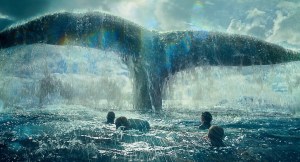 From a purely technical aspect, this is one of the better Howard films. The cinematography by Anthony Dod Mantle (Slumdog Millionaire) is rich and often breath taking, with plenty of stunning aerial and underwater images. The whale attack sequence is harrowing and thrilling. Howard finds ways to imply the harsher aspects of this life without going overboard, maintaining that PG-13 rating. While the look of the film has an enhanced color palate thanks to the extra boost of CGI filters, I still appreciated the vibrancy of the on screen images. As I said with the similarly boosted Mad Max: Fury Road, I’d rather have vibrant and bright colors than a drab and washed-out color palate. Even as the movie drifts and the characters fail to grab you, at least the visuals are pretty. While sitting through the second half, I started to rethink my own prejudices concerning Howard as a filmmaker, a man who lacks a distinctive style but has a definite feel for how to tell a story. I’m not going to excuse him for The Grinch and other misfires, or his tendency to settle for maudlin in place of subtlety, but the man is a born filmmaker.
In the Heart of the Sea is an old school movie that feels too sluggish, too underdeveloped, and too free of characters for the audience to invest in. When the framing device scores the biggest emotional pull, you better start rethinking your rip-roaring high-seas adventure. Master and Commander this is not. As the inspiration for Moby Dick, I wish I had just watched a remake of Melville’s actual novel (now with extra chapters about rope!). If you ever wanted a movie that ends on a blurb by Nathaniel Hawthorne as a payoff for Melville’s artistic neurosis, then your wait is over. In the Heart of the Sea feels like a whale of a tale that is hard to believe, which ends up inspiring a far greater story, which made me yearn for just watching that superior tale. Sometimes the “truth” behind famous stories is less interesting.
Nate’s Grade: C+


 nathanzoebl
You must be logged in to post a comment.