Blog Archives
Alternate Opinion: Lady Ballers Guest Essay
My friend and writing partner Ben Bailey asked me to host an extensive essay he was compelled to write after watching Ben Shapiro’s deeply disingenuous and presumably laugh-free sports comedy, Lady Ballers, a movie built upon not just transphobia but also misogyny. I plan on watching this movie as well because of course it will be one of the worst movies of the year and thus I’ll need to analyze these things for you to spare you, dear reader. In the mean time, enjoy Ben’s monumental take-down on the movie, its terms and goals, and the disingenuous nature of the toxic conservative media ecosystem.
______________________________________________
“Trigger Warning: A Woke Soy Cuck is About to Talk About Lady Ballers“
By Ben Bailey
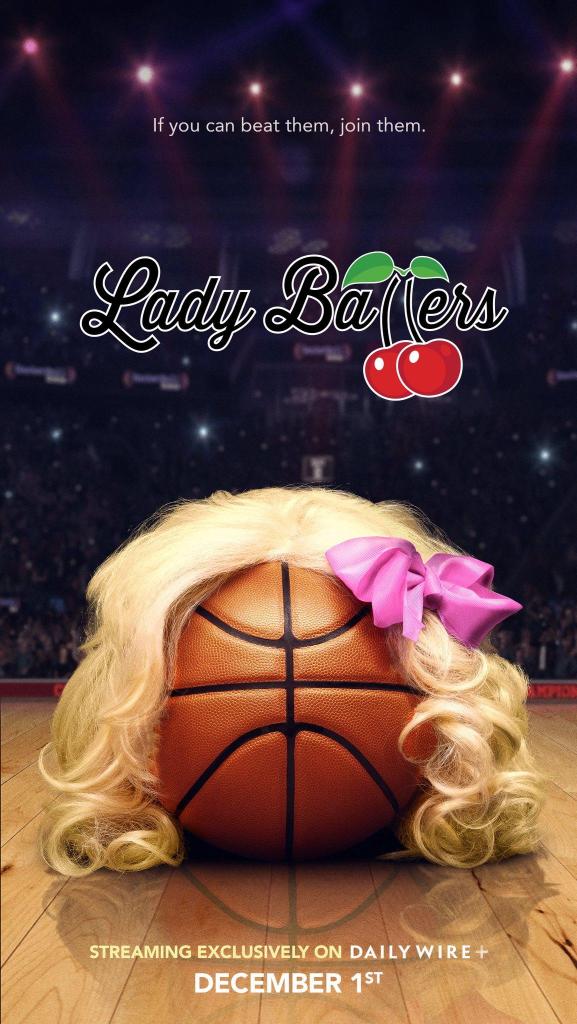
So, Lady Ballers is a thing. If you haven’t heard of it, or of Ben Shapiro’s right wing Daily Wire production company, I envy your life and your ability to avoid psychic pain. For the rest of you, maybe you’ve seen the trailer or some reaction videos on YouTube, and then you likely did what most rational people would do and casually dismissed it as something you will never have any reason to watch. At least I assume most people will never watch Lady Ballers because most people don’t have a subscription to Daily Wire+ or the wherewithal to actively seek it out through other quasi-legal means, but I watched it, and if only to justify the effort of doing so, I decided to commandeer my good friend’s blog for a bit to talk about it. You should know that I insisted he watch it, because even though I cited him as a friend just now, I secretly hate him and only want bad things for him.
Lady Ballers is the story of the whitest basketball team you’ve ever seen in your life deciding to take advantage of our modern “woke obsession” with regarding trans people as human beings with basic dignity by pretending to identify as women so that they can compete in women’s sports, where they will obviously dominate due to their manly testosterone being the natural kryptonite to weak lady estrogen. If you are as exhausted reading that synopsis as I became writing it, rest assured that the rest of this isn’t actually going to be much of a traditional review of the film on its cinematic merits, because that would be completely pointless. If you’ve seen the trailer and know anything about the people who made it, you already know it’s bad. It’s not funny, its amateurish and just generally poorly made, because it was made by unfunny amateurs who don’t know how to make anything good. I will touch on quality issues here and there, but mostly I want to focus on what the film represents in the larger cultural and political context in which it is being presented. What is the point of Lady Ballers, and what does its form and function say about the bigots behind it and the zeitgeist they so desperately wish to influence?
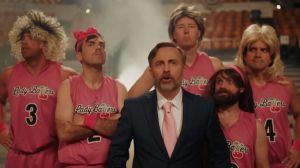 I also want to stress at the outset that the level of critical analysis I am about to apply to Lady Ballers should not be seen as any attempt to elevate it to the level of art worth engaging with or expanding any intellectual strain to deconstruct. Just by talking about this movie, or even calling this loose assortment of tired hate-filled nonsense a movie, might leave the erroneous impression that Lady Ballers is, in any way, inherently interesting. It is not. It is in fact, beyond the novelty of its miserably cynical polemic, a very boring thing that I would defy most people not already tuned into its disgusting message to even sit through (and frankly I bet most of its target audience would find it difficult as well).
Let’s start with Ben Shapiro, the public face of the Daily Wire brand, who appears briefly in a cameo as a referee at one of the games to deliver a line that unintentionally reveals more about him and this movie than anything else in it, flatly stating that he’s just getting paid to be here and doesn’t actually care about anything going on. Ben Shapiro is a grifter, and almost certainly a bad person who probably believes a lot of terrible things about people, but I say probably because you can never be sure with someone like Ben if he actually believes anything he says or is just saying what he needs to say to appeal to an audience of people as bad as he is presenting himself to be. The science is not yet in on whether he is biologically a piece of shit, but he clearly identifies as one, and just as he seems to regard trans identification according to his film, he’s only doing it for the clout and the money. Whether or not Shapiro actually believes any of his own hate-filled rhetoric is immaterial to his main goal, which is raking in money from the suckers in his audience who very much do believe it, and the reason we know this for sure, is because he just made a movie called Lady Ballers.
You see, in a recent interview about the movie on his website, Shapiro revealed that the original intention for Lady Ballers was not creating a kind of dumb, raunchy, shocking for its own sake comedy that he would almost certainly hate if he hadn’t made it himself, but rather, a hard-hitting documentary focusing on his favorite fake culture war controversy. The plan was to have cis-gendered men actually pretend to identify as women in order to infiltrate women’s sports for real and prove that all the so-called trans-women currently doing it were just liars like them trying to get a hairy leg up on the competition. The problem apparently became immediately obvious when they found that the standards for applying to women’s sports as trans-women were much higher than any of their stooges were willing to meet, as they weren’t ready to undergo the hormone treatments, surgeries, and other little details required to prove that they weren’t just a bunch of assholes trying to co-opt something they don’t care about in order to score political points with MAGA douchebags. You get it, right? It’s the one legitimately fascinating thing about Lady Ballers, that its very existence in its current form invalidates its entire thematic premise. They had to make a fictional “comedy” version of the story they wanted to tell because it was impossible to present the thing they claim to believe is actually true in any way that could qualify as a documentary even by their incredibly low standards. As Shapiro is fond of saying, facts don’t care about feelings, and in this case, that appears to be true.
 But of course, that didn’t stop them, so they went ahead and made Lady Ballers, and I could go on for quite a while listing off all the transphobia and misogyny and racism awash in it, as well as all the stuff that wasn’t deliberately objectionable but still offensively unfunny, but again, what would be the point? More interesting to me is what this movie says about the people who made it and the audience it is targeting and what the perceived existence and marketability of that audience says about us as a country and a species. I always felt that the rise of Donald Trump was less about him than it was about us, that whether he won or lost, or wins again or loses again in 2024, it would be a test of our own moral character for us to pass or fail. Do we accept that this is who we are, or do we actually try to live up to what we all want to believe are our better selves? The vitriol intrinsic to Lady Ballers and the Daily Wire and this whole movement of stoking anti-trans hatred to rile up bigots, ultimately in the hope of pushing them to the polls to support a fascist overthrow of our democracy, just seems to me to be another facet of that test, and how close we are to passing or failing it is the only question worth thinking about.
For a movie supposedly about the topic of trans-people in sports, it is a bit surprising that this movie doesn’t actually feature any depictions of real trans-people in it. Obviously, I wasn’t expecting any portrayal to be positive, but I at least expected there to be a trans-character, if only to take the role of a villain or antagonist representing the thing the movie is railing against. We have the aforementioned cis-men pretending to be trans but otherwise no one who genuinely considers themselves to be trans. Even if you dismiss the authenticity of trans identification and say they just wrongly believe something about their gender, you’d think they would show someone like that in their own movie, right? There’s a brief bit at the end where a character suggests they might be, but only as a quick throwaway ball-kicking joke. If trans people are the bad guys in real life, why are they not the bad guys in this movie that wants you to come away thinking that they are so bad?
More to the point, why are there no trans conservatives in the movie? I know there aren’t that many, but off the top of my head I can think of at least two public examples. Maybe Caitlin Jenner was too big a get for this and just saying that the vaunted star of Can’t Stop The Music, Jack and Jill, and literally no other movies is too good for this is saying something, but what about Blair White? Pretty sure she’s been on the Daily Wire a couple of times, but apparently, they couldn’t get her to show up to provide any kind of cover for the transphobic message. That’s literally what she does for a living, being the trans person willing to sell out her own people for conservative clout, and either they didn’t want her in this for some reason, or even she turned them down. Blair White agreed to appear in a Tom MacDonald music video but turned down Lady Ballers?
 That can’t be it. It’s not possible that they even asked them, or ever considered including any trans-people, even as imaginary straw-women to make fun of them, because that would require acknowledging that they are actual people who exist. As the film’s mid-credit stinger suggests, depicting one of the main characters attending Jordan Peterson’s reparative therapy to cure their trans-delusions, for this movie and the ideology behind it to make any sense, trans-people can’t exist, and anyone claiming to be trans is either mentally ill or pulling the same scam as the film’s protagonists. If Jenner had shown up, sure she may have parroted the talking points about keeping sports segregated by the gender binary, but she would have presumably done so with the confidence of a person who clearly believes that they have the right to exist as they are without being accused of being crazy or a liar, which would go against the movie’s larger message that trans-people aren’t just illegitimate as players in sport but illegitimate as people in general. The people behind Lady Ballers are grifters who don’t believe anything, so naturally they assume that everyone else is too, and that includes trans-people, who don’t actually believe what they say about themselves, and are merely grifting a gullible public, just like the Daily Wire is doing.
Designed to work in tandem with freak-outs about Drag Queen Story Hours grooming your kids and doctors prescribing hormone blockers to babies without their consent, the faux controversy about trans-people in sports has always been a thinly-veiled cover for the larger goal of trans erasure, a way to launder openly genocidal rhetoric designed to inspire the very kind of deadly violence against trans-people we’ve seen increase in the last few years as if it were just some completely legitimate concern for the integrity of women’s sports. But Lady Ballers is so blunt and bad at its own messaging that it fails to hide what it needs to hide, giving away the game, no pun intended. Obviously, these people don’t genuinely care about women’s sports; a major running gag in the movie is about how literally no one cares about women’s sports, and the central premise of the movie assumes that any man, regardless of skill, is inherently physically superior to every woman and could beat any women at any sport at any time purely by virtue of being a man.
And I know that sounds like a joke, to the point where you might question my criticizing it in the context of a movie at least intended to be a comedy, but that’s not a joke in this movie. You as the audience are not meant to take the idea that any man is better than all women at all sports as an exaggerated, farcical concept. That is the actual thing you are meant to unironically accept so that the other jokes in the movie work, the underlying rational assumption upon which the other jokes are made relatable. You aren’t meant to laugh at the idea that these men are trouncing these women at the sports the women trained for and the men didn’t, you are meant to laugh at the absurdity that any woman would ever think they could try to go up against any man. A few years ago, there was a poll that found that 1-in-8 men genuinely believed that they could beat Serena Williams in tennis, and this movie was written for them.

If you know who this person is in the picture, I’m sorry.
The virulent misogyny dripping from every corner of Lady Ballers would seem to preclude any genuine regard for the integrity of women’s sports or women in general. The most prominent female character in the film is a conniving reporter colluding with the team’s head coach to cynically milk the “stunning and brave” human interest story for viewers, who casually references her regular abortions as the annoying minor consequence of aggressive promiscuity, you know, the way all women who get abortions do? At one point, one of our “heroes” stares off into the middle distance while spitting out a creepy incel screed sarcastically defining women as just like men but better because they shave their legs, brag about bravery for things that aren’t brave, and aren’t afraid to cry at work, and the next shot is the reporter shrugging and nodding in agreement, as if it was the truest thing ever said and, despite her prior demonstration of assertive hostile feminism, she has absolutely no way to refute it.
Again, you might be saying, these are just jokes. Bad taste jokes, maybe even jokes based on faulty premises that could only be enjoyed by the terrible people who accept those premises, sure, but still, only jokes. But that’s the weird thing about a movie like Lady Ballers that is more preoccupied with its political and cultural message than its service as a functional comedy. The message is not in the service of the comedy, the comedy, such as it is, is in the service of the message. Comedy is about subverting expectations, while cultural polemics are about reaffirming expectations. For instance, if you start your movie with a bunch of characters assuming that simply being men would allow them to dominate women’s sports, one would think the next scene would be them realizing that this was not the case, in a montage of them getting taken down a peg for their sexist hubris. Or you might have an actual trans character presented as a contrast for the absurdity of their fake trans grift. But this movie can’t do any of those things, because to subvert the expectations of its audience of bigoted right-wing morons would defeat the whole point, which is to validate their bigotry and to keep the cash flow coming. The needs of a comedy and the needs of whatever this movie is are diametrically opposed to one another.
Fairly early on in Lady Ballers, before the film’s gender-bending twist, the head coach delivers one of his famously rousing motivational speeches to his team, getting them to chant a motto that will return in the third act: “Winners are just losers who win.” Credit where its due, unlike most of what passes for comedy in the movie, this line at least structurally conforms to be a recognizable joke. It’s not particularly funny or clever, just a superficial rhetorical absurdity, but it also serves as another one of those accidental confessions on the part of the producers. Because if you think about it, losers who win basically describes the Rightwing Influencer Pipeline to which the Daily Wire crew belong.

Also, Ted Cruz cameo.
To the extent that they have won anything, or rather succeeded financially as a grift or culturally as propaganda for a noxious worldview, it has always been with the distinct stench of loser-dom. C.H.U.D.s like Matt Walsh or Michael Knowles speak with all the confidence of people with an actual point, but there’s always this underlying sense that beyond the choir to which they are preaching, the cringe and bluster are obvious to anyone else. When Ben Shapiro tries to own Cardi B and Megan The Stallion’s W.A.P. by questioning whether the titular wetness is a disturbing medical condition, unintentionally revealing to the world that he’s apparently never made his own wife sexually aroused, the self-own, while hilarious, is not even a little surprising. In short, contrary to the utter gob-smacking dearth of actual jokes in their movie, these guys are themselves complete jokes.
And the more important point is that the joke isn’t landing anymore, if it ever did. One need only look to the spectacular failure of Moms For Liberty, a group that tried to ride the wave of transphobia to take local school board elections by storm, only to lose almost every seat they ran for in 2023. If there is any saving grace to Lady Ballers, it is that it decidedly does not feel like the work of people who are or even think they are winning anything. This doesn’t feel like a triumphant victory lap of the Anti-Trans Right, but rather the sad last desperate gasp of a dying movement that was never even a real movement to begin with, the fizzled fart of stale air escaping a punctured basketball, or if you prefer, a balloon used to approximate a fake boob by someone who’s never done drag and didn’t bother to research anything about how to do it right. And that’s good. Not the lack of research but the larger failure of the mission that this movie represents. You still shouldn’t watch it because it sucks.
The thing I’ve always found interesting about Shapiro is that in spite of his horrible takes on everything, he strikes me as someone at least smart and self-aware enough to feel some measure of secret disdain for how his career is dependent upon debasing himself to the kinds of people who boycott M&Ms because the green one isn’t sexy enough anymore. If you didn’t know, he got into the right-wing commentary business after a failed attempt at making it as a screenwriter, and it would seem that the Daily Wire getting into its own film production is at least on some level a way for him to live out the dreams that were robbed of him by his crippling lack of creative talent. I like to think that knowing Lady Ballers is the closest he’s come to the achievement of his lifelong aspirations, and that the actual career he did build for himself is an active impediment to those aspirations trapping him in a cage of his own bullshit from which he can never escape to a land where he is regarded as a legitimate creative person, is the funniest joke of all.
(Addendum: I didn’t have any other place for this, but I did feel I would be disingenuous if I did not mention the one actual good idea in the movie. At one point, the head coach goes to a Hooter’s-esque sports bar but one staffed entirely by men in drag. Of course, in the context of the film this is yet another joke about how men dressed as women are silly and should be dehumanized and presumably executed by the state in the next Trump administration, but out of that context, it’s just a solid concept for a restaurant and I would patronize the hell out of a place like that. Not sure if anyone has ever tried something like it in real life, but if not, they should.)
[Editor’s Note: At the film’s premier, one of the actors was arrested by the FBI and charged with four crimes relating to the January 6 insurrection because of course.]

Share this:

Alternate Opinion: Zack Snyder’s Justice League Guest Essay
My friend and writing partner Ben Bailey asked me to host an extensive essay he was compelled to write after watching the four-hour Snyder cut of Justice League. I’ve never featured anyone else’s words or opinions on this review blog before, but it’s been so long since he really devoted himself to an artistic analysis, and with such detail, that I felt compelled to publish it on my personal review platform. Behold, a guest essay on the nature of Art, Ayn Rand’s Objectivist theory, super heroes and their appeal, Zack Snyder as a filmmaker and philosopher, and capitalism.
____________________________________________________________
“Zack Snyder’s Justice League and The Virtue of Shallowness: An Essay In Search of a Point” By Ben Bailey
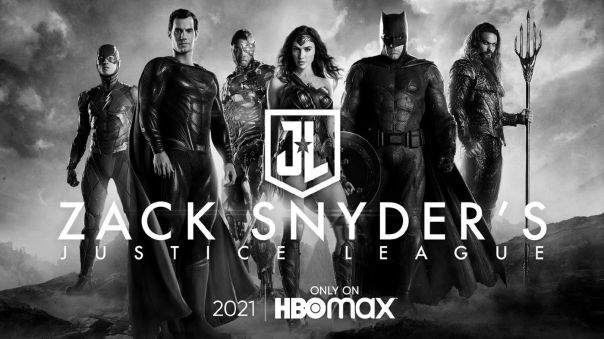
All Art is self-indulgent, but not all self-indulgence is Art.
Back in 2010, legendary film critic Roger Ebert famously groused that video games could never be Art. His reasoning was largely an attempt to grasp at the essential definition of what Art is, and how it can and cannot be applied to various artistic mediums in order to claim supremacy for his preferred medium, cinema, over one he pompously scorned. At the time, as a 25-year-old man-baby gamer, I objected strenuously to his argument but not in a way that I could articulate with the same thoughtful presentation with which he made his case. I just instinctively rebelled against the notion that a thing I loved in the same way Ebert loved movies could not be Art like movies clearly are because smart people like Ebert said so. I was still struggling with what Ebert struggled with in his piece, as I hadn’t yet developed a working definition of what Art actually was. Unlike Ebert, who never settles on a definition and just decides to declare himself right, I have since found one that at least works for me, and now in the cold hard light of 2021, I’m forced to conclude that Ebert was sort of correct but not for the reason he thought he was. The vast majority of video games are not Art, just like the vast majority of movies, TV shows, and books are not Art, because Art is something special and pretty hard to achieve in a capitalist society designed to stifle creativity at the altar of marketability.
For me at least, Art has a practical and a poetic definition. The practical one can best be distilled as, “Deliberate creative expression done for its own sake.” Artistic Intent is everything. It has to be something done on purpose, not something retroactively defined as Art by someone experiencing it separate from the Artist. It has to be a creative expression, which is to say something done to reflect the internal life or point of view of the Artist as opposed to something a craftsmen might build to be functional but not intellectually or emotionally inspired (All Art is craft, but not all craft is Art). And most importantly, it has to be done for its own sake, free of any creative compromise. For something to be Art, the Artist has to do it because it is something they simply must do, because it is born inside of them and must be birthed through the process of creative expression so that it isn’t left stillborn inside their soul to rot and kill its host. If it is done for any other motive, for profit or to cater to the whims of a prospective audience, it ceases to be Art and becomes Commerce, a commodity that belongs to the world and no longer to the Artist.
 The poetic definition is a bit looser as you might expect: “Art is the process of making your dreams come true.” It is how we physically manifest our imagination into literal reality, recreating what is inside of us to bare our souls to the world, not because it matters what the world might think of them or who might want to buy or sell the product of their representation, but simply because the soul of an Artist burns bright and the fire has to go somewhere. Many things are mistaken for Art because they are created with the same tools through the same mediums. A really entertaining movie you love might seem like Art to you, but chances are, just given the realities of how movies are made in the studio system, it wasn’t created by an Artist or group of Artists collaborating to bring something beautiful into the world from their own minds. It may have started out that way, or that may have been the hope at the outset, but inevitably to get the thing made, money people began to influence what it should be, and test audiences and marketing algorithms ultimately dictated its form. A spatula might be used to make pancakes or spank your lover, but that doesn’t make your breakfast foreplay.
You might have noticed by now that my conception of Art is marked by an almost Platonic ideal of the Artist as Rugged Individualist, perhaps an expansive application of Auteur Theory that would mean almost nothing could be Art if it involves any kind of collaboration. That’s not entirely untrue, as I am trying to say that Art is a very rare and exclusive thing, at least when it comes to the kind of creative works we are typically exposed to in a society built on commercial industry. But to clarify, multiple Artists working together on a shared vision like a film or video game, while always more difficult to coalesce than one person articulating a singular vision like a painting or novel, can still be Art as long as the intent remains pure, or if the idea of purity sounds a bit fishy to you, at least free of external influences from non-Artists. Still, it’s just easier to conceptualize the Auteur as Artist for the purposes of discussing artistic intent, eschewing the messiness of multiple Artists trying to figure out the workable common denominator of their unique perspectives. If Art is a person making their dreams come true, the fact that it is their dream and no one else’s would seem to be the pertinent factor in assessing whether it is true to what it is. You might call it the Virtue of Selfishness. And that is where Zack Snyder comes in.
 At this point, I don’t think I need to provide too much on the history surrounding the supposed epic tragedy of behind-the-scenes studio machinations that was the 2017 Justice League film. Suffice it to say if you don’t know, the theatrically released version of the movie was a sort of Frankenstein’s monster of two competing visions, one the culmination of original director Zack Snyder’s bleak, realistic take on DC superheroes introduced in two previous films, and the other a studio-mandated effort to re-shape the project to dilute Snyder’s influence and better ape the success of the Marvel Cinematic Universe (MCU) through the inclusion of re-shoots, re-edits, and post production work provided by the MCU’s most notable director at the time, famed garbage person Joss Whedon. The result was widely regarded as mediocre at best, a mishmash of clashing ideas and tones representing diametrically opposing perspectives on what a superhero movie should be. It was assumed at the time that the relative critical and commercial failure of the film meant that it and the cinematic universe it spearheaded was, much like Snyder’s conception of the DC Universe, completely hopeless. And then some weird stuff happened.
A strange confluence of circumstances involving the changing nature of our engagement with modern media, the increasing ubiquity of streaming platforms challenging and possibly supplanting the theatrical model of film distribution, and also a freaking pandemic, led to Snyder getting an incredibly rare second bite at the apple in the form of the Snyder cut. A long fabled, often dismissed as mythical truer version of Snyder’s masterpiece, the Snyder cut had been cruelly torn from him and mutilated beyond recognition by shortsighted naysayers who just didn’t understand the deep and profound things the director of Sucker Punch was trying to say in the movie where Lex Luthor apparently pees in a jar to make a point to a senator before killing her. Or I don’t know, maybe he got his assistant to do it before sending her to die in the explosion he didn’t tell her about? Okay, that’s not the point, but Batman V. Superman is still really stupid. The point is, fans demanded it, and Warner Bros.’ long history of poor decision-making led them to provide a whopping 70 million dollars, roughly the budget of an entire year’s worth of quality Blumhouse movies, to complete a thing that was supposedly already basically done. And now it’s here.

Author Ayn Rand
If you didn’t pick up on my reference earlier to the Virtue of Selfishness, consider yourself lucky to have never been exposed to any kind of deep dive into the nonsense of Objectivist “philosopher” Ayn (rhymes with “whine”) Rand. I use “philosopher” in quotes because Rand famously rejected all philosophers post-Aristotle other than herself, most likely because all of modern philosophy might as well be collected with the subtitle: “Why Ayn Rand Is An Idiot,” so her rejection of them was likely a preemptive strike done with the same degree of defensive self-awareness that led her to rail against government hand-outs her whole life only to accept Social Security and Medicare in her autumn years. The Virtue of Selfishness refers specifically to a collection of essays encapsulating Rand’s ethical vacuousness better than I could with any description, so I would say you should just read it, though you really shouldn’t. You could also check out her much more popular and well known novels, the CEO’s on strike fantasy Atlas Shrugged, or The Fountainhead, about a self-described brilliant artist who would rather see his greatest work destroyed than allow it to be altered by the people with the moral temerity to think they had the right to dictate what it should be just because they paid for it. Coincidentally, Zack Snyder has been trying to make that book into a film for years.
Snyder is, by his own admission, a devotee of Ayn Rand and a committed Objectivist, and despite my already established aversion to this worldview, I want to state clearly here that I don’t bring this up to say that Zack Snyder believes in something I find ridiculous and is therefore a ridiculous person. I might think that if I got to know him, but that isn’t the point I’m making here. I have no reason to think that Snyder isn’t a perfectly nice, intelligent person as an individual, at least by the standards that we might judge those things in the abstract. I don’t know the man personally, so I don’t know for a fact that his love of a philosopher who said we owe nothing to each other means he believes the same thing wholeheartedly, and I have no way of knowing how he might translate his conception of Objectivism into his daily interactions with other people. He may be a sweetheart or a total bastard for all I know. As a filmmaker, however, I feel like I can say with some degree of certainty that his Randian worldview is at the forefront of his creative vision. If his movies are any indication of his artistic intent (as one assumes they should be), the Artist’s fire that burns in his soul is one that seeks to burn down the liberal social order predicated on the notion that our success as a civilization requires that we care about each other.
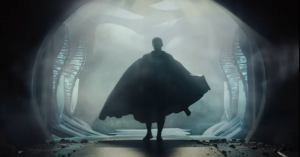 I would submit that the reason Zack Snyder’s approach to superhero movies feels so strange and off putting to so many people, whether or not they can articulate why, is because it lacks empathy. That isn’t to say that a movie or even a work of Art requires empathy, but its absence always feels wrong because art is the language of the soul, and having no interest in appealing to our shared humanity is the spiritual equivalent of gibberish. It feels especially wrong in superhero fiction because empathy is the basis for all superheroes on a fundamental conceptual level. The thing that makes them heroes is that they care about other people and, because of that, dedicate their lives to helping others. The people with similar powers who only use them for personal gain or to hurt other people, because they don’t believe we owe anything to one another, are the bad guys. So when Snyder, a filmmaker who views the world and the worlds he creates through the literal and figurative lens of Randian self-interest, tries to realize the characters of Superman, Batman, or Wonder Woman, it does not occur to him that anyone like them would ever sublimate their own selfish interests for the good of humanity. He has no frame of reference for altruism, so he can’t relate to characters designed to be the personification of it.
Snyder’s Superman spends almost the entirely of Man Of Steel rejecting the idea that he should use his amazing powers to help anyone, and only begrudgingly takes on the threat of General Zod when he is personally threatened and it is in his interest to fight, famously failing to even try to save Metropolis from the destruction wrought by his battle because civilian casualties were immaterial to him. In the sequel Batman vs Superman: Dawn Of Justice, the idea that all of this superheroic carnage has any real toll on real people that we should care about is addressed almost as a petty response to the backlash Man Of Steel faced for its callous depiction of the character, with Batman representing the side that at least cares enough to seek revenge, only to be revealed as short sighted in his zeal to defend humanity from this all-powerful alien god after a few common enemies and a coincidence involving their mothers’ names causes him to see the monster as a misunderstood hero. In between this convoluted arc, we have a montage of Superman saving lives that is one of the most morose series of images ever put to film, suggesting its the last thing he wants to spend his time doing. We see Wonder Woman coming out of hiding after decades of refusing to use her powers for the good of anyone, and we also find out that Batman, the billionaire who spent his life and vast wealth defending the innocent from evil, has since broken his oath never to kill and seemingly delights in sending criminals to prison branded with a symbol that almost assuredly marks them as targets for rape and murder.
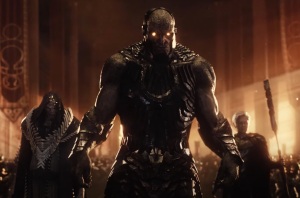 Back in 2019, Snyder directly addressed the criticism of his dark, “realistic” approach to superheroes, and specifically the idea that Batman would kill, by saying “It’s a cool point of view to be like, ‘My heroes are still innocent. My heroes didn’t fucking lie to America. My heroes didn’t embezzle money from their corporations. My heroes didn’t commit any atrocities.’ That’s cool. But you’re living in a fucking dream world.” And you know what, he’s absolutely right. It’s a dream world called comic books. You could say the same thing about something like Star Trek, the idea that we could all give up on greed and completely restructure society around the idea of helping each other is pretty naive and will probably never happen, but that’s not the point. The point is to imagine a world where it could happen, compare that imaginary world to our own, and think about what we might need to do to bridge the gap between them. Fantasies aren’t supposed to be realistic, they are supposed to be inspirational and aspirational. Most billionaires do probably embezzle money, and most people given the powers of a god would probably be corrupted by that power and commit atrocities. But what if they didn’t? What if those people were innocent do-gooders who helped other people instead? That would be super, and pretty heroic at that.
Of course, Snyder is in no way obligated to like or care about what superheroes are traditionally meant to represent in order to make movies about them, but it begs the question of why he would want to spend so much of his time and effort crafting an entire series of superhero movies if he doesn’t. A cynical approach to answering that question might start with the dumptruck of money Warner Bros presumably wheeled to his home, and might even posit a sort of trollish pleasure in taking down something he clearly detested through creative deconstruction a la Rian Johnson’s The Last Jedi. Or perhaps his motives were even more insidious. Perhaps he hates the very idea of altruistic superheroes and altruism in general so much that he dedicated an entire film franchise to subverting our love of superheroism so that we would lose hope in the empathetic message they are meant to inspire, and with nothing else left to cling to, fully embrace our Randian dark sides. For the record, I don’t think it’s any of those things, but any one of them would be more interesting that what I think the actually answer is, which gets me to my biggest problem with Snyder’s work overall, and especially his latest magnum opus, the Justice League Snyder cut.
 Every single movie Snyder has ever made has been at its core a parable extolling the virtue of selfishness, but none of them were intended to be that because they were never intended to be anything. If Snyder were a political or philosophical polemicist for Objectivism or any ideology, I would at least respect the intellectual exercise even if I couldn’t appreciate the end result, but that’s not what Snyder does. While his visual style is marked by hyper-realism, all slow-motion grandiosity, his storytelling is focused on reflecting the real world as he sees it, and his point of view just happens to be skewed the way it is. Remember, he doesn’t want to live in a dream world of his own making, he wants everything to be like the real world, which he just happens to see as one where nobody cares about or likes each other. Beyond that, there’s no inherent meaning in anything he does, which is insane considering how skilled he is at creating visuals meant to evoke the feeling of deeper meaning. When Aquaman stands on that pier with waves crashing over him and “There Is A King” playing in the background, it certainly feels like its saying something, but what? He’s sad? Angry? Symbolic of… anything? When Superman poses like Jesus, he’s clearly not meant to represent any form of Christ narrative I’ve ever read, but the image is iconic and memorable and just feels important somehow, and that’s all that matters.
Snyder’s shallowness is not in and of itself a problem, even if given his talents it represents a crushing waste of potential. The problem is that when your movie is four hours long and serves as a once-in-a-lifetime opportunity to rectify the injustice of studio meddling as a battle cry for every artist who ever had their work stolen from them, not having anything of importance to say and adding literally nothing of substance to the two-hour studio cut everyone hated is maybe the most disappointing thing you could have done. Obviously, the tragic circumstances surrounding his leaving the project in 2017 and the seemingly shady way Whedon was brought onto the project do not make Warner Bros look good, but if I’m supposed to believe this narrative that Snyder was betrayed and his dream project was bastardized by philistines, I shouldn’t be coming away from his original vision with so much more respect for the mediocre hatchet job. I know the prevailing critical consensus coming out of this is that whatever you may think of Snyder’s version, it’s at least better than the Joss Whedon version, but these people are just wrong.
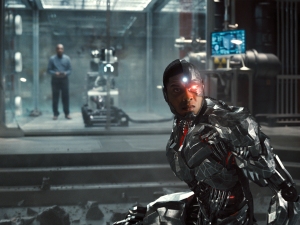 Comparing the two cuts is apples and oranges. One of them is a movie, created under the auspices of a studio director’s responsibilities to their contract, and the other is a vanity project with no such restrictions. Whedon completed a film that was palatable to a wide audience and within a reasonable running time to be shown in theaters, which is presumably what the studio thought Snyder was going to do too. If we are to believe that what we have now is Snyder’s true, uncompromised vision for it, then what was he going to do when they told him you can’t put a four-hour movie in theaters? What would he have cut to get it to two hours? If I had to guess, I’d say probably almost everything Whedon did, since the stories are so similar that its clear the content Snyder put back in was largely superfluous to the narrative. Most of what Whedon cut was unnecessary slow-mo, call backs to movies we wanted to forget, and setups for movies nobody wanted, and redundant moments already covered elsewhere. All the action scenes are present between the two cuts, except for the completely pointless Flash sequence, but in the Snyder cut they’re all twice as long. Same beats, same information conveyed to get the point across, just longer and less well paced than in the theatrical version.
Is Steppenwolf a more interesting villain now that we know he serves Darkseid because of some past mistake we don’t know about, rather than just assuming he does it because he’s from Darkseid’s totalitarian world where everyone serves him? Does Darksied’s comical incompetence as a despot make him a more enticing prospect for a sequel, somehow forgetting that the thing he devoted his life to searching for was on the one planet he failed to conquer, which just so happens to be the one planet where they left behind all those doomsday devices waiting centuries to be easily activated? We’re told it’s such a shame that we missed out on the great character of Cyborg, and now we finally get to see what could have been, but to quote the black clad Superman at the end of the Snyder cut, I’m not impressed. What more did we learn to deepen his story? Daddy never came to his football games but he still misses him when he’s dead? Riveting! Did we need a six-minute excursion into his mind palace with a voice over explaining all of his powers like we’re children when the original just demonstrated all of them by showing them to us? And what does it all amount to? In the end, he gets to ascend to his rightful place as the least interesting mopey superhero who hates being a superhero with all the other mopey self-hating superheroes. Hooray?
 Naturally, you’re probably thinking, it wasn’t all just cuts, what about all that stuff Whedon added in? “What about brunch?” you say. Sure, I’m not going to defend everything Whedon did to make his version work. You’re mileage may vary; I would say about half of his new additions worked for me and half were cringe worthy, but the good half seems even more vital now than it did when we didn’t know the alternative. The brighter color palette alone is a welcome change from the dreary, washed out look of the Snyder cut, and for every bit where Flash wedges his face in Wonder Woman’s cleavage, we get one like Cyborg laughing about his injuries after stopping the mother box, the only moment in either version where he resembles the fun, lighthearted character from the comics and TV shows. The Flash never gets his hot dog-strewn first meeting with Iris West, but he gets a heart-to-heart with Batman about how being a real hero means saving people one at a time that speaks to the greatness of both characters in a way nothing in the Snyder cut does. When Superman smiles in Joss’ version, it’s because he’s saving lives and he’s happy when he gets to do that. When he smiles in the Snyder cut, it’s a menacing sneer because he’s about to lay the smack down on a weaker opponent to show him who’s boss. And then we get that delightful Russian family.
Yeah, I know, you hate the Russian family, and I get it. I hated the Russian family when I first saw the 2017 cut. Why would they waste time showing these characters who don’t seem to have any bearing on the story? The thing is, we only thought that because we were treating this superhero movie like a superhero movie, where we don’t necessarily need to be reminded that superheroes save lives as long as that’s a base-level assumption. But in Snyder’s world, it isn’t. In his cut, there’s no family to save because who cares about saving families? The stakes in the Whedon cut are clear and personal, real people will be hurt if they fail. We are them and they are us. It’s not subtle but neither is anything Snyder has ever done in his life. In the Snyder cut, we know that the Earth is doomed, but it’s all theoretical, our entire planet reduced to the same collateral damage that Metropolis became in Man Of Steel, where the people are there, we assume, but they don’t matter enough to be our focus. And in the end (of the Whedon cut anyway) the villain is defeated by his own fear, because the fear he represents cannot stand up against what the heroes represent in opposition to him: love, for each other and for the world they fight for. In the Snyder cut, they just savagely whale on him, stab him, and cut his head off with terrifying glee in their eyes, and then we cut to a flash-forward into a future world seemingly based on the Injustice video game series where we find out they failed to save the planet anyway.
 Again, I would like to stress that I am not making a one-to-one connection between filmmaking style and personal character. I’m not saying that Zack Snyder the person doesn’t care about people, and I know Joss Whedon doesn’t. I assume that before he shot those Russian family scenes, he made sure to make some of his female employees feel like dirt because making women cry is the only thing that gives Whedon an erection. But the real-life context matters. You might be asking why I keep bringing up the Ayn Rand stuff even though I don’t even think he’s intentionally injecting it into his movies. It’s because when I saw the original 2017 cut, I was disappointed but I didn’t hate it. When I saw this new cut, I was incensed, and I couldn’t quite figure out why until that side of it clicked for me. I went through something similar with Quentin Tarantino’s Once Upon a Time… In Hollywood. Everybody was loving it but I couldn’t explain quite why I didn’t until it dawned on me that it wasn’t anything about the filmmaking but the larger context, a director who made millions working with Harvey Weinstien, making a love letter to old Hollywood in the wake of the Me Too movement centered around the exploitation of an actress and making the story about two clueless men. It just felt wrong, and I’m finally to the same point with Snyder’s movies.
The 2017 cut of Justice League came out shortly after the election of our fascist, white supremacist, and eventually traitorous former president Donald Trump, a man so comically evil that he literally served as one of the inspirations for Lex Luthor when he was transformed from a mad scientist into an 80’s-style corporate tyrant. His rise to power, or rather the lie he tells people about being a self-made man and not a trustfund baby, is basically a Randian Horatio Alger story, and not just because both men were fabulists rumored to be pedophiles. You might even call him a Randian Superman, and the line from Randian Self-Interest to CEO worshiping Social Darwinism to Trumpian fascist strongman politics is undeniable. This new Justice League, where Zack Snyder tries to turn all my favorites superheroes into fascist action figures, comes out only a few months after a bunch of traitorous right-wing scumbags tried to raid our nation’s Capitol to usurp our democracy at the whims of a would-be king. One technically doesn’t have anything to do with the other, but the images are iconic and the connection just feels like there’s something meaningful there, even if it’s unintentional. I just can’t treat Snyder’s bad politics as just some interesting facet of his directing style anymore. I don’t want it in my polity, I don’t want it in my entertainment, and I sure as hell don’t want it in my superheroes.
So what was the point of any of this? Why start with that long boring excursion into the definition of Art? And what’s more, if Art is the one place where the Virtue of Selfishness makes sense, where does any audience or any would-be critic like myself have any place to question an Artist like Zack Snyder? Why write 20-plus long paragraphs, the Snyder cut of Snyder cut hot take think pieces, if an Artist should never care about what anyone thinks of what they create? That’s where I’ve been the last few days. As you might guess, I find the whole notion of Art criticism to be utterly worthless and without merit. The entitlement that audiences have surrounding the Art they consume is equally abhorrent to me, as if what they think of something should have any bearing on the form it should take. So where does that leave me? Feeling like a hypocritical piece of garbage.
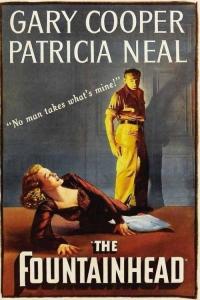 I keep coming back to The Fountainhead (as a metaphor, not the actual book, because I read it once in college and that was enough). The protagonist Roark was hired to design a building and insisted he could blow the thing up if they didn’t let him build it the way he wanted, and when he does, he goes to trial, and makes a passionate plea in defense of his own rights over his creation that wins over all the doubters who couldn’t force him to conform to tradition. I keep wanting to force this narrative where Snyder is Roark and the saga of the Snyder cut is his quest to finally build that eyesore upon the skyline the way he always wanted, but it just doesn’t work for me. Art is deliberate creative expression for its own sake. The Snyder cut is certainly deliberate, and while it was made at the behest of the studio for a profit and an audience, I’m even willing to give Snyder the benefit of the doubt that he didn’t care about either of those things and really did set out to make it for its own sake. But then there’s that middle part, creative expression, something that reflects the internal life or point of the view of the artist. What if there’s nothing interesting about the internal life to reflect, and any apparent point of view is accidental and despicable at that? Is Zack Snyder the architect Frank Gehry, building beautiful sculptures people just happen to live and work in, or is that just who he thinks he is and who we want him to be, and really he’s just a very skilled craftsmen with nothing to say? How boring and uninspired can a work of Art get before it ceases to be Art at all from the sheer weight of its pointlessness?
Roger Ebert tried to say that video games could not be Art, but really he just didn’t understand them or like them, and for years, similar charges have been leveled at comic books and comic book movies. Whatever I might feel about Snyder or his work, he has been instrumental in lending a degree of legitimacy to comic book storytelling in the minds of a lot of people who otherwise dismissed it. Maybe not as much as the MCU has, but he’s still a part of it, and as a lifelong comic book fan, I can’t ignore that. I feel like I should be right there with everyone else, if not loving the Snyder cut, then at least loving what it represents, that for once the little guy won over the big guy, even if the little guy is usually on the side of the big guy unless he’s the one getting screwed, and he didn’t really win so much as reveal his limitations and give me a reason to say “I have more respect for Joss Whedon as an artist” which is something I never wanted to say again. But I’m not there, and I don’t think that’s what this represents, and really, I just wish that someone else, or really anyone else could have gotten the opportunity that Snyder did. Maybe this release makes that more likely in the future, but I don’t have much hope for that. I don’t have much hope for anything left in me anymore because I just watched a four-hour Zack Snyder movie and I’m pretty sure our future is going to be a Randian dystopian Knightmare. Release the David Ayer cut! Release the Gareth Edwards cut! Release the Lord and Miller cut! Release the Michael Cimino cut! Release all the cuts!
Just try to keep them under two hours, please.


 nathanzoebl
You must be logged in to post a comment.