Blog Archives
Pain Hustlers (2023)
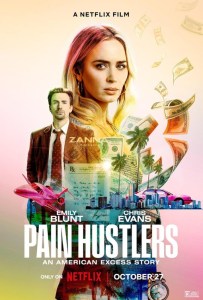
Pain Hustlers is the next attempt to dramatize the numerous stories behind the opioid crisis, a storytelling edict that is becoming its own tragic true-crime sub-genre (Dopesick, Pain Killer, Four Good Days, Recovery Boys, All the Beauty and the Bloodshed). The Netflix original has a starry cast and a topical and serious subject but it’s an un-serious movie caught up in the superficial quirks and appeal of being and making a goofy crime story of greedy sleazeballs.
Liza (Emily Blunt) is a struggling single mother trying to claw her way out of debt and, with her unfinished education and criminal record, few options are widely available. Then enters Pete Brenner (Chris Evans), a loud, gouache pharmaceutical rep for a powerful pain killer. He promises a lifestyle of luxury and power, as long as Liza is willing to ignore or bend a few ethics along the way. Together, they build a sales force of attractive women who wine and dine smaller doctors in order to get them to prescribe their special drug to anyone in need. It’s just that a drug intended for end-of-life pain wasn’t meant for common headaches. As sales boom, Liza begins to worry that her glitzy lifestyle is built upon a mountain of American corpses.

The biggest drawback of Pain Hustlers is that it fully focuses on the glitz and gives lip service to the cost of chasing that avarice. Plenty of movies illuminating bad people doing bad things are accused of glamorizing the misdeeds, from gangster movies to dark romances, though this narrow viewing often seems to conflate depiction with condoning the behavior (see: The Wolf of Wall Street). Watching stories about people stumbling their way into glamorous positions should provide some allure so as to better understand the seductive draw for the characters. The world of vice and power will be a compelling conflict, but for Pain Hustlers, it falters by just focusing on the high-powered lifestyle yet it still lacks specificity to make this story feel interesting on its own. You’ve seen variations of this kind of story before (we’ll call it Scorsese-esque) about the people struggling with less who get a ticket into a new world of access and freedom and then begin to worry At What Cost. Pain Hustlers goes through its plot beats with the most mechanical of movements. The personal details from this supposedly true story feel so generic, reminiscent of similar tales like, Love & Other Drugs and Hustlers. It feels less like an insider account of how these shady people exploited so many and more like the screenplay was cobbled together by what the filmmakers assumed this story must have pertained without reading much of the source novel by Evan Hughes. It’s absent the useful details that allow more of these accounts to prosper as we investigate moral relativism.
The other nagging shortcoming of Pain Hustlers is the consequences for all these bad people. I’m not saying that we need to see comeuppance and justice levied in order for the movie to work thematically; very often these white collar criminal types receive the faintest glance of judicial punishment. What this movie lacks is the emphasis on the consequences, and considering our main characters are pushing sleazy doctors to push highly addictive opioids, that’s a big miss. The movie is all about the climb for its heroine, the comparison of having the fancy life versus a life without. It shortchanges the extremely human cost of its bad actors in a way that does a disservice to the movie and its message. Because of its lack of specificity, this story could have been propelled by any prescription drug, from Viagra to Lipitor. The fact that we’re talking fentanyl, a drug responsible for 200 deaths every day last year according to the CDC, seems immaterial, and that is bizarre.

The effects of the opioid crisis begun by Purdue Pharma and the Sackler family, and then trickled down through the complicated tributaries of the American medical infrastructure, will be felt for generations. This is a major story. It would be like, say, telling the story of a struggling single mom who decides to take a career advancement in the Nazi Party in 1940s Germany. You’re not just doing a disservice to the people who really suffered, you’re doing a disservice to the audience to ignore the gravity of their moral culpability and excuse-making, of the drama of the character having to confront their part. For a movie about people profiting from opioid over-prescriptions, there is a grand total of one scene where Liza has to deal with the harsh real-world consequences of her actions (minor spoilers ahead, but I’d advise you to continue, dear reader). Early in the movie, when Liza was forced out of her home, she spent a few days living in a motel. The neighbor lady at the motel has a husband who dies from the opioid crisis, and this one man is meant to symbolize what she has wrought as a whole. It doesn’t work, and the fact that the movie presents Liza in tears trying to make amends to this widow, a character we haven’t had any thought over since Liza leaving her Act One beginnings, is a pitiful excuse for a reckoning.
Evans (The Grey Man) and Blunt (Oppenheimer) feel on autopilot here, namely because of the broad and bland characterization. Blunt resumes her Southern accent I recall from the Quiet Place movies, but her energy level feels too low, too disengaged, like she’s already at her quiet rectitude character phase when she should be at the gee-whiz giddiness of her moral slide. Evans is meant to be playing a cad prone to vulgar boasts and condescension for those he willfully steps over to reach his goals, but his “sleazeball” acting tics feel too forced, too played up, in all the ways that Blunt feels dialed down. There’s no baseline for the two of them, so the scenes they share together feel over and under-cooked, and with a generically developed rise-and-fall screenplay to boot. Andy Garcia (Father of the Bride) is the most interesting character as the head of the company, a doctor who began trying to ensure those in desperate need could have the dignity of mitigating their pain, and transforms into a megalomaniacal huckster who only wants to keep meeting the next sales projections. His rise-and-fall seems much more steep and intriguing than trying to give us Liza, a gutsy single mom (with a wacky mother of her own played by Catherine O’Hara) who we’re supposed to identify with and forgive for playing her part in a deadly chain that has wrecked untold lives across the country and world. She did it for her own kid’s medical treatment. So it’s all okay, right?

This is director David Yates’ first movie away from the familiar confines of the Harry Potter universe since the ill-fated 2016 Tarzan reboot, and only his second non-Potter movie since 2005. Given that history, I’m curious whenever this man jumps onto a non-Potter project because you would assume it has to be special in some manner. I’ll credit Yates with changing his visual preferences from the very drabby and gray palette of his Potter filmography.Pain Hustlers adopts a lot of the stylistic tics we expect in glitzy crime thrillers, from handheld camerawork to sun-bleached colors. There are other techniques to bring a documentary-like authenticity, but the constant cutting back to black-and-white interviews with the characters after the fact only serves as a narration crutch to keep things moving. The character narration lacks further insight from the distance or remorse of the onscreen events. The whole movie feels like a copy of a Scorsese imitator, something akin to 2009’s forgettable The Middle Men, a crime movie about a plunge into the underworld from a naif that doesn’t try too hard beyond empty reconfiguration of the superior style of its influences that I doubt anyone really remembers (you might as well add directorial narration, “Ever since I was young I always wanted to make a gangster movie…”). As immediate evidence to the case, there is a slow-motion house party in Pain Hustlers set to “Turn Down For What.”
Should you spend two hours watching Pain Hustlers? Not really, though if you have a fascination with the many schemers who contributed to making the opioid crisis as trenchant and terrible as it currently is, and likely will be for the near future, then maybe there’s some mild value to be had here. But even those people would be better served watching another Netflix series tackling the same subject matter, the 2023 limited series Pain Killer. For me, the Pain Hustlers story was too broad, and where it could have broken out with specificity is where it decided to wimp out and defer to genre cliches. It’s hard for me to argue that you should spend two hours watching this movie on the subject when you would be far better served, from an informative and entertainment standpoint, watching the two-part, four-hour 2021 documentary Crime of the Century by masterful filmmaker Alex Gibney. That film is damning and compelling and authentic in ways Pain Hustlers can only hope to imitate.
Nate’s Grade: C
Share this:

Father of the Bride (2022)
 Those familiar with the 1991 Steve Martin movie, or the 1950 original with Spencer Tracy, or even the 1949 novel by Edward Streeter, who was born in 1891, will understand that Father of the Bride is an old story that can still be relatable with new wrinkles and details. The core elements of the story, about the stress and chaos of wedding planning, or the pressure and patience of family, are still present with this new version where Andy Garcia and Gloria Estefan star as the parents of the bride (Adria Arjona). Garcia is a first-generation Cuban-American, a successful Floridian architect about celebrating old traditions, and a bridezilla of epic proportions terrorizing every soul in Miami. He is an awful person, holding to outdated and cringe-inducing misogyny and at several points making demands that because he is the father of the bride, he will be dictating exactly how his daughter’s wedding will proceed no matter the objections from the bride. Even when the groom’s wealthy Mexican family comes into the picture, neutralizing his power of the purse, Garcia’s bad dad just gets even more pushy and prissy. Ultimately, of course, he sees the error of his ways, the opulent wedding is nixed for something more spur of the moment combining traditions old and new, and everyone seems to get along by the end as one big happy family. I liked the added subplot of Garcia and Estefan hiding the fact that they are getting a divorce, which provides farcical potential. However, some of the subplots feel lightly developed, especially the other daughter being tasked with making all the bridal dresses for her sister. She wants to be a designer but cannot get a break, and yet the final reveal of the wedding gown is absent any drama, taking away from the relationship between the two sisters. Same with a friend who may or may not be queer and vibing for the bride’s sister. It’s strange that the two daughters get underdeveloped when they’re so essential to the wedding, and especially considering the movie is practically two hours long. I wish the filmmakers had trimmed some of the redundant “Andy Garcia is awful” moments and given more time to other supporting players. Father of the Bride is a chuckler of a movie, never netting bigger laughs but providing a few chuckles and smiles here and there. It’s a pleasant movie to watch, though I don’t think Garcia’s tyrannical father has earned his epiphany and forgiveness by the end. Given a Hispanic spin, the personal details and cultural authenticity allows an old story to feel fresh or at least fresher.
Nate’s Grade: B-
Share this:

Wrath of Man (2021)
 Wrath of Man is the least Guy Ritchie movie of Guy Ritchie’s career. It’s a crime movie, yes, and based upon a 2004 French film, but it’s absent his trademark big colorful Cockney personalities, ironic coincidences and upheavals, and broad slapstick violence. It has some narrative shuffling on board, as you can’t have a Ritchie heist movie where he’s not cross cutting between characters explaining the steps of the heist and enact it simultaneously, but Wrath of Man has far more in common with a lean, stripped down crime thriller like Heat than Snatch or Lock, Stock, and Two Smoking Barrels. Even a fun caper like 2015’s Man from U.N.C.L.E. felt like a clear distillation of his signature style into a new mod studio setting. This movie doesn’t feel like a Guy Ritchie movie. There is style, sure, but it’s far more gritty and less self-consciously flashy. It’s a solid vengeance tale, a pulpy though confusingly structured B-movie, a crime story with a message about anticlimax, and a sign that Ritchie can restrain himself when his film project calls for it.
In an opening scene, we watch an armored truck robbed and both drivers are executed. The repercussions of this will echo throughout the story. H (Jason Statham, reuniting with Ritchie for the first time since 2005’s Revolver) is a new hire for that same armored truck company, escorting large sums of money. He and his partner, Bullet (Holt McCallany), are held hostage by armed thieves and H methodically dispatches them, killing them all. Who is this man? He’s someone trying to find the culprits behind the opening robbery for his own personal reasons of vengeance, and that means setting up tantalizing traps for would-be robbers and working his way across Los Angeles to determine who is going to feel his manly wrath.
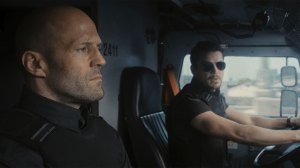 This is a darker and more somber vengeance movie where the violence has more weight to it. Everything feels heavier in Wrath of God. Even though this is strict B-movie territory, Ritchie does a commendable job of making the violence feel real and dangerous. It’s not cartoonish. There are recognizable genre moments, like too-cool interrogations, but this feels closer to a version of our own world where violence isn’t cool but awful. That may sound like the opposite of a recommendation, and I can hear someone say, “Why would I want THAT in my Jason Statham thriller?” Fair point, but the visceral nature of this depiction of crime makes the thrills feel more earned and less fleeting. The musical score by Christopher Benstead (The Gentlemen) is heavy dread personified for the entire two-hour running time. I was surprised how involved I found myself getting as the movie progressed, and during a climactic shootout I was feeling palpable nervous tension. I didn’t know who was exactly going to make it out alive, but I also wanted the “bad guys” to be taken down, but I was uncertain whether any of this would happen. Wrath of Man is an efficiently calibrated thriller when the action heats up. It doesn’t do anything special but what it does is build its moments with compounding dread. You’re waiting for bad things to happen, and you should expect bad things to happen, but you don’t quite know if they’ll happen to characters you like or don’t like, and that pumps up suspense. I was honestly surprised how invested I was during that shootout despite the limitations of characters as genre placeholders. The action and confrontations are chilly and ruthlessly efficient.
It’s the structure that’s the real villain here. I’m exaggerating a bit but there are significant structural curve balls that attempt to make Wrath of Man more unpredictable and I think take away from its overall impact and coherency. We see the opening robbery from three eventual perspectives, the drivers inside the truck, the perpetrators, and the bystander victims. We’re also shifting perspectives from chapter to chapter, but I’m not certain that all this fancy narrative shuffling is actually worth the strained effort. I’ll agree it keeps things unpredictable, but any movie where beginnings and middles are rearranged would achieve that same effect. Our first segment presents a mystery, but then it’s answered immediately in the next segment. The third segment answers another mystery, and it’s here where I started feeling like these answers weren’t quite worth the efforts to get there. There’s a notable anticlimactic design to much of the reveals, and while I believe it has ripe thematic purpose (more on that later), it also removes degrees of satisfaction that you can take from the movie. When you find out who H really is, you’ll be like, “Oh. Okay.” And from there he seems like an unkillable superhero. And when you find out who is responsible for the opening robbery, you’ll likely be like, “Oh. Okay.”
 The problem is that these answers aren’t nearly as satisfying because the people are so one-dimensional. The gang involved in the robbery, and responsible for H’s tragedy, are just one-note dudes and with a super obvious liability they keep on their team that takes away from their so-called professionalism. By taking characters in and out for long portions of the movie, we can lose track of meaningful supporting characters but also it limits the dramatic appeal. If we knew who hit that robbery early, and how they’re reacting, we might feel more conflict when they come head-to-head again with H in the climax. Or we might be better off simply not knowing them at all for as much time as they are given. Getting such shrift characterization, and with an obvious psychopath on board, feels like a half-hearted shrug. Likewise, knowing H’s tragic back-story later into the movie doesn’t really produce much more than had the movie opened with that information. It feels like Ritchie and company have recognized the limitations of their mystery and rearranged the pieces just to provide some extra questions for an audience to grapple with longer. I enjoyed early on discovering just how capable H was, and I enjoyed how the movie doesn’t pretend the obvious isn’t apparent (“Your shooting was… unambiguously precise”). However, this is Jason Statham, so we already know he’s going to be more than capable on the job.
I wanted to talk about the emptiness of the movie, and I don’t mean this as a pejorative assessment but in the themes. It’s about greed and pride and vengeance and, ultimately, it’s about how little any of these motivating factors add up. This is a gloomy movie about bad people, each with a reported reason for doing the bad things that they do. There’s been a million “crime doesn’t pay” messages in movies, but this is one of the few where I felt the futility of it all. By the conclusion, as innocent people are being killed by not-so-innocent people, and then they are just as easily dispatched by even less innocent people, I kept thinking of Marge Gunderson’s inability to reconcile criminal behavior during the end of the brilliant movie Fargo: “And all for a little bit of money? There’s more to life than money, ya know?” I don’t think it’s a spoiler to say that H does get his vengeance at long last in the movie’s resolution, but by that point I felt like it didn’t even matter. Sure I still wanted the antagonist to be toppled, but after such mayhem and such loss of life, and all for a little bit of money, the anticlimactic nature of the ending felt purposely designed. The movie has been leading up to this moment and yet when it comes, it’s not quite what we would have hoped. That intentional emptiness is meant to convey the hollow nature of vengeance as well as a nihilistic approach to crime movies. It kind of works but also it works because the movie didn’t do much work making this antagonist memorable or multi-dimensional so that I could relish his eventual smiting. It feels, in some ways, like the grimy B-movie equivalent of Matt Damon getting clipped at the end of The Departed (spoilers?).
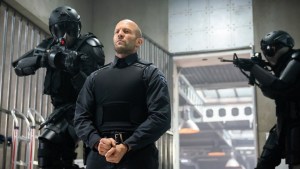 Wrath of Man is a solid vengeance thriller with some heavier themes and some weightier violence, but it’s still a movie where Jason Statham cleans shop. It’s still going to scratch those very basic demands but I applaud it for trying to be a little something more. It succeeds in some areas, like tone and theme and thrills, and doesn’t so much in others, like the non-linear narrative and too many one-dimensional characters. Ritchie demonstrates some artistic growth taking just a few fateful steps outside his cocksure and gaudy signature style. I would welcome more Ritchie signature movies akin to Snatch, but I would also welcome more well-oiled thrillers where Ritchie sublimates his style for the good of the story and mood. Either way, I’d just be happier with more good Guy Ritchie movies (and a sequel to The Man from U.N.C.L.E., please).
Nate’s Grade: B
Share this:

The Mule (2018)
 Clint Eastwood plays a real-life 90-year-old drug mule, though I must inform you dear reader that at no point does he hide his cargo in a very uncomfortable place. The Mule is an interesting story about the most unexpected mule. Eastwood plays a man broke and on the outs with the family he’s neglected their entire lives. He takes up an offer to simply drive albeit for a Mexican drug cartel. As with most life-of-crime movies, what starts off uneasily becomes second nature as our characters get in over their heads. Except that doesn’t really happen in The Mule. I would estimate twenty percent of the movie is watching Eastwood drive and sing along to the radio. There are some tense near misses where he’s almost caught, but these are confined to the first half. In the second half the cartel becomes the chief source of danger, all because he doesn’t go by their routes. If he’s their most successful mule, having never had a ticket in his life, then why micromanage? There are some other nitpicks that nagged at me, like the cartel knows the DEA agents (Bradley Cooper and Michael Pena) are pulling over a very specific color and kind of car, but at no point do they change out Eastwood’s car. Also, Eastwood is spending vast sums of money in public for a man who was losing his house, and yet no red flags there. Eventually Eastwood has to make a choice of family over angering the cartel and risking his life, and I think you’ll know where his character arc is destined. The dramatic shape of the movie feels a little too inert for the stakes involved, leading to an all too tidy conclusion. Eastwood delivers a fine performance, as does every other actor involved. The movie kind of coasts along, much like Eastwood in his truck, on the inherent interest of its premise and the star power of its lead/director. The Mule might have worked better as a documentary.
Nate’s Grade: B-
Share this:

Ocean’s 13 (2007)
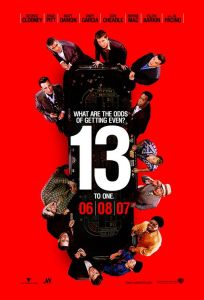 Much more like 11 than 12, this latest Ocean’s caper is just as preposterous as all the others but remembers that the audience needs to have fun too. Danny (George Clooney) and his baker’s dozen are plotting revenge on Willie Bank (Al Pacino, looking like a leather couch), a ruthless casino mogul who pushed old friend Rueben (Elliot Gould) out of a business agreement. The boys must outwit casino workers, modern technology, and a super computer able to detect pupil dilation in order to fleece Bank’s Vegas eyesore. Thankfully, all of the players are back and given tasks to do, and some of the means of their scheme are ingenious. How do you pass a lie detector tests? Place a tack in your shoe so that all your truthful answers match the intensity of your false ones. How do you get your hands on rigging dice? You send a couple guys to work in the Mexican factory and, why not, start a worker’s revolt. Ocean’s Thirteen glides along almost too smoothly, barely stopping to enjoy the crazy amount of absurd machinations before they fly by. The dialogue is packed with coded terms and the film doesn’t even stop to explain them. The movie works on the contact high of cool it luxuriates in, but unlike Ocean’s Twelve, this time the gang is given an objective, allows the audience in on their plot, and then we sit back and watch the execution. Steven Soderbergh and the gang have created a slick and amusing sequel. It lacks the freshness of the first go-round in 2001, but Ocean’s Thirteen is the most satisfying three-quel so far in a summer already weighed down by them.
Nate’s Grade: B
Share this:

Smokin’ Aces (2007)
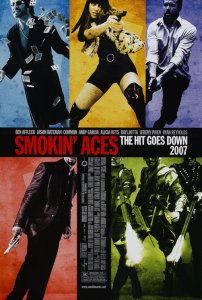 Writer/director Joe Carnahan (Narc) wants to impress an audience so bad with his muscular and macho gangster flick, but his Smokin’ Aces is vapid, nihilistic, and opines not to simply be a Tarantino rip-off, but a rip-off of a Tarantino rip-off. The premise seems ripe enough as we follow a rogue’s gallery of hitmen and killers trying to be the first to knock off a mob snitch/Vegas magician (Jeremy Piven) for a million dollar bounty. The colorful characters are introduced and some are quickly and unexpectedly taken out, but Carnahan never fully knows what to do with his bushel of baddies after he establishes their character quirks. The killers don’t really interact that much with one another and some of them hardly have any screen time at all; perhaps less would have been more in this jumbled stew. Carnahan throws out a few nifty visual tricks but it’s all superfluous and empty. Smokin’ Aces moves quickly, doesn’t make much sense in the beginning and end, and little to any of the characters have satisfying conclusions. So much of the writing feels like lame macho posturing without anything new or interesting to add to an overstuffed shoot-em-up. There are cops, robbers, plenty of gunfire, lesbians, and all sorts of convoluted twists, but it never holds together. Carnahan throws a lot of different elements together but they never extend beyond the elemental stage, so every storyline and character feels like an introduction that?s never capped off. The man has no idea what to do with what he’s started, and a karate kid on Ritalin is all the proof I need. Guy Ritchie did this territory far better service with the marvelously entertaining 2001 film Snatch. Rent that instead and save yourself the headache.
Nate’s Grade: D+
Share this:

Ocean’s 12 (2004)
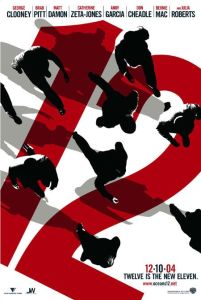 In 2001, Steven Soderbergh’s remake of Ocean’s Eleven was a giant surprise. It was a blast of fun with an impressive collection of Hollywood royalty. It had clever dialogue, fun characters, and a gala of amusing plot twists. It was one of the breeziest, most entertaining movies in years. Now, come late 2004, Ocean’s Twelve is released with the entire cast returning, including the lovely Catherine Zeta-Jones in tow. Expectations are high for another glitzy romp, but what you’re left with in Ocean’s Twelve is all glitz and no romp.
It’s been three years after the gang robbed ruthless casino owner Terry Benedict (Andy Garcia) of 160 million dollars. Benedict tracks down each member of Ocean’s Eleven and gives them the same ultimatum: either pay back what they stole, with interest, in two weeks or they’ll be killed. Danny Ocean (George Clooney) leaves his attempts at normal home life with Tess (Julia Roberts) and reassembles the team, many of whom have burned through their shares of the millions. Danny and his right-hand man Rusty (Brad Pitt) figure they’re too hot stateside so they’ll need to travel overseas if they’re to steal their fortunes. Linus (Matt Damon) also wants to have a greater role in the heist this time around.
In Europe, Ocean is challenged by a French playboy (Vincent Cassel) who moonlights as the notorious thief, the Night Fox. The challenge is to see who can steal a priceless Faberge egg, and if bested the Night Fox promises to pay all of Ocean’s debts to Benedict. Hot on the heels of both thieves is Isabel (Zeta-Jones), an expert police officer that also happens to be the former girlfriend to Rusty.
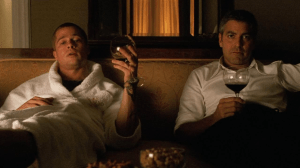 Ocean’s Twelve does not work as a heist picture. For starters, the audience has no idea what’s going on for most of it. A general heist movie bylaw is to explain what the heist will entail, and then we watch the team hit it step by step. Forget that. In Ocean’s Twelve we’re never told how they are going to do their heist, and as they commence with their plan it’s not surprising to an audience, only confusing. I had to wait until the very end for some character to go into a monologue to explain how they accomplished their heist, and let me say, it was not worth two hours of waiting and scratching my head. The result seems to push away an audience instead of involving them in the fun of the scheme.
The story doesn’t utilize the talents of the assembled members. There’s a reason you hire a demolitions expert or a pick pocket, and that’s to let them work their skill. Well in Ocean’s Twelve we get none of that. Most of the cast’s skills are not ever put to use, which further gunks up a heist movie. The movie really errs by putting many of its eleven on ice for long stretches of the film. Around the second act almost everyone gets arrested. Pity poor Bernie Mac, who is in jail for near the whole movie. It seems that Soderbergh doesn’t know what to do with all his characters, and the new additions, so he stashes them away for long stages of time hoping an audience won’t notice.
Soderbergh is in danger of becoming a parody of himself. His usual narrative flourishes are present, including jumps in time and perspective; however, they don’t add up to much except unnecessary showmanship. The nonlinear leaps and shell game of information do not add to the film. Soderbergh keeps his audience in the dark for too long and then cheats us with the ending. Ocean’s Twelve is a good looking film (the vistas look beautiful), but it’s a good looking movie with nowhere to go. What’s even more frustrating is the ending to Ocean’s Twelve. You see, in the end we find out that the last hour plus of the movie was unnecessary. Yes, the movie actually makes a reveal that nullifies over half of the film. It’s cheap and unappreciated. Ocean’s Twelve, there’s a difference between tricking an audience and conning them. Maybe some day you’ll realize this.
 The new storylines never really develop. Zeta-Jones doesn’t add much besides another authority figure to chase after Ocean and the boys. Her subplot involving finding her master thief father is abrupt and easy. The best new addition to Ocean’s Twelve was the prospect of a rival, but again nothing really happens with our French thief. He’s more of a catalyst for the plot than anything else, and it’s a shame, because he could have opened the door for a great film pitting two competitive teams of thieves against each other.
Ocean’s Twelve is too satisfied with itself to be that entertaining. It’s now actually reminiscent of the 1960 original film (my grandmother swears it’s wonderful, take that for what you will), starring the Rat Pack. Plot and logic are secondary to a bunch of cool characters having fun. I really enjoyed Ocean’s Eleven (the 2001 film, not my grandmother’s preferred version), but this new sequel lacks any charm and verve. I can’t even say there were many good scenes, just some good ideas that they didn’t fully actualize, like stowing Yen in baggage and then losing their luggage (nothing comes of this). There’s a fun scene involving Topher Grace spoofing his own micro-celebrity, but beyond that many of the scenes and ideas don’t seem developed. The best moment of Ocean’s Twelve, for me, was when I saw Eddie Izzard, the funniest man on the face of the Earth and then some, chat with Hollywood’s A-list on screen. God bless you Eddie Izzard.
Ocean’s Twelve wilts in comparison to its witty, effervescent predecessor. Ocean’s Eleven was fun and hip but didn’t need to coast on star appeal. It had a believable heist, engaging personalities, and it was fun because we knew what was going on and it mattered! I’m sure the cast of Ocean’s Twelve had a blast making the movie together, and their friendly camaraderie shows, but when I left the theater I felt like I had been stuck with the bill for someone else?s good time.
Nate’s Grade: C


 nathanzoebl
You must be logged in to post a comment.