Blog Archives
Regretting You (2025)
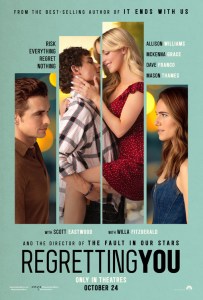 I do not care for Colleen Hoover as an author. She exploded thanks to social media and has, as of 2024, sold over 34 million books, primarily romantic dramas, primarily featuring wounded women trying to get back on their feet. She is a full-blown publishing phenomenon. Hoover has become so prolific and successful that she takes up an entire shelf. She’s already joined the ranks of your James Pattersons, Stephen Kings, Danielle Steels, the familiar names of authors that can be found in grocery checkout lanes. Her popularity is indisputable. Her quality is another matter, and that’s where I have trepidation with Hoover as a storyteller. Admittedly, I have never read any of her novels, so take all criticisms with a degree of incredulity. I’m making my judgement based entirely on the movie adaptations of her novels. Again, this might be an unfair guide considering if I did the same thing for, say, Stephen King, it would be easy to form a scathing opinion of the man’s literary work. 2024’s It Ends With Us made me deeply uncomfortable with its misplaced attempts to romanticize domestic violence. It wasn’t just misguided but it offered little insights into the mentality of abuse victims, instead slotting this disturbing story element into the awkward love triangle expected from the genre. It wasn’t good. Next, we have Regretting You, based upon Hoover’s 2019 novel of the same name. At this point, I’m wondering if I need to hold a regular spot in my annual worst of the year lists for the slew of Hoover adaptations to come.
In 2007, Morgan Grant (Allison Williams) and her friend Jonah Sullivan (Dave Franco) are clearly in love. I guess it’s too bad they’re seeing other people. Both are also dealing with pregnancies. Morgan marries Chris (Scott Eastwood) and has her baby, Clara. Jonah abandons his pregnant girlfriend, Jenny (Willa Fitzgerald) but comes back many years later to have another baby together (I guess Jenny terminated her earlier pregnancy but it’s never really dealt with). Cut to present-day, and teenage Clara (Mackenna Grace) is smitten with the charming film school aspiring Miller Adams (Mason Thames), a guy ripped out of a quirky rom-com. Then the big tragedy happens: Jenny and Chris die in a car accident, the same car, and it’s revealed the two were engaging in a longstanding affair. Morgan and Jonah must try and navigate these complex feelings of betrayal while also determining how much to tell Clara.
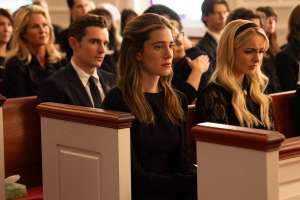 Just glancing through that brief plot synopsis, there are a LOT of elevated, dangerously soapy story elements packed into a two-hour movie, and that’s not including Clancy Brown as a cranky grandfather who Miller feels indebted to take care of as he’s scheduled to begin chemotherapy. There’s a lot going on here, and I’ll just state that there are two movies jostling for dominance that should have been split. The teen storyline does not fit next to the adult storyline. Every time it jumps from one to another, it was tonal whiplash and it became so much more dissonant. That’s because the teen storyline is awash in the burgeoning feelings of new love that we see in many YA tales and teen-centric rom-coms. It’s new and hopeful and very familiar for the teen drama genre. The adult storyline is awash in grief and betrayal, with both spouses trying to make sense of their pain and heartache and uncover what they can of what they didn’t know. One of these stories is bubbly and sunny and comedic, and one of these stories is tragic and searching and painful. They do not work in tandem, each taking away from the appeal of the other.
In particular, the adult drama deserved its own showcase to really explore the details of its complex feelings. Discovering after death that your spouse was not who you thought they were is so conflict-rich, especially that they were linked to another person experiencing that same shock and loss and confusion, it’s a recipe for real anguish and an unknown path of healing. Morgan and Jonah should never have known one another, let alone had an unrequited romance that hangs over them as adults. All this does is set up the obvious coupling, cruelly killing their spouses so these two can finally be together as destiny demands. It would have been far more intriguing for them to discover one another through this shared betrayal, but then again that might remind people of Random Hearts, but then again I doubt anyone recalls much about this 1999 movie that has an 18% rating on Rotten Tomatoes. This is where the real drama lies, but like much else of Regretting You, it’s unexplored and replaced with tropes and predictability. The exploration of grief and anger isn’t even given its proper due. Morgan primarily sits on her couch and drinks wine throughout the day. Jonah at one point rejects his new baby thinking he’s not the biological father. This conflict is, like many others, resolved so simply, merely having Morgan tell him to man up. These characters should be discovering unexpected aspects of themselves through this unique circumstance. These two characters should be striving to process their varied emotions but it’s all too easily distilled into a predictable payoff to their decades-in-the-making romantic matching. It’s reductive and boring.
 The YA-styled romance is also too familiar and underdeveloped as its adult drama. Miller (I hate that his first name is “Miller” – apologies to all first-name “Miller”s out there reading) is the kind of kid who loves movies but never seems to talk about what he loves about them or even make references to them. He wants to be a filmmaker but we don’t see his projects. That’s because Miller isn’t so much a character but being a dreamy ideal boyfriend, a sweetheart who is always concerned for Clara’s well-being and is so respectful of her boundaries and desire to wait to be intimate. He requests help moving a town limits sign a couple blocks every so many days with the intention of eventually having the ability to order from his favorite pizza place that said his home was out of their delivery zone. This is the kind of cute, whimsical activity we expect from the Manic Pixie Dream Girls of romantic comedies. If you think harder about this it actually becomes nonsensical. Why would the pizza shop change their earlier refusal because now there is a sign in front of Miller’s home that says it’s within city limits? It’s only a single sign. The house hasn’t physically moved, the distance is still the same, and the store’s GPS would still indicate as such (“But-but there’s a sign, and even though the sign is inaccurate, you should abide by it”). This is only a silly detail that I don’t mean to harp on but it’s indicative of the lackluster character writing. Because of this there’s really no genuine conflict between the two young lovers. He’s a dull dreamboat ideal.
Really, the only drama present with Clara is when she will discover the harsh truth about her father, and so you’re just waiting for this eventual Sword of Damocles to fall, to have her question why her mom would make this choice. In some regard it makes sense, to hide a painful truth from her daughter, to delay further having to process it herself, but it’s also something that cannot be contained forever. She’s going to find out eventually, and then she’s going to be additionally upset that her own mother withheld this news from her. It’s not like Morgan has complete ownership of this information. It likely would be common knowledge that they died together, in the same car, and it’s hard to believe rumors would not emerge, with classmates snickering behind her back through the school hallways or taunting her directly. It’s a shame that this looming hard truth is the only thing that Clara has going for her in this movie. Their relationship is generally conflict-free, or what conflicts there are are so easily resolvable. She’s young, in love, and her dreamy boyfriend easily ditches his girlfriend, the one obstacle to their union. This is because Clara is not her own character, not even a reflection of her mother; she is only a plot device to be plucked into tears.
 There are a few creative decisions that caused me deep confusion. Chief among them is the choice to have the same actors play their mid-to-late 30s selves as their high school selves. The opening high school graduation just establishes the four characters’ relationships, the obvious fact that Jonah and Morgan feel something for one another but oh well, and that there are unexpected pregnancies. From there the movie makes a sizable time jump but doesn’t make that clear this has happened. So we went from Morgan at a graduation party to Morgan chatting with Clara, and I thought she was a younger sister. Why would I have automatically assumed this is now the 16-year-old daughter that we had just confirmed was a zygote in the previous scene especially when Williams is made to look exactly the same over those 17 or so years? I don’t think the opening was even necessary. They could have established these character histories without a direct flashback where Jonah literally says that maybe they’re with the “wrong people” as he stares deeply into her eyes. This is also the kind of movie that has no faith in its audience, and yet we’re intended to catch the big time jump. Clara sees a movie at Miller’s theater, and he asks her why she’s crying at the conclusion of a Mission: Impossible sequel. She says it’s because her dad took her to a lot of movies. We get it. She associates the movies with her father who she dearly misses. But then the movie adds an additional line where she literally says, “That’s why I’m crying.” Thanks, movie. Ugh.
Something amusing to me that I doubt anyone else would really notice is the design of the movie theater. Miller works at an AMC movie theater so there are a few sequences, including the big rom-com rush to greet one another and have the big swooning kiss moment. Because the movie is a Paramount production, there are only posters present promoting other Paramount movies, 2025 releases like The Running Man and the latest Mission: Impossible, but then also classic movies like Sabrina and The Godfather. God forbid a movie theater advertise other titles from competing film studios. Perhaps this is just a very singularly loyal theater. Anyway, as a person who worked at a movie theater for over a decade, this little incongruous detail stuck with me. It’s the same thing with Miller’s bedroom. All of his posters are Paramount movies, which means he just loves that studio so much. Maybe that’s why he works at a movie theater that plays exclusively Paramount movies (the corporate synergy reminds me of young Christian Grey having a Chronicles of Riddick poster in his childhood bedroom brought to you by Universal). Perhaps somehow Miller doesn’t even know the existence of non-Paramount movies and is in for a world of shock when film school students talk about stuff like Godard and Cassavetes and Fincher and Tarantino, and he’ll just be so pitifully confused.
 With a title like Regretting You, it allows for so many ready-made quips, especially when the finished movie isn’t quite up to snuff. The term “soap opera” is usually referenced as a pejorative, that a movie has so much heightened incidents to be distanced from the nuance of adult reality. However, just because something is soapy in scope doesn’t mean it cannot be fascinating and engrossing in execution. The films of Pedro Almadovar (All About My Mother, Talk to Her, Parallel Mothers) are often, on paper, a random assembly of soap opera histrionics, and yet the man’s creativity and empathy finds, almost without fail, ways to really open up and explore the details of his characters and their unique emotional states. The premise of Regretting You could have done this, but the desire to be appealing to teenagers with the YA-styled teen romance, sabotages the exploration of grief and betrayal into a clipped and frustratingly tidy little package. It’s not good storytelling, folks, but it had some potential to be. There are two more Colleen Hoover film adaptations slated for 2026, and most definitely more even after, so it’s best to prepare dear reader because It Ends With Us wasn’t actually predictive with its title. It only begins.
Nate’s Grade: C-
Share this:

M3GAN (2023)
 It’s early January, typically a dumping ground for the unwanted leftovers of Hollywood studios, but an unexpected meme queen has emerged in the form of M3GAN. The latest hit from Blumhouse is styled as a horror-comedy and from the same writer as 2021’s Malignant, which was a delightfully gonzo horror movie that only got more absurdly entertaining the crazier it went. My hopes for M3GAN were confirmed early as I laughed within seconds of the movie. There isn’t much in the way of genuine scares as a PG-13 chiller, so M3GAN leans into the knowingly awkward camp comedy. An advanced robot is given to an orphan to test-drive and the little robot forms a strong attachment that cannot be broken even by bloodshed. It’s a crazy killer doll movie combined with a crazy killer robot movie as well as a corporate satire. When the little robot literally bursts out into song to help cheer up her human counterpart, there’s nothing to do but laugh and acknowledge this is what the filmmakers wanted in response. It’s a fun movie that doesn’t overstay its welcome but needed a little more crazy or a little more biting satire to really satisfy. I was hoping for a more Malignant-style escalation of crazy and was left wanting. Still, it’s a goofy horror comedy that just wants to have fun with the uncanny valley of your expectations.
Nate’s Grade: B
Share this:

Get Out (2017)
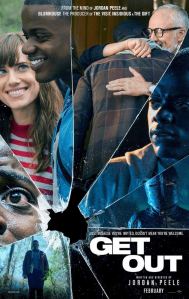 After years as a brilliant sketch comedian, Get Out is Jordan Peele’s first foray into horror, and if this gifted comic mind only wanted to make suspense thrillers from now on, that would be mighty fine. This is the first horror movie in years that left me buzzing, feeling charged and anxious, anxious to share with others so they too can feel the full effect of this live wire of a movie. It may be my favorite theatrical horror film since 2012’s The Cabin in the Woods, and what they both have in common is a knowing understanding of their genres and expectations, a delicately balanced sense of tone, and a funhouse of darkly clever surprises. This is a movie rich with commentary, suspense, payoffs, and it all begins by exploring the dread-filled everyday existence of African-American men in this country as a waking horror movie that cannot be escaped.
Before even going further, I advise most readers to go into Get Out with as little knowledge as possible, which I understand means delaying reading this review. I can accept the loss of eyeballs knowing that more people will go in with an even greater ability to be surprised (I’ll avoid significant spoilers below, so fear not, dear reader).
Chris (Daniel Kaluuya) is visiting the parents of his girlfriend for the first time. He’s worried that Rose Armitage (Allison Williams) hasn’t mentioned that he’s black. She assures him that her rich, wealthy, and liberal family won’t care in the slightest. Rose swears her parents are the least racist people she can think of. Dean (Bradley Whitford) is a retired brain surgeon, Missy (Catherine Keener) is a hypnotherapist who volunteers to help Chris stop smoking, and Rose’s younger brother, Jeremy (Caleb Landry Jones), is obsessed with martial arts and lacrosse. They also have black housekeepers, which Dean says he hates how it looks. It isn’t long before Chris’ sense of unease starts to make him rethink this weekend getaway and whether or not something sinister is under the surface.
 Early on, Peele tips his hand to the sharp social and genre criticism. In the opening scene we watch Andrew (Lakeith Stanfield), a young black man, walking around lost in a tony suburban neighborhood. He checks his phone for an address when a lone car drives past him, stops, and turns around, pulling up next to Andrew and idling, blasting the old song “Run Rabbit Run.” He takes one look at the situation and immediately turns around, heading in the opposite direction. “Not today,” he says to himself, clearly providing voice to the audience’s apprehension. And yet, he’s incapacitated, and abducted by masked assailants. Even self-awareness and avoidance will not be enough for this man to survive if captured within the crosshairs of modern White America. He becomes another horror victim just like we might see splashed across the news all too often.
Peele’s biting social commentary is ever-present but it never outpaces the genuine fun and entertainment from his genre storytelling. It’s a condemnation of the fallacy of a post-racial society and an exploration of the uncomfortable burdens African-Americans are disproportionately expected to bear in general. Rose’s family is all too happy to show off how seemingly inclusive they are. Rose’s father confesses, with no legitimate conversational prompting, that he would have voted for Obama a third time (trust me, there’s a lot of people in the camp, Dean). Yet he seems to enjoy awkwardly inserting recitations of “my man” while also trying to openly explain why he has eerily subservient black housekeepers. Rose’s antic brother seems to hungrily size Chris up as a physical challenge to battle, openly admiring his “genetic gifts.” Despite their self-styled liberalism and protests to the contrary that race doesn’t matter, the family can’t help but treat Chris like an other. Race “doesn’t matter” to people who have the position where it might not matter, the same going for those who elect to be “color blind.”
This stifling sense of condescension and pandering is best exemplified in a deeply awkward sequence where Chris is introduced at a party to the whole older majority-white neighborhood. One man informs him he likes Tiger Woods. Another says being black is hip. A woman squeezes his muscles in transparent lust. Another asks what the “African-American experience” is like and whether Chris feels being born black is an advantage. All through this meet-and-greet gauntlet, Chris is holding his carefully crafted smile, trying to shrug off the mounting discomfort, and being told not to make a big deal out of it. After all, these are well-educated liberals, the “good ones.” They can’t be racist too.
 Get Out is also an excellent example of a movie that straddles a precise tone to perfection. Peele has a carefully refined comedy sensibility, but I was genuinely awed in his ability to go from sardonically funny to creepy funny to just plain creepy. There’s an increasingly heightened sense of dread from the get-go. It’s like any other horror premise where our protagonist goes into the house they shouldn’t and combats a host of horrors be they supernatural or superhuman. In this case, the scary scenario is white people. There’s a general off feeling about the Armitage estate and this is best encapsulated with their hired help, Walter (Marcus Henderson) and Georgina (Betty Gabriel). They seem to be in a robotic daze, smiles plastered to their faces, their tone of voice disquietingly calm and meticulous. Even the antiquated and culturally incongruous vocabulary they employ contributes to their unsettling vibes. Something is wrong here. There is a remarkable scene where Chris speaks with Georgina, and she hovers closer to him to apologize. Peele keeps the camera locked on his actor’s faces in extreme close-ups and he has a damn good reason for it. Gabriel (The Purge: Election Year) tries to reassure him all is normal and in one mesmerizing moment the camera fixates on her as she repeats “no,” each time a different reflection, her eyes tearing up as she tries to fight back subverted emotions. It feels like you’re watching twenty emotions and impulses fighting for dominance behind an impassive mask of compliance. Peele magnificently finds ways to keep his elements intensely upsetting while still finding room to laugh and break tension and increase tension.
While more a suspense thriller than a traditional horror film, Peele proves himself shockingly adept at a genre that I would have assumed outside his comfort zone. The shot arrangements and the natural development of tension shows clear knowledge and affinity for the horror genre; Peele knows when to hold onto a moment for extra suspense, when to pull back, and especially when to litter the camera frame with something to draw the eye. Peele has a great eye for his troubling, surreal visuals. When Chris is hypnotized and instructed to “sink into the floor” it’s like he’s falling into an inky void while his consciousness plays out on a square, like his life is a movie only he can watch from a distance. You feel the helplessness but it’s also a beautiful and beautifully unnerving image. There are a few jump scares accompanied by loud musical stings but the far majority of the movie is the overwhelming discomfort and dread marvelously kept at a continual simmer. I was squirming in my seat for long stretches and started backpedaling in others, and I can’t remember another movie in years affecting me that well. It’s partly the terrific execution of his genre elements but also partly because I liked the protagonist and had no idea what would happen to him next, which is the foundation of all horror. The last act cranks up the genre elements but Peele has brilliantly structured his script, laying out all the pieces he’ll need that provide an array of payoffs when we’re breaking for the finish line. This is a movie that knows how to satisfy all audiences, rest assured.
The actors are pitch-perfect and Kaluuya (Sicario, Black Mirror) delivers a star-making performance. He has to wear his own mask to deal with the small and large iniquities of whether or not these people are sinister or whether they’re just oblivious cretins. Chris is a black man expected to mind his manners and to laugh away the casual ignorance afforded by the oblivious privilege of others. He can never be unaware as the lone black man in a sea of white faces. It’s a position I think many people in the audience will be able to relate to and hopefully others can empathize with. Kaluuya has some standout emotional sequences where he digs deep to show the real depth of a character others fetishize or dismiss. Kaluuya is also British and you’d never know it. The Armitage family clan are each their own slice of weird. Whitford (The Cabin in the Woods) is exploding with thinly veiled smarm and great comic awkwardness. Keener (Capote) is chilling in her icy WASP den mother role with her weapon of choice, and hypnotic aid, being a literal silver spoon. Williams is like her blithely privileged character stepped out of HBO’s Girls, and her flippant attitude to Chris’s perspective belies something familiar and darker. The other best actor in the movie is LilRel Howrey (The Carmichael Show) who play’s a friend to Chris that works for the TSA. He’s a reliable and reliable crude source of comic relief but he’s also our ally on the outside, and he behaves like an intelligent investigator trying to save him. I was actually applauding his sensible steps to see through the sinister conspiracy.
 It’s been hours since I saw Get Out and I’m still buzzing from the experience. I was unprepared for how genuinely unnerving and invigorating the movie was as a horror thriller, character piece, but also as a trenchant social satire on race. Jordan Peele has established himself as an immediate visionary in the world of horror, taking the black protagonist who might usually be the first to get killed in a Hollywood slasher flick and widening the boundaries of horror. The real-lie horror film is day-to-day existence in the United States as a person of color. Get Out was conceived in the Obama era but has even more renewed resonance under the beginnings of the Age of Trump. I remember people saying that America now existed in a post-racial world, but we live in the kind of world that takes a call for innocent black lives to stop being executed by police officers and transforms it into All Lives Matter. It’s a hazardous world and Peele has created a marvelous movie where the insidious, ever-present force that cannot be escaped is not a maniac with a chainsaw or some cranky ghost, it’s white society itself. As the news has indicated, from Trayvon Martin to Sandra Bland and numerous others, there isn’t exactly a safe territory to escape to. Danger and death can come at any moment as long as a larger society perceives black skin as a threat first and a person second. Get Out is a timely movie but also timeless, thanks to how brilliantly conceived, developed, and executed Peel’s movie performs. This will make my top ten list for the year. Simply put, stop whatever you’re doing and go out to go see Get Out as soon as possible.
Nate’s Grade: A


 nathanzoebl
You must be logged in to post a comment.