Blog Archives
Bombshell (2019)
 More an expose on toxic work environments than anything overtly political, Bombshell is an effective true-life drama about the many pitfalls, humiliations, traps, harassment, and compromises that women face in the workforce. We follow the downfall of news magnate Roger Ailes (John Lithgow), the imposing man who built the Fox News empire and who also bullied his employees and solicited sexual favors from the many women who were on his payroll. Margot Robbie plays an invented character meant to provide that entry point into Ailes the creep in creepy action. She’ll be harassed and pressured for sex by a man described as “Jabba the Hut,” and Robbie is terrific in her big dramatic moments portraying what the pressure and shame does for her ambitious anchor. The other two main characters wrestle with how far to go in a corporate culture of keeping secrets from very powerful, very dirty old men. Gretchen Carlson (Nicole Kidman) is consulting lawyers for a personal harassment lawsuit against Ailes the person, not Fox News, but she needs other women to come forward. Megyn Kelly (Charlize Theron) is struggling with the scrutiny she has endured after then-presidential candidate Donald Trump turns his small Twitter thumbs against her. The Fox bigwigs won’t go on record to defend her, and their journalists, because they need Trump to drive ratings. The movie uses several Big Short-style narrative tricks to help tell its sordid tale, including swapping narration and fourth-wall breaks; a run through of hearing from Ailes’ past victims in their own words is striking, especially a woman who says she was only 16 at the time. Part of the fun are the many many cameos and just watching actors portray different Fox News personalities (Richard Kind as Rudy Guiliani!). The makeup is also phenomenal and Theron looks unrecognizable as Kelly. The film itself doesn’t feel like it’s telling you anything you already don’t know about the subject; people will compromise their morals for personal gain, power leads to exploitation, women are unfairly treated, and it’s easier to fall in line than stand up to power. There’s still a thrill of watching the downfall of a serial abuser, and the acting is strong throughout, but Bombshell can’t shake the feeling of being a slicker, more star-studded TV movie version of recent history. Even with the urgency of the topic, it feels light, and not because of its use of incredulous humor. I could have used more behind-the-scenes details, and maybe that’s where Showtime’s miniseries The Loudest Voice comes in, retelling the same story with Russell Crowe as Ailes. It’s a solid movie on a very pertinent subject and worth seeing but it also makes me wish for a harder-hitting, more widely sourced expose on this very bad man who felt forever protected by the status quo of power.
Nate’s Grade: B
Share this:

Star Trek Into Darkness (2013)
J.J. Abrams’ return to the final frontier had me extremely excited for what the sequel to 2009’s smash Star Trek would be. It’s a different sort of Trek, a more rough-and-tumble, popcorn entertainment with the recognizable flavor of that other famous space opera that Abrams is steering into theaters come 2015. Having seen Star Trek Into Darkness twice, certain things became very clear to me. First, this is about everything you could ask for in a summer popcorn action movie. The set pieces are thrilling (my fave may be a human bullet shoot through a field of debris), there’s something new and dangerous going on just about every fifteen minutes, the stakes are constantly changing, and there are a bevy of well plotted character arcs for a deep and well acted ensemble. It’s about everything you’d want in a Star Trek movie… if you were a big fan of the 2009 film. If you’re a lifelong fan, you may have some reservations, notably the inclusion of a famous villain that shouldn’t be too hard to guess. The second half references to Trek cannon, especially Star Trek 2, feel weird for a film that broke away into a parallel universe so that it could chart its own course rather than relive the old stories. There’s homage and then there’s just subservience. Still, there are plenty of resonant themes, like friendship, sacrifice, and family, that are given adequate attention, amidst all the big-budget escapist thrills. There are even some surprisingly poignant moments that the actors ace. Benedict Cumberbatch (TV’s Sherlock) is incredible as the villain, a terrorist with a menacing, velvety voice that I could listen to all day. The vast majority of Into Darkness is tremendously entertaining, with a great pulse and sense of scene construction. The Abrams team knows how to make blockbusters in the old Spielberg variety, spectacle with humanity and humor and sweep. If this is what he can do with the Trek universe, just wait until Episode VII people.
Nate’s Grade: A-
Share this:

Men in Black III (2012)
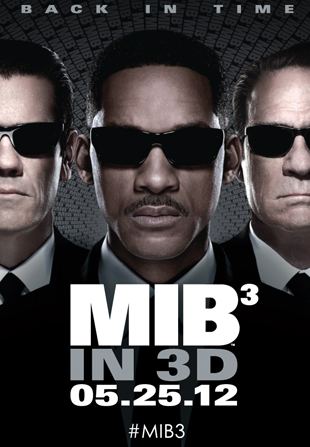 It wouldn’t be a Men in Black film without script problems. The first film languished for some time, originally taking place in Kansas of all places, before director Barry Sonnenfeld became attached and insisted upon a New York City location. The 1997 sci-fi buddy cop comedy was a hit, and rightfully so, and Will Smith became a megastar. Then the 2002 sequel’s climactic action sequence had to be rewritten due to the fact that it was originally going to take place in the World Trade Center. If only that lackluster sequel had gone through more extensive creative revisions. However, these past hiccups don’t seem to come close to Men in Black III, which to Sonnenfeld’s admission, started shooting in late 2010 without a finished script. It had a beginning, an ending, but nothing definite to tie together. So the whole production took eight months off to work on the meat of that movie sandwich. Hollywood movies, especially modern films of huge-scale budgets and set release dates, have routinely started production without completed scripts, including Gladiator, Jaws, Apocalypse Now, and Lawrence of Arabia. Naturally, those are the exceptions to the rule.
Boris the Animal (Jermaine Clement) has escaped from pison and out to seek revenge on the man who put him away and took his arm – Agent K (Tommy Lee Jones). Boris travels back to July 1969, when a young Agent K (Josh Brolin) thwarted the big bad Boris. Boris kills Agent K and alters the future. The Earth is now vulnerable to an alien invasion from Boris’ species. Agent J (Smith) has to travel back in time to save his old partner and the planet.
It’s been ten years since the spotty Men in Black II and almost four years since Smith has been seen in a movie. Where did the time go? Fortunately, this third movie hews closer to the droll brilliance of the first film. Part of that is a sharper story with a more clearly defined goal and a return of the playful exuberance that belies the franchise. Also, I must say that absence has made the heart grow stronger, because I’ve missed Smith’s effortless charisma onscreen. Agent K is such a natural fit for the guy and it’s just fun to watch him stumble through strange alien encounters (this time we learn all super models are aliens; listen good, young women of America who punish themselves to fit this image of beauty). Time travel is usually employed when a franchise seems like it’s all out of gas; it’s usually more focused on the comic fish-out-of-water possibilities, which there are a few in Men in Black III. As one characters notes, 1969 wasn’t exactly a great time for black people in America, and J combats casual racism, black panic, and ignorance with a defiant attitude that is amusing to watch. I’m glad the whole race-relations reality was addressed, though it’s also for the best that the movie doesn’t get bogged down with scenes of Agent J conflicting with bigoted authority. Men in Black III remembers that we’re here to have fun, and the screenplay by Etan Coen (Tropic Thunder) has a light-handed touch. I enjoyed the opening jailbreak sequence with Boris, though I would have thought a lunar prison would have better security. Bill Hader (Superbad) has a fun cameo as a self-hating Andy Warhol, really an undercover MIB agent, though the idea that Warhol’s Factory artists as aliens seem a tad simple. The glaring cameo omission was Jon Hamm (TV’s Mad Men) as a scotch-drinking MIB ladies man of legend.
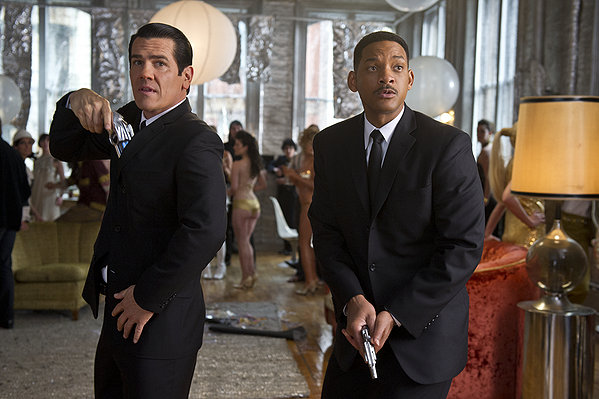 As evidenced from the trailers and marketing, Men in Black III is really Brolin’s movie. The guy establishes an uncanny Tommy Lee Jones impersonation. The eerie brick-faced stoicism, the melodic lilt of his voice, the syncopation of his speech patterns; Brolin nails it all. Watching his interaction with K are the film’s most enjoyable segments. At this point in the series, Agent J and K have gone beyond the rookie/mentor phase and now have something of a friendship, though their arguments at year fifteen of their partnership sound more like the arguments they would have in year two (you need to “open up” and be less grumpy, sounds elementary). Still, there is a personal connection to this case that eluded the last movie, and it gives the film a sense of urgency even when the comic shenanigans seem to hog the spotlight. The personal reveal in the last act didn’t have as much emotional power for me, mostly because I did the math and realized whom a certain unseen character of significance was before we got their true identity. The end does give the film series a circuitous sense of finality.
For a franchise that seems like it can go anywhere at any time with limitless possibilities, the worst thing you can do is be shut off to better avenues of storytelling. Take for instance the climax at Cape Canaveral, which itself is a rather anticlimactic sequence involving the launch of Apollo 11 (don’t they know that alternative 1960s history was sooo summer of 2011?). J has his time travel doohickey that lets him travel back. He gets to use this device once during the climactic fight, allowing him to travel back one minute in time so he knows how to properly duck. That is it. What a fantastic waste. If you’ve got a device that essentially allows for unlimited do-overs, then I want this device to be an integral part of the climax. I want J to have to regularly use it to fix past mistakes and learn more and more from each time jump. Just memorizing how to duck is lame. The entire subplot with Agent O (Emma Thompson in the present, Alice Eve in the past) and her dalliance with K is so carelessly thrown away that I wonder why the filmmakers even bothered to include it. Then there’s our villain, Boris, whose name itself is even lazy. He’s just a bad dude with some sort of insect that lives in his hand and shoots spikes. That is it. He’s a guy who can fire projectiles. So what? What about that makes him interesting? An unrecognizable Clement (Flight of the Conchords) does his best but the character just doesn’t have anything about him that deserves special attention; he could have been any villain (I think Vincent D’Onofrio was undervalued in his go-for-broke physical performance as the first film’s villain). I did like the idea of Present Boris arguing with Past Boris, but like most promising ideas in Men in Black III, this space-time sparring is never fully realized. While enjoyable, there’s little you’ll be able to think back on with Men in Black III and say, “That was well developed.”
Paradoxically, I think Men in Black III has a character that might simultaneously be the best and worst thing about the film. Allow me to explain. About halfway in, we’re introduced to the alien Griffin, played by the great Michael Stuhlberg from A Serious Man and TV’s Boardwalk Empire. He’s a creature who can see nigh unlimited timelines, all the variations of choice and possibility play out before his eyes, one after another. He never knows which timeline he’s in until the moment occurs, thus he’s constantly worried about every moment to come in his life. This foreknowledge sounds like a wretched curse, and with Stuhlberg gives a forlorn edge to his character’s eccentricity. So when J and K meet the guy, there are some clever moments, like when Griffin details every peculiar aspect of chance that lead to the 1969 Mets World Series victory. The moment, and by extension the character, is a nicely reflective idea that every moment is a miracle of causation. Griffin is just an interesting character. Here’s where the worst part comes in. Rarely is he treated as a character because, you see, Griffin is really a magic plot device. He can tell the Men in Black agents whatever they need to do at any point, instantly providing a narrative cheat. When in doubt, just ask the guy who sees the future and he’ll steer you without fail to the next necessary plot point.
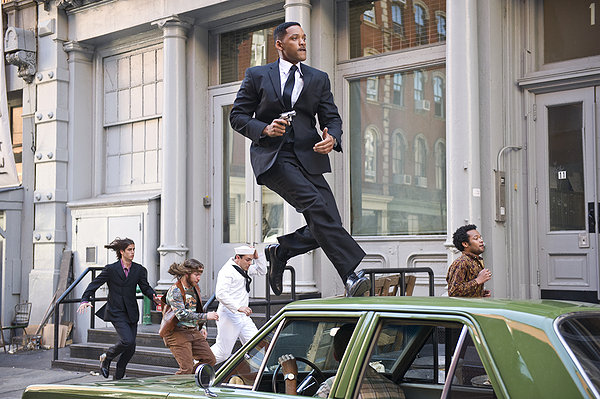 I saw this movie in 3D, not by choice mind you, and for the first half hour it felt like one of the better 3D conversions out there. Sonnenfeld’s camera plays a lot with depth of field and primarily forward-backwards movement, which made for a slightly elevated viewing experience. But somewhere around the halfway mark, I swear the movie forgot it was supposed to be 3D and the dimensional differences became negligent. It never really recovers, and so I advise all potential ticket-buyers to skip the 3D screenings.
With most time travel escapades, there’s going to be some plot holes. Working with a flurry of alien technology, it would have been exceptionally easy for the filmmakers to just explain away the plot holes with some magic device, much like the Paradox Machine in Dr. Who. Hey, there’s a machine that makes sure we don’t have paradoxes? Good enough for me. It’s like in Thank You for Smoking when Rob Lowe’s character explains why actors would be able to smoke in an all-oxygen space environment: “It’s an easy fix. One line of dialogue. ‘Thank God we invented the… you know, whatever device.’” The fact that Men in Black III doesn’t even address its biggest plot hole astounds me. If Agent K is killed in 1969, then he was never alive to recruit Agent J into the service. Let’s even assume that J’s credentials would still get him noticed and staffed with the MIB; if Boris killed Agent K in the past, then there was no reason for Boris in the future to travel back in time to kill Agent K. Again, these aren’t nit-picky gripes, these are major, easily understood plot holes, and I’m dumbfounded why no characters even address them. I could nit-pick over why Boris decides to go to 1969 when he just as readily could have gone to a time when K was a child and thus more vulnerable. Surely a child is easier to dispatch than a 29-year-old man.
Men in Black III is a far improvement over its stilted predecessor, but it still ends up falling well short of the potential it flashes. It’s intermittently amusing with some fun cameos and some visual panache, but this movie should have been stronger, stranger, and more playful with its central time travel conceit. It’s hard to work up that much distaste for the movie, especially since it has such a lively, jocular feel. Not all of the jokes work, but enough do, and the movie maintains an overall pleasant sensibility, zigzagging in imaginative directions that most Hollywood movies never beckon. It’s the stuff that works that illuminates the potential left behind as it goes into summer blockbuster territory. Men in Black III is an example of diminished returns, yes, but some franchises start so high that even latter, lesser sequels will have more entertainment value than their competitors. While it won’t set the world on fire, Men in Black III exceeds expectations and provides enough entertainment that it’s worth a look and little else.
Nate’s Grade: B
Share this:

She’s Out of My League (2010)
 This is a fairly lackluster, flaccid, infantile comedy that aims to follow the same Judd Apatow formula of equal parts heart and raunch. Where this movie utterly fails is its choice of lead. Jay Baruchel (Tropic Thunder) is not a good leading man (his voice is very nasally and hard to listen to at times), but worse, his character, Kirk, is a callow, simpering, snot-nosed dolt. He has a dearth of a personality; he’s constantly berating himself or groveling for support by his oblivious family and mean ex-girlfriend. You simply don’t care. Kirk is not a guy worth watching. There’s empathy and then there’s pity. The movie wants to be a “nice guy gets the girl” story, but instead She’s Out of My League is a “guy with zero self-esteem and charisma gets the magazine cover model” story. At least in Apatow productions, the schlubby leads had personalities and redeeming qualities. I started enjoying the respites away from Kirk, time spent with his callous family members or his annoyingly juvenile friends. Anything to escape. The jokes have a pretty low ratio of hits to misses (an early ejaculation actually almost becomes an act break that keeps the couple apart), becoming subservient to a clichéd romantic comedy that wants to teach us that looks don’t matter. It’s what’s on the inside that counts. Have you heard that one before this week? If what’s on the inside is what matters, then She’s Out of My League has little to offer.
Nate’s Grade: C
Share this:

Sex and the City 2 (2010)
 Sex and the City is a cultural phenomenon that women around the globe celebrate. When the show first premiered on HBO in the late 90s, it chronicled the lives of professional women that wanted to have it all, and they wouldn’t apologize for their sexual appetites or fashion splurges. The successful show then launched a very successful movie in 2008, but the movie tied up everyone’s storylines in fairly nice little bows. So now where to? For the fans, it hardly matters. Sex and the City is a cause of celebration, a girl’s night out with cosmo in hand. The content of the movie seems almost like an afterthought. Fans aren’t going to be too picky but there is a lot to pick at with Sex and the City 2.
It’s two years after the events in the first film. Carrie (Sarah Jessica Parker) and her husband, John James “Mr. Big” Preston (Chris Noth), are settling into married life. Miranda (Cynthia Nixon) feels mistreated and unappreciated by her boss because she’s a woman. Charlotte (Kristin Davis) has her hands full with two young children, and motherhood in reality isn’t at glamorized as she thought. She’s also worried that her husband (Evan Handler) might cheat with their busty Irish nanny (Alice Eve, the “10” from She’s Out of My League). They girls dub her “Erin Go-bra-less,” I think as a weird wordplay on Erin Brockovich. Your guess is as good as mine. And then there’s Samantha (Kim Cattrall) who is 52 and desperately fighting to look and feel young again. She has a regiment of hormone pills and creams she uses daily to keep the encroaching effects of menopause at bay. To give the girls an excuse to get away, a rich middle Eastern sheik wants to persuade Samantha to do some PR work for his hotel, so he invites the foursome on a fabulous all-expenses-paid trip to Abu Dhabi in the United Arab Emirates.
 I know coming from my non-demographic perspective that I’m going to have some difficulty relating to these main characters, but these gals are so self-absorbed in their petty, rich people problems, I question who could really relate to much of this drama. Charlotte is being driven mad by the toll of motherhood, which is relatable, except her toll involves staying at home in a rich apartment, never having to worry about money, and handing off her screaming kids to the nanny. Not relatable. Carrie’s dilemma is the most forced and therefore the worst of the bunch. After having her storyline tied up in the first film, where can she go? She has got the guy, she got her wedding, she has a luxurious apartment, and her man wants to spend time with her. She’s in her mid-to-late 40s at this point and wants to still go out every night on the town. She complains that they stay in TWO NIGHTS a week. When Big gets her a thoughtful anniversary gift, a flat-screen TV in the bedroom so that they can watch old romantic movies TOGETHER, she pouts and says, “Jewelry would have been nice.” Her main problem is that her guy, the one she married, wants to spend time with his wife in their comfy abode and relax TOGETHER. When Carrie asks for two days leave so she can get some work done on an article, Big allows her the time off and then wonders if that apply to their marriage: each takes a day or two off to concentrate on work, relax, catch up with friends, etc. It’s her idea, but when he voices it suddenly it becomes threatening and again all about Carrie. She responds, “Is this because I’m a bitch wife who nags you?” Well, at least she cuts to the chase. These are the problems that people have when they don’t actually have any real problems.
There is one, count ’em, one great scene in the movie and it doesn’t involve Carrie or the ever increasingly cartoonish Samantha. Charlotte and Miranda are by themselves sipping from cocktails and confessing about the hardships of motherhood. Both take sips and then admit a guilty secret. One says she feels like a failure at being a mother. Another admits that being a stay-at-home mom just isn’t enough for her in life. They both admit that they love their children dearly, but have enjoyed the time away from them. The scene feels genuine, with some heartfelt laughs derived from the situation. Charlotte bashfully admits that her first thoughts following the idea that her husband might cheat with the nanny were, “No, I can’t lose that nanny,” and it feels honest and right for her character, plus it’s funny. And then they admit something that the audience had fortuitously forgotten in that moment — they do all this with help. Charlotte has a nanny and Miranda has her grandmother-in-law living with them to help raise the kids. A really nicely written and acted moment that peels away to showcase the complexities of the modern mother is dashed. Even the universal concerns we can all relate to (infidelity, doubt, settling, getting older) take a backseat to the overly manufactured melodrama.
 The rampant consumerism hasn’t slowed down despite the economic meltdown of 2008. Carrie makes a quick comment about how it “wasn’t a good time to sell her apartment,” and so she keeps her spacious apartment along with the multi-million dollar one she lives with Big. The sheer celebration of consumerism has turned into blind worship; it’s all about the stuff. The characters have long since burrowed into their types (the fussy one, the career-minded one, the sexually voracious one, and the self-involved one), and those types have become entrenched, and the men have become just another accessory for a large closet of goods. The real star of this movie is the outlandish, sometimes garish, fashion, and there is heaps of it. One outing into the Arabic desert makes use of three separate costume changes. The name-dropping and product placement are aggressive. For the first film I wrote: “‘I’m not going to charge the film with setting back feminism or anything but why do the main characters have to be so shallow, brand-conscious, and live to splurge? The emphasis on buy, buy, buy to make yourself feel good is a rather sad and empty message.” The Sex and the City movies have morphed into consumerist, female wish-fulfillment fantasies, enabling Carrie’s princess indulgences and superficial demands. The girls are all panicked towards the end about he possibility of, gasp, flying coach, you know, like the rest of us. These women haven’t lived in anything resembling reality for some time. It’s a shame that in these cost-conscious times, the Sex and the City universe seems unaffected. I would have enjoyed seeing how these high-powered women dealt with the repercussions of an economic recession (not to mention Carrie dealing with the death of print publishing). Yes, I know, it’s designed to be escapism, and that’s all well and good, but I wanted to escape from these characters and their lifestyles.
But what will get the most attention is the extensively long escapade in the Middle East, like Sex and the City is planning to solve global politics. Obviously, there is something wrong with how women are treated in several majority Muslim countries, from the demands to cover themselves in heavy garments so as not to tempt men, to the void of rights, to honor killings and stonings, and murdering women just because they went to school. This is a serious matter. These countries are behind the times and women deserve an equal footing and an equal say, and several contemporary movies have dealt with these issues in a thoughtful manner. Sex and the City 2, on the other hand, takes a patronizing approach that is culturally insensitive at best and downright racially insulting at worst. These ambassadors of modern feminist thinking basically show themselves to the Arab world as the quintessential ugly Americans; the ladies of Sex and the City are exactly what radicals think about when they order women to cover up or else. These women are self-indulgent, materialistic, vapid, and riding high on Western self-righteousness. I am in no way apologizing for how large portions of the Muslim world treat women, but Carrie and company are quite possible the worst ambassadors to argue the case for feminine equality. And remember, they complain about their pity-party problems while on an all-expenses-paid vacation to a lifestyle of lavish luxury in the Middle East. They reduce the problem of Muslim women into simplistic, indignant quips. It’s more than a little insulting to have somebody wearing clownish outfits telling women in other countries how to dress. This foursome is brash and in-your-face with their strong sense of cultural superiority, practically baiting the locals into making a scene. At one point, Samantha is jailed and shocked that the authorities might be upset that she was caught having sex on their beach. Don’t these women understand culture clash? In the end the women are chased out of town and you almost (I repeat — almost) feel for the other side.

This is considered fashionable?
Even worse than the ethically dubious moralizing is the fact that this extended portion of the movie (about 100 minutes) grinds the plot to a halt. Most of the storylines are set up before the trip, and then they are all tied up somehow when the women return, though the time in Abu Dhabi seems to have had no effect. Miranda’s conflict with her boss is resolved before the gals ever get on a plane, so she becomes essentially tour guide and confidant for the trip. Samantha is denied her plethora of pills at the airport, so she becomes the slapstick comic relief trying to stave off menopause. Her pun-heavy dialogue is full of groaners like, “Lawrence of my labia.” Her sex kitten act is getting as tiresome as her futile attempts to keep Mother Nature at bay. Samantha is the same from the beginning of the movie to the end, and fans will probably rejoice at this lack of character development. The entire misadventure in Abu Dhabi feels like a Hope & Crosby road picture, or, worse, one of those lame TV-movie gimmicks from sitcoms (luckily Carrie is spared the curse of the tiki idol).
But whatever I say will be regarded with shrugs by the legions of Sex and the City fans. They’ve grown with these characters over 12 years, so I understand the attachment fans feel. Like I said before, the movie medium is not the ideal place for these ladies. In half hour doses their quirks and problems seem cute, but when stretched to a bloated running time they come across as vapid and whiny. The conflicts don’t seem too relatable and the humor is once again tied to slapstick and leaden puns. The problem is that after six seasons and one 145-minute movie, the characters feel tapped out. They’ve been through plenty and now the crew is just coming up with whatever excuse they can have to reunite the cast on the big screen (stay tuned for Sex and the City 3 … in Space!).
Nate’s Grade: C


 nathanzoebl
You must be logged in to post a comment.